
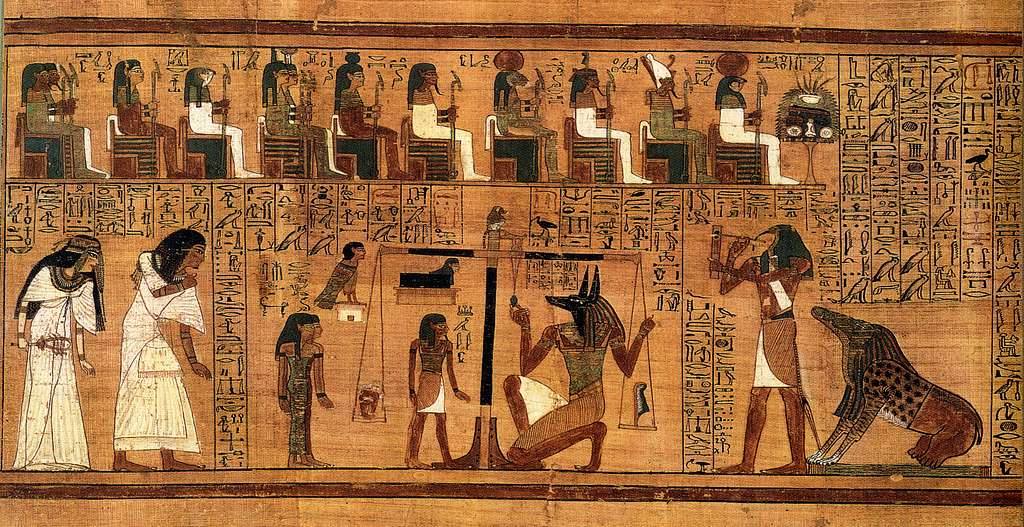
I firmly believe that in the afterlife, we will be judged for what we have done during our lives.
Despite the Western Orientalist use of “reincarnation” as a narrative device in several different “Mummy” movies, reincarnation does not figure into the Egyptian afterlife scenario. Souls instead have a linear afterlife wherein they are either transfigured into akhu (blessed ancestor spirits, identified with the stars in the nighttime sky) or are fed to the daemon Ammut, whereupon they cease to exist for all time. In other words, we will either live forever beyond death or we will “die the second death.”
In this way, Kemetic eschatology is much closer in principle to Christian afterlife beliefs than it is to, say, Hindu or Buddhist ideas. But there is still an extremely important difference. In evangelical Christianity especially, entrance into heaven is “impossible” without personal submission to Christ. But in Kemetic theology, the soul is measured against its earthly deeds and misdeeds during the Weighing of the Heart. We are either “saved” or “damned” based on OUR OWN ACTIONS, here upon this earth.
Evangelical eschatology is problematic because it prioritizes submission to a specific deity over ethical decision making. You could be a horrible psychopathic murderer your entire life, and all you have to do is “accept Christ” and alashazam, you’re suddenly “saved.” On the other hand, you could be a perfectly good person your entire life, but you will “go to hell” for “rejecting Christ” no matter how good a person you are. This theology makes the evangelical God seem like a total narcissist who just doesn’t care whether His followers are actually good people or not.
In Egyptian polytheism however, this problem does not exist. It literally doesn’t matter whether you worship Set, Osiris, Sekhmet, or even nobody at all. As long as you uphold Ma’at by being a good neighbor, modeling compassion, helping those who need help, taking responsiblity for your own actions, etc., then you have nothing to worry about. You don’t have to be a perfect person; you just have to have enough Ma’at in your heart that it outweighs any isfet or toxicity.
For someone like Jeffrey Epstein, who has committed countless crimes and abuses against innocent people, it will not matter how much they cry or beg for forgiveness. It will not matter if they beg Osiris, Set, or even Jesus Christ Himself to “have mercy” on them. There will be no mercy for them at all, for at the end of the day, neither Osiris nor Set nor Christ is responsible for what they have done. THEY are responsible for bringing their own damnation upon themselves.
The point here is that our eschatological destinies have nothing to do with which God(s) we worship (if any); nor are they dependent upon the whims of any God(s). What happens to us after we die is literally DETERMINED BY OUR VERY OWN ACTIONS IN THE HERE AND NOW, while we live and breathe.
Every single ethical decision we make will have some bearing on our afterlives, no matter how small or insignificant that decision might seem. Even the smallest acts of kindness can make all the difference; so too can even the smallest acts of malice.
The next time you’re standing in line for coffee and you find yourself losing patience with your barista, remember that even the way you choose to interact with this stranger is being spiritually tracked, and even this can have repercussions that reach far beyond your current scope of awareness. Maybe the barista is having a bad day, or maybe they are suicidal. The way you treat them can make their day either better or worse. It can also make the day better or worse for everyone else who might be involved in that person’s life. This one little interaction can either improve or ruin the day for a whole lot of people you might never even meet. If you are someone who values Ma’at, you will want to treat this person with kindness, even if they make a mistake or do something wrong. But if you are a toxic person whose soul is already destined for Ammut’s litterbox, you will more likely treat this person like an insect, or perhaps even yell at them or try to humiliate them in front of everyone,
There is also an apocalyptic implication to this, as well as the eschatological implication. If enough people uphold Ma’at and treat each other well, things get better and better for more people. But if too many people spread isfet and treat each other like total sacks of shit, things get worse and worse for more people instead. This shows us that even the smallest acts of kindness or malice can contribute to larger social trends. If we want to save the world, we have to start by improving ourselves and the ways we treat others. No amount of prayer or wishful thinking can replace this extremely important work.