Setianism Predates “The Left-Hand Path”

On the conflation of all Setian spirituality with what Western occultists call “the left-hand path,” and why this is problematic.
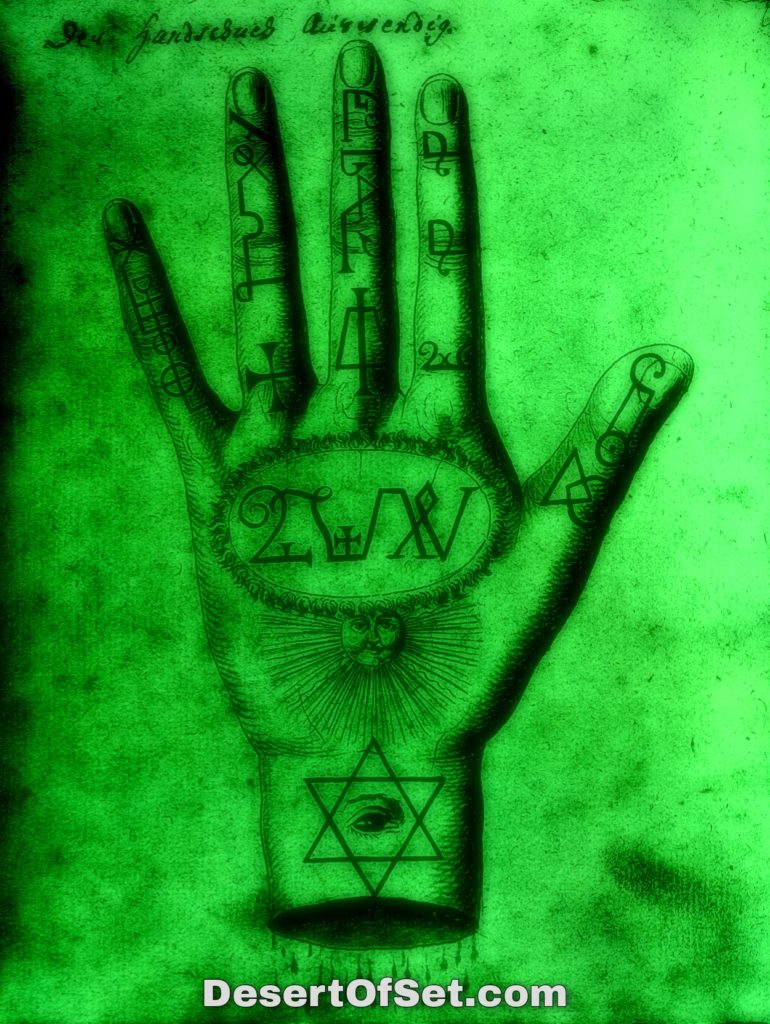
Setianism is often linked with something Western occultists call “the left-hand path,” and this is thanks largely to the Temple of Set. The term originates from Hindu and Buddhist Tantra, in which the Vama Marga or “left-handed way” to enlightenment involves practices that most orthodox believers find “repugnant” (e.g., erotic mysticism). Helena Blavatsky, the founder of Theosophy, appropriated the name for virtually any kind of Western occultism she didn’t like. Ever since then, it has been evocative of “black magic” and “devil worship.”

Most other occult writers followed Blavatsky’s example in this respect, including Aleister Crowley, the founder of Thelema (who was himself regarded as a “brother of the left-hand path” by many of his contemporaries due to his controversial views and practices). The first Western writer to actually adopt the left-hand path (or “LHP” for short) as a positive self-label was Kenneth Grant, a protege of Crowley’s who developed his own “Typhonian” school of Thelema. Grant’s philosophy hinges on Set rather than Horus, and it has much to do with contacting qliphothic forces from alternate universes via the use of sexual magic. Grant was also a UFOlogist and a pioneer in Lovecraftian occultism, or the use of H.P. Lovecraft’s “Cthulhu Mythos” in actual esoteric practice. His use of the term “left-hand path” is probably the closest I have seen among Western sources to the original Tantric idea of the Vama Marga (perhaps because Grant studied under an actual Indian guru, Ramana Maharshi).

The next Western writer to adopt the left-hand path was Anton LaVey, founder of the Church of Satan. LaVey conceptualized the LHP as being like a carnival huckster’s take on spirituality: it’s all “make-believe,” we are just meat machines that cease to exist upon death, and there are no actual Gods or spirits to hear any of our prayers. But at the same time, there is nothing wrong with all of this “make-believe” so long as it enriches and empowers the “believer.” In LaVey’s worldview, conventional religions (“the right-hand path”) use made-up dogmas to control the masses, while the left-hand path uses such fantasy to liberate the individual instead. Success is measured not by any spiritual advancement, but by purely material milestones. For example, a successful actor or musician would be considered far more adept at “the black arts” than someone who can recite each of the Enochian Keys by heart, but who flips burgers at McDonald’s for a living.

Michael Aquino, the founder of the Temple of Set, developed a radically different construct from that of LaVey. His LHP is a more metaphysical process of “immortalizing the psyche,” with the potential achievement of a sentient afterlife being the ultimate goal. For Aquino and his followers, the problem with conventional religion is that it stifles the powers of the mind, leading to a total dissolution of consciousness after death. If people just ditched such creeds and started exercising their minds intellectually and metaphysically, they’d have a much better chance of becoming discarnate alien intelligences when they die—or so the theory goes. If there is one element of LaVeyan belief that Aquino maintained, it is the claim that authentic LHPers do not actually “worship” any of the forces they evoke in their magic (including Set Himself). Aquino’s take centers on worshiping one’s own highest potential to the exclusion of anyone or anything else that might (or might not) exist.

Many additional Western LHP perspectives would bloom over the following decades, including those of Zeena and Nikolas Schreck, Michael W. Ford, and Thomas Karlsson. Notable themes that many sects seem to share include autotheism (the worship of oneself); an indiscriminate affinity for so-called “dark” forces (like conflating Set with Apep); an intersection of Gnosticism, hedonism, nihilism, and/or anti-cosmicism; and a rather unfortunate disposition toward right-wing sociopolitical ideologies (from American Libertarianism to outright National Socialism). The very worst example of this would be the Order of the Nine Angles, whose supporters are known to be terrorists and white supremacists. Even among LHPers who do not entertain such views seriously, there is an ugly tendency to glorify fascist imagery (often because it is “shocking” or “cool”), going all the way back to Anton LaVey’s inclusion of “Might is Right” (a racist diatribe by Ragnar Redbeard) in 1969’s The Satanic Bible.

Though many Setians identify as “left-hand path,” not all of us do. Part of the confusion on this stems from the fact that many Setian writers are either Temple of Set members or adherents to some variation of its philosophy. This has always been something of a “pet peeve” for me personally, because I think the word Setian really belongs to Set. It is understood that not all Setians will believe or practice the same way, as Set loves variety and freedom. But if any particular theme should be the one common element that we all share, that theme is and must be SET HIMSELF—not the Book of the Law, The Nightside of Eden, the Satanic Bible, or the Book of Coming Forth By Night. This does not preclude Setians from sharing additional interests; but Set was there long before Vama Marga, Typhonian Thelema, LaVeyan Satanism, the Temple of Set, or any other LHP variant, and a person doesn’t need EITHER of those things to know Set and walk with Him. To claim otherwise is to ignore the fact that Setianism began over five millennia ago as a North African animist and polytheist tradition in which our Namesake was clearly revered and venerated (as He deserves to be).

Which returns us to the matter of right-wing ideological influences in Western LHP circles. This rather disgusting tendency is made all the more revolting whenever it happens to manifest among so-called “Setians.” For one thing, Set is an Egyptian God, and the Egyptians were a North African people. They were PEOPLE OF COLOR, you idiots. We owe everything to them, too; there is not a single white person who would be walking with any of the Netjeru today if it hadn’t been for these blessed ancestors. So if you pay lip service to an Egyptian God while supporting white supremacy, you are a fucking idiot and you deserve to have your ass handed to you. Furthermore, Set is the absolute WORST mascot for any kind of fascist cause, given that His hatred for authoritarianism is purer than venom. We call Him “He Who Commands the Riot” for a reason, you know. Set is a God who smites other Gods whenever they need smiting, and He has even less patience with human megalomaniacs. If you take His name but support tyranny, you are no Setian; you are just a servant of Apep in disguise—and we Setians know just how to deal with Apep!
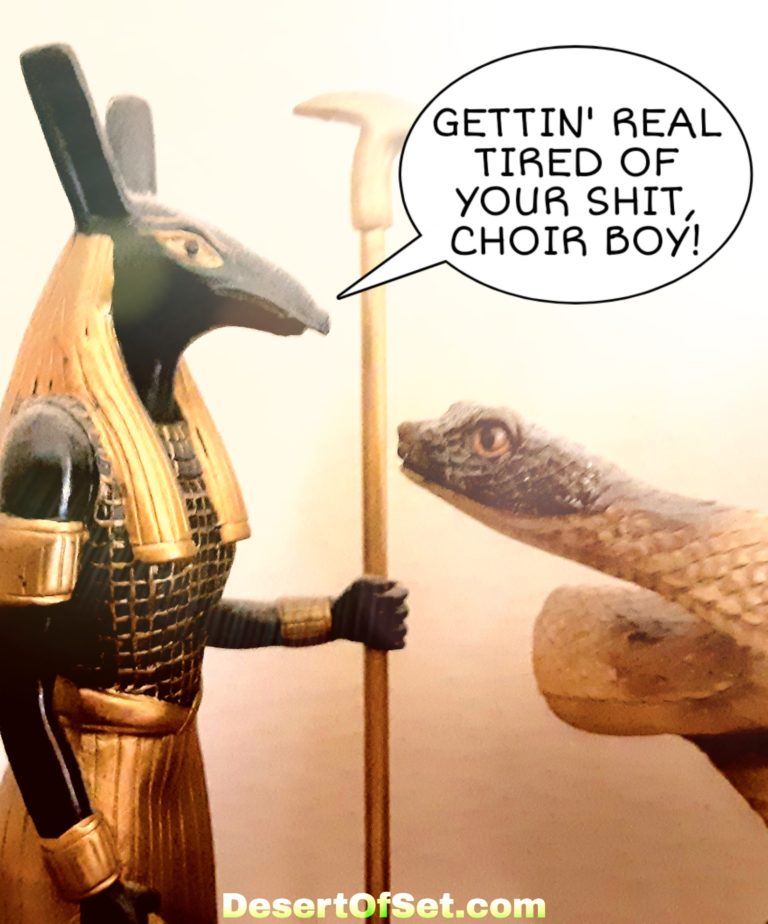
Not today, Apoop!

I’m willing to bet that most of Set’s people today are probably Kemetics or some other flavor of devotional polytheist—or at least, that is how it looks across the internet (which is probably a better reflection of things today than it was in the 1990s). We devotionalists have just as much right to Set’s name as any Thelemite, Satanist, or Chaos Magician (if not more), and I for one insist on taking ownership of the term Setian for this reason. LHPers are welcome to walk with Set too in my book, but they are NOT welcome to look down their noses at those of us who actually revere and venerate Him as the ancients did. And those who favor any of that “might is right” fuckery should just pack their shit and leave. It seems egregiously stupid that I should even have to say this to anyone, but y’all are just gonna have to live with the fact that there are Setians who worship and pray to Set, who are animists and polytheists, and who believe in trying to make things better for everyone, not just ourselves.

Setken’s The Praying Mantis God of Ancient Egypt (Mini-Documentary)

My good friend, the artist Setken, has directed a mini-documentary about the Egyptian praying mantis god, Abyt. Setken asked me to compose some music for the film, and I was very happy to oblige. I’m also happy to announce that Setken’s film has been selected by the Anatolian Short Film Festival for September 2020. Follow the link below to watch the documentary and vote for the film!

And if you enjoy the music in the film, you can also stream or download it for free by clicking the image below:

We sincerely hope that everyone enjoys this work – especially Abyt Himself! Dua Abyt!

Setian Meditations

Three brief sermons in which I discuss Set’s affinity for the color red, why Setianism is substantially different from many other religions, and how the Red Lord saves us all every night.

Red isn’t just a color; it’s a part of Set Himself. Or to put it another way, the Red Lord doesn’t just “like” the color red; He is the very essence of redness.

Within the spectrum of visible light, red exists between orange (where red meets yellow) and violet (where red meets blue). Technically, its wavelength is approximately 620–740 nanometers on the electromagnetic spectrum. It has historically been associated with aggression, blood, heat, lust, and passion. It’s also linked to the planet Mars and the sphere of Geburah on the Qabalic Tree of Life. Mars, of course, is named after the Roman God of war, who is often conflated with the Greek God Ares. (Hence why Mars is so often associated with hostile alien space invaders, as in H. G. Wells’ The War of the Worlds.) Geburah is where the Gods pass judgment and destroy things, causing us all to be transformed (whether we want to be or not). It’s also the sphere where the Gods take whatever steps they need to beat the crap out of evil.

Red is further linked to iron, which is likely because (1) there is actually iron in our blood and (2) Late Stone Age people often used ochre, a clay that is given a reddish tint by iron oxide. Even today, tribal peoples still use ochre to treat animal skins, repel insects, stop bleeding, and protect themselves from the sun. Red also continues to be the preferred color for warnings and danger signs (both in human society and in nature), with the highest threat levels being “red alerts.”

The Egyptians associated Set with red because He is a storm deity. While most Thunder Gods are linked with fertility and kingship due to the part storms usually play in fertilizing crops, storms almost never occur in the Nile Valley. The crops there are sufficiently irrigated by the Nile itself when it floods each year; so even when storms do happen, they tend to have disastrous consequences. They more often occur in the deserts on either side of the Nile Valley, the sands of which are colored red (making Set “the Lord of the Red Lands”). Red-haired animals and people were likewise linked with Set as well, and by the time He was completely demonized during the Late Period, it wasn’t uncommon for such animals and people to be killed as a way of execrating Him. Redheads continued to be demonized by European Christians, who thought such people were especially prone to “worshiping the devil” and becoming “witches.” This construct came from the Egyptians, who considered Set to be the original “red-headed stepchild.”

In many Typhonian spells from the Greek magical papyri, the directions call for magic words to be written in donkey’s blood (which is often described as “Typhon’s blood”). In the LV-426 Tradition, we think that harming any of Set’s sacred critters will definitely draw His attention to you, but not in a way that any sane or rational person would want. I do, however, think that the more red things you can include in your rituals, the better. I prefer to light red candles for the Big Guy, myself.


What does it mean to be “religious”? The answer to this question is much more nuanced and evasive today than it was hundreds of years ago.

When I use this descriptor in relation to myself, it often catches people off guard because I just “don’t seem like the religious type.” I don’t attend any kind of church, take any scriptures literally, try to convert people, or seek to legislate other people’s lives. I also cuss like a sailor and tend to be hypercritical of organized religion in general (to the point of supporting the strict taxation of all churches).

Some people dismiss my religiosity for just these reasons, because their definition of “religion” is limited to the conservative Christian model. And since my religion does not fit within those specific parameters, people always want to tell me I am “spiritual, not religious” at best.

Excuse me, but let’s make something perfectly clear: I am a SETIAN, and SET is my God. I do what I do out of profound reverence and devotion to HIM. The only theological expectations I care to meet are HIS; the standards of other faiths DO NOT APPLY.

Furthermore, Set is not some bullshit authoritarian deity; He has nothing to do with giving commandments, judging humanity for its sins, or bullying anyone with the threat of a miserable afterlife. Set is a cosmic individualist in the truest possible sense of the term; He demands not only freedom for Himself, but for EVERY sentient individual to be the unique and different creature they really are. And even in 3200 BCE, this included everyone from foreigners and immigrants to LGBTQ people to nomadic desert peoples to others who just “didn’t fit in” for whatever reason (especially if they were redheads).

Set is a God who approves of having drag queens read books to children at public libraries, for instance, while contemporary Christians still quarrel over whether Jehovah even accepts such lovely people as human beings. So do not presume to judge MY religiosity according to YOUR (highly questionable) standards. As far as Setians like me are concerned, your own religious priorities are absolutely fucked!

As for the “spiritual but not religious” crowd, I fully support everyone’s right to self-identify as they please. I reject this label myself, for it simply doesn’t do me justice. Walking with Set is not a “hobby” or a “game,” it’s a motherfuckin’ QUEST that takes your entire life, and which continues long after you die! I will not belittle myself, my God, or the magic we work together by referring to it as anything else BUT religious. And those who want to bash all religion in general because “it’s all the same” can kindly kiss my ass.


With respect to the

Wise Donkey  from L. Frank Baum’s The Magical Monarch of Mo.

“Have I been saved? Yes; in fact, my God saves me every day. He saves you every day, too, even though you don’t believe. The fact that the world is still here when we wake up each morning—that we don’t all just blink right out of existence while we’re asleep—is a direct result of His operations out there, on the Frontier of Creation. He’s out there right now, fighting for all of us. He doesn’t care if you’re strong or weak, noble or corrupt, pious or irreligious. Nor does He care that most people vilify Him, if they acknowledge Him at all. Whether He is cursed as a devil or dismissed as a fairy tale, it makes no difference to Him. It’s neither His job nor His concern to judge the world. Even if no one ever rooted for Him at all, my God would still be out there, saving the whole of Creation each night!

“Don’t get me wrong; He does notice those mortals who call out to Him in praise. Given that there are so few of us, it would be hard for Him not to! And though He has His own battles to fight, He shares His strength and His steel with us. When we have tribulations that are too much for us to bear alone, we can ask Him for strength and clarity of vision. We can use our words of power to actually become Him in human flesh, and nothing—not even the Chaos Serpent itself—can stand against us when we do! When we perform this Great Work, we are saving our own little parts of the world. With our Holy Father, salvation becomes a team effort; our victories are His, and His victories are ours!

That is why Set, alone of all the Gods, has my undying loyalty. That is why the subjective realities of other faiths can just never compare to mine. There are no threats, no guilt trips, and no extortions here. It all comes down to just one thing, baby: making sure there’s always tomorrow!

1 10 11 12 13 14 17