Every Day Is Judgment Day


I firmly believe that in the afterlife, we will be judged for what we have done during our lives.

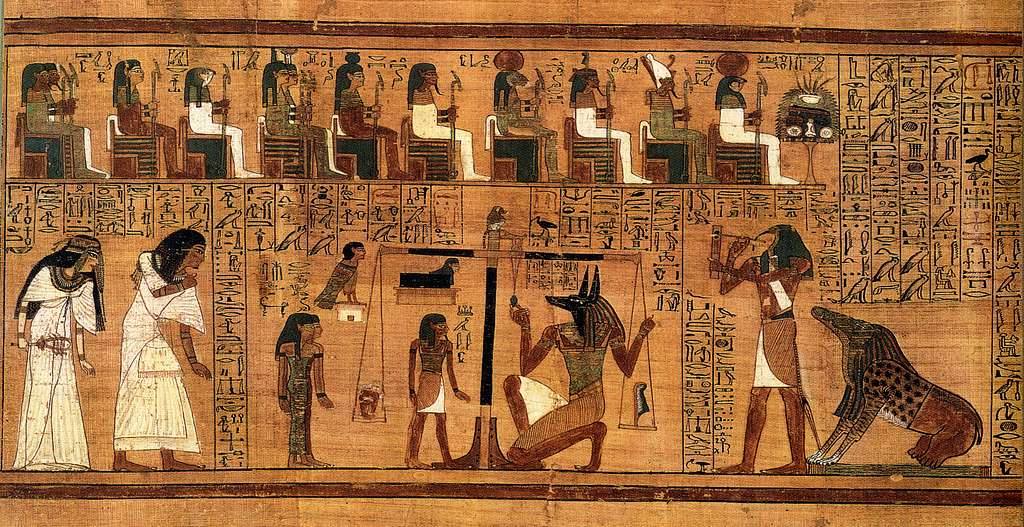
Despite the Western Orientalist use of “reincarnation” as a narrative device in several different “Mummy” movies, reincarnation does not figure into the Egyptian afterlife scenario. Souls instead have a linear afterlife wherein they are either transfigured into akhu (blessed ancestor spirits, identified with the stars in the nighttime sky) or are fed to the daemon Ammut, whereupon they cease to exist for all time. In other words, we will either live forever beyond death or we will “die the second death.”

In this way, Kemetic eschatology is much closer in principle to Christian afterlife beliefs than it is to, say, Hindu or Buddhist ideas. But there is still an extremely important difference. In evangelical Christianity especially, entrance into heaven is “impossible” without personal submission to Christ. But in Kemetic theology, the soul is measured against its earthly deeds and misdeeds during the Weighing of the Heart. We are either “saved” or “damned” based on OUR OWN ACTIONS, here upon this earth.

Evangelical eschatology is problematic because it prioritizes submission to a specific deity over ethical decision making. You could be a horrible psychopathic murderer your entire life, and all you have to do is “accept Christ” and alashazam, you’re suddenly “saved.” On the other hand, you could be a perfectly good person your entire life, but you will “go to hell” for “rejecting Christ” no matter how good a person you are. This theology makes the evangelical God seem like a total narcissist who just doesn’t care whether His followers are actually good people or not.

In Egyptian polytheism however, this problem does not exist. It literally doesn’t matter whether you worship Set, Osiris, Sekhmet, or even nobody at all. As long as you uphold Ma’at by being a good neighbor, modeling compassion, helping those who need help, taking responsiblity for your own actions, etc., then you have nothing to worry about. You don’t have to be a perfect person; you just have to have enough Ma’at in your heart that it outweighs any isfet or toxicity.

For someone like Jeffrey Epstein, who has committed countless crimes and abuses against innocent people, it will not matter how much they cry or beg for forgiveness. It will not matter if they beg Osiris, Set, or even Jesus Christ Himself to “have mercy” on them. There will be no mercy for them at all, for at the end of the day, neither Osiris nor Set nor Christ is responsible for what they have done. THEY are responsible for bringing their own damnation upon themselves.

The point here is that our eschatological destinies have nothing to do with which God(s) we worship (if any); nor are they dependent upon the whims of any God(s). What happens to us after we die is literally DETERMINED BY OUR VERY OWN ACTIONS IN THE HERE AND NOW, while we live and breathe.

Every single ethical decision we make will have some bearing on our afterlives, no matter how small or insignificant that decision might seem. Even the smallest acts of kindness can make all the difference; so too can even the smallest acts of malice.

The next time you’re standing in line for coffee and you find yourself losing patience with your barista, remember that even the way you choose to interact with this stranger is being spiritually tracked, and even this can have repercussions that reach far beyond your current scope of awareness. Maybe the barista is having a bad day, or maybe they are suicidal. The way you treat them can make their day either better or worse. It can also make the day better or worse for everyone else who might be involved in that person’s life. This one little interaction can either improve or ruin the day for a whole lot of people you might never even meet. If you are someone who values Ma’at, you will want to treat this person with kindness, even if they make a mistake or do something wrong. But if you are a toxic person whose soul is already destined for Ammut’s litterbox, you will more likely treat this person like an insect, or perhaps even yell at them or try to humiliate them in front of everyone,

There is also an apocalyptic implication to this, as well as the eschatological implication. If enough people uphold Ma’at and treat each other well, things get better and better for more people. But if too many people spread isfet and treat each other like total sacks of shit, things get worse and worse for more people instead. This shows us that even the smallest acts of kindness or malice can contribute to larger social trends. If we want to save the world, we have to start by improving ourselves and the ways we treat others. No amount of prayer or wishful thinking can replace this extremely important work.
It’s Okay To Have Demons

Expecting people to be John Rambo—including Setians—is unrealistic.

It’s fucked up how the behaviors we develop to survive as kids can bite us in the ass when we are grownups.

As a kid, I was conditioned to believe that asserting myself is bad, wrong, mean, and selfish. I was taught that if I love someone, I should just keep my mouth shut whenever they do anything that disappoints me or hurts me. If I speak up about it, I am being an asshole and I don’t deserve to be loved.

How insidious it is that such conditioning can affect us even as adults. I recently lost a good friend who occasionally did things that disappointed me. I kept silent about my feelings for so long that when I finally tried to express myself, it destroyed the friendship. Then I started hating myself for even trying to talk with this person about my misgivings at all. “If I just hadn’t said anything, we would still be friends,” my brain keeps telling me. “I ruined this friendship, and it’s all my fault.”

This kind of childhood conditioning can even affect your professional life. If I land a better job and my current employer gets upset that I am leaving, I feel like a horrible person. I feel like I’m an ungrateful prick. I feel like I’m being mean and something bad is going to happen to me, as a “punishment.” Even when my logical mind knows I am doing something good for myself, even when I remember that other people hire into better jobs all the time; I still feel like I am bad.

Well the reality is that NONE of these things is true. The voice that whispers these awful things to me inside my brain is not my own voice, but the voice of my childhood trauma. When I blame myself for ruining that friendship, or when I hate on myself for doing something that’s good for my own professional development, it is not really me that’s speaking; it’s my male parental unit. It’s the man who bullied me and manipulated me when I was little; the man who was never impressed by anything I tried to do; the man who delighted in making me feel powerless, trapped, and afraid.

I resonate with Set because He refuses to control or be controlled. Like Him, I chafe at the thought of anyone telling me who or what I can or cannot be. And like Him, I absolutely detest the idea of trying to control anyone else’s life. When I came to Set at age 14, it drove my male progenitor nuts. Here was something he couldn’t take away from me, no matter how much he hit me or tried to shame me. He could burn all my books and break all my sacred objects, but he could never remove Set from my heart. And this gave me the resilience I needed to truly start defining myself apart from the toxicity in which I was raised.

But even though I started on this quest all those years ago, the journey is still in progress. I am still learning how things in my childhood are affecting my adult life. I am still learning how to not hate myself when I do things that are good for me. I am still learning how to love myself and not listen to that ugly voice in my mind that expects me to fail. I am still learning how to determine myself and to not let anyone else define me.

So take it from a Setian who has been walking with Big Red for over 24 years… Ain’t NONE of us here are “Nietzschean supermen.” It’s totally OK if you are still fighting demons from your childhood. Nobody, least of all Set, expects you to be John Rambo. (And even if Rambo were real, he’d be suffering from PTSD too, just like all the rest of us.) If you struggle with hating yourself because of traumatic things that happened to you, you are not alone by any stretch of the imagination. And it’s absolutely OK. Just try to remember that when you get to feeling that way, it’s your trauma talking; it is NOT reality. And try to remember too that talking about your feelings is a STRENGTH, not a weakness. Listening to others talk about their feelings, and helping them feel comfortable enough to share them, is a strength as well.

It’s Setian, Not “Satanic”

Christians and Satanists might hate each other’s deities, but Setians can honor Set and Osiris at the same time. 

One of the more annoying misconceptions against Setianism is this idea that Set is the “Egyptian devil” or “God of evil,” and that we His followers are all a bunch of raving psychopaths who thrive on chaos and violence. Another annoying assumption is the idea that if you ever attract Set’s attention to yourself, your house will burn down and your entire family will drop dead. (Or something like that.)

People who describe Set as “evil” have no business pontificating on Him (or any other Netjer or Egyptian deity, for that matter). He is really not comparable to the Christian devil at all. He is not a “fallen angel” who tries to drag people down into hell with him. He is a full-blown GOD in His own right. He is a SAVIOR who wards off the monsters of chaos.

Yes, Set has some drama with certain other members of the Egyptian pantheon; but this is not at all relatable to the “God versus Satan” dynamic of Christianity. The antagonism between Set and Osiris, for example, is not about some moral dichotomy of “good versus evil”; it is instead a theological metaphor for how ecosystems and agricultural cycles work. Christians and Satanists might hate each other’s deities, but it is not unusual for Kemetic polytheists to honor Set and Osiris together at the same shrine. This is because we know BOTH Gods are really necessary and good, and that BOTH deserve to be loved and appreciated. That’s just how polytheism works.

And I have never met a single Setian who resembled a real-life Mad Max character, gleefully running from one explosion to the next. Every Setian I know is a regular everyday person who values consistency, security, and safety. We get PTSD when bad things happen to us, just like everyone else. Many of us also seem to work in fields relating to public health, helping other people achieve a better quality of life. I am actually super fucking impressed with the number of Setians I personally know who work as counselors, caregivers, educators, and other similar roles. I think this alone demonstrates that our God is neither as “chaotic” nor as “destructive” as certain people like to think.

As for the idea that reaching out to Set will cause a bunch of chaotic shit to happen in your life… Well I’ve been worshiping Him for more than 24 years now, and it has never caused my life to fall apart. In fact, my life has only become more organized and secure since I first met Him at age 14. Besides, chaotic things will happen to us no matter WHAT we do. They will happen whether we pray to Set or not. They will even happen if we pray to someone else, or if we pray to no one at all. Worshiping Set does not increase anyone’s chances of having chaotic things happen to them; it also doesn’t PREVENT such things from happening, either. But let me tell you, it sure does help to have the Red Lord in your corner during a crisis. Setians do not thrive on chaos; we thrive on SET, who helps us PERSEVERE against chaos. 

One other idea I find super annoying is this notion that Setians are supposed to be having intense paranormal experiences all the time, like on a near-daily basis or something. Ghosts, visions, and prophetic dreams are actually just as rare for me as they are for most other people. I suspect this is true of most other Setians, as well. 

You don’t have to be a psychic or a ghosthunter to be Setian. Hell, some people don’t even need rituals. Maybe you just don’t “feel right” going through the motions for whatever reason. Maybe you feel more comfortable just meditating, or trying something different. As long as you have Set in your heart, you’re Setian enough by my standards. If people can still be Christian without going to church every Sunday, you can still be Setian without keeping any shrines or casting any spells. We each get to walk with Big Red in our own way.