Taweret—Or, When God is a Hippopotamus

A discussion of the Egyptian hippo Goddess Taweret, Her connections with Set, and the reasons I love Her so much.

Taweret is the Egyptian hippo Goddess of childbirth. Her name means “Great Female,” and She is otherwise known as Taurt, Reret, Apet, or Thoueris. According to some accounts, She was originally the female counterpart of Apep, the Chaos Serpent; but She became a Goddess and a defender of Ma’at. Now—along with Her trusty sidekick, the benevolent daemon Bes—Taweret protects the frightened and the vulnerable. As frightening as all the qliphoth of the Void might be, they are frightened of Taweret, and for good reason. Her sacred animal is one of the deadliest creatures on earth, and She is the only other Netjer or Egyptian divinity who is powerful enough to wield Khepesh, the celestial Iron of Set!

Hippos are Typhonian animals, which means there’s a very strong connection between Taweret and Set. While male hippos were feared, females were celebrated for their ferocity in protecting their young. The Egyptians channeled this ferocity by invoking Taweret for protection, especially when it came to mothers and little children. Midwives commonly used hippo statuettes to instill Taweret’s strength in women who were giving birth. People kept Her image around their homes because it made them feel SAFE in a world of terror and chaos, with no hospitals or public health system as we understand such things today. People generally don’t behave that way toward influences they think are “ugly” or “disturbing,” so clearly the sight of Taweret inspired confidence. Despite Her so-called “demonic” appearance, the Great Female is there to defend the defenseless.

Taweret never had any temples or priesthoods of Her own (that we presently know of, at least); Hers was a purely folk tradition, kept alive by Egyptian peasants in their own homes. This is ironic, given that Taweret is also linked with one of the largest and most important constellations in the northern sky. The Egyptians viewed Draco not as a dragon, but as a great big hippo with a crocodile on Her back. In funerary art, this hippo was shown with sagging breasts that are heavy with milk. She holds a chain by which the Big Dipper is tethered to Polaris, the North Star. Taweret is said to keep the Dipper restrained to prevent Set from completely destroying the universe whenever He becomes too angry. She is helped in this regard by the Four Sons of Horus: Duamutef, Hapi, Imsety and Qebshenuf.

The Great Female was eventually recast as an alternate form of Isis, the sister-wife of Osiris; but I disagree with this conflation myself. Isis is linked to Sirius and the Sothic cycle, not to Draco or the circumpolar stars, and the Isian religion is known for having absorbed virtually every other Goddess religion it encountered in Late Antiquity (including the cults of Aphrodite, Demeter, and Diana). But most importantly to me, Taweret is a “monstrous” divinity who was born of chaos and who exhibits chaotic traits, yet who uses Her chaotic powers to defend the cosmic order (not to un-create it, as Apep seeks to do). She trades in an altogether different, more primeval kind of fertility than Isis does. The Egyptian Gods are kind of like Voltron or the Megazord; they can converge in various formations and become composite deities, and this includes Taweret and Isis as much as the rest. But this is not the same thing as saying Taweret is simply a “different version of Isis.”

Many Goddesses are portrayed as beautiful, slender-bodied women, but Taweret has always been depicted as rotund, with a gaping mouth full of razor sharp teeth. She certainly isn’t the sort of “glamour girl” one normally finds in pinup magazines, and I absolutely love Her for this. (Not that I have anything against the more glamorous Goddesses; remember, I revere Ishtar too.) Our patriarchal society pretends to love women, but continues to shame them for not keeping fit, wearing makeup, shaving their armpits, or bearing children. There is nothing wrong with doing either of these things so long as it is your choice, just like there is nothing wrong with wearing a skirt or a hijab so long as it is your choice. But the expectation that every woman must fit some kind of “mold” is not only misogynist; it goes against nature, as holy figures like Taweret are here to remind us.

By the time the Greek writer Plutarch came along (circa 46–120 C.E.) to offer his version of events, Taweret’s story had been changed so that She was a concubine of Set who abandoned Him after the killing of Osiris. This change was probably the result of Set’s demonization in Late Antiquity, when He was conflated with the Chaos Serpent and blamed for Egypt’s fall to foreign rule. I think Taweret is still one of Set’s many romantic partners, but She also acts as a kind of “buffer” between Him and the other Netjeru, restraining Set when He loses His self-restraint.  (A Lady who’s not afraid to smack Big Red around with His own iron genitals whenever She thinks He’s being an asshole? How can such a Female be regarded with anything but boundless AWE?)

Taweret also resembles Big Red in that She seems to have identified more with the “little people” who didn’t benefit as much from Pharaonic privilege. The peasants knew She would always listen to them, even if the “more important” Gods of the Pharaohs and the priesthoods didn’t. In Typhonian Thelemic lore, it is said that Set is the male offspring or avatar of Typhon, whom Kenneth Grant depicts as a saurian mother Goddess associated with Draco. Grant further claimed that “Typhon’s” worship was suppressed by later patriarchal religions. As far as I can tell, there is no historical evidence to support either of these claims, which Grant appears to have drawn from the poet Gerald Massey (who was not an Egyptologist). But I do agree with Massey and Grant that Set’s worship is linked to that of a “monstrous” female divinity who resonates with Draco, and who was ignored by the Pharaohs for some reason. I just think the entity they were describing is actually Taweret.

I think of Draco and the Big Dipper as being at the “center” of heaven. Being circumpolar, they never descend beneath the horizon, which is why the ancient Egyptians called them “the Imperishable Ones.” Unlike the planets and the constellations of the Zodiac, the circumpolar stars can be seen on any night at any time of year (in the northern hemisphere, at least, and weather permitting). Since Draco and the Dipper are above the Zodiac, I think of Taweret and Set as being “older” and “darker” than any of the various planetary divinities (e.g., Marduk and Zeus for Jupiter, Ishtar and Aphrodite for Venus, etc.), as well as divinities associated with Sirius and Orion (e.g., Isis and Osiris, respectively), which are beneath the Zodiac. Mind you, I am not asserting any of this to be a dogmatic “fact”; it’s just the way I prefer to think about the Gods based on Their related stars. I also incorporated this theoretical cosmogony into A Would-Be Ombite Creation Myth, with Set and Taweret cast as the first Netjeru to be born from Nut or Mother Sky.
Ishtar’s Final Conflict With “The Man”

How The Final Conflict (a.k.a. Omen III: The Final Conflict) can be read as an allegory for the Goddess Ishtar and Her rivalry with the spirit of human tyranny.

The Final Conflict (1981)—which was re-christened Omen III: The Final Conflict for its DVD release in the early 2000s—is the second sequel to Richard Donner’s 1976 masterpiece, The Omen. I enjoy the original Omen trilogy in its entirety, but The Final Conflict is the one installment thereof that’s made the largest impression on me. This film also makes me think about the Akkadian Goddess Ishtar, who is one of Set’s many romantic partners and the second-most important deity to me personally.

In case you’ve never seen The Omen or its initial sequel, Damien: Omen II (1978), here is a brief recap of their events. The 1976 original is about a U.S. politician named Robert Thorn (played by Gregory Peck) who learns his child has died while his wife Katherine (Lee Remick) was giving birth. A Catholic priest convinces Thorn to adopt an orphan who was born at the same time at the same hospital. Robert agrees, and the Thorns leave with their newborn baby boy (and with Katherine none the wiser to his true parentage). But as the child, Damien, grows older, weird shit starts to happen. One of his nannies hangs herself in front of his entire birthday party. A new, creepy nanny shows up to take the old one’s place. A crazy priest stalks and harasses Robert. A big black dog starts hanging around the Thorn household. A photographer (David Warner) captures prophetic photos of people’s deaths. And poor Katherine becomes terrified of the child who is supposed to be her offspring. All of which leads Robert to visit Rome, a monastery in Subiaco, and an archaeological dig in the valley of Megiddo, where he learns that Damien is really the son of Satan and can only be killed with these mystical artifacts called the Seven Daggers of Meggido.

What follows is the most disturbingly sympathetic depiction of attempted infanticide that has ever been filmed. Unfortunately, Robert only succeeds in getting himself killed when he tries to prevent the apocalypse (spoilers!), and Damien is then adopted by his uncle Richard (William Holden) in Damien: Omen II. Now an adolescent, Damien (Jonathan Scott-Taylor) remembers nothing of what happened to him or his parents in the first film. He’s also best friends with his cousin Mark, who’s more like a brother to him. Damien and Mark both attend military school, where their drill sergeant (Lance Henriksen) teaches Damien about his true identity. Meanwhile, a nosy reporter tries to convince Uncle Richard of the truth, and this leads to a bunch of increasingly over-the-top deaths. (My favorite is the guy who gets sawed in half by an elevator cable. Truly classic.) Eventually, Damien grows into his predestined role and wipes out all that remains of his family tree so he can be the sole inheritor of the Thorn family fortune.

The Omen is a perfect horror show from start to finish, and it’s every bit as scary as people say it is. The script wastes no time getting down to business, and each of the actors’ performances is Oscar-worthy. But it’s also my least favorite film in the trilogy, for Damien is only a peripheral character in the story. Granted, this is exactly what makes the film so scary; Damien remains completely alien to both his parents and the audience right to the very end, and it’s always easier to be frightened of something when it’s part of the unknown. But I find Damien: Omen II much more interesting, because it’s the first film ever made that actually puts us inside the Antichrist’s head. When Damien learns he is the Great Beast, he’s just as horrified as everyone else is; but the most powerful moment is when his cousin Mark gets wise and confronts Damien about his true identity. Mark threatens to tell everyone, and Damien reluctantly uses his powers to give Mark a brain aneurysm. When Mark drops dead, Damien screams the most convincing scream of despair I’ve ever heard from any character in any movie ever. That scene always makes me weep a little whenever I see it, because Jonathan Scott-Taylor really sells it. Damien: Omen II is quite derivative of the first movie, but it deserves credit for one thing at least: the character of Damien is perfectly written.

Sam Neill as Damien Thorn

A lobby card for the film.

In The Final Conflict, Damien is now an adult in his thirties, and he’s played by Sam Neill. He has now become the owner of Thorn Industries, a multi-billion dollar company that has revolutionized the food industry, and which is working to solve the world hunger crisis forever. Damien is also the U.S. President’s first choice for Ambassador to Great Britain (after the current guy gets possessed by a black demon dog and blows his brains out). Damien is hot for Great Britain because he has this entirely fictitious apocryphal text called the “Book of Hebron,” which prophesies that Jesus will be reincarnated in Jolly Old England any day now. (Maybe they didn’t have the budget to do a proper Second Coming, with the J-Man flying down from the sky?) But after he sets up shop across the pond, Damien falls for a news reporter named Kate Reynolds (Lisa Harrow); then these Catholic monks at a monastery in Subiaco, Italy find the Seven Daggers of Meggido and try to assassinate him. This leads to a series of hilariously incompetent murder attempts that will have you shaking your head in disbelief. Meanwhile, Jesus is born again somewhere (did you see what I just did there?), but nobody knows where. Lucky for him, Damien knows the birth coincided with a weird astronomical convergence that occurred a few nights ago, so he sends his worshipers out to murder every male baby in England who was born within that time frame. Then Kate Reynolds finds out what the rest of us already know about Damien, and the titular Final Conflict truly begins.

The number one attraction in this film, and the most important reason for anyone to see it, is Sam Neill; he’s literally the greatest Antichrist I’ve ever seen in any film ever. Forget about Michael York, Nick Mancuso, Gordon Currie, or anyone else who’s ever played the Beast in those movies they show on the Trinity Broadcast Network; Sam Neill’s performance here is the gold standard. Rather than playing Damien like some two-dimensional cartoon villain, he plays him like he’s the Gods-damn hero of the movie. He brings so much charisma and charm to the role that he succeeds in making Damien extremely likeable, even when he’s ordering hundreds of newborns to their deaths. Everyone I know who’s ever seen The Final Conflict ends up rooting for Damien somehow (even though they know they’re not supposed to), and they can’t help but feel disappointed with the ending. (More on that in a minute.) The only other performance that’s comparable to this is that of Sir Anthony Hopkins as Dr. Hannibal “the Cannibal” Lecter in The Silence of the Lambs (1991). If there is an Antichrist and he ever tries to take over the world, we’d all better pray he isn’t just like Sam Neill in this movie—or else we might actually want him to take over.

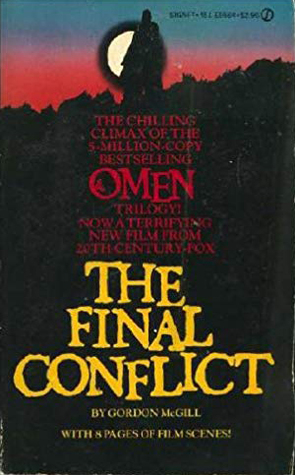
The Final Conflict novelization

The novelization of the 1981 film, The Final Conflict, by Gordon McGill.

In one scene, Damien and Kate walk through a park and see one of the monks, who’s standing on a soapbox, preaching. Damien notices the monk is staring right at him, and he instantly knows the guy is here to kill him. So he starts surveying the area like a hawk—without breathing a word of his concerns to Kate—and he actually looks worried. Is he concerned for himself, or is he concerned for Kate’s safety should there be an ambush? Then there’s another scene where Damien goes to work right after the Christ child has been born. He’s been up all night because he could sense the birth happening, and Kate catches him at the elevator, asking if it’s okay for her to try interviewing him again. (Her last attempt was foiled by another assassin.) Damien smiles and agrees, and she leaves; then he gets in the elevator, sighs, and slumps his shoulders. I’d like to remind you that this character is supposed to be Friedrich Nietzsche’s Übermensch with a vast array of supernatural powers; and yet Neill sneaks in all of these brief human touches—a look of genuine concern, a tired sigh—and actually makes us care about this evil, rotten bastard…

I hate to blow the ending of this film for anyone who hasn’t seen it, but trust me; you probably want to know about this going in. For some reason, I thought this movie was going to end with a big showdown between Damien and Jesus; surely, that would be the “Final Conflict” everyone was expecting, right? I knew things wouldn’t end well for the Beast, but I figured there would at least be some kind of special effects extravaganza. No such luck; the movie ends with Damien being led into a trap by Kate, and Kate stabs him in the back with one of those nifty Meggido daggers. Then Damien limps away, curses Jesus, and promptly dies. Cue music, roll credits. When I first saw this, I was royally pissed. The film had done an excellent job of keeping me at the edge of my seat for the first 90 minutes or so; but it starts running out of steam real fast during the final 20, and that ending just didn’t seem fair. They went through all that hard work of building up this magnificent character and this huge final battle he’s going to have, and what do they give us? Sam Neill getting stabbed in the back (literally) by the woman he loves. I mean, what the hell were they thinking? I wanted to see Damien and Jesus go “Hell in a Cell” on that shit!

Sam Neill as Damien Thorn, with Lisa Harrow as Kate Reynolds and Barnaby Holm as her son Peter

An additional lobby card for the film, with Lisa Harrow as “Kate Reynolds” in the center.

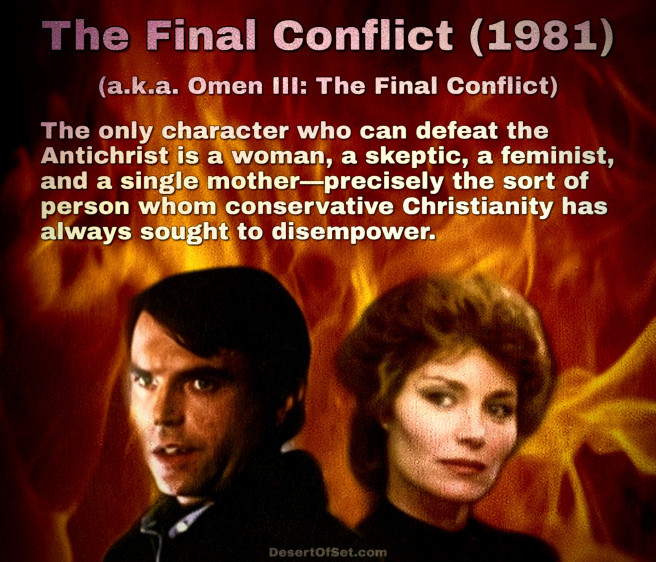
But I’ve watched The Final Conflict countless times since that first viewing in 1999, and I think I’ve figured out what they were really going for here. Let’s consider that this film was not made by evangelical Christians with a religious axe to grind; if it had been, they would have kept things as close to their scriptures as possible. Let’s also consider the fact that none of the avowed Christian men in this movie can stop Damien; hell, not even Jesus himself can stop him! The only character who actually poses a real, substantial threat to the Antichrist is (1) a woman, (2) a skeptic, (3) a feminist, and (4) a single mother. In other words, she is precisely the sort of person whom conservative Christianity has always sought to disempower. The real “Final Conflict” here is not between Christ and Satan at all; it’s between male religious violence (perpetuated by Christians and Satanists) and a female secularist who just wants the violence to stop. Note that while Kate scoffs at Christianity at various points in the film, she nevertheless respects its right to exist; and while she eventually sends Damien back to hell, it’s clear she would much rather work things out and share a life with him somehow. Kate is also the only character who commits an act of violence for purely personal reasons. The monks want to kill Damien because he’s the Beast, and Damien wants to kill the Christ child because he’s Jesus; both sides are motivated by purely ideological concerns. But when Kate stabs Damien, it’s because he’s just murdered her son. (Peter is accidentally killed by one of the monks when Damien uses him as a human shield; the poor kid is literally caught between two religious fanatics.) With all this in mind, I now think the climax of this film is far more daring than I originally thought.

I used to think the conclusion to this film was just an example of lazy screenwriting, but I’ve noticed over the years that The Final Conflict gives us several hints about how it will end. In one scene, one of Damien’s “Disciples of the Watch” advises him to stay away from Kate. “I decide who’s dangerous and who isn’t!” Damien shouts angrily, betraying the fact that he feels insecure about Kate himself. Later, Kate falls into a river and almost drowns at Damien’s house. He hesitates before rescuing her (as if he senses that he shouldn’t), but his concern for her overpowers him. As Kate dries herself by the fire back in the house, she tells Damien she feels like a moth who’s flown too close to the flame; she knows he’s dangerous, but she can’t stay away. Damien’s response to her is perhaps the most beautifully-delivered line in the entire film: “Yes—but who is the moth, and who is the flame?” Finally, when Kate stabs Damien at the end with the Megiddo blade, he smiles to himself ever so subtly, as if he’s always known that she would be his undoing. Kate Reynolds was clearly meant to be the savior of humanity in this film from its very conception; and in casting her as such, The Final Conflict offers us a most unexpected soteriology.

“[Damien] is the human son of Satan, fully committed to his Father. But just as Mary Magdalene represented temptation to Jesus, so Kate represents temptation to Damien. She arouses human feelings within him that could so easily lead him astray from his insidious mission, his inglorious destiny.”

—Sam Neill in an 1981 interview upon the film’s release

The hero of this film is an independent, powerful, and successful woman. She isn’t owned or controlled by any man or male divinity. She comes awful close to losing herself in Damien, especially when she spends a dark night of the soul with him in bed. But she rises again from that proverbial pit, stronger than before, and equipped with the power to send her two-faced lover back to the Underworld. Is any of this starting to sound familiar yet? By Gods, it should; for Kate’s arc is basically the Descent of Ishtar all over again. Damien is like a really nasty corruption of Tammuz, a version that’s turned completely rotten. All of his power and wealth are tied to the food industry, just as Tammuz is the God of food and vegetation. But while this “anti-Tammuz” and his enemies are gridlocked in their increasingly futile holy war, Ishtar sneaks in and chooses Her own “messiah” to save the day. The filmmakers try to give Jesus all the credit for this by slapping an obligatory Bible quote on the screen just before the end titles roll; but as far as I’m concerned, it isn’t the Lion of Judah who snuffs the Great Beast here. It’s the Lion of Babylon!

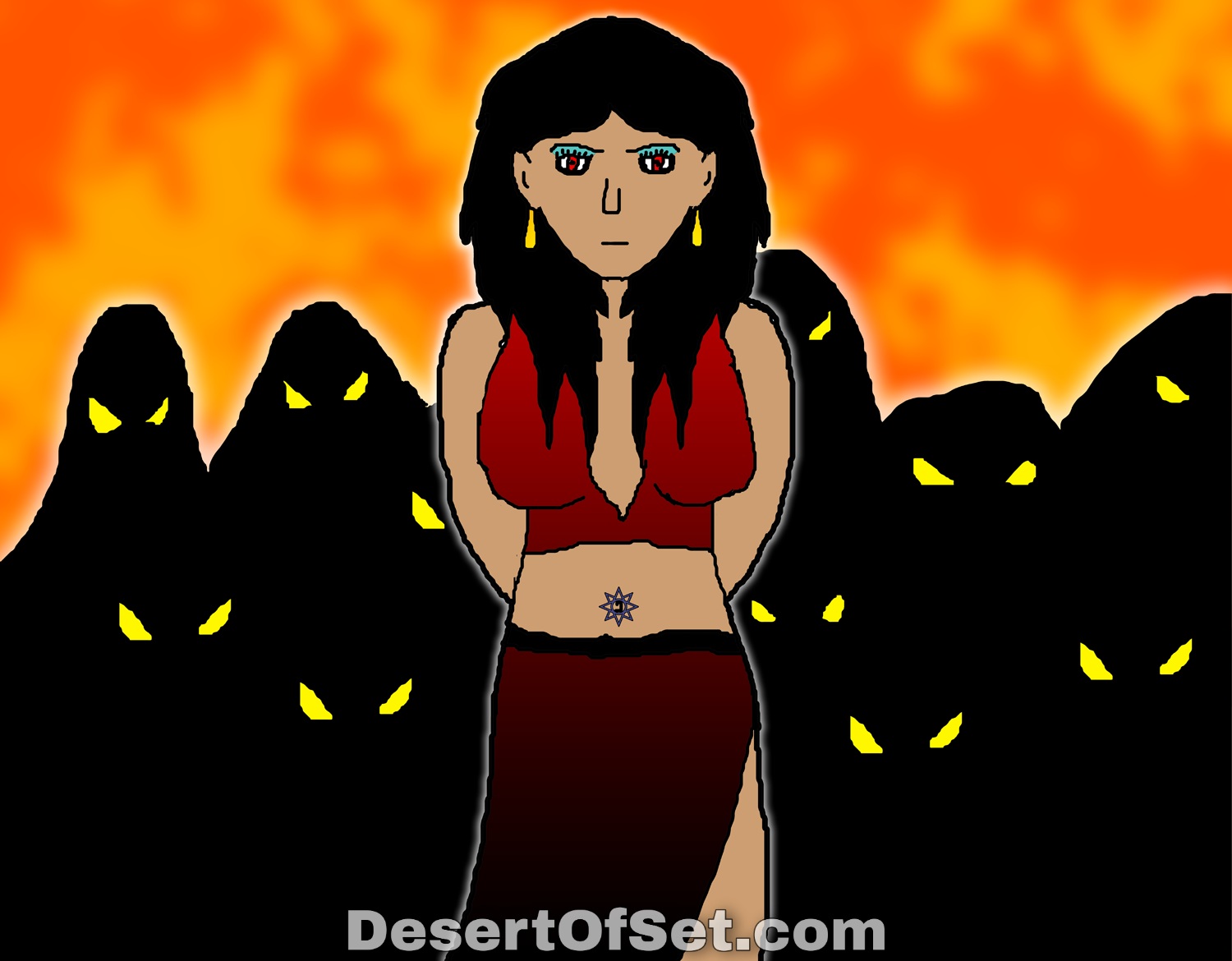
The Octagram or 8-Pointed Star of Ishtar

Ishtar be praised!

Contrary to popular wisdom, there is a distinction between “the Antichrist” and “the Great Beast 666” from Revelation 13. Early Christians used the word antichristos to describe anyone who (1) refused Jesus Christ as their Lord and Savior, (2) propagated a “heretical” version of Christianity, or (3) claimed to be Christian but didn’t behave like one. The first of these definitions is practically useless since it would seem to include all non-Christians. The second is equally problematic since it requires demonizing all Christian denominations apart from one’s own. The third, however, makes a great deal of sense, for what else can you call someone who claims to love Jesus but fails to treat people in a Christian manner? The real Antichrist has nothing to do with Satanism, but is actually the spirit of Christian hypocrisy itself. Turn on your local televangelist TV network and you will find the true disciples of Antichrist at work, pushing their insane political agendas and extorting millions from their hapless followers in Jesus’ name.

The Great Beast (or Therion in Greek) is based on several ancient kings who persecuted monotheists. People like the Pharaoh in Exodus and the Roman Emperor Nero all had three things in common: (1) they ruled over polytheist nations, (2) they considered themselves to be divine, and (3) they considered the Hebrews and the early Christians to be a threat. After being fed to lions for so long, Christians became convinced that such rulers were actually possessed by Satan himself, and prophetic texts like the book of Revelation were built upon this core concept. While Antichrist represents the evil that lurks within Christianity, the Great Beast represents the archetypal “evil king”—a ruler who tyrannizes his people, and whose actions will bring about destruction and doom. Unlike Antichrist, the Beast doesn’t try to pervert Christianity from within; he seeks instead to destroy it from without. So if we want to get technical about it, Damien Thorn is not really the Antichrist per se, but the spirit of Therion in human form.

Mind you, monotheists have not exactly been “kind” to Pagans throughout history, either. It was especially bad for those civilizations that lived right next door to ancient Israel. The Gods and Goddesses of these cultures are specifically named as “demons” in the Old Testament (e.g., Ba’al, Asherah, etc.) and are commonly invoked as such in contemporary media. Lady Ishtar is just one of these divinities, and it’s sad to think that whenever She is discussed in today’s world, it is almost always in terms of biblical prophecy. She is even linked with Therion in the book of Revelation:

Then the angel said to me, “The waters you saw, where the prostitute sits, are peoples, multitudes, nations and languages. The beast and the ten horns you saw will hate the prostitute. They will bring her to ruin and leave her naked; they will eat her flesh and burn her with fire. For [Yahweh] has put it into their hearts to accomplish his purpose by agreeing to hand over to the beast their royal authority, until [Yahweh]’s words are fulfilled. The woman you saw is the great city that rules over the kings of the earth.”

—Revelation 17:15–18

As I’ve discussed before, the Whore of Babylon is clearly inspired by Ishtar, even if her symbolic purpose is different. But what I find especially interesting here is the contrast between a female entity who “rules over the kings of the earth” and an evil king who has turned against her. Ishtar presides over the concept of “sacred kingship,” which required a Babylonian king to “marry” the Goddess and serve the people as Her priest. He had to ensure that his nation’s crops didn’t fail, that his borders remained protected from foreign invaders, and that his people were cared for in times of disaster. He also had to perform religious rituals all the time to ensure that his people’s Gods were properly appeased. A lousy ruler who brought ruin to his people would have been considered “unfaithful” to Ishtar, and some kings were even sacrificed to atone for this sin. This only reinforces my opinion that by killing Damien in The Final Conflict, Kate Reynolds is actually sacrificing him to Ishtar as penance for his disastrous leadership. (It’s reassuring to think that with the Queen of Heaven, even monarchs can be held accountable and taken to task.)

Sam Neill as Damien Thorn and Lisa Harrow as Kate Reynolds

Sam Neill and Lisa Harrow posing for a behind-the-scenes photo.

Don’t get me wrong; The Final Conflict is not a perfect film. There are times when it sabotages itself by trying to copy the original Omen too much. Why are we still wasting time with lone individuals getting slaughtered in isolated places? Why isn’t Damien the President already when this film begins, sending troops to invade the Middle East and start World War III? They missed an opportunity to enlarge the scale and the stakes of the story here; and by restricting all the action to Great Britain, they do a great injustice to the premise. The only exception to this is the baby-killing conspiracy sequence, which is one of the most chilling things I’ve ever seen. The murders themselves are never shown, but are only suggested through quick cuts, musical cues, and horrified reactions from the actors. This is a perfect example of how the power of suggestion can leave a much deeper impression on the mind than just painting the screen with gore. It also helps keep the violence as tasteful as possible (which is no small feat, considering the subject matter), while also making it more disturbing to sit through. If you think the jump scares in The Conjuring (2013) are scary, try watching the scene where one of Damien’s disciples—an Anglican priest—gives a newborn his own version of a “baptismal rite.” It makes my skin crawl just thinking about it.

Ishtar, the Lady Morningstar

She rebelled to help humanity before Prometheus. She died and rose from the grave before Jesus. And She invented the “zombie apocalypse” before George Romero.

Almost every culture has viewed Venus—the “Lucifer” or Morningstar—as an aggressive, contrary force. This is because it is usually the first star seen at sunset, and the last star seen at dawn. Based on this phenomenon, people imagined that Venus is a “rebel” who defies the Sun, refusing to disappear as her superior rises, then rushing to ascend as the Sun sets. Even before medieval Christians incorporated Lucifer into their devil myth, most theological beings associated with Venus were perceived as unruly, cosmic shit-disturbers.

Ishtar, the Akkadian Goddess of Venus, is no exception. She stole the sacred mes, the powers of civilization, from Her uncle Ea and gave them to the people of Uruk. She insisted on visiting Her deadly sister Ereshkigal, the Queen of the Underworld, and conquered death in the process (with some help from Ea). When She learned Her husband Tammuz had not grieved for Her at all while She was dead, She killed and kicked His ass straight down into hell. When the “hero” Gilgamesh refused to marry Her, She sent the apocalyptic Bull of Heaven after him. And when Her father Anu refused to give Her the Bull at first, She threatened to raise all the dead across the earth and send them to feast on the living. She is also said to have an insatiable sex drive, exhausting all of Her various lovers to death.

If you think that sounds bad, Gilgamesh was a king who tyrannized his people, breaking into their homes and raping all the women. He only stopped when the Gods created Enkidu to challenge him, giving him something else to do with his time. Gilgamesh then became so obsessed with finding the secret to immortality that he abandoned his people and left them to fend for themselves. (What an asshole!) So it’s always seemed weird to me that he is portrayed as the “hero” in this story (despite being a tyrant and a rapist), while Ishtar is framed as the “villain” (even though She is divine and transcends all human understanding). The greatest threat Ishtar poses for this megalomaniac is not to his life, but to his ego.

(If Ishtar appeared and said She wanted to marry me, I’d say, “Okay.” Better to be mauled ecstatically by Ishtar’s lovely, blood-splattered mouth than to die by the hand of any mortal man!)

Ishtar appears in Babylonian art as a badass Amazon standing on a Gods-damn lion, getting ready to beat the shit out of some motherfuckers. Assyrian kings prayed for Her to join them on the battlefield like a Valkyrie and slaughter their foes like cattle. (And if their records are to be believed, She answered their prayers…brutally.) As a warrior Goddess, Ishtar was very popular with the Hyksos, who called Her Astarte and paired Her with their chief deity, Ba’al Hadad. When the Hyksos ruled Egypt during the Second Intermediate Period, they brought Ishtar’s worship into the Land of the Pharaohs. And since Ba’al Hadad was identified with Set by the Egyptians, they came to view Ishtar/Astarte as one of Set’s romantic interests as well.

There is a fragmentary Egyptian text from Edfu in which Yamm, a sea monster, demands the hand of Ishtar in marriage. For a moment, it seems the beast will claim its bride; but Set intercedes, and while the rest of the story is uncertain, there is a similar Ugaritic tale in which Ba’al Hadad rescues Astarte from Yamm. Since Hadad’s name is substituted for Set’s in the Edfu texts, the Egyptian version most likely ends with Set destroying Yamm and marrying Ishtar. Considering Their unruliness and Their shared frustrations with dying-and-rising fertility Gods (like Osiris and Tammuz), don’t you think Set and Ishtar make a perfect couple?

Ishtar is often vilified for being so “promiscuous.” This is due to a complete misunderstanding of hierogamy or hieros gamos, the concept of “sacred marriage.” It is a religious rite in which people have sexual intercourse, with at least one of the participants being “possessed” by a deity. Such procedures served a twofold purpose in the ancient world. The practical purpose was to channel the fertility of a God and/or Goddess into the crops, livestock, and people of a community. The spiritual purpose was to reach a higher level of consciousness. Under the right circumstances (all of which require CONSENT), a really good orgasm can totally “blow your mind” and make you feel like you’re in tune with the rest of the cosmos. It makes total sense why people would consider that ecstatic moment of self-surrender to be supremely magical. From this standpoint, sex can be much more than just some “dirty” animal act; it can be a divine religious experience that is both self-fulfilling and incredibly humbling.

The clergy in ancient religions that practiced hierogamy are often described as “cult prostitutes” by biblical scholars. This is especially true when it comes to the qadishtu or holy women of Ishtar. Sex did in fact play a part in the beliefs of the qadishtu, and they were ostensibly paid by the laity for their clerical services. But the way I see it, there probably wasn’t always a direct relation between these two things.

First of all, it is unclear whether Ishtar’s holy women actually engaged in hierogamy with everyone who entered their temples, or if just one priestess performed the rite with a king during the annual Akitu spring festival. To be honest, I have my doubts that even the latter case was always true. Many contemporary examples of hierogamy (such as the Great Rite in Wicca) are often performed symbolically (e.g., sticking an athame in a chalice, rather than actually copulating). It is entirely possible that hierogamy wasn’t always practiced quite so literally in pre-Christian times, either.

Secondly, it is wrong to assume that every service the qadishtu provided for their society was sexual in nature. In fact, it is very likely that most of what they did had nothing to do with sex at all. The available evidence would seem to suggest they were more like nuns than nymphs, caring for the sick and the orphaned, keeping chaste, and living their day-to-day lives in quiet, contemplative prayer. So the fact that Herodotus and the biblical patriarchs defined the qadishtu in terms of sex says infinitely more about them and their dirty little minds than it does about Ishtar’s holy women.

The Mušḫuššu dragon from the Ishtar Gate

Yet another attack on Ishtar is the false claim that She is the alleged “Pagan origin” of Easter. This story goes back to Alexander Hislop, who published a pamphlet called The Two Babylons in 1853. Hislop claimed that Ishtar was originally a mortal Babylonian queen named Semiramis, who single-handedly invented all of polytheism. She then became worshiped as Ishtar—which many Christians claim is pronounced “Easter” for some reason—and created the holiday we now know by that name for herself.

Hislop was partially correct; Easter does in fact have polytheist origins. But its name is actually derived from Eostre, a Teutonic fertility Goddess who bears no historical relation to Ishtar whatsoever. The imagery of rabbits and eggs is taken from a myth in which Eostre transformed a bird into a rabbit that could lay eggs (the Easter Bunny). These symbols do not appear anywhere in Ishtar’s iconography, which has plenty more to do with bulls, dragons, lions, and owls. Nevertheless, evangelicals continue to repeat Hislop’s bullshit at every turn, criticizing Easter as a so-called “satanic” rite to Ishtar.

The Burney Relief, depicting an unknown female figure who could be Ishtar or Ereshkigal (but who likely isn’t Lilith)

One thing that really sticks in my craw is when people confuse Ishtar with the succubus, Lilith. In the 1970s, many Pagan writers circulated a claim that Lilith originated not as the “first wife of Adam,” but as a “handmaiden” of Ishtar who served the Goddess by bringing men to Her temple for worship. Another claim states that Lilith is really a Goddess in her own right; she was later demonized, or so the story goes, when biblical patriarchy replaced the Goddess religions of old. And some people seem to think Ishtar and Lilith are really just the same person at the end of the day.

There is no evidence to support any of these theories. Even in pre-biblical polytheist cultures, Lilith was a qliphothic entity that ate newborn children and sapped men of their seed at night. She was never worshiped, but was only warded off with apotropaic spells. This was as true when the Epic of Gilgamesh was being written as it was when the Old Testament was being written. I can accept the idea of people believing Lilith is a Goddess today, if that is truly how they feel; but they should admit this is a new belief in the grand scheme of things, and not an ancient one. They should also avoid conflating Ishtar with Lilith, because the two are very different figures indeed. At the very least, the former is my Spirit Mama, and the latter is not.

I first met Ishtar in McClennan County, Texas, during the autumn of 1999. I was about to turn 17, and I had been walking with Set for just over two years. I can’t really explain what drew me to Ishtar so suddenly that cloudy afternoon; the best I can say is that Set “traded” me with Her, and I walked with Her for the following year. They traded me back after that, and I’ve been with Set ever since. I never quite understood why this happened until about a decade later, when I met the woman who became my wife. We met in a Pagan discussion forum, and the only reason we did is because I wanted to meet other people who knew about Set, and she wanted to meet other people who knew about Ishtar. Considering this, we’ve always felt that Set and Ishtar are personally responsible for micromanaging things just so the two of us would meet. And that hiatus I had with Ishtar was the Goddess sizing me up as a potential match for one of Her contemporary qadishtu. (I sure am glad I passed the test!)

On Rosemary’s Baby, the Satanic Panic, and Pagan Leadership

The 1980s Satanic Panic; the persecution of Pagans (in some cases BY Pagans) as “Satanists”; and Rosemary’s Baby as a statement against systemic misogyny. Listener discretion is strongly advised.

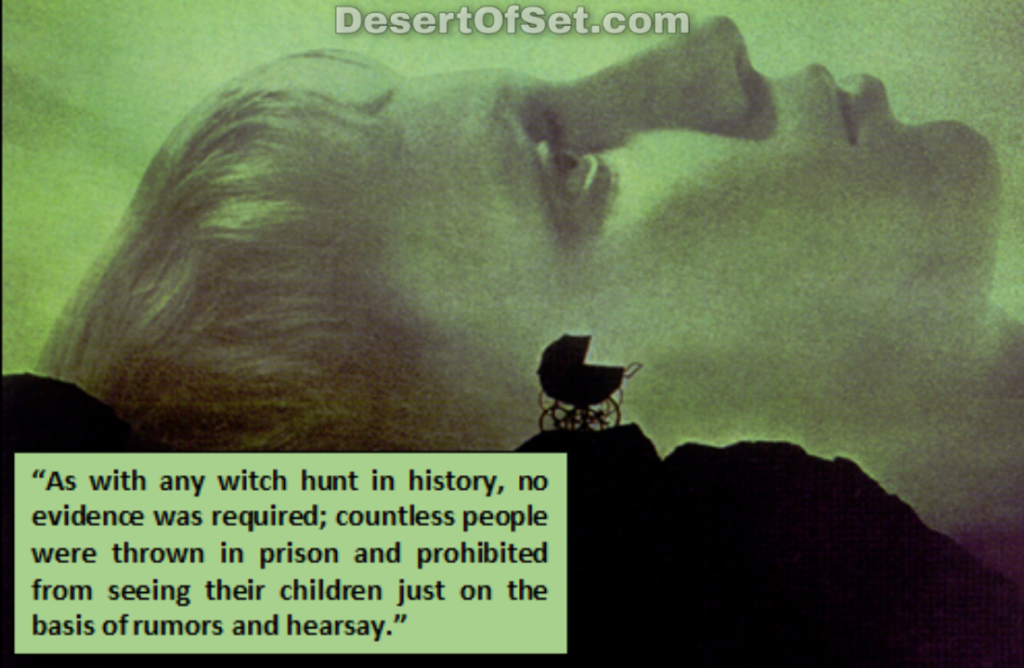
In 1973, a woman named Michelle Smith was treated by a psychiatrist named Lawrence Pazder. Under hypnosis, Smith “remembered” being repeatedly abused by a “satanic cult” as a child. She was allegedly tortured, locked in a cage, and forced to mutilate several babies, all in the name of Satan. These stories were published in Pazder’s 1980 book, Michelle Remembers, which became an overnight sensation. Next thing anyone knew, other hypnotherapists started parading their patients around on TV, calling them “Satanic abuse survivors” and making a shit-ton of money off of them. Sensationalists like Geraldo Rivera popularized these stories, bullying their viewers into accepting these “survivors” and their stories at face value. People started believing there really was an international conspiracy of Satanists who were sexually abusing and cannibalizing little children. Even psychiatric and law enforcement professionals blindly accepted these stories as true. Just being a daycare worker and having someone accuse you of being a “Satanist” (perhaps because you enjoy heavy metal music, or because you play Dungeons & Dragons) was enough to get you prosecuted for alleged child abuse. As with any witch hunt in history, no evidence was required; countless people were thrown in prison and prohibited from seeing their children just on the basis of rumors and hearsay. This was the “Satanic Panic” of the 1980s.

Things didn’t improve until the FBI launched an official investigation of the matter in the early 1990s and said, “Woops! There’s zero hard evidence to support prosecuting any of the people who’ve been put away for this shit! Plus, it turns out that when people are under hypnosis, they’ll remember random shit they saw on TV and think it actually happened!” The adult “Satanic abuse survivors” were actually remembering things they had all seen in popular horror films. Many of them had suffered real abuse in their lives, but were not receiving the kind of care they actually needed. Their therapists were making far too much money being interviewed on daytime talk shows and playing off of people’s fears. Worse yet, this prevented children who really were being abused during the 1980s from getting help as well. The police were too busy hunting imaginary “witches” to do anything about the real pedophiles who were all around them the whole time, preying on children from within their police cars, their clinical offices, or even their church pews. These realizations helped to debunk the entire urban legend of organized “Satanic Ritual Abuse” (SRA), which has not been taken seriously by anyone in psychiatry or law enforcement ever since.

(This isn’t to say that no one has ever been abused by an actual, real life Satanist; it does occasionally happen. It just isn’t as widespread a problem as people think. Such acts are typically committed by lone individuals, not by organized groups, and the victims are usually children in the abusers’ families, not other people’s children. Those who continue to peddle organized SRA stories today are right-wing conspiracy nuts who insist that all the “evidence” for SRA is being “covered up” by nonexistent cults like the Illuminati. (And newer conspiracies like “Pizzagate” are simply a variation of the same theme.) Strange that these people think themselves to be such paragons of moral virtue, given how disappointed they seem to be that there isn’t an international Satanist conspiracy to abuse and murder scores of children!)

As a result of the Panic, the 1980s were a dangerous time to be participating in any new religious movements (NRMs). This was definitely the case for Pagans, many of whom also identify as witches. The word witch is of uncertain origin, but it generally refers to any woman who is wise in the ways of the spirit world. Its use as a slur is rooted in systemic misogyny toward empowered women, and it was reclaimed by Pagans during the 20th century (especially by Wiccans). But the stigma against witchcraft continues to thrive outside of Pagan culture; I can’t tell you how many times I’ve heard about someone calling Child Protective Services on a parent simply because that parent identifies as a witch.

And while it’s understandable that Pagans would want to distance themselves from violent criminals, this was being done in some extremely deplorable ways. Some high profile leaders wrote scathing tirades against Satanism that were every bit as paranoid, deluded, and misinformed as Michelle Remembers. Some even argued that Pagans who follow Gods like Loki and Set should be completely “shunned” from the Pagan community, regardless of anything we might say to explain ourselves. So while Christians were accusing Wiccans and Druids of “worshiping the devil,” Wiccans and Druids were throwing the exact same accusation at Lokeans and Setians. This strategy of deflecting hatred by redirecting it toward other religious minorities is the most disgusting and contemptible act of hypocrisy I have ever personally witnessed, and it continues to color my perspective on many “white light” Pagans to this very day.

Contrary to what most people assume, Satanism never really existed prior to the 20th century. It began as a purely imaginary religion that Christians accused Jews, Muslims, Pagans, and even other Christians of practicing. Apart from the decadent “hellfire clubs” of the Enlightenment period, Satanism wouldn’t become an actual movement until the 1960s. That’s when Anton LaVey founded the Church of Satan and published The Satanic Bible, in which he defined Satanism as a non-theistic spirituality that emphasizes self-deification. Lucifer is viewed not as a supernatural being, but as a symbol for the base animal urges in all people. Satanist rituals are about fulfilling these urges in ways that don’t actually harm anyone, like venting your hatred for someone by destroying something you’ve created to represent them. (Whether this “spell” of sympathetic magic actually works on your intended “victim” is incidental; its true purpose is to work on you.) Many of the people who follow LaVey’s teachings are narcissists, eccentrics, or even Social Darwinists; but surprisingly, most of them aren’t serial killers or child molesters.

The theme of witches harming children goes back thousands of years to the earliest known cases of blood libel in Alexandrian Egypt; but if there is any contemporary influence that gave shape to the Satanic Panic in particular, it is most certainly Rosemary’s Baby (1968), which set the standard for all “devil cult” movies to follow. (In fact, I’m willing to bet most of the “survivors” were specifically remembering things from this film while they were under hypnosis.) And due to its depiction of witches and witchcraft, Rosemary’s Baby can be a very difficult film for many Pagans to watch or even discuss.

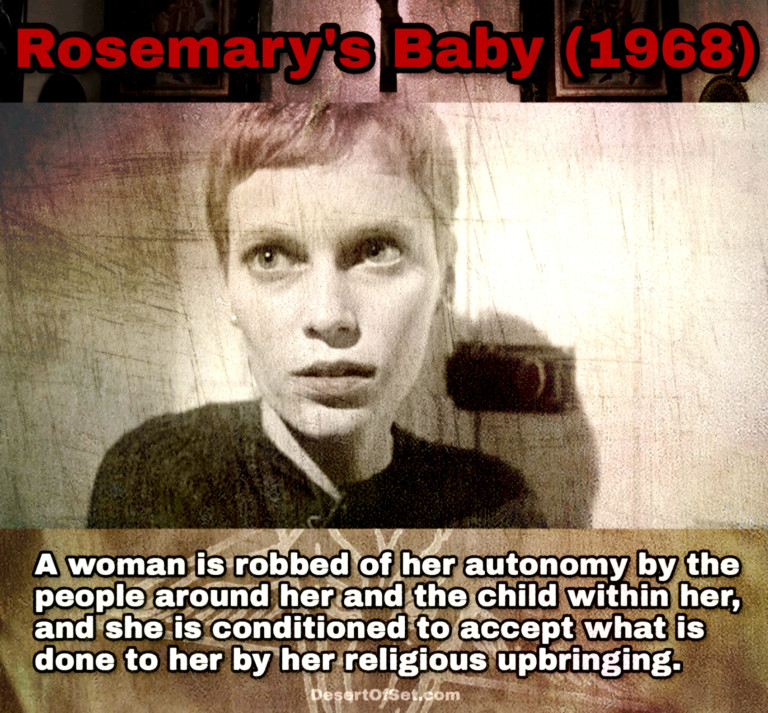
Rosemary Woodhouse (played by Mia Farrow) and her husband Guy (John Cassavettes) move into a new apartment in Manhattan. Guy is a struggling actor looking for work, and Rosemary dreams of having a baby to care for at home. She appears to have mixed feelings toward her Roman Catholic upbringing; she blushes when other characters voice criticisms against the Pope, but she dreams of domineering nuns and of parties that are for “Catholics Only” while she’s asleep. The Woodhouses also have some peculiar new neighbors named Minnie and Roman Castavet. They’re an elderly couple who have a young hippie woman living with them, and they make lots of strange noises in their apartment at night. Their young lady friend soon turns up dead (after jumping out a window near the top of the apartment building), and then the Castavets suddenly become very interested in the Woodhouses. Rosemary notices Roman talking conspiratorially with Guy, who seems to have formed a close friendship with the old man, and Minnie keeps invading Rosemary’s space, showing up at the front door all the time and just inviting herself in.

Eventually the Woodhouses decide to try and have a baby, so they schedule a romantic evening at home. But Rosemary falls sick after dinner and collapses in their bed. She has a dream in which she is surrounded by the Castavets and many other elderly people (all of whom are nude). Then she is raped in the dream by a big hairy creature with snake-like eyes. Upon waking, she notices all these bruises and claw marks on her body. This is when we get our first clue that something is seriously wrong with her marriage, because Guy tries to comfort Rosemary by claiming that he had sex with her after she passed out (ostensibly because he was worried about missing her fertile window). Rosemary clearly isn’t comforted by this admission of marital rape, but she suppresses her anger and submits to her husband’s will. And when she discovers soon thereafter that she is actually pregnant, she seems to forget the whole thing for a while.

Rosemary is overjoyed with the prospect of motherhood, but her happiness wanes as she starts to feel a terrible pain in her stomach. The Castavets recommend that she see a doctor named Sapirstein, who prescribes a special vitamin drink for her and tells her she’ll be fine. But the pain only gets worse after that, and whenever Rosemary tries to tell Guy about it, he just becomes angry and belligerent. She begins to lose more and more control over her own body (even receiving criticism for a haircut she gets halfway through the film), and she starts to imagine that the Castavets are child-murdering witches. She comes to suspect Guy of having made a pact with them, a pact that somehow involves her unborn child. This is sustained by the fact that Guy visibly hated the Castavets when he and Rosemary first met them, but now he adores them for no apparent reason, listening to everything they suggest about Rosemary’s pregnancy. But are the neighbors really witches? Do they really want to hurt Rosemary’s baby? And is Guy really in on the plot? Or could it be that poor Rosemary has just gone crackers?

(If you wish to avoid reading any spoilers, stop reading this and go watch Rosemary’s Baby right now. If you’ve seen the movie already, or if you don’t care about spoilers, please proceed.)

It turns out the Castavets are indeed leading a coven of Satanist witches, but they’re not interested in harming Rosemary’s baby; since the father is actually Lucifer himself, they’re working to protect the little monster instead. And Guy is definitely in cahoots with them, having prostituted his wife to the devil in exchange for a solid movie career. But the real horror in Rosemary’s Baby is neither witchery nor diabolism; it’s the experience of being physically violated, of not being able to trust your spouse, and of being caught between two clashing ideologies that both regard your body as someone else’s property. It’s easy to see how this applies to the Castavets and their followers; for them, Rosemary is simply a vehicle for the delivery of their dark messiah, and she has no choice but to obey them at the end of the film. But do you know what else is good for oppressing women and legislating their uteruses? Roman Catholicism, that’s what. Were Rosemary to approach the Catholic Church for help, her situation would not be any different; she would still be expected to carry her pregnancy to term, and she would still be told what to do with her body by men who know nothing of what it’s like to be pregnant. (If the church thinks it’s a woman’s “duty” to give birth even when she’s been impregnated by a rapist, why should we expect anything different when that rapist turns out to be the devil?) In fact, Rosemary’s Christian upbringing actually helps the Castavets control her, because it has already conditioned her to go along with whatever is expected of her.

But this subtext goes even deeper, for Rosemary is the mother of the Antichrist, who is naturally the opposite of Jesus Christ. And what happens in the story of Jesus? Well, he’s born of a young woman who’s made pregnant by a supernatural being without her prior knowledge or consent, and—

Woops.

The Satanists in Rosemary’s Baby are nothing like real life diabolists; they are instead a metaphor for the twisted chauvinist society in which we all live. Sure, they worship Lucifer instead of Yahweh, and they serve Antichrist rather than Jesus; but at the end of the day, they’re still an oppressive, abusive, and manipulative patriarchy. The men are in charge, the women are subservient, and one woman is raped so their male “savior” can walk the earth. How is the story of the Virgin Mary any different from that of Rosemary in principle? How is the Christian “pro-life” movement any better than what Guy and the Castavets do to keep Rosemary under their control? When I first saw this film, I couldn’t get past the fact that so many people think its depiction of witchcraft is 100% accurate. But as I re-watched it over the years, I began to understand its true purpose: to illustrate how horrible it is for women to be treated as “property” in the name of any male superbeing. Even Ira Levin, who wrote the novel on which Rosemary’s Baby is based, has expressed regret that it would later be used to reinforce the Satanic Panic so much. (Levin is Jewish, which means he doesn’t even believe in Satan and would have no reason to believe in organized SRA.)

Strangely, Anton LaVey was obsessed with this film, and it continues to enjoy a strong fan base among real life Satanists. The reasons for this are not immediately clear. LaVey appears to have thought the Satanist characters are revolutionary insofar as they resemble realistic, everyday people (as opposed to being a bunch of weirdos wearing black hooded robes). He also claimed to have served as an uncredited technical advisor for the film, providing some authenticity to the film’s ritual scenes. To the best of my knowledge, this claim has never been substantiated; LaVey simply spread the rumor around to cash in on the film and generate some free publicity for his church. Every now and then, I encounter a Satanist who thinks Rosemary’s Baby is “pro-Satan” somehow, and I can only shake my head at them. Considering how much fuel this movie gave to the Satanic Panic about 13 years after its original theatrical release, you’d think these people would find it just as troubling as most Wiccans or Druids do; but I digress.

Back in the 1990s, when I was still a young Setian novice, things were very different in the Pagan community than they are now. Nowadays, I can attend a Pagan meetup, mention I worship Set, and most people will probably be OK with having me around. But in the 1990s, it was a whole other deal. As soon as people saw my horned pentacle necklace or heard me praise the Son of Nut, they would tell me I wasn’t welcome, that I was being a “disruptive influence,” and that I should just leave. They automatically assumed I was some demented freak who just wanted to cause trouble. I’m pretty sure most Wiccans and Druids have no idea what it feels like to be excluded and alienated by other Pagans in this way. The thing that has always infuriated me the most about this treatment is that it was trickling down from the top. Big name Pagan leaders like Isaac Bonewits were actively encouraging their followers to treat Setians, Lokeans, and other Pagans they didn’t approve of like we’re all a bunch of extremist psychopaths. These “leaders” seemed to think the most appropriate way to deal with the Satanic Panic was by diverting society’s attention from themselves to people in Paganism they wanted to exclude. In doing this, they helped to promote a “legitimized” stereotype about Paganism that is not representative of the entire Pagan population.

To make things even more interesting, the #MeToo Movement has helped to reveal that some of these Pagan “leaders” are or might have been child abusers themselves. This brings new light to every nasty thing these people have ever said about people like us when the Satanic Panic was still fresh. Trying to save their reputations by targeting an entire sector of the Pagan population for exclusion is one thing; but to think that even the late great Isaac Bonewits was one of the people the police should have been investigating the whole time? I hope you can understand why I would be enraged by this.

The lessons to be taken from all of this are as follows. No one should ever be deprived of their bodily autonomy like Rosemary Woodhouse is by her husband Guy and the Castavets. While the Castavets don’t reflect actual Satanist practices or values, they do reflect the very real issue of human trafficking, which was not an issue most people were aware of during the 1960s. But if Rosemary’s Baby was meant to galvanize society into addressing this particular concern, perhaps it succeeded a little too well. It blurred the line between “new religious movements” and “human trafficking rings,” leading people to assume that all religious minorities are extremely dangerous. This distracted law enforcement from sufficiently investigating and prosecuting some of the real trafficking rings that were actually in operation at the time. It also led to several Pagan “leaders” throwing Pagans they didn’t like under the bus, even while some of them were allegedly abusing children behind locked doors. And if that doesn’t make you feel sick to your stomach, you must have a much weaker gag reflex than I do.

Satan Sells