Update: Tuesday, January 26, 2021

When I was 14 years old, I had an experience that convinced me the Egyptian god Set is real. That was the moment I first became a Setian. But over the years, I would experience several crises of faith. I alternated between thinking Set is actually real and thinking I am just imagining things.

It didn’t help that there were people in my life who were obsessed with “proving me wrong” about my beliefs. The Christians I knew were most obvious, assaulting me with their apologetics and their conversion tactics. I never minded them that much, because none of their arguments were ever based on logic. They were rooted instead in emotions (“Don’t you want to go to heaven with the rest of your family?”), and they all hinged on biblical scriptures. These people didn’t understand that the Bible has no bearing on my life at all. It’s like trying to convince a Star Trek fan they are “wrong” by quoting Star Wars at them; it’s just NOT going to work.

But the people who really succeeded in shaking my faith at times were the militant atheists I knew. They would laugh at me for believing in Egyptian gods, claiming this is somehow “even sillier” than being a Christian. They constantly asked me things like, “What proof do you have for your beliefs? Why should I believe any of this?” Few of them understood that I am not interested in “proving” my beliefs to other people; nor am I interested in “converting” anyone. But they all seemed to take great relish in putting me on the spot, embarrassing me, and making me feel humiliated.

Whenever I started to think that maybe the atheists were right and maybe I really was just imagining things, it made me terribly depressed. My walk with Set is the one thing that truly helped me determine myself in my life, and to think that it might simply be a “delusion” was very upsetting to me indeed. There were other experiences that contributed to such crises of faith, as well, including a suicidal depression in high school and some truly terrible experiences I had while meeting up with other esotericists during my twenties. Such experiences were cited as “proof” by my tormentors that my spiritual interests were simply a recipe for madness, saying I should “get wise” and resign myself to atheism.

In 2007, I made a pilgrimage to Malvern, Pennsylvania, which is where I was living when Set first exploded into my life back in 1997. I needed to see my old stomping grounds and visit all the woodsy areas I used to frequent. There is one area in the woods by Malvern where I always used to pray and worship back in the early days. This area is called Duffy’s Cut, and much to my surprise, they uncovered a mass grave of Irish railroad workers there at some point after I moved to Texas. So when I returned to Malvern and visited Duffy’s Cut, I thanked the ancestors who had been buried there for letting me use their place of rest for my rituals.

Just being there, in that place where Set and I first met, re-awakened something truly powerful in me. And when I returned from that pilgrimage to Duffy’s Cut, I no longer cared what my atheist colleagues said to me. None of their attacks on my faith bothered me anymore. They were completely missing the point, and they had succeeded in making me miss the point as well. But no more.

The point is that it really doesn’t matter if Set (or any other god) is actually “real” or not. Even if the atheists are right and it IS all just make-believe, this still would not negate the efficacy of my spiritual work. Just believing in Set and working to emulate Him throughout my life has saved me from self-annihilation time and time again. Even if Set is just a fictional character, praying to Him and making offerings to Him has had a profoundly positive impact on my life. This does not “prove” that He is real by any means; but it does indicate that He is real enough, and that Setianism is a powerful tool regardless of whether “the supernatural” actually exists or not.

And no one has any business busting my chops for utilizing a tool that helps me to improve myself (especially if THEY are in need of some serious self-improvement, themselves!).

I have not had any crises of faith since I made this realization in 2007. This is not to say that everything has been all peaches and cream. There are times when I actually don’t find this stuff very useful, and I have to put it away and take a break for a while. This has nothing to do with losing faith; it is simply a matter of needing to rest my brain or focus on something else for the time being. Setianism does not work like Christianity, where there is all this pressure to absolutely “buy into” the belief system all the time. This stuff is always here when we need it, and we can also put it away whenever we don’t.

Furthermore, Setians should never feel guilty about needing to take breaks from their quests. Set does not expect any of us to be Terminators. He doesn’t expect us to put Him before ourselves all the time. He also doesn’t judge or condemn anyone for lapsing in their faith or their practice. Set wants His children to be fully autonomous and self-determined, and sometimes this means doing things without Him if you need to for any reason. He is not bothered by this at all; nor does He consider it any kind of “sin” or “offense.” He understands these issues better than most any other deity, and He is always there waiting for us when we need Him again.

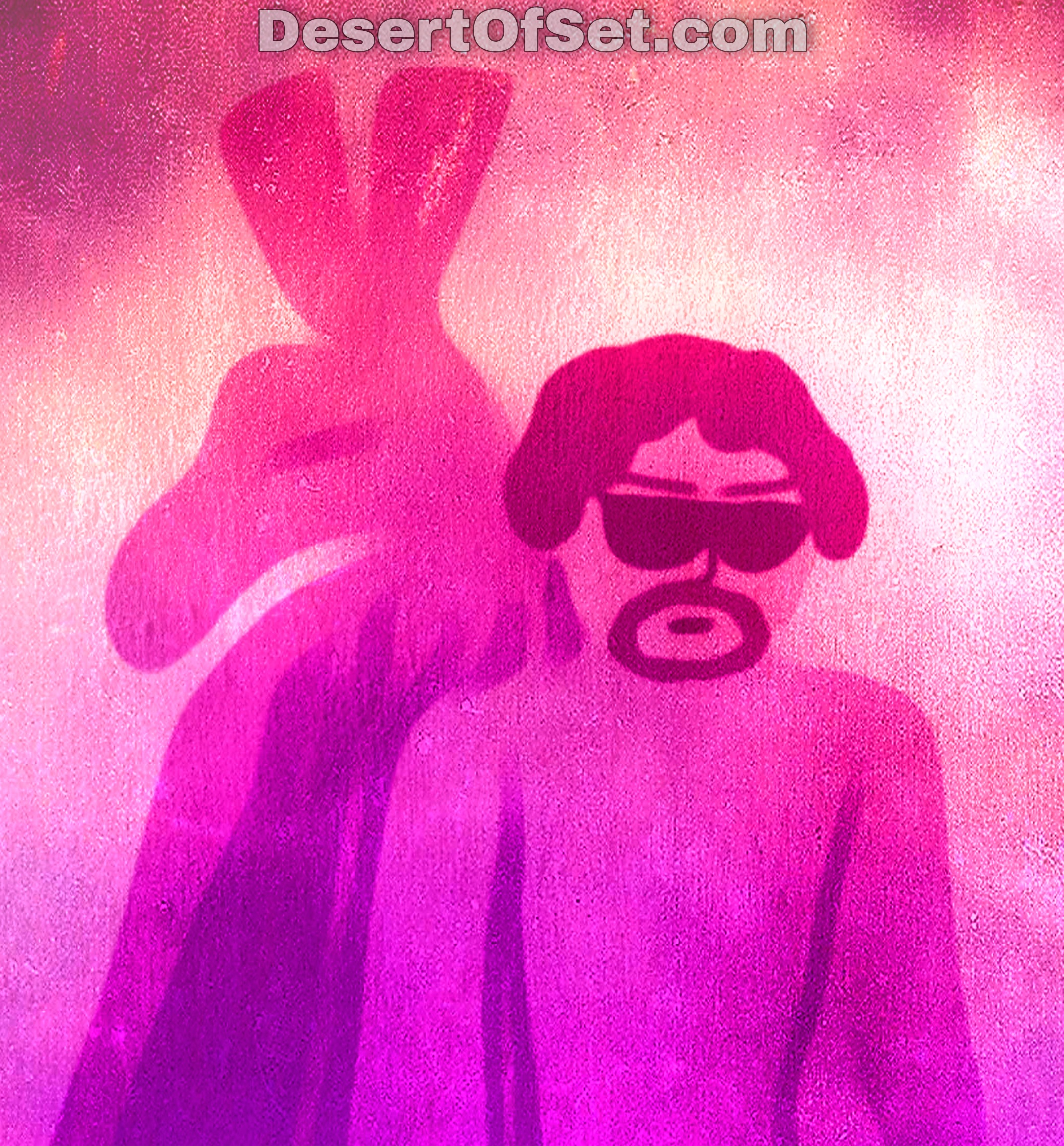
Update: Sunday, January 24, 2021

For personal reasons, I don’t feel comfortable recording sermons for my podcast at present. I will likely get back to that eventually, as I do not intend to stop producing In the Desert of Set.

But since the holidays, I have only felt comfortable expressing myself in pictures. I would like to try expressing myself in words again, but I need to regain my footing with electronic print before I can feel comfortable with public speaking again.

I’m not prepared to produce the kind of in-depth content I have been writing for the podcast up until recently, or at least not yet. So I will be focusing on writing shorter offerings; hence this new Updates page featured on my website.

It may be some time before I return to producing the podcast; but Set has Opened my Mouth, and I must speak no matter what. If pictures and brief blurbs are the only way I can do so right now, then so be it.

Set’s Will be done.

Prayer Against Depression

O Dazzling One!
You who were made desolate,
But who never dies!
You who were rejected,
But who always saves the dawn!

Straighten my spine!
Make strong my limbs!
Open my mouth!

You are what makes me to STAND!
You are what makes me to FIGHT!
You are what makes me to SPEAK!

The Serpent strikes me every day,
But I will NOT be stopped!
I will NOT be rendered powerless!
I will NOT be kept silent!

Holy Outlaw! Divine Rebel!
You who lay tyrants to waste!
Put me to Your holy work!

Do not let me stop
Until MA’AT HERSELF
Decrees my descent!

May I never EVER stop
Bringing joy to loved ones
And strangers alike!

May the Serpent TREMBLE
Whenever I pass near!

DUA SUTEKH!
SO MOTE IT BE!

My Religious Taxonomy

The LV-426 Tradition of Setianism is a fusion of Kemetic polytheist theology with (Setianized) Western occult practices.

Recently a good friend of mine asked me, “What name do you call what you practice, if it fits into any one religion that has a name?”

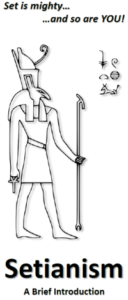
The simplest and most direct answer to this question is that I identify as a Setian, a person who reveres and works to emulate Set. Given that Set is central to my entire spiritual life, I am Setian in the same way that Christ followers are Christians, or that Shiva devotees are Shaivites. I therefore think of what I do as a type of Setianism. (For more information on Setianism in general, check out Episode #1 of this series.)

But like the words “Christian” or “Shaivite,” there are some contexts in which the word Setian requires further explanation. Not all Christians or Shaivites believe or practice the same things, and neither do all Setians. I think it’s probably fair to say we are mostly divided into two major groups:

  • Setians who are Kemetic polytheists, a term taken from Kemet or “Black Land” (the indigenous name for ancient Egypt). People in this category are more likely to believe Set is actually a real, living force of nature; that He is not “the Egyptian devil”; and that He deserves to be worshiped as a personal deity.
  • Setians who are Western occultists, which means they take more of their inspiration from 20th century sources like Aleister Crowley. People in this category are more likely to think Set is somehow “separate from nature”; that He is “completely 100% opposed to Christianity”; and/or that “true” Setians bow to no Gods, not even Set.

And then you have people like me who blur the lines between these categories in certain ways. In my case, my theology and values are very much Kemetic; I treat the Netjeru (the Egyptian Gods) as literal beings, and I consider ancient Egyptian literature on Set to be more important than anything Kenneth Grant or Michael Aquino ever wrote about Him. Plus, my entire spirituality is aimed at actually revering and making offerings to Set, not on becoming some kind of “black magician.”

But at the same time, my ritual style—the way I specifically express my reverence for Set in ceremony and prayer—is very much influenced by Western occult sources. I was not yet aware of the Kemetic community when I first came to Set; I was only aware of His occultist followers at the time, and their ritual templates were the first to which I was exposed. I found such examples helpful, but could never quite buy into the claims that “worshiping Set is un-Setian” (!) or that “Set is a force ‘against’ nature” (?) or whatever. (This contradicted the fact that Setians in ancient Egypt very clearly did not believe EITHER of those things.) So in 1997, I started xeroxing all the rituals by Crowley and other occult writers I could find at my local library; then I would go home and repurpose these litanies to suit my devotional intentions.

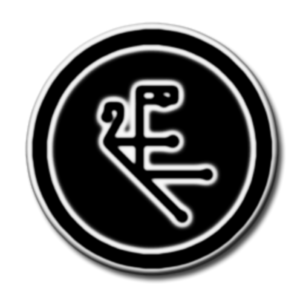
The Sigil of the LV-426 Tradition

A few years later, my friend the Tonester came to Set and asked for my help in learning how to worship. I showed him how I had been doing things up to that point, and we bonded because neither of us was impressed with the occult community in general. No one we knew who was into this stuff was really interested in worshiping anything but themselves. Many of these same individuals were also manipulative egomaniacs with absolutely zero regard for other people’s mental or emotional well-being. Seeking help or support from anyone was always treated as a “spiritual weakness”—like if you can’t just shake off all that depression or anxiety you’re living with, you can’t be a “real” Setian or something like that. So the Tonester and I both said, “FUCK dem apples; we’ll just start our OWN outfit.” And such is more or less how the LV-426 Tradition of Setianism began, back in 2003.

An LV-426 Walpurgisnacht postcard!

It wasn’t until sometime in the mid-2000s that I met any Kemetic polytheists or became aware of modern reconstructionist groups like the House of Netjer and the Church of the Eternal Source. Learning of this community really blew my mind; here were all these people who actually believed in worshiping the Egyptian Gods, and I hadn’t known about them this whole time! And I was impressed by the sheer amount of empathy that Kemetics just seem to feel for each other in general. Things might be different now than they were in the early 2000s; but back then, to speak of having suicidal feelings in a group of left-hand path occultists was to invite them to shame you into “just feeling better,” “getting up and doing something about it,” and/or “leaving if you can’t take the heat.” But to this day, I still see Kemetics supporting each other emotionally through such terrible struggles—something that anyone who claims to love the Gods of Egypt SHOULD be doing (YES, even if your patron Netjer is SET!). Despite any differences in my ritual style, I would much rather hang out with a bunch of Kemetics for an informal Moomas party than attend something like one of the Temple of Set’s annual conclaves.

In summary, the simplest term for my faith is Setianism; but if we want to get really taxonomical about it, my particular kind of Setianism (LV-426) is a unique fusion of Kemetic polytheist theology with (Setianized) Western occult ritual practices. We do not claim to be following “the one true way” of Set or anything like that; this is just OUR way, and others can take it or leave it. But one thing we LV-426ers will NOT tolerate is being told by any Social Darwinist occultniks that THEIR ways of “being Setian” are somehow more “accurate” or “legitimate” than ours. In absolutely any situation where this ignorant claim might arise, we will be sure to correct people accordingly (and mercilessly).

(To paraphrase Ozzy Osbourne: “Tell me I’m a phony? I got news for you: I spoke to Set this evening, and HE DON’T LIKE YOU!”)

As a final note, the LV-426 Tradition is a private fellowship, and membership is by invitation only. This is not because we want to be a “secret society”; it’s because we treat each other as family, and that is not a dynamic people can just develop by sending us a check and applying to join. It usually takes several years for someone we know personally to even realize they are one of us; then we have to all agree with each other before the candidate can be initiated. Sometimes when you’ve had a really bad week, it feels damn good to sob uncontrollably in the presence of Sutekh and your siblings in Him during one of our Sabbats. And this kind of atmosphere is most successful when there aren’t any “might is right” crotchgoblins around, trying to shame people for having problems and needing support.

But while we are extremely protective of whom we allow into our personal lives, we want to share the magic we’ve worked together so that others may benefit from it too. You don’t even have to join us or pay us to learn how we do things; hell, just read this damn website and take notes! If other Setians find our material useful but would like to make changes, I encourage them to do the same thing I did with Crowley or whomever and tinker with the work as they see fit. While I am in no hurry to expand my own coven, I do hope to hear of more like-minded Setian groups popping up across the globe some day.

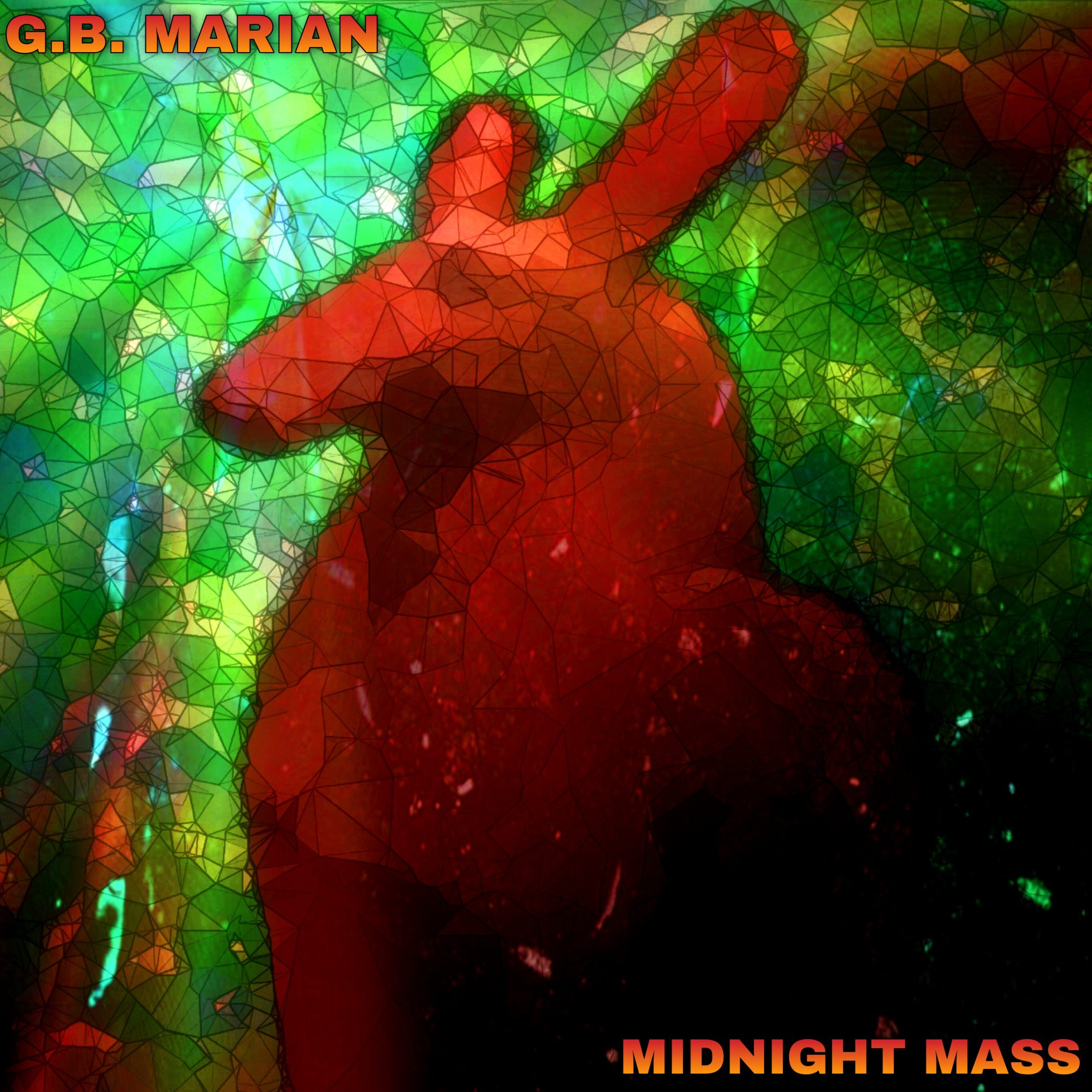
Midnight Mass

A Setian midnight mass performed and recorded for an imaginary AM radio station.

Available at

gbmarian.bandcamp.com

Good evening.

For tonight’s episode of “In the Desert of Set,” we are brought to you live from the First Typhonian Anabaptist Church of Grover’s Mill, Pennsylvania by Hem Sutekh Radio, WZLP AM 770.

We now give you Reverend G.B. Marian, Priest of Set in the LV-426 Tradition, who will now lead tonight’s Midnight Mass.

Happy Holidays from LV-426!

Shedding Skin With the Snake God (and Snake People!)

Thoughts on Nehebukau, the holy Snake God, and the concept of Snake People, with an analysis of their appropriation by modern pop culture and conspiracy theorists. 

It’s important to understand that snakes are not a universal symbol of “evil” in Kemetic or ancient Egyptian lore. Actually they are more like angels, a special class of preternatural being. There are good snakes like Wadjet and Meretseger who serve Atum-Ra the Creator; and there are also bad snakes that serve Apep and who seek to disintegrate all things. One story of Nehebukau is that He was originally one of the bad snakes; but this was only because of a pinched nerve in His spine that was hurting Him real bad, making Him terribly grouchy. Eventually, Ra healed Nehebukau by touching His back and fixing that nerve, and the latter has been a good and holy snake ever since, working Ma’at and assisting sentient beings through their various kheperu or transformations in life and the afterlife (what might be called a “shedding of skins”). In this way, Nehebukau fits right in with some of the other Gods I hold most dear. Like Set and Taweret, He’s kind of like a monster that learned to be better, and who is in a very unique position to empathize with humans in our struggles against isfet

Dua Nehebukau! Hail, sweet Soul Serpent!

To be clear: when I refer to “the Snake God,” I am referring to Nehebukau, and not to the monster Apep. When I refer to “the Chaos Serpent,” the situation is reversed. The distinction here is that Nehebukau is a proper God or Netjer, while Apep is more like an “ungod.” If it confuses anyone that I would use “snake” and “serpent” in different ways like this, just remember the comparison to angels above. Nehebukau is no mere angel (and neither is Apep for that matter), but one might say Nehebukau is a Snake God in the same way that Gabriel is a “holy angel,” while Apep is a Chaos Serpent in the same way that Satan is a “fallen angel.” There are additional good male snake Gods among the Netjeru as well (e.g., Geb, Mehen, etc.); but as I have not personally interacted with any of them myself, Nehebukau is the particular Netjer I mean to invoke when I write “Snake God” in capital letters. 

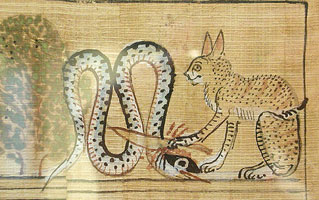
A good cat slaying Apep the Chaos Serpent—not to be confused with Nehebukau the Snake God!

Prior to collaborating with Setken on Hymn To The Soul Serpent (Hymn To Nehebukau), I don’t recall actually being that cognizant of Nehebukau before. I recall seeing Him in Egyptian art in His winged, double-headed serpent form from time to time; but it wasn’t until my exposure to Setken’s artistry that I remember seeing the Snake God depicted in a humanoid form (as exemplified in Setken’s Study For The Netjeru!: Nehebukau). Apart from just being really fucking beautiful, Setken’s paintings spoke to something buried deep within the furthest regions of my memory. It was not until we were almost ready to release Hymn to the Soul Serpent that I suddenly realized just what these sacred icons were actually reminding me of. 

Available at gbmarian.bandcamp.com

(When Setken first proposed the Hymn to the Soul Serpent project to me, I mistook him for saying “Nekhebet,” and I immediately started studying footage of vultures for inspiration. When I realized my mistake, I apologized to to Nehebukau profusely, even though I am reasonably certain He wasn’t actually offended. But perhaps some kind of project for Nekhebet might be on the horizon!)

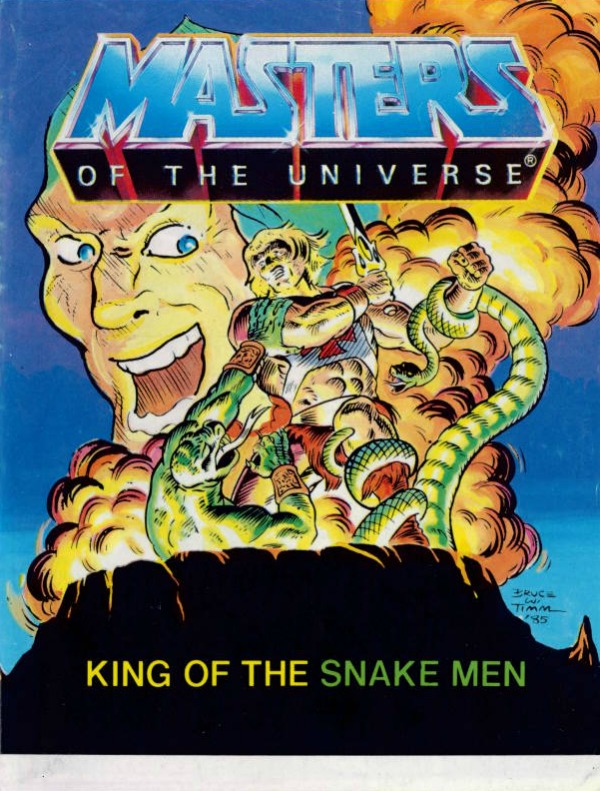
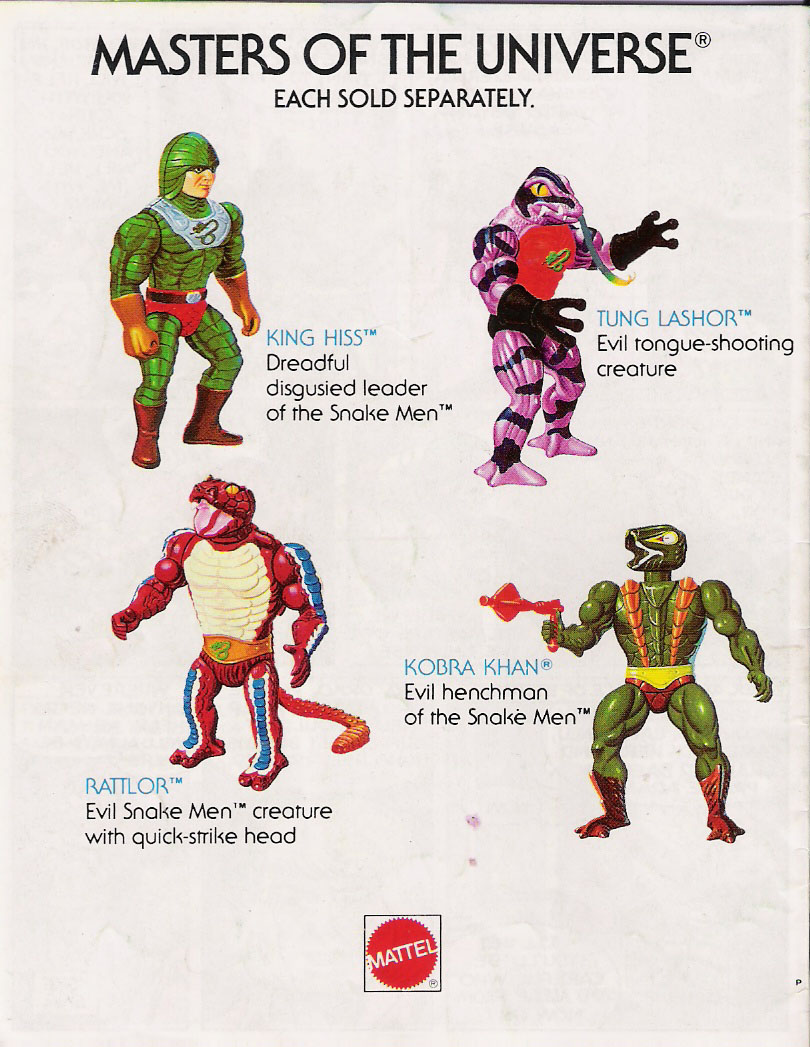
This is probably going to get me into trouble (more on this later), but I’ve had a fascination with the idea of reptile people for as long as I can remember. I think my first exposure to this was from watching He-Man and the Masters of the Universe. I also collected the dolls (or “action figures,” if it really bothers other men so much), and my absolute favorites were the Snake Men. King Hiss looked like a normal dude, but his entire torso came apart to reveal his true form as a writhing mass of vipers. Tung Lashor had a super-long poison tongue that came rocketing out of his mouth when you operated the button on his back. And Rattlor’s neck could extend with quite some force, rendering him somewhat hazardous around children’s eyeballs. These characters were not featured in the He-Man cartoons, but the dolls came with miniature comic books that explained their background stories and such. 

According to the comic that came with King Hiss, the Snake Men are native to He-Man’s homeworld, Eternia, and they controlled a powerful empire long before the reign of King Randor. They were banished to some alternate dimension, but the evil wizard Skeletor found a way to bring them back. Thanks to He-Man, Skeletor only succeeded in facilitating the return of three Snake Men: King Hiss, Tung Lashor, and Rattlor. The Snake Men then launched a campaign to return the rest of their kind to Eternia, so they could invade and enslave humanity once more.

Is any of this starting to sound familiar to you yet? In Episode #10 of this series, I discuss one of my least favorite anti-Setian tropes in popular culture: the theme of an “evil snake God” called “Set” who was banished to an alternate dimension, who has legions of “Serpent Men” under his command, and who seeks to return and invade the world of human beings. This theme originates from the short fantasy fiction of Robert E. Howard (creator of Conan the Cimmerian and Kull the Conqueror), and it gained even more traction when Marvel Comics was licensed to adapt Howard’s fiction into its own fictional universe in the 1970s. Since then, the “Set and His evil Serpent Men” trope has emerged in countless cartoons, movies, role-playing games, and science fiction TV shows. He-Man and the Masters of the Universe, with its Snake Men and their tyrannical King Hiss, just happens to be the most obvious example of this trend.

One thing I disliked about He-Man was the fact that these Snake Men were bad guys. I have always loved snakes, especially the non-lethal ones like garter snakes, and I always thought it would be neat if these characters could have been heroes instead. I remember imagining my own Saturday morning cartoon shows where the heroes were all benevolent Snake People (with badass edgy names like Queen Hissteria and Big Bad Mamba), and the bad guys were just normal-looking humans. Curiously, the animated He-Man series does feature another race of snake people, the Reptons, who are peaceful and kind. (One of them, Kobra Khan, is one of Skeletor’s goons; but the show makes it clear that Khan is just a bad egg, and the rest of the Reptons are cool.) But when it comes to stories that add a little more dimension to this concept than what I usually expect, my life changed forever when I saw Doctor Who.

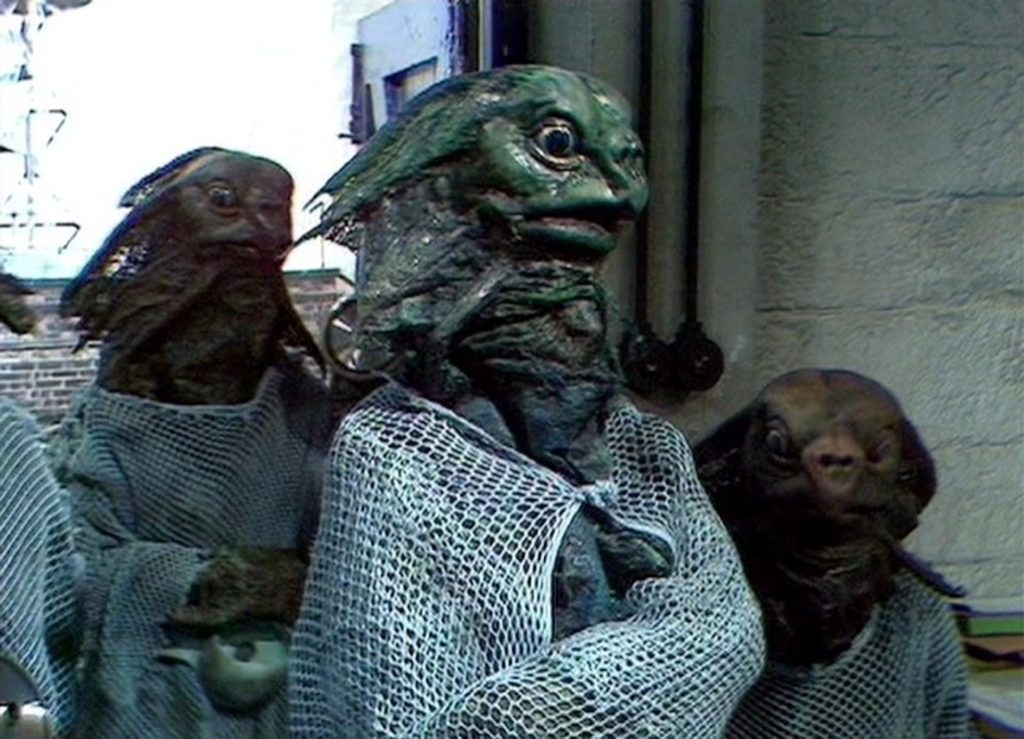
No, I’m not talking about the newer Who series that’s been in production since 2005. I speak to you of those lost long days when the only way you could catch Doctor Who here in the States was by watching PBS and sitting through all those passive aggressive pledge drives they used to do, where they’d threaten us with no Doctor Who ever again if we didn’t call in to buy that nifty coffee mug with the disappearing TARDIS. During the Jon Pertwee years, there were two serials that dealt with the theme of reptile people specifically: The Silurians and The Sea Devils, written by Malcolm Hulke. In the first of these adventures, the Doctor (who is currently stuck on earth with an inoperative TARDIS) learns there was another intelligent species that ruled this planet long before humans evolved from apes. These reptile people are not aliens, but native to earth. They went into hibernation deep underground when their advanced astronomy detected the incoming comet that eventually wiped out the dinosaurs. Their machines were supposed to awaken them shortly after the disaster, but a malfunction caused them to remain in suspended animation until they were accidentally revived by human nuclear testing during the 1970s. 

“Hey it’s OK, these guys are sailors. If we get ’em laid, we won’t have any trouble!”

Having resurfaced, the reptile people are understandably distressed to find their planet invaded by ultraviolent hairless apes. Some of them are willing to try and co-exist with us peacefully, and the Doctor tries his best to facilitate an arrangement to this effect. But racists on both the human and reptilian sides of this dispute eventually stifle this hope, with the reptiles unleashing their biological warfare upon us, and the humans bombing all the rest of their hibernation chambers. In the second of these serials, the Doctor encounters another tribe of reptile people who belong to an aquatic subspecies, and the whole thing starts all over again. (Things are made even worse this time by the Master, played by Roger Delgado, who actively seeks to escalate the conflict between humans and reptilians.) Doctor Who lore is curiously divided as to how the reptilian characters in these stories are to be identified, but when I was a kid at least, I always went by the Malcolm Hulke novelizations, which refer to the land-dwelling reptilians as Silurians and their oceanic cousins as Sea Devils. 

I remember CRYING a lot whenever I watched these episodes of Doctor Who, to the point that my parents were concerned I was actually scared and would have nightmares. But while I did find this stuff disturbing, it wasn’t because it was scary; it was because it was sad. I thought the Silurians and the Sea Devils were cool, and I wanted things to work out so that everybody can share this planet together and get along. I will admit that I was very young at the time, and I didn’t yet grasp that this was all just make-believe. But I also remember that when I got a little older and I first learned about some of the colonialist atrocities that have been (and still are) perpetuated against Native Americans, my initial reaction was to reflect back on Malcolm Hulke’s stories and the profound emotional reactions they invoked in me. The difference, though, is that THIS WAS FUCKING REAL, it ACTUALLY HAPPENED, it is most certainly NOT make-believe. And learning THAT horrible truth (in addition to others) has kept me awake at night far more than any scary TV show ever could. (Somehow, I sense that if I could ask Malcolm Hulke about this today, he would tell me this was exactly his point in writing these awesome stories.) 

Incidentally, the Silurians and Sea Devils return in a few later Doctor Who adventures, but Malcolm Hulke had nothing to do with these serials, and I am not really a fan. In the 1983 episode Warriors of the Deep, the Fifth Doctor (Peter Davison) ends up wiping out two combined tribes of terrestrial and aquatic reptilians all at once. Sure, Davison makes a fantastic Doctor, and he clearly doesn’t WANT to commit genocide against the reptilians; but he does it anyway, and it’s gross, and there is no text or subtext about colonialism anywhere to be seen. It’s just “We gotta kill the people with animal heads so the humans can live.” This leaves the whole story feeling way too hollow and mean-spirited for my tastes. 

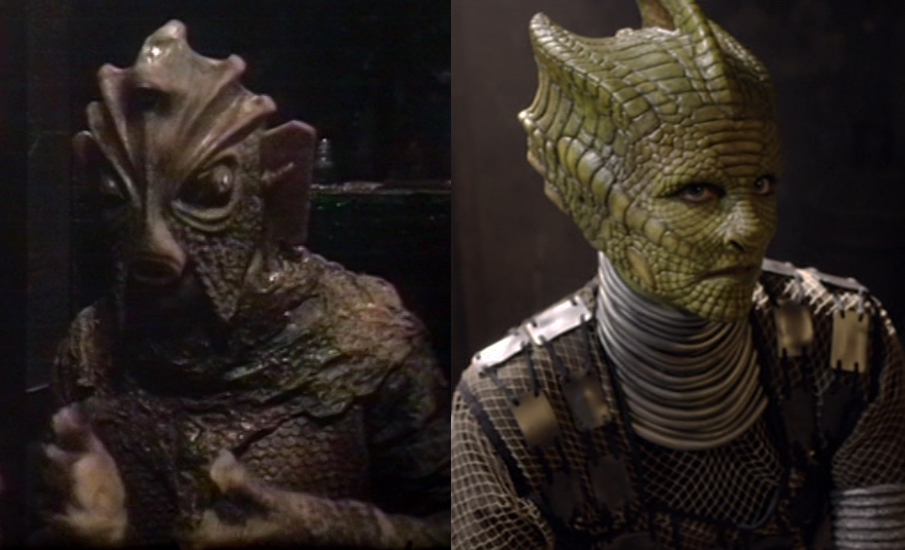
Decades later, the new Doctor Who series re-introduced the Silurians during the Matt Smith era. These episodes deal with Malcolm Hulke’s creations much more respectfully, and I really enjoy the idea of a badass lady Silurian living in Victorian England and kicking hiney to help the Doctor save the world and stuff. I believe they even wrote it that at some point in Earth’s future history, humans and reptilians really do learn to co-exist. This is definitely a major victory as far as my inner child is concerned; but I just can’t stand the new makeup design for the Silurians. Old Silurians (and Sea Devils) actually look like people with reptile heads, much like the Serpent Men from Conan and the Snake Men from Masters of the Universe. The new versions are really just people with reptile skin, and they don’t resemble the beloved creatures from my childhood enough to resonate. Still, I do enjoy the fact that Doctor Who‘s reptile people have at least been vindicated in terms of their collective story arc after all these years. 

Another show in which Robert E. Howard’s Serpent Men resurface is Hasbro’s G.I. Joe: A Real American Hero. In the 1987 animated film adaptation of the popular cartoon series, it is revealed that the international terrorist organization Cobra is really just a front for an ancient civilization called Cobra-La, which of course was populated by Snake People. These reptilians naturally seek to reclaim what they perceive to be their stolen earth, and the entire history of Cobra as a human totalitarian human regime is really just one more phase in their long game.

I don’t remember owning any G.I. Joe dolls, but I remember really enjoying the cartoon and its huge ensemble of diverse and fairly well-developed characters (especially my first true love, the Baroness Anastasia Cisarovna). But imagine my surprise when I learned that Cobra wasn’t actually created by Hasbro, which launched the toyline. Rather, it was “invented” by Marvel Comics, which was commissioned to write a story for Hasbro when it re-launched its catalogue in the 1980s. The writers at Marvel pointed out that the heroes needed some villains to fight if there were going to be any story worth telling; and for lack of any better alternative, they more or less cloned the concept of Hydra—the terrorist organization battled by superhero teams like the Avengers—and re-named it “Cobra.” 

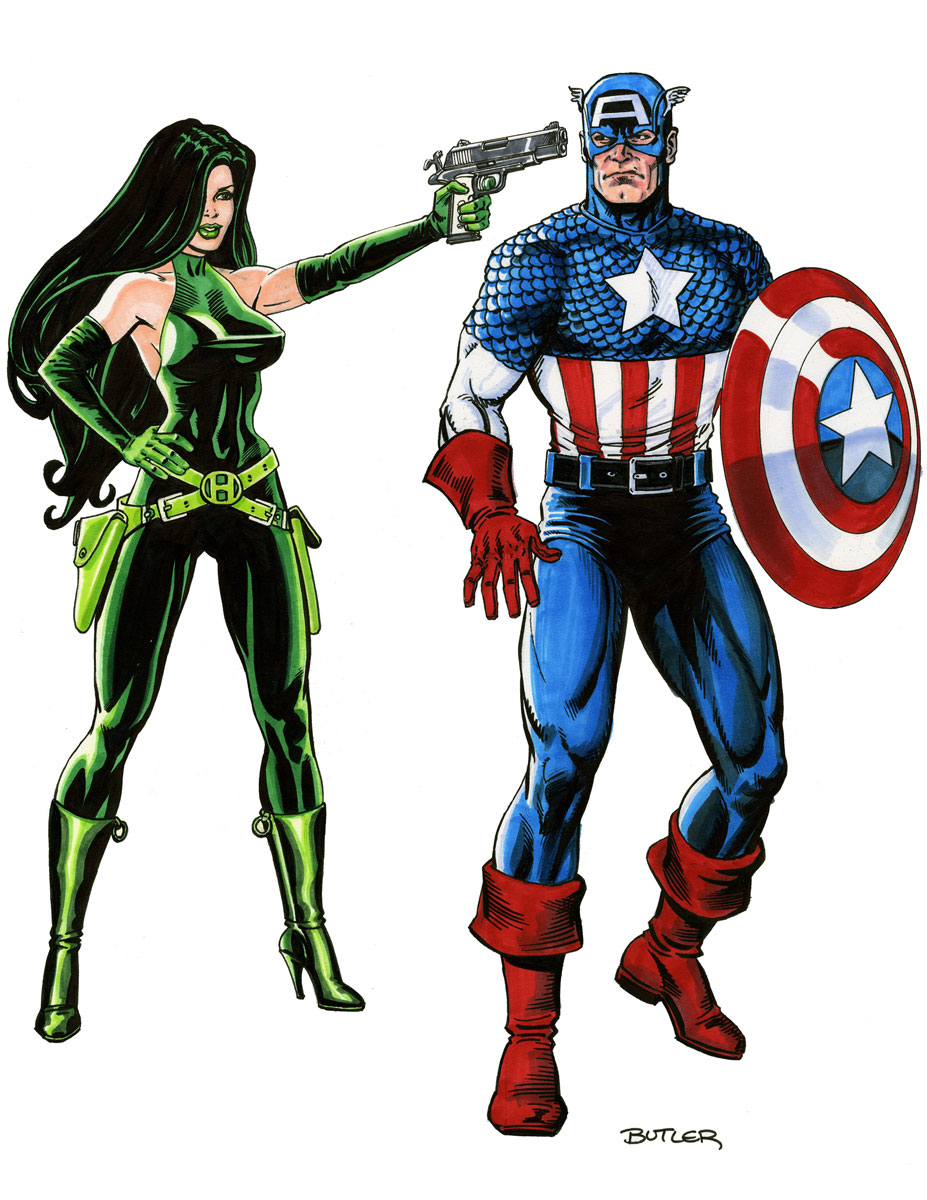
Like Cobra, Hydra was originally founded by ancient reptilians, who later infiltrated human governments for their own purposes, including that of Nazi Germany. Then there’s the fact that many of Hydra’s most infamous members are named after snakes in one way or another, including Viper/Madame Hydra, Gorgon, Anaconda, etc. But there’s an extra layer here: the Serpent Men who founded Hydra turn out to be the very same Serpent Men who serve the “evil snake God” Set in Howard’s Kull and Conan tales. This bastardization of Set has even appeared throughout Marvel Comics as an actual character for superheroes like the Avengers to fight. This is ironic given that the real Egyptian God Set also makes a personal appearance in an episode of G.I. Joe; but as discussed in Episode #10, G.I. Joe was much much closer to the mark! Its version of Set doesn’t appear to be involved with the civilization of Cobra-La, either. 

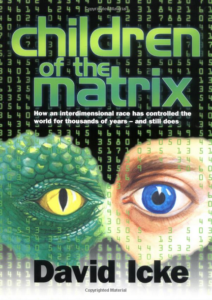
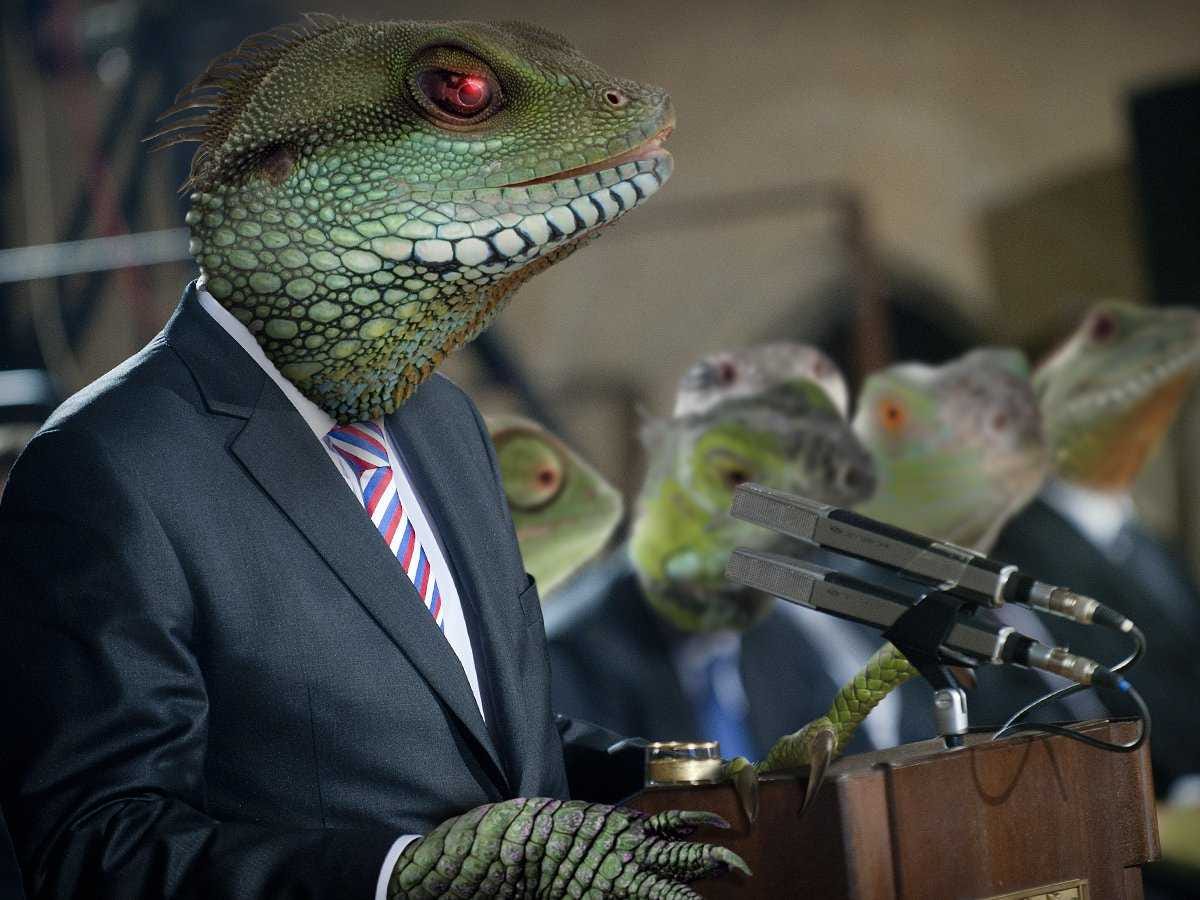
Now I must return to my earlier point about how writing about all of this will probably get me into some trouble with some people. (It’s okay, I don’t really care—this is all for Nehebukau, to whom I shall return in just a moment!) I am sure readers in the know are already chomping at the bit for me to touch on reptilian humanoid conspiracy theories and the bizarre subcultures they have bred in real life. I’m referring of course to the belief some people have that there are actual reptilians living among us here on earth. These people mostly take their cue from the exact same source: David Icke, a pseudoscientist and total huckster. Since the late 1990’s, Icke has popularized this belief that reptilians from a planet orbiting Alpha Draconis invaded our planet way back in ancient times. They were mistakenly worshiped as “Gods” by “wayward” people like the ancient Egyptians, and they continue to infiltrate modern human governments (including the entire Bush family, no less). Furthermore, this ancient alien reptile conspiracy is supposed to kidnap little children and drain them of their spinal fluid so it can be fed to Hillary Clinton, who is herself alleged to be a reptilian warlord in disguise. (Icke even manages to tie his evil reptilians together with Nazi Germany somehow, which explains the trope of Adolf Hitler secretly floating around the Arctic in submarines with reptile people.)

If you ever see this book lurking around your neighborhood, set it on fire. (The book, not your neighborhood.)

There are so many things wrong with David Icke’s bullshit, it’s impossible for me to address each particular grievance in today’s sermon. But my most immediate critiques are that Icke’s take on ancient civilizations is hopelessly racist; his encouragement of secularized Satanic Panic nonsense is absolutely deporable; and worst of all, domestic terrorists have adopted his anti-reptilian routine, trying to assassinate politicians they believe are reptilians. Yet there is something else wrong with all of this that should hopefully be CRYSTAL fucking clear by this point, given everything I have already explained above:

It’s ALL fiction, and NONE of it is original. 

Robert E. Howard made a lot of this crap up back in the 1920s. Then Marvel Comics came along and made up some more in the 1970s. Then a bunch of Saturday morning cartoons boosted the signal for it during the 1980s. And of course there have been countless other science fiction authors and media properties that have played around with the concept in one way or another. David Icke never wrote any of his conspiracy theory bullshit until the late 1990s, by which point the meme had already been well established in popular culture. So it’s pretty fucking clear that he plagiarized his entire routine from a bunch of cartoons and comic books. And the assholes who are willing to kill people over this shit are really doing it for nothing. 

Don’t know about this guy’s politics…But his profile is kickin’!

Here’s the thing: I do not actively believe there are any reptilian humanoids living on this earth, or at least not in the sense of “ancient aliens” (more on this below). I’m not saying it isn’t possible; I just haven’t found any evidence to substantiate such an idea. But even if I did, I would quicker assume such entities are just as native to this world as we are, and that they have just as much right to be here as we do. I don’t believe any of this nonsense about aliens controlling human governments; human beings are the single most dangerous creatures on this planet, we don’t need extraterrestrials to make us any better at wreaking havoc. If there ARE any Snake People around, they’re probably HIDING from us because they’re fucking SCARED TO DEATH of us! 

And to assume that an entire sentient race would be inherently evil simply because it evolved from reptiles is, to call a spade a spade, racist. WE evolved from motherfucking APES, and apes do some pretty fucked-up shit you know. Maybe it’s just because I grew up learning important lessons about these things from Captain Jean-Luc Picard; but I see no reason to assume a civilized reptilian people would be any worse at respecting Ma’at or fighting isfet than civilized simian peoples apparently are. (I can already read the emails from Icke’s zombie followers, skewering me for being some dumb, deluded PR boy for the Visitors who want to eat me and my family!)

The thing is, there are other people who believe in real reptilians so to speak, and who hold more sensible views about them than anything offered by David Icke. The most prevalent example of this would be Hindu, Buddhist, and other Asian religious belief systems that acknowledge the Nagas. These semi-divine creatures can appear as snakes, people, or any variety of human/serpentine hybrid. They are believed to have pre-existed humans, and while they can be good or evil just like us, most of them appear to be dutiful servants of the Devas (the Hindu Gods). They enjoy living in rivers, lakes, oceans and raindrops, and they guard all kinds of ancient knowledge and treasures. Though they are not necessarily Gods, the Nagas are often venerated with offerings, which helps to attract good fortune. Much of this is echoed in Chinese folk beliefs about dragons, as well. Lóng or Chinese dragons are also shapeshifters who can appear human and who bring good luck to those who show them the proper gratitude and respect.

I first learned about the Nagas not from a textbook or a cartoon show, but from my best friend in second grade, a boy named Pawan. Pawan and his family were Indian American immigrants and deeply observant Hindus. I remember seeing various images of the Devas whenever I visited their apartment. I do not recall which sect or tradition Pawan and his family might have followed (and being only eight years old or so, I lacked the head space to even formulate such a question at the time). But I remember asking Pawan’s mother to tell me about the Nagas, and she seemed really happy to share some stories with me. It must have been crazy to have this weird little white boy from next door take such a genuine interest in her family’s culture and heritage! 

But then I would go home and tell my parents about this stuff. For some reason, they were only okay with such beliefs as long as it was Pawan and his family practicing them. I received every indication that it is only acceptable for white people to be Christians and believe in one God, even though neither of my parents has ever been a committed religious believer of any kind. Much later I would meet some of David Icke’s followers (most of whom are white), who insisted to me that both Naga and Lóng veneration is really just another part of the evil reptilian plot to murder children and keep the world hypnotized. When these people claim that Asians are actually venerating evil demons or aliens—or if they suggest that such religious traditions are “beneath” white people for any reason—they are blatantly endorsing Christian white supremacism; full stop.

Even Nehebukau Himself was given the Marvel Comics treatment!

Furthermore, neither the Nagas nor the Lóng are space aliens that ride around in spaceships. There are no tales about them eating people or operating any nefarious shadow governments. They are nature spirits and religious figures, not science fiction monsters. The same is true of other Snake People who are acknowledged in other cultures too, including African Mami Wata spirits and Native American horned serpents. This begs the question: could the ancient Egyptians have believed in something similar? There doesn’t appear to be any specific term in Egyptian for “serpent man” or “snake person” (or at least not that I have found just yet); but perhaps this would have been redundant. The Egyptians appear to have regarded normal, everyday snakes as sentient creatures with magical powers. How else could serpents be held accountable to Ma’at, with the good snakes serving Ra and the evil snakes following Apep? This distinction makes little sense, at least to me, unless we stop to consider that maybe snakes are actually people too!

Which helps me circle back to the Netjeru. It is curious that I never felt drawn to any particular Egyptian snake deities until Setken first proposed that we collaborate on his Hymn to the Soul Serpent project together. Only then did it occur to me that everything I ever needed to justify my enthusiasm for snakes (whether as animals, sentient beings, or magical anthropoids) is already included in the belief system I already follow. And when I laid eyes on Setken’s humanoid portrayals of Nehebukau, I was taken back to those far-off days when I would play with my Snake Men dolls; when I would weep over the Silurians and the Sea Devils; when I secretly rooted for Cobra or Hydra as reptilian freedom fighters; and when I listened to Pawan’s mother explain to me about the Nagas. Could it be that Nehebukau was looking in on me even back then, thinking, “This is the kid I want to co-write a song for Me someday”? Could it have been His double-headed wisdom that helped me see through all of David Icke’s bullshit when it was first presented to me? Hell; I reckon Set and Nehebukau probably both had all of this arranged somehow before I was even born!

Writing one song isn’t all I think I am meant to do, either. I think Nehebukau has probably put all of this stuff into my brain for some kind of purpose, and I mean to put it to use somehow. This very likely means another album will soon be in the works. I always wanted to make movies when I grew up; and failing that, I enjoy adapting some of my old story pitches from childhood into “soundtracks” for films that don’t exist (as with Summer’s End and His Nocturnal Majesty, with which I am very happy). I’ve successfully introduced the crimefighting mummy Het-Sem-Peckinpah to the world, as well as the mysterious Knights In Sutekh’s Service. Now that my Halloween and apocalypse “movies” have been taken care of, so to speak, perhaps it is time to revisit my old sword-and-sorcery “movie” pitch as well. It could be that Queen Hissteria, Big Bad Mamba, and other Saurian Warriors of Basilisk Basilica will soon be making an appearance…

Looks like Nehebukau be shakin’ His booty for Wadjet and Meretseger!

Thoughts On Kemetic Soul Anatomy

One Setian’s take on ancient Egyptian concepts of the self—including our bodies, souls, spirits, hearts, shadows, names, and the hope for unification of these features into a multidimensional whole after death. 

The way I read the Heliopolitan cosmogony at least, human beings are not creations or playthings of the Netjeru (Gods); we are their younger and less powerful relatives, a race of living demigods. As discussed in Episode #19, every sentient being can be considered an avatar or incarnation of Atum-Ra, the Creator. This is evident from the fact that people can use heka (magic or spirituality) to work Ma’at (truth, balance, order, and interconnectedness) against isfet (falsehood, toxicity, injustice, and disintegration), just as the Gods do. But while the Gods work Ma’at together up at their higher, more cosmic levels of existence, it is our responsibility to work Ma’at here on earth as their mortal counterparts. In this way, the war between the Netjeru and Apep or other powers of isfet is reflected in even the most mundane human struggles against evil, no matter how small or mundane they might seem.

Given this, it is important to understand what it actually means to be the Great He-She incarnate. It is not a license to just do whatever we want; for even the Gods aren’t perfect, and any mistakes they make could have cataclysmic consequences for everyone (including themselves). The same is equally true of people, who run around wasting natural resources, splitting atoms, and unleashing terrible pollution and plagues upon this world. We have such remarkable power and potential, but we have so little patience for delay of gratification that we have fucked up the planet and each other well beyond measure. If we do not want our world to fall apart, we must each take responsibility like the Gods do by upholding Ma’at and abjuring isfet. This is not just a call to behave ethically, but a real spiritual battle, a lifelong magical quest. Both here and in Duat  (the Spirit World), the best way to help ourselves is by helping others, and the best way to destroy ourselves is by destroying others.

The ancient Egyptians believed the human self consists of several multidimensional components. The following is neither an exhaustive list nor a definitive explanation of what these components actually are; it is simply how I conceptualize them personally, at least at present. While I like to think I know my stuff when it comes to Set, I really can’t claim to be an “expert” on Kemetic Soul Anatomy. I therefore reserve the right to adjust my opinions on these topics as I acquire more knowledge over time.

I should also clarify that I am not a Kemetic reconstructionist exactly. My walk with Set is definitely influenced by Kemetic sources, but I have also been deeply influenced by Western occultism, which has been known to take some mighty big liberties with Egyptian thought. (Just look at Thelema.) LV-426 Setians like me are probably every bit as eclectic in our approach to the Other Side as most Western occultists are; but we also pride ourselves on being crystal clear about what is actually “Kemetic” and what is not. That being said, I am not prepared to claim that what I have written about the Egyptian concept of the self below is 100% authentically Kemetic; these are just my own thoughts on the matter (such as they may be), so take from them what you will.

The most obvious component of the self is the physical body, which the Egyptians called the khat. Images are magical windows to alternate universes, and there is no greater image for the self than one’s very own material form. In the West we tend to dissociate ourselves from our bodies all the time, but this ontological dualism does not exist so much in Kemetic belief. To me at least, it is more a matter of the body being a “seed” in which our incorporeal aspects are fundamentally rooted. We aren’t souls born into bodies; we are bodies from whence souls sprout! So essential is the khat to the self’s existence that its preservation was deemed absolutely critical to having a pleasant afterlife; hence the tradition of mummification. For those whose corpses are lost or destroyed, new images can be created to serve as magical surrogates (statues, drawings, etc.).

I think even the Netjeru have khatu or physical bodies; it’s just that their blood and bones are in plants, animals, the elements, and other natural phenomena. When we see their actual flesh, we think we are just observing weather patterns, seasonal changes, or astronomical events; but our ecosystem is just as alive with soul and spirit as we are. It is when we grasp this principle that we can actually peek beyond the Veil and into Duat. There are also tales of the Netjeru having lived right here on earth with literal bodies as we understand them (and with flesh made of gold and bones made of silver, to boot). There is a point in Egyptian mythology where the history of the world transitions from being linear to becoming cyclical. When the Gods still walked this earth, time was linear, with events unfolding between the Netjeru from beginning to middle to end; but when the Gods ascended to the heavens, nature switched to following cyclical time. What were once linear events for the Gods are now cyclical events that we experience here on earth over and over again as the seasons, the human reproductive cycle, etc.

A person’s ba or soul hovering above their corpse.

In our Western vernacular, little distinction is ever made between the concepts of “soul” and “spirit.” These terms are used interchangeably in any number of different contexts, but I prefer to differentiate between the two as carefully as I can. The Egyptians distinguished between the ba and the ka, which I use as my benchmarks on this matter. The ba, represented as a human-headed bird, was conceived as the innermost personality of a sentient being, which is how I tend to conceptualize “the soul.” The ka, represented as a doppelganger that follows a person throughout their entire life, is more like a secondary, invisible body that individual can use to interact with things in Duat. This is more or less what I mean when I refer to “the spirit.” So your soul is like the part of you that consistently stays the same, no matter how much you might kheper or transform over time. Your spirit is more like the part of you that can touch or be touched by Gods and other spirits (living or discarnate).

The God Khnum fashioning a person’s body and their ka or spirit on a potter’s wheel.

There is also a story about the God Khnum sculpting the bodies and spirits of unborn children on his potter’s wheel, then placing them within the wombs of expectant mothers. This is such a powerful image; it evokes how the ka is like a twin version of yourself that occupies the exact same points in time and space that you do, but in a slightly different dimension you might say. Heka or magic is the art of learning to use your ka or spirit to create change, as opposed to implementing more conventional physical methods. For example, the logic behind a healing spell (as I see it at least) is that you are basically sending regenerative vibes to the recipient’s spirit from your own, which will hopefully heighten the recipient’s chances for a speedy recovery. Even a thoughtful “Get Well” card can be an incredibly magical act in this regard, for it is literally a matter of trying to “lift” the other person’s spirit.

This applies to when we have spiritual experiences with Gods or ancestors, too. Whenever I have a vision of Set, for example, I think of it as a matter of Set’s spirit interacting with mine, not of me actually seeing a literal Sha-headed man with my physical eyes. We physically observe Set with the eyes of our khatu all the time whenever we observe thunderstorms, donkeys, the Big Dipper, or even people with red hair. But when we bear witness to Set in ways that most people would call “supernatural,” we are actually seeing one or more of the kau or spiritual bodies of the God—and we are seeing these kau with the eyes of our own kau as well.

Each of the holy Netjeru has multiple bau or souls as well. The way I read it, this speaks to how there are really multiple universes, infinite timelines brought forth from the Big Bang, that moment when the First Netjer awakened and determined themself. In some realities, that Netjer determined themself as Atum-Ra; in others, they determined themself as Ptah, Amun, Neith, etc. (There might even be a universe where Set is the Creator!)  There is probably some other dimension where I’m gay and married to one of my best male friends. Or maybe I’m a woman who lives alone in the woods somewhere with a passel of cats. Maybe I’m a hip crime fighter in one world, and a devious supervillain in another. Whomever and whatever I might be in whichever reality we care to consider, I think of these alternate personalities as my various bau or souls; they may be different versions of me, but they are all still me. (Just like Doctor Who is still the Doctor, whether they are being played by Jon Pertwee or Jodie Whittaker.)

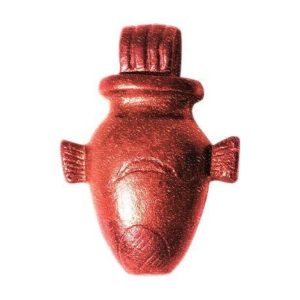
An Egyptian heart amulet.

Another core component of the self in Kemetic thought is the ib or “heart,” by which the Egyptians meant the literal bodily organ (as opposed to a purely figurative concept of “heart,” like in Captain Planet or something). Advanced as they were, the ancient Egyptians didn’t realize the brain is the body part that enables us to think; they identified the heart as serving this function instead. It was considered to be the seat of a person’s consciousness, as well as the part of their body where their khat and their ka are connected.

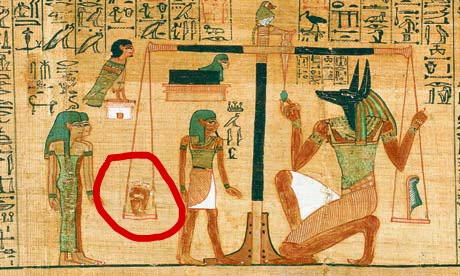
The Weighing of the Heart (i.e., the person’s heart is circled).

When a person’s ib or heart stopped, the khat, ba, and ka were all separated. The spirit would remain with the corpse while the soul was guided by Anubis or another psychopomp to the Hall of Judgment in Duat. There the soul underwent the Weighing of the Heart, which meant the person was judged for all of their deeds and misdeeds in life—a thing for which only sentient beings with hearts (or in our culture, brains) can be held responsible for. If the person’s heart was too heavy with isfet, they were deemed unfit for the afterlife and fed to the daemon Ammut or cast into a lake of fire. Back on earth, the spirit withered away and died; or it could become restless and terrorize the living as an evil ghost. But if a person’s heart was more or less in good standing with Ma’at, their ba and their ka were reunited by the Gods, transforming the deceased into an Akh or Imperishable One.

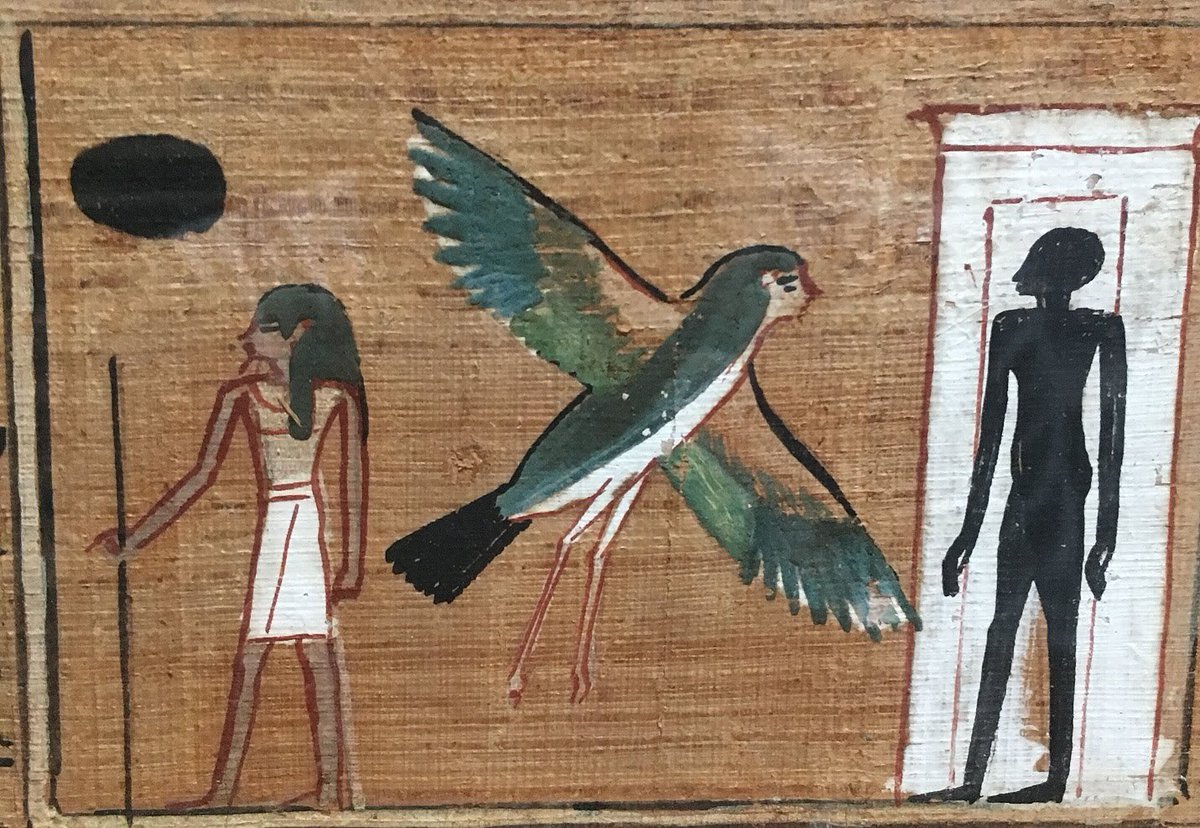
A person (left), their ba or soul (middle), and their shut or shadow (right).

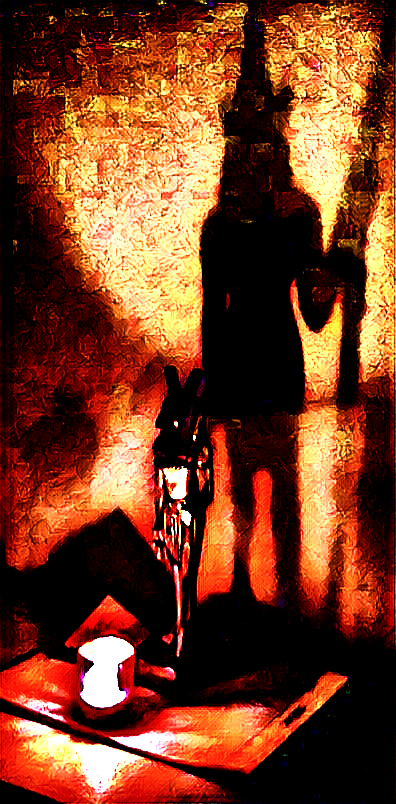
An Akh is also united with what the Egyptians called the shut or khaibit (the “shadow”). The “shadow” in this context is literal, referring to those black shapes our bodies cast on walls or the ground whenever we stand in the light. Our shadows are not just apparitions, but living parts of ourselves; we create them without even thinking about it, and a part of us exists in them and is reflected in them. In the exact same way, a person can exist in other things they intentionally create as well, like songs, paintings, photographs, works of literature, etc. This is exactly why the Egyptians built so many monuments and wrote down so much of their knowledge and history. To preserve their culture in so meticulous a manner has not only been a benefit for modern archaeologists in piecing together the Kemetic worldview; it has also helped the ancient Egyptians live on and continue influencing people today. This applies to when we look at photos or read letters from our departed loved ones, as well; art and literature do in fact help us live on after death, and I think it is our shutu or shadows that probably benefit from such creative work specifically.

Names, or renu in ancient Egyptian, are also significant dimensions of the self. This includes not only our birth names, but any titles, nicknames, and other names we might be given or choose for ourselves as well. Each of the Gods has various names by which they are known, and the same is true of us. Names are living extensions of ourselves that carry a real, lasting power of their own; for though they are long dead, we still speak the names of  Hatshepsut, Joan of Arc, Princess Diana, and other blessed ancestors in regular conversation today. Doing so helps to keep this aspect of the self alive after death. There is also a story in which the Goddess Isis tricks Atum-Ra into giving her their true secret name, which only Ra had known up to that point. By learning the true unknown name of Ra, Isis becomes the most powerful Goddess, magician, and woman of all time.

An artefact bearing the ren or name of Pharaoh Seti I (within the cartouche).

Conversely, the Egyptians defaced or erased the names of people and things they wanted to write out of history and existence. This is what happened to the Heretic King, Akhenaten (born Amenhotep IV), who prioritized the new religion of Atenism over his duty to be a good and responsible leader. His name was removed from various monuments after his death in an attempt to forget that this particular ruler even existed. This is also why modern Kemetics generally write the name of Apep in strikeout text. Simply writing the name is not good enough, because it can actually attract the monster’s attention to ourselves. Writing its name in strikeout text serves as a way for us to communicate about the rotten bastard without actually evoking it into our lives.

It is not exactly clear what happens when a deceased person passes the Weighing of the Heart and is transformed into an Akh. But I imagine that person would be united with themself across both this world (as a corpse and a spirit) and the Other Side (as a soul), as well as with their various names and any objects in which their shadows might reside (photos, diaries, etc.). I also imagine they would be united with all the possible variations of their soul that might exist across the vast multiplicity of universes. Akhu are said to reside with the Netjeru in Duat, but there are actually many different heavens included there. I think Akhu are free to visit either of these various realms, but they are also free to visit the living and travel to alternate realities as well. This mobility of the Akhu between universes is remarkable when compared to other religious teachings about the soul after death. I can’t even begin to grasp what such an existence might be like; but I think it probably isn’t that far removed from how the people of the “Q Continuum” exist in Star Trek: The Next Generation (1987–1994).

My mother-in-law, Pamela, present via her shadow (in the photograph) and some of her remains (in the urn).

The Egyptians also referred to additional facets of the self, but our knowledge of what these things actually are is unclear. There is something called sekhem, which translates to mean “power” or “form.” This could be referring to the latent magical power that exists within each of us as unique incarnations of Ra; but I am really just guessing. It is tempting to compare sekhem with what Chinese folk medicine calls qi or “chi”: a vital life force or energy flow that can be used to guide exercises and reinforce medical treatments. It might also be similar to Japanese Reiki, a form of alternative medicine that involves energy healing.

There is also something called a sahu, which seems to be an additional spiritual body that is generated for the deceased during their funerary rites. It is not evident how this feature should be distinguished from the ka or spirit exactly, except perhaps that the ka exists from birth while the sahu doesn’t. I have heard it said that the state of sahu is probably closest to how the Netjeru experience their own existence; but the concept remains unclassifiable nevertheless. Rather than try to pontificate on things for which there is currently so little available evidence, I simply accept that there are no clear answers to this particular question at present.

For now at least, it is enough for me to know I am a body with a soul, a spirit, a heart, a shadow, and a name. There are many different versions of me that exist in all kinds of different universes, too. When I die, I hope to be found worthy of the afterlife during the Weighing of my Heart. I hope for all the pieces of my self to be re-united so I can become an Akh and get up to some shenanigans with other Akhu out in Set’s Desert, beyond the Great Bear. And I hope that when I get there, I’ll meet Ronnie James Dio and we can go smite some monsters of isfet together!


Setken’s The Praying Mantis God of Ancient Egypt (Mini-Documentary)

My good friend, the artist Setken, has directed a mini-documentary about the Egyptian praying mantis god, Abyt. Setken asked me to compose some music for the film, and I was very happy to oblige. I’m also happy to announce that Setken’s film has been selected by the Anatolian Short Film Festival for September 2020. Follow the link below to watch the documentary and vote for the film!

And if you enjoy the music in the film, you can also stream or download it for free by clicking the image below:

We sincerely hope that everyone enjoys this work – especially Abyt Himself! Dua Abyt!