
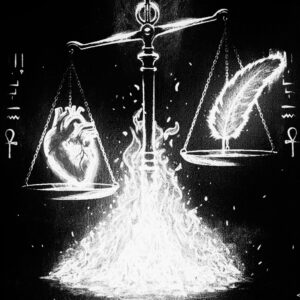
Every Day Is Judgment Day


I firmly believe that in the afterlife, we will be judged for what we have done during our lives.

Despite the Western Orientalist use of “reincarnation” as a narrative device in several different “Mummy” movies, reincarnation does not figure into the Egyptian afterlife scenario. Souls instead have a linear afterlife wherein they are either transfigured into akhu (blessed ancestor spirits, identified with the stars in the nighttime sky) or are fed to the daemon Ammut, whereupon they cease to exist for all time. In other words, we will either live forever beyond death or we will “die the second death.”

In this way, Kemetic eschatology is much closer in principle to Christian afterlife beliefs than it is to, say, Hindu or Buddhist ideas. But there is still an extremely important difference. In evangelical Christianity especially, entrance into heaven is “impossible” without personal submission to Christ. But in Kemetic theology, the soul is measured against its earthly deeds and misdeeds during the Weighing of the Heart. We are either “saved” or “damned” based on OUR OWN ACTIONS, here upon this earth.

Evangelical eschatology is problematic because it prioritizes submission to a specific deity over ethical decision making. You could be a horrible psychopathic murderer your entire life, and all you have to do is “accept Christ” and alashazam, you’re suddenly “saved.” On the other hand, you could be a perfectly good person your entire life, but you will “go to hell” for “rejecting Christ” no matter how good a person you are. This theology makes the evangelical God seem like a total narcissist who just doesn’t care whether His followers are actually good people or not.

In Egyptian polytheism however, this problem does not exist. It literally doesn’t matter whether you worship Set, Osiris, Sekhmet, or even nobody at all. As long as you uphold Ma’at by being a good neighbor, modeling compassion, helping those who need help, taking responsiblity for your own actions, etc., then you have nothing to worry about. You don’t have to be a perfect person; you just have to have enough Ma’at in your heart that it outweighs any isfet or toxicity.

For someone like Jeffrey Epstein, who has committed countless crimes and abuses against innocent people, it will not matter how much they cry or beg for forgiveness. It will not matter if they beg Osiris, Set, or even Jesus Christ Himself to “have mercy” on them. There will be no mercy for them at all, for at the end of the day, neither Osiris nor Set nor Christ is responsible for what they have done. THEY are responsible for bringing their own damnation upon themselves.

The point here is that our eschatological destinies have nothing to do with which God(s) we worship (if any); nor are they dependent upon the whims of any God(s). What happens to us after we die is literally DETERMINED BY OUR VERY OWN ACTIONS IN THE HERE AND NOW, while we live and breathe.

Every single ethical decision we make will have some bearing on our afterlives, no matter how small or insignificant that decision might seem. Even the smallest acts of kindness can make all the difference; so too can even the smallest acts of malice.

The next time you’re standing in line for coffee and you find yourself losing patience with your barista, remember that even the way you choose to interact with this stranger is being spiritually tracked, and even this can have repercussions that reach far beyond your current scope of awareness. Maybe the barista is having a bad day, or maybe they are suicidal. The way you treat them can make their day either better or worse. It can also make the day better or worse for everyone else who might be involved in that person’s life. This one little interaction can either improve or ruin the day for a whole lot of people you might never even meet. If you are someone who values Ma’at, you will want to treat this person with kindness, even if they make a mistake or do something wrong. But if you are a toxic person whose soul is already destined for Ammut’s litterbox, you will more likely treat this person like an insect, or perhaps even yell at them or try to humiliate them in front of everyone,

There is also an apocalyptic implication to this, as well as the eschatological implication. If enough people uphold Ma’at and treat each other well, things get better and better for more people. But if too many people spread isfet and treat each other like total sacks of shit, things get worse and worse for more people instead. This shows us that even the smallest acts of kindness or malice can contribute to larger social trends. If we want to save the world, we have to start by improving ourselves and the ways we treat others. No amount of prayer or wishful thinking can replace this extremely important work.

“Well There’s Your Problem Right There, Vern”: Deflecting Accountability for Christian Hypocrisy

I think most of us can agree that political violence is evil, that Charlie Kirk didn’t deserve to be murdered, and that his killer is a real fucked-up person who should be brought to justice.

What we CAN’T seem to agree on is just how hateful and destructive Kirk’s rhetoric actually was during his life.

I’m sorry the man was killed, but I’m not shedding any tears for him, and his forward to Lucas Miles’ recently published The Pagan Threat is a textbook example as to why.

I won’t dissect the entire thing, and there are numerous problems with Lucas’ entire book that will require a much more in-depth analysis. The trouble is that there are so many falsehoods crammed into each and every sentence, it might require an entire encyclopedia collection just to address them all. For now, I will just address this one cute little hum-dinger from Kirk right here:

“In the Pagan world, the individual human life was of no importance. Therefore abortion, infanticide, human sacrifice, and more were just a part of life. Under Paganism, there is no notion that humans had equal innate worth, so one tribe enslaved another, or rulers enslaved their subjects, all with impunity.”

The idea that only Christianity introduced the concept of human dignity, or that human dignity was utterly unknown in ancient polytheism, is provably false.

Ancient Egypt alone possessed a complex legal system, with extensive writings on Ma’at. People valued hospitality and kindness, and they mourned both people and animals who died, very much like we do today.

The entire concept of Ma’at involves living a good, balanced life and being a responsible member of society who treats others with dignity. The way we treat others has a direct effect on one’s afterlife as well: for people who uphold Ma’at will have a good afterlife, while those who violate Ma’at will not.

And this is just from ancient Egypt; other polytheist civilizations had their own complex legal and ethical systems as well. Virtually all of them had space for things like (1) grieving for the dead, (2) seeking lawful action against crime, and (3) believing they might somehow be judged in the afterlife for their actions here on Earth. Each of these ideas is built upon the assumption of human dignity; you don’t have things like funerals or laws against theft of personal property when you think the individual human life is of “no importance.”

I find it extremely problematic whenever Christians raise alarms about “human sacrifice.” For one thing, “human sacrifice” often served as capital punishment in many societies, with the sacrifices being criminals or prisoners of war. While there was often a ritualized element to appease certain deities or restore cosmic order, the functionality was really no different from sending someone to the gas chamber today (and having a minister “pray over” them before they go).

In other cases, the “human sacrifices” were not killed but left to die, either because they were fatally ill or there weren’t enough resources to be spared. This might sound callous, but we can be sure that it wasn’t easy for the families involved. Imagine having to leave a baby behind because you can’t feed it, and there are no hospitals or orphanages. Not a very easy decision to make, and I daresay that even Christians would find themselves making such hard decisions under the right circumstances. Thankfully, such practices tend to die out as civilizations (including polytheist ones) develop more and more infrastructure over time.

In still other cases, the “human sacrifices” were not killed to glorify any deities at all, but to accompany a king or a loved one in the afterlife (these are called “retainer sacrifices”). There is evidence to suggest that these were voluntary suicides, rather than ritualized murders. Either way, the practice was eventually phased out, EVEN DURING POLYTHEIST TIMES. The Egyptians in particular developed ushabti figures as a replacement, which could be used to accompany people in Duat *without* anyone being killed. And again, none of these “sacrifices” had anything to do with appeasing any deities; they had more to do with afterlife beliefs than with any theological claims about the Gods.

It is also a little bizarre to see Christians froth at the mouth against “human sacrifice,” when all of their religious symbolism and literature emphasizes the torturing and painful death of a man who was executed for an alleged crime, and who is himself presented to be their own version of a “human sacrifice.” Something about (1) the glorification of this horrific imagery combined with (2) the appetite many American Christians seem to have for watching other people suffer or be punished has always made my skin crawl. So much for Matthew 7:3-5, I guess.

Plenty of people in history have been slaughtered either for (1) not believing in Christ or for (2) not believing in Christ “correctly,” according to whichever authorities happened to be in power at the time. From the Crusades to the Inquisition to the witch hysterias, history is full of murders and violence being committed in the name of Christ. These heinous acts qualify as “human sacrifices” as well, and NOWADAYS, most religious violence and terror is being perpetuated by either Christians, Muslims or Jews. You’re more likely to be murdered by someone just for talking shit about Christ or Allah or Israel or Palestine than you are to find yourself in any real-life re-enactments of “The Wicker Man” or “Rosemary’s Baby.”

As for abortion; the concept of “fetal personhood” literally didn’t exist ANYWHERE – not even IN CHRISTIANITY – until the 1960s CE, *after* Roe v. Wade. This belief is NOT EVEN A CENTURY OLD, and Christians can’t even apply it to their very own predecessors. It’s about as “biblical” and “historical” as the Rapture.

Now for the bit about slavery. Dear GODS, Charlie; SLAVERY? Where do I even start?

Slavery has existed in virtually EVERY human society at some point – INCLUDING those shaped by Christianity, long after its arrival. Our own American history is full of horrific examples. American slaveholders often used selectively quoted scripture to argue for the divine sanction of slavery. They even popularized the so-called “Curse of Ham” as justification for this unfounded belief. Additionally, here are some specific examples of American Christian involvement in promoting slavery:

  • The Jesuits sold 272 enslaved people in 1838 to save Georgetown University from financial ruin; the Society of Jesus had previously relied on slave labor for decades.
  • The Church of England (Anglican) made direct investments in the transatlantic slave trade, operating profitable sugar plantations in Barbados. Profits from these plantations funded the church, and the slaves there faced brutal conditions.
  • The Southern Baptist Convention specifically broke away from their northern counterparts in 1845 to defend the “right” of their missionaries to own slaves; the entire denomination is founded on a pro-slavery ideology.
  • The Presbyterian Church had ministers who were slaveholders, including its earliest American leader, Reverend Francis Makemie, and it invested profits from selling slaves to generate income.

Frankly, I don’t want to hear ANOTHER FUCKING WORD about Christianity supposedly being morally “superior” to other religions in terms of its historical stance on slavery, EVER AGAIN. This is categorically, and quite despicably, FALSE.

To equate Paganism with wanton violence, and Christianity alone with compassion, is to erase the genuine spiritual, ethical, and legal advancements made by various non-Christian cultures throughout history. It also ignores the history of violence and oppression that has historically occurred under Christian rule, including slavery, persecution, and marginalization of outsiders.

This is NOT to say that “nothing good” ever comes from Christianity, or that everything ancient polytheists ever did was “okay.” Reality is seldom ever so cut-and-dry, no matter how much we might want it to be. No one is bad or evil just for being Christian, any more than they are just for being Pagan or anything else. I would like to live in a world where we don’t even need to have these discussions anymore, and everyone just understands that there are good people and crazy people in every possible religious category you might care to mention, and that no one is “evil” just because they fall into one category or another.

The point here is that Kirk and his fellows are blaming Pagans (in addition to transgender people, atheists, leftists, feminists, Democrats, etc.) for “stealing” people away from Christianity, when the thing that’s really driving most people away from their religion is CHRISTIAN HYPOCRISY. This is a problem that can only be addressed by Christians, and for which Christians can only hold themselves responsible.

But of course, such distortions of reality are the entire point, aren’t they? In writing this and other such extreme statements, people like Kirk show us they have zero interest in any facts or the truth. They don’t care about fairness, good faith, or actual dialogue. This is not the kind of verbiage people use when they truly believe in “peaceful coexistence.” If you truly “love your neighbor,” you don’t talk about them like they’re systematically organized and funded to “infiltrate” society, “brainwash” your kids, “overthrow the government,” etc.

No, this kind of language is specifically designed by and for people who want to see whatever demographic(s) they’re talking about removed from public life entirely. Dehumanize the target as much as possible so as to discourage any further helpful dialogue between our communities whatsoever. Make the reader feel “persecuted,” when really THEY are the ones most well-positioned to do the persecuting. Increase the likelihood of persecution—and religious violence—against the target by instilling as much misinformation and fear in the audience as possible. People are always more likely to obey and not ask questions when they’re scared.

In contrast, you won’t find nearly so many Pagan authors who call for Christians to be completely removed from society. Most of us just want to co-exist and be left alone. Some of us might say things that are extremely critical about Christianity, but this is no different from any other religion critiquing its peers. Besides, if Charlie Kirk can accuse people like me of being an “evil conspiracy” that threatens the very fabric of society, it seems only justified that I should be able to have my say too. And I say that all the right-wing politicians and media people who are actively capitalizing on Kirk’s death right now—like, say, Lucas Miles, for instance—are the REAL evil conspiracy, and one that we should ALL be worried about (Christians, Pagans, atheists alike).

How ironic it is that Kirk should claim Paganism denies the significance of individual human life, when the significance of his OWN life appears to have been denied to him by a fellow Christian, and when the entire narrative of his life has now been hijacked by OTHER fellow Christians, who are now using his “martyrdom” to fill their pockets, demonize innocent Americans, and dismantle our entire republic.

Setianism Predates “The Left-Hand Path”

On the conflation of all Setian spirituality with what Western occultists call “the left-hand path,” and why this is problematic.

Setianism is often linked with something Western occultists call “the left-hand path,” and this is thanks largely to the Temple of Set. The term originates from Hindu and Buddhist Tantra, in which the Vama Marga or “left-handed way” to enlightenment involves practices that most orthodox believers find “repugnant” (e.g., erotic mysticism). Helena Blavatsky, the founder of Theosophy, appropriated the name for virtually any kind of Western occultism she didn’t like. Ever since then, it has been evocative of “black magic” and “devil worship.”

Most other occult writers followed Blavatsky’s example in this respect, including Aleister Crowley, the founder of Thelema (who was himself regarded as a “brother of the left-hand path” by many of his contemporaries due to his controversial views and practices). The first Western writer to actually adopt the left-hand path (or “LHP” for short) as a positive self-label was Kenneth Grant, a protege of Crowley’s who developed his own “Typhonian” school of Thelema. Grant’s philosophy hinges on Set rather than Horus, and it has much to do with contacting qliphothic forces from alternate universes via the use of sexual magic. Grant was also a UFOlogist and a pioneer in Lovecraftian occultism, or the use of H.P. Lovecraft’s “Cthulhu Mythos” in actual esoteric practice. His use of the term “left-hand path” is probably the closest I have seen among Western sources to the original Tantric idea of the Vama Marga (perhaps because Grant studied under an actual Indian guru, Ramana Maharshi).

The next Western writer to adopt the left-hand path was Anton LaVey, founder of the Church of Satan. LaVey conceptualized the LHP as being like a carnival huckster’s take on spirituality: it’s all “make-believe,” we are just meat machines that cease to exist upon death, and there are no actual Gods or spirits to hear any of our prayers. But at the same time, there is nothing wrong with all of this “make-believe” so long as it enriches and empowers the “believer.” In LaVey’s worldview, conventional religions (“the right-hand path”) use made-up dogmas to control the masses, while the left-hand path uses such fantasy to liberate the individual instead. Success is measured not by any spiritual advancement, but by purely material milestones. For example, a successful actor or musician would be considered far more adept at “the black arts” than someone who can recite each of the Enochian Keys by heart, but who flips burgers at McDonald’s for a living.

Michael Aquino, the founder of the Temple of Set, developed a radically different construct from that of LaVey. His LHP is a more metaphysical process of “immortalizing the psyche,” with the potential achievement of a sentient afterlife being the ultimate goal. For Aquino and his followers, the problem with conventional religion is that it stifles the powers of the mind, leading to a total dissolution of consciousness after death. If people just ditched such creeds and started exercising their minds intellectually and metaphysically, they’d have a much better chance of becoming discarnate alien intelligences when they die—or so the theory goes. If there is one element of LaVeyan belief that Aquino maintained, it is the claim that authentic LHPers do not actually “worship” any of the forces they evoke in their magic (including Set Himself). Aquino’s take centers on worshiping one’s own highest potential to the exclusion of anyone or anything else that might (or might not) exist.

Many additional Western LHP perspectives would bloom over the following decades, including those of Zeena and Nikolas Schreck, Michael W. Ford, and Thomas Karlsson. Notable themes that many sects seem to share include autotheism (the worship of oneself); an indiscriminate affinity for so-called “dark” forces (like conflating Set with Apep); an intersection of Gnosticism, hedonism, nihilism, and/or anti-cosmicism; and a rather unfortunate disposition toward right-wing sociopolitical ideologies (from American Libertarianism to outright National Socialism). The very worst example of this would be the Order of the Nine Angles, whose supporters are known to be terrorists and white supremacists. Even among LHPers who do not entertain such views seriously, there is an ugly tendency to glorify fascist imagery (often because it is “shocking” or “cool”), going all the way back to Anton LaVey’s inclusion of “Might is Right” (a racist diatribe by Ragnar Redbeard) in 1969’s The Satanic Bible.

Though many Setians identify as “left-hand path,” not all of us do. Part of the confusion on this stems from the fact that many Setian writers are either Temple of Set members or adherents to some variation of its philosophy. This has always been something of a “pet peeve” for me personally, because I think the word Setian really belongs to Set. It is understood that not all Setians will believe or practice the same way, as Set loves variety and freedom. But if any particular theme should be the one common element that we all share, that theme is and must be SET HIMSELF—not the Book of the Law, The Nightside of Eden, the Satanic Bible, or the Book of Coming Forth By Night. This does not preclude Setians from sharing additional interests; but Set was there long before Vama Marga, Typhonian Thelema, LaVeyan Satanism, the Temple of Set, or any other LHP variant, and a person doesn’t need EITHER of those things to know Set and walk with Him. To claim otherwise is to ignore the fact that Setianism began over five millennia ago as a North African animist and polytheist tradition in which our Namesake was clearly revered and venerated (as He deserves to be).

Which returns us to the matter of right-wing ideological influences in Western LHP circles. This rather disgusting tendency is made all the more revolting whenever it happens to manifest among so-called “Setians.” For one thing, Set is an Egyptian God, and the Egyptians were a North African people. They were PEOPLE OF COLOR, you idiots. We owe everything to them, too; there is not a single white person who would be walking with any of the Netjeru today if it hadn’t been for these blessed ancestors. So if you pay lip service to an Egyptian God while supporting white supremacy, you are a fucking idiot and you deserve to have your ass handed to you. Furthermore, Set is the absolute WORST mascot for any kind of fascist cause, given that His hatred for authoritarianism is purer than venom. We call Him “He Who Commands the Riot” for a reason, you know. Set is a God who smites other Gods whenever they need smiting, and He has even less patience with human megalomaniacs. If you take His name but support tyranny, you are no Setian; you are just a servant of Apep in disguise—and we Setians know just how to deal with Apep!

Not today, Apoop!

I’m willing to bet that most of Set’s people today are probably Kemetics or some other flavor of devotional polytheist—or at least, that is how it looks across the internet (which is probably a better reflection of things today than it was in the 1990s). We devotionalists have just as much right to Set’s name as any Thelemite, Satanist, or Chaos Magician (if not more), and I for one insist on taking ownership of the term Setian for this reason. LHPers are welcome to walk with Set too in my book, but they are NOT welcome to look down their noses at those of us who actually revere and venerate Him as the ancients did. And those who favor any of that “might is right” fuckery should just pack their shit and leave. It seems egregiously stupid that I should even have to say this to anyone, but y’all are just gonna have to live with the fact that there are Setians who worship and pray to Set, who are animists and polytheists, and who believe in trying to make things better for everyone, not just ourselves.

On the So-Called “Demonization” of Evangelicals

My reactions to an especially hypocritical plea for “acceptance” on behalf of a community that utterly refuses to accept diversity.

From ReligionNews.com:

“White evangelicals must bear their share of responsibility for both racism and Christian nationalism, so I have no argument with these careful, well-researched critiques.”

“I do take issue with these legitimate criticisms becoming a license for others to marginalize, even demonize, white evangelical Christians. White evangelicals are routinely and unfairly stereotyped, lumped together in the basket of deplorables with the neo-Nazi marchers in Charlottesville and other supremacists. Some may think it’s not possible to be bigoted against a group that is so closely associated with the historical trajectory of power in America. I disagree.”

My response:

No one should ever be marginalized or demonized just for being who they are, but there is a huge difference between this and calling people out for their behavior when it is demonstrably unethical (to say the very least). It is understood that not every evangelical Christian is an asshole who wants to legislate other people’s lives and deprive them of their inalienable rights; but this is the exception, not the rule. And since the entire evangelical community decided to support Trump in his rise to power, they have little room to complain about being “lumped together” with the rest of his supporters. Whether you support Trump because you’re a Christian or a Nazi, it makes no difference, the end result is exactly the same, and it has proven extremely harmful to everyone who ISN’T an evangelical or a white supremacist.

Furthermore, hearing evangelicals whine and cry about being “unfairly stereotyped” is just fucking hilarious. These are the exact same people who distribute literature claiming that Pagans and witches want to sacrifice babies, or that Planned Parenthood is run by genocidal murderers, or that the entire LGBTQ community is possessed by Satan. Do you really want to go down this path? Because if we’re keeping score on “unfair stereotypes” here, evangelicals continue to perpetuate FAR more than their fair share.

“White evangelicals are certainly complicit in our country’s history of systemic racism and overt nationalism, but I offer three reasons why transparent prejudice against them offers no way forward. First, this prejudice reduces a large, complex group to their political activities; the philosophical term is “essentialism.” In a mass culture dominated by Amazon, Netflix, Google, Harvard and MIT, evangelical ideas barely register, other than as stock villains and straw men. But in politics they loom larger, so the mainstream culture defines them entirely by their political activities and seek to “cancel” them.”

Check your privilege, dude. There are areas of this country where evangelicals hold all the cards when it comes to the law. I know because I lived in such an area for 10 years, and it was absolute hell. If evangelical Christians do not want to be “reduced” to their political activities, they should become less political and stop trying to impose their morality on all the rest of us. If you don’t believe in abortions, don’t get one; but don’t make it impossible for anyone else to get one. You people have no business trying to legislate other people’s lives, and so long as you refuse to stop attacking our freedoms, you will continue to face severe criticism and pushback. (You lie in the bed you make!)

It is also ironic that this writer complains of evangelicals being “reduced” to just their politics when this is exactly what EVANGELICALS do to all the rest of us. For example, evangelicals generally do not characterize LGBTQ people as human beings with valid concerns and perspectives; they dismiss them as some kind of “unholy conspiracy” that’s out to destroy civilization as we know it. And when those of us who love our LGBTQ family and friends try to correct religious right-wingers on this matter, we are usually dismissed for “becoming political.” I’m sorry, but fighting for my transgender nephew’s right to self-identify as he pleases, or for my best friend’s right to marry the woman she loves, or for my wife’s right to determine what she does with her own body is not a matter of “politics.” It is a simple matter of human decency, being a good person, and protecting the people I love. When evangelicals use such dehumanizing language against us, they signal to us that they do not even acknowledge us as people.

Additionally, evangelical Christians have no concept whatsoever of what it feels like to be “canceled.” Having people disagree with you and oppose your political platforms does not count as “canceling.” The only way you can be “canceled” is if you are never permitted to speak or share your opinion with anyone at all – and that is simply not the case for evangelicals, at least not here in America. When you have entire publishing companies, AM radio stations, and 24-hour TV networks to support your cause, you are not hurting for representation whatsoever. So stop trying to play the victim here, you aren’t fooling anyone dude.

“Second, many evangelicals, far from seeking out division, are the salt of the earth. They donate time and energy to their churches, but also to strangers, including strangers in other countries, where they are well known for fighting sex trafficking and providing clean water. They are conscientious parents, church members and Little League coaches. They are honest businesspeople. If racism is systemic, well, they are not the elites who own the systems. They don’t see themselves as racist because, to them, racism is a matter of personal attitude. They don’t see themselves as nationalists either, or if they do, their definition is more akin to what the rest of us call patriotism.”

Oh yes, evangelical missionaries are SO fucking noble. That is precisely why they continue to endanger indigenous cultures despite the COVID-19 pandemic (and all for the sake of winning more converts, i.e. political allies). And while the missionaries do fight sex-trafficking and provide clean water and other good works like that, they also do everything they can to DECULTURALIZE the people they help, insisting that their ancestral religious traditions are “satanic” and they must accept “the White Man’s God” in order to become truly “civilized.” Next thing you know, the new converts start hanging or burning accused “witches” in their communities (including little children!) because “God told them to,” and white evangelicals continue to shirk any responsibility for this whatsoever. Do you really expect anyone to believe you aren’t racist when you engage in such blatant modern colonialism?

“Lastly, marginalizing and demonizing this group is politically untenable. White evangelical Christians make up about 25% of the U.S. population, around 85 million people. When this election is over, they will still be here. And they will still be deeply intertwined in American life. These folks are our fellow-citizens, part of our country’s lifeblood. We need to be building bridges toward evangelicals of goodwill, not burning them.”

Can you point us to a substantial example of when evangelicals ever tried building bridges of goodwill toward Pagans, LGBTQ people, or feminists en masse? You have completely misplaced the responsibility for “making amends,” here. That burden rests squarely on the shoulders of evangelicals, not on anyone else’s. We do not owe evangelicals any apologies or reparations; THEY owe US the apologies and reparations, instead. But I am not going to hold my breath waiting for THAT to ever happen, given your community’s record for “doing the right thing.”

“But America cannot be rebuilt without white evangelical Christians. Excoriating them for the sake of Twitter likes only moves us in the wrong direction. Look for common ground. Acknowledge others’ attempts to eradicate personal prejudice even as you seek to educate yourself and others about systemic discrimination. Look for the fine line between the nationalism you fear and the patriotism you value. Take note of the positive contributions made by others, even when they believe, and vote, differently than you.”

This fellow seems absolutely determined to believe that no one could ever have a good reason for ripping on evangelical Christians. When an entire religious community seeks to deprive you of your autonomy and your freedom, we have little choice but to regard that community as an enemy. If evangelical Christians would like this situation to change, the responsibility is on THEM to BE BETTER. They can have their beliefs and live their lives the way they want to without interfering with any of the rest of us; but they consistently choose not to, and THAT is why we are angry. Gaslighting us with your empty-hearted appeals for “understanding” and “acceptance” is nothing more than a diversion. This is not a “both sides” issue, this is an issue of one side CLEARLY BEING WRONG and the other being consistently victimized.

Now REPENT, motherfuckers!

Setian Meditations

Three brief sermons in which I discuss Set’s affinity for the color red, why Setianism is substantially different from many other religions, and how the Red Lord saves us all every night.

Red isn’t just a color; it’s a part of Set Himself. Or to put it another way, the Red Lord doesn’t just “like” the color red; He is the very essence of redness.

Within the spectrum of visible light, red exists between orange (where red meets yellow) and violet (where red meets blue). Technically, its wavelength is approximately 620–740 nanometers on the electromagnetic spectrum. It has historically been associated with aggression, blood, heat, lust, and passion. It’s also linked to the planet Mars and the sphere of Geburah on the Qabalic Tree of Life. Mars, of course, is named after the Roman God of war, who is often conflated with the Greek God Ares. (Hence why Mars is so often associated with hostile alien space invaders, as in H. G. Wells’ The War of the Worlds.) Geburah is where the Gods pass judgment and destroy things, causing us all to be transformed (whether we want to be or not). It’s also the sphere where the Gods take whatever steps they need to beat the crap out of evil.

Red is further linked to iron, which is likely because (1) there is actually iron in our blood and (2) Late Stone Age people often used ochre, a clay that is given a reddish tint by iron oxide. Even today, tribal peoples still use ochre to treat animal skins, repel insects, stop bleeding, and protect themselves from the sun. Red also continues to be the preferred color for warnings and danger signs (both in human society and in nature), with the highest threat levels being “red alerts.”

The Egyptians associated Set with red because He is a storm deity. While most Thunder Gods are linked with fertility and kingship due to the part storms usually play in fertilizing crops, storms almost never occur in the Nile Valley. The crops there are sufficiently irrigated by the Nile itself when it floods each year; so even when storms do happen, they tend to have disastrous consequences. They more often occur in the deserts on either side of the Nile Valley, the sands of which are colored red (making Set “the Lord of the Red Lands”). Red-haired animals and people were likewise linked with Set as well, and by the time He was completely demonized during the Late Period, it wasn’t uncommon for such animals and people to be killed as a way of execrating Him. Redheads continued to be demonized by European Christians, who thought such people were especially prone to “worshiping the devil” and becoming “witches.” This construct came from the Egyptians, who considered Set to be the original “red-headed stepchild.”

In many Typhonian spells from the Greek magical papyri, the directions call for magic words to be written in donkey’s blood (which is often described as “Typhon’s blood”). In the LV-426 Tradition, we think that harming any of Set’s sacred critters will definitely draw His attention to you, but not in a way that any sane or rational person would want. I do, however, think that the more red things you can include in your rituals, the better. I prefer to light red candles for the Big Guy, myself.


What does it mean to be “religious”? The answer to this question is much more nuanced and evasive today than it was hundreds of years ago.

When I use this descriptor in relation to myself, it often catches people off guard because I just “don’t seem like the religious type.” I don’t attend any kind of church, take any scriptures literally, try to convert people, or seek to legislate other people’s lives. I also cuss like a sailor and tend to be hypercritical of organized religion in general (to the point of supporting the strict taxation of all churches).

Some people dismiss my religiosity for just these reasons, because their definition of “religion” is limited to the conservative Christian model. And since my religion does not fit within those specific parameters, people always want to tell me I am “spiritual, not religious” at best.

Excuse me, but let’s make something perfectly clear: I am a SETIAN, and SET is my God. I do what I do out of profound reverence and devotion to HIM. The only theological expectations I care to meet are HIS; the standards of other faiths DO NOT APPLY.

Furthermore, Set is not some bullshit authoritarian deity; He has nothing to do with giving commandments, judging humanity for its sins, or bullying anyone with the threat of a miserable afterlife. Set is a cosmic individualist in the truest possible sense of the term; He demands not only freedom for Himself, but for EVERY sentient individual to be the unique and different creature they really are. And even in 3200 BCE, this included everyone from foreigners and immigrants to LGBTQ people to nomadic desert peoples to others who just “didn’t fit in” for whatever reason (especially if they were redheads).

Set is a God who approves of having drag queens read books to children at public libraries, for instance, while contemporary Christians still quarrel over whether Jehovah even accepts such lovely people as human beings. So do not presume to judge MY religiosity according to YOUR (highly questionable) standards. As far as Setians like me are concerned, your own religious priorities are absolutely fucked!

As for the “spiritual but not religious” crowd, I fully support everyone’s right to self-identify as they please. I reject this label myself, for it simply doesn’t do me justice. Walking with Set is not a “hobby” or a “game,” it’s a motherfuckin’ QUEST that takes your entire life, and which continues long after you die! I will not belittle myself, my God, or the magic we work together by referring to it as anything else BUT religious. And those who want to bash all religion in general because “it’s all the same” can kindly kiss my ass.


With respect to the

Wise Donkey  from L. Frank Baum’s The Magical Monarch of Mo.

“Have I been saved? Yes; in fact, my God saves me every day. He saves you every day, too, even though you don’t believe. The fact that the world is still here when we wake up each morning—that we don’t all just blink right out of existence while we’re asleep—is a direct result of His operations out there, on the Frontier of Creation. He’s out there right now, fighting for all of us. He doesn’t care if you’re strong or weak, noble or corrupt, pious or irreligious. Nor does He care that most people vilify Him, if they acknowledge Him at all. Whether He is cursed as a devil or dismissed as a fairy tale, it makes no difference to Him. It’s neither His job nor His concern to judge the world. Even if no one ever rooted for Him at all, my God would still be out there, saving the whole of Creation each night!

“Don’t get me wrong; He does notice those mortals who call out to Him in praise. Given that there are so few of us, it would be hard for Him not to! And though He has His own battles to fight, He shares His strength and His steel with us. When we have tribulations that are too much for us to bear alone, we can ask Him for strength and clarity of vision. We can use our words of power to actually become Him in human flesh, and nothing—not even the Chaos Serpent itself—can stand against us when we do! When we perform this Great Work, we are saving our own little parts of the world. With our Holy Father, salvation becomes a team effort; our victories are His, and His victories are ours!

That is why Set, alone of all the Gods, has my undying loyalty. That is why the subjective realities of other faiths can just never compare to mine. There are no threats, no guilt trips, and no extortions here. It all comes down to just one thing, baby: making sure there’s always tomorrow!

Nephthys, the Dark Midwife

The sister and ex-wife of Set is a renowned healer of wounded hearts and minds.

Even more than Ishtar or Taweret, Nephthys is the Goddess who is most often linked with Set. In fact, some people might be wondering why it’s taken me 40 whole episodes before I got around to discussing Her. Truth is, I wanted to highlight the aforementioned Goddesses first because Their interactions with Set are far less known. I also think Set and Nephthys share a much more complex relationship than what is typically imagined about God and Goddess couples, for reasons I shall explain.

The name of this Goddess, which comes from the Egyptian Nebet-Het, means “Lady of the House.” It refers to a temple enclosure, rather than a domestic residence. In the Heliopolitan cosmogony, Nephthys is one of the fourth generation of Netjeru (the others being Osiris, Isis, Set, and even Horus in some accounts). As such, She is one of the divinities who facilitate life here on earth, and who contributes to the arts of human civilization.

The fourth generation of Gods was somewhat disruptive to the natural order of things at first. There is even a story about Ra, the first Netjer, prohibiting their granddaughter, the sky Goddess Nut, from giving birth to these young’uns (despite already being pregnant). Thankfully, the wise God Thoth finds a technicality that allows Nut to have her children while still technically obeying Ra’s decree. So first it was just Ra, and all things were united in them. Then Ra begat Shu and Tefnut, the breath and the waters of life, who are the first male and female. After that, Shu and Tefnut begat another male and female, Nut and Geb, the deities of heaven and earth. While Ra themself is hermaphroditic, the second and third theological generations are dichotomous, falling into a strict gender binary that is strongly tied to the reproductive cycle.

Reproduction becomes a major theme for the fourth generation of Netjeru as well, but in a radically different way. For one thing, there are not just two deities in this generation, but at least four (if not five, depending on whether you choose to include Horus—but more on that in a moment). Only two of these figures—Isis and Osiris—are a fertile heteronormative couple, and they become the darlings of the pantheon for this reason. Set and Nephthys are sterile and barren, incapable of producing any offspring. Set is also attracted to Gods of the same sex, and there is reason to think the same might be true of Nephthys. While Isis and Osiris are like celebrities, receiving all the glory and the privilege from their elders, everybody tries to forget about Set and Nephthys in the beginning, pairing Them together and leaving Them to fend for Themselves.

The way I see it, this is what sets the entire Osirian drama into motion. More than anything, Nephthys—sometimes described as “an imitation woman with no vagina”—wants to have a child; She wants to experience all the same parts of womanhood that Isis enjoys. So She disguises Herself as Isis and sleeps with Osiris, who is so miraculously fertile, he could even impregnate a corpse. Nephthys then gives birth to Anubis, the jackal God, and tries to hide Him so Set won’t find out what happened. But Set learns the truth and loses His temper big time. Instead of trying to harm Nephthys or Anubis, however, He squashes Osiris instead (twice, in fact). Then Isis goes on her journey to raise Osiris from the dead. She succeeds, sleeps with her brother-husband one last time before he goes to Duat, and becomes pregnant with Horus. (This is where the question of when Horus is born comes up again. I prefer to place it here at this point in the narrative, as it makes the most thematic sense to me personally; but there are other versions of the same narrative that cite Nut as the mother of Horus. Just one more example of how the ancient Egyptians were way ahead of quantum physicists or science fiction writers when it comes to the idea of alternate universes.) Nephthys dutifully accompanies Isis through all of this insanity, helping Her sister every step of the way.

Women from popular culture who have a “Nephthys vibe.” From left to right and up to down: Guinan (Whoopi Goldberg) from Star Trek: The Next Generation; Death from DC/Vertigo’s The Sandman comics; Elise Rainier (Linda Shaye) from the Insidious horror film franchise; goth rock artist Siouxsie Sioux; Morticia Addams (Carolyn Jones) from The Addams Family; and Lydia Deetz (Wynona Ryder) from Beetlejuice.

This is especially the case when it comes to the funeral of Osiris; and here is where Nephthys’ innermost drive becomes most evident. She and Her son Anubis help Isis reconstruct the body of Osiris and restore him to life. Through much of this process, Nephthys weeps and wails and whimpers with Isis, empathizing with the widowed Goddess and sharing in her profound sorrow. The Egyptians prayed to Nephthys as a kind of “dark midwife” you might say, a divine grief counselor who assists those in terrible emotional anguish, helping them heal and feel better over time. This fits together with the role of Anubis, who invents the funerary arts and becomes the first mortician. Nobody enjoys experiencing death or loss, but they are facts of life, and those of us who survive must find a way to live again. To think that Nephthys and Anubis have always been there to nurture things that help us cope with such experiences (such as counseling or mortuary science) makes my heart glow like a jack-o’lantern.

Nephthys sides with the Osirian Trinity during the Contendings of Horus and Set, and She sticks with them for the most part after the Great Reconciliation. She continues associating with Big Red when it comes to fighting the Chaos Serpent, and She appears to have been revered as a powerful fire-breathing warrior in this regard. But the one member of the Divine Family Nephthys truly seems to have fallen in love with is Isis. To make things even more interesting, other cosmogonies have cited Set as being Anubis’ father; the two are often linked (or even outright confused with each other) even today.

None of what I say next should be treated as any kind of official religious dogma. This is just what I personally take from these wonderful stories, and you can either take it or leave it. But I think Nephthys is a lesbian Goddess. I think She and Set still love each other; They have just always loved each other as brother and sister for the most part. They are divorced, but for good reason; They were never very attracted to each other in the first place. Isis and Osiris are married because they love each other; Set and Nephthys were paired together as an afterthought to make the rest of the pantheon happy. This refusal to properly integrate the forms of life and being that Set and Nephthys represent is what almost caused the downfall of Creation, and the apocalypse was only averted when the Netjeru got wise as a society and changed their ways. Now these two outcasts are truly accepted by Their family as equals, and Set has even grown to love Anubis and become His stepdad.

This trinity of Set, Nephthys, and Anubis is truly remarkable for many reasons. A divorced pansexual genderbending dad, a barren lesbian spinster mom, and a so-called “illegitimate” stepchild born of “adultery”? What isn’t there to love about this, or the fact that these figures were considered acceptable and divine in ancient Egyptian culture? The Western patriarchal concept of “the nuclear family”—which insists that all families must consist of two heteronormative cisgender adults with 2.3 biological offspring born in wedlock—is not only a more recent invention in the grand scheme of things, but a blatant work of isfet (poisonous falsehood and injustice) that contradicts Ma’at (everlasting goodness and truth). There is a place for EVERY sentient being in this world, AND for the sentient beings they love too. It simply DOES NOT MATTER whether we are male or female, gay or straight, trans or cisgender, married or unmarried, monogamous or non-monogamous, biologically related or adopted—and it NEVER has. Other religions need to hurry the fuck up and get wise to this, already. Set, Nephthys, and Anubis were already on top of this well ahead of Yahweh and Jesus, and things still don’t look so good for those two on this score today.

(Plus, Set, Nephthys, and Anubis are all goth as hell, like They’re the original Addams Family—and that is just cool.)

If there is any one divinity I associate with Hallowtide in particular (which is no easy task, given the sheer quantity of Gods who align with the occasion perfectly), Nephthys is the one. My wife and I enjoy visiting cemeteries all around our state in October and November, and to me, this is a way of honoring Nephthys throughout the holiday season. Just to walk among the graves and admire the craftsmanship of the headstones and tombs; to see all the ancient iconography that still shows up, even among the newer statuary; to soak in the names of the ancestors who rest there, and the times in which they lived; to be alone in the eerie silence. Even if you don’t believe in ghosts, there is just something about visiting such places for a couple of hours that has an effect on you. Most people seem to find the idea spooky, but I find it very peaceful and meditative, helping me achieve a level of mindfulness I usually can’t reach otherwise. To me, this kind of mindfulnessness is a huge part of what Lady Nephthys is all about.

Lest She be accused of never being colorful, Nephthys is also the guardian of the Bennu. This avian divinity was associated with heron birds and the solar cycle in Heliopolis. The Greek writer Herodotus described it as the phoenix (a possible Greek derivative of Bennu), which later developed into the archetypal “bird of fire” that ritually burns and rises from its own ashes. These more modern associations are fascinating when put together with Nephthys’ reputation as a healer of wounded minds and hearts, as well as Her role as a fiery monster-slayer. Though it is really about Russian folklore, I enjoy listening to Igor Stravinsky’s The Firebird each year at Hallowtide because I find the titular creature analogous to that of the Bennu, and phoenix symbolism is very evocative of Nephthys to me personally.

Gorgo, the Irish Feminist Sea-Dragon

Gorgo (1961) is a British kaiju (giant monster) movie with several interesting subtexts, all of which seem relevant to the Goddess Taweret.

In Gorgo (1961), two guys named Sam and Joe are traveling the British seas, looking for gold and other precious junk on the ocean floor. Their ship gets damaged during a weird volcanic eruption that happens in the middle of the sea for no apparent reason, and they end up having to stay on an island off the coast of Ireland for a few days. While repairing their ship, Sam and Joe notice that the people of this island seem to be hiding something. Well, that something turns out to be a giant bipedal lizard with big floppy fins for ears. Sam and Joe decide to capture the creature, and when they do, the Irish government implores them to give the beast to the University of Dublin for scientific research. Unfortunately, our protagonists decide to bring the reptile to Dorkin’s Circus in London instead, where they make a shit-ton of money off the poor creature. The joke’s on them, though, because they soon learn that “Gorgo” (the name Dorkin gives to the creature, which is taken from the three Gorgons in Greek mythology) is not the only one of its breed. It’s really just a baby, in fact, and its mother—who is significantly larger and meaner—is now on her way to file one hell of a grievance against the entire city of London.

That’s pretty much the entire plot to the film right there, and considering its year of release, we’re dealing with some pretty predictable stuff. For the most part, Gorgo is largely a remake of King Kong (1933), save that its giant monster is of the saurian persuasion. Yet there are several things that distinguish this kaiju film from all of its contemporaries. At the most obvious level, it’s not Japanese but British, and it provides some interesting insight into the United Kingdom’s sociopolitical situation at the time. When Sam and Joe arrive at the island with their crew, they seek help from the Irish locals. But the locals will only respond to them in Gaelic, even though they clearly understand English. Sam and Joe also learn the harbormaster has been salvaging archaeological finds from the ocean, and they bully the dude into giving them all of his loot as “payment” for capturing Gorgo. Later on, when they decide to sell Gorgo to the London circus, they are effectively giving the Irish government the middle finger. That’s not once, but twice in the same film where Ireland gets screwed over by Anglo-Saxons, who rob the Gaels not only of their history (in the form of their archaeological treasures), but of their very own real-life dragon as well.

I first saw Gorgo when I was five or six years old. I had already seen a lot of giant monster flicks by that point, and in most of them, the “ethnic” people are usually people of color (or white and/or Japanese people in blackface or brownface). This goes all the way back to King Kong (1933), which unfortunately depicts black people as savages whom the white characters could easily exploit. But Gorgo was the first of these movies I ever saw where it’s white people treating other white people this way. Seeing Englishmen mistreat Irish people and animals in Gorgo was my introduction to subjects like Hibernophobia and the Troubles of Northern Ireland. I also love the film for being my first exposure to Gaelic language and culture.

But there’s another subtext in this film. So there’s this Irish kid named Sean, and he’s the only character who sympathizes with the monsters at first. He even stows away on Sam and Joe’s ship, hoping to free Baby Gorgo out at sea. The kid gets caught, but what do you think happens after that? Sam and Joe decide to let Sean live with them, that’s what. And yes, I said “with them.” With only a few brief exceptions, these two men spend the entire movie together; and the body language they use around each other at home is most interesting. There’s one scene where Sam and Joe are comfort little Sean while he tries to go to sleep, and Joe stands at the head of the bed in a typical fatherly pose, while Sam sits beside Sean on the mattress in a more gentle and nurturing pose. Then there’s another scene where Sam and Joe squabble over a carnival worker who has been killed by Baby Gorgo. Sam is worried about the guy’s wife and kids, and Joe, not wanting Sam to worry, promises he will send the family some money. There’s even a scene where the two of them are introduced as “Joe Ryan and his partner, Sam Slade”—and while that kind of terminology didn’t have the same connotation in 1961 that it has today, it’s hard not to imbue it with contemporary significance. It’s also interesting that there isn’t a single girl or woman in the entire cast, and that when one of the adult characters finally starts to side with Sean about setting Baby Gorgo free, it’s Sam (the “motherly” father). In other words, it’s totally believable to me that Sam and Joe are a couple, that they’ve adopted Sean, and that the three of them have become a family.

Sam (William Sylvester), Joe (Bill Travers), and Sean (Vincent Winter)—a 1960s same-sex family?

I say Gorgo has no women in it (aside from a few here or there among the extras during the final act), but there is at least one female in the film (if not two), and that’s Mama Gorgo. It’s never specifically confirmed at any point that she’s got a XX pair of sex chromosomes, but I think we can safely assume that this is true. How else can we explain Baby Gorgo? If you’re wondering where the father might be, there are such things as the New Mexico whiptail, a lizard species that is entirely female and that reproduces through parthenogenesis. It seems likely to me that Baby Gorgo is female as well, given that Dorkins names her after the Gorgons of Greek mythology (all of whom are ladies). Gorgo was also the name of a famous Queen of Sparta who lived and ruled during the 6th and 5th centuries BCE. So any way you slice it, it would seem that the giant lizards in Gorgo are the only female characters in this entire movie. This would make sense in light of certain combat myths like the Enuma Elish, for just as Marduk used his masculine strength to slay his saurian mother Tiamat and create the universe from Her corpse, so too do Sam and Joe try to create a multimillion dollar empire with the female Irish sea dragon they’ve captured. But things don’t go quite so well for them as they did for ol’ Marduk, which brings us to why I think Gorgo is something more than just a King Kong cash-in.

Gorgo the Irish Feminist Sea-Dragon (with Daughter)

I’ve always found the original 1933 King Kong too horrific to watch, because it’s about people committing acts of animal cruelty and not having to pay any real consequences for doing so. While many viewers sympathize with the titular giant ape, there is no indication in the film itself that we’re supposed to; Kong is presented as being just a big dumb animal who has to die so the damsel in distress can live to marry the dashing male hero. None of the characters mourn for Kong, and no one acknowledges that removing him from his natural environment and exploiting him was wrong (or at least, not until the remakes came along). Such was the general attitude audiences had toward giant monsters until 1954, when Ishiro Honda gave us the original Godzilla. The monster in that film also had to die, but its death is treated more like a funeral; the audience is actively encouraged to sympathize with it and to consider the aftermath of all the violence that happens in the film. Gorgo, in contrast, is the first kaiju film in which the monsters are not only sympathetic, but victorious. There’s nothing quite so satisfying as seeing Mama and Baby Gorgo swimming back home to Ireland at the end of the film, and it wasn’t long after their victory that Mothra, Godzilla, King Kong, and the giant turtle Gamera were each re-imagined as kid-friendly superheroes.

No phallic symbolism is safe from Mama Gorgo!

So the conflict in this film would seem to exist between two different same-sex families: (1) a single mother and her little girl (the Gorgos), and (2) two men and their son (Sam, Joe, and Sean). Neither of these two families is “normal” according to “traditional” patriarchal standards; and yet the film never tries to “punish” either of them for this. As mentioned earlier, the Gorgos are reunited and get to go home, alive and happy; but even the human family turns out okay in the end. They also share a collective character arc; at first it’s just Sam and Joe, and all they care about is fame and money. Then they adopt Sean, and Sam starts sympathizing with the Gorgos like Sean does. Joe—the “fatherly” dad—remains an asshole for most of the story, but then redeems himself during Mama Gorgo’s attack on London. He protects Sean amidst all the destruction, and they are both safely re-united with Sam at the end. Based on how Joe behaves earlier in the film, you would expect this character to try and save his own skin while leaving the kid alone to die (and then be promptly eaten by the monster for being a dick). Not so with Joe; he sees the light, chooses his kid over his own self-preservation, and actually works hard to be a good dad. You almost never see this kind of character transition in giant monster movies, especially in the 1960s, and to think Joe is a gay man just makes it cooler.

Gorgo does have its flaws, but most of them are the kind I tend to overlook. The writing isn’t as sharp as it could have been; most of the character development is restricted to the first two acts (which tends to bore the hell out of most viewers), while most of the action occurs during the final act (at which point, the film forgets its human characters almost entirely). These things don’t really bother me; the only serious criticism I have about Gorgo is the fact that during its final 18 minutes, it suddenly introduces a news reporter character who narrates every single detail about Mama Gorgo’s parade through London. This segment is so glaringly unnecessary, it’s virtually impossible to ignore it. The first 60 minutes of the story are easy enough to follow, so why the hell did anyone think the last 18 needed a narrator?

Another thing I love about Gorgo is the fact that it makes me think about Taweret, the hippo fertility Goddess. Taweret is like a benign chaos monster; instead of being killed to save (or create) the world, She kills other monsters that threaten the future of the world. Mama Gorgo is a perfect cinematic avatar for Taweret, and watching this film is like watching the Great Female crush the white racist capitalist patriarchy beneath Her cute, stubby toes. Seeing this movie as a kid probably helped put me on Taweret’s wavelength, even back then. If you’re Pagan and you love animals (especially gigantic reptilian beasties with wiggly ears), I bet dollars to donuts you will enjoy Gorgo. If you’ve never seen it and you’d like an additional bonus to go with it, this movie is featured in Episode 9 from Season 9 of Mystery Science Theater 3000.

Dua Sutekh (Free Album)

A free 22-minute album of ambient devotional Setian music.

I decided to drop a free, 22-minute album of music I wrote in honor of Lord Set. If pressed to categorize this material, I would describe it as a combination of ambient, electronic, industrial, and trance—except everything you hear is actually just my voice. There are no musical instruments to speak of, just samples of myself that have been processed through a variety of voice changers, then painstakingly sequenced together in an audio editor to construct the melodies included here. Personally, I don’t think this turned out half bad considering the whole thing is really just me humming and whispering and wailing to myself in my back yard. Anyway, if you enjoy this music, it is also available for free streaming and download at gbmarian.bandcamp.com, and here is a copy you can stream on YouTube as well. Dua Sutekh!

FREE ALBUM — Dua Sutekh

https://gbmarian.bandcamp.com/releases

Electronic ambient devotional music for the Egyptian god Set, composed and recorded by G.B. Marian in July 2020.

Tracks:

1. Creation’s Frontier (5:03)
2. Dua Sutekh (2:36)
3. Prince of the Darkest Heavens (4:30)
4. Snakedance (6:00)
5. Going Forth By Dawn (4:15)

Taweret—Or, When God is a Hippopotamus

A discussion of the Egyptian hippo Goddess Taweret, Her connections with Set, and the reasons I love Her so much.

Taweret is the Egyptian hippo Goddess of childbirth. Her name means “Great Female,” and She is otherwise known as Taurt, Reret, Apet, or Thoueris. According to some accounts, She was originally the female counterpart of Apep, the Chaos Serpent; but She became a Goddess and a defender of Ma’at. Now—along with Her trusty sidekick, the benevolent daemon Bes—Taweret protects the frightened and the vulnerable. As frightening as all the qliphoth of the Void might be, they are frightened of Taweret, and for good reason. Her sacred animal is one of the deadliest creatures on earth, and She is the only other Netjer or Egyptian divinity who is powerful enough to wield Khepesh, the celestial Iron of Set!

Hippos are Typhonian animals, which means there’s a very strong connection between Taweret and Set. While male hippos were feared, females were celebrated for their ferocity in protecting their young. The Egyptians channeled this ferocity by invoking Taweret for protection, especially when it came to mothers and little children. Midwives commonly used hippo statuettes to instill Taweret’s strength in women who were giving birth. People kept Her image around their homes because it made them feel SAFE in a world of terror and chaos, with no hospitals or public health system as we understand such things today. People generally don’t behave that way toward influences they think are “ugly” or “disturbing,” so clearly the sight of Taweret inspired confidence. Despite Her so-called “demonic” appearance, the Great Female is there to defend the defenseless.

Taweret never had any temples or priesthoods of Her own (that we presently know of, at least); Hers was a purely folk tradition, kept alive by Egyptian peasants in their own homes. This is ironic, given that Taweret is also linked with one of the largest and most important constellations in the northern sky. The Egyptians viewed Draco not as a dragon, but as a great big hippo with a crocodile on Her back. In funerary art, this hippo was shown with sagging breasts that are heavy with milk. She holds a chain by which the Big Dipper is tethered to Polaris, the North Star. Taweret is said to keep the Dipper restrained to prevent Set from completely destroying the universe whenever He becomes too angry. She is helped in this regard by the Four Sons of Horus: Duamutef, Hapi, Imsety and Qebshenuf.

The Great Female was eventually recast as an alternate form of Isis, the sister-wife of Osiris; but I disagree with this conflation myself. Isis is linked to Sirius and the Sothic cycle, not to Draco or the circumpolar stars, and the Isian religion is known for having absorbed virtually every other Goddess religion it encountered in Late Antiquity (including the cults of Aphrodite, Demeter, and Diana). But most importantly to me, Taweret is a “monstrous” divinity who was born of chaos and who exhibits chaotic traits, yet who uses Her chaotic powers to defend the cosmic order (not to un-create it, as Apep seeks to do). She trades in an altogether different, more primeval kind of fertility than Isis does. The Egyptian Gods are kind of like Voltron or the Megazord; they can converge in various formations and become composite deities, and this includes Taweret and Isis as much as the rest. But this is not the same thing as saying Taweret is simply a “different version of Isis.”

Many Goddesses are portrayed as beautiful, slender-bodied women, but Taweret has always been depicted as rotund, with a gaping mouth full of razor sharp teeth. She certainly isn’t the sort of “glamour girl” one normally finds in pinup magazines, and I absolutely love Her for this. (Not that I have anything against the more glamorous Goddesses; remember, I revere Ishtar too.) Our patriarchal society pretends to love women, but continues to shame them for not keeping fit, wearing makeup, shaving their armpits, or bearing children. There is nothing wrong with doing either of these things so long as it is your choice, just like there is nothing wrong with wearing a skirt or a hijab so long as it is your choice. But the expectation that every woman must fit some kind of “mold” is not only misogynist; it goes against nature, as holy figures like Taweret are here to remind us.

By the time the Greek writer Plutarch came along (circa 46–120 C.E.) to offer his version of events, Taweret’s story had been changed so that She was a concubine of Set who abandoned Him after the killing of Osiris. This change was probably the result of Set’s demonization in Late Antiquity, when He was conflated with the Chaos Serpent and blamed for Egypt’s fall to foreign rule. I think Taweret is still one of Set’s many romantic partners, but She also acts as a kind of “buffer” between Him and the other Netjeru, restraining Set when He loses His self-restraint.  (A Lady who’s not afraid to smack Big Red around with His own iron genitals whenever She thinks He’s being an asshole? How can such a Female be regarded with anything but boundless AWE?)

Taweret also resembles Big Red in that She seems to have identified more with the “little people” who didn’t benefit as much from Pharaonic privilege. The peasants knew She would always listen to them, even if the “more important” Gods of the Pharaohs and the priesthoods didn’t. In Typhonian Thelemic lore, it is said that Set is the male offspring or avatar of Typhon, whom Kenneth Grant depicts as a saurian mother Goddess associated with Draco. Grant further claimed that “Typhon’s” worship was suppressed by later patriarchal religions. As far as I can tell, there is no historical evidence to support either of these claims, which Grant appears to have drawn from the poet Gerald Massey (who was not an Egyptologist). But I do agree with Massey and Grant that Set’s worship is linked to that of a “monstrous” female divinity who resonates with Draco, and who was ignored by the Pharaohs for some reason. I just think the entity they were describing is actually Taweret.

I think of Draco and the Big Dipper as being at the “center” of heaven. Being circumpolar, they never descend beneath the horizon, which is why the ancient Egyptians called them “the Imperishable Ones.” Unlike the planets and the constellations of the Zodiac, the circumpolar stars can be seen on any night at any time of year (in the northern hemisphere, at least, and weather permitting). Since Draco and the Dipper are above the Zodiac, I think of Taweret and Set as being “older” and “darker” than any of the various planetary divinities (e.g., Marduk and Zeus for Jupiter, Ishtar and Aphrodite for Venus, etc.), as well as divinities associated with Sirius and Orion (e.g., Isis and Osiris, respectively), which are beneath the Zodiac. Mind you, I am not asserting any of this to be a dogmatic “fact”; it’s just the way I prefer to think about the Gods based on Their related stars. I also incorporated this theoretical cosmogony into A Would-Be Ombite Creation Myth, with Set and Taweret cast as the first Netjeru to be born from Nut or Mother Sky.