Every Day Is Judgment Day


I firmly believe that in the afterlife, we will be judged for what we have done during our lives.

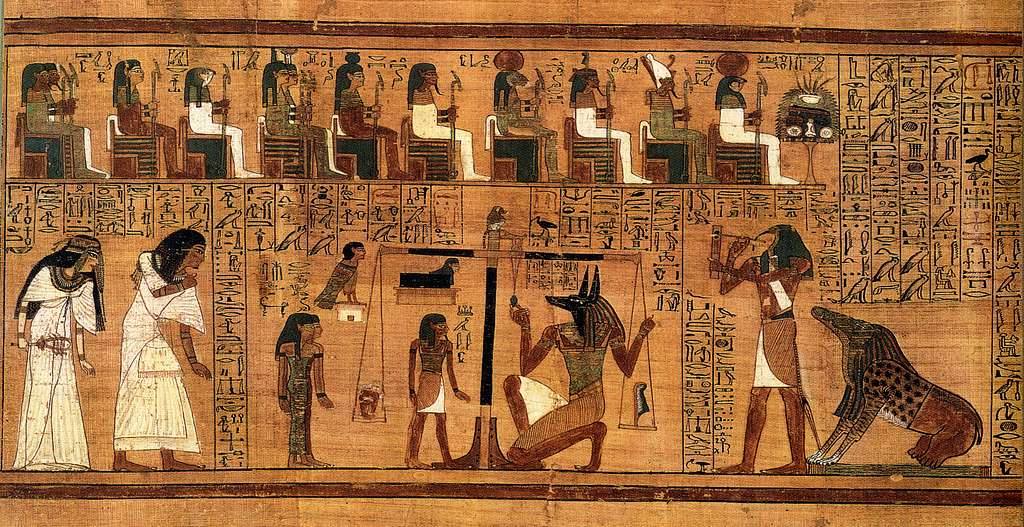
Despite the Western Orientalist use of “reincarnation” as a narrative device in several different “Mummy” movies, reincarnation does not figure into the Egyptian afterlife scenario. Souls instead have a linear afterlife wherein they are either transfigured into akhu (blessed ancestor spirits, identified with the stars in the nighttime sky) or are fed to the daemon Ammut, whereupon they cease to exist for all time. In other words, we will either live forever beyond death or we will “die the second death.”

In this way, Kemetic eschatology is much closer in principle to Christian afterlife beliefs than it is to, say, Hindu or Buddhist ideas. But there is still an extremely important difference. In evangelical Christianity especially, entrance into heaven is “impossible” without personal submission to Christ. But in Kemetic theology, the soul is measured against its earthly deeds and misdeeds during the Weighing of the Heart. We are either “saved” or “damned” based on OUR OWN ACTIONS, here upon this earth.

Evangelical eschatology is problematic because it prioritizes submission to a specific deity over ethical decision making. You could be a horrible psychopathic murderer your entire life, and all you have to do is “accept Christ” and alashazam, you’re suddenly “saved.” On the other hand, you could be a perfectly good person your entire life, but you will “go to hell” for “rejecting Christ” no matter how good a person you are. This theology makes the evangelical God seem like a total narcissist who just doesn’t care whether His followers are actually good people or not.

In Egyptian polytheism however, this problem does not exist. It literally doesn’t matter whether you worship Set, Osiris, Sekhmet, or even nobody at all. As long as you uphold Ma’at by being a good neighbor, modeling compassion, helping those who need help, taking responsiblity for your own actions, etc., then you have nothing to worry about. You don’t have to be a perfect person; you just have to have enough Ma’at in your heart that it outweighs any isfet or toxicity.

For someone like Jeffrey Epstein, who has committed countless crimes and abuses against innocent people, it will not matter how much they cry or beg for forgiveness. It will not matter if they beg Osiris, Set, or even Jesus Christ Himself to “have mercy” on them. There will be no mercy for them at all, for at the end of the day, neither Osiris nor Set nor Christ is responsible for what they have done. THEY are responsible for bringing their own damnation upon themselves.

The point here is that our eschatological destinies have nothing to do with which God(s) we worship (if any); nor are they dependent upon the whims of any God(s). What happens to us after we die is literally DETERMINED BY OUR VERY OWN ACTIONS IN THE HERE AND NOW, while we live and breathe.

Every single ethical decision we make will have some bearing on our afterlives, no matter how small or insignificant that decision might seem. Even the smallest acts of kindness can make all the difference; so too can even the smallest acts of malice.

The next time you’re standing in line for coffee and you find yourself losing patience with your barista, remember that even the way you choose to interact with this stranger is being spiritually tracked, and even this can have repercussions that reach far beyond your current scope of awareness. Maybe the barista is having a bad day, or maybe they are suicidal. The way you treat them can make their day either better or worse. It can also make the day better or worse for everyone else who might be involved in that person’s life. This one little interaction can either improve or ruin the day for a whole lot of people you might never even meet. If you are someone who values Ma’at, you will want to treat this person with kindness, even if they make a mistake or do something wrong. But if you are a toxic person whose soul is already destined for Ammut’s litterbox, you will more likely treat this person like an insect, or perhaps even yell at them or try to humiliate them in front of everyone,

There is also an apocalyptic implication to this, as well as the eschatological implication. If enough people uphold Ma’at and treat each other well, things get better and better for more people. But if too many people spread isfet and treat each other like total sacks of shit, things get worse and worse for more people instead. This shows us that even the smallest acts of kindness or malice can contribute to larger social trends. If we want to save the world, we have to start by improving ourselves and the ways we treat others. No amount of prayer or wishful thinking can replace this extremely important work.

The Gods Can Handle Our Anger

It’s okay to be angry or upset with the Gods, and it’s okay for us to tell Them so as well. 

A very good friend of mine occasionally becomes profoundly angry with Set and/or the other Netjeru for not saving them from the horrific things they endured as a child. When this happens, they put away every religious icon they own. When they are especially upset, they might even smash these holy images in a fit of blind rage. Then they feel guilty and anxious afterwards, fearing the Netjeru will punish them for being so disrespectful.

(I will not go into details, but I do wish to be extra super double sure I’m making myself absolutely clear on this point: these behaviors are coming from a place of pain and fear, not from a place of pride or insolence. Any comments that assume otherwise will be removed. Thank you.)

When my friend confides in me about these occasions, I do what I always do. I gently remind them that no, they are not bad for feeling anger, and no, they are not bad for expressing their anger to the Gods.

The ancient Egyptians got angry with the Netjeru all the time, even threatening to withhold offerings from Them if They failed to answer certain prayers in times of great need. Here, the God-and-worshiper relationship is symbiotic and reciprocal. We must give to the Gods, but the Gods must also give to us. If the Gods give and we do not, They can condemn or abandon us; and if we give and the Gods do not, we can condemn or abandon Them.

Mind you, the Netjeru are not mere genies who exist just to grant our wishes. It is unreasonable to condemn or abandon Them for not solving all of our problems for us. But it is at least reasonable for devotees to expect some kind of benefit from worshiping Them. We deserve to at least feel guided or supported by our Gods somehow; and if a deity can’t even seem to deliver that much for whatever reason, it is only natural for a person to stop worshiping Them.

The idea that we are obligated to continue worshiping a particular God no matter what They do or don’t do for (or to) us is profoundly un-Setian. I would argue it is even un-Kemetic, since each of the Netjeru can potentially receive angry tirades or threats of abandonment from Their followers. Besides, even if you scream obscenities at a Netjer, you are still communicating with Them in a heartfelt manner. You are still engaging Them in a kind of prayer. You are just praying a prayer of grievance rather than gratitude, if you will.

So I tell my friend it’s absolutely okay for them to put away their religious icons whenever they feel upset with the Gods. It’s even okay for them to smash said images when they are especially distressed (provided, of course, that they actually own the icons they smash, and no person or animal gets hurt in the process, including themselves).

Learning about the Netjeru turned out to be very helpful for my friend; yet they are still trying to reconcile their past with the idea that there are actually Gods out there who care about them. If this is true, they ask me, why then did the Gods allow them to be harmed as children?

There is very little anyone can say to answer such a question that is actually helpful (or even truthful, in my opinion at least). All I know is, if the Gods are truly Gods, They are big and tough enough to take our anger, especially if it’s coming from someone who is confused and hurting very deeply.

I also don’t believe for one second that the Gods hold it against anyone for being traumatized and needing help. I think Set would actually prefer that my friend curse and smash His icons to having them traumatize any of the other people in their life. No matter what they might do to His icons, my friend can at least be sure they won’t hurt Set Himself; the same cannot be said for their loved ones.

There aren’t any easy answers for when bad things happen to good people. But if you happen to find yourself in a situation similar to that of my friend, I just want someone to have told you it’s okay. Set is not going to smite anyone just for being traumatized and crying out to Him for help—not even if the only way they are currently able to seek help is combative or confrontational. (He can always smite us for other reasons, of course; but Big Red is big enough to handle our feelings, even the really bad ones.) 

Set Doesn’t Need A Church (And Neither Do We)

I have been asked before: “Why don’t you start your own church?” Here are some reasons why this is not only unnecessary for Setians, but probably undesirable as well.

The question has been raised before: why not start a new Setian church—one that speaks to those of us who actually revere and venerate Set, and which honors Him above all other Gods?

It is certainly true that some things are easier to accomplish in groups, and that there are limits to what any one individual can do alone. But what exactly do we need to “do” for Set in large crowds? He does not demand to be worshiped by the masses. He is a hunter God who is always on the prowl, and who is much more concerned with saving all our butts from crazy hellbeasts than He is with micromanaging our lives. Divinities like Set are loners who tend to prefer the company of other loners, if They desire any company at all.

It will be pointed out, of course, that His Nocturnal Majesty was worshiped in certain ancient Egyptian temples. This is quite true, but Egyptian temples worked very differently than modern churches do. Their innermost sanctuaries were closed to the public, and the priestly rituals for a temple’s God(s) were generally private. Though public piety existed, the Egyptians had no concept of “going to church” as such; they more often honored their ancestors and/or the God(s) of their choice at home, or at neighborhood shrines that technically weren’t on temple grounds. Along with just being good neighbors and citizens, this was the basic template for religion in ancient Kemet; there were no dogmatic litmus tests for “membership,” and there was no real concern for what individuals might or might not believe theologically. I think it’s probably fair to say most Setians, Kemetics, and polytheists in general are already living this way by default, and we clearly don’t need a church to continue doing so.

It’s also worth noting that our Western model of religious affiliation appears to be slowly going extinct. The most vocal and visible churches continue to deny science and harbor known evildoers among their leadership. Such institutions have consistently raped, murdered, or otherwise oppressed countless innocents throughout history. The masses have grown tired of their bullshit, and church attendance is now at an all-time low. So perhaps starting a church in today’s environment would not be the wisest investment of anyone’s time and resources. Again, our God doesn’t necessarily want to be worshiped by large crowds of people anyway; nor does He want us to waste our energy fighting each other, which we are much more likely to do when we gather in large numbers. Virtually every organized religion has been fragmented by its own rival sects over time; it is human nature for groups of people to quarrel and eventually schism. I therefore see little point in trying to coordinate such a project, only to have it eventually fall apart or become corrupt.

Church corruption is most blatant when it comes to our tax exemption laws, which are meant to help them invest as much of their funding into charity as possible. This seems perfectly legit—money that is used to help others ought not to be taxed. But the problem is that most church spending around the world does not actually go into charity. Most of that spending goes into building lavish cathedrals, lobbying for (usually conservative or right-wing) political causes, and acquiring more converts (i.e., donors). In some cases, the money just goes straight into the leadership’s pockets. The truth is that churches are really more like businesses than anyone wants to admit. Time and time again, the government has given stimulus money to corporations so they can pay better wages to their employees, only for the employers to predictably keep all that money for themselves. Churches function in much the same way, except they don’t have to pay any of what they keep back to the rest of society, and the government bails them out every fucking year.

The saddest part of all this is that if we DID tax churches, we would have MORE than enough money in the national budget to shelter all of our homeless citizens, improve all of our schools, and finance other badly needed social initiatives—things churches are supposed to do with all their money, but don’t. It seems clear to me at least that organized, institutionalized religion holds us back from evolving and growing into a truly advanced society; it always has, and it always will.

Maybe if churches operated more like Ghost, I’d like ’em better.

I realize I must sound like an atheist to some people. I am not. My faith in Set and other divinities, though unique, is considerably devout. I did not say religion is the problem—I said that organized, institutionalized religion is the problem. We are taught in this culture to think of faith as something that must always be standardized and static, never being allowed to change. But once upon a time, religion was much more personal and fluid for the vast majority of believers across the globe. Some of us, including yours truly, still adhere to this perspective today, and it may very well become the norm again quite soon.

It is true that churches can provide avenues of critical social support for their members; yet there are safer and more sensible alternatives today. If Sally Setian needs money for an operation, we can launch a Kickstarter drive for her, and all the money donated to her will actually go to her bank account; it won’t be divided up (or outright stolen) to pay for some pastor’s new limousine. I enjoy sending donations to random people I know online who really need it whenever I can; but I would not enjoy being pressured to donate money to a church at regular intervals (upon fear of being considered “un-Setian” if I don’t).

Yet there is another, deeper reason why starting a Setian church doesn’t seem too worthwhile. We do not need to “serve” Set by “bringing more people” to Him. He neither expects nor even wants us to actively seek converts. If what we do helps others to find Him, it is a blessing and a work of great magic; but to try and aggressively expand our numbers is antithetical to the Setian disposition. It also suggests that Set needs us to go around convincing people to believe in Him, when He is perfectly capable of doing this Himself. If it is important enough to Him that someone should believe in Him for whatever reason, it is for Him and that person to decide together, and no one else. So most of us who are drawn to Set deplore proselytism, and would find the idea of “winning souls” for Him quaint at best.

I propose an alternative to all of this church nonsense: simple social networking. We are already talking to each other, collaborating with each other, and helping each other right here on the various social media we all frequent. And each of us is already doing and contributing about as much to our scene as we probably would if we were all in a church together (or in rival churches, bickering and quarreling with each other). I think this is more or less how walking with Set is meant to be. Our faith is not a dogma but an art, and our God is not a micromanager but a muse. Must artists join organized groups with rules and regulations to be artists? No, that isn’t how art works; and it isn’t how Setianism works either. We are not a congregation in need of a church; we’re more like a bunch of individual artists who just network with each other as needed or desired.

As a final note, some readers and listeners have referred to the LV-426 Tradition as a “church.” Just to be clear: we are not and have never claimed to be any such thing. LV-426 currently consists of only four people who grew up knowing each other; so I would sooner describe us as “a very small coven” at best.

I am sincerely grateful to Setken, Siobhan Welch, and several other beloved friends and family for their generous help in preparing this sermon for the public, and for encouraging me to preach again. Thank you all, and thank Set for each of you.

Pazuzu Saves

Forget what you think you “learned” from The Exorcist (1973) about Pazuzu, and join this mighty deity as He quests against both human and spiritual cruelty.

The last several months of my life have been quite painful, and I imagine I am not alone in this respect. Yet the Gods are merciful and good, and one of them in particular saw fit to help me just recently, even though I have never specifically reached out to Him before.

Pazuzu is another ancient God who, like Set, has an extremely bad reputation today, thanks largely to William Peter Blatty and his novel, The Exorcist (i.e., the source material for the 1973 movie). It is interesting that Blatty would choose an explicitly Pagan deity for his novel’s antagonist, rather than one of the fallen angels from his own religious lore.

Far from possessing little girls and making them vomit pea soup or spider-walk up and down staircases, Pazuzu was commonly invoked in ancient times to protect pregnant mothers and newborn children from horrific monsters, most especially the night demon Lamashtu. Sure, He’s creepy and He’s kooky (again, much like Set), and He ain’t much for sunshine and rainbows. But no matter how “evil” people think Pazuzu might be, He clearly hates bullies who harm the defenseless; and though the identity of His mother in Assyro-Babylonian mythology seems unclear, I get a strong feeling that Pazuzu loves His mother very much indeed.

Last week, Pazuzu “possessed” me to record a new album in His honor (ha ha). I could barely sleep or even take any breaks while I put this puppy together. It HAD to be finished last week for some reason; imagine my surprise when I suddenly remembered that Friday was Walpurgis Night!

Anyway, this is my attempt at setting the record straight about Pazuzu, and at providing something good and helpful for His worshipers who live today. Working on this has been an incredibly healing experience; I pray that Pazuzu enjoys it, and that others will too.

Update: Wednesday, January 27, 2021

One time in the 2000s, the Tonester and I were invited to participate in a Pagan meetup down in central Texas. We were so excited, we stayed up all night the previous evening to bake a shit-ton of chocolate chip cookies. Then we put on our best black duds and went to the meetup.

When we arrived, we found we were two of the only three men present, and that everyone else at the meetup was a Wiccan. They took one look at our black clothes and our horned pentagram necklaces and thought we were bad news. And they were really weirded out by the fact that we had made so many chocolate chip cookies. They were like, “Who the hell are these devil worshipers, and why did they bring cookies?”

We tried to make friends and explain what we were all about; but things didn’t go well. As soon as we mentioned Set’s name, we received the standard response: “Isn’t He the bad guy of the Egyptian pantheon? Why would you worship the bad guy?” And when we attempted to explain, we were chastised for “not being Pagan enough.” Everything we told them about Ma’at, isfet, and Set’s war against Apep sounded “too Christian” to them. They seemed to think we had simply taken Christianity and replaced Jesus with an Egyptian devil-god. They didn’t believe that anything we were talking about had actually originated from Egypt.

After a while, it became clear that we just weren’t welcome (despite the fact that everyone seemed to enjoy our cookies). So we left and went home. We put so much energy into this event, and we really tried our best to be cordial and make friends. But we were treated like creeps, and it was demoralizing. We never went to another Pagan meetup again after that.

The word Pagan comes from the Latin paganus, which means “country dweller.” When the Roman Empire adopted Christianity as its official state religion, pagan was applied to virtually anyone who refused to convert—with the insinuation being that non-Christians were primitive, backward yokels. No one in history ever referred to themselves as a Pagan until after the Industrial Revolution, when artists of the Romantic movement started incorporating ancient polytheist ideas into their work. Since then, Pagan has become a “catch-all” term for various new religious movements that each take their inspiration from nature and ancient mythology in some way (e.g., Wicca, Druidism, Heathenry, Kemeticism, etc.). It does not actually denote any particular theology, philosophy, or creed; it is simply a collective “safe space” for several religious communities that just don’t feel welcome anywhere else.

So when Pagans alienate other Pagans from this “safe space,” it is especially hypocritical. Even Wiccans know what it is like to have people call Child Protection Services on you simply for identifying as a “witch.” You would think, therefore, that they would be a little more sympathetic to other Pagans who struggle with similar prejudices. But in my experience, people generally deal with persecution by trying to shift it on to somebody else. This ugly tendency is every bit as true of Pagans as it is of other religious communities.

Sometimes when people ask about my religion, they get confused because of all the different terms that can be applied to it. I prefer to identify as a Setian, but I can also be described as a Kemetic polytheist. And of course, I include myself beneath the Pagan umbrella (even though certain other Pagans would prefer that I didn’t). But really, Pagan is my least favorite self-label. It can be very useful for networking purposes; but apart from that, it is practically meaningless.

Prayer Against Depression

O Dazzling One!
You who were made desolate,
But who never dies!
You who were rejected,
But who always saves the dawn!

Straighten my spine!
Make strong my limbs!
Open my mouth!

You are what makes me to STAND!
You are what makes me to FIGHT!
You are what makes me to SPEAK!

The Serpent strikes me every day,
But I will NOT be stopped!
I will NOT be rendered powerless!
I will NOT be kept silent!

Holy Outlaw! Divine Rebel!
You who lay tyrants to waste!
Put me to Your holy work!

Do not let me stop
Until MA’AT HERSELF
Decrees my descent!

May I never EVER stop
Bringing joy to loved ones
And strangers alike!

May the Serpent TREMBLE
Whenever I pass near!

DUA SUTEKH!
SO MOTE IT BE!

My Religious Taxonomy

The LV-426 Tradition of Setianism is a fusion of Kemetic polytheist theology with (Setianized) Western occult practices.

Recently a good friend of mine asked me, “What name do you call what you practice, if it fits into any one religion that has a name?”

The simplest and most direct answer to this question is that I identify as a Setian, a person who reveres and works to emulate Set. Given that Set is central to my entire spiritual life, I am Setian in the same way that Christ followers are Christians, or that Shiva devotees are Shaivites. I therefore think of what I do as a type of Setianism. (For more information on Setianism in general, check out Episode #1 of this series.)

But like the words “Christian” or “Shaivite,” there are some contexts in which the word Setian requires further explanation. Not all Christians or Shaivites believe or practice the same things, and neither do all Setians. I think it’s probably fair to say we are mostly divided into two major groups:

  • Setians who are Kemetic polytheists, a term taken from Kemet or “Black Land” (the indigenous name for ancient Egypt). People in this category are more likely to believe Set is actually a real, living force of nature; that He is not “the Egyptian devil”; and that He deserves to be worshiped as a personal deity.
  • Setians who are Western occultists, which means they take more of their inspiration from 20th century sources like Aleister Crowley. People in this category are more likely to think Set is somehow “separate from nature”; that He is “completely 100% opposed to Christianity”; and/or that “true” Setians bow to no Gods, not even Set.

And then you have people like me who blur the lines between these categories in certain ways. In my case, my theology and values are very much Kemetic; I treat the Netjeru (the Egyptian Gods) as literal beings, and I consider ancient Egyptian literature on Set to be more important than anything Kenneth Grant or Michael Aquino ever wrote about Him. Plus, my entire spirituality is aimed at actually revering and making offerings to Set, not on becoming some kind of “black magician.”

But at the same time, my ritual style—the way I specifically express my reverence for Set in ceremony and prayer—is very much influenced by Western occult sources. I was not yet aware of the Kemetic community when I first came to Set; I was only aware of His occultist followers at the time, and their ritual templates were the first to which I was exposed. I found such examples helpful, but could never quite buy into the claims that “worshiping Set is un-Setian” (!) or that “Set is a force ‘against’ nature” (?) or whatever. (This contradicted the fact that Setians in ancient Egypt very clearly did not believe EITHER of those things.) So in 1997, I started xeroxing all the rituals by Crowley and other occult writers I could find at my local library; then I would go home and repurpose these litanies to suit my devotional intentions.

The Sigil of the LV-426 Tradition

A few years later, my friend the Tonester came to Set and asked for my help in learning how to worship. I showed him how I had been doing things up to that point, and we bonded because neither of us was impressed with the occult community in general. No one we knew who was into this stuff was really interested in worshiping anything but themselves. Many of these same individuals were also manipulative egomaniacs with absolutely zero regard for other people’s mental or emotional well-being. Seeking help or support from anyone was always treated as a “spiritual weakness”—like if you can’t just shake off all that depression or anxiety you’re living with, you can’t be a “real” Setian or something like that. So the Tonester and I both said, “FUCK dem apples; we’ll just start our OWN outfit.” And such is more or less how the LV-426 Tradition of Setianism began, back in 2003.

An LV-426 Walpurgisnacht postcard!

It wasn’t until sometime in the mid-2000s that I met any Kemetic polytheists or became aware of modern reconstructionist groups like the House of Netjer and the Church of the Eternal Source. Learning of this community really blew my mind; here were all these people who actually believed in worshiping the Egyptian Gods, and I hadn’t known about them this whole time! And I was impressed by the sheer amount of empathy that Kemetics just seem to feel for each other in general. Things might be different now than they were in the early 2000s; but back then, to speak of having suicidal feelings in a group of left-hand path occultists was to invite them to shame you into “just feeling better,” “getting up and doing something about it,” and/or “leaving if you can’t take the heat.” But to this day, I still see Kemetics supporting each other emotionally through such terrible struggles—something that anyone who claims to love the Gods of Egypt SHOULD be doing (YES, even if your patron Netjer is SET!). Despite any differences in my ritual style, I would much rather hang out with a bunch of Kemetics for an informal Moomas party than attend something like one of the Temple of Set’s annual conclaves.

In summary, the simplest term for my faith is Setianism; but if we want to get really taxonomical about it, my particular kind of Setianism (LV-426) is a unique fusion of Kemetic polytheist theology with (Setianized) Western occult ritual practices. We do not claim to be following “the one true way” of Set or anything like that; this is just OUR way, and others can take it or leave it. But one thing we LV-426ers will NOT tolerate is being told by any Social Darwinist occultniks that THEIR ways of “being Setian” are somehow more “accurate” or “legitimate” than ours. In absolutely any situation where this ignorant claim might arise, we will be sure to correct people accordingly (and mercilessly).

(To paraphrase Ozzy Osbourne: “Tell me I’m a phony? I got news for you: I spoke to Set this evening, and HE DON’T LIKE YOU!”)

As a final note, the LV-426 Tradition is a private fellowship, and membership is by invitation only. This is not because we want to be a “secret society”; it’s because we treat each other as family, and that is not a dynamic people can just develop by sending us a check and applying to join. It usually takes several years for someone we know personally to even realize they are one of us; then we have to all agree with each other before the candidate can be initiated. Sometimes when you’ve had a really bad week, it feels damn good to sob uncontrollably in the presence of Sutekh and your siblings in Him during one of our Sabbats. And this kind of atmosphere is most successful when there aren’t any “might is right” crotchgoblins around, trying to shame people for having problems and needing support.

But while we are extremely protective of whom we allow into our personal lives, we want to share the magic we’ve worked together so that others may benefit from it too. You don’t even have to join us or pay us to learn how we do things; hell, just read this damn website and take notes! If other Setians find our material useful but would like to make changes, I encourage them to do the same thing I did with Crowley or whomever and tinker with the work as they see fit. While I am in no hurry to expand my own coven, I do hope to hear of more like-minded Setian groups popping up across the globe some day.

1 2 3 5