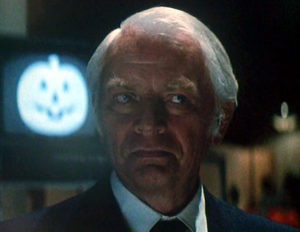
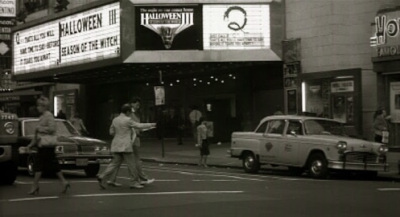
Debra Hill once recounted that Dan O’Herlihy knew an awful lot about the true origins of Halloween . He told all kinds of folk stories about Samhain to the rest of the film’s cast and crew. These stories were apparently so enthralling that everyone took to calling O’Herlihy “Mister Halloween.” It’s unfortunate that Hill couldn’t recall any specifics from these conversations, but I can certainly imagine what they must have been like. After all, Halloween III is one of very few flicks ever made in which the word Samhain is pronounced correctly, and it is O’Herlihy himself who pronounces it in his native Gaelic tongue.
I have a hunch that Dan O’Herlihy was primarily interested in Halloween III for its references to Irish culture. Considering the long list of films in which he has appeared, it’s interesting to note that almost none of them have anything to do with Ireland (either culturally, historically, mythically, etc.). I sense this man was really proud of his heritage, and that when his agent handed him the script to Halloween III, he recognized the project as an opportunity to finally represent that heritage onscreen somehow.
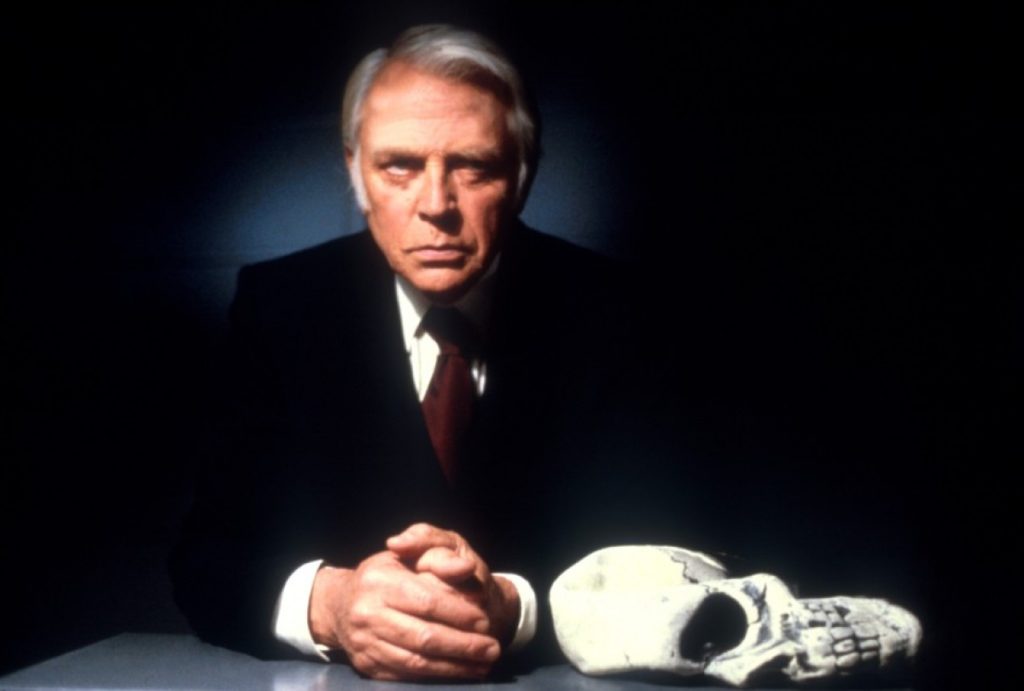
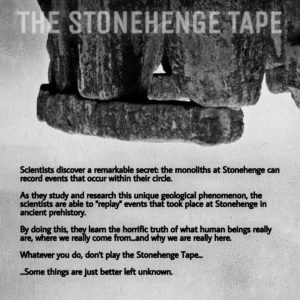
The original screenplay for Halloween III was written by Nigel Kneale, creator of the British Quatermass films and TV serials. The first draft included a great deal more science fiction than the finished film does. Conal Cochran turns out to be some kind of daemon or alien; he simply impersonates a human being with his mask-manufacturing know-how. He also transports the monolith from Stonehenge to America by interdimensional means, and there is plenty more speculation as to what Stonehenge is actually made of (and why it becomes so volatile whenever the planets are aligned). More of Cochran’s genocidal plan is explained, as well. John Carpenter and director Tommy Lee Wallace both felt that some of this material wouldn’t translate very well for American audiences, so they took turns re-writing the script to “Americanize” it a little. This led Nigel Kneale to demand that his name be removed from the credits; but it seems to me that his original ideas are still present (and mostly intact) in the film.
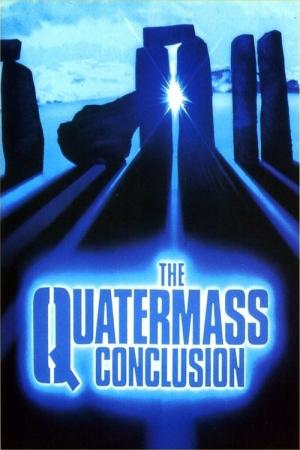
In 1979’s The Quatermass Conclusion, Stonehenge and other prehistoric places are revealed to be “landing sites” for a hostile alien force. It is difficult to be certain without reading Kneale’s original script, but it seems plausible to me that Season of the Witch and The Quatermass Conclusion were meant to be thematically linked in some way. The Quatermass serials also had a direct influence on Doctor Who, which explores many similar ideas and themes. Perhaps it is no accident, then, that Conal Cochran resembles a classic Doctor Who villain like Davros, the Master, or even the Black Guardian. I can totally see him as an evil renegade Time Lord, disguised as an Irishman.
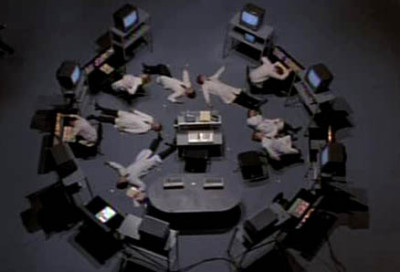
Arthur C. Clarke’s Third Law states that “Any sufficiently advanced technology is indistinguishable from magic,” and the scene when Cochran explains his plot to Dr. Challis is a great example. “Advanced…” he says, pointing to a room full of computers, “…and ancient technology,” he finishes, pointing to the monolith he has stolen from Stonehenge. His machines are all arranged in a large circle formation that’s clearly modeled on Stonehenge; a visual hint that the original monument might be some kind of ancient “supercomputer” itself. The implications of this are staggering; who or what built this prehistoric machine, and for what purpose? Halloween III never answers these questions, but I suspect Cochran knows. And if just one piece of this “supercomputer” is sufficient to devastate the entire North American continent in one fell swoop, what the hell would happen if all of Stonehenge were suddenly “switched on?”
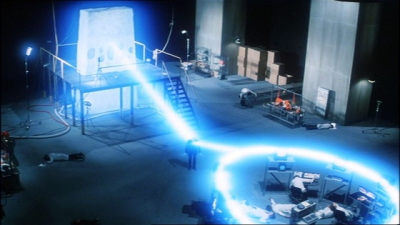
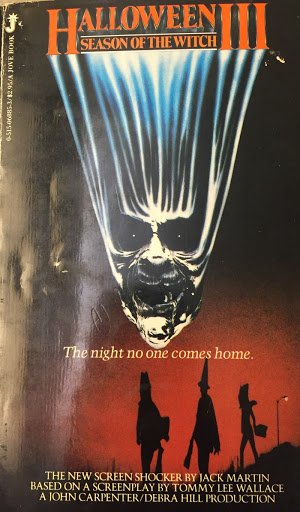
At the end of the film, Conal Cochran is zapped by a big blue laser that shoots out from the stolen (and newly re-activated) Stonehenge monolith. When this happens, Cochran’s features are momentarily distorted, as if his face were really just a mask. Then he vanishes into thin air, never to be seen again. Many viewers assume this to be Cochran’s “death scene,” but I beg to differ. The Halloween III novelization by Dennis Etchinson (writing as “Jack Martin”) makes it clear that this moment in the story is really just the beginning of Cochran’s evil. It also goes into detail on how Cochran isn’t just a crazy toymaker, but something that transcends time and space as we tend to understand such things.
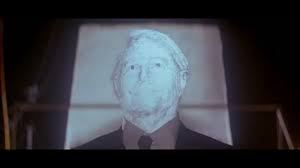
Here’s a snippet from the novel, in which Dr. Challis considers Cochran’s true cosmic nature:
Cochran was nothing new, whatever his latest disguise. He and the dark forces he represented had been around in one form or another since the beginning of time; there was no good reason to believe something so ancient had really been destroyed in a blaze of fireworks in a small town on a cold autumn night. This year’s dark venture was like a rerun on the Late, Late, Very Late Show, an endless loop re-enacting the last reels of the same relentless stalking of the heart of the American dream. It had always been so…He would come to movie theaters and TV screens over and over in untiring replays for as long as people turned away and pretended he was not really there; for that very refusal gave him unopposed entrance to their innermost lives. Nothing ever stopped his coming and nothing ever would stop it, not for as long as people deferred the issue of his existence to the realm of fantasy fiction, that elaborate system of popular mythology which provided the essence of his access…For now, he was still advancing, merely shifting from one field of view to another, larger one, from a single television screen to the televised psyches of a nation. Challis shuddered.
Before he pulls his disappearing trick, Cochran says “we” a lot. This suggests that he actually has peers; yet no one who works for him at Silver Shamrock seems to really qualify as such (especially since most or all of his employees are robots, anyway). Cochran’s “we” must therefore be referring to some other group of peers whom we never get to see. He also mentions “those who came before” him, and he speaks of human beings as if he thinks we’re all insects. It seems clear to me, at any rate, that Conal Cochran is not a “human being” at all, but some preternatural creature that has been visiting our world since ancient times. This is sustained not only by the novelization, but by what is known about the Nigel Kneale script as well. In fact, I suspect Conal Cochran is actually what Celtic folklore calls a “Fae of the Unseelie Court.”
The popular image of fairies as “cute little Tinkerbells” is utter horseshit. The oldest stories depict these creatures as being much darker and more sinister than any Disney movie would have us believe. Celtic folklore is full of benign fae who are willing to live in balance with their human friends and neighbors; but it’s also full of malevolent fae (the “Unseelie Court”) who just want to commit horrific atrocities, like kidnapping babies or tricking people into cannibalizing each other. These entities can make themselves look like anything as well, including animals, trees, furniture…or even Dan O’Herlihy!