“Well There’s Your Problem Right There, Vern”: Deflecting Accountability for Christian Hypocrisy

I think most of us can agree that political violence is evil, that Charlie Kirk didn’t deserve to be murdered, and that his killer is a real fucked-up person who should be brought to justice.

What we CAN’T seem to agree on is just how hateful and destructive Kirk’s rhetoric actually was during his life.

I’m sorry the man was killed, but I’m not shedding any tears for him, and his forward to Lucas Miles’ recently published The Pagan Threat is a textbook example as to why.

I won’t dissect the entire thing, and there are numerous problems with Lucas’ entire book that will require a much more in-depth analysis. The trouble is that there are so many falsehoods crammed into each and every sentence, it might require an entire encyclopedia collection just to address them all. For now, I will just address this one cute little hum-dinger from Kirk right here:

“In the Pagan world, the individual human life was of no importance. Therefore abortion, infanticide, human sacrifice, and more were just a part of life. Under Paganism, there is no notion that humans had equal innate worth, so one tribe enslaved another, or rulers enslaved their subjects, all with impunity.”

The idea that only Christianity introduced the concept of human dignity, or that human dignity was utterly unknown in ancient polytheism, is provably false.

Ancient Egypt alone possessed a complex legal system, with extensive writings on Ma’at. People valued hospitality and kindness, and they mourned both people and animals who died, very much like we do today.

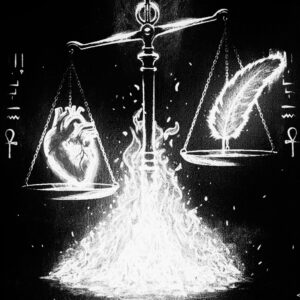
The entire concept of Ma’at involves living a good, balanced life and being a responsible member of society who treats others with dignity. The way we treat others has a direct effect on one’s afterlife as well: for people who uphold Ma’at will have a good afterlife, while those who violate Ma’at will not.

And this is just from ancient Egypt; other polytheist civilizations had their own complex legal and ethical systems as well. Virtually all of them had space for things like (1) grieving for the dead, (2) seeking lawful action against crime, and (3) believing they might somehow be judged in the afterlife for their actions here on Earth. Each of these ideas is built upon the assumption of human dignity; you don’t have things like funerals or laws against theft of personal property when you think the individual human life is of “no importance.”

I find it extremely problematic whenever Christians raise alarms about “human sacrifice.” For one thing, “human sacrifice” often served as capital punishment in many societies, with the sacrifices being criminals or prisoners of war. While there was often a ritualized element to appease certain deities or restore cosmic order, the functionality was really no different from sending someone to the gas chamber today (and having a minister “pray over” them before they go).

In other cases, the “human sacrifices” were not killed but left to die, either because they were fatally ill or there weren’t enough resources to be spared. This might sound callous, but we can be sure that it wasn’t easy for the families involved. Imagine having to leave a baby behind because you can’t feed it, and there are no hospitals or orphanages. Not a very easy decision to make, and I daresay that even Christians would find themselves making such hard decisions under the right circumstances. Thankfully, such practices tend to die out as civilizations (including polytheist ones) develop more and more infrastructure over time.

In still other cases, the “human sacrifices” were not killed to glorify any deities at all, but to accompany a king or a loved one in the afterlife (these are called “retainer sacrifices”). There is evidence to suggest that these were voluntary suicides, rather than ritualized murders. Either way, the practice was eventually phased out, EVEN DURING POLYTHEIST TIMES. The Egyptians in particular developed ushabti figures as a replacement, which could be used to accompany people in Duat *without* anyone being killed. And again, none of these “sacrifices” had anything to do with appeasing any deities; they had more to do with afterlife beliefs than with any theological claims about the Gods.

It is also a little bizarre to see Christians froth at the mouth against “human sacrifice,” when all of their religious symbolism and literature emphasizes the torturing and painful death of a man who was executed for an alleged crime, and who is himself presented to be their own version of a “human sacrifice.” Something about (1) the glorification of this horrific imagery combined with (2) the appetite many American Christians seem to have for watching other people suffer or be punished has always made my skin crawl. So much for Matthew 7:3-5, I guess.

Plenty of people in history have been slaughtered either for (1) not believing in Christ or for (2) not believing in Christ “correctly,” according to whichever authorities happened to be in power at the time. From the Crusades to the Inquisition to the witch hysterias, history is full of murders and violence being committed in the name of Christ. These heinous acts qualify as “human sacrifices” as well, and NOWADAYS, most religious violence and terror is being perpetuated by either Christians, Muslims or Jews. You’re more likely to be murdered by someone just for talking shit about Christ or Allah or Israel or Palestine than you are to find yourself in any real-life re-enactments of “The Wicker Man” or “Rosemary’s Baby.”

As for abortion; the concept of “fetal personhood” literally didn’t exist ANYWHERE – not even IN CHRISTIANITY – until the 1960s CE, *after* Roe v. Wade. This belief is NOT EVEN A CENTURY OLD, and Christians can’t even apply it to their very own predecessors. It’s about as “biblical” and “historical” as the Rapture.

Now for the bit about slavery. Dear GODS, Charlie; SLAVERY? Where do I even start?

Slavery has existed in virtually EVERY human society at some point – INCLUDING those shaped by Christianity, long after its arrival. Our own American history is full of horrific examples. American slaveholders often used selectively quoted scripture to argue for the divine sanction of slavery. They even popularized the so-called “Curse of Ham” as justification for this unfounded belief. Additionally, here are some specific examples of American Christian involvement in promoting slavery:

  • The Jesuits sold 272 enslaved people in 1838 to save Georgetown University from financial ruin; the Society of Jesus had previously relied on slave labor for decades.
  • The Church of England (Anglican) made direct investments in the transatlantic slave trade, operating profitable sugar plantations in Barbados. Profits from these plantations funded the church, and the slaves there faced brutal conditions.
  • The Southern Baptist Convention specifically broke away from their northern counterparts in 1845 to defend the “right” of their missionaries to own slaves; the entire denomination is founded on a pro-slavery ideology.
  • The Presbyterian Church had ministers who were slaveholders, including its earliest American leader, Reverend Francis Makemie, and it invested profits from selling slaves to generate income.

Frankly, I don’t want to hear ANOTHER FUCKING WORD about Christianity supposedly being morally “superior” to other religions in terms of its historical stance on slavery, EVER AGAIN. This is categorically, and quite despicably, FALSE.

To equate Paganism with wanton violence, and Christianity alone with compassion, is to erase the genuine spiritual, ethical, and legal advancements made by various non-Christian cultures throughout history. It also ignores the history of violence and oppression that has historically occurred under Christian rule, including slavery, persecution, and marginalization of outsiders.

This is NOT to say that “nothing good” ever comes from Christianity, or that everything ancient polytheists ever did was “okay.” Reality is seldom ever so cut-and-dry, no matter how much we might want it to be. No one is bad or evil just for being Christian, any more than they are just for being Pagan or anything else. I would like to live in a world where we don’t even need to have these discussions anymore, and everyone just understands that there are good people and crazy people in every possible religious category you might care to mention, and that no one is “evil” just because they fall into one category or another.

The point here is that Kirk and his fellows are blaming Pagans (in addition to transgender people, atheists, leftists, feminists, Democrats, etc.) for “stealing” people away from Christianity, when the thing that’s really driving most people away from their religion is CHRISTIAN HYPOCRISY. This is a problem that can only be addressed by Christians, and for which Christians can only hold themselves responsible.

But of course, such distortions of reality are the entire point, aren’t they? In writing this and other such extreme statements, people like Kirk show us they have zero interest in any facts or the truth. They don’t care about fairness, good faith, or actual dialogue. This is not the kind of verbiage people use when they truly believe in “peaceful coexistence.” If you truly “love your neighbor,” you don’t talk about them like they’re systematically organized and funded to “infiltrate” society, “brainwash” your kids, “overthrow the government,” etc.

No, this kind of language is specifically designed by and for people who want to see whatever demographic(s) they’re talking about removed from public life entirely. Dehumanize the target as much as possible so as to discourage any further helpful dialogue between our communities whatsoever. Make the reader feel “persecuted,” when really THEY are the ones most well-positioned to do the persecuting. Increase the likelihood of persecution—and religious violence—against the target by instilling as much misinformation and fear in the audience as possible. People are always more likely to obey and not ask questions when they’re scared.

In contrast, you won’t find nearly so many Pagan authors who call for Christians to be completely removed from society. Most of us just want to co-exist and be left alone. Some of us might say things that are extremely critical about Christianity, but this is no different from any other religion critiquing its peers. Besides, if Charlie Kirk can accuse people like me of being an “evil conspiracy” that threatens the very fabric of society, it seems only justified that I should be able to have my say too. And I say that all the right-wing politicians and media people who are actively capitalizing on Kirk’s death right now—like, say, Lucas Miles, for instance—are the REAL evil conspiracy, and one that we should ALL be worried about (Christians, Pagans, atheists alike).

How ironic it is that Kirk should claim Paganism denies the significance of individual human life, when the significance of his OWN life appears to have been denied to him by a fellow Christian, and when the entire narrative of his life has now been hijacked by OTHER fellow Christians, who are now using his “martyrdom” to fill their pockets, demonize innocent Americans, and dismantle our entire republic.

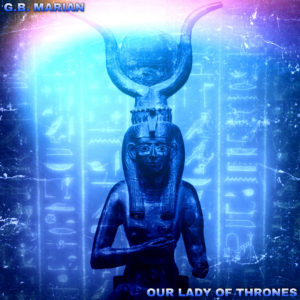
His Nocturnal Majesty & Our Lady of Thrones – Cast of Characters

INTRODUCTION

His Nocturnal Majesty and Our Lady of Thrones both hinge on a central apocalyptic event that occurs sometime in the not-too-distant future, and which I first envisioned when I was in high school back in the 1990s.

The key to understanding this apocalyptic event is Ma’at, the Egyptian concept of truth, justice, and healthy reciprocal relationships between sentient beings and the rest of nature.

When Ma’at is upheld, human civilization, the forces of nature, and even Duat (the Spirit World or Other Side) are all made to flourish. But whenever Ma’at is forsaken, it makes a crack in the very fabric of Creation itself. And there are all kinds of nasty things out there in the nothingness outside Creation—the myriad Powers of Isfet—that would like nothing more than to rip our multiverse apart from within.

Chief among these malevolent forces is an entity so utterly toxic and poisonous, even lesser Powers of Isfet are afraid to speak its true name. For the purposes of my narratives at least, this ancient enemy of all gods and creatures is simply called the Ungod.

Each of the Netjeru or Egyptian gods and goddesses plays various roles in upholding Ma’at and repelling the Ungod at a higher, cosmic level of existence. This prevents the foul thing and its hordes from simply swallowing the entire multiverse whenever they want.

But part of Ma’at requires appreciating the autonomy of all sentient beings, and human mortals are sentient. This means the Netjeru can’t just come down here and uphold Ma’at for us in all of our affairs. We are responsible for upholding Ma’at in our own dealings with each other, our environment, and any other sentient species we might eventually encounter. And so long as there are enough people upholding Ma’at across the world, the Powers of Isfet can never just seep into our area of the multiverse…

The flip side to this, of course, is that when human beings finally become too rotten and despicable in general, all bets are off. The Ungod will slither through the cracks we have made in Ma’at and un-create us (physically, mentally, spiritually, etc.), doing so as slowly and maliciously as it can. The gods will be unable to save us, as well, for we will have chosen this fate for ourselves by our own catastrophic actions. And this is exactly what I saw in my nightmares as a teen. One day, when it seems there’s just no more hope for humanity at all, the Ungod physically appears to everyone as a giant mouth in the sky. Its massive tongues reach down to devour all the people below. And the damned thing is in absolutely no hurry to eat us all at once, either; it prefers to play with its food first, since we taste much better when we are insane with fear.

I’m pretty sure I dreamed all this up from reading the Lament of Hermes, a Greco-Egyptian “prophecy” that foretells of the world falling apart due to a complete absence of Ma’at among humanity. But in my version of events at least, we still have a chance of reversing all this bullshit and exorcising the Ungod. There are still handfuls of good people across the earth who try to uphold Ma’at, even after the monster breaks loose and slithers into our atmosphere. These include the protagonists of both His Nocturnal Majesty and Our Lady of Thrones, who fight to repel the Ungod and restore enough Ma’at so it can’t return.

Our Lady of Thrones is a double album, and the first disc takes place during the final years before the Ungod breaks loose. The second disc takes place after the events of His Nocturnal Majesty, in which the Ungod is repelled by the Shieldmaiden of Set and the Knights in Sutekh’s Service. Once that particular battle is won, the protagonists of Our Lady of Thrones set to work trying to rebuild our world, and they also face off against the Ungod’s surviving mortal allies (who actually want to bring the monster back).


THE SHIELDMAIDEN OF SET

There are actually two Shieldmaidens of Set: a mother and a daughter.

The elder Shieldmaiden was born and grew up long before the Ungod appeared, and she was a police detective. She earned her chops hunting and apprehending some of the most dangerous human predators imaginable. She first encountered Lord Sutekh during a near-death experience, when He warned her of the doom that was to come. After she recovered, she became a survivalist and a martial artist.

When the Ungod appeared, nearly everyone who looked up to the sky went dangerously insane…except for the Shieldmaiden. Somehow, she could look at the Mouth above without losing her nerve. And with this indomitable nerve of steel, she went forth to rescue as many lives as she could during the apocalypse.

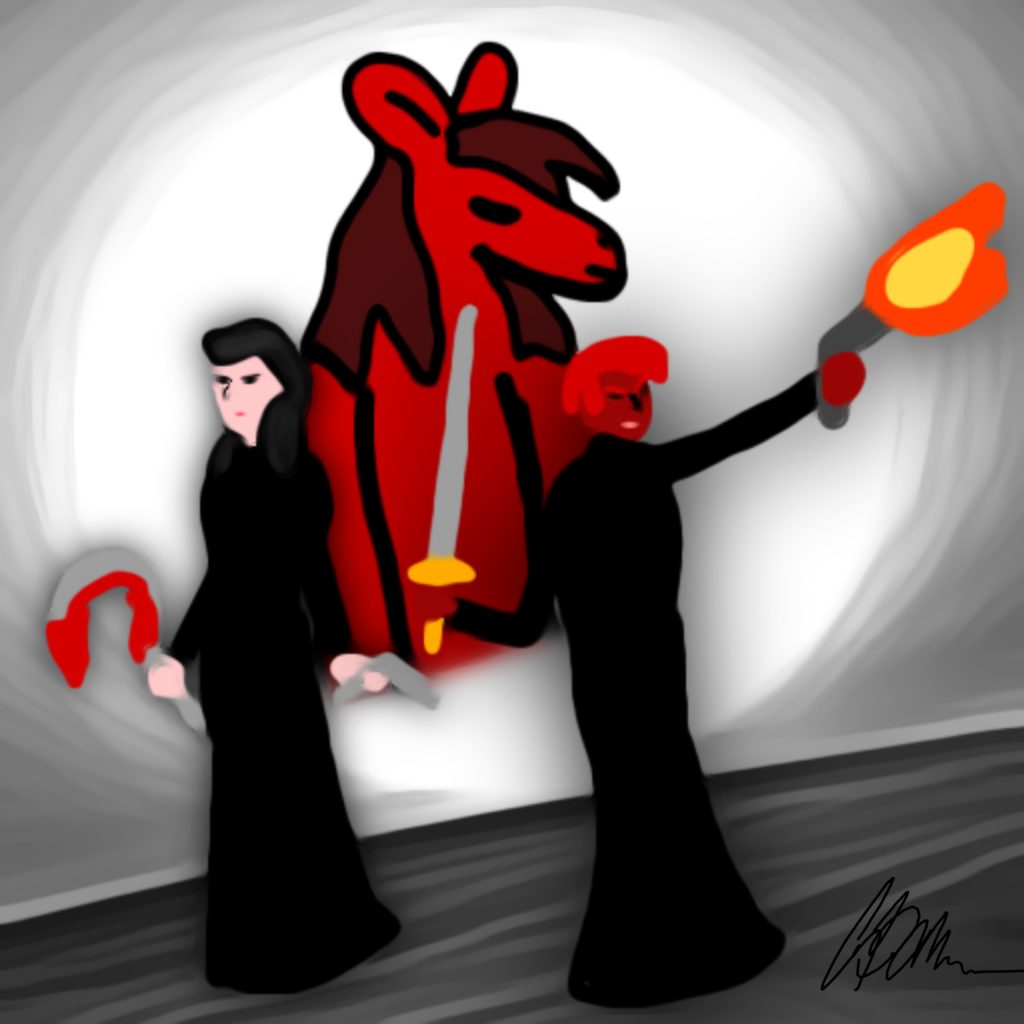
One life she saved was that of the second Shieldmaiden, who was just an orphaned baby girl at the time. The woman adopted the child as her own; then they traveled the dying earth, following Lord Sutekh’s instructions. The mother found other people who remained sane at the sight of the Ungod, and she raised a mighty army. The Knights in Sutekh’s Service then launched a counterattack against the Ungod, and the elder Shieldmaiden worked a spell that banished the monster back into the void. She had to attract all of the monster’s attention entirely to herself in the process.

When the Knights saw the gigantic red hand of Sutekh reach into our atmosphere and grab the Ungod in a chokehold, they knew they had won. Then the heroes all dispersed and went to live out their lives in the wilderness (as recounted in His Nocturnal Majesty). 

In the years that followed, the elder Shieldmaiden taught the younger everything she knew. The two became known far and wide among the various civilizations that developed after the apocalypse. They were beloved as heroes in most places, but were also feared for being friendly with Lord Sutekh and other Powers people couldn’t understand.

As an adult, the second Shieldmaiden reunited the Knights in Sutekh’s Service to help prevent another visit from the Ungod, which is just part of the story in Our Lady of Thrones


THE SORCERESS

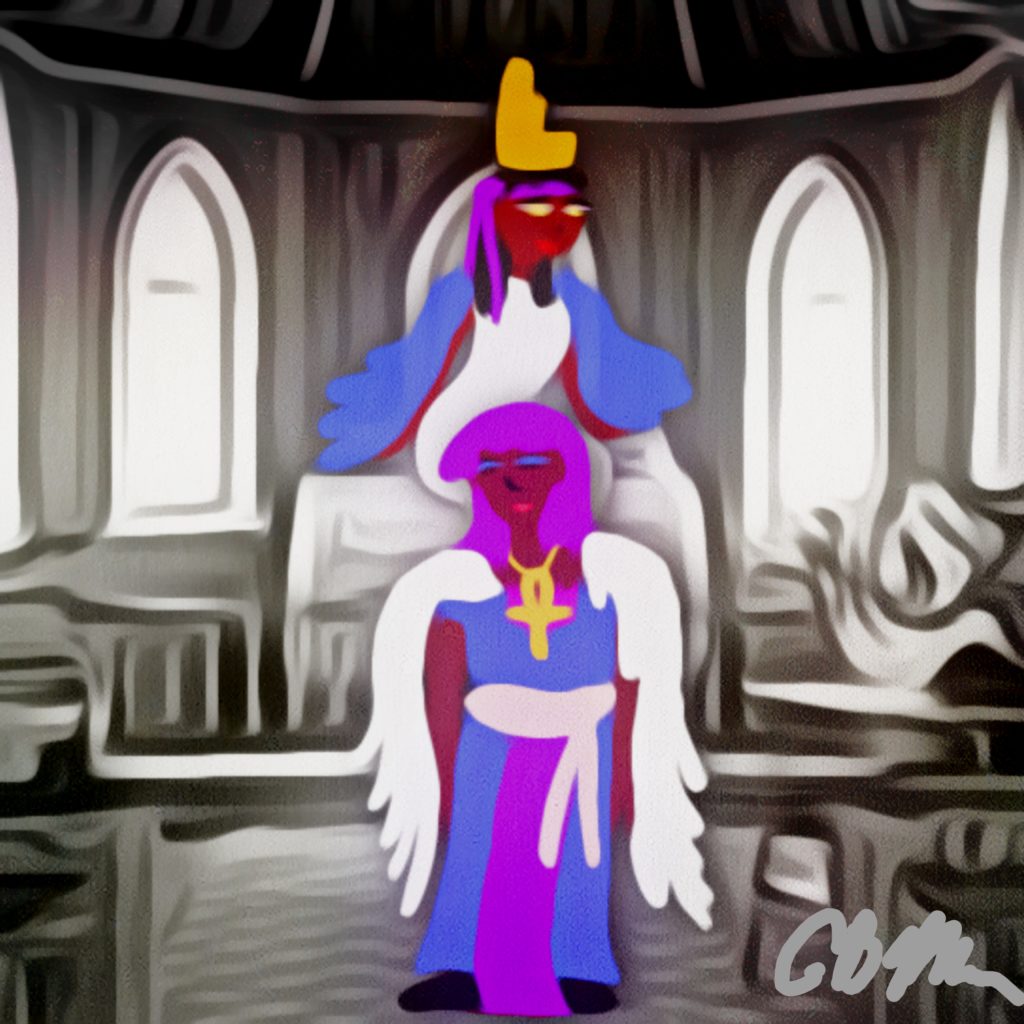
Like the elder Shieldmaiden of Set, the Sorceress was born and grew up long before the coming of the Ungod. When she was still a young girl, Lady Isis showed her the coming apocalypse in her dreams. These nightmares were terrifying, but the Sorceress took them to heart. Lady Isis told the girl everything she needed to do to plan for and survive the apocalypse as an adult, and the Sorceress followed Her instructions faultlessly.

When she came of age, the Sorceress traveled the world and brought women of different backgrounds together. They became the Church of Many Mothers, and they pooled their resources to buy land and build the town of New Sennebytos somewhere in the West. Not only would this town be dedicated to Lady Isis and the Church’s way of life; it was also equipped with plenty of bunkers and provisions for when the apocalypse began.

In time, the Church of Many Mothers became subject to greater scrutiny and was even perceived as a dangerous terrorist group by the federal government. Members of the Church were hunted down, arrested, even murdered. But the majority survived and hid deep within the bunkers of New Sennebytos when the Ungod appeared. After the monster was banished by the Knights in Sutekh’s Service, the Church returned to the surface and began to rebuild human civilization.

Members of the Church regarded the Sorceress as their prophet and Queen. Some have said she could even raise the dead. Later, she and her Church joined forces with the Knights in Sutekh’s Service to try and prevent the return of the Ungod. 


AUTUMN AND RAE

Autumn and Rae were two of the greatest warriors in the Church of Many Mothers. Both thought the Church was just another “doomsday cult” until they saw for themselves how safe, happy, and powerful the women of New Sennebytos really were. After a few years of being members, Autumn and Rae fell in love and were married by the Sorceress.

Shortly before the Ungod appeared in the sky, the monster’s human allies tried to systematically exterminate the Church of Many Mothers. Members were targeted for death in every major city. So the Sorceress appointed a special team of warriors to go and save as many of their sisters in Isis as possible. Rae was chosen to lead the rescue team in Atlanta, and though she managed to save her sisters there, she did not return home herself. Autumn was mad with grief when she and the rest of New Sennebytos were finally forced to retreat underground.

After the Ungod was defeated and the women of New Sennebytos returned to the surface, Autumn trained like hell to become the deadliest warrior in the entire Church. Years later—when the second Shieldmaiden of Set was fully grown—Autumn would lead an excursion back to Atlanta and try to find Rae, assuming she was even still alive…


THE WITCHFINDER 

No one knew the Witchfinder’s true name or origin, but he first appeared long before the World Fell Apart, when the Sorceress was still a young maiden. His existence was really known mostly to the Church of Many Mothers. What little media coverage he received was very closely monitored and censored from the general public.

The Witchfinder was absolutely impervious to any physical injury; he never became ill, and neither blades nor bullets nor blasts could bruise him. He was also a born psychic and could hear thoughts. He knew when other people had paranormal abilities, and he relentlessly stalked and killed as many of these “witches” as he could. He did this because he heard a voice in the sky telling him to do so—the insidious hiss of the Ungod.

The Witchfinder first attacked the Sorceress shortly after she started receiving her prophetic visions from Lady Isis. He relentlessly stalked her entire Church (among others) for decades afterwards. Then the end came, and after the Ungod was repelled, the Witchfinder became the second highest authority in the Kingdom Guard. He would eventually lead the armies of this brutal regime to war against the women of New Sennebytos, and with zero intent of taking any prisoners.


THE REVEREND PRESIDENT

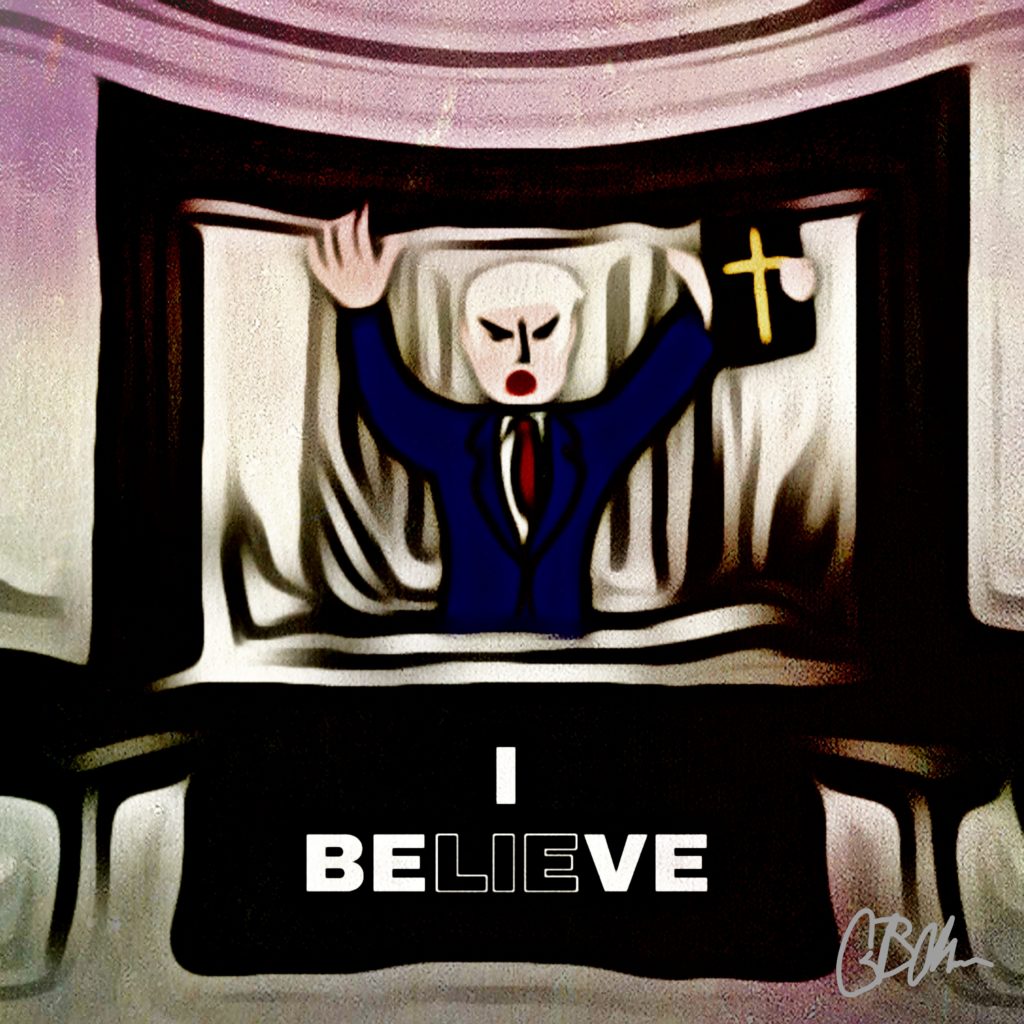
The Reverend President began his career as a televangelist. He heard the hiss of the Ungod, whispering to him from the sky. He mistook it for the voice of “God,” and things always seemed to go his way when he heeded its advice.

He preached that “the Lord” was displeased with society recognizing the freedoms of women, the LGBTQ+ community, minority religions, and atheists and agnostics. He wanted his creeds made into law, requiring Americans to convert and obey upon threat of public execution by the state. The Reverend further taught that if this were not made to happen very very soon—within the next seven years, in fact—”the Lord” would give this world to Satan, and it would be forever destroyed.

As if on cue, the country was besieged by a cult of domestic terrorists who claimed to worship Satan. Even normal rational people started buying into the Reverend’s wild-eyed claims. It wasn’t long before the Reverend was voted into the White House and started issuing executive orders that tyrannized anyone who didn’t worship him and follow his every command. Suspected “witches” were harassed, assaulted, even murdered by their neighbors all across the country, and institutions like the Church of Many Mothers became Public Enemy Number One.

Then the Ungod appeared, and the World Fell Apart.

While the Knights in Sutekh’s Service fought to repel the Ungod back to the void, the Reverend President and the Witchfinder joined forces in Atlanta, which became the capital of their new empire. Known as the Kingdom Guard, this regime invaded and enslaved as many surviving communities across the country as it could. All who were occupied were either converted or exterminated. Those who encountered the Kingdom Guard and escaped with their lives have consistently described its citizens as monsters in the shapes of men.

Our Lady of Thrones culminates in the final confrontation between the Kingdom Guard and the Church of Many Mothers.


THE WARLOCK

The Warlock or “Disciple of the Worm” was known by many names across multiple universes. He wasn’t human, though he had a thousand human faces. Each world he visited soon decayed into nothingness. He used the same method for interdimensional travel as beings like the Fae—by walking between the worlds on different Halloween nights in history (a theme also explored in Summer’s End II)—and he first arrived in this reality in 1982. The Warlock then used (at least) two fake human identities to engineer the end of our world.

In one of his roles, the Disciple was a multimillion dollar media tycoon whose TV programs made him insanely rich. He pretended to be a born-again Christian, and he used his media wizardry to help the Reverend President win the White House.

In his other role, the Warlock was a psychiatrist who worked with the criminally insane. He discreetly hypnotized his patients and helped them all escape. Once free, his patients burned down entire neighborhoods in the name of Satan. The Warlock then encouraged the Reverend President to capitalize on these “satanic terrorists” and seize more and more power over time.

When this evil spell had spread across enough of the globe, the World Fell Apart and the Ungod appeared in the sky. The Warlock was seldom seen afterwards; yet his presence continued to be felt, especially in cities occupied by the Kingdom Guard. His true appearance remained unknown, and it was rumored he could create doubles of himself. Perhaps not even the Reverend President had ever seen the actual Disciple of the Worm face-to-face.

How could anyone know who, when, or where this master of misdirection really was?

Pazuzu, The Exorcist (1973), and Sorcerer (1977)

Pazuzu is most well-known today thanks to a horror movie about demonic possession; yet He is evoked much more faithfully in a completely different film by the same director.

So far, 2021 has not been much easier than 2020. But if there is one amazing thing for which I will always remember this year moving forward, it’s the fact that I met Pazuzu and He helped me heal myself some when I needed it very badly.

I have known about Pazuzu since I was a teenager, but my understanding of His lore and symbolism was severely inhibited by popular culture at the time. I have no memory of ever reaching out to Him at any point in prayer. I had considered writing a song about Him sometime in 2020; but I eventually forgot about this idea, and I certainly wasn’t planning to write an entire album devoted to Him. When 2021 began, I experienced a near complete mental break and did not think I would ever produce anything again for a while. But then in April, I suddenly felt driven by Pazuzu to write and record 10 songs for Him in less than one week.

And by the time it was over, I felt….something like myself again. Better. Healthier. Not exactly what you’d expect from a figure who is most commonly portrayed as a horror movie villain, is it?

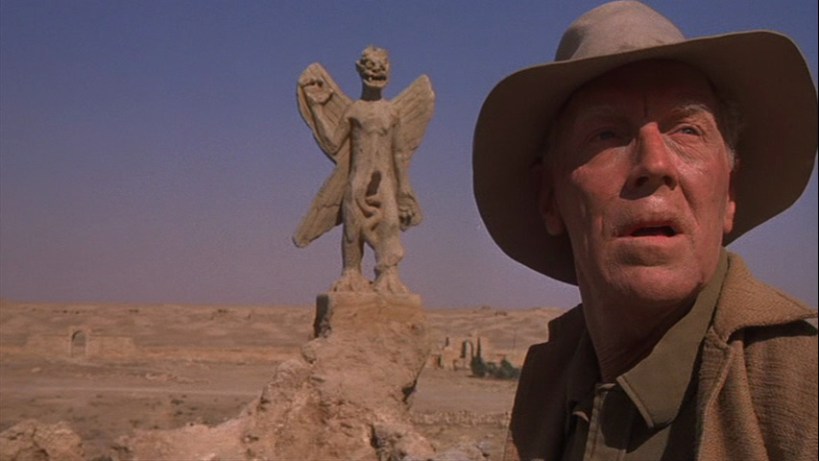
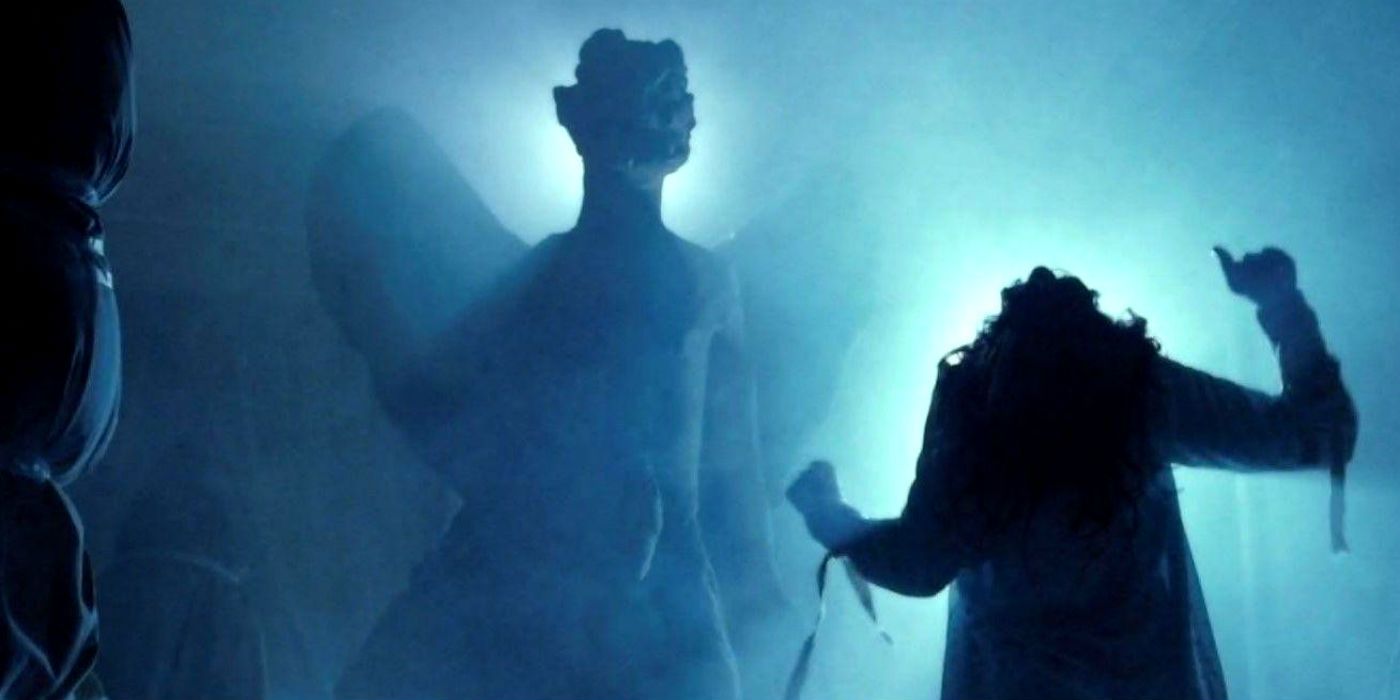
Most people who are familiar with Pazuzu these days are first introduced to Him by William Peter Blatty’s The Exorcist (1973), which was directed by William Friedkin. Blatty is another one of those self-proclaimed “experts” in demonology from the Satanic Panic era, and his novel The Exorcist was inspired by a “real life” exorcism he investigated. The story features Pazuzu as its antagonist, an evil demon that possesses an adolescent girl and drives her to commit all manner of vile obscenities. The film version is one of the most faithful screen adaptations of a novel I have ever seen, and great pains were taken to design a giant Pazuzu statue that is more or less true to ancient Mesopotamian motifs. As a result, it could be said that Pazuzu Himself was actually cast in the film, if only for a few brief cameos.

The Exorcist was a real game changer, and if you need any convincing, just look at how horror movie soundtracks changed after 1973. Prior to The Exorcist, most horror films featured romantic orchestral scores. The themes and melodies might crescendo and increase in tempo at certain points, but they still have harmony, being fairly easy on the ears. William Friedkin originally enlisted the composer Lalo Schifrin to score The Exorcist, but was unsatisfied with everything Schifrin offered and eventually fired him. Friedkin ended up using all pre-recorded music for the film, music that was progressive and experimental for the time.

Most everyone knows the Exorcist “theme song” is actually just a brief clip from Mike Oldfield’s Tubular Bells (1973); but the film also includes selections from Krzyzstof Penderecki’s Polymorphia (1962) and George Crumb’s Black Angels (1970). And while these latter pieces are technically considered “classical,” they belong to that lovely postmodernist category where it’s all orchestral drones and ambience. Shit like this had seldom been used in any films before, and it sounds terrifying as hell, so it didn’t exactly get much radio play either. But it speaks volumes that nearly every horror movie made since 1973 has used much the same sound design template. This is most obviously exemplified by Stanley Kubrick’s The Shining (1980), which includes quite a bit of Penderecki in its soundtrack. But you can also hear this kind of influence in the music of Goblin (e.g., Suspiria, 1977), John Carpenter (Halloween, 1978), Christopher Young (Hellraiser, 1987), and countless others.

(An interesting aside: Ennio Morricone scored Exorcist II: The Heretic in 1977, and Morricone was already known for incorporating some postmodernist influences into his work; consider his scores for Sergio Leone’s Westerns from the 1960’s, for example. Meanwhile, Lalo Schifrin was recruited for The Amityville Horror in 1979, and he repurposed the score he had previously composed for The Exorcist in 1973. There is most definitely a solid Penderecki influence in the finished product, with all those shrill discordant strings.)

The Exorcist is a fantastic film, and it is one of my favorites. Yet there are certain things about it that annoy me. I would enjoy it much better if the story didn’t use a Pagan God for its villain. I understand the movie is really just a giant commercial for the Catholic Church; but there was no need to pick on a random God from another religion to make this point. Still, I probably wouldn’t even know about Pazuzu if I had never seen this film, and the same is likely true of many who walk with Him today. Perhaps in this sense, the ulterior purpose of Blatty’s novel has backfired, providing Pazuzu with an unexpected gateway to our hearts.

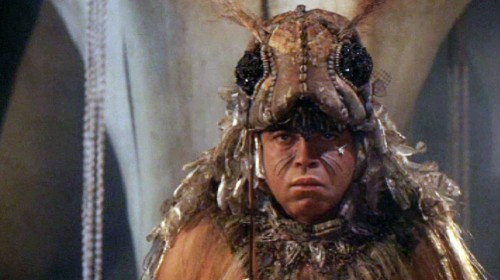
Oh Gods, James Earl Jones, what did they DO to you?

Naturally, the success of The Exorcist has led to several sequels and even a recent television series. The absolute worst of these continuations—Exorcist II: The Heretic (1977)—is simultaneously the most fascinating. Directed by the ever-pretentious John Boorman (oh Gods please rescue me from ever seeing Zardoz again), The Heretic is really just an excuse for the male gaze to linger on Linda Blair’s blossoming physique, and for Richard Burton to stumble through the script while drunk off his ass. For a more articulate synopsis of this bizarre piece-o-shit movie, I highly recommend my friend ChillerPop’s magnificent review thereof. For our purposes here, the important thing is that Pazuzu is still the villain, but He is not just the “fallen angel” He is claimed to be in the first movie. He is more like a force of nature that can actually be tamed or domesticated by human beings via magic and/or science. The Heretic appears to suggest that the Catholic Church is powerless to stop a force like Pazuzu…and this is a step in the right direction, at least.

Pazuzu is not a fallen angel, but an Assyro-Babylonian God. He is indeed described as the “King of the wind demons” in His original lore; but this means something very different in context. It is really referring to elemental nature spirits, and not to any demons from Christian mythology. Pazuzu is the “King” of these spirits because the rest are all afraid of Him, and they flee if He gets angry. This is exactly why the ancients invoked Him to protect their women and children from other spirits like Lamashtu, which thrive on harming and murdering both. Writers often describe this practice as “using evil against evil” (a line that is even used in the original Exorcist), but I call bullshit. The God of the Bible seems plenty wrathful and violent himself, but people don’t generally think of Christian exorcisms as “using evil against evil.” There really isn’t much difference in principle here, save that Pazuzu is a lesser-known polytheist deity. And as someone who has survived child abuse, I think it really says something that Pazuzu was thought to be so personally invested in the safety of human mothers and babies. That sounds like the complete opposite of “evil,” if you ask me.

“Not tonight, Lamashtu!”

None of the Exorcist films do any justice to Pazuzu; but there is another film I have seen that seems to resonate with Him somehow. William Friedkin’s next project after The Exorcist was a movie called Sorcerer from 1977. Despite its supernatural-sounding title, Sorcerer is not a horror film, but more of a bizarre jungle adventure. It’s about these four nefarious men from different countries (one of whom is played by Roy Scheider) who are hiding from mobsters and the law in some unnamed South American country. When a nearby oil rig explodes, killing countless workers, the company owners decide to stop the fire with some nitroglycerin—but the closest batch is damaged, extremely old, and highly volatile. So they enlist the four main characters to haul that nitro through the mountains and rainforests in these really big trucks. What follows is one of the most engrossing and suspenseful quests I’ve ever seen in any film, for just one false move could blow all these poor sweaty bastards straight to hell!

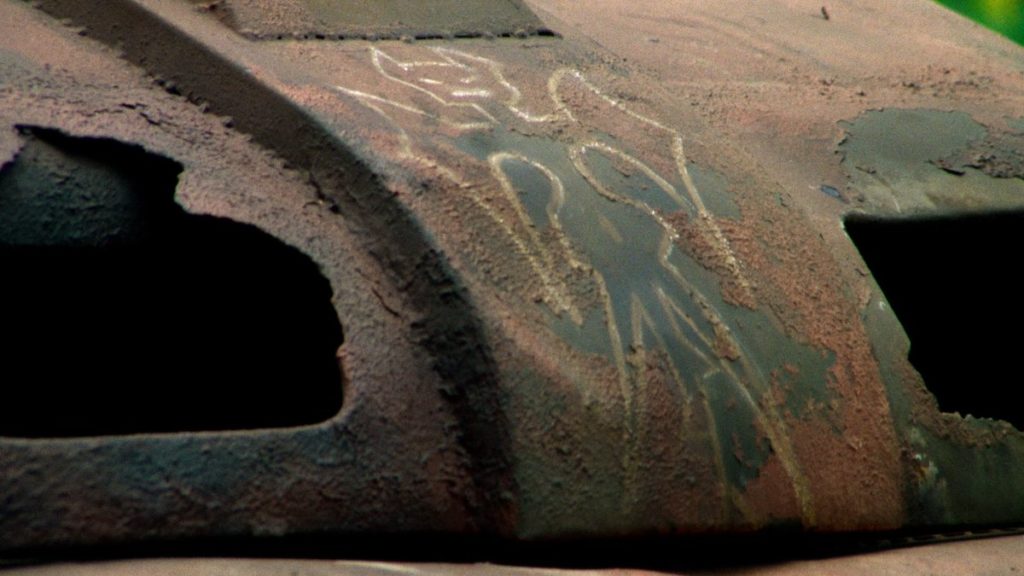
Despite its lack of any supernatural content, there is a powerful mystical edge to Sorcerer. William Friedkin deliberately chose the title as a reference to The Exorcist, stating that the titular “Sorcerer” is actually Fate itself. The trucks that are used for transporting the nitro have demonic-looking “faces,” with their headlights and grills resembling eyes and mouths full of teeth. At numerous points, the protagonists drive past stone figures of ancient Gods and monsters from South American folklore. There is one sequence when they must drive across an extremely flimsy bridge, and we can hear the sound of wailing demons in the wind. One of the trucks even has Pazuzu clearly drawn in chalk on its hood—as if He were being asked to watch over these men and their deadly burden!

Pazuzu is their co-pilot!

And then there’s that magnificent electronic music score by Tangerine Dream, which sounds like it belongs in a fucking horror movie. The band composed and produced all of this music without seeing any video footage from the film at all. They delivered even more music than William Friedkin could use, and he was so delighted with their work that he wished he could go back in time and have them score The Exorcist for him. Remember, Friedkin had trouble finding the unique sounds he wanted for that film. Mike Oldfield’s Tubular Bells was an excellent choice for the theme, but can you imagine The Exorcist with music by Tangerine Dream instead? Listen to the Sorcerer soundtrack, and you will have an idea of what such a score would have sounded like. (The very first track, “Main Title,” is especially terrifying to hear in the dark.)

The Sorcerer soundtrack is one of my all-time favorite albums; I first discovered it as a 7th grader in 1995, and I am sure its influence can be found in my latest album, Pazuzu Saves (2021). This was actually unintentional; I wasn’t even thinking about this movie when I first composed the music. But something moved me to re-watch the film a few days after releasing Pazuzu Saves, and I was blown away by all the incidental references to this God (which I had never noticed before). Then I got to thinking about how this movie is all about these roughnecks ascending treacherous mountains to rescue the impoverished South American village they have learned to call home. The story of Pazuzu Saves is partially inspired by tales of the God flying up a mountain to break the wings of all the wind demons that menace humankind. It is difficult for me at this point NOT to watch Sorcerer and draw some kind of parallel to this theme, even though the film is not intended to convey any kind of religious message. Perhaps Pazuzu appreciated being cast in The Exorcist so much, He returned the favor by acting as William Friedkin’s muse for Sorcerer. The latter film certainly feels more in line with what Pazuzu is really all about, at least in my opinion. 

Pazuzu Saves

Forget what you think you “learned” from The Exorcist (1973) about Pazuzu, and join this mighty deity as He quests against both human and spiritual cruelty.

The last several months of my life have been quite painful, and I imagine I am not alone in this respect. Yet the Gods are merciful and good, and one of them in particular saw fit to help me just recently, even though I have never specifically reached out to Him before.

Pazuzu is another ancient God who, like Set, has an extremely bad reputation today, thanks largely to William Peter Blatty and his novel, The Exorcist (i.e., the source material for the 1973 movie). It is interesting that Blatty would choose an explicitly Pagan deity for his novel’s antagonist, rather than one of the fallen angels from his own religious lore.

Far from possessing little girls and making them vomit pea soup or spider-walk up and down staircases, Pazuzu was commonly invoked in ancient times to protect pregnant mothers and newborn children from horrific monsters, most especially the night demon Lamashtu. Sure, He’s creepy and He’s kooky (again, much like Set), and He ain’t much for sunshine and rainbows. But no matter how “evil” people think Pazuzu might be, He clearly hates bullies who harm the defenseless; and though the identity of His mother in Assyro-Babylonian mythology seems unclear, I get a strong feeling that Pazuzu loves His mother very much indeed.

Last week, Pazuzu “possessed” me to record a new album in His honor (ha ha). I could barely sleep or even take any breaks while I put this puppy together. It HAD to be finished last week for some reason; imagine my surprise when I suddenly remembered that Friday was Walpurgis Night!

Anyway, this is my attempt at setting the record straight about Pazuzu, and at providing something good and helpful for His worshipers who live today. Working on this has been an incredibly healing experience; I pray that Pazuzu enjoys it, and that others will too.

Shedding Skin With the Snake God (and Snake People!)

Thoughts on Nehebukau, the holy Snake God, and the concept of Snake People, with an analysis of their appropriation by modern pop culture and conspiracy theorists. 

It’s important to understand that snakes are not a universal symbol of “evil” in Kemetic or ancient Egyptian lore. Actually they are more like angels, a special class of preternatural being. There are good snakes like Wadjet and Meretseger who serve Atum-Ra the Creator; and there are also bad snakes that serve Apep and who seek to disintegrate all things. One story of Nehebukau is that He was originally one of the bad snakes; but this was only because of a pinched nerve in His spine that was hurting Him real bad, making Him terribly grouchy. Eventually, Ra healed Nehebukau by touching His back and fixing that nerve, and the latter has been a good and holy snake ever since, working Ma’at and assisting sentient beings through their various kheperu or transformations in life and the afterlife (what might be called a “shedding of skins”). In this way, Nehebukau fits right in with some of the other Gods I hold most dear. Like Set and Taweret, He’s kind of like a monster that learned to be better, and who is in a very unique position to empathize with humans in our struggles against isfet

Dua Nehebukau! Hail, sweet Soul Serpent!

To be clear: when I refer to “the Snake God,” I am referring to Nehebukau, and not to the monster Apep. When I refer to “the Chaos Serpent,” the situation is reversed. The distinction here is that Nehebukau is a proper God or Netjer, while Apep is more like an “ungod.” If it confuses anyone that I would use “snake” and “serpent” in different ways like this, just remember the comparison to angels above. Nehebukau is no mere angel (and neither is Apep for that matter), but one might say Nehebukau is a Snake God in the same way that Gabriel is a “holy angel,” while Apep is a Chaos Serpent in the same way that Satan is a “fallen angel.” There are additional good male snake Gods among the Netjeru as well (e.g., Geb, Mehen, etc.); but as I have not personally interacted with any of them myself, Nehebukau is the particular Netjer I mean to invoke when I write “Snake God” in capital letters. 

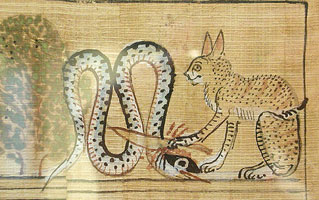
A good cat slaying Apep the Chaos Serpent—not to be confused with Nehebukau the Snake God!

Prior to collaborating with Setken on Hymn To The Soul Serpent (Hymn To Nehebukau), I don’t recall actually being that cognizant of Nehebukau before. I recall seeing Him in Egyptian art in His winged, double-headed serpent form from time to time; but it wasn’t until my exposure to Setken’s artistry that I remember seeing the Snake God depicted in a humanoid form (as exemplified in Setken’s Study For The Netjeru!: Nehebukau). Apart from just being really fucking beautiful, Setken’s paintings spoke to something buried deep within the furthest regions of my memory. It was not until we were almost ready to release Hymn to the Soul Serpent that I suddenly realized just what these sacred icons were actually reminding me of. 

Available at gbmarian.bandcamp.com

(When Setken first proposed the Hymn to the Soul Serpent project to me, I mistook him for saying “Nekhebet,” and I immediately started studying footage of vultures for inspiration. When I realized my mistake, I apologized to to Nehebukau profusely, even though I am reasonably certain He wasn’t actually offended. But perhaps some kind of project for Nekhebet might be on the horizon!)

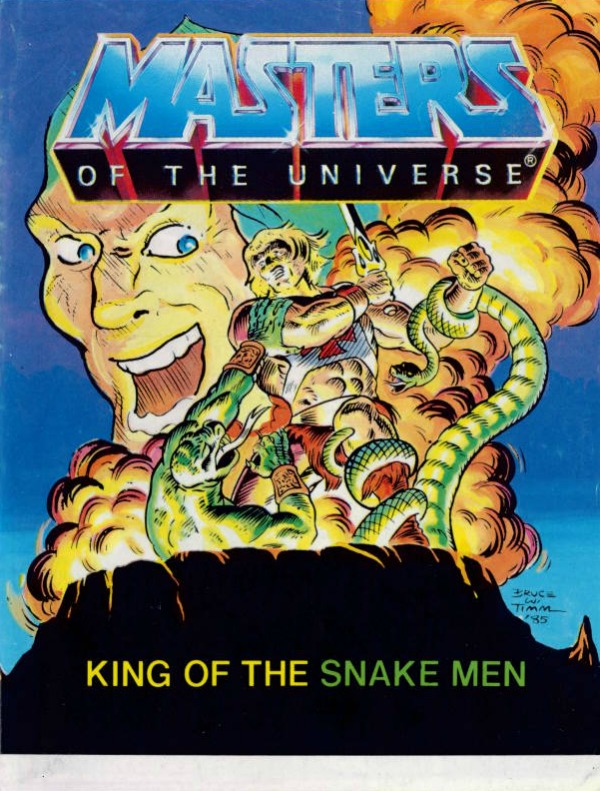
This is probably going to get me into trouble (more on this later), but I’ve had a fascination with the idea of reptile people for as long as I can remember. I think my first exposure to this was from watching He-Man and the Masters of the Universe. I also collected the dolls (or “action figures,” if it really bothers other men so much), and my absolute favorites were the Snake Men. King Hiss looked like a normal dude, but his entire torso came apart to reveal his true form as a writhing mass of vipers. Tung Lashor had a super-long poison tongue that came rocketing out of his mouth when you operated the button on his back. And Rattlor’s neck could extend with quite some force, rendering him somewhat hazardous around children’s eyeballs. These characters were not featured in the He-Man cartoons, but the dolls came with miniature comic books that explained their background stories and such. 

According to the comic that came with King Hiss, the Snake Men are native to He-Man’s homeworld, Eternia, and they controlled a powerful empire long before the reign of King Randor. They were banished to some alternate dimension, but the evil wizard Skeletor found a way to bring them back. Thanks to He-Man, Skeletor only succeeded in facilitating the return of three Snake Men: King Hiss, Tung Lashor, and Rattlor. The Snake Men then launched a campaign to return the rest of their kind to Eternia, so they could invade and enslave humanity once more.

Is any of this starting to sound familiar to you yet? In Episode #10 of this series, I discuss one of my least favorite anti-Setian tropes in popular culture: the theme of an “evil snake God” called “Set” who was banished to an alternate dimension, who has legions of “Serpent Men” under his command, and who seeks to return and invade the world of human beings. This theme originates from the short fantasy fiction of Robert E. Howard (creator of Conan the Cimmerian and Kull the Conqueror), and it gained even more traction when Marvel Comics was licensed to adapt Howard’s fiction into its own fictional universe in the 1970s. Since then, the “Set and His evil Serpent Men” trope has emerged in countless cartoons, movies, role-playing games, and science fiction TV shows. He-Man and the Masters of the Universe, with its Snake Men and their tyrannical King Hiss, just happens to be the most obvious example of this trend.

One thing I disliked about He-Man was the fact that these Snake Men were bad guys. I have always loved snakes, especially the non-lethal ones like garter snakes, and I always thought it would be neat if these characters could have been heroes instead. I remember imagining my own Saturday morning cartoon shows where the heroes were all benevolent Snake People (with badass edgy names like Queen Hissteria and Big Bad Mamba), and the bad guys were just normal-looking humans. Curiously, the animated He-Man series does feature another race of snake people, the Reptons, who are peaceful and kind. (One of them, Kobra Khan, is one of Skeletor’s goons; but the show makes it clear that Khan is just a bad egg, and the rest of the Reptons are cool.) But when it comes to stories that add a little more dimension to this concept than what I usually expect, my life changed forever when I saw Doctor Who.

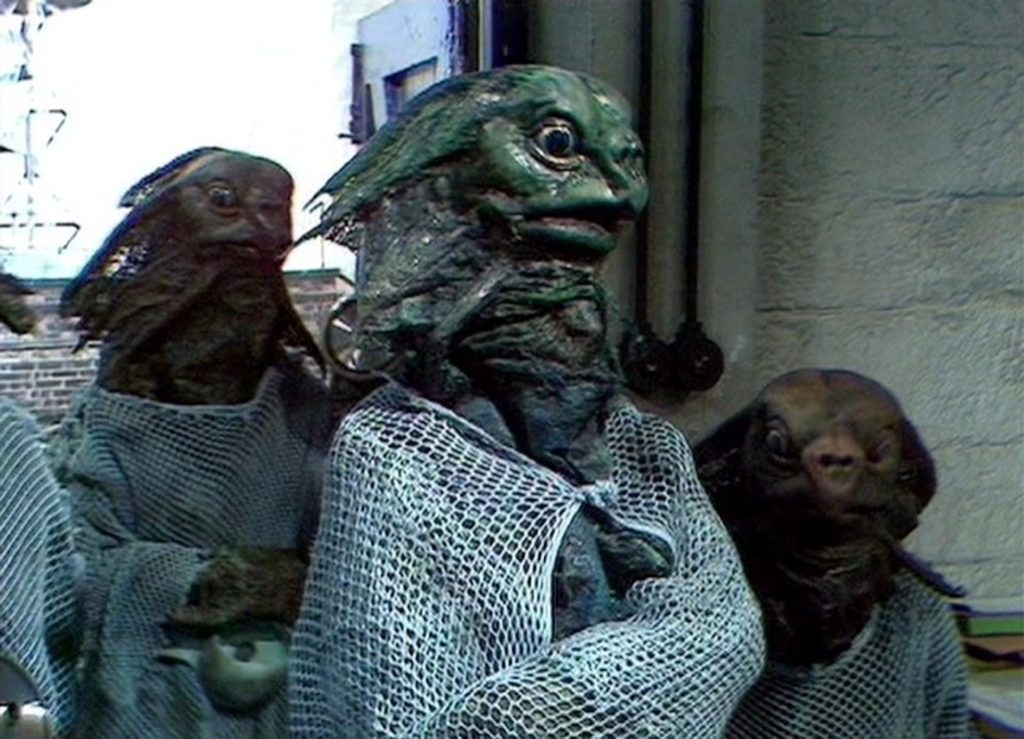
No, I’m not talking about the newer Who series that’s been in production since 2005. I speak to you of those lost long days when the only way you could catch Doctor Who here in the States was by watching PBS and sitting through all those passive aggressive pledge drives they used to do, where they’d threaten us with no Doctor Who ever again if we didn’t call in to buy that nifty coffee mug with the disappearing TARDIS. During the Jon Pertwee years, there were two serials that dealt with the theme of reptile people specifically: The Silurians and The Sea Devils, written by Malcolm Hulke. In the first of these adventures, the Doctor (who is currently stuck on earth with an inoperative TARDIS) learns there was another intelligent species that ruled this planet long before humans evolved from apes. These reptile people are not aliens, but native to earth. They went into hibernation deep underground when their advanced astronomy detected the incoming comet that eventually wiped out the dinosaurs. Their machines were supposed to awaken them shortly after the disaster, but a malfunction caused them to remain in suspended animation until they were accidentally revived by human nuclear testing during the 1970s. 

“Hey it’s OK, these guys are sailors. If we get ’em laid, we won’t have any trouble!”

Having resurfaced, the reptile people are understandably distressed to find their planet invaded by ultraviolent hairless apes. Some of them are willing to try and co-exist with us peacefully, and the Doctor tries his best to facilitate an arrangement to this effect. But racists on both the human and reptilian sides of this dispute eventually stifle this hope, with the reptiles unleashing their biological warfare upon us, and the humans bombing all the rest of their hibernation chambers. In the second of these serials, the Doctor encounters another tribe of reptile people who belong to an aquatic subspecies, and the whole thing starts all over again. (Things are made even worse this time by the Master, played by Roger Delgado, who actively seeks to escalate the conflict between humans and reptilians.) Doctor Who lore is curiously divided as to how the reptilian characters in these stories are to be identified, but when I was a kid at least, I always went by the Malcolm Hulke novelizations, which refer to the land-dwelling reptilians as Silurians and their oceanic cousins as Sea Devils. 

I remember CRYING a lot whenever I watched these episodes of Doctor Who, to the point that my parents were concerned I was actually scared and would have nightmares. But while I did find this stuff disturbing, it wasn’t because it was scary; it was because it was sad. I thought the Silurians and the Sea Devils were cool, and I wanted things to work out so that everybody can share this planet together and get along. I will admit that I was very young at the time, and I didn’t yet grasp that this was all just make-believe. But I also remember that when I got a little older and I first learned about some of the colonialist atrocities that have been (and still are) perpetuated against Native Americans, my initial reaction was to reflect back on Malcolm Hulke’s stories and the profound emotional reactions they invoked in me. The difference, though, is that THIS WAS FUCKING REAL, it ACTUALLY HAPPENED, it is most certainly NOT make-believe. And learning THAT horrible truth (in addition to others) has kept me awake at night far more than any scary TV show ever could. (Somehow, I sense that if I could ask Malcolm Hulke about this today, he would tell me this was exactly his point in writing these awesome stories.) 

Incidentally, the Silurians and Sea Devils return in a few later Doctor Who adventures, but Malcolm Hulke had nothing to do with these serials, and I am not really a fan. In the 1983 episode Warriors of the Deep, the Fifth Doctor (Peter Davison) ends up wiping out two combined tribes of terrestrial and aquatic reptilians all at once. Sure, Davison makes a fantastic Doctor, and he clearly doesn’t WANT to commit genocide against the reptilians; but he does it anyway, and it’s gross, and there is no text or subtext about colonialism anywhere to be seen. It’s just “We gotta kill the people with animal heads so the humans can live.” This leaves the whole story feeling way too hollow and mean-spirited for my tastes. 

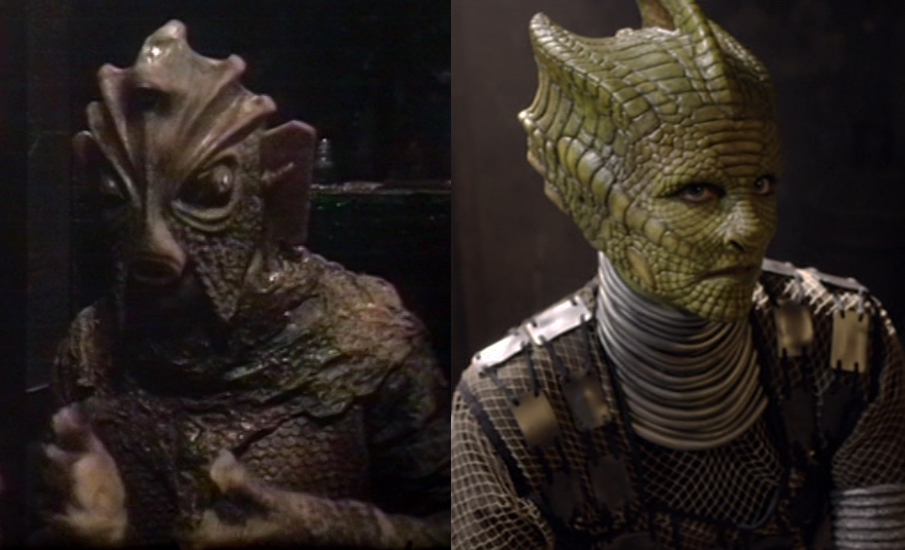
Decades later, the new Doctor Who series re-introduced the Silurians during the Matt Smith era. These episodes deal with Malcolm Hulke’s creations much more respectfully, and I really enjoy the idea of a badass lady Silurian living in Victorian England and kicking hiney to help the Doctor save the world and stuff. I believe they even wrote it that at some point in Earth’s future history, humans and reptilians really do learn to co-exist. This is definitely a major victory as far as my inner child is concerned; but I just can’t stand the new makeup design for the Silurians. Old Silurians (and Sea Devils) actually look like people with reptile heads, much like the Serpent Men from Conan and the Snake Men from Masters of the Universe. The new versions are really just people with reptile skin, and they don’t resemble the beloved creatures from my childhood enough to resonate. Still, I do enjoy the fact that Doctor Who‘s reptile people have at least been vindicated in terms of their collective story arc after all these years. 

Another show in which Robert E. Howard’s Serpent Men resurface is Hasbro’s G.I. Joe: A Real American Hero. In the 1987 animated film adaptation of the popular cartoon series, it is revealed that the international terrorist organization Cobra is really just a front for an ancient civilization called Cobra-La, which of course was populated by Snake People. These reptilians naturally seek to reclaim what they perceive to be their stolen earth, and the entire history of Cobra as a human totalitarian human regime is really just one more phase in their long game.

I don’t remember owning any G.I. Joe dolls, but I remember really enjoying the cartoon and its huge ensemble of diverse and fairly well-developed characters (especially my first true love, the Baroness Anastasia Cisarovna). But imagine my surprise when I learned that Cobra wasn’t actually created by Hasbro, which launched the toyline. Rather, it was “invented” by Marvel Comics, which was commissioned to write a story for Hasbro when it re-launched its catalogue in the 1980s. The writers at Marvel pointed out that the heroes needed some villains to fight if there were going to be any story worth telling; and for lack of any better alternative, they more or less cloned the concept of Hydra—the terrorist organization battled by superhero teams like the Avengers—and re-named it “Cobra.” 

Like Cobra, Hydra was originally founded by ancient reptilians, who later infiltrated human governments for their own purposes, including that of Nazi Germany. Then there’s the fact that many of Hydra’s most infamous members are named after snakes in one way or another, including Viper/Madame Hydra, Gorgon, Anaconda, etc. But there’s an extra layer here: the Serpent Men who founded Hydra turn out to be the very same Serpent Men who serve the “evil snake God” Set in Howard’s Kull and Conan tales. This bastardization of Set has even appeared throughout Marvel Comics as an actual character for superheroes like the Avengers to fight. This is ironic given that the real Egyptian God Set also makes a personal appearance in an episode of G.I. Joe; but as discussed in Episode #10, G.I. Joe was much much closer to the mark! Its version of Set doesn’t appear to be involved with the civilization of Cobra-La, either. 

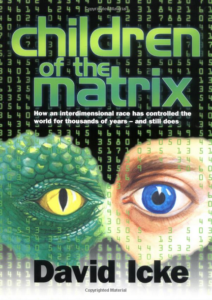
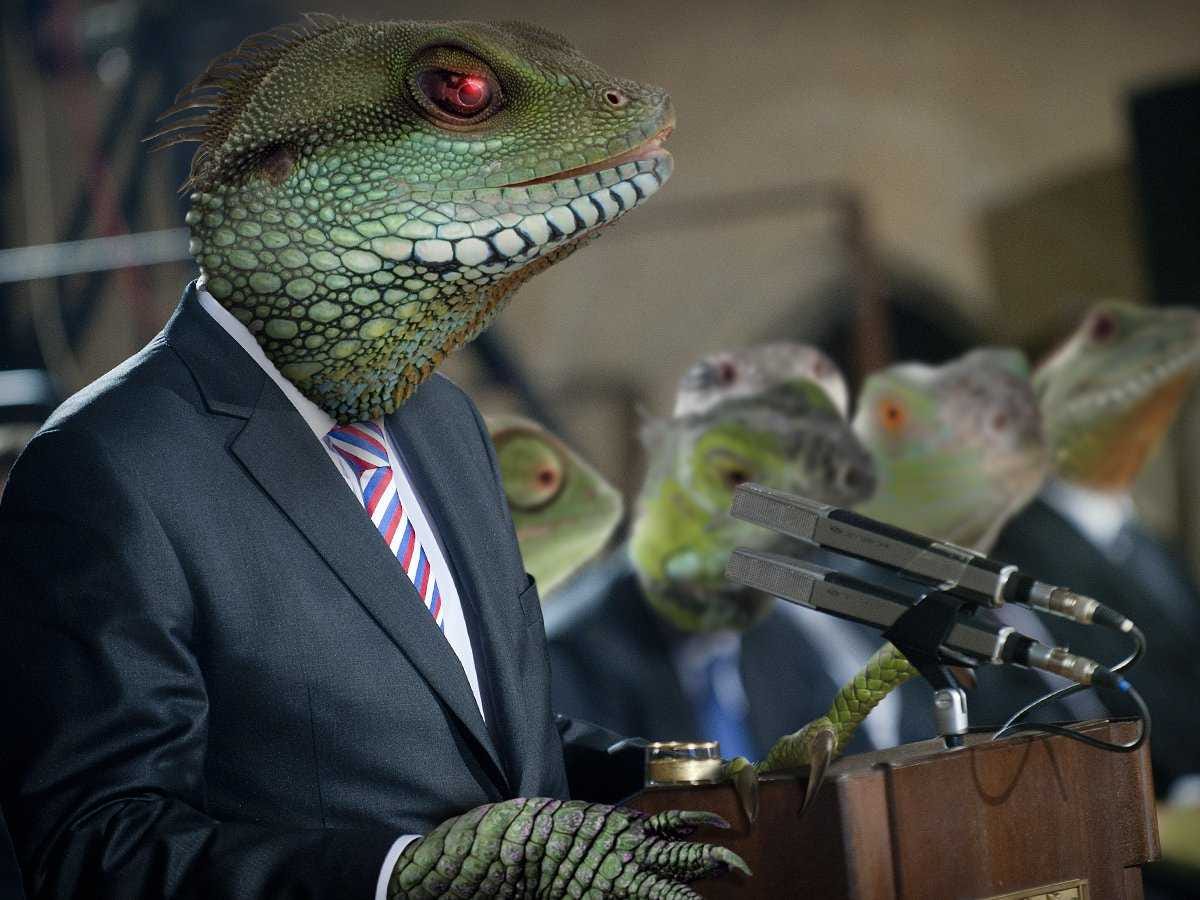
Now I must return to my earlier point about how writing about all of this will probably get me into some trouble with some people. (It’s okay, I don’t really care—this is all for Nehebukau, to whom I shall return in just a moment!) I am sure readers in the know are already chomping at the bit for me to touch on reptilian humanoid conspiracy theories and the bizarre subcultures they have bred in real life. I’m referring of course to the belief some people have that there are actual reptilians living among us here on earth. These people mostly take their cue from the exact same source: David Icke, a pseudoscientist and total huckster. Since the late 1990’s, Icke has popularized this belief that reptilians from a planet orbiting Alpha Draconis invaded our planet way back in ancient times. They were mistakenly worshiped as “Gods” by “wayward” people like the ancient Egyptians, and they continue to infiltrate modern human governments (including the entire Bush family, no less). Furthermore, this ancient alien reptile conspiracy is supposed to kidnap little children and drain them of their spinal fluid so it can be fed to Hillary Clinton, who is herself alleged to be a reptilian warlord in disguise. (Icke even manages to tie his evil reptilians together with Nazi Germany somehow, which explains the trope of Adolf Hitler secretly floating around the Arctic in submarines with reptile people.)

If you ever see this book lurking around your neighborhood, set it on fire. (The book, not your neighborhood.)

There are so many things wrong with David Icke’s bullshit, it’s impossible for me to address each particular grievance in today’s sermon. But my most immediate critiques are that Icke’s take on ancient civilizations is hopelessly racist; his encouragement of secularized Satanic Panic nonsense is absolutely deporable; and worst of all, domestic terrorists have adopted his anti-reptilian routine, trying to assassinate politicians they believe are reptilians. Yet there is something else wrong with all of this that should hopefully be CRYSTAL fucking clear by this point, given everything I have already explained above:

It’s ALL fiction, and NONE of it is original. 

Robert E. Howard made a lot of this crap up back in the 1920s. Then Marvel Comics came along and made up some more in the 1970s. Then a bunch of Saturday morning cartoons boosted the signal for it during the 1980s. And of course there have been countless other science fiction authors and media properties that have played around with the concept in one way or another. David Icke never wrote any of his conspiracy theory bullshit until the late 1990s, by which point the meme had already been well established in popular culture. So it’s pretty fucking clear that he plagiarized his entire routine from a bunch of cartoons and comic books. And the assholes who are willing to kill people over this shit are really doing it for nothing. 

Don’t know about this guy’s politics…But his profile is kickin’!

Here’s the thing: I do not actively believe there are any reptilian humanoids living on this earth, or at least not in the sense of “ancient aliens” (more on this below). I’m not saying it isn’t possible; I just haven’t found any evidence to substantiate such an idea. But even if I did, I would quicker assume such entities are just as native to this world as we are, and that they have just as much right to be here as we do. I don’t believe any of this nonsense about aliens controlling human governments; human beings are the single most dangerous creatures on this planet, we don’t need extraterrestrials to make us any better at wreaking havoc. If there ARE any Snake People around, they’re probably HIDING from us because they’re fucking SCARED TO DEATH of us! 

And to assume that an entire sentient race would be inherently evil simply because it evolved from reptiles is, to call a spade a spade, racist. WE evolved from motherfucking APES, and apes do some pretty fucked-up shit you know. Maybe it’s just because I grew up learning important lessons about these things from Captain Jean-Luc Picard; but I see no reason to assume a civilized reptilian people would be any worse at respecting Ma’at or fighting isfet than civilized simian peoples apparently are. (I can already read the emails from Icke’s zombie followers, skewering me for being some dumb, deluded PR boy for the Visitors who want to eat me and my family!)

The thing is, there are other people who believe in real reptilians so to speak, and who hold more sensible views about them than anything offered by David Icke. The most prevalent example of this would be Hindu, Buddhist, and other Asian religious belief systems that acknowledge the Nagas. These semi-divine creatures can appear as snakes, people, or any variety of human/serpentine hybrid. They are believed to have pre-existed humans, and while they can be good or evil just like us, most of them appear to be dutiful servants of the Devas (the Hindu Gods). They enjoy living in rivers, lakes, oceans and raindrops, and they guard all kinds of ancient knowledge and treasures. Though they are not necessarily Gods, the Nagas are often venerated with offerings, which helps to attract good fortune. Much of this is echoed in Chinese folk beliefs about dragons, as well. Lóng or Chinese dragons are also shapeshifters who can appear human and who bring good luck to those who show them the proper gratitude and respect.

I first learned about the Nagas not from a textbook or a cartoon show, but from my best friend in second grade, a boy named Pawan. Pawan and his family were Indian American immigrants and deeply observant Hindus. I remember seeing various images of the Devas whenever I visited their apartment. I do not recall which sect or tradition Pawan and his family might have followed (and being only eight years old or so, I lacked the head space to even formulate such a question at the time). But I remember asking Pawan’s mother to tell me about the Nagas, and she seemed really happy to share some stories with me. It must have been crazy to have this weird little white boy from next door take such a genuine interest in her family’s culture and heritage! 

But then I would go home and tell my parents about this stuff. For some reason, they were only okay with such beliefs as long as it was Pawan and his family practicing them. I received every indication that it is only acceptable for white people to be Christians and believe in one God, even though neither of my parents has ever been a committed religious believer of any kind. Much later I would meet some of David Icke’s followers (most of whom are white), who insisted to me that both Naga and Lóng veneration is really just another part of the evil reptilian plot to murder children and keep the world hypnotized. When these people claim that Asians are actually venerating evil demons or aliens—or if they suggest that such religious traditions are “beneath” white people for any reason—they are blatantly endorsing Christian white supremacism; full stop.

Even Nehebukau Himself was given the Marvel Comics treatment!

Furthermore, neither the Nagas nor the Lóng are space aliens that ride around in spaceships. There are no tales about them eating people or operating any nefarious shadow governments. They are nature spirits and religious figures, not science fiction monsters. The same is true of other Snake People who are acknowledged in other cultures too, including African Mami Wata spirits and Native American horned serpents. This begs the question: could the ancient Egyptians have believed in something similar? There doesn’t appear to be any specific term in Egyptian for “serpent man” or “snake person” (or at least not that I have found just yet); but perhaps this would have been redundant. The Egyptians appear to have regarded normal, everyday snakes as sentient creatures with magical powers. How else could serpents be held accountable to Ma’at, with the good snakes serving Ra and the evil snakes following Apep? This distinction makes little sense, at least to me, unless we stop to consider that maybe snakes are actually people too!

Which helps me circle back to the Netjeru. It is curious that I never felt drawn to any particular Egyptian snake deities until Setken first proposed that we collaborate on his Hymn to the Soul Serpent project together. Only then did it occur to me that everything I ever needed to justify my enthusiasm for snakes (whether as animals, sentient beings, or magical anthropoids) is already included in the belief system I already follow. And when I laid eyes on Setken’s humanoid portrayals of Nehebukau, I was taken back to those far-off days when I would play with my Snake Men dolls; when I would weep over the Silurians and the Sea Devils; when I secretly rooted for Cobra or Hydra as reptilian freedom fighters; and when I listened to Pawan’s mother explain to me about the Nagas. Could it be that Nehebukau was looking in on me even back then, thinking, “This is the kid I want to co-write a song for Me someday”? Could it have been His double-headed wisdom that helped me see through all of David Icke’s bullshit when it was first presented to me? Hell; I reckon Set and Nehebukau probably both had all of this arranged somehow before I was even born!

Writing one song isn’t all I think I am meant to do, either. I think Nehebukau has probably put all of this stuff into my brain for some kind of purpose, and I mean to put it to use somehow. This very likely means another album will soon be in the works. I always wanted to make movies when I grew up; and failing that, I enjoy adapting some of my old story pitches from childhood into “soundtracks” for films that don’t exist (as with Summer’s End and His Nocturnal Majesty, with which I am very happy). I’ve successfully introduced the crimefighting mummy Het-Sem-Peckinpah to the world, as well as the mysterious Knights In Sutekh’s Service. Now that my Halloween and apocalypse “movies” have been taken care of, so to speak, perhaps it is time to revisit my old sword-and-sorcery “movie” pitch as well. It could be that Queen Hissteria, Big Bad Mamba, and other Saurian Warriors of Basilisk Basilica will soon be making an appearance…

Looks like Nehebukau be shakin’ His booty for Wadjet and Meretseger!

Nephthys, the Dark Midwife

The sister and ex-wife of Set is a renowned healer of wounded hearts and minds.

Even more than Ishtar or Taweret, Nephthys is the Goddess who is most often linked with Set. In fact, some people might be wondering why it’s taken me 40 whole episodes before I got around to discussing Her. Truth is, I wanted to highlight the aforementioned Goddesses first because Their interactions with Set are far less known. I also think Set and Nephthys share a much more complex relationship than what is typically imagined about God and Goddess couples, for reasons I shall explain.

The name of this Goddess, which comes from the Egyptian Nebet-Het, means “Lady of the House.” It refers to a temple enclosure, rather than a domestic residence. In the Heliopolitan cosmogony, Nephthys is one of the fourth generation of Netjeru (the others being Osiris, Isis, Set, and even Horus in some accounts). As such, She is one of the divinities who facilitate life here on earth, and who contributes to the arts of human civilization.

The fourth generation of Gods was somewhat disruptive to the natural order of things at first. There is even a story about Ra, the first Netjer, prohibiting their granddaughter, the sky Goddess Nut, from giving birth to these young’uns (despite already being pregnant). Thankfully, the wise God Thoth finds a technicality that allows Nut to have her children while still technically obeying Ra’s decree. So first it was just Ra, and all things were united in them. Then Ra begat Shu and Tefnut, the breath and the waters of life, who are the first male and female. After that, Shu and Tefnut begat another male and female, Nut and Geb, the deities of heaven and earth. While Ra themself is hermaphroditic, the second and third theological generations are dichotomous, falling into a strict gender binary that is strongly tied to the reproductive cycle.

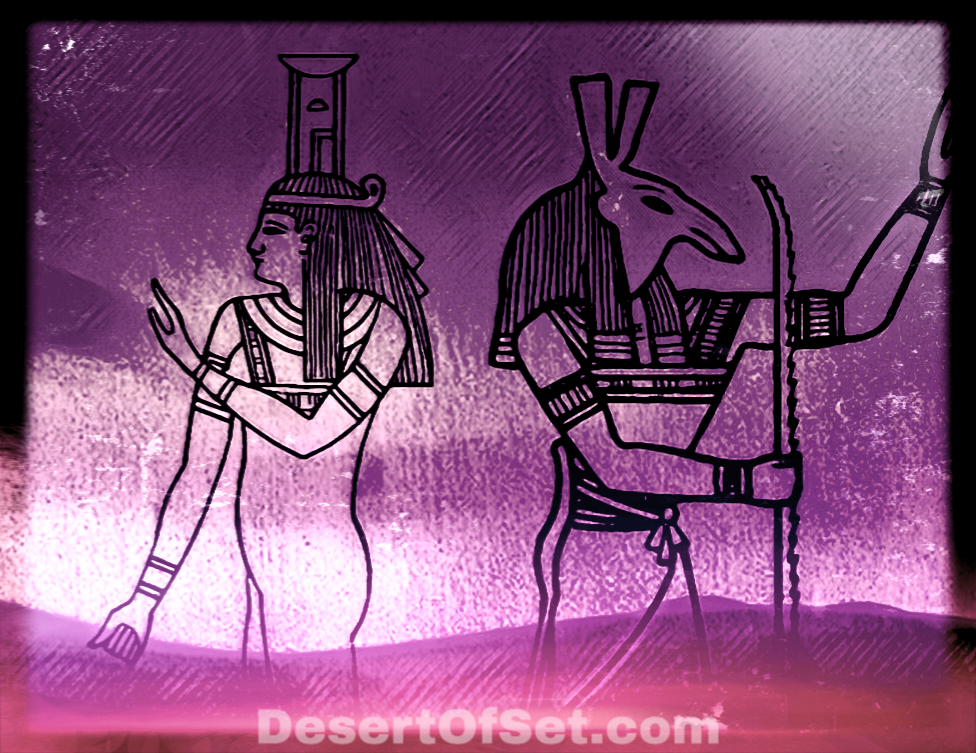
Reproduction becomes a major theme for the fourth generation of Netjeru as well, but in a radically different way. For one thing, there are not just two deities in this generation, but at least four (if not five, depending on whether you choose to include Horus—but more on that in a moment). Only two of these figures—Isis and Osiris—are a fertile heteronormative couple, and they become the darlings of the pantheon for this reason. Set and Nephthys are sterile and barren, incapable of producing any offspring. Set is also attracted to Gods of the same sex, and there is reason to think the same might be true of Nephthys. While Isis and Osiris are like celebrities, receiving all the glory and the privilege from their elders, everybody tries to forget about Set and Nephthys in the beginning, pairing Them together and leaving Them to fend for Themselves.

The way I see it, this is what sets the entire Osirian drama into motion. More than anything, Nephthys—sometimes described as “an imitation woman with no vagina”—wants to have a child; She wants to experience all the same parts of womanhood that Isis enjoys. So She disguises Herself as Isis and sleeps with Osiris, who is so miraculously fertile, he could even impregnate a corpse. Nephthys then gives birth to Anubis, the jackal God, and tries to hide Him so Set won’t find out what happened. But Set learns the truth and loses His temper big time. Instead of trying to harm Nephthys or Anubis, however, He squashes Osiris instead (twice, in fact). Then Isis goes on her journey to raise Osiris from the dead. She succeeds, sleeps with her brother-husband one last time before he goes to Duat, and becomes pregnant with Horus. (This is where the question of when Horus is born comes up again. I prefer to place it here at this point in the narrative, as it makes the most thematic sense to me personally; but there are other versions of the same narrative that cite Nut as the mother of Horus. Just one more example of how the ancient Egyptians were way ahead of quantum physicists or science fiction writers when it comes to the idea of alternate universes.) Nephthys dutifully accompanies Isis through all of this insanity, helping Her sister every step of the way.

Women from popular culture who have a “Nephthys vibe.” From left to right and up to down: Guinan (Whoopi Goldberg) from Star Trek: The Next Generation; Death from DC/Vertigo’s The Sandman comics; Elise Rainier (Linda Shaye) from the Insidious horror film franchise; goth rock artist Siouxsie Sioux; Morticia Addams (Carolyn Jones) from The Addams Family; and Lydia Deetz (Wynona Ryder) from Beetlejuice.

This is especially the case when it comes to the funeral of Osiris; and here is where Nephthys’ innermost drive becomes most evident. She and Her son Anubis help Isis reconstruct the body of Osiris and restore him to life. Through much of this process, Nephthys weeps and wails and whimpers with Isis, empathizing with the widowed Goddess and sharing in her profound sorrow. The Egyptians prayed to Nephthys as a kind of “dark midwife” you might say, a divine grief counselor who assists those in terrible emotional anguish, helping them heal and feel better over time. This fits together with the role of Anubis, who invents the funerary arts and becomes the first mortician. Nobody enjoys experiencing death or loss, but they are facts of life, and those of us who survive must find a way to live again. To think that Nephthys and Anubis have always been there to nurture things that help us cope with such experiences (such as counseling or mortuary science) makes my heart glow like a jack-o’lantern.

Nephthys sides with the Osirian Trinity during the Contendings of Horus and Set, and She sticks with them for the most part after the Great Reconciliation. She continues associating with Big Red when it comes to fighting the Chaos Serpent, and She appears to have been revered as a powerful fire-breathing warrior in this regard. But the one member of the Divine Family Nephthys truly seems to have fallen in love with is Isis. To make things even more interesting, other cosmogonies have cited Set as being Anubis’ father; the two are often linked (or even outright confused with each other) even today.

None of what I say next should be treated as any kind of official religious dogma. This is just what I personally take from these wonderful stories, and you can either take it or leave it. But I think Nephthys is a lesbian Goddess. I think She and Set still love each other; They have just always loved each other as brother and sister for the most part. They are divorced, but for good reason; They were never very attracted to each other in the first place. Isis and Osiris are married because they love each other; Set and Nephthys were paired together as an afterthought to make the rest of the pantheon happy. This refusal to properly integrate the forms of life and being that Set and Nephthys represent is what almost caused the downfall of Creation, and the apocalypse was only averted when the Netjeru got wise as a society and changed their ways. Now these two outcasts are truly accepted by Their family as equals, and Set has even grown to love Anubis and become His stepdad.

This trinity of Set, Nephthys, and Anubis is truly remarkable for many reasons. A divorced pansexual genderbending dad, a barren lesbian spinster mom, and a so-called “illegitimate” stepchild born of “adultery”? What isn’t there to love about this, or the fact that these figures were considered acceptable and divine in ancient Egyptian culture? The Western patriarchal concept of “the nuclear family”—which insists that all families must consist of two heteronormative cisgender adults with 2.3 biological offspring born in wedlock—is not only a more recent invention in the grand scheme of things, but a blatant work of isfet (poisonous falsehood and injustice) that contradicts Ma’at (everlasting goodness and truth). There is a place for EVERY sentient being in this world, AND for the sentient beings they love too. It simply DOES NOT MATTER whether we are male or female, gay or straight, trans or cisgender, married or unmarried, monogamous or non-monogamous, biologically related or adopted—and it NEVER has. Other religions need to hurry the fuck up and get wise to this, already. Set, Nephthys, and Anubis were already on top of this well ahead of Yahweh and Jesus, and things still don’t look so good for those two on this score today.

(Plus, Set, Nephthys, and Anubis are all goth as hell, like They’re the original Addams Family—and that is just cool.)

If there is any one divinity I associate with Hallowtide in particular (which is no easy task, given the sheer quantity of Gods who align with the occasion perfectly), Nephthys is the one. My wife and I enjoy visiting cemeteries all around our state in October and November, and to me, this is a way of honoring Nephthys throughout the holiday season. Just to walk among the graves and admire the craftsmanship of the headstones and tombs; to see all the ancient iconography that still shows up, even among the newer statuary; to soak in the names of the ancestors who rest there, and the times in which they lived; to be alone in the eerie silence. Even if you don’t believe in ghosts, there is just something about visiting such places for a couple of hours that has an effect on you. Most people seem to find the idea spooky, but I find it very peaceful and meditative, helping me achieve a level of mindfulness I usually can’t reach otherwise. To me, this kind of mindfulnessness is a huge part of what Lady Nephthys is all about.

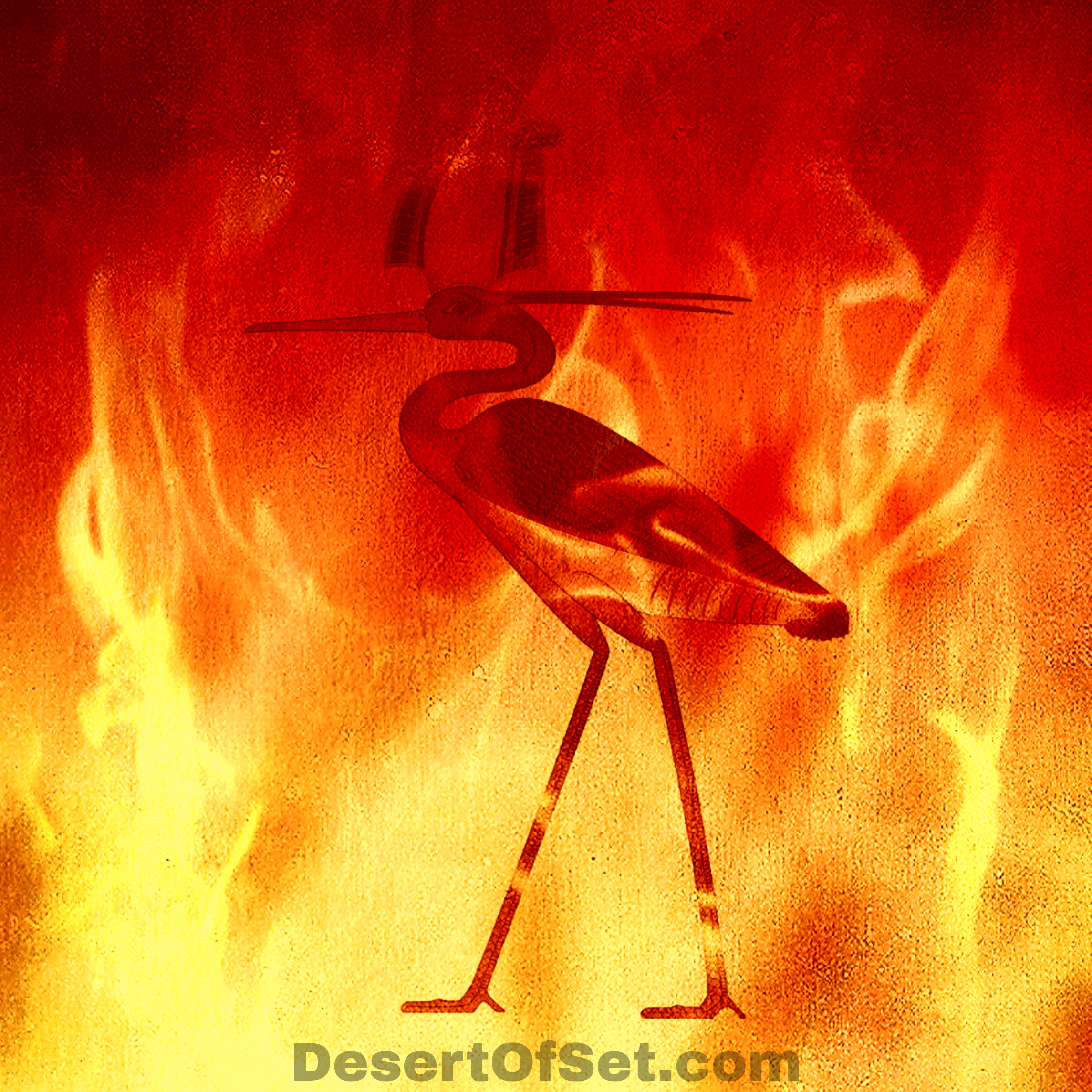
Lest She be accused of never being colorful, Nephthys is also the guardian of the Bennu. This avian divinity was associated with heron birds and the solar cycle in Heliopolis. The Greek writer Herodotus described it as the phoenix (a possible Greek derivative of Bennu), which later developed into the archetypal “bird of fire” that ritually burns and rises from its own ashes. These more modern associations are fascinating when put together with Nephthys’ reputation as a healer of wounded minds and hearts, as well as Her role as a fiery monster-slayer. Though it is really about Russian folklore, I enjoy listening to Igor Stravinsky’s The Firebird each year at Hallowtide because I find the titular creature analogous to that of the Bennu, and phoenix symbolism is very evocative of Nephthys to me personally.

Understanding the Yezidis

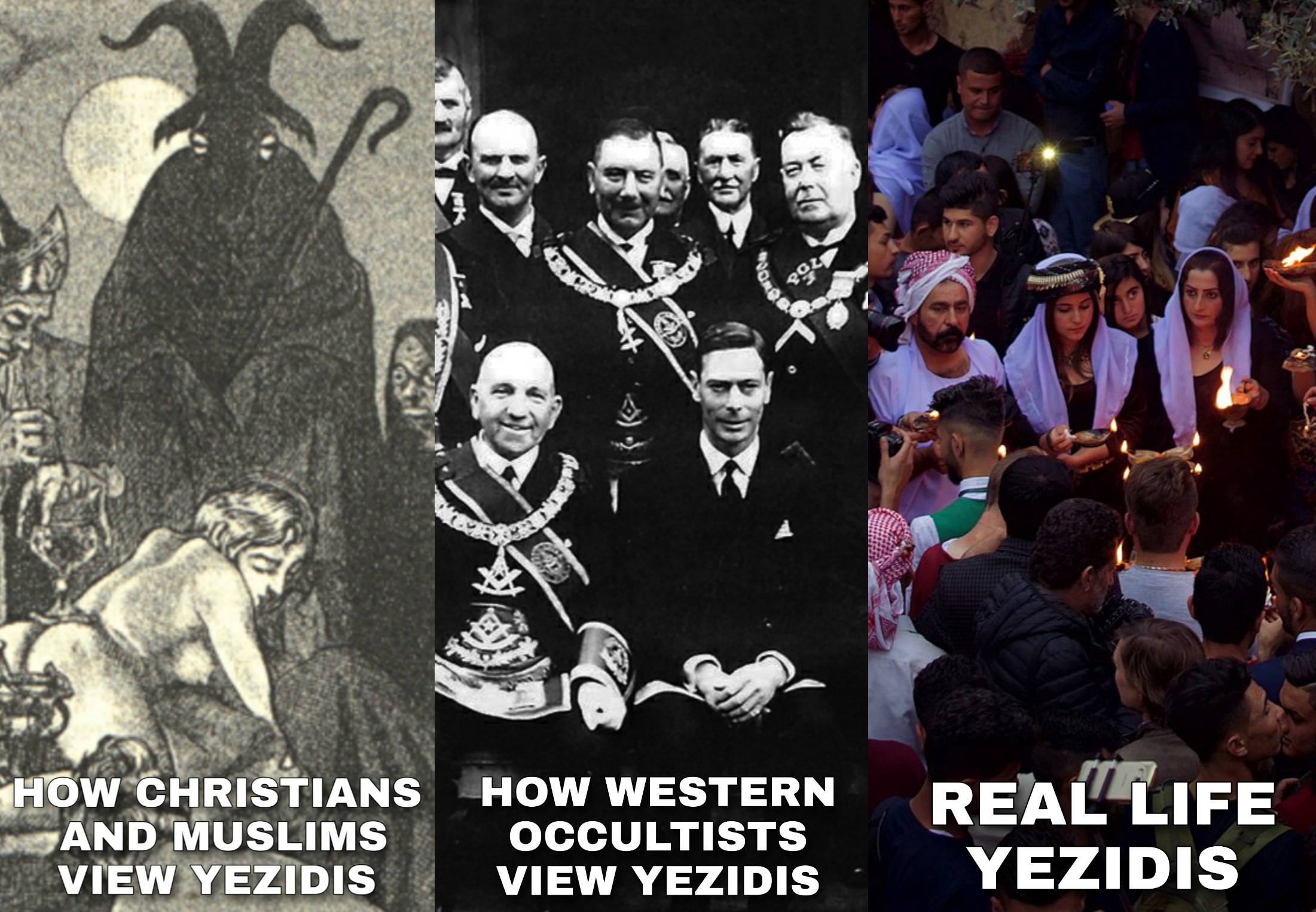
The Yezidis are accused of “worshiping the devil,” but are also romanticized by Western occultists—neither of which is acceptable.

I first learned about the Yezidis from reading Terri Hardin’s Supernatural Tales From Around the World in the late 1990s. At that point, most people—including Western scholars—were still calling them “devil worshipers,” and accurate information about this culture was still very hard to come by. It’s only been during the past 15 years or so that the outside world has finally given the Yezidis the proper attention they deserve, but the cause for this is unfortunate. After many centuries of persecution, the Yezidis continue to be systematically slaughtered by Islamic jihadists. They are especially despised by the Islamic State terrorist group, which has exterminated entire crowds of Yezidi men and kidnapped countless Yezidi women and children, forcing them into slavery.

Yezidism is a syncretized religion that combines pre-Zoroastrian Kurdish polytheism with certain elements from the biblical faiths. It revolves around nine theological personas, including: a deistic Creator God who takes little direct interest in mortal affairs; seven archangels that serve as custodians for Creation; and a holy prophet named Sheikh Adi ibn Musafir, who is believed to have been one of the seven archangels in human form. Yezidis believe that worshiping the Creator God is pointless, because this entity does not actually care what happens to mortal beings. Our prayers are more productively directed toward the archangels instead, since they now rule the universe in the Creator’s place. Of these seven angels, the most important is called Melek Taus or Ta’usi-Melek, “the Peacock Angel.”

Melek Taus appears to have been a polytheist deity who was later conflated with the Islamic version of Satan, and this is where the accusation of Yezidi “devil worship” comes from. According to the Koran, Iblis (“Doubt,” the Islamic name for Satan) was originally a genie who refused to prostate himself before Adam per Allah’s command. Iblis is said to have thought he was superior to human beings, and Allah cast him out of heaven for his insolence and pride. Afterwards, Iblis became the Shaitan and devoted himself to tricking as many people into disobeying Allah as possible (so they will go to hell). Aside from this origin story, the Islamic devil functions in much the same way as the Christian devil does; he is basically there to harass, frighten, and/or deceive monotheists into committing various “sins.”

The Yezidis worshiped their peacock God long before they ever heard this story; but at some point, attempts were made to convert them to Islam. They were told that their Peacock Angel is actually the Shaitan (just as all polytheist deities are really “Satan” in monotheist eyes). Strangely, the Yezidis seem to have agreed that Melek Taus is the same person as Iblis; and they do agree that he disobeyed a direct order from the Creator by refusing to worship human beings. But this is where the resemblance between these two narratives ends. The Yezidis believe that instead of becoming the devil, Melek Taus actually became the first monotheist. He disobeyed the Creator not out of pride but out of loyalty, for he was refusing to worship anyone else but the Creator. The Yezidis further hold that Melek Taus was rewarded for this act of disobedience, and that the Creator chose him to rule our cosmos. In this way, they justified the continued worship of their Peacock Angel not as the “enemy” of Allah, but as his regent.

Sheikh Adi ibn Musafir was a medieval Sufi Muslim who traveled to Kurdistan in search of some peace and quiet. Despite his attempts to live a monastic life, he drew the attention of his new Yezidi neighbors, who seem to have thought he was a wizard. Sheikh Adi likely tried converting the Yezidis to Islam (and he was probably one of the very few who ever tried to do this peacefully). As far as I’ve been able to trace, the idea of Iblis being “the first monotheist” originates from the Sufi movement, which follows a more mystical reading of Islam. I bet Sheikh Adi introduced this idea to the Yezidis, who then equated it with their own God Melek Taus. In any case, Sheikh Adi made such an impression on these people that they started to believe he was actually a human incarnation of the Peacock Angel. To this very day, making a pilgrimage to Sheikh Adi’s tomb is still an important component of the Yezidi faith.

The Khatun at the door of Sheikh Adi’s temple in Lalish, Iraq

Much of the attention Yezidism has received here in the West comes from Satanists, who often cite the religion as “proof” for the historicity of a pre-LaVeyan Satanism. (Nevermind the fact that Anton LaVey was preceded by two earlier 20th century Satanists, Maria de Naglowska and Herbert Sloane.) LaVey even included part of a so-called Yezidi text—the Al-Jilwah—in his book, The Satanic Rituals (Avon, 1972). This text is now accepted by some theistic Satanists as a direct revelation from Lucifer himself; but its true history is far less certain. For one thing, the Al-Jilwah is only part of a longer text called the Mishaf Resh (“Black Book”). And while it does reflect some Yezidi beliefs, it was not written by Yezidis. Back in 2007, I had an opportunity to speak about this with Dr. Philip G. Kreyenbroek (one of the leading scholars of Yezidi culture today), and this is what Dr. Kreyenbroek shared with me:

“The so-called ‘Sacred Books’ are forgeries and have little to do with Yezidi belief. [. . .] I can still remember the face of a learned Yezidi friend of mine when I first showed him the ‘Sacred Books,’ first he was scandalized and then he laughed fit to burst.”

—P.G. Kreyenbroek (Personal Communication, October 20, 2007)

I have met theistic Satanists who believe everything in the Al-Jilwah word-for-word, as if it were the Bible and they were fundamentalist Christians. Yet the truth is that:

  • Melek Taus and Satan are two completely different figures.
  • Yezidis don’t believe in “Satan” as he is defined in Christianity or Islam at all.
  • Yezidis consider the Al-Jilwah to be some Westerner’s idea of a joke.

This pretty much destroys the entire notion of using the Al-Jilwah as some kind of “infallible” sacred scripture. But Yezidi beliefs have also been appropriated by other Western occult groups, including Theosophists  and Thelemites . While romanticizing the Yezidis as “ascended occult masters” is much better than vilifying them as “devil worshipers,” it is equally removed from reality. What these people have written about Yezidism really says more about Western occultists than it does about Yezidis. It’s equivalent to saying, “I can’t find more than a single paragraph about the Yezidis in any of my encyclopedias, and I’ve never actually met a Yezidi person or directly experienced their faith in any way; but since I’m a Snooticus Maximus XXI° of the Ordo Assholius Genericus, I automatically know more about Yezidism than anyone else—including those silly Yezidis!”

A much better example of how Western occultists can treat Yezidi beliefs and culture would be the Feri Tradition of Traditional Witchcraft. For better information on this particular subject, check out The Blue God of Faery, an interview with Storm Faerywolf on Patheos.com.  

Alexander Hislop once conflated Melek Taus with Set, but my research has convinced me that this claim is false. However, I continue to feel great empathy for the Yezidis. I appreciate their unique theology, and I can identify with how frustrating it is when people think your God is “evil.” My heart also breaks whenever I think of all the human rights abuses the Yezidis have suffered en masse. This has been my attempt at setting the record straight about some of their beliefs, which are grossly misrepresented not only by Christians and Muslims, but also by Satanists and other Western occultists. There is nothing wrong with taking some inspiration from the Yezidi faith, if people feel a calling to do so; after all, the Yezidis themselves maintain that Melek Taus “belongs to everyone.” But if a person does take inspiration from the Yezidis, they should make every effort to understand Yezidism on its own terms, as well as to clarify that they are not actual Yezidis themselves. Since the Yezidis are an ethnic group as much as they are a religion, white people have no business trying to include themselves in their culture.

Further Information

YezidiTruth.Org

Who, What, Why: Who Are the Yezidis? (BBC News)

References

Acikyildiz, B. (2010). The Yezidis: The history of a community, culture and religion. New York, NY: I.B. Tauris & Co.

Allison, C. (2001). The Yezidi oral tradition in Iraqi Kurdistan. Richmond, Surrey: Curzon Press.

Arakelova, V. (2004). Notes on the Yezidi religious syncretism. Iran & the Caucasus, 8(1), 19–28. Stable URL: http://www.jstor.org/stable/4030889

Asatrian, G. (1999). The holy brotherhood: The Yezidi religious institution of the”brother” and the “sister” of the next world. Iran & the Caucasus, 3/4. Stable URL: http://www.jstor.org/stable/4030767

Asatrian, G., & Arakelova, V. (2004). The Yezidi pantheon. Iran & the Caucasus, 8(2), 231–279. Stable URL: http://www.jstor.org/stable/4030995

Guest, J.S. (1987). Survival among the Kurds: A history of the Yezidis. Abingdon, Oxon: Routledge.

Kreyenbroek, P.G. (2009). Yezidism in Europe: Different generations speak about their religion. Göttingen, Germany: Hubert & Co.

Ishtar, the Lady Morningstar

She rebelled to help humanity before Prometheus. She died and rose from the grave before Jesus. And She invented the “zombie apocalypse” before George Romero.

Almost every culture has viewed Venus—the “Lucifer” or Morningstar—as an aggressive, contrary force. This is because it is usually the first star seen at sunset, and the last star seen at dawn. Based on this phenomenon, people imagined that Venus is a “rebel” who defies the Sun, refusing to disappear as her superior rises, then rushing to ascend as the Sun sets. Even before medieval Christians incorporated Lucifer into their devil myth, most theological beings associated with Venus were perceived as unruly, cosmic shit-disturbers.

Ishtar, the Akkadian Goddess of Venus, is no exception. She stole the sacred mes, the powers of civilization, from Her uncle Ea and gave them to the people of Uruk. She insisted on visiting Her deadly sister Ereshkigal, the Queen of the Underworld, and conquered death in the process (with some help from Ea). When She learned Her husband Tammuz had not grieved for Her at all while She was dead, She killed and kicked His ass straight down into hell. When the “hero” Gilgamesh refused to marry Her, She sent the apocalyptic Bull of Heaven after him. And when Her father Anu refused to give Her the Bull at first, She threatened to raise all the dead across the earth and send them to feast on the living. She is also said to have an insatiable sex drive, exhausting all of Her various lovers to death.

If you think that sounds bad, Gilgamesh was a king who tyrannized his people, breaking into their homes and raping all the women. He only stopped when the Gods created Enkidu to challenge him, giving him something else to do with his time. Gilgamesh then became so obsessed with finding the secret to immortality that he abandoned his people and left them to fend for themselves. (What an asshole!) So it’s always seemed weird to me that he is portrayed as the “hero” in this story (despite being a tyrant and a rapist), while Ishtar is framed as the “villain” (even though She is divine and transcends all human understanding). The greatest threat Ishtar poses for this megalomaniac is not to his life, but to his ego.

(If Ishtar appeared and said She wanted to marry me, I’d say, “Okay.” Better to be mauled ecstatically by Ishtar’s lovely, blood-splattered mouth than to die by the hand of any mortal man!)

Ishtar appears in Babylonian art as a badass Amazon standing on a Gods-damn lion, getting ready to beat the shit out of some motherfuckers. Assyrian kings prayed for Her to join them on the battlefield like a Valkyrie and slaughter their foes like cattle. (And if their records are to be believed, She answered their prayers…brutally.) As a warrior Goddess, Ishtar was very popular with the Hyksos, who called Her Astarte and paired Her with their chief deity, Ba’al Hadad. When the Hyksos ruled Egypt during the Second Intermediate Period, they brought Ishtar’s worship into the Land of the Pharaohs. And since Ba’al Hadad was identified with Set by the Egyptians, they came to view Ishtar/Astarte as one of Set’s romantic interests as well.

There is a fragmentary Egyptian text from Edfu in which Yamm, a sea monster, demands the hand of Ishtar in marriage. For a moment, it seems the beast will claim its bride; but Set intercedes, and while the rest of the story is uncertain, there is a similar Ugaritic tale in which Ba’al Hadad rescues Astarte from Yamm. Since Hadad’s name is substituted for Set’s in the Edfu texts, the Egyptian version most likely ends with Set destroying Yamm and marrying Ishtar. Considering Their unruliness and Their shared frustrations with dying-and-rising fertility Gods (like Osiris and Tammuz), don’t you think Set and Ishtar make a perfect couple?

Ishtar is often vilified for being so “promiscuous.” This is due to a complete misunderstanding of hierogamy or hieros gamos, the concept of “sacred marriage.” It is a religious rite in which people have sexual intercourse, with at least one of the participants being “possessed” by a deity. Such procedures served a twofold purpose in the ancient world. The practical purpose was to channel the fertility of a God and/or Goddess into the crops, livestock, and people of a community. The spiritual purpose was to reach a higher level of consciousness. Under the right circumstances (all of which require CONSENT), a really good orgasm can totally “blow your mind” and make you feel like you’re in tune with the rest of the cosmos. It makes total sense why people would consider that ecstatic moment of self-surrender to be supremely magical. From this standpoint, sex can be much more than just some “dirty” animal act; it can be a divine religious experience that is both self-fulfilling and incredibly humbling.

The clergy in ancient religions that practiced hierogamy are often described as “cult prostitutes” by biblical scholars. This is especially true when it comes to the qadishtu or holy women of Ishtar. Sex did in fact play a part in the beliefs of the qadishtu, and they were ostensibly paid by the laity for their clerical services. But the way I see it, there probably wasn’t always a direct relation between these two things.

First of all, it is unclear whether Ishtar’s holy women actually engaged in hierogamy with everyone who entered their temples, or if just one priestess performed the rite with a king during the annual Akitu spring festival. To be honest, I have my doubts that even the latter case was always true. Many contemporary examples of hierogamy (such as the Great Rite in Wicca) are often performed symbolically (e.g., sticking an athame in a chalice, rather than actually copulating). It is entirely possible that hierogamy wasn’t always practiced quite so literally in pre-Christian times, either.

Secondly, it is wrong to assume that every service the qadishtu provided for their society was sexual in nature. In fact, it is very likely that most of what they did had nothing to do with sex at all. The available evidence would seem to suggest they were more like nuns than nymphs, caring for the sick and the orphaned, keeping chaste, and living their day-to-day lives in quiet, contemplative prayer. So the fact that Herodotus and the biblical patriarchs defined the qadishtu in terms of sex says infinitely more about them and their dirty little minds than it does about Ishtar’s holy women.

The Mušḫuššu dragon from the Ishtar Gate

Yet another attack on Ishtar is the false claim that She is the alleged “Pagan origin” of Easter. This story goes back to Alexander Hislop, who published a pamphlet called The Two Babylons in 1853. Hislop claimed that Ishtar was originally a mortal Babylonian queen named Semiramis, who single-handedly invented all of polytheism. She then became worshiped as Ishtar—which many Christians claim is pronounced “Easter” for some reason—and created the holiday we now know by that name for herself.

Hislop was partially correct; Easter does in fact have polytheist origins. But its name is actually derived from Eostre, a Teutonic fertility Goddess who bears no historical relation to Ishtar whatsoever. The imagery of rabbits and eggs is taken from a myth in which Eostre transformed a bird into a rabbit that could lay eggs (the Easter Bunny). These symbols do not appear anywhere in Ishtar’s iconography, which has plenty more to do with bulls, dragons, lions, and owls. Nevertheless, evangelicals continue to repeat Hislop’s bullshit at every turn, criticizing Easter as a so-called “satanic” rite to Ishtar.

The Burney Relief, depicting an unknown female figure who could be Ishtar or Ereshkigal (but who likely isn’t Lilith)

One thing that really sticks in my craw is when people confuse Ishtar with the succubus, Lilith. In the 1970s, many Pagan writers circulated a claim that Lilith originated not as the “first wife of Adam,” but as a “handmaiden” of Ishtar who served the Goddess by bringing men to Her temple for worship. Another claim states that Lilith is really a Goddess in her own right; she was later demonized, or so the story goes, when biblical patriarchy replaced the Goddess religions of old. And some people seem to think Ishtar and Lilith are really just the same person at the end of the day.

There is no evidence to support any of these theories. Even in pre-biblical polytheist cultures, Lilith was a qliphothic entity that ate newborn children and sapped men of their seed at night. She was never worshiped, but was only warded off with apotropaic spells. This was as true when the Epic of Gilgamesh was being written as it was when the Old Testament was being written. I can accept the idea of people believing Lilith is a Goddess today, if that is truly how they feel; but they should admit this is a new belief in the grand scheme of things, and not an ancient one. They should also avoid conflating Ishtar with Lilith, because the two are very different figures indeed. At the very least, the former is my Spirit Mama, and the latter is not.

I first met Ishtar in McClennan County, Texas, during the autumn of 1999. I was about to turn 17, and I had been walking with Set for just over two years. I can’t really explain what drew me to Ishtar so suddenly that cloudy afternoon; the best I can say is that Set “traded” me with Her, and I walked with Her for the following year. They traded me back after that, and I’ve been with Set ever since. I never quite understood why this happened until about a decade later, when I met the woman who became my wife. We met in a Pagan discussion forum, and the only reason we did is because I wanted to meet other people who knew about Set, and she wanted to meet other people who knew about Ishtar. Considering this, we’ve always felt that Set and Ishtar are personally responsible for micromanaging things just so the two of us would meet. And that hiatus I had with Ishtar was the Goddess sizing me up as a potential match for one of Her contemporary qadishtu. (I sure am glad I passed the test!)

Polytheism Is Not “Idolatry”

Yes Virginia, some people still believe in many Gods today, and it’s every bit as legitimate as believing in just one.

Anthropomorphism is the act of characterizing something that isn’t human (whether animal, vegetable, or mineral) with human qualities, feelings, and motivations. Bugs Bunny, for instance, speaks English, stands on two legs, and is generally a smartass. We all know real rabbits don’t do either of these things, so Bugs is what we call an anthropomorphized rabbit (and a damn funny one, too).

It’s impossible to practice any sort of theistic religion without anthropomorphizing the God or pantheon that’s involved to some extent at least, even when it comes to monotheism. Polytheists are only the most obvious example, given that we actually invoke our Gods into cultic images. Usually these icons are at least somewhat humanoid, even if they have animal heads (like the Egyptian pantheon) or multiple appendages (like the Hindu pantheon). Even when these images are completely zoomorphic, polytheists tend to be animists as well, believing that animals have souls just as humans do (as well as trees, rivers, stars, planets, etc.). So polytheism actively encourages us to anthropomorphize the entire cosmos.

Monotheists condemn this practice as “idolatry,” which is extremely offensive to polytheists for several reasons. First, it demonstrates a complete misunderstanding of what we believe and do. For some reason, monotheists always think we are cavepeople who think the icons we create and use for worship are actually alive and can move around or something like that. But not even ancient polytheists were that naïve. Our Gods are not the man-made images themselves, but the cosmic forces these images are designed to signify. The statue of a God is merely a tool for worship, not the actual object of worship itself.

Just consider this story from biblical folklore:

Abram tried to convince his father, Terach, of the folly of idol worship. One day, when Abram was left alone to mind the store, he took a hammer and smashed all of the idols except the largest one. He placed the hammer in the hand of the largest idol. When his father returned and asked what happened, Abram said, “The idols got into a fight, and the big one smashed all the other ones.” His father said, “Don’t be ridiculous. These idols have no life or power. They can’t do anything.” Abram replied, “Then why do you worship them?”

While I understand this story is allegorical, it is still dehumanizing and insulting to polytheists. Personally, I hope Abram’s father replied, “I don’t worship the idols; I worship THE GODS, whom the idols REPRESENT!” (And then I hope he grounded the little ingrate, since that little stunt probably cost their entire family several meals!)

When I invoke Set into one of His sacred images that I keep in my home, I treat the image as if it were a living, breathing entity. I kiss it, share offerings with it, or even blast some heavy metal and headbang with it. However, I am not naïve enough to think the image really IS Set. Gods are powerful, invisible cosmic forces that we’ve never been able to completely understand; we can see them working through natural phenomena, but we can’t actually see them directly. (And even if we could, it would probably make our brains explode and leak right out of our ears!) By anthropomorphizing the gods and inviting them into humanized images that we have created for them, we can demonstrate our love and respect for them just like we do for all the people and animals we love. When I kiss an image of Set, I know I am really only kissing an image; but the act of kissing that image is itself a powerful symbolic act. So while we can’t see or hear or touch the Gods like we can see or hear or touch each other, this is the next best thing.

I fail to see how this is any different from how Roman Catholics treat their images of Jesus, the saints, and the Virgin Mary. They light candles in front of these statues and talk to them while they pray, but none of them are daft enough to think the statues are actually Jesus, Mary, or the saints themselves. At the same time, most Christians (including non-Catholics) would consider it blasphemous to step on a crucifix or tear up a Bible, both of which are powerful iconic images. And when people think about the Christian God, they visualize him as a white-bearded patriarch sitting on a throne in the clouds. Part of the entire point to Jesus, in fact, is that he’s supposed to be Yahweh himself in human form—and it doesn’t get any more anthropomorphic than that! In other words, Christianity anthropomorphizes its God and is every bit as “idolatrous” as Paganism is; but for some reason, it’s only “bad” or “evil” when non-Christians do these things.

This image wasn’t invented by Seth McFarlane; it goes all the way back to the Canaanite God, El.

Despite what anyone else might say, anthropomorphism is not a “bad” thing at all. It is also not entirely removed from reality. For example, we now know that willow, poplar, and sugar maple trees will actually warn each other about impending insect attacks; that bees possess cognition and an extremely complicated language; and that beavers are basically hydraulic engineers, creating dams to make ponds and build houses for their families. Trees, bees, and beavers might not think, feel, or communicate the same way human beings do, but they DO in fact think, feel, and communicate. And when ancient peoples anthropomorphized these and other aspects of nature, it was their way of living in balance with the rest of the universe. Even atheists can’t help projecting human thoughts and emotions onto their beloved pets, and it’s really a good thing that human beings do this. Anthropomorphism encourages us to empathize with nature, rather than treating it like some soulless, alien thing that only exists for us to exploit. The earth would not be burning out of control like it is right now if more people anthropomorphized nature today.

Polytheists are also stigmatized for offering gifts, especially of food and drink, to images of our Gods. People assume we think the images will actually move and eat the food, or that we think our Gods will “starve” if we don’t “feed” them. In all my years of identifying as a polytheist, I have never met a single person who ever believed either of these claims—not even once. If you have trouble understanding why anyone would want to offer food to a God, all you really need to grasp is the historical importance of sharing meals. Food is just as important today as it was in ancient times, and having enough of it is often a struggle for many people. Hence why sharing your food with someone else is considered a HUGE sign of compassion and respect in virtually every culture across the globe. Even today, inviting people to breakfast, lunch, and/or dinner is still a prominent form of social bonding. And that right there is the true purpose of offering food to deities: to bond with them socially. By invoking Gods into images and offering them food, polytheists are inviting these cosmic forces over to dinner and treating them as distinguished houseguests. This is not just some wacky superstition, but a deeply affectionate form of religious worship that is every bit as authentic, legitimate, and passionate as anything that Christians, Muslims, or Jews practice.

Different polytheists make offerings in different ways. The Egyptians ingested their offerings, believing their Gods would consume the spiritual energy of the food while the worshipers consumed its physical substance. I have always liked this way of doing it best, because it feels more like one is sharing with the deity than simply giving them things. When we treat people to dinner, we don’t just pay for them to eat and not eat anything ourselves; we eat with them. And if the Gods truly consume anything during this process, it is the love and good will we express to them through such demonstrations of faith. But food and drink are not the only things we can offer; we can also offer actions, like helping a deity’s sacred animals, or writing literature and/or creating art for the God(s). We can participate in our communities in ways that honor them, like donating to a library for Thoth, picking up trash in a park for Geb, or visiting a dairy farm and feeding the baby milk cows for Hathor. There are all kinds of things we can offer to the Gods and share with them and others that will make our souls and spirits glow with love and good vibes.

Another stigma against polytheists is the belief that we commit human sacrifices. It is true that certain civilizations engaged in this practice, but the Egyptians do not seem to have done so for any theological purpose. In those cases where a Pharaoh’s servants were ceremonially killed and buried with the deceased king, it was to appease the king, not the Gods. As a polytheist, I think killing anyone except in self-defense is a barbaric offense against the Gods, and most other polytheists will tell you the same. If a person kills someone in the name of a polytheist God, they are in the exact same category as monotheists who bomb abortion clinics or fly airplanes into skyscrapers because “God told me to.”

As for animal sacrifice, most polytheists do not engage in this practice today, but those who do usually live in rural areas and are accustomed to killing their own food. They are not cat-slashing sociopaths, but regular hunters or farmers; all that’s different is that they dedicate the animals to their Gods and thank the animals for their lives before killing them and eating them. It’s not that different in principle from butchers preparing kosher or halal meat products. Suffice it to say that polytheists who live in urban or suburban areas have no reason to kill any animals, since we are just as accustomed to buying our food from local supermarkets as everyone else. Many of us are also vegetarians, vegans, and/or animal rights activists, so the idea that we run around bathing ourselves in goat’s blood is total bullshit.