Holy Days of the LV-426 Tradition

The times we consider most sacred in our coven.
Today I figured I’d discuss the major holidays observed by Setians of the LV-426 Tradition. These aren’t necessarily the only holidays we celebrate; some of us also celebrate things like Christmas, Mabon, or even St. Patrick’s Day. But these particular times are the ones we all agree are most important to our shared religious calendar.

The LV-426 Sabbat

The word Sabbat is used differently in many faiths. In LV-426, we use this term in reference to a weekly night of worship that has most often been observed on Friday nights, but which can really be observed on any night of the week. The idea is to meet with Set for a Sabbat every seventh night, in any case, and whenever possible.

Our Sabbat procedure is simple. We use the basic rite that is offered in the very first episode of this series (Setianism: A Brief Introduction). When we get to the part when we speak our wills to Set, we discuss all the high and low points of our week with Him, speaking informally. If more than one person is present for worship, each attendee takes a turn at doing this.

Once everyone has had a chance to say what they wish to say, we throw on some heavy metal and break out the booze, chatting through the night until dawn. Set is asked to remain present if it pleases Him to do so, and He guides the conversations we have during these sessions. There is no other situation in which I am quite so comfortable, happy, or grateful as when I am meeting with Set and my brothers and sister in Him for our Sabbat.

It’s been several years now since our coven has been able to keep the Sabbat together as a group; but the procedure can be followed in a solitary context as well. You don’t even need the booze or the heavy metal; all you really need is to pick a night that works best for you, then try your best to spend some time with Set on that same night every week. How you choose to spend or structure that time with Him is entirely up to you. And if you are unable to follow the same procedure every week for any reason, do not hate on yourself. Set is always with His chosen ones, and He knows what we are all going through. Our Sabbat is not a commandment, but a gift. There is no expectation that we must observe it every week; but it is always there whenever we need it.

Egyptian New Year

The Egyptian New Year festival (or Wep Ronpet, which means “Opening of the Year”) coincides with the heliacal rise of Sirius, the annual flooding of the Nile, and the Dog Days of Summer. It technically falls on a different date each year, and the precise calculation of this date depends on your geographical location.

A heliacal rising occurs when a star that hasn’t been seen in the nighttime sky for a while becomes visible again in the east, just before dawn. Sirius disappears for about 70 days in May, and it reappears toward the end of July and the middle of August. (This is called the “Sothic Cycle.”) The Nile River always floods soon thereafter, just like clockwork. There isn’t much rainfall in Egypt at all, so this annual inundation provided the only means for irrigation in ancient times. And when the Egyptians saw Sirius rising in the east just before dawn in late July, they took it as a sign from the Goddess Isis (the ruler of Sirius) that it was time to start planting all their crops for the year. To this very day, the Egyptian people still celebrate the annual flooding of the Nile as a two-week civil holiday called Wafaa El-Nil, which begins each year on August 15.

August 15 is also a significant date for me personally, as it marks the anniversary of when I first came to Set in 1997. So while everyone who observes this holiday will understandably observe it on different dates due to the Sothic Cycle, I just celebrate it on August 15 each year and call it a day. To be honest, the Dog Days of Summer (which take their name from Sirius, “the Dog Star” in Canis Major) just feel very sacred to me in general.

Wep Ronpet is not just the start of a new year; it is also an echo of the Zep Tepi or “First Time,” when the first God began to stir within the primordial ocean of chaos. One way to mark this occasion is to greet the sun as it rises (on whichever date you prefer to celebrate) beside a body of water (preferably a large one, if possible). As you watch the sunrise, know that you aren’t just watching the start of another day; you are witnessing a “re-run” of the Creation of the universe. Another worthwhile holiday activity would be execrating any negativity you might have collected in your life over the past year, which is something many people who walk with the Egyptian Gods do. (For an example of an execration rite that we use in LV-426, check out Episode #31 of this series.)

Hallowtide

Halloween isn’t “just for kids,” and it wasn’t invented by the candy companies either. It originates from a blend of Celtic folk religion and Roman Catholicism. It is just the first of three holy days—All Hallows’ Eve (October 31), All Saints’ Day (November 1), and All Souls’ Day (November 2)—which are collectively known as Hallowtide.

Even before the Catholic Church reached Great Britain and Ireland, these three dates were already an ancient festival called Samhain (“SOW-wynn”) in Gaelic and Nos Galan Gaeaf (“knows GAIL-uhn GUY-ov”) in Welsh. It marked the end of the harvest season and the start of winter, which was an extremely frightening time for the Celts. Many of them would die of starvation, disease, or freezing temperatures before the following summer. For this reason, the first night of winter weighed heavily upon their minds, and people thought the barriers between this world and the next were temporarily lifted, allowing the dead and other paranormal beings to roam free. This wasn’t so bad when it came to ghosts, who were viewed as beloved ancestors to be welcomed. Malevolent faeries and qliphothic entities were the real concern, and people dressed in frightening animal skins, carved protective charms from turnips, and left out offerings of food to keep such things away. It’s from these ancient traditions that wearing costumes, carving jack o’lanterns, and trick-or-treating are all descended.

Halloween was always my favorite holiday growing up, more important than the winter holidays, and it’s the first thing in which I ever took a religious interest, even before Set. I enjoy handing out candy to trick-or-treaters on October 31st; but once the boils and ghouls have all gone home, I begin my all-night vigil for the dead. I light some candles for our ancestor shrine in the kitchen, and I say some words to our dearly departed. I keep the candles burning all night long, not going to bed until 5:30 in the morning or so. Then I repeat this process the following two nights.

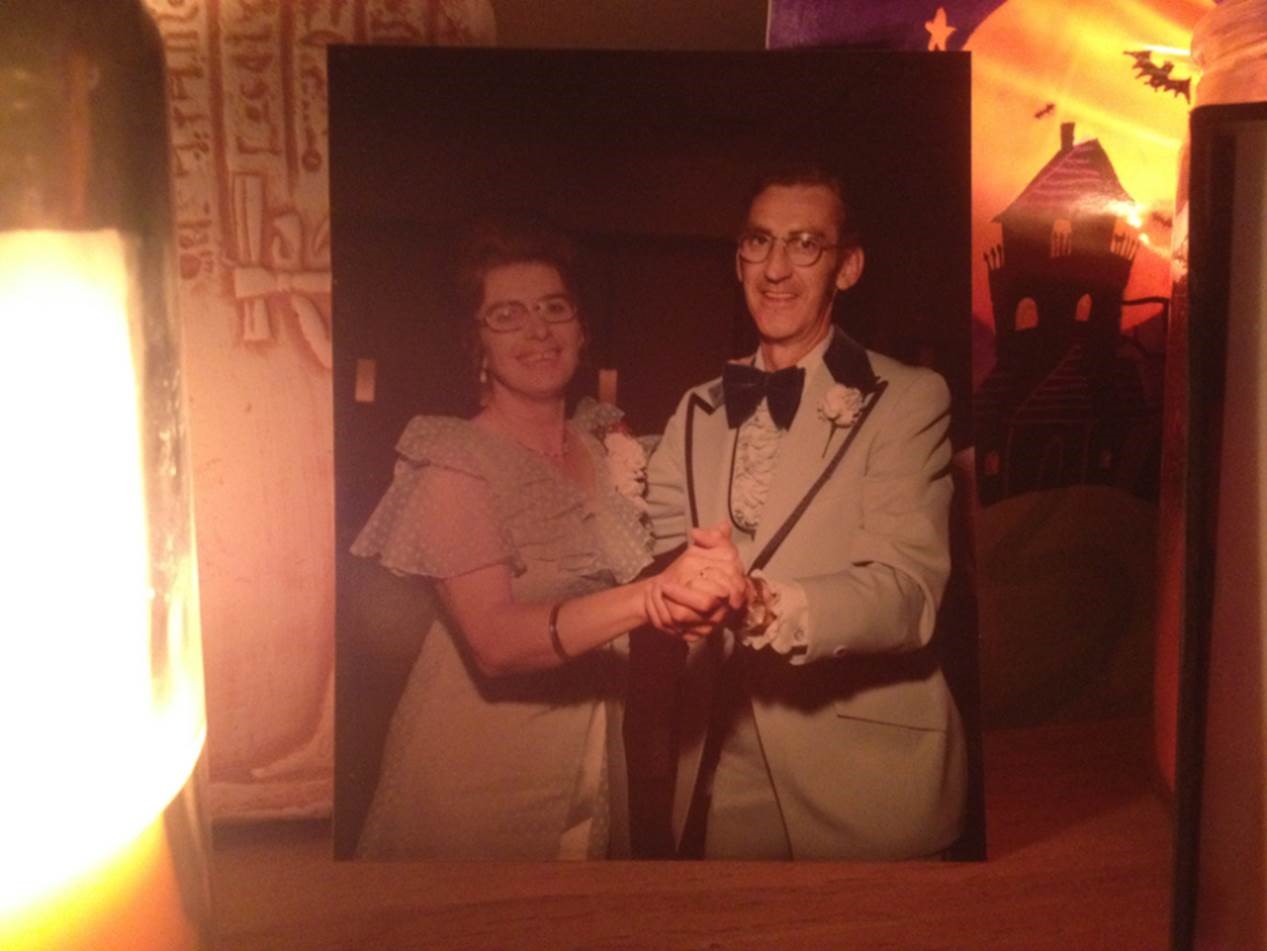
Spooky things do tend to happen during these vigils, like voices or footsteps that come from nowhere (especially around 3:00 am). But nothing scary or sinister ever happens, perhaps due to our ancestors’ protection. Call it “superstition” if you like, but we take this stuff pretty seriously. I think it’s important to keep the true spirit of Halloween alive as much as we can.

Walpurgis

Walpurgisnacht or Walpurgis Night is a spring fertility festival that’s observed each year on April 30. It’s the Teutonic equivalent to May Day or the Celtic Beltaine, but was later renamed after the medieval Christian Saint Walpurga. It represents the cross-quarter point of our solar year between the Spring Equinox and the Summer Solstice, and it’s a time for warding off the last vestiges of winter. It’s most often observed in continental Europe by wearing scary costumes, lighting huge bonfires, and making all kinds of Gods-awful racket to scare away the evil spirits. In fact, you might say Walpurgisnacht is Germany’s version of Halloween; one might even call it “Samhain in the Spring.”

A Walpurgisnacht gathering at the Heidelberg Thingstätten in 2007 (from Wikimedia Commons)

For Setians in LV-426, the lore of witches roaming mountains on this night, throwing bacchanalian rites to a horned God mistaken for “Satan” is suggestive of our own experiences with Set. Since He is a nocturnal God of the wilderness, we’ve always preferred to recite our incantations to Him in lonely woodsy areas after dark (or immediately before dawn). And since the ears of Set’s most holy symbol, the Sha, resemble “horns” (not to mention that some of His other sacred animals include such horned and hoofed critters as antelope and oryx), it is easy enough to conceptualize ourselves as “witches” who invoke a horned God at night. So adopting Walpurgisnacht into our religious calendar has always made sense, at least to us.
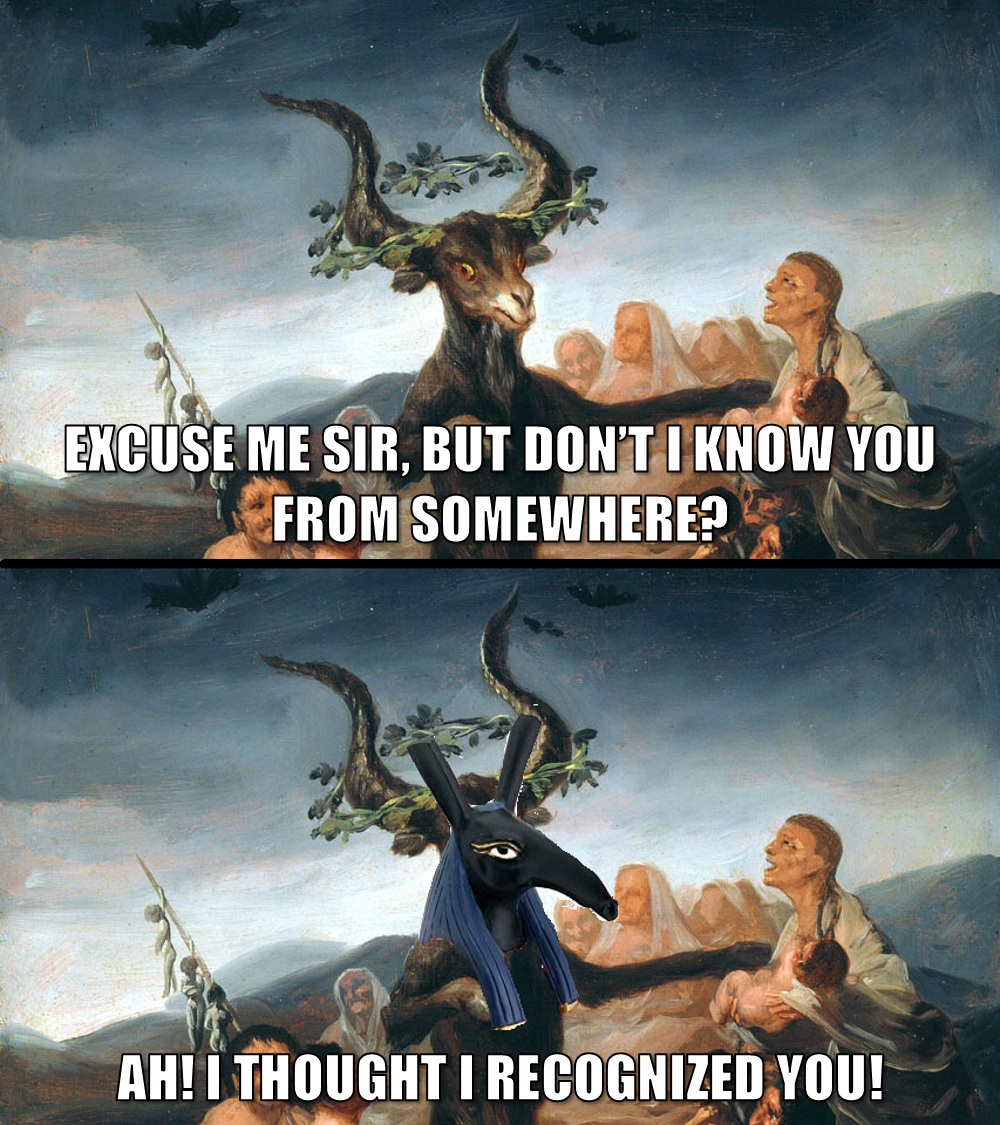
With apologies to Francisco Goya…

Perhaps the greatest Walpurgisnacht in LV-426 history so far was in 2005. It was on a Saturday that year, and I was living in Houston. The Tonester drove down to visit me for the whole weekend, and we hit the city together like bricks fired from a machine gun. We roamed every strip club, antique book store, and vintage record shop we could afford at the time, growling the lyrics to all our favorite death metal songs and shouting a random “DUA SET!” at every turn. It was perhaps the only time in my life that I have ever felt completely comfortable wearing my spirituality on my sleeve in public. It was a weekend full of booze, lewd jokes, horror flicks, and about a ton and a half of heavy fuckin’ metal. We really shook the pillars of heaven, by Gods, and when it was over, we both knew Big Red was mighty pleased.

“Turn it up to 11, Hoss!”

Saturday, April 30, 2005: The city of Houston fell under siege to a bizarre sect known only as LV-426. Heads were turned and jaws were dropped as two strapping young lads of Sutekh took to the streets. No slice of pepperoni pizza was safe. No vintage record shop could run. No 1970s folk horror movie could hide. But lo, musical instrument shops had it the worst by far; for Set’s crazed servants did ecstastically hammer on drums, strum on electric guitars, and scream psalms to His Majesty on microphones turned up to 11 in full public view. Never before had such madness been seen or endured by the community, and the dark wizards soon vanished as mysteriously as they had appeared, like a nightmare before the break of day. No evidence remains of the outlandish lunacies that were witnessed on that fateful Walpurgis Night—not even a photograph…

Friday the Thirteenth

When Set slays Osiris in Egyptian mythology, He chops him into 14 pieces, 13 of which are then buried throughout the world (before they are re-assembled and restored to life by Isis), while Set feeds the final piece—Osiris’ phallus—to an elephantfish. (Dennis Wheatley refers to this fish as “the Talisman of Set” in his 1934 novel, The Devil Rides Out.) There were also 13 people at the Last Supper of Christ, which was soon followed by his crucifixion (on a Friday, no less). In both tales, the dying-and-rising God can’t rise from the dead until he is killed first (with Judas Iscariot fulfilling the Setian role in the Christian narrative). The God must be sacrificed before he can rise again and offer new life to the world, and in this context, the number 13 represents initiation: the (often painful) ending of one phase of existence, followed by the glorious emergence of a new and better life.

In LV-426, we don’t view Set and Osiris as “enemies”; we think of the two as being like a gardener and a rosebush, respectively. It’s Set’s job to “prune” Osiris so the latter can produce fresh “blooms,” which keeps the universe alive and healthy. If Set were not there to keep Osiris regenerating himself, there would be no past and no future; there would only be a static present in which nothing new can thrive. So while the experience of being “pruned” by life’s hard knocks certainly isn’t pleasant for anyone, Setians in LV-426 believe it’s important to honor Set for His role in this process. We also think it’s important to take a moment and Hail Osiris as well, and Friday the Thirteenth is our preferred time for doing so.

Watermelon is reported to be one of Set’s favorite foods, and since it’s a plant, it is also sacred to Osiris. So one LV-426 custom for Friday the Thirteenth is to buy a watermelon, recite some prayers over it, chop it up, and share it with Set and Osiris as a sacred meal. As we each eat the watermelon, we also partake of Osiris’ regenerative powers so we can heal and grow back stronger from whatever trials we are currently facing in life. One year, we hosted this dinner at a derelict cemetery, and we respectfully shared our offerings of watermelon with the forgotten ancestors who were buried there.

 “Dinner with the Dead” we hosted in honor of Osiris for Friday the 13th, August 2010.

Aside from hockey masks (thanks to Jason Voorhees), black cats are one of the first things people associate with Friday the Thirteenth. Everyone knows the old superstition about how you’ll get “seven years’ bad luck” if a black cat crosses your path. But what most people don’t realize is that cats are actually very lucky creatures to have around, and that black cats are especially lucky. Remember, cats were worshiped in ancient Egypt; they were protected by law from injury and death, and families mourned, mummified, and buried their beloved felines as if they were human beings. Cats were thought to have a special connection to the spirit world, and were especially cherished for driving away evil spirits. The color black was also considered very lucky indeed, given its association with the fertile soil of the Nile Valley. From this perspective, a black cat is twice as lucky as usual, for it not only has all the standard demon-repelling bells and whistles; it also carries the promise of hope, fertility, and regeneration wherever it goes.

My youngest child, Bishop.

The number of days in February and March are such that if Friday the Thirteenth ever falls in the former, it will also fall in the latter (unless we’re in a leap year). Having two consecutive Friday the Thirteenths in the same month like this only happens 3 times every 28 years, and it never happens at any other time of year. For these and other reasons, this occasion is considered highly sacred in LV-426 and is observed as a month-long festival that we call Miew Khem or “the Month of the Black Cat.”

An LV-426 Execration Ceremony

An example of an execration ritual, a procedure to cast out and/or ward off negative energy.

Everyone showed up at our house around 5:00 PM that Saturday, and each person was given a small ceramic pot and a black Sharpie marker. I instructed them to write and/or draw whatever they liked on their pots. Whatever they wrote or drew had to represent negative things that were bothering them and that they wanted to cast out from their lives. It was a silent and solemn twenty minutes as everyone meditated on the demons that were haunting them the most, pouring all that sad and frightening energy into their drawings.

Once everyone had finished decorating their qliphothic pots, I implored them not to touch anyone else’s pot (or to let anyone else touch theirs). We had just created the magical equivalent of bio-hazardous waste products, and it was vital that no one be “infected” by anyone else’s bad vibes.

Then we all went out into the back yard, where Blackwyn and I had prepared a small altar to Set (complete with His statue and a big red lantern). We had also set up a couple of garden tiles on which all of our qliphothic pots could be smashed.

One of our friends brought her 2-year-old daughter, and the little girl had brought her toy pig. As we prepared to recite the opening invocation, the girl approached the altar and stared at Big Red’s statue. We were briefly worried that we’d need to intercede, but she just stood there, quietly and respectfully gazing at the man with the funny animal head. Then she placed her toy pig right beside the statue and said, “That better”—as if she somehow understood that pigs are one of Set’s favorite critters. As the child walked back to her mother, everyone who was present felt a powerful chill, including those who weren’t committed believers.

It was evident that Set was already present, but I invoked Him into our ceremony just the same:

Hail, Son of Nut! You Before Whom the Sky Shakes! Hear us, O Lord of the Wastelands! O Divine Foreigner! O Bringer of Winds! O Savior of the Sun! As You travel the Desert between the Worlds, as You smite the Evil One again and again, look down upon us and straighten our spines! Open our mouths to speak great words of power! We are Your soldiers upon this Earth; put us to Your work!

Now it was time to conjure the Chaos Serpent and kill it together as a tribe—as a constellation brought together by Set from across the Earth:

Torment be upon you, Apep! You enemy of Set, of all gods and all creatures! The Companions of Set prevail over you, for you are but the filth of unborn pasts! Accursed shell and nothingness, the Typhonian Beast shall rip and tear you asunder, and scatter your meat as confetti to the winds! Taste your death, Apep! Get back and retreat, O enemy of Set! Fall down, be repulsed, get back and retreat! For the Eye of Set is upon you, piercing you like a spear! It is His Army that drives you back with all of our thunder and metal! O vile and vapid corruption, WE CAST YOU BACK INTO NOTHINGNESS!

Then we all took a deep breath…and we chucked our qliphothic pots upon the garden tiles as forcefully as we could, all at the same time.

Ceremonial smashing of demon pots

No one expected the crash of the pots to be as loud as it was; it echoed throughout the neighborhood like a thunderclap. The shards flew more violently than we had anticipated as well, but no one was harmed. We were briefly shaken by the sight and the sound of what we had done, but we also felt a clear and powerful sense of release, like a knotted muscle melting into butter.

Then I brought our spell to a close:

Back, fiend! An end to you! Set has driven thunder and lightning at you! Set has made you to be destroyed, and Set has condemned you to evil! An end, an end to you! Taste your death! An end to you! You will NEVER swallow the dawn! You will NEVER win the night!

Our curse had been cast, and our demons were on the run. The others went inside to decompress from this experience, and Blackwyn and I went to sweep up the debris of the qliphothic pots.

Then, as if on cue, it started to rain.

We decided to leave the qliphothic pots alone, so Big Red could piss on the Chaos Serpent’s corpse for a spell.

Polytheism Is Not “Idolatry”

Yes Virginia, some people still believe in many Gods today, and it’s every bit as legitimate as believing in just one.

Anthropomorphism is the act of characterizing something that isn’t human (whether animal, vegetable, or mineral) with human qualities, feelings, and motivations. Bugs Bunny, for instance, speaks English, stands on two legs, and is generally a smartass. We all know real rabbits don’t do either of these things, so Bugs is what we call an anthropomorphized rabbit (and a damn funny one, too).

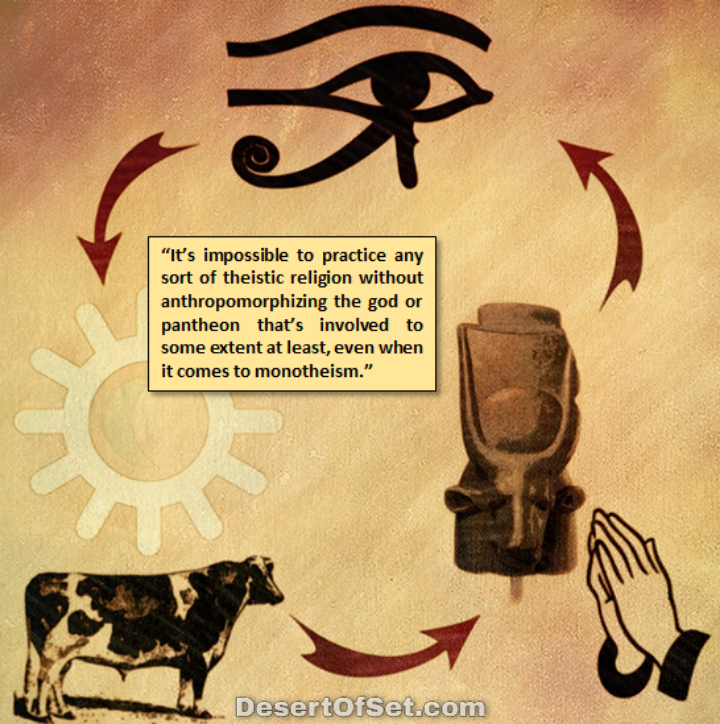
It’s impossible to practice any sort of theistic religion without anthropomorphizing the God or pantheon that’s involved to some extent at least, even when it comes to monotheism. Polytheists are only the most obvious example, given that we actually invoke our Gods into cultic images. Usually these icons are at least somewhat humanoid, even if they have animal heads (like the Egyptian pantheon) or multiple appendages (like the Hindu pantheon). Even when these images are completely zoomorphic, polytheists tend to be animists as well, believing that animals have souls just as humans do (as well as trees, rivers, stars, planets, etc.). So polytheism actively encourages us to anthropomorphize the entire cosmos.

Monotheists condemn this practice as “idolatry,” which is extremely offensive to polytheists for several reasons. First, it demonstrates a complete misunderstanding of what we believe and do. For some reason, monotheists always think we are cavepeople who think the icons we create and use for worship are actually alive and can move around or something like that. But not even ancient polytheists were that naïve. Our Gods are not the man-made images themselves, but the cosmic forces these images are designed to signify. The statue of a God is merely a tool for worship, not the actual object of worship itself.

Just consider this story from biblical folklore:

Abram tried to convince his father, Terach, of the folly of idol worship. One day, when Abram was left alone to mind the store, he took a hammer and smashed all of the idols except the largest one. He placed the hammer in the hand of the largest idol. When his father returned and asked what happened, Abram said, “The idols got into a fight, and the big one smashed all the other ones.” His father said, “Don’t be ridiculous. These idols have no life or power. They can’t do anything.” Abram replied, “Then why do you worship them?”

While I understand this story is allegorical, it is still dehumanizing and insulting to polytheists. Personally, I hope Abram’s father replied, “I don’t worship the idols; I worship THE GODS, whom the idols REPRESENT!” (And then I hope he grounded the little ingrate, since that little stunt probably cost their entire family several meals!)

When I invoke Set into one of His sacred images that I keep in my home, I treat the image as if it were a living, breathing entity. I kiss it, share offerings with it, or even blast some heavy metal and headbang with it. However, I am not naïve enough to think the image really IS Set. Gods are powerful, invisible cosmic forces that we’ve never been able to completely understand; we can see them working through natural phenomena, but we can’t actually see them directly. (And even if we could, it would probably make our brains explode and leak right out of our ears!) By anthropomorphizing the gods and inviting them into humanized images that we have created for them, we can demonstrate our love and respect for them just like we do for all the people and animals we love. When I kiss an image of Set, I know I am really only kissing an image; but the act of kissing that image is itself a powerful symbolic act. So while we can’t see or hear or touch the Gods like we can see or hear or touch each other, this is the next best thing.

I fail to see how this is any different from how Roman Catholics treat their images of Jesus, the saints, and the Virgin Mary. They light candles in front of these statues and talk to them while they pray, but none of them are daft enough to think the statues are actually Jesus, Mary, or the saints themselves. At the same time, most Christians (including non-Catholics) would consider it blasphemous to step on a crucifix or tear up a Bible, both of which are powerful iconic images. And when people think about the Christian God, they visualize him as a white-bearded patriarch sitting on a throne in the clouds. Part of the entire point to Jesus, in fact, is that he’s supposed to be Yahweh himself in human form—and it doesn’t get any more anthropomorphic than that! In other words, Christianity anthropomorphizes its God and is every bit as “idolatrous” as Paganism is; but for some reason, it’s only “bad” or “evil” when non-Christians do these things.

This image wasn’t invented by Seth McFarlane; it goes all the way back to the Canaanite God, El.

Despite what anyone else might say, anthropomorphism is not a “bad” thing at all. It is also not entirely removed from reality. For example, we now know that willow, poplar, and sugar maple trees will actually warn each other about impending insect attacks; that bees possess cognition and an extremely complicated language; and that beavers are basically hydraulic engineers, creating dams to make ponds and build houses for their families. Trees, bees, and beavers might not think, feel, or communicate the same way human beings do, but they DO in fact think, feel, and communicate. And when ancient peoples anthropomorphized these and other aspects of nature, it was their way of living in balance with the rest of the universe. Even atheists can’t help projecting human thoughts and emotions onto their beloved pets, and it’s really a good thing that human beings do this. Anthropomorphism encourages us to empathize with nature, rather than treating it like some soulless, alien thing that only exists for us to exploit. The earth would not be burning out of control like it is right now if more people anthropomorphized nature today.

Polytheists are also stigmatized for offering gifts, especially of food and drink, to images of our Gods. People assume we think the images will actually move and eat the food, or that we think our Gods will “starve” if we don’t “feed” them. In all my years of identifying as a polytheist, I have never met a single person who ever believed either of these claims—not even once. If you have trouble understanding why anyone would want to offer food to a God, all you really need to grasp is the historical importance of sharing meals. Food is just as important today as it was in ancient times, and having enough of it is often a struggle for many people. Hence why sharing your food with someone else is considered a HUGE sign of compassion and respect in virtually every culture across the globe. Even today, inviting people to breakfast, lunch, and/or dinner is still a prominent form of social bonding. And that right there is the true purpose of offering food to deities: to bond with them socially. By invoking Gods into images and offering them food, polytheists are inviting these cosmic forces over to dinner and treating them as distinguished houseguests. This is not just some wacky superstition, but a deeply affectionate form of religious worship that is every bit as authentic, legitimate, and passionate as anything that Christians, Muslims, or Jews practice.

Different polytheists make offerings in different ways. The Egyptians ingested their offerings, believing their Gods would consume the spiritual energy of the food while the worshipers consumed its physical substance. I have always liked this way of doing it best, because it feels more like one is sharing with the deity than simply giving them things. When we treat people to dinner, we don’t just pay for them to eat and not eat anything ourselves; we eat with them. And if the Gods truly consume anything during this process, it is the love and good will we express to them through such demonstrations of faith. But food and drink are not the only things we can offer; we can also offer actions, like helping a deity’s sacred animals, or writing literature and/or creating art for the God(s). We can participate in our communities in ways that honor them, like donating to a library for Thoth, picking up trash in a park for Geb, or visiting a dairy farm and feeding the baby milk cows for Hathor. There are all kinds of things we can offer to the Gods and share with them and others that will make our souls and spirits glow with love and good vibes.

Another stigma against polytheists is the belief that we commit human sacrifices. It is true that certain civilizations engaged in this practice, but the Egyptians do not seem to have done so for any theological purpose. In those cases where a Pharaoh’s servants were ceremonially killed and buried with the deceased king, it was to appease the king, not the Gods. As a polytheist, I think killing anyone except in self-defense is a barbaric offense against the Gods, and most other polytheists will tell you the same. If a person kills someone in the name of a polytheist God, they are in the exact same category as monotheists who bomb abortion clinics or fly airplanes into skyscrapers because “God told me to.”

As for animal sacrifice, most polytheists do not engage in this practice today, but those who do usually live in rural areas and are accustomed to killing their own food. They are not cat-slashing sociopaths, but regular hunters or farmers; all that’s different is that they dedicate the animals to their Gods and thank the animals for their lives before killing them and eating them. It’s not that different in principle from butchers preparing kosher or halal meat products. Suffice it to say that polytheists who live in urban or suburban areas have no reason to kill any animals, since we are just as accustomed to buying our food from local supermarkets as everyone else. Many of us are also vegetarians, vegans, and/or animal rights activists, so the idea that we run around bathing ourselves in goat’s blood is total bullshit.

On the Temple of Set

Some thoughts on what is probably the most well-known Setian community today.

The Temple of Set was founded by Michael Aquino, a Lieutenant Colonel in the U.S. military, in 1975. This was the result of a schism within the Church of Satan, in which Aquino had been a high-ranking member. Aquino had some major philosophical and administrative differences with the church’s founder, Anton LaVey, especially when it came to the theological existence of “the devil.” LaVeyan Satanists are not theistic devil worshipers, but scientific materialists who just happen to share a taste for gothic theatricality. (And why not? Goth stuff is sexy.) But in 1975, some members believed a real supernatural force was somehow attending their rituals, and Anton LaVey eventually made it clear that such views just weren’t welcome in his outfit. So Aquino left and performed a rite of his own to invoke “the devil” and figure out what to do next. He was answered not by any biblical concept of Satan, but by the Egyptian god Set, who impressed upon Aquino the concept of kheper (spelled Xeper in Temple of Set literature). Aquino then founded the Temple, which is still the most publicly well-known Setian community today.

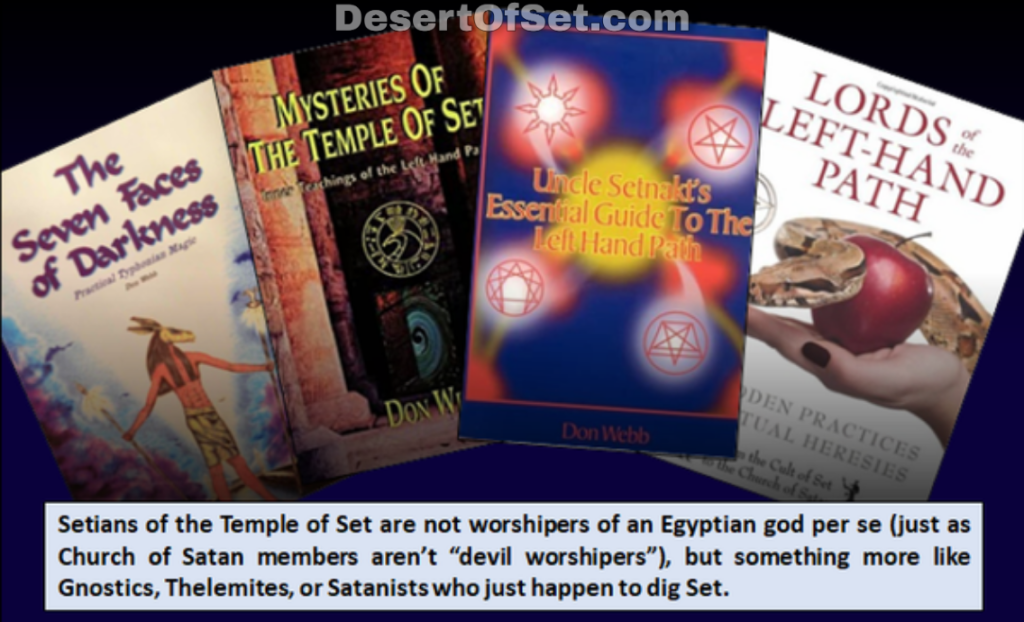
Aquino’s Setianism requires some explanation. Reconstructing a neo-Egyptian faith was never his intent; his philosophy really begins with a refutation of LaVeyan materialism, and not with any Kemetic groundwork. Aquino was reacting to LaVey’s teaching that human beings are just organic meat machines that cease to exist upon death; he argues that human intelligence is supernatural by its very definition, and that it can indeed survive the shedding of its mortal coil. He drew more of his inspiration from Gnosticism, Neoplatonism, Thelema, and LaVey than he did from actual Egyptian sources; and while he does acknowledge Set as a real being, he has never condoned venerating Him. Temple of Set members prioritize kheper, the evolution of their souls or psyches to become gods after death. Like LaVeyan Satanists, they seem to look down upon devotional religion of any sort, even when it is directed toward Set. They claim that submission to any external deity will lead to total dissolution of the soul in the afterlife. As such, Setians of the Temple of Set are not worshipers of an Egyptian God per se (just as Church of Satan members aren’t “devil worshipers”), but something more like Gnostics, Thelemites, or Satanists who just happen to dig Set. They approach the Red Lord from a completely different playing field than Kemetic-based traditions do; our faiths are rooted in Egyptology, while theirs is rooted in Western ceremonial magic.

I am occasionally asked if I am a Temple of Set affiliate. The answer is no, and I never have been. While I have a great deal of respect for the Temple and many of their publications, I determined a long time ago (when I was 18, in fact) that this organization would not be a good fit for me personally. I identify as a Setian first and foremost because I love Set and want to honor Him as much as I can in this life. I find it annoying when “left-hand path” occultists conflate all devotional religion with “submission” and “self-denial,” since this conveniently ignores the fact that historical Setians like Aapehty and Ramses II clearly worshiped Set. I resent the suggestion that ancient Setians “didn’t understand” Set as well as we do today; that is some major white colonialist bullshit right there. And I have never trusted religious organizations that charge annual membership fees, or that possess rigid hierarchies. I understand things can’t get done without regular funding, and that all churches require good administrative leadership if they are to succeed; but I don’t think anyone should have to pay any money or kiss any hiney to learn about Big Red.

I’ve interacted with some junior Temple members (“Setians I°”) who insisted I couldn’t possibly have any authentic standing with Set without joining the Temple and learning all the secret things they keep from the public. I realize these individuals weren’t speaking for the Temple’s priesthood; but in my experience, such clique-ish attitudes tend to trickle down from the top. And if people can’t reach out to Set and be answered by Him without the Temple’s guidance, how the fuck did people worship Him in ancient Egypt? What do these people have that the Egyptians didn’t, and which the rest of us can’t find by visiting any museum or public library? It’s one thing for homegrown witch covens to keep some of their lore and rituals private, so as to prevent these things that are sacred to them from being appropriated by outsiders. It’s quite another matter for organized, incorporated, tax-exempt churches to claim they hold cosmic secrets one can only learn by paying regular dues. So even as a young Typhonian foal, I saw little point in trying to join.

In Temple of Set literature, Set is often defined as the Platonic Form or Principle of “Isolate Intelligence,” a “non-natural” alien entity that somehow modified the DNA of our primate ancestors so we would evolve to have individual psyches or souls. (It gets even more complicated from there.) This has little to do with anything the ancient Egyptians believed, and that has always been a major turn-off for me. I am a Pagan; for me, Set is a part of nature, not something that exists apart from or in opposition to it. The latter idea is a little too close to qliphothic anti-cosmicism for my interest, and this is only reinforced by all the Temple literature I’ve seen that poo-poos Paganism. Mind you, I don’t believe Set even recognizes words like “heresy” or “blasphemy”; so disagreeing with someone else’s Setian theology is not really a big deal. I can think your understanding of Set is totally batshit while still accepting you as a fellow Setian. Yet I am a proud animist and devotional polytheist, and if you tell me you think worshiping nature is ignorant or backward, I’m going to question why you align yourself with a Pagan God in the first place.

But just as I can appreciate Anton LaVey without agreeing with everything he ever said, so too can I appreciate Michael Aquino. He used his professional reputation to help see that minority religions are better represented among the U.S. Armed Forces, and he was at the front lines when it came to fighting the Satanic Panic during the 1980s. He is somewhat infamous for being so fascinated with Nazi history; but he just writes about how Nazi occult rituals were perversions of Norse polytheism (which is absolutely true, as any Heathen can verify); I’ve never seen him praise Hitler, promote fascism, deny the Holocaust, call for the extermination of Israel, or anything that Nazis actually do. Plus he’s a veteran, and some vets are just really into certain areas of military history that make people uncomfortable in polite conversation. I’m sure the man ain’t perfect, but it means a lot to me that someone like Aquino was there to raise awareness about Set back in the day. Even though I disagree with some of his opinions, anyone who has learned about Set from me should know that learning about Aquino is what catalyzed my own conversion in 1997.

Even Zeena Schreck, the youngest daughter of Anton LaVey, eventually left the Church of Satan and joined the Temple for a while; then she left that as well and started her own project, the Sethian Liberation Movement. Remember that Schreck is the first person on record to have been raised a Satanist from birth. She ditched her father’s Satanism, but she came to Set instead of coming to Jesus you might say (and she identifies as a Buddhist, too). The idea that this forgotten Egyptian God would steal people away from Satan’s “Black Pope”—including his own daughter—and inspire them to be Setians instead has always been especially meaningful to me. Schreck is not the only former Temple member to continue walking with Set in her own unique direction, either. Some have become Kemetics or devotional polytheists, and as I mentioned above, even those of us in the LV-426 Tradition have benefitted from Aquino’s work. So while I have about as much interest in the Temple as they probably do in me, I believe Big Red really did answer Aquino’s call to “the devil” on that dark night in 1975; and I’m quite grateful He did.

Set, Horus, and the Law of Thelema

Set’s relationship with His brother and/or nephew, the god Horus, and how my faith is influenced by Thelemic beliefs.

Horus is the god who is most often contrasted with Set, but there were actually several deities called by this name in ancient Egypt. Heru-UrHaroeris, or Horus the Elder is a god of the sky whose eyes are the sun and the moon. He is a son of the sky goddess Nut, and a brother to Osiris and Set. He often conflicts with the latter, but is reconciled with Big Red in the end. Indeed, Set and Heru-Ur are both said to help Osiris ascend the ladder of heaven to join with Ra in the Pyramid Texts. But Heru-Sa-Aset or Horus the Younger, the son of Isis snd Osiris, is Set’s nephew who seeks revenge for Osiris’ death; He is the Horus who is more often referenced in popular culture today. And then there’s Ra-Horakhti, the Horus of the Two Horizons (East and West), who is a composite of Heru-Ur with the solar Creator deity, Ra.

Each of the various Horuses is firmly linked with falcons, solar imagery, and the Pharaohs, who were considered to be incarnations of the god (regardless of which “Horus” was being worshiped at the time). Each Horus also has a rocky relationship with Set and is said to either “castrate” Him or amputate His “foreleg” after Set “blinds” them in one eye. Either we are dealing with different gods sharing several synchronicities here, or we’re dealing with one god who has manifested under slightly different forms in numerous alternate timelines (sort of like how Jon Pertwee and Jodie Whittaker are both Doctor Who). Some Egyptologists and Kemetic Pagans seem to take the former of these two positions, and I believe they are likely correct. But I personally lean toward the latter position myself. Perhaps the “Horus” I have personally experienced is really a composite of several gods that answer to this name; and perhaps this composite has been influenced by Thelema as much as it has by Kemeticism.

Thelema is a religion started by Aleister Crowley, who had several powerful experiences in Cairo, Egypt in April 1904. These events were catalyzed by the Stele of Ankh-ef-en-Khonsu (otherwise known as Crowley’s “Stele of Revealing”), which was on exhibit at the Egyptian Museum of Cairo (serendipitously registered as Exhibit #666, no less). Ankh-ef-en-Khonsku’s Stele is a painted piece of wood with a vibrant image of the priest presenting gifts to Ra-Horakhti. This beautiful work caused first Rose Edith Kelly, Crowley’s wife, and then Crowley himself to receive prophetic messages from Aiwass, an angel of Horus, who revealed to them the text of Liber AL vel Legis (the Book of the Law). In this text, the goddess Nuit (Nut), the god Hadit (or Horus of Behudeti, identified with Ra as the midday sun) and the god Ra-Hoor-Khuit (Crowley’s rendering of Ra-Horakhti) together declare the beginning of a New “Aeon.”

The new Law proclaimed by the gods in Liber AL is this:

“Do what thou Wilt shall be the whole of the Law;
Love is the Law, Love under Will.”

People often assume this statement justifies doing whatever one likes, regardless of consequence; but I read it to mean something more like, “The highest priority in life is to find your true destiny and follow it; to truly love yourself (and not in a narcissistic sense) is the highest law.” Thelemites believe “Every man, woman and child is a star,” and that the way to “worship” Horus in his New Aeon is to bring out that glowing hot ball of light inside your soul and let it shine for all to see. Separating our fleeting, day-to-day desires from our everlasting True Wills can take years of reflection, and the rituals Crowley devised for Thelema are meant to facilitate this process of discretion in a powerful way.

There are some big problems with all of this, the most obvious being that Aleister Crowley was an abusive, racist, misogynist prick. He endangered many people’s lives, especially at his infamous “Abbey of Thelema” in Sicily (where he and his followers lived in unsanitary conditions, leading to at least one death), and during his ill-fated 1902 expedition of Mount Everest with Oscar Eckenstein. For a guy who liked preaching about the absolute divinity and autonomy of self, he sure was an authoritarian bully; he even enjoyed being called “the Great Beast 666” and “the Wickedest Man in the World.” He considered himself to be the spirit of Therion incarnate; and given that Therion is the archetypal evil ruler who brings ruin to his own people, I think he did a pretty good job of emulating that presence.

Why in Nut’s starry bosom would Horus (or any convergence of Horuses) choose such a horrible role model to herald the dawn of his (or their) New Aeon? I think the secret to this may lie in how the concept of Thelema resembles the Egyptian principle of Ma’at. Written in hieroglyphs as an ostrich feather, Ma’at is both a Goddess and an action. As a deity, she sets the order of the seasons, the movements of the stars, and the times of birth and death for all creatures. As an action, Ma’at is doing whatever is right, whatever is just, whatever is well-balanced. To uphold Ma’at in all of one’s affairs is to procure Ma’at and good fortune for oneself, both in this world and the next. A person’s fate in the afterlife depended on how much Ma’at was in their heart (shown as a Weighing of the Heart against an ostrich feather, with the idea being that your heart must weigh the same as Ma’at). This concept is tied to both one’s personal destiny and what people call “the Golden Rule,” and I think the same is equally true of Thelema.

Thelema teaches we can live harmoniously by following our true, Higher Wills, since no True Will can supposedly cross any other in the grand scheme of things. Crowley totally sucked at exemplifying this, but it does echo the idea of doing right by yourself and others so we can all enjoy a good life and afterlife. While the Egyptians had the Pharaohs to dispense Ma’at throughout the Two Lands for them, the Horus(es) in Liber AL seem(s) to charge every single individual with the task of dispensing Ma’at everywhere. You might say Horus/Hadit/Ra-Hoor-Khuit effectively democratizes the role of Pharaoh for everyone, so that everyone can recognize themselves as a royal demigod in their own right.

I think the Gods wanted everyone to see just how bad things can get if we let our individualized Pharaonic power go straight to our heads. Like the heretic king, Akhenaten, who put his obsession with one particular God (the Aten or Sun Disk) over his duty to defend all his people and their Gods, Crowley prioritized his own ego over being a good role model for the Aeon. This cost him dearly in the long run, but it’s almost like he did all the wrong things so we can know what not to do by his example, without having to learn it the hard way. Crowley’s ideas have influenced not only Thelemites, but also quite a few Pagans, Qabalists, Satanists, Chaos Magicians, and rock musicians (the Beatles, David Bowie, Black Sabbath, Led Zeppelin, and many others). It seems to me that Horus (or some version thereof) truly did work through Crowley somehow, for the man certainly made a difference despite all his faults.

I have not personally interacted with any Horus(es) in my own spiritual journey, or at least not in the devotional sense of actually worshiping him/them. But his/their relationship with Set is still an important theological consideration. The dichotomy of a God of light and a God of darkness being sworn enemies is nothing new to most religions; but the idea that both sides are evenly matched, that neither side is perfect, and that both must eventually get along is uniquely Egyptian. Greek adaptations of this story rewrote the ending so that Set is either destroyed or cast out from the pantheon entirely; but with all due respect to Herodotus and Plutarch, I simply don’t accept such accounts as “canon.” The Egyptian civilization lasted roughly 3,600 years, and Set was never completely demonized until well after the first 2,800. Egypt was an occupied territory by that time, being deprived of its own government and culture; and what was remembered of the old ways had been garbled and syncretized with Greek influences. For thousands of years prior to that, the official story was always that Set and Horus are reconciled in the end.

Appropriations of Egyptian mythology (like Alex Proyas’ 2016 film, Gods of Egypt) insist on forcing Horus and Set into a Christian-based “good versus evil” dichotomy; but this runs contrary to the source material. Recall that Set doesn’t kill Osiris until after He finds out that His sister-wife, Nephthys, slept with him. According to some accounts, Nephthys truly loves Osiris and Set truly loves Isis, but neither can be with the mate of Their choice; They are paired together as an afterthought because nobody else wants to be with either of Them. Is it any wonder, then, that Nephthys eventually sleeps with Osiris to bear a child (Anubis), the one thing She wants more than anything? And is it any wonder that when He finds out, Set loses His shit and goes crazy? Mind you, Horus isn’t exactly an innocent little choir boy, either. One of the more shocking moments in the story is when Horus captures Set and prepares to kill Him, but Isis releases Big Red because He’s still her brother and she loves him. Then Horus goes apeshit and decapitates his mother in a fit of blind rage. (Thankfully Isis is healed by Thoth, who gives her a cow’s head; but still.) So I’m afraid this idea that Horus is the “Jesus” to Sutekh’s “Satan” just doesn’t wash.

A Would-Be Ombite Creation Myth

My attempt at writing a Setian Creation myth that someone living in the ancient city of Nubt (Ombos or Naqada) might have believed.

People are often surprised to learn that the Egyptians developed more than one Creation myth. Each priesthood had its own ideas of how the universe was created, and of who created it. They each considered the divinities they were separately assigned to worship as supreme. Hence why the priesthood of Iunu or Heliopolis taught that Atum-Ra created the universe by ejaculating it from themself, while the priesthood of Khmun or Hermopolis thought it all began with a convergence of the Ogdoad (i.e., eight primordial Gods). The priests of Mennefer or Memphis believed Ptah created the world by commanding it to exist, while the priests of Waset or Thebes were convinced that Amun was the Creator. These are the four most popular schools of thought when it comes to Egyptian theology.

There were far more cosmogonies in Egyptian religion than just these four, however. There is one in which the Goddess Neith gives birth to the universe, while another cites Geb (Father Earth) as the demiurge. There is even a version of events where Sobek, the crocodile God, gives birth to the sun. If you’re wondering how the Egyptians could have tolerated having so many different Creation myths, it’s because they conceptualized religion very differently than we do today. As far as they were considered, each of these stories is simultaneously true; they are simply different ways of telling the same tale. In this way, it’s almost as if the Egyptians predicated the “many worlds” interpretation of quantum mechanics.

Set’s worship goes all the way back to the predynastic era (to 3200 BCE at least, when our northern pole star was still Thuban in the constellation Draco). This means Set was worshiped in Egypt long before the Pharaohs came along. His cult appears to have originally been centered in an Upper Egyptian gold-mining town called Nubt, which is also known as Ombos in Greek and Naqada in Arabic. The people of Nubt had a temple that was dedicated to Set, and it stands to reason that this temple would have been maintained by a priesthood. It also stands to reason that the members of this sect would have had their own ideas of how Creation occurred, and that Set would have played a central role in this ideology. Unfortunately, there are no written records to indicate what such a cosmogony might have been like; the temple of Set in Nubt no longer stands, and whatever secrets it once held are now lost to us forever.

I don’t claim to know who really created the universe or how, and I actually don’t care about this question all that much. It’s enough for me to put my trust in Set, and to enjoy and give thanks for His blessings. Yet it has always bugged me a little how the only Egyptian Creation story you ever seem to hear about is the Heliopolitan cosmogony. The roles that were assigned to Set in this schematic (great-grandson to Ra; grandson to Shu and Tefnut; son to Geb and Nut; brother to Osiris, Isis, and Nephthys) were given to Him at a comparatively later point in Egyptian history, and they only reflect how He was understood by the Heliopolitans. What would a citizen of Ombos have been raised to think? What kinds of roles and relationships would Set have been given by Ombite theologians?

There is really no way to answer such questions, but the following is my attempt at imagining what an Ombite Creation myth might have looked like. Please keep in mind, however, that this is not intended to be read as any kind of dogmatic scripture. This was not supernaturally revealed to me by Set, and He has never once told me anything like, “BELIEVE THIS STORY, IT’S ABSOLUTELY TRUE, OR I WILL KILL YOU.” Big Red certainly inspired me to write this, but it is really just a thought experiment, and I hope it will either be accepted, critiqued, and/or improved upon as such.

I’ve tried to make this seem like something a person living in predynastic Nubt might have actually believed; so there are no references to Horus or Osiris, given that those stories did not develop until after the unification of Egypt. Here I refer only to divinities whom we know were worshiped or at least recognized either in Ombos itself, or in some of its closest neighbors (including the cities of Abdju/Abydos, Gebtu/Coptos, and Waset/Thebes). Aside from Set, His mother Nut, and the hippo Goddess Taweret, this narrative also includes Sobek, Montu (the Theban sun God of war), Raet (a Theban sun Goddess), Min (the Coptic God of fertility and sexuality), Aset/Isis, and Khenti-Amentiu (a jackal God of the dead who was worshiped in Abydos, and who might or might not be an earlier form of AnubisWepwawet, or Osiris). The order in which the Gods are born is based on how their stars are arranged in the sky. Set, Taweret, and Sobek come first because the Great Bear, Draco, and the Little Dipper are in the celestial north; Montu and Raet are next since the Zodiac is beneath these constellations; and Min and Aset follow since Orion and Sirius are beneath the Zodiac. With all that being said, I now humbly submit the following.


Before the Dawn of Time, there was nothing else but the Goddess Nut. She was alone, and her infinite black body was not yet tattooed with stars. Everything which now exists was still one with Nut, and since there was nothing else with which she could be compared, everything was nothing. All was Nut, and Nut was all.

Dua Nut!

But then a powerful hunger awoke within the body of the Goddess, a craving for existence rather than nothingness. So powerful was this force that it grew and grew within Nut until it could no longer be contained. This new force then exploded from Nut’s side, cleaving her in twain and becoming the Red God, Set. In this way, the Dawn of Time began not with the first dawn (as the priests of Atum teach their children in Iunu), but with the first storm.

Dua Set!

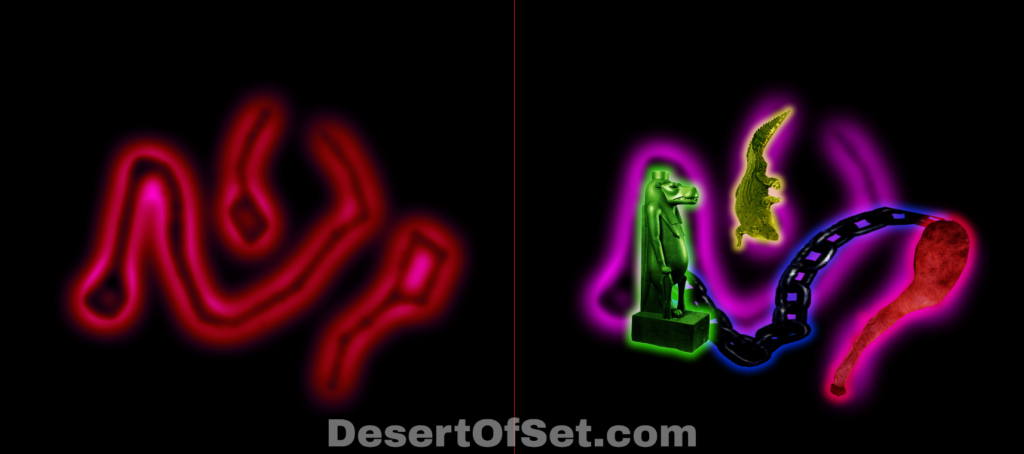
One part of Nut descended and became her brother Geb, upon whose body we now live. The other half remained above and became Mother Sky. Set was still attached to Nut by His navel string, but He cut the string with His iron phallus and was freed. He then roamed the body of Geb, spreading desolation and dust wherever He went. His navel string did not fade away, but became angry and attacked the Red God. Thus did the evil thing become Apep, the Chaos Serpent, which seeks to return all of Nut’s children to her womb and make her miscarry for all time.

Apep eventually attacked Set and castrated Him with its horrible teeth. The Red God roared in pain, but would not be defeated; He merely retrieved His iron phallus, forged it into a massive Scimitar, and hacked the Serpent into pieces. Yet did the monster regenerate itself, with all of its pieces coming back together save one. That one remaining piece grew to become the Goddess Taweret, who fell in love with Set and joined Him in battling the Serpent.

Dua Taweret!

Taweret also restrained Set by chaining His Scimitar to the navel of Nut. In this way, Taweret established Ma’at and made it possible for life to develop upon the body of Geb. She and Set then became the Great Hippopotamus (Draco) and the Foreleg (Ursa Major) in the northern sky. Such is how the Red God was tamed to become the defender of our world. His war against Apep will rage for all time; were it not for Set’s grace, the Serpent would swallow us all.

Some time later, Taweret made Herself pregnant and gave birth to Sobek, who appears as the Great Crocodile (Ursa Minor) in heaven. Sobek descended to Geb and created Iteru (the Nile), the first river; then he laid a gigantic egg in what is now Waset. When this egg hatched, the sun deities Montu and Raet came forth. Then, in what is now Gebtu, Montu and Raet brought forth Min and Aset. Together, these four divinities created all life upon the body of Geb. Finally, Min and Aset gave birth to Khenti-Amentiu, who guides the dead to safety in Duat.

Dua Sobek!

The people of Waset praise Montu as the Creator, and the people of Gebtu praise Min. But we who live here in Nubt know that Set is the One who truly started it all. Our humble little town is where He first stepped foot on Geb. He has blessed our people with the gold that we mine from the hills, as well as with the surrounding desert that preserves our Blessed Dead. It is our sacred duty to offer food, drink, and pottery to the Red God at the House we have built for Him here; let those in other towns appease the other Netjeru.


Set and the Scarab of Ra

Explaining kheper, the ancient Egyptian concept of divine transformation, and how it relates to the scarab beetle, the solar Creator deity Atum-Ra, and Set as the Champion of Ra. 

In Egyptian mythology, the solar deity Ra (or to be more specific, Atum-Ra) is not only our literal sun, but the first God, the progenitor of all things, and the divine spark that’s hidden within every person. They are the starfire from which our planet and our very bodies are forged, and I refer to them with gender-neutral pronouns as much as possible, given they are also known as “the Great He-She.”

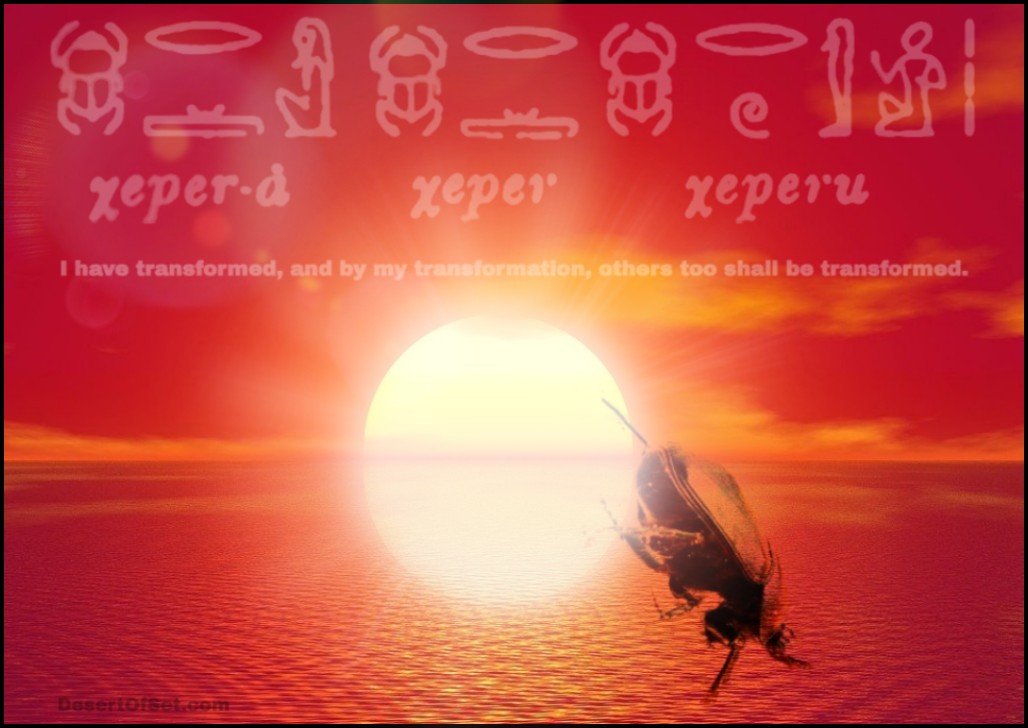
Ra is not said to design the universe like an architect, but to asexually reproduce it through an act of divine masturbation (both a theological and a literal “Big Bang,” you might say), right after creating themself through an act of divine introspection. First Ra lifts themself from Nun, the primordial ocean of infinite chaos, proclaiming, Khepera Kheper Kheperu—which means something to the effect of:

“I have transformed,
and by my transformation,
others too shall be transformed.”

Then Ra asexually begets the infinite plurality of Gods, animals, and people that exists today. Every sentient being is, in fact, a miniature alternate Ra within the macrocosmic collective Ra, right on down from the highest of the Netjeru to the tiniest baby animal or human.

Ra’s first children, Shu and Tefnut, were separated from the Self-Created One shortly after their births. So Ra removed one of their glowing Eyes, which became the solar cow Goddess Hathor, and sent her to search for the missing children. By the time Hathor reunited Shu and Tefnut with Ra, the children had come of age and produced babies of their own: the sky Goddess Nut and the earth God Geb (who would later beget Osiris, Isis, Set, and Nephthys). And when Ra was reunited with all these children, they wept the happy tears that fell down to Geb and mixed with the earth, becoming the first human beings. So while the Gods might be greater and more powerful than us, every person is a living demigod, a human particularization of the Great He-She, and we possess certain rights and dignities even the Netjeru can’t take away. We are not their creations or their playthings, but something more like their younger cousins.

At a later point in the myth cycle, Ra says they are “Khepera at dawn, Ra at midday, and Atum at sunset.” They are a child in the morning, an adult in the afternoon, and an elder in the evening. When night falls, Ra dies and becomes a ghost or “Night Sun” that journeys through the Underworld to be reborn again as Khepera. It is in the darkest hours before dawn that they are attacked by the Chaos Serpent, which is safely repelled by Set and His starry Iron. This is not just a solar myth, but an allegory for the sleep cycle. Many of the Netjeru are said to follow Ra’s same pattern of dying and rising, sleeping and reawakening, just as we ourselves do every day. And just as the Serpent’s assault on Ra is truly an assault on every God and mortal by extension, so too is Set’s battle with the monster a battle for all of us, from the Creator themself to that angry customer you have to deal with at work. Set is the God who never dies and who never sleeps, that the rest of us may all sleep and die and awaken and rise again in safety.

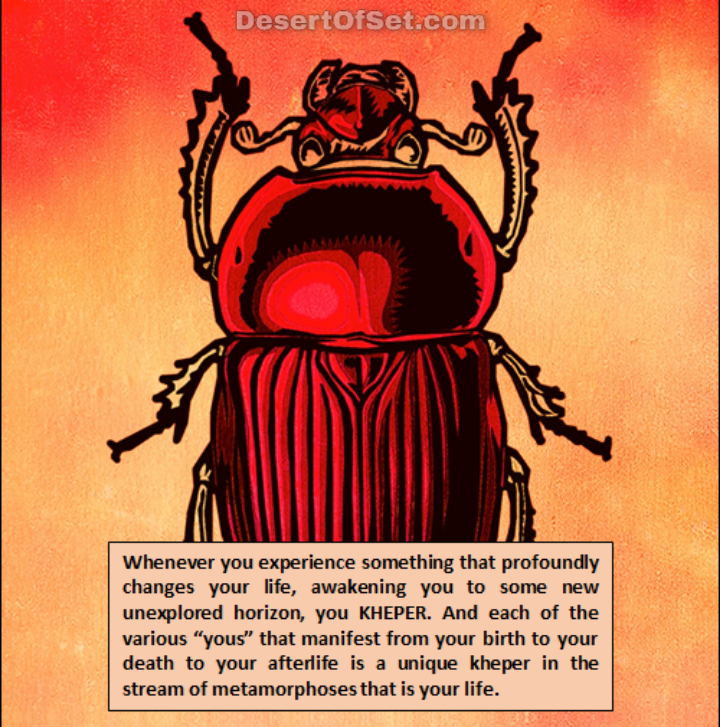
The name Khepera is especially interesting because it is related to the word kheper, which has at least two interrelated meanings. The most obvious translation is “scarab beetle,” an insect that is sacred to Ra. The Egyptians admired scarabs for their life cycle (from egg to larva to pupa to adult), and for their unique reproductive behavior. They lay their eggs in dung, which they then roll into large balls and move around as needed. People drew parallels between these egg-filled dung balls and the sun, imagining that Ra rolls a giant radiant egg ball across the sky. Furthermore, the scarab’s life cycle was likened to Ra’s cycle from night/ghost to dawn/child to noon/adult to dusk/elder, which brings us to the second translation for kheper. As a verb it means “to transform,” and as a noun it means “a transformation.” Whenever you experience something that profoundly changes your life, awakening you to some new unexplored horizon, you KHEPER. And each of the various “yous” that manifest from your birth to your death to your afterlife is a unique kheper in the stream of metamorphoses that is your life.

Considering that kheper is encoded in Ra’s first words at the Dawn of Time (“Khepera Kheper Kheperu”), this is an extremely powerful “magic word” indeed. So powerful, in fact, that when Michael Aquino, a leading minister in the Church of Satan, invoked “the devil” for guidance on what to do following a schism in the church in 1975, he was answered not by Lucifer but by Set, who permanently impressed the concept of kheper on Aquino that very night. Aquino and his colleagues in the Temple of Set prefer to capitalize and spell this word with the Greek letter chi (i.e., Xeper) to signify its centrality to their particular Setian current. I prefer to spell the word phonetically to prevent any confusion for my readers, and I diverge from Temple of Set members insofar as my love for Set is prioritized over kheper in my hierarchy of spiritual values. I agree kheper is important, and that Set cares more about getting us all to kheper than being worshiped. Nevertheless, I identify as a Setian because I love Set first and foremost; if kheper or Khepera were truly the central focus of my path, I would identify as a Kheperian instead.

That being said, kheper is what happens when the sun rises at dawn, when a grub emerges from the soil as an adult beetle, and when a soul or spirit is fundamentally transformed by some profound, life-altering experience. It is the principle that enables us all—cosmic God and mortal demigod alike—to theoretically live beyond death. Additionally, Set is the only other deity in the Ennead or Company of Nine to have willed Himself into existence apart from Ra (by tearing Himself from the womb of His mother, Nut). Since the Netjeru are both distinct beings and extensions of Ra’s own primeval essence, the argument can be made that Set is the aspect of Ra that enabled them to kheper in the first place, even before Big Red came forth as an entity in His own right. This would explain why He continues to play such an important role in procuring Khepera’s safe rebirth, both in the macrocosm and the microcosm. Similar to how St. John believed Christ was with Yahweh in the beginning, before the Creation of heaven and earth, you might say I believe Set was with Ra in the beginning, before the Dawn of Time.

Khepera Kheper Kheperu

On Setian Priesthood & Pagan Ministry

On being a priest of Set and a Pagan minister, and what spiritual leadership should (and shouldn’t) look like.

I occasionally receive inquiries about how I came to be ordained, and how others might do the same. Here is my best attempt at distilling all my thoughts on this matter, in one convenient place.

People often refer to the concepts of “priesthood” and “religious ministry” as if they were interchangeable, but I prefer to distinguish between these two functions very carefully. The assumption that a minister is always a priest and vice versa is rooted in the monotheist premise that people in the same religious community will always follow the same God, and it is inappropriate to hold Pagans to this standard.

  • In a polytheist context at least, priesthood is the act of serving one or more particular deities with regular rituals and/or offerings, by studying their lore, and by helping others understand them as necessary. It is a devotional occupation that is all about doing something for a God or a pantheon, or their followers.
  • Ministry, in my opinion, has less to do with serving any Gods in particular, and more to do with serving human beings. It is an act of community service that is mostly about helping people legally marry, procure good fortune, and/or memorialize their dead. These are practical issues that all kinds of people need help with, regardless of which God(s) they prefer to acknowledge (if any).

So when I officiate a wedding, bless a baby, or eulogize somebody’s ancestor, I am serving strictly as a minister. I don’t care if the people I help believe in any deity or not, and I will even tailor my services to reflect their beliefs (within reason, of course). Theology is only a point for discussion when it comes to my services for Set, which I see as fulfilling a more priestly role. While a person can certainly be a minister and a priest at the same time (as with most monotheist clergy), in Paganism you can also be just one or the other, or even alternate between the two as necessary.

I should clarify that I am not recognized as a priest in any particular congregation apart from my own, and that others are welcome to dispute my use of this term as they see fit. I would hope that all the work I have done so far will prove I sincerely do my best to live up to the label, and that I am not just some occultnik hack. Our coven might only consist of four people, but I’m confident enough in our shared experiences not to care too much if other groups consider us “legitimate” or not. We have little interest in increasing our own numbers, since we don’t believe anyone should have to join any sect, pay any dues, or kiss any hiney to learn about the mighty Champion of Ra. Hence my insistence on publishing everything I write about the Big Guy for free; everything in this ongoing work (such as it may be) is a votive offering not only to Him, but to all my fellow Setians as well. It is hoped that others will find the material helpful enough in some manner, even if we must agree to disagree on certain points.

As we LV-426 initiates reached adulthood, two of us decided to get married (not to each other, but to our own separate sweethearts). And since we manifest Set’s rebellious disposition so nicely, neither of us was willing to appease either of our extended families by conceding to a conventional Christian wedding ceremony, or even to a more secular procedure at a local courthouse. For this reason, I was legally ordained in the Universal Life Church Monastery so I could officiate a ceremony to my Sister Bean’s liking, and we enlisted another minister from the Monastery to officiate my own ceremony. Since then, I’ve officiated ceremonies for other couples who needed it, without concern for whether they are Setian or Pagan, and without charging any fees. Apart from working execrations, blessing a few newborns, and the one time I administered last rites for someone, weddings represent the bulk of my ministerial experience at present.

The ULC Monastery is one of those “anything goes” churches that ordains anyone who signs up for free. Such institutions are often viewed as “shams” by more traditional churches, which have huge populations and generate enough (tax-exempt) revenue to fund things like Bible colleges and theological seminaries, where they can actually send their clergy to be trained. Pagans do not enjoy anything close to the same numbers or resources that Christians enjoy, making it much harder for us to successfully launch our own churches (let alone seminaries) and keep them going. While it is not a Pagan church specifically, the Monastery makes it possible for covens like ours to enjoy the benefits of ordination without paying a shit-ton of money we don’t have to some institution we don’t even agree with. This seems only fair to us, given that we don’t own any property as a group, we have no treasury to speak of, we don’t request or accept monetary donations from anyone, and we certainly don’t charge each other any membership fees.

There are other multifaith churches that offer more conventional ordinations, such as the Universal Unitarian Church. Some Pagans I know have enrolled in such ministries to benefit from the training they offer. It’s a lot of hard work, and I have the utmost respect for anyone who chooses to go through that process. I’ve always lacked the time and the money to do it myself, and while I work well with authority in a strictly business context, this is not the case when it comes to religion. My faith is the one area in life where I get to have absolute control, and I chafe with resentment when I feel like that control is being restricted. However, I don’t wish to discourage anyone else from considering options like the UU. Online ordination has served my purposes pretty well thus far, but it is not the best option for everyone, and I wish nothing but the best for those who endeavor to graduate from more structured ministerial programs.

That being said, I fully disclose that I am not a licensed counselor or social worker, and that I am ill-equipped to handle some of the issues ministers in other faiths are trained to deal with. I do, however, work in a field relating to public health, and whenever I meet someone who needs help to such an extent, I always refer them to licensed (and preferably secular) professionals. I don’t milk them for all they’re worth like some televangelist faith healer. I also don’t fuck around with people’s safety, and if I think someone might be extremely dangerous to either themselves or others, I will report any evidence I find to the appropriate authorities. There are traditional organized churches that train their ministers in all kinds of ways, but which also harbor and protect obvious evildoers among their own leadership. So whenever I hear more privileged faiths poo-poo the idea of online ordination, it just tells me they hate minority religions and want to keep us down. Besides, my ministerial work is supplemental to my sacerdotal work anyway. While I do my best to help whomever I can whenever I can, I really do what I do for Set and for other Setians—which is to say, I identify as a Setian priest first and a Pagan minister second.

Piggybacking on a multifaith online church is certainly not an optimal method for circumventing the lack of legal equity between our various religious traditions; but starting my own church has never seemed like a practical idea. I doubt there would be that many people knocking down the door to join, and I am uncertain as to what I could really offer those who did. I also have serious ethical problems with how churches are allowed to become tax-exempt businesses, political interest groups, and safe havens for sex offenders in this country. Part of me would want any church I help launch to actually pay taxes, just as a matter of principle and accountability. But then again, there are many ways in which tax exemption is extremely helpful for Pagan churches that are already struggling to get by as it is; so I am conflicted on the matter. Until a better option presents itself, I’ll just make do with independently serving Set as a priest from LV-426, and with facilitating any ministerial work I might need to provide through the ULC Monastery.

While I take my work very seriously, I don’t claim to be some prophet who holds the keys to all the mysteries of the universe, and I am extremely critical of anyone else who does. Set demands self-determination, not blind obedience, and anything that infringes upon your personal sovereignty is anathema to Him. There are far too many priests and ministers (of all religions, including Paganism) who prey on the people they “help” for power, money, or sex. If someone demands that you give something of yourself that you don’t want to give—whether it’s your time, your money, your ability to think critically, or even your body—that is NOT OKAY. I don’t care what religion you are, Set’s gift of autonomy is for ALL sentient beings, and those who deprive others of this gift will become pet food for Ammut in the Underworld!

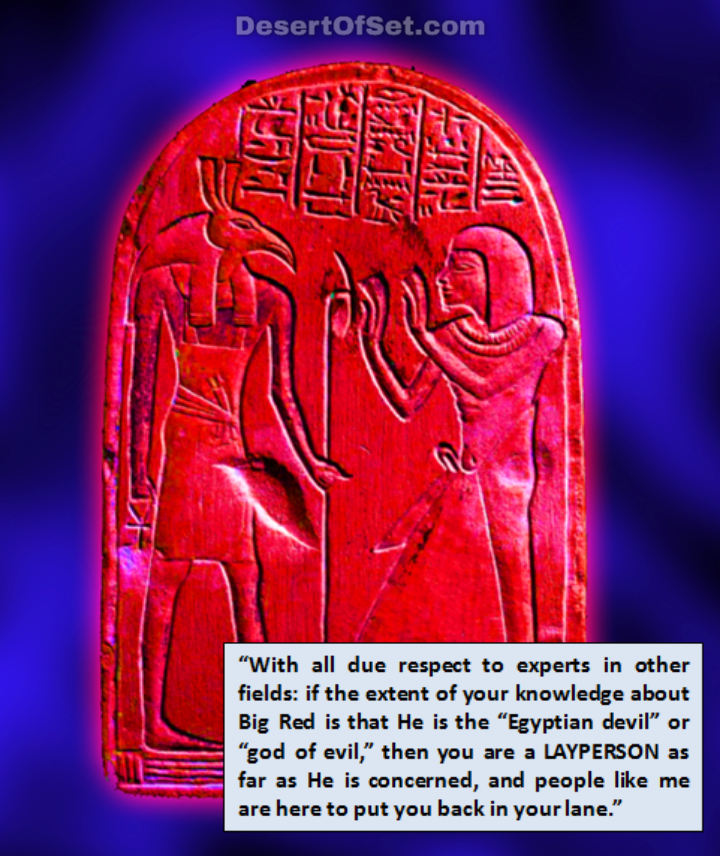
As a final note, I still occasionally meet other Pagans who think I must either talk backwards, eat babies, or spin my head around 360 degrees because I worship Set. With all due respect to experts in other fields: if the extent of your knowledge about Big Red is that He is the “Egyptian devil” or “God of evil,” then you are a LAYPERSON as far as He is concerned, and people like me are here to put you back in your lane. We aren’t going away any time soon, either; in fact, I reckon the 2020s will see more of us awakening to our true identities than ever before! Set is mighty, and so are we!

“Do You Worship the Devil?”

The word devil is really just as vague and complex as the word God, holding multiple meanings across the world. So when we “speak of the devil,” just what in hell are we actually speaking about? 

Accusing someone of “worshiping the devil” is the easiest way to discredit their faith and beliefs. Pagans are no strangers to such accusations, and this is doubly true for Setians, Lokeans, and others who walk with the so-called “powers of darkness.” But the word devil is really just as vague and complex as the word God, holding multiple meanings for different people and cultures across the world. So when we “speak of the devil,” just what in hell are we actually speaking about?

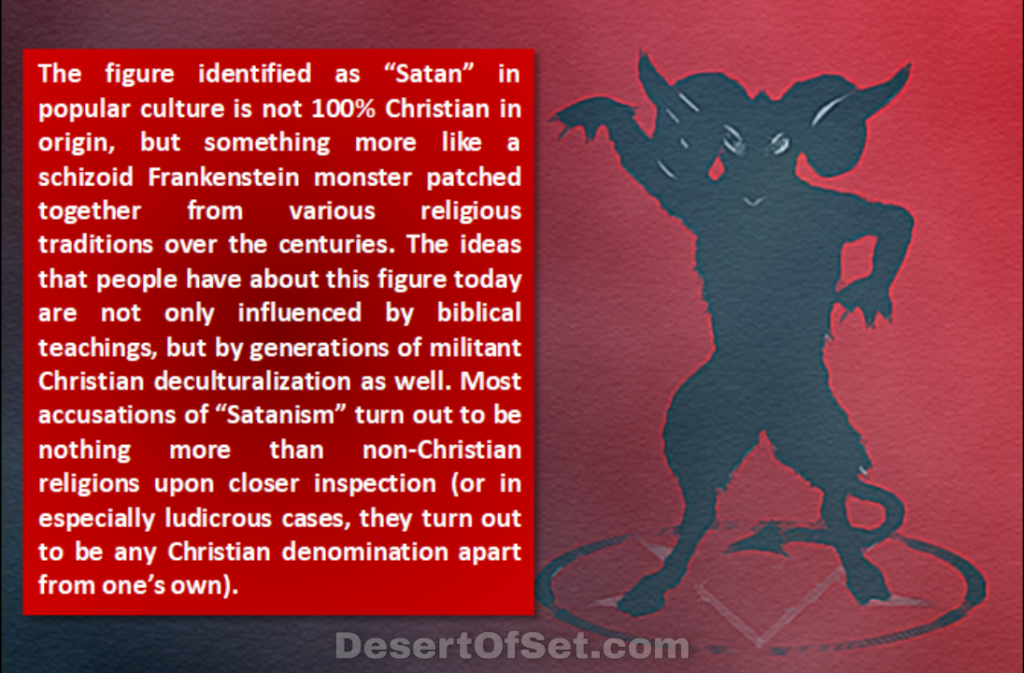
The figure identified as “Satan” in popular culture is not 100% Christian in origin, but something more like a schizoid Frankenstein monster patched together from various religious traditions over the centuries. The ideas that people have about this figure today are not only influenced by biblical teachings, but by generations of militant Christian deculturalization as well. Most accusations of “Satanism” turn out to be nothing more than non-Christian religions upon closer inspection (or in especially ludicrous cases, they turn out to be any Christian denomination apart from one’s own). There are also several different versions of “Satan” referenced throughout popular culture, and people never seem to know which of these variants they happen to be discussing at any given time. The situation gets even more complex when we account for actual Satanist beliefs about the devil, which is a whole other kettle of elephantfish.

Satan as the Heavenly Prosecutor

Introduced to us in the biblical book of Job, this version of Satan is far less subversive than people commonly know. He is but a servant of the Israelite God, only committing the harms his maker allows him to commit. Tormenting humans, tempting them, and testing their faith in Yahweh is not an act of rebellion, but a service he provides at his maker’s behest. As such, the purest distillation of Satan in my opinion is simply the shadow side of monotheism itself. If the entire point of such belief is our submission to just one God (and our strict avoidance of all others), then naturally someone is needed to periodically test that allegiance. The way I see it, the Old Testament Satan represents the dark side of Jehovah himself; there is no other role for a devil that makes any theological sense in a purely monotheist context.

While I accept the Christian God as being ontologically real, I remain skeptical of his alleged omnipotence, omniscience, omnipresence, and omnibenevolence. I believe Yahweh and Jesus Christ both exist, but they are just two more Gods occupying our shared multiverse, neither more nor less important or perfect than any other divinity in objective reality. I accept they are of central importance to their own followers, and I can see how Satan the Heavenly Prosecutor would figure largely in their personal value systems. But to “worship the devil” in this context seems equivalent to accepting a payoff from Mr. Slugworth, then learning the slick bastard was really working for Willy Wonka the whole damn time (but now you can’t have any chocolate!). In my experience, this version of the devil isn’t venerated by anyone (not even by real Satanists); people are only ever accused of trafficking with him by monotheists.

Satan as a Serpent, Dragon, or Gnostic Figure

In the book of Genesis, the first man and woman are deceived into disobeying Yahweh by a talking snake. Many people think of that snake as Satan, but it was never identified as such until New Testament times. By that point, Judaism and Christianity had both been influenced by such combat myths as the Babylonian Enuma Elish. These are tales of divine warriors battling monstrous serpents or dragons to create or save the world, and Set’s daily pre-dawn battle with Apep is just one of many variants. Judaism already developed its own variant of this story in the figure of Leviathan, a sea monster that represents all human and supernatural defiance of Yahweh. (Leviathan originally comes from Phoenician mythology, in which it is sent to attack the Elohim by the daemon Yamm, who is battled by Set in the Edfu Texts.) So by the time Roman emperors started feeding Christians to lions for sport, the biblical idea of the Genesis snake had been firmly conflated with the polytheist Chaos Serpent, which seeks to end the universe. Hence the depiction of Satan as an apocalyptic “great red dragon” in the book of Revelation.

The Gnostics were Jewish and Christian heretics who lived during New Testament times, and who deviated from monotheism. They believed in not one but two Gods: a benevolent God of pure spirit who transcends the physical universe, and an evil material God who keeps our souls trapped and miserable here on earth. Some viewed the Genesis snake as a messiah sent by the good God to free us from the prisons of our flesh. Mainstream Christians decided these people were “Satanists” for this reason, and some real life Satanists actually take their cues from Gnosticism as a result.

To be honest, I find Gnosticism troubling. It teaches that nature is soulless, and that human souls are alien not only to their surroundings, but to their own bodies as well. Such anti-cosmicism is really in vogue among left-hand path circles, which often re-define the Chaos Serpent as a kind of Gnostic savior figure. There are even Setians who engage in this, conflating Set with Apep (which is predicated on Set’s demonization as the Greek Typhon circa 712–323 BCE). With all due respect to these people, I believe Setianism is about revering a God who is a part of nature, and who is absolutely essential to how the cosmos perpetuates itself. Qliphothic diabolism, on the other hand, is the adoration of something external or even hostile to nature (which contradicts the entire premise of honoring a Pagan God in the first place). Setians can combine their love for Set with any other spiritual traditions they like, and we do not need each other’s approval to do so. But to my mind at least, Set shares more similarities with Jesus Christ, the archangel Michael, and even Jehovah in this particular context (Aberamentho!) than He does with Satan.

(Mind you, I don’t believe Set is “angered” or “offended” by anyone identifying Him with the Serpent. He’s a big god, He’s got a thick proverbial skin, and I’m sure He has His reasons for interacting with folks like Kenneth Grant and Michael W. Ford. I fully admit I am likely more bothered by this subject than Set is Himself. My intent here is not to “shame” anyone into ditching their copies of Nightside of Eden or Sekhem Apep, though I encourage people to at least consider the idea.)

Satan as Antichrist or the Great Beast 666

There is a major biblical distinction between “the Antichrist” and “the Great Beast 666,” which is called Therion in Greek. Antichrist is basically the spirit of Christian hypocrisy itself, or the impulse to do un-Christian things in Christ’s name; Therion is the archetypal evil tyrant who brings disaster upon his own nation. The latter goes back to the primeval origins of human government, but Christians first met him in the guise of the Roman emperors, whom they considered to be satanically possessed (and for good reason). Somewhere down the line, Antichrist and Therion were blurred together into the same popular image: that of the devil’s half-human offspring, destined to set the world ablaze.

In this context, Satan is a metaphor for both Christian and political corruption. Anyone can be deceived by a corrupt politician, including Pagans; but the idea that we are out to cause the downfall of human civilization is just ridiculous. And accusing us of worshiping Christian hypocrisy makes no sense at all. People like Paula WhiteCreflo DollarKenneth CopelandRod Parsley, and other “prosperity gospel” televangelists do a much better job of driving people away from Christ than Pagans ever could. No one does a better job of publicly glorifying Antichrist than these false ministers of Mammon.

As for Therion, there are reasons for thinking he might be enemies with Ishtar, who is my Holy Mother Goddess. Part of Ishtar’s role in ancient Babylon was to empower the kings and punish them severely if they failed to take good care of their people. Especially shitty rulers were offered as blood sacrifices to Her, demonstrating that She does not suffer tyrants lightly. Even the Bible seems to agree that the Great Beast and the “Whore of Babylon” despise each other (Revelation 17:15–18). So if someone accuses me of “worshiping Satan” in the sense of supporting the tyrannical persecution of Christians, they couldn’t be further from the truth. As a Pagan, I would prefer to live in a world where no one is ever persecuted for living the life they want to live, neither Pagans nor Christians nor anyone else.

But while Therion is a symbol of tyranny and persecution for Christians, he more often represents freedom, liberty, and self-empowerment for Satanists. This interpretation is not biblical, but is influenced by the teachings of Aleister Crowley, who actually claimed to be Therion incarnate. (Considering how oppressive and manipulative a person he was, I’m inclined to agree that Crowley was a perfect avatar for the Final Tyrant.) If we define Therion in a strictly Thelemic or Satanic context, I can see how the figure might be used to exemplify key Setian values like autonomy and self-ownership. But if we define him in the Christian context, I consider him anti-Setian and want nothing to do with him.

Satan as a Fallen Angel (“Lucifer”)

The devil’s most well-known origin story is that he was originally an angel in heaven named Lucifer. He tried to usurp his Creator’s throne, was cast down from heaven for his pride, and now rules his own kingdom down in hell. This story does not appear anywhere in the entire Bible; it’s actually a polytheist theme that was not fully absorbed into Satan’s demonology until the medieval era. (The reference to “Lucifer” in Isaiah is a shoddy Latin translation; the original Hebrew text refers to a mortal Babylonian king.) Prior to this, Lucifer was one of many polytheist Gods identified with Venus, the Morningstar. The astronomical behaviors of this planet—keeping near the horizon; shining brightest at twilight; “defying” the sun by appearing just before dawn—led people to associate it with several uppity Gods who subverted their elders. Each of these Venusian powers is linked with fire and fertility, as well as with death and resurrection. Females like Aphrodite and Inanna are usually successful in their rebellious designs, but their male counterparts are more often ruined and forced into exile, which brings us back to Lucifer.

There is no direct relation between Set and the Lucifer myth, but some people draw parallels between the two anyway. Set’s demonization can be likened to Lucifer’s fall from heaven; and then there’s the theme of Set defending Ra from Apep in the Underworld just before sunrise. The idea of a rebellious Red God facilitating the sun’s rebirth can be linked with the theme of a “fallen angel” heralding the dawn. I must admit, however, that these associations are a bit of a stretch for me personally. Set has little to do with Venus, and most other divinities who do are “dying-and-rising” figures. Set never dies, and He never “falls down” into the Underworld either; He just travels there every night with the Creator to serve as Ra’s personal bodyguard. This dynamic doesn’t really jive so well with the “Fuck God, I’d rather rule in hell!” attitude that Lucifer more often exemplifies. In my opinion, Set and Lucifer are two completely unrelated figures, though I can see how Big Red might bond with the latter as a drinking buddy.

The truth is that when I hear or read the word Lucifer, I think of ISHTAR and not Set. Lady Morningstar appears in my mind’s eye as a beautiful angel with raven-black hair and wings, shining with unbridled fury. I can’t help but root for Her as She tricks Ea into giving Her the powers of civilization; as She descends into the Netherworld to face Her sister Ereshkigal; as She slays Her ungrateful husband Tammuz to take Her place in hell; and as She rages against that insolent megalomaniac, Gilgamesh. Ishtar’s resemblance to the biblical “Whore of Babylon” is famous, but She also resembles a female Lucifer who (unlike the more popular male version) generally succeeds in getting Her way. So if anyone accuses me of “worshiping Lucifer,” my first reaction is not to deny the accusation, but to correct it. (“My Angel of Light is a Lady, so if you absolutely have to call Her something in Latin, it really ought to be Lucifera!”)

Satan as a Horned God

By far, the most well-known version of the devil is that of a wooly goatman who frolicks with witches in the dead of night. This motif developed well after the Protestant Reformation, when the European witch hysterias reached their apex. It has no biblical basis, but is instead a synthesis of Protestant reactions to Judaism, Catholicism, several medieval Christian heresies, and numerous polytheist folk traditions. Much has already been said of how the devil’s horns and cloven hooves were appropriated from the Greek satyr God Pan, who similarly enjoys frolicking with nymphs at night. But there are actually several Gods who were absorbed into this devil, not just Pan. Virtually every culture has acknowledged some kind of nocturnal horned God who digs raunchy, bacchanalian rites; and it is here that I experience the most trouble with my surrounding culture. As with most people, this is the “Satan” I always think of first whenever anyone brings up “the devil.” Society has drilled it into me since birth that horned, hoofed goatmen are supposed to be “evil”; and yet this imagery is quite sacred and inspirational to me personally.

Set is just one of the many Gods whose imagery was appropriated for this version of Satan (thanks to the Coptic Church). We see this in Set’s affinity for nighttime, the color red, and such horned Artiodactyla as oryx and antelope. We can also see it in His attraction to Goddesses who defy conventional gender roles (Taweret, Ishtar, Nephthys, Anat, etc.). And then there’s the fact that He is the God of wilderness, deserts, and other places beyond human civilization. From the moment I first met Him back in 1997, I have always felt compelled to honor Set out in the woods at night; so I identify with the Horned God image pretty strongly. For this reason, my brain does two things whenever people talk about “Satan” around me (whether it’s in conversations about religion, horror movies, or heavy metal music):

  • It immediately conjures up a Horned God image.
  • It immediately translates the name Satan into SET.

Some claim that the Hebrew word Satan is etymologically derived from Set’s name (via “Set-Hen” or some variant thereof). There is no evidence to support this assertion; yet it speaks to a very real Setian emotional experience. Some of us (myself included) first come to Set without fully understanding who or what He really is. Some don’t even know that much about ancient Egypt when He first calls them; they might realize there’s this spooky nocturnal Red God speaking to their souls, but that’s it. Setians in these situations often have little choice but to conceptualize themselves as “Satanists” when they first answer the call. (What the hell else are we supposed to do when society tells us that’s exactly what we are, and we don’t know any different?) Some may continue to identify as such for life; remember, Setian beliefs are not limited to Kemeticism, but can also intersect with other religious traditions (including Satanism and Christianity, both). Still others may discard “Satan” into the proverbial wastebasket once they develop a more Kemetic understanding of Big Red. (I can’t tell you how much better I felt once I achieved this for myself.)

Here’s an example of what I mean about my brain “translating” the Horned God motif into Set. One of my favorite bands is the Danish metal group Mercyful Fate, fronted by King Diamond. One of their greatest songs is “The Oath” from their 1984 album, Don’t Break the Oath. The lyrics of the song are partially adapted from Dennis Wheatley’s 1960 novel, The Satanist, which features a so-called “black mass.” But whenever I listen to this song, here is how my brain translates the lyrics:

Here is a link to the original song by Mercyful Fate, for anyone who might be interested.

It might seem odd that anyone would appropriate Satanic symbolism for a Pagan God (as opposed to simply rejecting such iconography altogether); but the way I see it, this is a perfectly logical thing for Pagans to do in our contemporary environment. Christians came along, wrested control of our religious narratives, and indoctrinated entire generations into thinking our various horned Gods are really “the devil.” So it seems only right that Pagans, in turn, should appropriate “the devil” and turn it back into something positive that we can use for our own purposes, as demonstrated in the graphic above.

Satan as a Romantic Anti-Hero

From the 17th to the 19th centuries, serious belief in Satan had waned throughout the West, with the figure seldom appearing in any religious context. During this period, he was more often seen in works of art, literature, folklore, and political philosophy. Several artists, writers, and even radical leftists invoked the devil in their works as a sympathetic rebel against tyranny (personified by the Christian God). John Milton’s epic poem Paradise Lost is only the most prominent example; others include various works by William GodwinLord ByronPercy Bysshe ShelleyPierre-Joseph ProudhonMikhail Bakunin, and even Mark Twain. And since the point of this artistic movement was to encourage freethinking (for which Satan was thought to be the perfect symbol), it has since become known as “literary Satanism.”

It always confuses people to learn that mainstream Satanist groups like the Church of Satan and the Satanic Temple don’t actually “worship the devil” per se, but are atheists. This makes a great deal more sense when we remember that such groups are really descended from the literary Satanism movement. Anton LaVey didn’t take his Satan from the Bible; he drew him from Paradise Lost and other similar works. The point is not to be a “devil worshiper” but to actually become an arch-rebel oneself, in the flesh. While the chosen terminology might frighten outsiders, the whole thing amounts to little more than thinking rationally, challenging authority, and championing personal liberty, which I think are values most people can agree with. There are some things about mainstream Satanism I find annoying (e.g., I can do without Peter Gilmore’s near-constant assertion that all theists are categorically insane); but on the whole, I think it’s a pretty reasonable way of looking at the world (“Satanic” or not).

Returning to the $666 Million Question: “Do You Worship the Devil?”

When Pagans are accused of “worshiping the devil,” our typical response is to say “We don’t believe in Satan.” But as I have discussed here, the word devil is just as culturally loaded as the word God. If we define Satan in strictly biblical terms, then no, most of us do not believe in “the devil” at all. But when most people discuss this figure (including Christians), they are referring to one or more non-canonical tropes, not to the original biblical concept. And whenever this is the case, things become much less cut-and-dry. Many of us worship a horned God and consider ourselves to be witches (myself included). Some pray to Venusian deities who can be read as prototypes for Lucifer (again, myself included). And there are even people who actually glorify the Chaos Serpent (myself NOT included, thank you very much). Some Pagans who fit these descriptions actually identify as Satanists too (or as Luciferians). Who are we to tell them they aren’t welcome in our community, so long as they live and let live? If we can accept Christopagans and Jewitches in our subculture but not Satanists, then we are hypocrites.

While more Pagans are fortunate enough to be raised in Pagan families today, the majority of us are converts from other faiths, and most of us were raised either Catholic or Protestant. “I still have a soft spot for the Catholic Church” is a common sentiment I’ve heard from Pagans who were raised Catholic, and this is likely because Catholicism absorbed quite a bit of Paganism into itself over the centuries. Blooming Pagan teenagers in Catholic families are already exposed to countless Pagan ideas, from venerating a Goddess (the Virgin Mary) to celebrating the three nights of Samhain (All Hallows’ Eve, All Saints’ Day, and All Souls’ Day). But the entire point to Protestantism is to purify Christianity of all such Pagan influences, consigning them to the devil. So Satan is often the only Pagan thing many Protestant kids are exposed to when they are young. And when a Pagan first blooms in such surroundings, it can be much more difficult to “unlearn” the things they have been conditioned to believe. Going from “hailing Mary” to “hailing Hathor” is one thing, but going from “fearing Satan” to “loving Pan” is quite another.