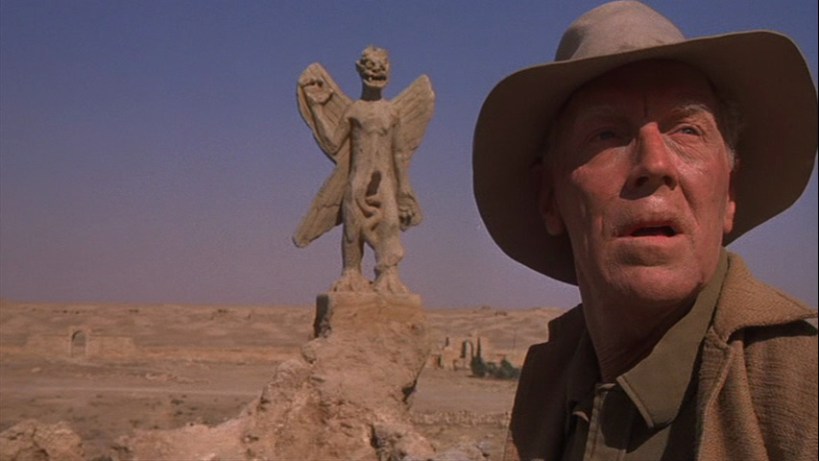
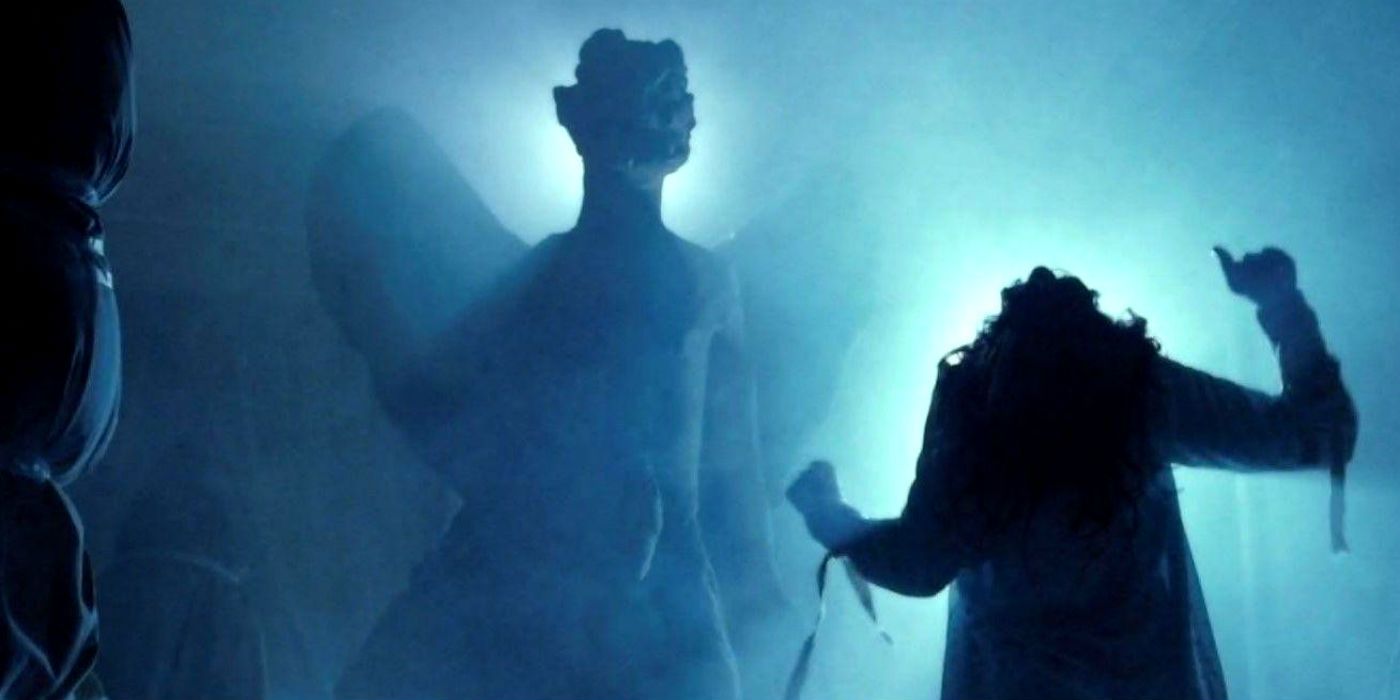
Forget what you think you “learned” from The Exorcist (1973) about Pazuzu, and join this mighty deity as He quests against both human and spiritual cruelty.
The last several months of my life have been quite painful, and I imagine I am not alone in this respect. Yet the Gods are merciful and good, and one of them in particular saw fit to help me just recently, even though I have never specifically reached out to Him before.
Pazuzu is another ancient God who, like Set, has an extremely bad reputation today, thanks largely to William Peter Blatty and his novel, The Exorcist (i.e., the source material for the 1973 movie). It is interesting that Blatty would choose an explicitly Pagan deity for his novel’s antagonist, rather than one of the fallen angels from his own religious lore.
Far from possessing little girls and making them vomit pea soup or spider-walk up and down staircases, Pazuzu was commonly invoked in ancient times to protect pregnant mothers and newborn children from horrific monsters, most especially the night demon Lamashtu. Sure, He’s creepy and He’s kooky (again, much like Set), and He ain’t much for sunshine and rainbows. But no matter how “evil” people think Pazuzu might be, He clearly hates bullies who harm the defenseless; and though the identity of His mother in Assyro-Babylonian mythology seems unclear, I get a strong feeling that Pazuzu loves His mother very much indeed.
Last week, Pazuzu “possessed” me to record a new album in His honor (ha ha). I could barely sleep or even take any breaks while I put this puppy together. It HAD to be finished last week for some reason; imagine my surprise when I suddenly remembered that Friday was Walpurgis Night!
Anyway, this is my attempt at setting the record straight about Pazuzu, and at providing something good and helpful for His worshipers who live today. Working on this has been an incredibly healing experience; I pray that Pazuzu enjoys it, and that others will too.
Thoughts on Nehebukau, the holy Snake God, and the concept of Snake People, with an analysis of their appropriation by modern pop culture and conspiracy theorists.
It’s important to understand that snakes are not a universal symbol of “evil” in Kemetic or ancient Egyptian lore. Actually they are more like angels, a special class of preternatural being. There are good snakes like Wadjet and Meretseger who serve Atum-Ra the Creator; and there are also bad snakes that serve Apep and who seek to disintegrate all things. One story of Nehebukau is that He was originally one of the bad snakes; but this was only because of a pinched nerve in His spine that was hurting Him real bad, making Him terribly grouchy. Eventually, Ra healed Nehebukau by touching His back and fixing that nerve, and the latter has been a good and holy snake ever since, working Ma’at and assisting sentient beings through their various kheperu or transformations in life and the afterlife (what might be called a “shedding of skins”). In this way, Nehebukau fits right in with some of the other Gods I hold most dear. Like Set and Taweret, He’s kind of like a monster that learned to be better, and who is in a very unique position to empathize with humans in our struggles against isfet.
Dua Nehebukau! Hail, sweet Soul Serpent!
To be clear: when I refer to “the Snake God,” I am referring to Nehebukau, and not to the monster Apep. When I refer to “the Chaos Serpent,” the situation is reversed. The distinction here is that Nehebukau is a proper God or Netjer, while Apep is more like an “ungod.” If it confuses anyone that I would use “snake” and “serpent” in different ways like this, just remember the comparison to angels above. Nehebukau is no mere angel (and neither is Apep for that matter), but one might say Nehebukau is a Snake God in the same way that Gabriel is a “holy angel,” while Apep is a Chaos Serpent in the same way that Satan is a “fallen angel.” There are additional good male snake Gods among the Netjeru as well (e.g., Geb, Mehen, etc.); but as I have not personally interacted with any of them myself, Nehebukau is the particular Netjer I mean to invoke when I write “Snake God” in capital letters.
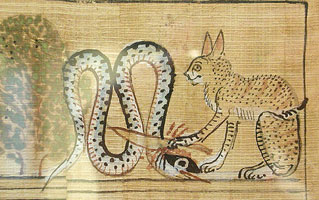
A good cat slaying Apep the Chaos Serpent—not to be confused with Nehebukau the Snake God!
Prior to collaborating with Setken on Hymn To The Soul Serpent (Hymn To Nehebukau), I don’t recall actually being that cognizant of Nehebukau before. I recall seeing Him in Egyptian art in His winged, double-headed serpent form from time to time; but it wasn’t until my exposure to Setken’s artistry that I remember seeing the Snake God depicted in a humanoid form (as exemplified in Setken’s Study For The Netjeru!: Nehebukau). Apart from just being really fucking beautiful, Setken’s paintings spoke to something buried deep within the furthest regions of my memory. It was not until we were almost ready to release Hymn to the Soul Serpent that I suddenly realized just what these sacred icons were actually reminding me of.
(When Setken first proposed the Hymn to the Soul Serpent project to me, I mistook him for saying “Nekhebet,” and I immediately started studying footage of vultures for inspiration. When I realized my mistake, I apologized to to Nehebukau profusely, even though I am reasonably certain He wasn’t actually offended. But perhaps some kind of project for Nekhebet might be on the horizon!)
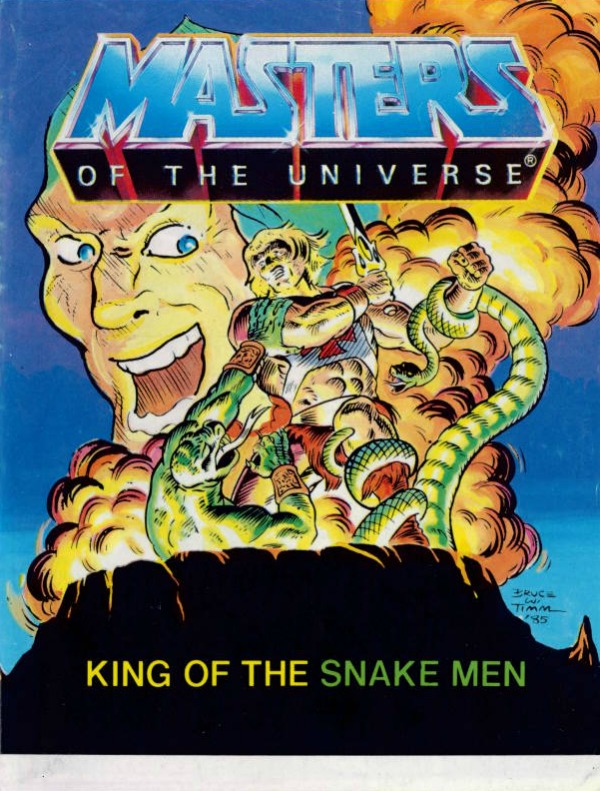
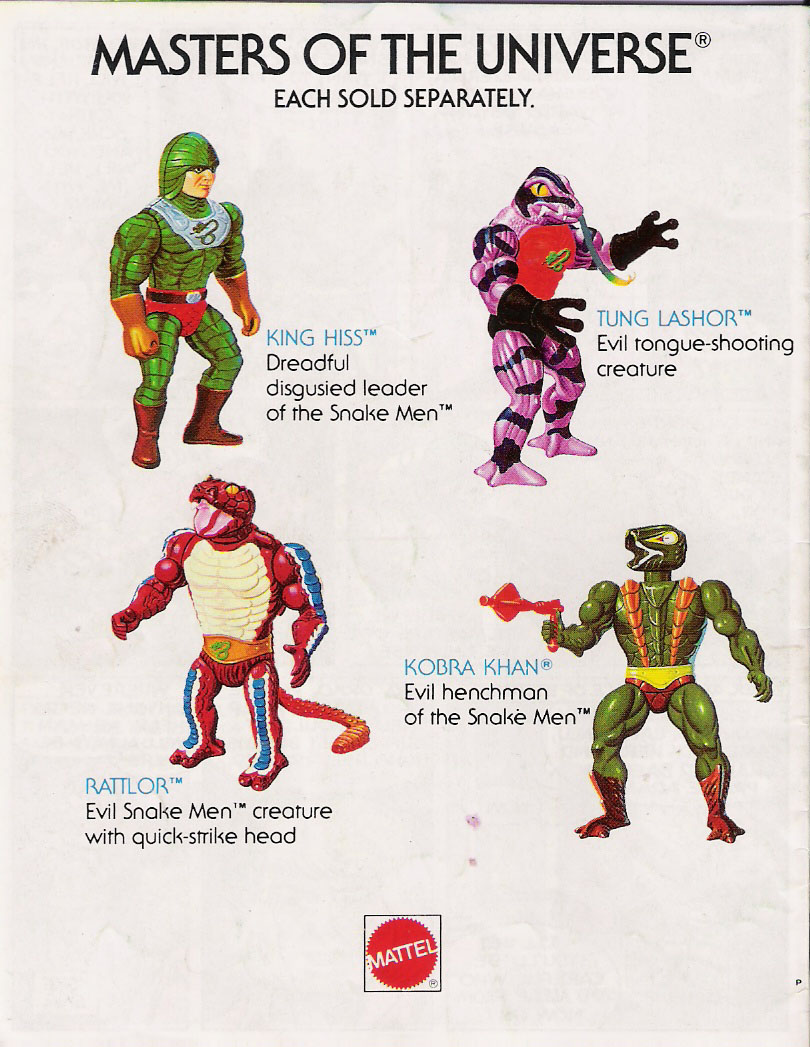
This is probably going to get me into trouble (more on this later), but I’ve had a fascination with the idea of reptile people for as long as I can remember. I think my first exposure to this was from watching He-Man and the Masters of the Universe. I also collected the dolls (or “action figures,” if it really bothers other men so much), and my absolute favorites were the Snake Men. King Hiss looked like a normal dude, but his entire torso came apart to reveal his true form as a writhing mass of vipers. Tung Lashor had a super-long poison tongue that came rocketing out of his mouth when you operated the button on his back. And Rattlor’s neck could extend with quite some force, rendering him somewhat hazardous around children’s eyeballs. These characters were not featured in the He-Man cartoons, but the dolls came with miniature comic books that explained their background stories and such.
According to the comic that came with King Hiss, the Snake Men are native to He-Man’s homeworld, Eternia, and they controlled a powerful empire long before the reign of King Randor. They were banished to some alternate dimension, but the evil wizard Skeletor found a way to bring them back. Thanks to He-Man, Skeletor only succeeded in facilitating the return of three Snake Men: King Hiss, Tung Lashor, and Rattlor. The Snake Men then launched a campaign to return the rest of their kind to Eternia, so they could invade and enslave humanity once more.
Is any of this starting to sound familiar to you yet? In Episode #10 of this series, I discuss one of my least favorite anti-Setian tropes in popular culture: the theme of an “evil snake God” called “Set” who was banished to an alternate dimension, who has legions of “Serpent Men” under his command, and who seeks to return and invade the world of human beings. This theme originates from the short fantasy fiction of Robert E. Howard (creator of Conan the Cimmerian and Kull the Conqueror), and it gained even more traction when Marvel Comics was licensed to adapt Howard’s fiction into its own fictional universe in the 1970s. Since then, the “Set and His evil Serpent Men” trope has emerged in countless cartoons, movies, role-playing games, and science fiction TV shows. He-Man and the Masters of the Universe, with its Snake Men and their tyrannical King Hiss, just happens to be the most obvious example of this trend.
One thing I disliked about He-Man was the fact that these Snake Men were bad guys. I have always loved snakes, especially the non-lethal ones like garter snakes, and I always thought it would be neat if these characters could have been heroes instead. I remember imagining my own Saturday morning cartoon shows where the heroes were all benevolent Snake People (with badass edgy names like Queen Hissteria and Big Bad Mamba), and the bad guys were just normal-looking humans. Curiously, the animated He-Man series does feature another race of snake people, the Reptons, who are peaceful and kind. (One of them, Kobra Khan, is one of Skeletor’s goons; but the show makes it clear that Khan is just a bad egg, and the rest of the Reptons are cool.) But when it comes to stories that add a little more dimension to this concept than what I usually expect, my life changed forever when I saw Doctor Who.
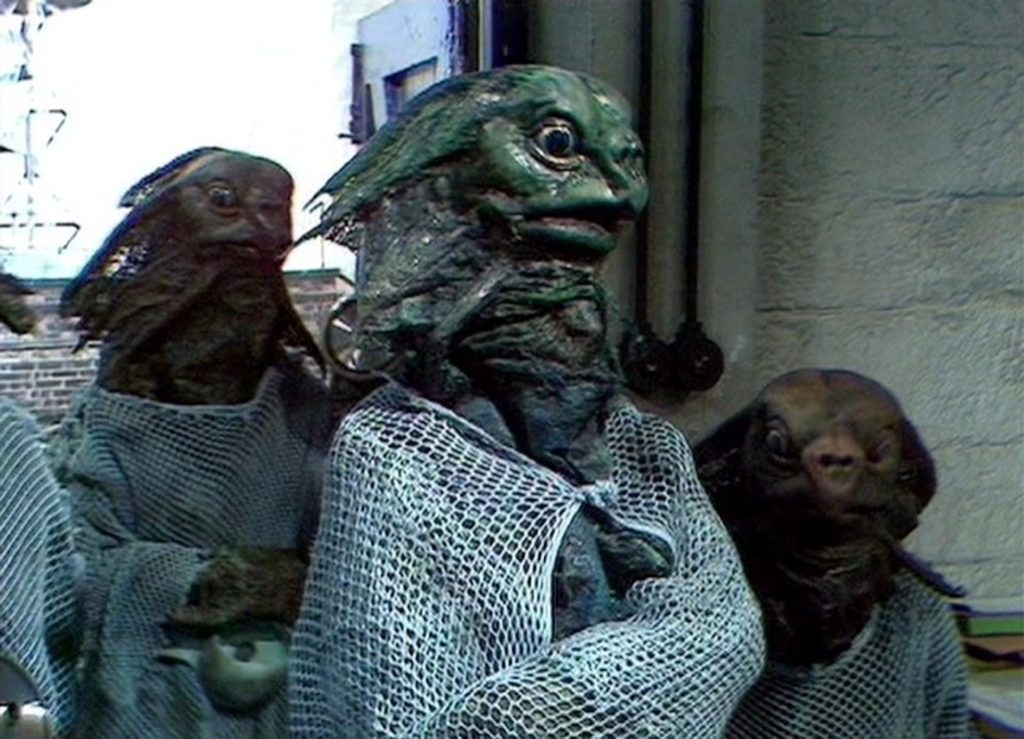
No, I’m not talking about the newer Who series that’s been in production since 2005. I speak to you of those lost long days when the only way you could catch Doctor Who here in the States was by watching PBS and sitting through all those passive aggressive pledge drives they used to do, where they’d threaten us with no Doctor Who ever again if we didn’t call in to buy that nifty coffee mug with the disappearing TARDIS. During the Jon Pertwee years, there were two serials that dealt with the theme of reptile people specifically: The Silurians and The Sea Devils, written by Malcolm Hulke. In the first of these adventures, the Doctor (who is currently stuck on earth with an inoperative TARDIS) learns there was another intelligent species that ruled this planet long before humans evolved from apes. These reptile people are not aliens, but native to earth. They went into hibernation deep underground when their advanced astronomy detected the incoming comet that eventually wiped out the dinosaurs. Their machines were supposed to awaken them shortly after the disaster, but a malfunction caused them to remain in suspended animation until they were accidentally revived by human nuclear testing during the 1970s.
“Hey it’s OK, these guys are sailors. If we get ’em laid, we won’t have any trouble!”
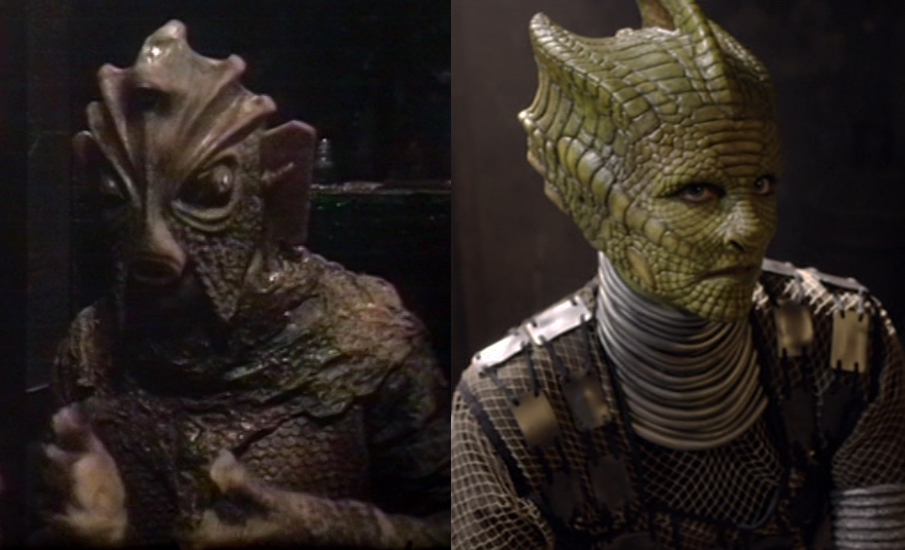
Having resurfaced, the reptile people are understandably distressed to find their planet invaded by ultraviolent hairless apes. Some of them are willing to try and co-exist with us peacefully, and the Doctor tries his best to facilitate an arrangement to this effect. But racists on both the human and reptilian sides of this dispute eventually stifle this hope, with the reptiles unleashing their biological warfare upon us, and the humans bombing all the rest of their hibernation chambers. In the second of these serials, the Doctor encounters another tribe of reptile people who belong to an aquatic subspecies, and the whole thing starts all over again. (Things are made even worse this time by the Master, played by Roger Delgado, who actively seeks to escalate the conflict between humans and reptilians.) Doctor Who lore is curiously divided as to how the reptilian characters in these stories are to be identified, but when I was a kid at least, I always went by the Malcolm Hulke novelizations, which refer to the land-dwelling reptilians as Silurians and their oceanic cousins as Sea Devils.
I remember CRYING a lot whenever I watched these episodes of Doctor Who, to the point that my parents were concerned I was actually scared and would have nightmares. But while I did find this stuff disturbing, it wasn’t because it was scary; it was because it was sad. I thought the Silurians and the Sea Devils were cool, and I wanted things to work out so that everybody can share this planet together and get along. I will admit that I was very young at the time, and I didn’t yet grasp that this was all just make-believe. But I also remember that when I got a little older and I first learned about some of the colonialist atrocities that have been (and still are) perpetuated against Native Americans, my initial reaction was to reflect back on Malcolm Hulke’s stories and the profound emotional reactions they invoked in me. The difference, though, is that THIS WAS FUCKING REAL, it ACTUALLY HAPPENED, it is most certainly NOT make-believe. And learning THAT horrible truth (in addition to others) has kept me awake at night far more than any scary TV show ever could. (Somehow, I sense that if I could ask Malcolm Hulke about this today, he would tell me this was exactly his point in writing these awesome stories.)
Incidentally, the Silurians and Sea Devils return in a few later Doctor Who adventures, but Malcolm Hulke had nothing to do with these serials, and I am not really a fan. In the 1983 episode Warriors of the Deep, the Fifth Doctor (Peter Davison) ends up wiping out two combined tribes of terrestrial and aquatic reptilians all at once. Sure, Davison makes a fantastic Doctor, and he clearly doesn’t WANT to commit genocide against the reptilians; but he does it anyway, and it’s gross, and there is no text or subtext about colonialism anywhere to be seen. It’s just “We gotta kill the people with animal heads so the humans can live.” This leaves the whole story feeling way too hollow and mean-spirited for my tastes.
Decades later, the new Doctor Who series re-introduced the Silurians during the Matt Smith era. These episodes deal with Malcolm Hulke’s creations much more respectfully, and I really enjoy the idea of a badass lady Silurian living in Victorian England and kicking hiney to help the Doctor save the world and stuff. I believe they even wrote it that at some point in Earth’s future history, humans and reptilians really do learn to co-exist. This is definitely a major victory as far as my inner child is concerned; but I just can’t stand the new makeup design for the Silurians. Old Silurians (and Sea Devils) actually look like people with reptile heads, much like the Serpent Men from Conan and the Snake Men from Masters of the Universe. The new versions are really just people with reptile skin, and they don’t resemble the beloved creatures from my childhood enough to resonate. Still, I do enjoy the fact that Doctor Who‘s reptile people have at least been vindicated in terms of their collective story arc after all these years.
Another show in which Robert E. Howard’s Serpent Men resurface is Hasbro’s G.I. Joe: A Real American Hero. In the 1987 animated film adaptation of the popular cartoon series, it is revealed that the international terrorist organization Cobra is really just a front for an ancient civilization called Cobra-La, which of course was populated by Snake People. These reptilians naturally seek to reclaim what they perceive to be their stolen earth, and the entire history of Cobra as a human totalitarian human regime is really just one more phase in their long game.
I don’t remember owning any G.I. Joe dolls, but I remember really enjoying the cartoon and its huge ensemble of diverse and fairly well-developed characters (especially my first true love, the Baroness Anastasia Cisarovna). But imagine my surprise when I learned that Cobra wasn’t actually created by Hasbro, which launched the toyline. Rather, it was “invented” by Marvel Comics, which was commissioned to write a story for Hasbro when it re-launched its catalogue in the 1980s. The writers at Marvel pointed out that the heroes needed some villains to fight if there were going to be any story worth telling; and for lack of any better alternative, they more or less cloned the concept of Hydra—the terrorist organization battled by superhero teams like the Avengers—and re-named it “Cobra.”
Like Cobra, Hydra was originally founded by ancient reptilians, who later infiltrated human governments for their own purposes, including that of Nazi Germany. Then there’s the fact that many of Hydra’s most infamous members are named after snakes in one way or another, including Viper/Madame Hydra, Gorgon, Anaconda, etc. But there’s an extra layer here: the Serpent Men who founded Hydra turn out to be the very same Serpent Men who serve the “evil snake God” Set in Howard’s Kull and Conan tales. This bastardization of Set has even appeared throughout Marvel Comics as an actual character for superheroes like the Avengers to fight. This is ironic given that the real Egyptian God Set also makes a personal appearance in an episode of G.I. Joe; but as discussed in Episode #10, G.I. Joe was much much closer to the mark! Its version of Set doesn’t appear to be involved with the civilization of Cobra-La, either.
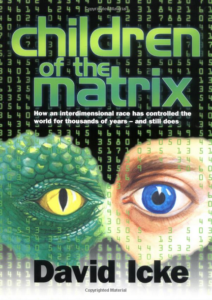
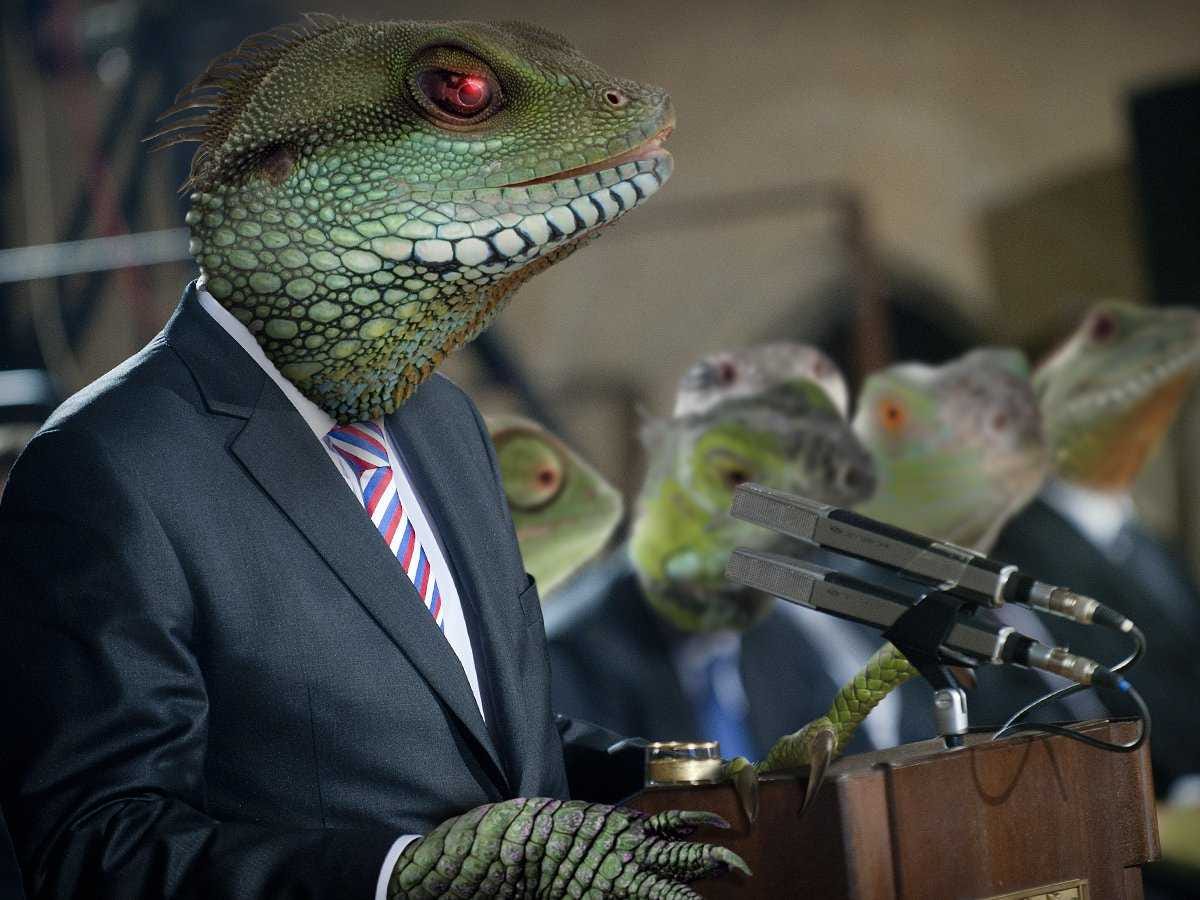
Now I must return to my earlier point about how writing about all of this will probably get me into some trouble with some people. (It’s okay, I don’t really care—this is all for Nehebukau, to whom I shall return in just a moment!) I am sure readers in the know are already chomping at the bit for me to touch on reptilian humanoid conspiracy theories and the bizarre subcultures they have bred in real life. I’m referring of course to the belief some people have that there are actual reptilians living among us here on earth. These people mostly take their cue from the exact same source: David Icke, a pseudoscientist and total huckster. Since the late 1990’s, Icke has popularized this belief that reptilians from a planet orbiting Alpha Draconis invaded our planet way back in ancient times. They were mistakenly worshiped as “Gods” by “wayward” people like the ancient Egyptians, and they continue to infiltrate modern human governments (including the entire Bush family, no less). Furthermore, this ancient alien reptile conspiracy is supposed to kidnap little children and drain them of their spinal fluid so it can be fed to Hillary Clinton, who is herself alleged to be a reptilian warlord in disguise. (Icke even manages to tie his evil reptilians together with Nazi Germany somehow, which explains the trope of Adolf Hitler secretly floating around the Arctic in submarines with reptile people.)
If you ever see this book lurking around your neighborhood, set it on fire. (The book, not your neighborhood.)
There are so many things wrong with David Icke’s bullshit, it’s impossible for me to address each particular grievance in today’s sermon. But my most immediate critiques are that Icke’s take on ancient civilizations is hopelessly racist; his encouragement of secularized Satanic Panic nonsense is absolutely deporable; and worst of all, domestic terrorists have adopted his anti-reptilian routine, trying to assassinate politicians they believe are reptilians. Yet there is something else wrong with all of this that should hopefully be CRYSTAL fucking clear by this point, given everything I have already explained above:
It’s ALL fiction, and NONE of it is original.
Robert E. Howard made a lot of this crap up back in the 1920s. Then Marvel Comics came along and made up some more in the 1970s. Then a bunch of Saturday morning cartoons boosted the signal for it during the 1980s. And of course there have been countless other science fiction authors and media properties that have played around with the concept in one way or another. David Icke never wrote any of his conspiracy theory bullshit until the late 1990s, by which point the meme had already been well established in popular culture. So it’s pretty fucking clear that he plagiarized his entire routine from a bunch of cartoons and comic books. And the assholes who are willing to kill people over this shit are really doing it for nothing.
Don’t know about this guy’s politics…But his profile is kickin’!
Here’s the thing: I do not actively believe there are any reptilian humanoids living on this earth, or at least not in the sense of “ancient aliens” (more on this below). I’m not saying it isn’t possible; I just haven’t found any evidence to substantiate such an idea. But even if I did, I would quicker assume such entities are just as native to this world as we are, and that they have just as much right to be here as we do. I don’t believe any of this nonsense about aliens controlling human governments; human beings are the single most dangerous creatures on this planet, we don’t need extraterrestrials to make us any better at wreaking havoc. If there ARE any Snake People around, they’re probably HIDING from us because they’re fucking SCARED TO DEATH of us!
And to assume that an entire sentient race would be inherently evil simply because it evolved from reptiles is, to call a spade a spade, racist. WE evolved from motherfucking APES, and apes do some pretty fucked-up shit you know. Maybe it’s just because I grew up learning important lessons about these things from Captain Jean-Luc Picard; but I see no reason to assume a civilized reptilian people would be any worse at respecting Ma’at or fighting isfet than civilized simian peoples apparently are. (I can already read the emails from Icke’s zombie followers, skewering me for being some dumb, deluded PR boy for the Visitors who want to eat me and my family!)
The thing is, there are other people who believe in real reptilians so to speak, and who hold more sensible views about them than anything offered by David Icke. The most prevalent example of this would be Hindu, Buddhist, and other Asian religious belief systems that acknowledge the Nagas. These semi-divine creatures can appear as snakes, people, or any variety of human/serpentine hybrid. They are believed to have pre-existed humans, and while they can be good or evil just like us, most of them appear to be dutiful servants of the Devas (the Hindu Gods). They enjoy living in rivers, lakes, oceans and raindrops, and they guard all kinds of ancient knowledge and treasures. Though they are not necessarily Gods, the Nagas are often venerated with offerings, which helps to attract good fortune. Much of this is echoed in Chinese folk beliefs about dragons, as well. Lóng or Chinese dragons are also shapeshifters who can appear human and who bring good luck to those who show them the proper gratitude and respect.
I first learned about the Nagas not from a textbook or a cartoon show, but from my best friend in second grade, a boy named Pawan. Pawan and his family were Indian American immigrants and deeply observant Hindus. I remember seeing various images of the Devas whenever I visited their apartment. I do not recall which sect or tradition Pawan and his family might have followed (and being only eight years old or so, I lacked the head space to even formulate such a question at the time). But I remember asking Pawan’s mother to tell me about the Nagas, and she seemed really happy to share some stories with me. It must have been crazy to have this weird little white boy from next door take such a genuine interest in her family’s culture and heritage!
But then I would go home and tell my parents about this stuff. For some reason, they were only okay with such beliefs as long as it was Pawan and his family practicing them. I received every indication that it is only acceptable for white people to be Christians and believe in one God, even though neither of my parents has ever been a committed religious believer of any kind. Much later I would meet some of David Icke’s followers (most of whom are white), who insisted to me that both Naga and Lóng veneration is really just another part of the evil reptilian plot to murder children and keep the world hypnotized. When these people claim that Asians are actually venerating evil demons or aliens—or if they suggest that such religious traditions are “beneath” white people for any reason—they are blatantly endorsing Christian white supremacism; full stop.
Even Nehebukau Himself was given the Marvel Comics treatment!
Furthermore, neither the Nagas nor the Lóng are space aliens that ride around in spaceships. There are no tales about them eating people or operating any nefarious shadow governments. They are nature spirits and religious figures, not science fiction monsters. The same is true of other Snake People who are acknowledged in other cultures too, including African Mami Wata spirits and Native American horned serpents. This begs the question: could the ancient Egyptians have believed in something similar? There doesn’t appear to be any specific term in Egyptian for “serpent man” or “snake person” (or at least not that I have found just yet); but perhaps this would have been redundant. The Egyptians appear to have regarded normal, everyday snakes as sentient creatures with magical powers. How else could serpents be held accountable to Ma’at, with the good snakes serving Ra and the evil snakes following Apep? This distinction makes little sense, at least to me, unless we stop to consider that maybe snakes are actually people too!
Which helps me circle back to the Netjeru. It is curious that I never felt drawn to any particular Egyptian snake deities until Setken first proposed that we collaborate on his Hymn to the Soul Serpent project together. Only then did it occur to me that everything I ever needed to justify my enthusiasm for snakes (whether as animals, sentient beings, or magical anthropoids) is already included in the belief system I already follow. And when I laid eyes on Setken’s humanoid portrayals of Nehebukau, I was taken back to those far-off days when I would play with my Snake Men dolls; when I would weep over the Silurians and the Sea Devils; when I secretly rooted for Cobra or Hydra as reptilian freedom fighters; and when I listened to Pawan’s mother explain to me about the Nagas. Could it be that Nehebukau was looking in on me even back then, thinking, “This is the kid I want to co-write a song for Me someday”? Could it have been His double-headed wisdom that helped me see through all of David Icke’s bullshit when it was first presented to me? Hell; I reckon Set and Nehebukau probably both had all of this arranged somehow before I was even born!
Writing one song isn’t all I think I am meant to do, either. I think Nehebukau has probably put all of this stuff into my brain for some kind of purpose, and I mean to put it to use somehow. This very likely means another album will soon be in the works. I always wanted to make movies when I grew up; and failing that, I enjoy adapting some of my old story pitches from childhood into “soundtracks” for films that don’t exist (as with Summer’s End and His Nocturnal Majesty, with which I am very happy). I’ve successfully introduced the crimefighting mummy Het-Sem-Peckinpah to the world, as well as the mysterious Knights In Sutekh’s Service. Now that my Halloween and apocalypse “movies” have been taken care of, so to speak, perhaps it is time to revisit my old sword-and-sorcery “movie” pitch as well. It could be that Queen Hissteria, Big Bad Mamba, and other Saurian Warriors of Basilisk Basilica will soon be making an appearance…
Looks like Nehebukau be shakin’ His booty for Wadjet and Meretseger!
Jesus is a dead alien; Satan is a prehistoric sentient ooze; and “God” is the greatest supervillain of all time. This unique fictional theology helped me think outside the box, for sure!
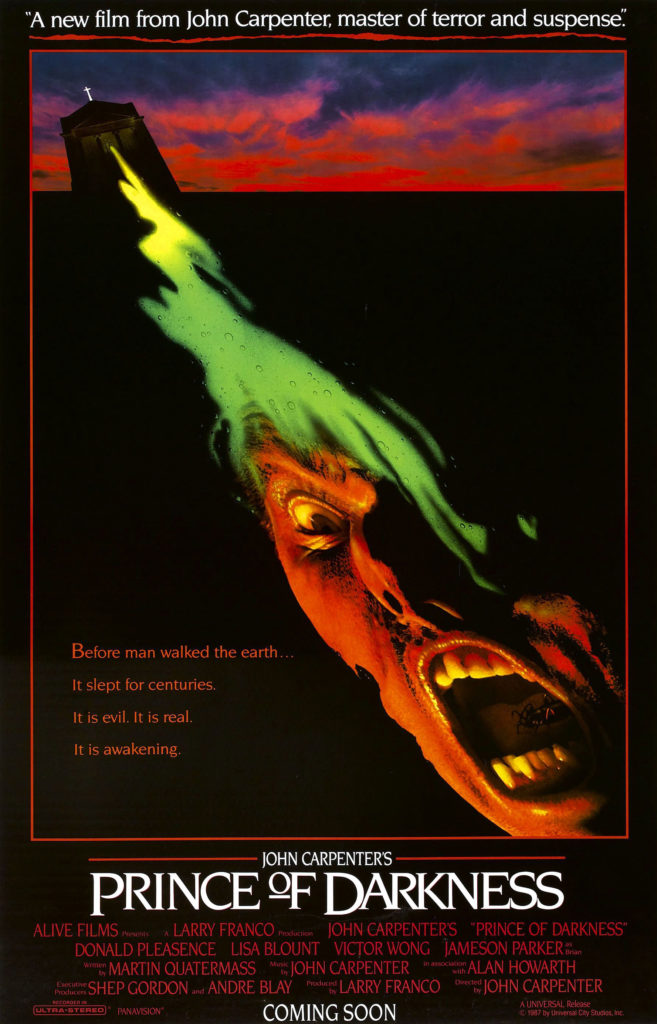
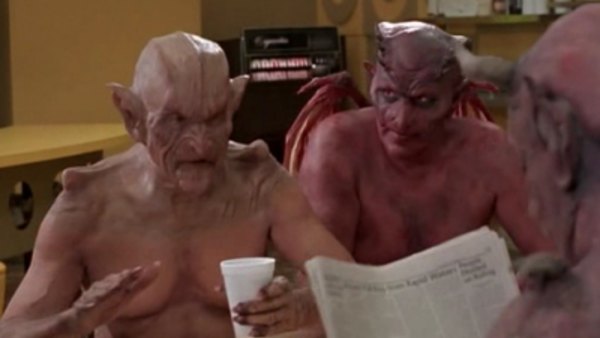
It probably isn’t fair that so many of my favorite films are John Carpenter (or Carpenter-related) movies; but it happens to be true, and I’m sure no one is surprised by this. I’ve already discussed three of these flicks—Halloween (1978), The Thing (1982), and Halloween III: Season of the Witch (1982)—but one of Carpenter’s lesser known masterpieces is Prince of Darkness (1987), in which the creator of Michael Myers gives us his version of “the devil.” And it is the single most original and engaging take on the subject I have ever seen. If you’re expecting to see anything like Tim Curry with big ass goat horns, or even Al Pacino leading a law firm, think again. In Carpenter’s Prince of Darkness, everything we think we know about “Satan” is thrown out the window, and what turns out to be true about him is far more terrible than anything conjured by biblical scholars or Christian theologians.
Professor Howard Birack (Victor Wong) is a world-renowned quantum physics lecturer at Kneale University, and his graduate students are some of the best and brightest young minds in his field. There’s Brian (Jameson Parker, who resembles a younger version of Tom Atkins in Halloween III); Catherine (Lisa Blount, a mathematician); and Walter (Dennis Dun, a total wisecracker), among others. These up-and-coming scientists are all bewildered by their instructor, who creeps them out with tales of how our human notions of “common sense” break down at the subatomic level, evaporating into “ghosts and shadows.” Perhaps it wouldn’t be so spooky to hear such things if there weren’t so many weird astronomical phenomena happening lately. Something about the lunar cycle seems different, and there’s also a newly discovered supernova being reported on TV. Some distant star died countless eons ago, and the particles from that explosion are only just now reaching our galaxy.
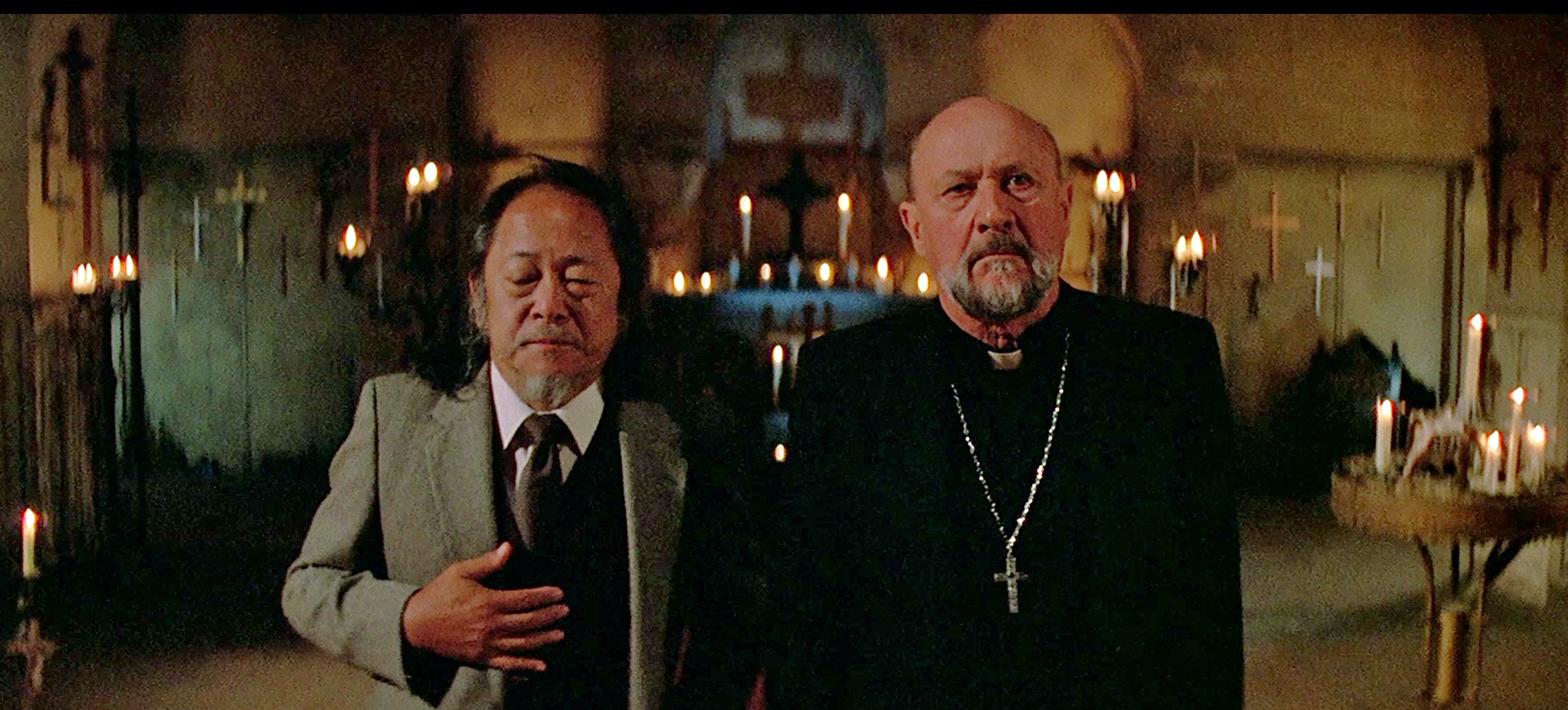
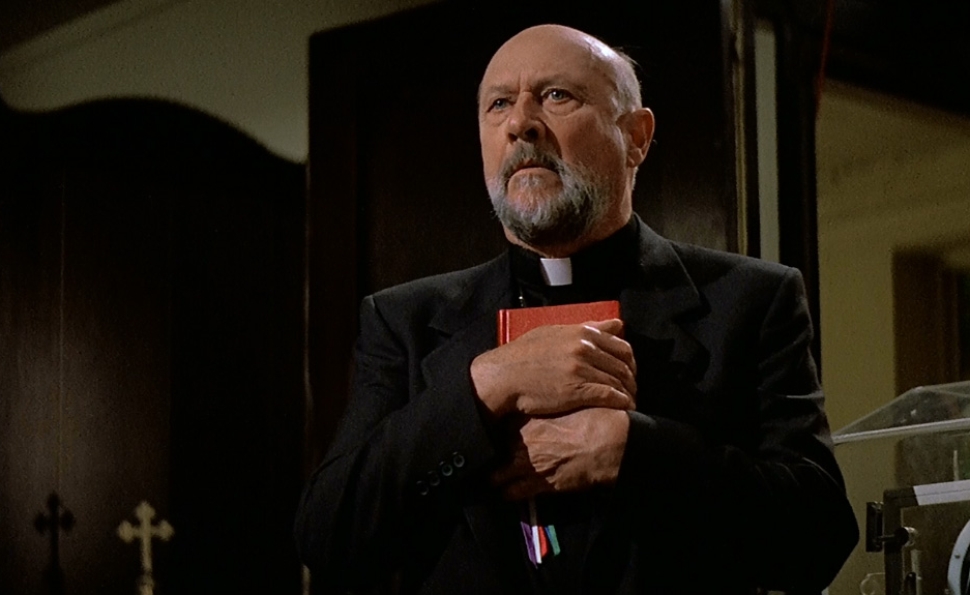
Then a Catholic priest (the magnificent Donald Pleasence) requests to meet with Professor Birack. The Priest claims he has made a terrible discovery, and he asks for Birack’s help in doing something about it. Birack accompanies the Priest to an abandoned derelict church called St. Goddard’s. As they descend into the church’s labyrinthine cellar, the Priest explains that he was on his way to visit another clergyman, who unfortunately died before the Priest could arrive. After reading his departed colleague’s diary, the Priest learned he had been living alone at St. Goddard’s, keeping something hidden in the basement. The clergyman was part of a sect so secret and powerful that even the Vatican doesn’t question its actions. Known only as “the Brotherhood of Sleep,” the sect has protected whatever the clergyman has been hiding at St. Goddard’s all this time. The clergyman was the last remaining member of the sect, and now that he has passed away, the Priest feels it is his duty to continue the Brotherhood’s work somehow.
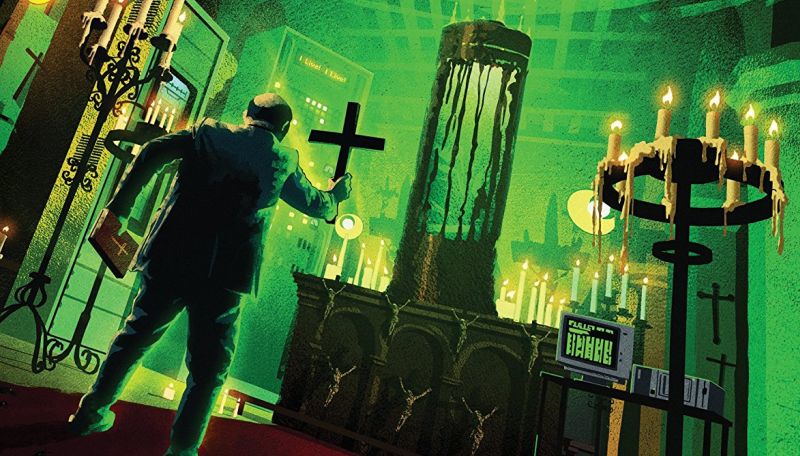
When Birack and the Priest reach the center of the basement, they find a shrine decorated with countless crucifixes, all of which surround an object that stops Birack cold in his tracks. It’s a huge container filled with a swirling, glowing green ooze, and something about that ooze makes both men feel like they are being WATCHED. When Birack asks the Priest what this object might be, the Priest refers to it with masculine pronouns (“he/him”), as if it were a sentient entity. He also suggests it might have something to do with the moon and the supernova, and that some even crazier bullshit might be ahead. Is there anything Birack can do to help get rid of this fucking thing?
After coming to terms with this encounter, Birack approaches his students with a one-time offer: a unique opportunity to study this crazy discovery and write a whole bunch of academic papers from it. He also wrangles a few other professors and their students into this plan as well. The team assembles one Friday afternoon at St. Goddard’s, where everyone gets a good look at the strange container in the basement. Suddenly no one wants to be there anymore, but they stick around just the same, working and gathering data from the artifact into the wee hours of the night. As they do, some homeless people who have been hanging around the church start behaving like Michael Myers, standing unnaturally still and staring in hostile silence. (One of them is even played by Alice Cooper, who wrote “Prince of Darkness” [from his 1987 album, Raise Your Fist and Yell] for the soundtrack.)
The scientists take turns napping through the night, and whenever they sleep, they each have the exact same dream: a vision of a TV recording someone has made. The footage shows a hideous figure lurking in front of the church in which they are now sleeping. There is also a distorted voice in the nightmare that says:
“We are using your brain’s electrical system as a receiver. We are unable to transmit through conscious neural interference. You are receiving this broadcast as a dream. We are transmitting from the year 1-9-9-9. You are receiving this broadcast to alter the events you are seeing. Our technology has not developed a transmitter strong enough to reach your conscious state of awareness. But this is not a dream. You are seeing what is actually occurring. This is not a dream.”
When the scientists carbon date the container downstairs, they learn that its mineral content is over seven million years old, and that it came from outer space a well. There is an opening mechanism at the top, but strangely the lid can only be opened FROM THE INSIDE. No analysis of the glowing green ooze can be made, but everyone starts to feel it is ALIVE and WATCHING them somehow.
The team also finds an ancient Brotherhood of Sleep manuscript that appears to contain differential equations—several centuries before such mathematics were previously thought to have been invented! According to this text (which also appears to pre-date the New Testament), Jesus Christ was not a supernatural being, but an extraterrestrial from another planet in some distant galaxy. Jesus escaped from his homeworld when the sun of his solar system went supernova, and he reached our earth thousands of years later, landing in Roman-occupied Judea. There, Christ went around using his advanced alien medical science to heal people. He also tried to warn everyone about what destroyed his home planet. The aliens from Jesus’ homeworld discovered there is indeed a Universal Mind that can control the behavior of subatomic particles across all of time and space. But rather than a loving Creator, this Supreme Being is a wrathful Destroyer, seeking not to sustain but to annihilate all things.
This all-powerful Anti-God was somehow “banished” to the realm of anti-matter by Jesus and his people with their incredible technology; but this process required destroying their own sun for some reason (hence the supernova). Unfortunately, the Anti-God knew what was going to happen and created a “son”—Satan—which it buried in suspended animation on our planet, somewhere in the Middle East. Christ came to Earth specifically to find Satan and help the human race get rid of him; for when the devil wakes up, he will cause reality to unravel, allowing the Anti-God to slither back into our universe. But then Jesus was crucified, and the responsibility for all of this fell to the Brotherhood of Sleep. They found Satan and kept him hidden for all these centuries, hoping he would stay asleep until humans could develop a science sophisticated enough to destroy him. They eventually transported him here to St. Goddard’s, where the devil has been buried ever since.
No one really wants to come out and say it; but after hearing all of this, everyone knows exactly what—and more importantly, WHO—it is that’s watching them from inside that container down in the basement.
Then the scientists realize they have each been having the same nightmare. The Priest explains that historically, everyone who encounters the Brotherhood of Sleep starts to have this dream every night for the rest of their life. Brian and Catherine theorize that the dream might actually be a real message from the future, sent backward in time by scientists via “tachyon beam” signals that our brains can only receive as dreams. The message makes it clear that if something isn’t done about the entity trapped downstairs, the world will somehow end in 1999.
And it’s at this point in the movie when the glowing green ooze OPENS ITS OWN CONTAINER and starts spraying itself at people, right into their mouths. After they choke on the slime for a while, it takes complete control of their bodies, effectively “possessing” them. This explains what happened to all the zombified homeless people lurking outside the church, and why they butcher anyone who tries to leave. Being dead does not prohibit the slime from possessing its hosts either, for several of the scientists’ mangled corpses are converted into zombies as well. Most of the ooze absorbs itself into one scientist in particular, sending the poor lady into a coma. The remaining survivors are trapped inside the church for the entire following day, unable to call or send anyone out for help.
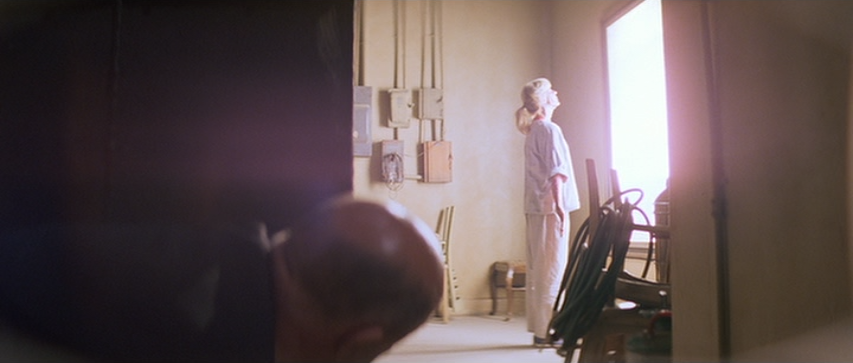
As night falls on the second day at St. Goddard’s, Satan’s primary host—who is now horribly disfigured and equipped with fierce telekinetic powers—awakens from her coma. The Prince of Darkness then transforms every mirror in the building into some kind of interdimensional gateway. On the other side of each gateway lurks the Anti-God, which is anxious to step back into this world and start the apocalypse. Just what the hell can Brian, Catherine, Walter, Birack, or the Priest do to stop any of this insanity? I ain’t gonna tell you; go watch the movie to see!
Without a doubt, Prince of Darkness is the most inventive and thought-provoking “devil movie” I have ever seen. Carpenter wrote the script under the pen name “Martin Quatermass,” which is an obvious homage to Nigel Kneale. (He even named the fictional college after his hero, calling it Kneale University.) The premise is very similar to Quatermass and the Pit (1967), in which another team of scientists battles a similar alien force that is likewise revealed to be “the scientific reality” behind a supernatural force. I think the concept for Prince of Darkness might have originated from when Carpenter was still involved with Halloween 4(1988) during its pre-production phase. He had pitched a script by Dennis Etchinson in which Michael Myers returns as some kind of reality-bending ghost. When this premise for Halloween 4 was rejected, Carpenter reworked it into the script that later became Prince of Darkness. (He even wrote in a character named “Etchinson,” who is clearly named after the horror novelist.) Carpenter was also reading tons of shit about quantum mechanics at the time, and all of this stuff collided together in his brain to form the idea of a cosmic supervillain: the all-powerful Anti-God.
If it seems unlikely that Prince of Darkness came from a rejected pitch for a Halloween sequel, just look at the Priest. He is functionally similar to Dr. Loomis from Halloween (1978) in almost every way; the Wise Elder who knows about the Evil, and who tries to do something about it. He even refers to Satan as his “prisoner” at various points, as if he were Dr. Loomis referring to Michael Myers. It also seems relevant that Carpenter chose not to give this character a name. When you watch Prince of Darkness with subtitles, the captions identify the Priest as “Father Loomis” for some reason (even though he is never addressed by name, not even in the end credits). Based on Pleasence’s performance here, I almost think Prince of Darkness is actually a direct sequel to Halloween from some alternate timeline. Perhaps in this cinematic universe, Dr. Loomis gave up on psychiatry after shooting the Shape at the end of Halloween, then launched a new career for himself in the Catholic Church. But now he is tasked with handling yet another unstoppable prisoner, and this one is even worse than the last!
Pleasence gives one of his very best performances here. When the truth about Satan is revealed, the Priest quickly accepts that the Catholic Church and its teachings are all a sham. But we can also see the terrible strain this knowledge puts on him. When the Priest hides from one of Satan’s hosts, he stands there quietly, whispering desperate prayers to his God. You can see on his face that he doesn’t really believe in who he’s praying to anymore. Something about Pleasence’s voice during that scene always makes me want to reach through the TV and tell him, “It’s gonna be all right, Father; let’s invoke SET into ourselves and BLUDGEON these slimy zombie fuckers SIX WAYS FROM SUNDAY!” Yet the Priest never becomes a problem or a liability for the other characters; he is nothing like Blair from The Thing(1982), who just totally loses his shit and tries to kill everybody. The Priest clearly isn’t having an easy time with any of this “Space Jesus” stuff; but his heart is still in the right place, and he does his best to stay useful and sane.
Another actor who is truly fantastic in this film is Victor Wong. You’ve probably seen this guy in tons of movies, but he also appears in John Carpenter’s Big Trouble in Little China (1986) as the benevolent kung-fu wizard, Egg Shen. Wong is another character actor who was generally cast to play the exact same role in everything he did, usually appearing as a monk, seer, or martial arts master (as seen in films like The Golden Child from 1986 and Three Ninjas from 1992). But Prince of Darkness is one of the few films I’ve ever seen in which Wong is not typecast in this way at all. Here he gets to be a Gods-damn quantum physicist, a role that would have normally been reserved for a white male back in 1987. Professor Birack is also one of the main characters, which is especially meaningful since Wong was typically cast only for supporting roles. As a matter of fact, Prince of Darkness features not one but two Wise Elders who know about the Evil and are trying to stop it: Birack and the Priest.
As a Pagan, one of my biggest pet peeves in science fiction is the conflation of Pagan deities with “ancient astronauts.” We see this trope again and again in things like Doctor Who, Stargate, and any number of other media fandoms. This notion stems from the white colonialist belief that other cultures simply “couldn’t” have accomplished their own achievements by themselves. To claim the pyramids were built by aliens rather than the ancient Egyptians, for example, is to claim the Egyptians were not as smart or resourceful as the Greeks or Romans (who are almost never accused of having anything “provided” for them by aliens, likely because they were white). The Egyptians were a highly advanced people and they did not need any help from extraterrestrials to develop their religion, their art, their fantastic monuments, or anything else.
Almost no one EVER writes this kind of bullshit about Jesus Christ, and we know exactly why that is, don’t we? Because if anyone did, Christians would get all butt-hurt about people dehumanizing their beliefs and traditions. For some reason, this never seems to apply to other deities and religions; writers dehumanize Pagan beliefs and traditions ALL THE FUCKING TIME. But John Carpenter’s Prince of Darkness gets revenge for this by unabashedly “alienizing” Christianity, giving Jesus and Yahweh the exact same treatment that things like Doctor Who give to Set!
(Incidentally, there are at least two other films I know of that “alienize” Jesus like this. One is Giulio Paradisi’s The Visitor [1980], which is just awful, and another is Larry Cohen’s God Told Me To [1976], which is actually pretty terrific. But neither of these films holds a candle to Prince of Darkness.)
I enjoy the fact that Carpenter completely deconstructs Christian mythology here. Compare Prince of Darkness to End of Days(1999), for example. The latter is an A-list, big budget exploitation movie that only exists to satisfy the demand for sex and violence. There’s nothing wrong with this in principle, but End of Days also tries to pass itself off as a “religious” movie that wants to “scare you back into church.” In Prince of Darkness, no sanctimonious lip service is paid to Christianity whatsoever; the entire religion is written off as simply being false. Absolutely none of the traditional Christian weapons against Satan (crucifixes, exorcisms, etc.) will work. The message I take from this film is, “God is EVIL, and the only way to stop him is with SCIENCE!” If End of Days wants you to get your ass to church, Prince of Darkness wants you to get your ass to a quantum physics classroom.
As a Setian, this film speaks to me very deeply, and in at least two different ways. It’s intriguing to think that Satan himself is not the true source of evil here, but just a facilitator for an even greater and more powerful villain. The Anti-God might as well be Apep from Kemetic mythology: an unstoppable disintegrator of reality that can be repelled, but which can never be completely defeated. It’s very easy for me to imagine the Brotherhood of Sleep and its new recruits (the Priest and the scientists) as a constellation of souls chosen by Set to try and cast this monster back into the void. On the other hand, the film also speaks to me in terms of my own religious conversion, in which I realized:
There is this thing in my life that I would call a God.
This God I experience defies everything I was told about “God” as a child.
Conventional religion just can’t seem to handle this God, because He scares most religious people too much.
So watching Prince of Darkness, in which the characters make these exact same discoveries about the Anti-God, really made an impression on me. The movie seemed to tell me, “Yes, G.B., it’s totally okay for you to THINK BEYOND CHRISTIAN IDEOLOGY!” When people around me learned of my love for Set, many of them insisted I was “worshiping the devil” and would “burn in hell.” (Some people still tell me this today.) Prince of Darkness helped me break out of this mental trap by reinforcing the idea that there CAN be higher cosmic realities that defy conventional religious expectations. This helped me come to terms with Set’s true identity as a Kemetic Netjer and understand that He is not, in fact, “the devil.” It also helped me understand that I am a Setian and a Kemetic polytheist, not a Satanist or a devil worshiper.
As a final note, John Carpenter typically scores most of his own films, and Prince of Darkness is no exception. The movie features 50 minutes or so of eerie electronic music by Carpenter and his frequent collaborator at the time, Alan Howarth. This score is haunting and beautiful, perfectly capturing the threat of total cosmic decay. Before I started composing my own tunes, this was one of my favorite albums to play during my rituals to Set. It has definitely been a major influence on my latest release, His Nocturnal Majesty, and I highly recommend it to anyone who enjoys my work.
How a really terrible Arnold Schwarzenegger movie influenced my spirituality and art.
Previously I discussed the television series Millennium, a brilliant show that made a huge impression on me as a Setian teenager back in the 1990s. There was another apocalyptic-themed horror romp from that era which made a huge impression on me too, but it was not nearly so remarkable. In fact, it’s really a terrible production most any way you look at it. But in those crazy days just before January 1, 2000, when lots of people were kinda worried the world might actually fall apart on New Year’s Eve, there was one theatrical film that dared to exploit all that juicy endtime paranoia. And shitty as it was, I’d be remiss if I didn’t address some of the influence it has had on me.
That’s right, I’m talking about the one and only End of Days (1999), that magnificent shit show in which Arnold Schwarzenegger squares off against Satan himself, who’s prowling the streets of New York City in Gabriel Byrne’s body. Oh Gods, where do I even START with this fucker?
Okay, so the story begins with a bunch of clergymen at the Vatican freaking out about a comet and some prophecy about a “satanic” child being born somewhere. Then, in New York City, Udo Kier kills a snake and baptizes a newborn baby girl with its blood. The girl just happens to be born with a birthmark that resembles some kind of glyph. Then, confusingly, we fast forward to December 1999, when a semi-invisible creature rises up from the sewers of NYC to possess some random business dude (Gabriel Byrne) so it can grab some poor lady by her bosom, then blow up a restaurant. Then we meet Jericho (Arnold Schwarzenegger), some kind of private security guy whose family was murdered and who is just one stone’s throw away from killing himself. Jericho is hired to protect the dude who’s possessed by Satan, which comes in handy when a crazy Catholic priest with no tongue tries to assassinate the guy.
Jericho does his job, but he doesn’t like the way things add up. So he decides to investigate the priest, which somehow leads him to track down Christine (Robin Tunney), the woman who was born and baptized at the beginning of the movie by Satanists. This is convenient too, because it turns out Satan is searching for her. Apparently, Christine was bred to be his bride at the End of Days. If the devil succeeds in raping Christine at the stroke of midnight on New Year’s Eve, it will somehow allow him to take over the world and burn the whole thing down to a crisp. This is all explained to us by another Catholic priest (played by Rod Steiger) who leads an underground movement to find Christine and keep her safe. But at the same time, a rival sect within the Church has sent an army of assassins to kill Christine before Satan can get to her. Any way you slice it, Arnold—er, I mean Jericho—feels compelled to get Christine the hell away from everyone. The whole thing leads to a midnight black mass in the sewers, a subway chase scene, and then a final confrontation in some random church. Satan possesses Jericho at the last minute before midnight, and all seems lost; but Jericho resists the devil’s will to rape Christine and commits suicide instead, thereby saving the poor lady and canceling the apocalypse.
(Are you keeping up with all of this? Fascinating how much plot they managed to cram into this movie, especially considering how shallow and empty the film actually is!)
End of Days clearly wasn’t made by dogmatic Christians; otherwise the writers would have adapted the book of Revelation much more faithfully (pun intended). It is the pinnacle of absurdity when Rod Steiger rants about how Jericho should “read the Bible” to understand what’s going on, given the absence of any real biblical content in this story. The fact that Steiger comes across as angry and scolding while he does this is definitely a turn-off, too. The film presents itself as trying to “scare audiences back into church,” but it doesn’t care enough to get any of its own bullshit right! Instead of actually adapting the book of Revelation or anything like that, this is basically just a Terminator movie that swaps the supernatural for science fiction.
Consider this film’s version of the devil, for instance. Other cinematic adversaries of the time were quite a bit more interesting, such as Al Pacino’s take on Lucifer in The Devil’s Advocate (1997) and Denzel Washington’s face-off against Azazel in Fallen (1998). Gabriel Byrne’s devil, however, is little more than a two-dimensional slasher movie villain who stalks and slashes people. This is quite a shame too, because Byrne is a magnificent actor and could have really owned this role if he had been allowed to do so. As it is, he just stands there, says a few cliches, and gets shot at. I suspect the director, Peter Hyams, is the real reason why Byrne’s performance in End of Days seems so forgettable. Maybe it’s just because I’m a Setian and I actually know the complex history of where “the devil” came from; but I personally prefer my satanic horror movies to be a little more innovative, thought-provoking, and weird. (Just wait for my NEXT sermon, in which I will give a most excellent example of what I mean!)
The magnificent Gabriel Byrne playing one of history’s most forgettable devils.
I also have two very serious objections to the plot. First, I don’t appreciate the fact that this entire story hinges on the threat of Christine being raped. And yes, I’m aware that she says, “I’m scared I might WANT to sleep with him” at some point; but I don’t care. Being hypnotized into having sex with someone STILL COUNTS AS RAPE. (In fact, there are other lady characters in the film who are raped in this manner.) And since there is no mention of the devil actually raping anybody in the book of Revelation, a decision was clearly made to capitalize on Satanic Panic hysteria here. I not only find this distasteful; I find it disgusting. They could have just as easily written it so that Satan has to eat a ham sandwich on New Year’s Eve to start the apocalypse (which would have been much more entertaining, actually!)
My second objection relates to the main character, Jericho. Let’s be honest here: Arnold Schwarzenegger isn’t exactly the greatest actor who ever lived. But his acting ability isn’t a problem for me; I enjoy him in many of his films just for his charisma. No, the problem here is that Jericho is written as a suicidal person who eventually HAS to take his own life (and at the Christian God’s behest, in fact). He has no character arc to speak of; he never grows or learns anything, he just stays exactly the same all the way through. So when Jericho has to kill himself at the end, it’s not like he says, “But wait, I’m not suicidal anymore!” or anything like that. No, far be it from End of Days to offer us any sort of character development. It’s more like Jericho has been waiting to kill himself this whole time, and now he can finally get it over with. The message I take from this is incredibly ugly, toxic, and mean-spirited. It feels like End of Days is saying, “Suicidal feelings are GOOD because they make men MANLY, and they make us better suited to serve God’s will!” And that is not a message I can ever agree with.
Dude, I fuckin’ LOVE this music.
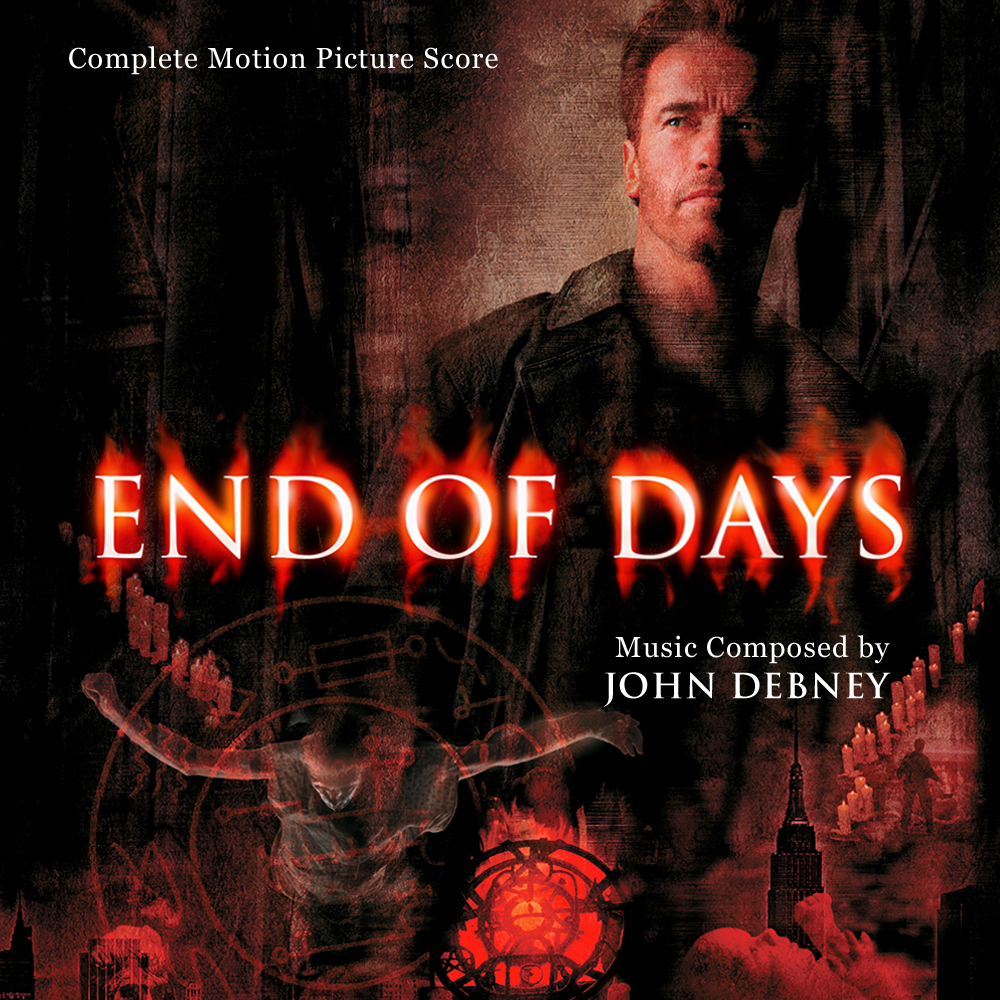
By now, you must be wondering how on earth End of Days could have influenced my spirituality or my art so much, given that I am so hyper-critical of this film. Well, the answer lies partly in my criticisms, which I will explain further in just a moment; but it also partly lies in the soundtrack. And no, I am not referring to the compilation album with the Rob Zombie and Guns N’ Roses songs. I’m talking about the instrumental movie score by John Debney, which features a lovely fusion of choral, orchestral, and electronic music. As soon as I heard this stuff while watching the film at the theater, I knew I had to purchase it on CD. I fucking hated End of Days as a movie, but the Debney score continues to be one of my all-time favorite records, even today. I listened to it every day for a while in high school, and it inspired me to try and come up with my own crazy apocalypse movie. I tried writing this as a script or a novel for years, but I could never quite hammer out the details in a way that satisfied me. All I knew was that I wanted it to be a Setian take on Armageddon, rather than a Christian (or quasi-Christian) one. And now, twenty full years later, I have finally actualized this dark dream in a form that others can enjoy: the album, His Nocturnal Majesty (2020).
But while I despised End of Days upon my initial viewing, something about the movie kept making me want to re-watch it over the years. I still think it is an egregiously stupid movie, and I would never recommend it to anyone. But at least now I can appreciate the film for a few reasons. I do rather enjoy the action sequences; Byrne’s devil is boring, but it is fun to watch Schwarzenegger launch grenades at the bastard. (I really enjoy the subway sequence in particular, for some reason.) I also enjoy the fact that whenever I watch End of Days, it takes me back to December 1999. I remember being skeptical of the Y2K bug and all that stuff; but there was still a tiny little part of my brain that wondered, “What if the world really does end tonight?” on New Year’s Eve that year. End of Days is not really a “religious” movie at all, for it has nothing of any real spiritual value to offer. It is instead an A-list, big budget exploitation movie. The real point was to exploit all that apocalyptic fear everyone was feeling, and to show us as much gore and sleaze in the process as possible. While I would much prefer the story to have been written without any rape or romanticization of suicide, I do have to admire the filmmakers for being so damn eager to deconstruct Christian apocalypticism in this manner.
One thing I absolutely adore about End of Days, however, is Arnold Schwarzenegger’s attitude toward Satan throughout the entire movie. I mean, he actually tells the devil “YOU’RE A FUCKING CHOIR BOY COMPARED TO ME!” at one point. And cheesy as it might sound, I love it! I think it perfectly exemplifies what Set probably thinks and feels whenever He locks eyes with Apep!
How my favorite TV show—a 1990s police procedural with apocalyptic overtones—influenced my walk with Set.
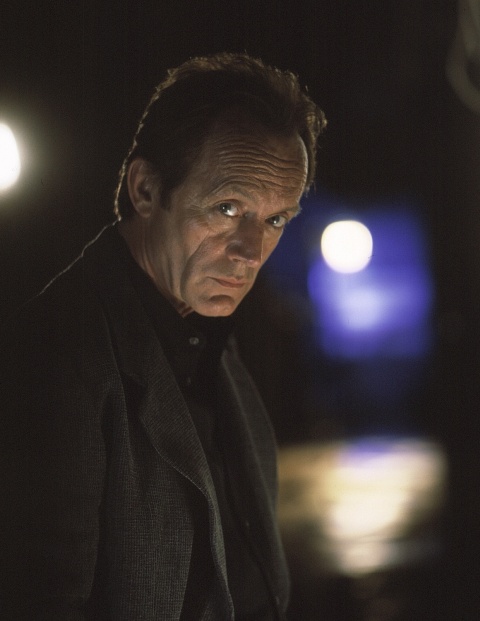
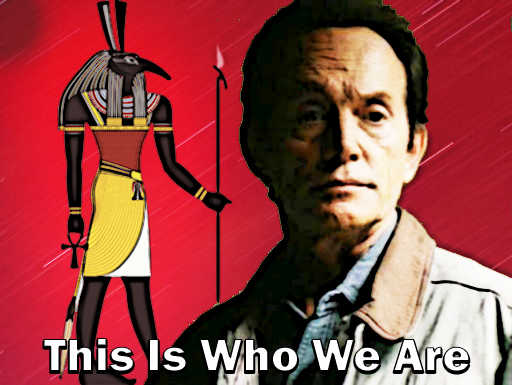
Millennium is one of my favorite TV shows ever made. It was created by Chris Carter, who also created The X-Files, and certain characters have appeared in both shows. But Millennium is no mere “X–Files spin-off”; it features a completely different cast of characters dealing with entirely different problems. While Special Agents Fox Mulder and Dana Scully track down weird monsters and alien conspiracies, retired FBI profiler Frank Black (played by genre favorite, Lance Henriksen) gets sucked back out of retirement to track down some of the most evil human beings imaginable. This is because Frank has a preternatural knack at seeing into the mind of every rapist, serial killer, or terrorist he targets his attention on. He can read about a murder in the paper and start getting random flashes of whatever the perpetrator is thinking and feeling. Much of this is due to Frank just being really good at his former job; yet he also clearly has “the second sight,” even catching glimpses of ghosts, angels, and demons from time to time. And as much as he wants to stay home with his wife and daughter and pretend “the bad men” aren’t really out there, Frank just can’t help himself; he’s driven to track down every evil thing he can pick up on his psychic radar, no matter what.
Lance Henriksen as “Frank Black” in Millennium(1996-1999)
Frank is approached by a private investigation firm called the Millennium Group, which consists of various ex-law enforcement personnel who’ve drawn some terrifying conclusions from all the horrific cases they’ve worked. For them, evil isn’t just a human ethical failing; it’s a real supernatural force that actively seeks to destroy our world (and which gets closer to achieving this goal every day). Every single rape or murder that happens is really a part of this gigantic plot, whether the human perpetrators fully understand what they’re doing or not. The Millennium Group also worries that the world might actually end in the year 2000, or perhaps not too long afterwards. Even though many members are deeply religious Christians who look forward to an eventual Second Coming, they nevertheless believe we can’t just sit back and “hope for a happy ending.” If something isn’t done about the state of things right fucking now, there may not be any human civilization left for Jesus to save when he comes back. So the Group uses a wide variety of resources to apprehend the human monsters that live among us, trying to save the world one case at a time. These resources include everything from all the best forensic science units to vast libraries of astrological, theological, and magical texts. And the Millennium Group is especially interested in Frank Black since he’s not only a total wizard at criminal profiling, but apparently an actual seer or oracle of sorts as well.
Terry O’Quinn as “Peter Watts,” a prominent Millennium Group member.
This show was inspired by many of the apocalyptic fears that ran rampant toward the end of the 1990s. (Does anyone else remember the Y2K scare?). This leads some people to think its subject matter is no longer relevant today. Let me just say, I beg to fucking differ. If there is one horrible truth that Millennium taps into, it’s the fact that people will always have apocalyptic fears that drive them to do terrible things. Even more terrifying, certain people actually want the world to end and will do everything they can to ensure that it does. This is every bit as true today in 2020 as it was back in 1996, and I would go so far as to say that Millennium is actually far more frightening and disturbing now than it was back then. I always found it much scarier than The X-Files because it was willing to take so many more risks. This is a show in which literally anyone can die at any time, and the fact that it lasted for three seasons (in the era of more popular shows like Angel and Buffy the Vampire Slayer) is nothing short of amazing.
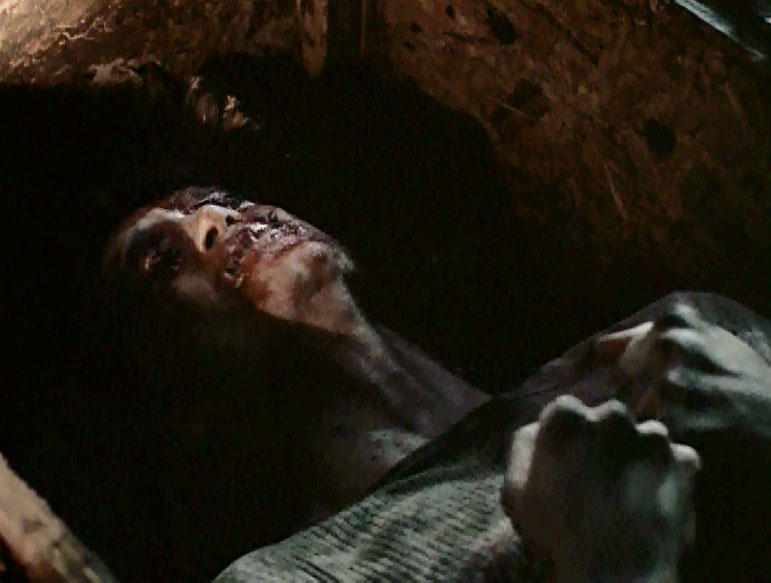
In the very first episode, Frank picks up his newspaper and learns that a local stripper has been horribly butchered. He then starts having visions of how (and, more importantly, why) this happened. That’s when Frank realizes he can’t just stay home and be with his family; he has to go back to work. (And the look that crosses Lance Henriksen’s face at that pivotal moment always makes me tear up and cry a little). So he approaches some old pals in the Seattle PD and offers to help them investigate the case. They eventually catch the killer, who thinks he’s the Messiah and is “passing judgment” on people by doing things to them that would have made Josef Mengele proud. But not before we see two of the most disturbing things that were ever shown on TV in the 1990s. First, Frank’s gift allows us to see just how Mr. Serial Killer sees the world, and it might as well be called “Hellraiser in the Park.” Then we get a scene where Frank and the cops uncover a man who’s been buried alive…and whose bodily orifices have all been stitched shut. They don’t just refer to this stuff off-camera, either; they fucking show it to us, clear as you please. That might not seem too impressive in today’s post-CSI world of gory police procedurals; but this was in 1996, and nothing like that had ever been seen on prime-time network TV before. Not even Law & Order or NYPD Blue went that far at the time, and this was all in the very first episode of Millennium, to boot! It scared me to death when it first aired back in October 1996, and it still gives me the shivers today.
This still ranks as one of the most disturbing things I have ever seen in any TV drama.
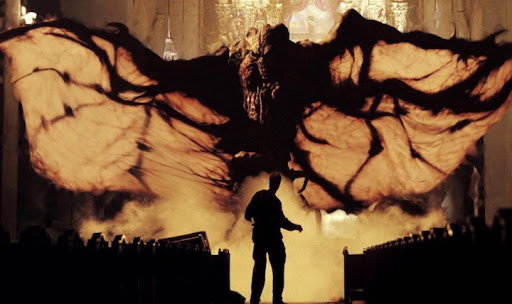
The three seasons of Millennium are drastically different from each other, as well. Apart from Frank Black’s psychic gift, there is almost nothing of the supernatural to be seen in the first season at all; the show is mostly just a police procedural at first, with our heroes chasing a different serial killer or terrorist each week. But as the season progresses, more explicitly supernatural things begin to happen. I will never forget the episode, “Lamentations,” in which Frank and the Millennium Group realize the killer they’re chasing is really a shapeshifting demon. The episode “Maranatha” is also terrific, featuring a Russian dignitary and mob boss who might actually be the Antichrist. These episodes were so brilliantly written, they completely caught audiences off guard at the time. Here we were, thinking this was just a police procedural with entirely human antagonists to be defeated; and then all of a sudden Chris Carter changes the rules on us and turns things up to 11. I remember being scared shitless by the scene in “Lamentations” when “Lucy Butler” walks down the staircase, showing us her real face between lightning strikes.
The formidable Lucy Butler in another of Millennium’s freakiest moments.
The second season of Millennium is my personal favorite; we get into some really crazy stuff here. Frank’s psychic powers become much stronger, he becomes more involved in the Millennium Group’s internal affairs, and he meets a lady named Lara Means (played by Kristen Cloke) who can see angels. (Whenever she sees the angels, it means something real fucked up is about to happen.) Frank also learns the Millennium Group consists of different factions that are bitterly opposed to each other, and that some high-level members are every bit as evil as all the serial killers and terrorists they help to catch. This leads to some truly remarkable stuff, including a civil war within the Millennium Group, a battle against Nazis for the Cross of the Crucifixion, and even the outbreak of a deadly supervirus! In some ways, Millennium Season Two almost feels like a totally different show; but the changes all worked, and every Millennium fan I know considers this era of the series to have been the very best.
Another of Millennium‘s most disturbing scenes, from the Season 2 Finale (“The Time Is Now”).
Unfortunately things did not turn out quite so well for Millennium Season Three. I remember waiting patiently through the entire summer of 1998 to see how Frank and his daughter Jordan (played by Brittany Tiplady) were going to escape a plague-infested Seattle. But when Season 3 begins, Frank and Jordan are suddenly living in Virginia with Jordan’s grandparents. We are told the outbreak in Seattle “wasn’t actually as bad as it seemed,” and nobody but Frank even seems to remember that it happened. Meanwhile, Frank teams up with FBI Special Agent Emma Hollis (played by Klea Scott) to try and bring down the Millennium Group, which has become completely evil. Peter Watts (played by Terry O’Quinn), who was Frank’s sidekick in Seasons One and Two, is now re-cast as Frank’s arch-nemesis. None of this has anything to do with where Millennium appeared to be going in Season 2, and it alienated most of the fan base pretty badly. Plus, most of the stories in Season 3 make no fucking sense at all; they are more like rejected X-Files episodes that are just weird for weirdness’ sake. It took me several years to finally watch the entire season all the way through, and I have zero interest in ever trying to doing so again. It felt like Chris Carter lost his marbles and decided to just give all of us Millennium fans the finger.
To add insult to injury, Carter included Frank Black as a guest character in an episode of X-Files after Millennium was canceled in 1999. In this episode (rather creatively titled “Millennium”), Frank is living in a psych ward when Mulder and Scully come to ask him some questions about the Millennium Group. This leads to a so-called “final confrontation” between Frank and the Group at a cabin in the woods, where the last remaining Group members have been turned into zombies. I for one do not know what the fuck Chris Carter was thinking when he wrote all of this. During Millennium‘s three-year run, viewers learned the Group is up to all kinds of crazy shit, including biological warfare. But according to The X-Files, the Millennium Group is really just a handful of zombies locked up in a basement. What the FUCK?To say that Millennium fans were disappointed by this is an understatement.
Frank Black and Fox Mulder watching football in “Millennium” (X-Files, Season 7).
In Egyptian cosmology, our universe is sustained and held together by Ma’at, which is both a principle and a Goddess. As a principle, it essentially represents helping others to help yourself, both in this life and in Duat (the Otherworld). The ancient Egyptians believed Ma’at is always endangered by the forces of isfet, which are led by the Chaos Serpent. Should Ma’at ever be completely dismantled, the entire cosmos would cease to exist. The “apocalypse” was not a “future” event that had yet to occur, but an ever-present threat that could happen at any possible moment. And the Egyptians believed it was really everyone’s responsibility to help prevent this from happening. The key to upholding Ma’at and fighting isfet was to be a good neighbor and citizen, treating others as you yourself wished to be treated. In this way, every human ethical decision has some part to play in the never-ending war between the Netjeru and Apep, no matter how small or insignificant such decisions might seem.
Even the powers of isfet need a coffee break. (From Season 2, “Somehow, Satan Got Behind Me.”)
Millennium really speaks to me on this level. Though it is mostly inspired by Christian themes, the idea of the Millennium Group trying to save the world one case at a time struck me as being more of a Kemetic concept. It was especially meaningful to me that Season 2 aired during my freshman year of high school, which was my very first year of walking with Set. My first weekend Sabbats were spent watching Millennium with Big Red and wondering how I could grow up to become just like Frank Black. I even considered studying to become a criminal profiler myself at one point, if you can believe it. (But then I came to my senses and remembered I struggle with depression enough as it is; so investigating murders and such is probably the last thing I should be doing). If there is any particular character from popular culture who has shaped my concept of “What it means to be a Setian,” it is most definitely Frank Black, who taught me that even the smallest acts of human kindness can be major victories for Ma’at!
2020 has been a year of horrors. Apart from the pandemic and watching the world burn and living beneath a stumbling demented child-king, I have essentially lost my mother, even though she is still alive. There have been so many times this year that I have wanted to just give up and die. But in searching for ways to cope with all the madness, I have at least been able to channel my immense grief into the work I do. Creating the In the Desert of Set podcast, the Summer’s Endalbum, and other artistic projects has been very therapeutic to me, and I hope these works prove helpful to others too.
The week of the 2020 American presidential election was so taxing on my nerves and emotional state that I couldn’t eat, sleep, or concentrate on anything much; I couldn’t even focus on writing any sermons. All I could do was try to capture the fear, despair, and rage inside me in music. In doing so, I have surprisingly put together a new full-length album just one month and some change after releasing Summer’s End.
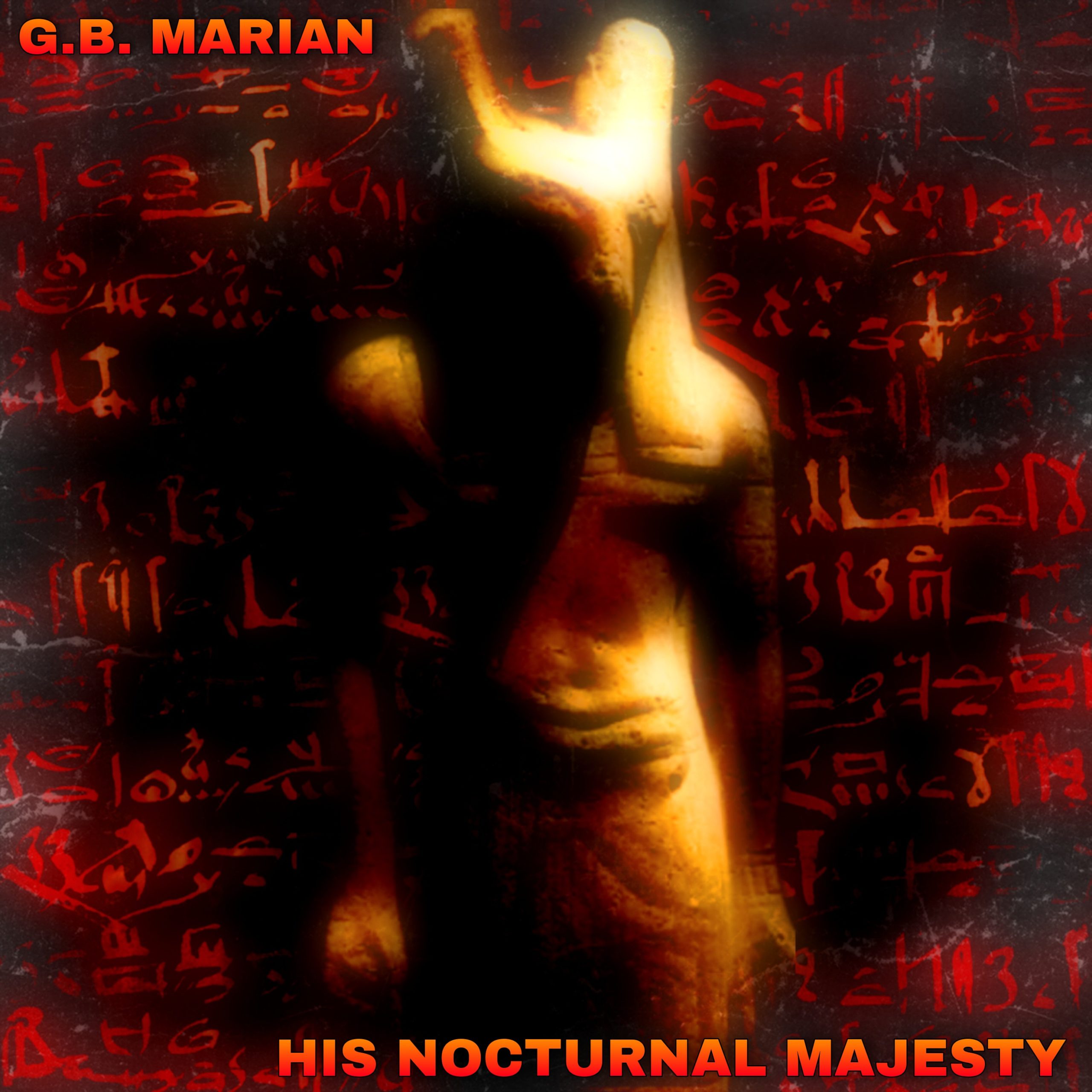
This work, His Nocturnal Majesty, is something like a soundtrack to a movie that doesn’t exist. It is very much inspired by two of my favorite films, The Final Conflict (1981) and John Carpenter’s Prince of Darkness (1987), which both deal with the apocalypse and ultimate evil in ways that subvert organized religious dogmas. (In The Final Conflict, the Antichrist is defeated by a godless feminist and single mother; in Prince of Darkness, Lucifer turns out to be the Supreme Being!) I’ve always wanted to see something of this unique subgenre that takes its cues from Kemetic rather than biblical sources. I have tried developing this premise into some kind of novel, comic, movie or TV show for decades, but I can never seem to figure out just how I want the story to go, or even who the characters are.
All I know is, I had a terrible nightmare back in the 2000s that I have never forgotten. In this dream, the world had grown so irredeemably evil and corroded that the very fabric of reality started to unravel, and the Chaos Serpent was finally able to slither into this world and devour us all PHYSICALLY. It appeared in the sky, big enough to blot out the sun and the stars, just a gaping giant mouth surrounding the globe, ready to swallow and digest us into its putrid gut. It was suddenly nighttime all over the world at the same time, and people and animals were all losing their minds and eating each other in the streets. But just when all seemed lost, a big beefy red hand came out of nowhere and knocked the Serpent right back into hell. And somehow, this battle between Set and Apep above our atmosphere was being magically reflected in a battle here on earth between some courageous heroes and these profoundly evil terrorists who actually wanted the world to be eaten.
I awoke from this crazy dream scared out of my mind—I will never forget seeing the sky turn into a MOUTH like that—and I knew I had to do something with it. Like I said, I struggled to develop it into any kind of coherent story with interesting characters. I can’t even draw the things I imagine; my drawing style is a little too cute and cartoony-looking for me to stomach its inclusion in a concept as serious and heavy as this. But while I was sitting there screaming in silence during the 2020 election, I kept thinking about that crazy nightmare, and it hit me rather suddenly: I just released Summer’s End, which is kind of like my soundtrack for a Halloween-themed movie that doesn’t exist. Why not turn this other movie that doesn’t exist into an album too? And next thing I knew, I had 50 minutes of new music ready to release.
My first plan was to sit on this material and wait to release it till next year, in case I wanted to make any changes. Something in my brain said, “You just released an album, wait till next year to release the next one.” But I have listened to this thing over and over again non-stop all week, and I’m pretty sure it’s finished now; His Nocturnal Majesty is ready for the public. I also get the sense that Set would like it very much if I released this album so people can enjoy it now. After all, why wait? Maybe hearing this stuff might really help someone. Well I don’t know who you are, but here you go; I hope you enjoy this latest batch of Kemetic Setian darkwave goodness!