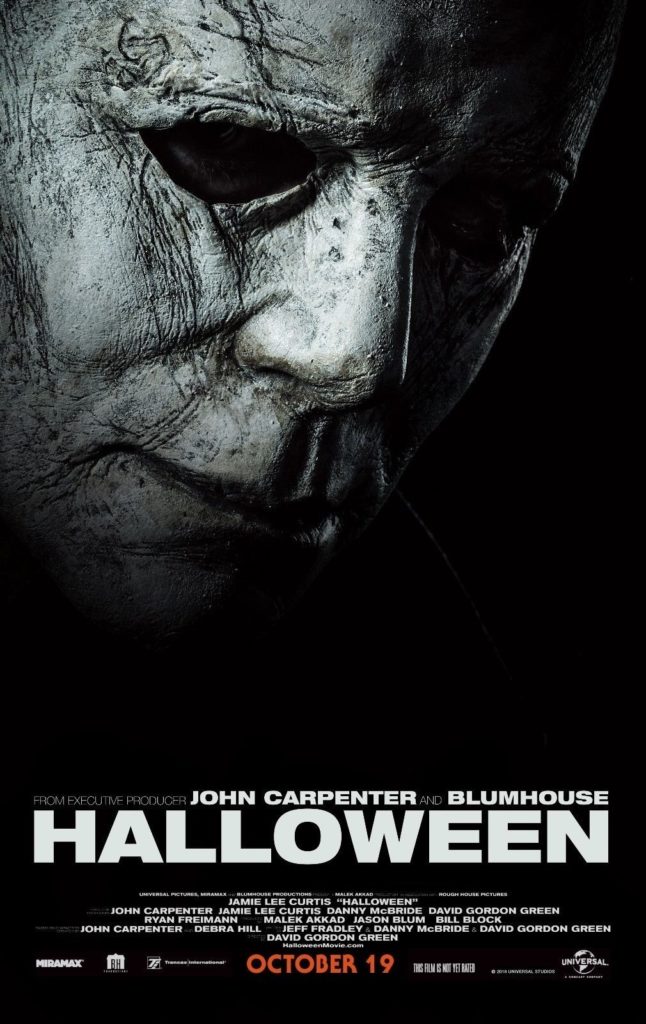
David Gordon Green’s Halloween (2018)

Why the 2018 “requel,” featuring the return of John Carpenter and Jamie Lee Curtis, is the best direct sequel to the original 1978 classic.

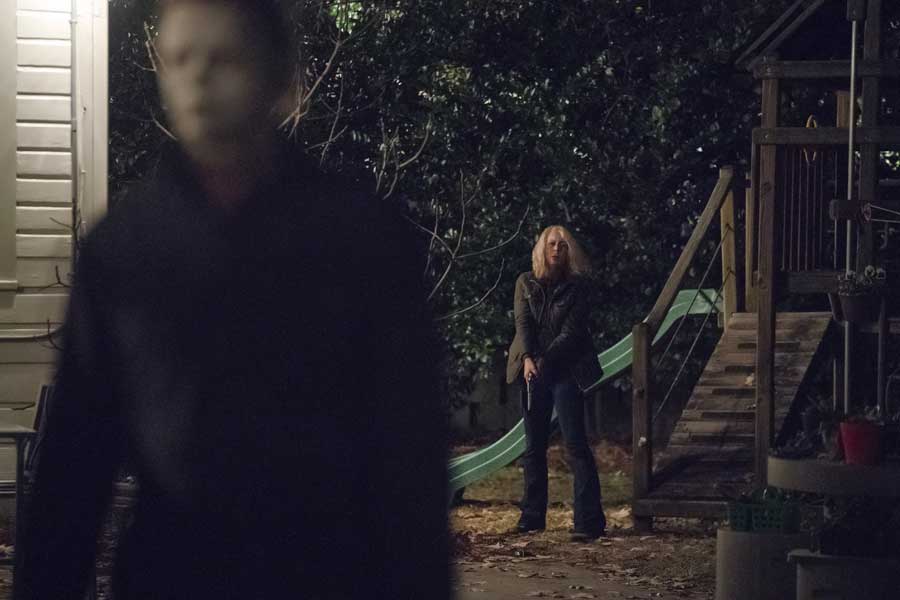
In the 2010s, David Gordon Green came along and pitched an idea to John Carpenter. Green proposed making a new film for the Halloween series that would establish a brand new timeline, but with an extra twist. This new film would be a direct sequel to just the 1978 original, ignoring all the other entries in the series (as well as the remakes). Green further proposed eliminating the “siblings” subplot that Carpenter first introduced in Halloween II (1981), re-establishing that Michael Myers and Laurie Strode are totally unrelated strangers. Jamie Lee Curtis would also become “the New Loomis” and take Donald Pleasence’s place as Haddonfield’s resident Boogeyman-hunter. Many people would balk at this suggestion, for the idea that Michael and Laurie are siblings has been considered “canon” for decades now. But John Carpenter, having always felt a little embarrassed over Halloween II, absolutely loved Green’s idea and signed on to be an executive producer, creative consultant, and composer for the film (his first involvement with the franchise since Halloween 4 was still in pre-production in 1988). It was almost too good to be true!

I can’t remember who it was, but when David Gordon Green’s Halloween (2018) was first released, some dingbat film critic trashed the notion that “Directors can apparently change canon at the drop of a hat now.” Whoever made that statement must not be a very good film historian, otherwise they’d know these movies have already been changing their own “canon” for decades (see 1998’s Halloween H20: Twenty Years Later as a good example). Halloween isn’t the first franchise to do this, either. Just look at Hammer Films and Toho Studios, which created alternate timelines for both Count Dracula and Godzilla in the 1970s and 1980s, respectively. The so-called “requel” is nothing new, and bringing the Shape back for a new spin on what happened after “The Night He Came Home” is really no different from letting Christopher Nolan take a crack at Batman. The Halloween flicks aren’t for everybody, but neither is this foolish idea that every film in a series must necessarily take place in the same cinematic universe. 

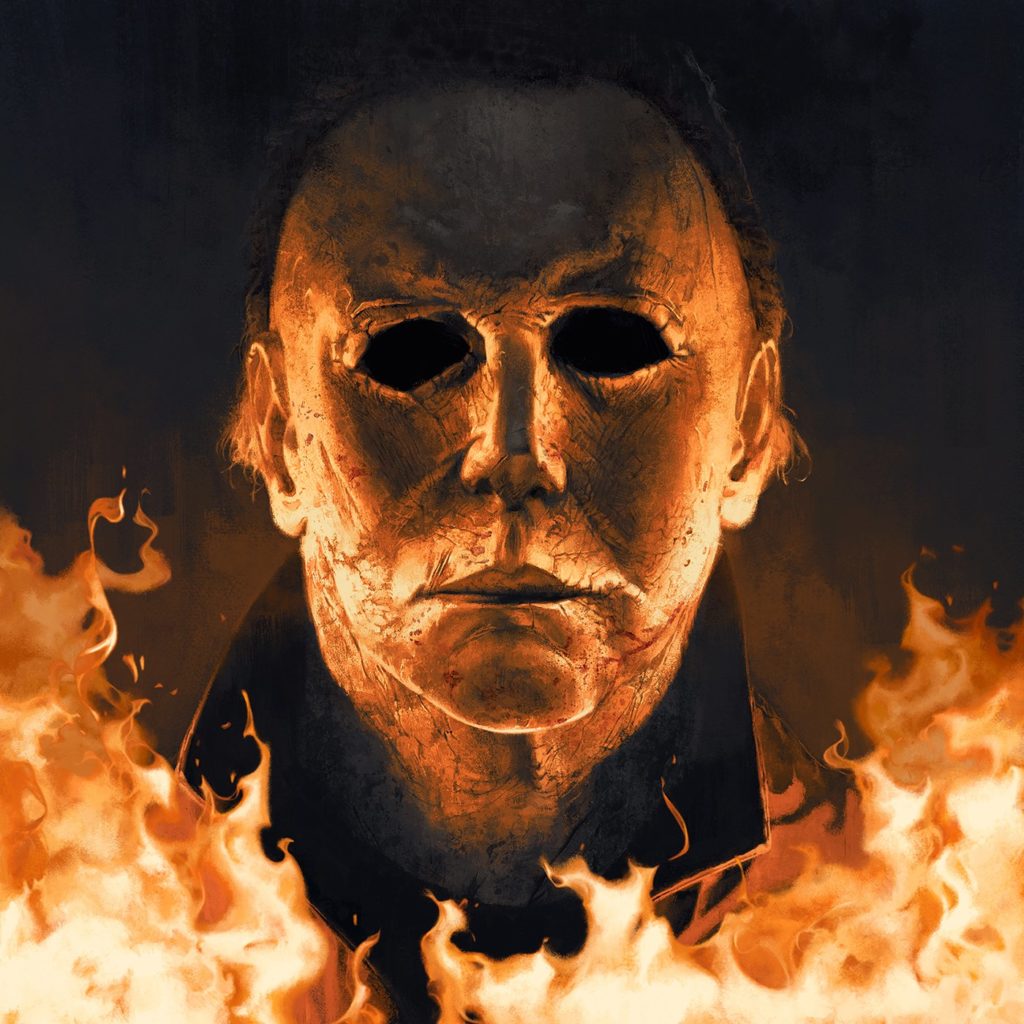
That being said, the 2018 Halloween begins with two podcast reporters (Jefferson Hall and Rhian Rees ) who are visiting Smith’s Grove Sanitarium in Illinois to see Dr. Ranbir Sartain (played by Haluk Bilginer) and his patient, Michael Myers (James Jude Courtney). We learn that shortly after the events of John Carpenter’s Halloween, Dr. Loomis tracked Myers through the neighborhood and was about to nail the fucker with another six slugs to the chest when the local PD showed up and “de-escalated” the situation. Myers was brought into custody and returned to the sanitarium, and Loomis was revoked of his license to practice medicine, which is how Sartain took over. Now it’s 40 years later, Loomis is deceased, and Myers is about to be transferred to a maximum security prison, where he is expected to rot. The reporters try to stoke a reaction from Michael by pulling out that odd, white, faceless mask he wore while stalking his victims in 1978. Myers gives them nothing, but every other patient in the sanitarium suddenly goes rabid, and that tells us right there that these idiot reporters just made a really bad mistake.

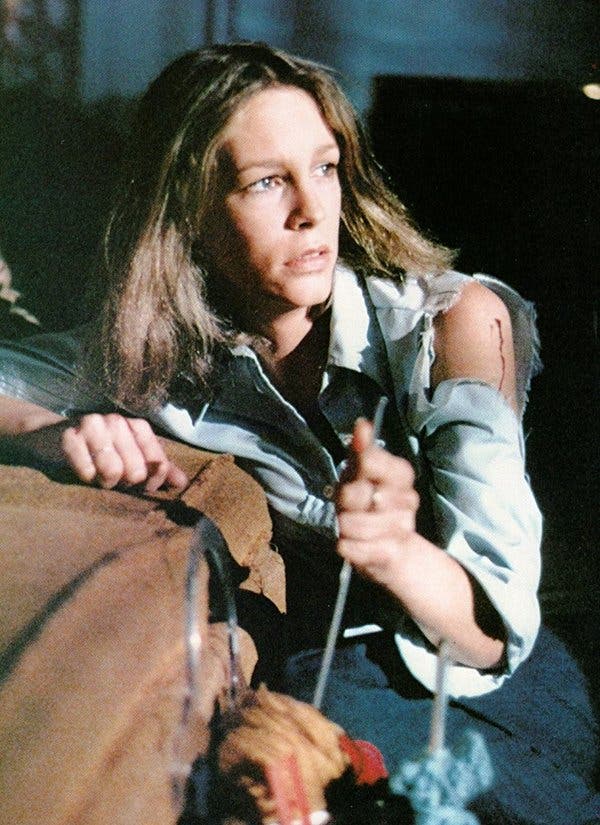
Damn, Jamie Lee, you’re as beautiful as ever!

Next, the reporters go to Haddonfield to visit Laurie Strode, the only teenager among Michael’s victims to survive—the one who fought back and lived. We learn that over the past 40 years, Laurie had a daughter named Karen (played in adult form by Judy Greer); but Laurie continues to exhibit terrible PTSD, and she’s also become a survivalist gun-nut. Her day-to-day behavior is so alarming, in fact, that the state eventually took Karen away from her custody. Mother and daughter have been estranged ever since, and Laurie now lives in a lonely old house in the woods, with an armory fit for Armageddon. She has always known deep in her heart that Michael Myers will escape again one day, and that the mysterious Shape will stalk the streets of Haddonfield once more. And when that happens, Laurie aims to finish what the local police prevented Dr. Loomis from doing all those years ago, once and for all.

The reporters don’t get much farther with Laurie than they did with Michael; they’re disrespectful to her, suggesting she’s just a hysterical old woman and no one should believe or listen to her. But instead of being silenced, Laurie kicks them the fuck out and goes right back to preparing for the Big Blow-Up. Then she goes to visit her granddaughter, Alyson (Karen’s daughter, played by Andi Matichak), who is experiencing her own share of maternal estrangement. It seems the adult Karen Strode still carries all her childhood demons from growing up under Laurie; for while she is much more stable and capable of raising a family than the elder Strode, she has nevertheless succeeded in alienating her daughter as well. She has restricted Alyson’s access to her grandmother so much that the two of them must meet in secret if they are to interact with each other at all. And while Karen thinks Laurie is just an attention-seeking prophet of doom, Alyson knows her grandmother’s trauma and grief are completely authentic.

It’s only a matter of time, of course, before Laurie’s prophecies about Michael Myers all turn out to be 100% true. The patient somehow manages to escape from a prison bus while he is being transferred to the maximum security facility on Halloween Eve. Then he tracks down the two podcast reporters at a local gas station to retrieve his mask from their belongings. I have to admit, this is the most thrilling sequence I’ve witnessed in any Halloween movie since the late 1980s. Michael Myers is somehow even more intimidating when he’s out of costume, walking around in broad daylight, with everyone around him none the wiser. This part of the film also made me realize just how much Myers resembles a Batman villain like the Scarecrow—complete with escaping from a psychiatric prison and dressing in a costume that seems to enhance (rather than conceal) his true personality. For when Michael finally retrieves his mask and wears it once again, he reverts to his true identity as “the Shape.”

(Beware of spoilers!)

So the Shape returns to Haddonfield and invites itself into random people’s homes, carving the residents up like jack-o’lanterns. It then crosses paths with Alyson while she’s walking home from a school dance, but she manages to elude it and find Officer Hawkins (Will Patton), who’s out patrolling the neighborhood with Dr. Sartain. Hawkins, Sartain, and Alyson then encounter the Shape again, and when Hawkins prepares to kill it, Dr. Sartain goes apeshit and kills the cop. Then he throws an unconscious Shape in the backseat of Hawkins’ police car (along with Alyson) and drives off toward Laurie Strode’s house. He explains that he’s obsessed with learning the secrets of Michael’s true motives, and that he believes he can uncover those secrets by forcing a showdown between Laurie and the Shape. But once they’ve almost reached the Strode house, the Shape re-awakens and tears the police car to shit with its bare hands. Alyson manages to escape by the very skin of her teeth, but things don’t go so well for Dr. Sartain, whom the Shape soon dispenses with. Then the Shape sees Laurie’s house down the road, and the Big Blow-Up between Strode and Myers begins.

Some people complain profusely about this plot twist with Dr. Sartain, claiming that it totally “came out of left field” or “served no purpose” for the story; but I thought it was absolutely brilliant, and for several reasons. First off, it’s clear that while Laurie and Sartain both believe the Shape wants to get her, the Shape itself has very different ideas. While Laurie has never stopped dwelling on that fateful Halloween night in 1978, the Shape doesn’t appear to even remember who she is. Imagine that someone attacked you and traumatized you several years ago, to the point where everything you do in your life is now shaped and dictated by that awful experience. Now imagine that you will finally have a chance to confront your tormentor several years down the road, only to learn that he doesn’t even remember you or the things he did to you! Not because he’s been “rehabilitated” or because he honestly forgot, but simply because you are insignificant to him in every possible way. While Laurie has focused all her energy on destroying the Shape for the past 40 years, the Shape hasn’t thought about her even once since 1978,  and that is some awful dark shit right there.

If it seems strange that a Halloween movie would feature another villain apart from the Shape, we need only remember Halloween 6. I believe the Sartain character is actually an homage to Dr. Terence Wynn, the “Man in Black.” According to Halloween 6, there are other people in Haddonfield who know what the Shape really is aside from Dr. Loomis, but who want to “control” or “understand” it rather than destroy it. Dr. Wynn and his “Thorn Cult” learned the hard way that this impossible, and Dr. Sartain learns the exact same lesson here. There are quite a few homages to earlier films in this movie, so I’m pretty certain this resemblance between Wynn and Sartain is intentional. I think the idea of the Shape having “fans” or “helpers” is not only interesting from a narrative perspective, but also quite scary and realistic. Just look at how people idolize monsters like Charles Manson or John Wayne Gacy in real life.

There are also numerous clues in the first half of the film that the Sartain plot twist is coming. Dr. Sartain is the one who deliberately allows the podcast reporters to taunt Michael with his mask at the start of the film. (What the hell kind of doctor lets the press fuck with his patient like that? Dr. Loomis would not have approved!) He also insists on accompanying Myers on the prison bus, and he is the only survivor we see on the bus after Michael’s escape. (Did Michael really kill all those guards—or did Sartain do it?) The doctor also says a lot of asinine things about empathizing with Michael, as if he doesn’t give a shit about any of the victims. Finally, when Laurie Strode and Dr. Sartain meet for the first and only time in the film, Laurie refers to him as “the New Loomis,” given his inherited role as Michael Myers’ psychiatrist. This line is absolutely loaded with irony considering that Sartain later turns out to be in cahoots with the Shape, and that Laurie herself turns out to be a much better Loomis than Sartain could ever be!

I also enjoy the Sartain plot twist because I honestly didn’t see it coming; despite all the clues, David Gordon Green does a masterful job of hiding the surprise, and it truly caught me off guard when I first watched the film. I can’t tell you how many times I will sit down and watch a new horror movie I’ve never seen before, only to correctly guess everything that’s going to happen throughout the film. I have even lower expectations when it comes to slasher movie sequels, which tend to follow a very rigid formula. So the fact that this sequence surprised me as much as it did is nothing short of amazing. And considering how important Sartain actually is to the story (mind you, he is the only reason Michael and Laurie ever cross paths), he has now become one of my favorite characters in the franchise. (Too bad he won’t be showing up in any more sequels, unless it’s in a flashback!)

Each of the male characters in this film is either helpless (like Officer Hawkins), untrustworthy (like Alyson’s boyfriend Cameron), or downright evil (like Myers and Sartain). There is a recurring theme about women not being heard and not being believed (not only by men, but by other women as well). After Michael was apprehended in 1978, no one aside from Laurie and Dr. Loomis seems to have considered him responsible for his own actions. The State of Illinois simply locked him away again, and everyone moved on. When the podcast reporters question Laurie about this, they seem to take Michael’s side for some reason, excusing him for his actions in 1978 because “He’s crazy” and “It happened so long ago.” So Laurie isn’t just fighting the Shape here; she’s fighting the entire patriarchy, which cares more about her tormentor’s side of the story than her own. In this way, David Gordon Green’s Halloween is really the only sequel in the entire franchise that taps into one of the original 1978 film’s most important themes: how society protects and even aids monsters like Michael Myers by gaslighting their victims. When the Strode women finally band together at the end to tackle the Shape, they aren’t just taking down a man in a mask; they are taking down the entire toxic narrative their patriarchal society has used to keep them disempowered for so long.

Another thing I love about this movie is the fact that the “babysitters-in-jeopardy” element of the story is limited to just the second act. We’ve already seen Michael Myers stalk babysitters for 90 minutes at a time (several times, in fact); there is so much more he can do as a character. David Gordon Green proves this by using the first and final acts to elaborate on things we’ve never seen in any Halloween movie before. The first act does a fantastic job of putting us in Laurie’s head, exploring her complexity as she alternates between her doomsday prepping and her struggles with PTSD. And the final act is a real powerhouse, escalating the conclusion of the 1978 original to full-blown action movie proportions. Now that Green is currently filming not one but two more Halloween films (to be released in October 2021 and 2022, respectively), I’m very excited to see what other new situations he might throw these characters into next. (I’ve always wanted to see the Shape square off against an entire SWAT Team, myself!)

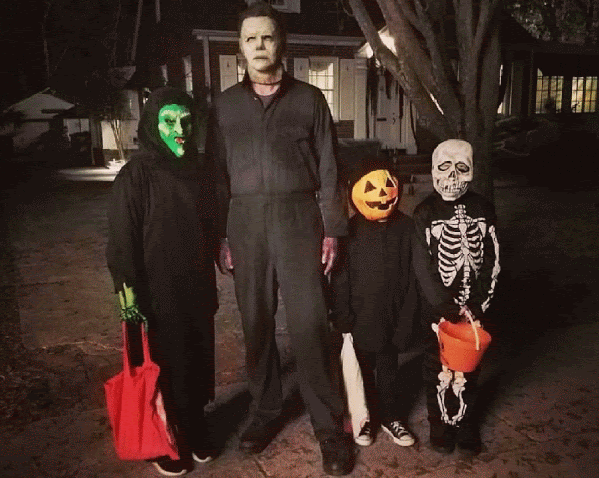
Keep your eyes peeled for some awesome Halloween III-related sight gags!

Without a doubt, David Gordon Green’s Halloween wins my vote for “Absolute Best Direct Sequel to the 1978 Original” (a title previously held by Halloween 4). This isn’t just some run-of-the-mill slasher movie; this is an example of how one night of terrible violence can still affect people several decades afterwards (even if they weren’t even born yet at the time!). And while the Halloween series has always featured strong female protagonists, the 2018 requel deserves special recognition for bringing this theme to a whole new level. I really can’t recommend it highly enough, especially for viewers who enjoy seeing powerful women beat the stuffing out of evil men (like I do!).

TO BE CONTINUED…

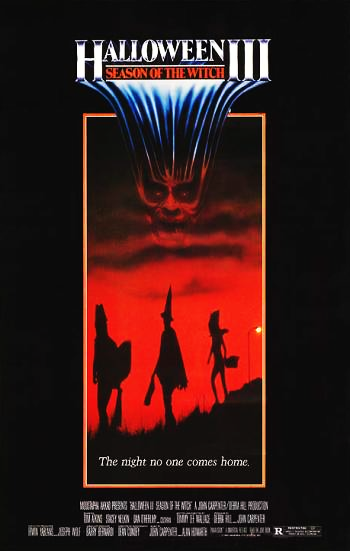
Halloween III: Season of the Witch (1982)

A preternatural Pied Piper turns people into creepy crawlies with his maleficent merchandise, his android assassins, and his Stonehenge supercomputers.

Halloween III: Season of the Witch (1982) is my second-favorite movie of all time, right after the original Halloween from 1978. Though it is marketed as a “sequel” to the latter film, it is really something completely different. It has nothing to do with Michael Myers, Laurie Strode, Dr. Loomis, or the town of Haddonfield, Illinois at all. By gods, it isn’t even a “slasher movie,” but something more like a British sci-fi/folk horror hybrid!

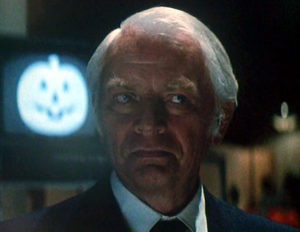
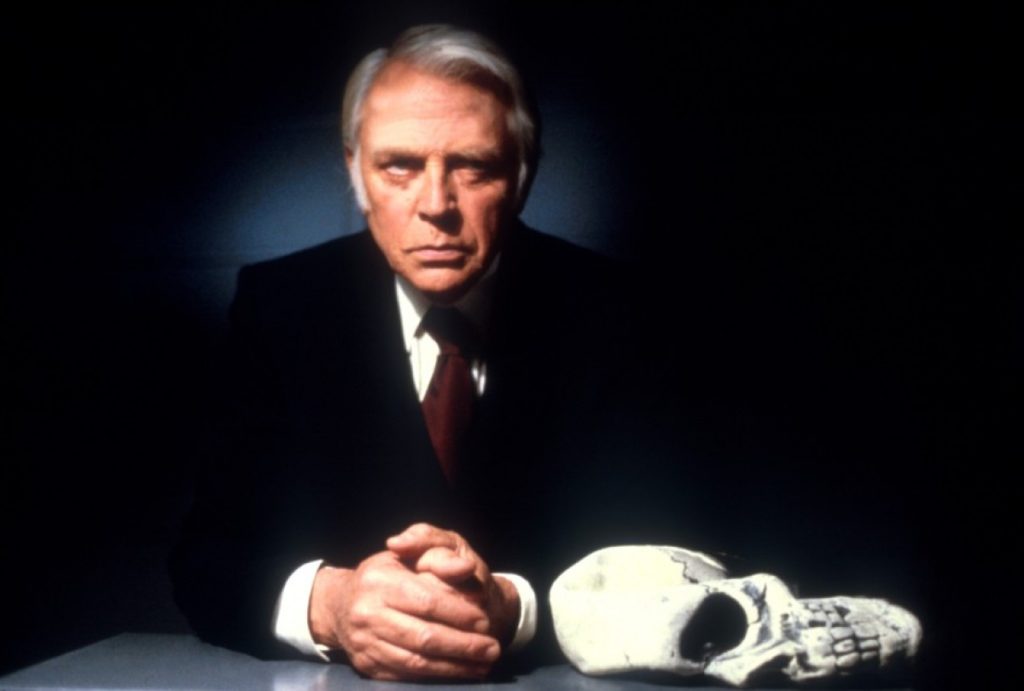
Season of the Witch is the story of Dr. Dan Challis (played by Tom Atkins) and Ellie Grimbridge (Stacey Nelkin), who decide to investigate a brutal murder their local police have chosen to ignore. In doing so, Dan and Ellie stumble upon a ghoulish plot masterminded by the one and only Conal Cochran (Dan O’Herlihy), founder and CEO of a major toy-manufacturing company called Silver Shamrock Novelties.

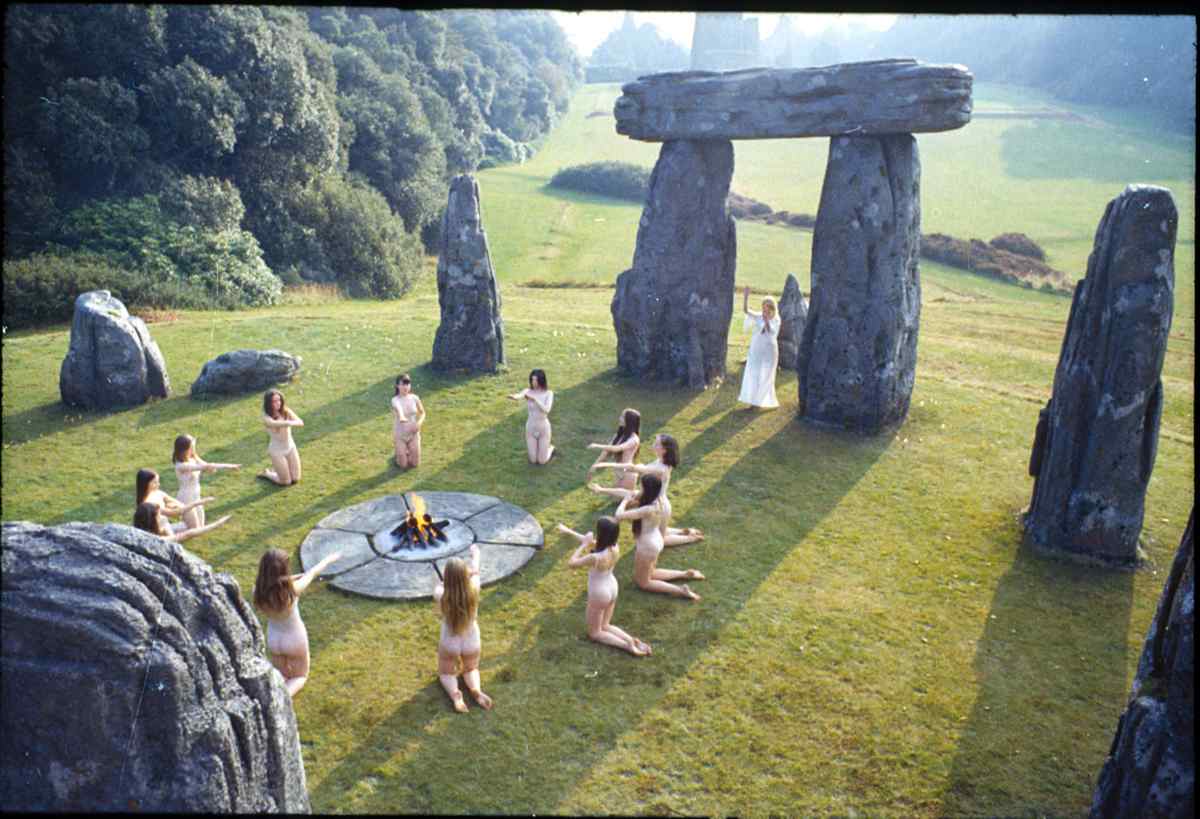
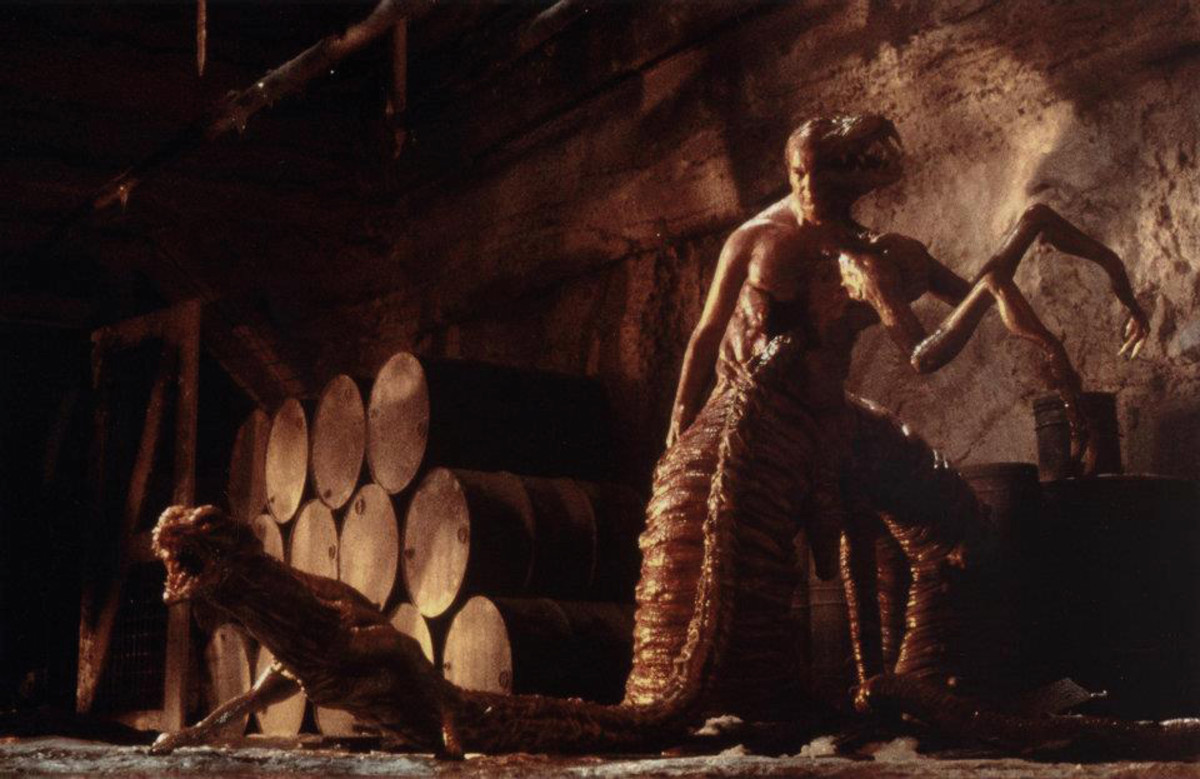
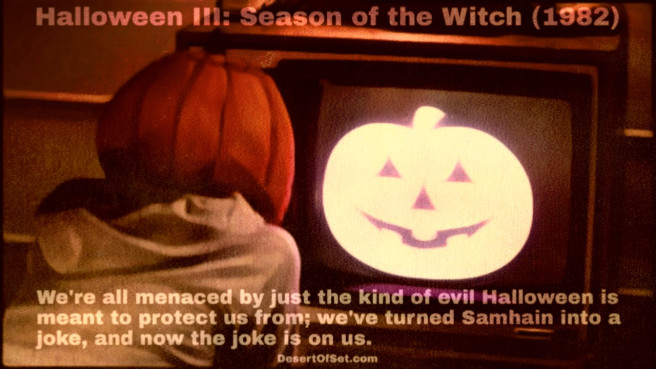
It turns out that Silver Shamrock, Inc. has stolen one of those monolithic rocks from Stonehenge and broken it down into countless microscopic pieces. They have inserted this debris into their world-famous Halloween masks, which children across the nation are buying in droves. They’ve also developed a TV commercial with a flashing “magic pumpkin” that activates the pieces of Stonehenge within the masks. This converts the masks into deadly cursed talismans, which transform their wearers into snakes and bugs (from the inside out!). Even crazier, most of Silver Shamrock’s employees appear to be killer androids with superhuman strength, and Cochran’s entire conspiracy is somehow tied to the fact that the planets of our solar system are currently in alignment.

You’re probably wondering why Halloween III has nothing to do with any of the other Halloween films. When John Carpenter and Debra Hill were approached for another sequel following the box office success of Halloween II (1981), they took the opportunity to conduct a most fascinating cinematic experiment. Starting with Halloween III, the series would now be an anthology like The Twilight Zone, featuring a different Samhain-themed story with each new installment. There are so many different things that we associate with October 31, including ghosts, witches, fairies, and druids; why then should a franchise called Halloween be limited to just an escaped spree killer?

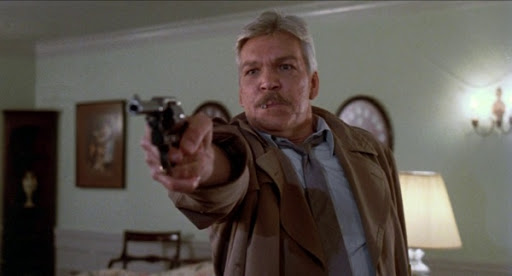
Tom Atkins, who plays Dr. Challis, is what they call a “character actor.” This means he usually plays supportive roles and is more or less the exact same character in each one. To this day, Season of the Witch is still the only film in which he ever got to be the leading man.

We usually expect our male sci-fi/horror protagonists to be young, dashing, and athletic; but Dr. Challis is middle-aged, visibly tired, and very much out of shape. He apparently lives and sleeps at the hospital where he works, and he is a divorced alcoholic who can’t stand his ex-wife or his kids (and who seems to have a history of avoiding them whenever possible). Given a choice between (1) spending time with his estranged children or (2) investigating a murder mystery with some hot young lady he barely knows, he doesn’t even stop to think about it; he chooses the second option immediately. But despite all his faults, Challis is anything but reprehensible. Whatever else he might be, he is a doctor from first to last, and he takes this role very seriously. He is all about making people better, and when the chips are down, he does everything he can to save the world (including his family).

Tom Atkins might not be a Christopher Lee or a Peter Cushing, but he really shines in this role. If you enjoy his performance here as much as I do, check out Night of the Creeps (1986). He plays Detective Cameron, an alcoholic cop whose girlfriend was butchered by a serial killer back in the 1950s. When Creeps begins, Cameron is on the verge of killing himself; but when he learns his town is being invaded by brain-eating slugs from outer space, he grabs a shotgun and starts blowing holes in everybody else instead!

Tom Atkins as “Detective Cameron” in Night of the Creeps (1986).

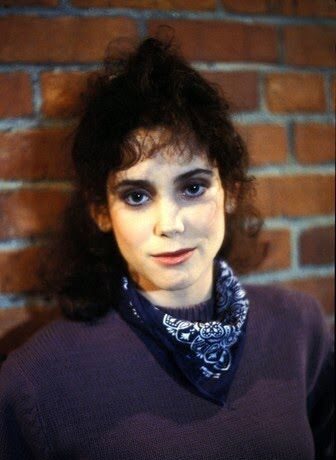
Ellie Grimbridge, played by Stacey Nelkin, seems to prefer older men; she takes a liking to Dr. Challis almost immediately, and as soon as they reach that motel in the mysterious little town of Santa Mira (where Silver Shamrock’s headquarters is located), she is all over him. Later, Ellie is kidnapped by Conal Cochran’s robot goons, and she is imprisoned somewhere in the Silver Shamrock factory. Challis busts in to rescue her, getting himself captured in the process. Then he learns the truth about Cochran’s dastardly scheme, escapes and finds Ellie, and torches the factory. Challis and Ellie drive off into the night, trying to plan how they can stop that crazy Silver Shamrock commercial from playing on TV and causing the apocalypse—

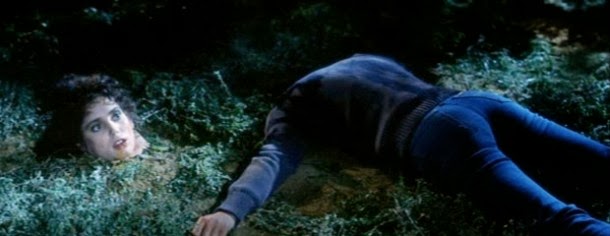
—and that’s when Ellie suddenly tries to kill Challis, revealing herself to be a goddamn robot!

Fans are divided as to whether Ellie is (1) human for most of the film (and replaced with a robot duplicate by Cochran during the final act), or (2) a robot the entire time. It makes no sense to me why Cochran would send a robot to seduce Challis into investigating his own damn conspiracy; but the idea of not knowing you’re sleeping with a killer robot is pretty disturbing. All I know for sure is, this sequence scared me really badly when I first saw it as a kid. To think you’ve just rescued someone you love, only to learn they’ve been replaced with a soulless imitation that wants to destroy you? That’s Grade-A nightmare fuel for me, right there!

Stacey Nelkin as “Ellie Grimbridge.”

Stacey Nelkin was also cast to play the sixth Nexus-6 replicant in Ridley Scott’s Blade Runner (1982), which was released the same year. Her part was cut from that film during principal photography due to budget cuts. (Blade Runner fans will recall that in at least one version of the film, Captain Bryant recruits Deckard to track down six fugitive replicants; yet there are only five that are accounted for in the entire film, and this is why.) It’s eerie to think that Nelkin was cast to play two murderous androids in two different films during the same year, huh?

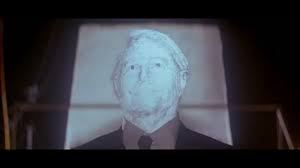
Conal Cochran, Halloween III‘s antagonist, is played by Dan O’Herlihy, an Irish actor of such stature that one wonders just how the hell anyone convinced him to do this movie. Unlike Tom Atkins, O’Herlihy was used to acting in things like Orson Welles’ version of Macbeth (1948), Luis Bunuel’s Robinson Crusoe (1954), and Sergei Bondarchuk’s Waterloo (1970). He even went toe-to-toe against Marlon Brando at the Academy Awards once. (Brando won, but O’Herlihy gave him a run for his money!) Considering Halloween III’s budget, I highly doubt O’Herlihy was paid very much for his work. So what the hell was it about Season of the Witch that made this legendary thespian say, “All right, I’ll do it”?

Dan O’Herlihy as “Conal Cochran.”

Debra Hill once recounted that Dan O’Herlihy knew an awful lot about the true origins of Halloween . He told all kinds of folk stories about Samhain to the rest of the film’s cast and crew. These stories were apparently so enthralling that everyone took to calling O’Herlihy “Mister Halloween.” It’s unfortunate that Hill couldn’t recall any specifics from these conversations, but I can certainly imagine what they must have been like. After all, Halloween III is one of very few flicks ever made in which the word Samhain is pronounced correctly, and it is O’Herlihy himself who pronounces it in his native Gaelic tongue.

I have a hunch that Dan O’Herlihy was primarily interested in Halloween III for its references to Irish culture. Considering the long list of films in which he has appeared, it’s interesting to note that almost none of them have anything to do with Ireland (either culturally, historically, mythically, etc.). I sense this man was really proud of his heritage, and that when his agent handed him the script to Halloween III, he recognized the project as an opportunity to finally represent that heritage onscreen somehow.

The original screenplay for Halloween III was written by Nigel Kneale, creator of the British Quatermass films and TV serials. The first draft included a great deal more science fiction than the finished film does. Conal Cochran turns out to be some kind of daemon or alien; he simply impersonates a human being with his mask-manufacturing know-how. He also transports the monolith from Stonehenge to America by interdimensional means, and there is plenty more speculation as to what Stonehenge is actually made of (and why it becomes so volatile whenever the planets are aligned). More of Cochran’s genocidal plan is explained, as well. John Carpenter and director Tommy Lee Wallace both felt that some of this material wouldn’t translate very well for American audiences, so they took turns re-writing the script to “Americanize” it a little. This led Nigel Kneale to demand that his name be removed from the credits; but it seems to me that his original ideas are still present (and mostly intact) in the film.

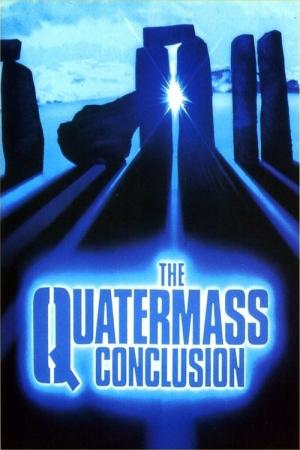
In 1979’s The Quatermass Conclusion, Stonehenge and other prehistoric places are revealed to be “landing sites” for a hostile alien force. It is difficult to be certain without reading Kneale’s original script, but it seems plausible to me that Season of the Witch and The Quatermass Conclusion were meant to be thematically linked in some way. The Quatermass serials also had a direct influence on Doctor Who, which explores many similar ideas and themes. Perhaps it is no accident, then, that Conal Cochran resembles a classic Doctor Who villain like Davros, the Master, or even the Black Guardian. I can totally see him as an evil renegade Time Lord, disguised as an Irishman.

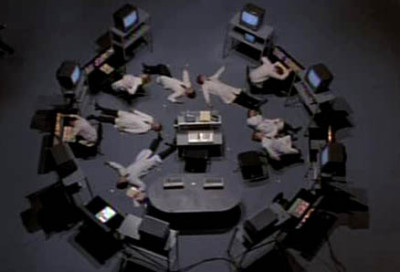
Arthur C. Clarke’s Third Law states that “Any sufficiently advanced technology is indistinguishable from magic,” and the scene when Cochran explains his plot to Dr. Challis is a great example. “Advanced…” he says, pointing to a room full of computers, “…and ancient technology,” he finishes, pointing to the monolith he has stolen from Stonehenge. His machines are all arranged in a large circle formation that’s clearly modeled on Stonehenge; a visual hint that the original monument might be some kind of ancient “supercomputer” itself. The implications of this are staggering; who or what built this prehistoric machine, and for what purpose? Halloween III never answers these questions, but I suspect Cochran knows. And if just one piece of this “supercomputer” is sufficient to devastate the entire North American continent in one fell swoop, what the hell would happen if all of Stonehenge were suddenly “switched on?”

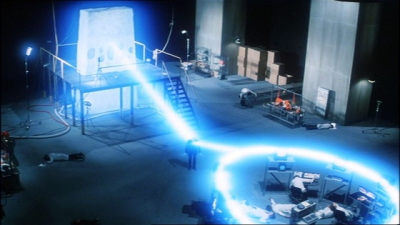
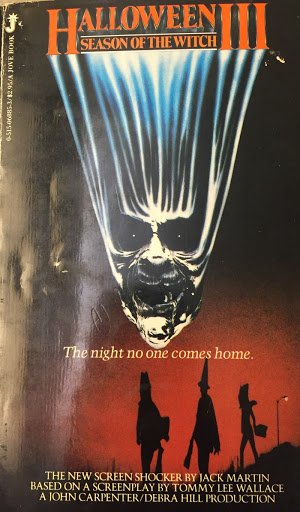
At the end of the film, Conal Cochran is zapped by a big blue laser that shoots out from the stolen (and newly re-activated) Stonehenge monolith. When this happens, Cochran’s features are momentarily distorted, as if his face were really just a mask. Then he vanishes into thin air, never to be seen again. Many viewers assume this to be Cochran’s “death scene,” but I beg to differ. The Halloween III novelization by Dennis Etchinson (writing as “Jack Martin”) makes it clear that this moment in the story is really just the beginning of Cochran’s evil. It also goes into detail on how Cochran isn’t just a crazy toymaker, but something that transcends time and space as we tend to understand such things.

Here’s a snippet from the novel, in which Dr. Challis considers Cochran’s true cosmic nature:

Cochran was nothing new, whatever his latest disguise. He and the dark forces he represented had been around in one form or another since the beginning of time; there was no good reason to believe something so ancient had really been destroyed in a blaze of fireworks in a small town on a cold autumn night. This year’s dark venture was like a rerun on the Late, Late, Very Late Show, an endless loop re-enacting the last reels of the same relentless stalking of the heart of the American dream. It had always been so…He would come to movie theaters and TV screens over and over in untiring replays for as long as people turned away and pretended he was not really there; for that very refusal gave him unopposed entrance to their innermost lives. Nothing ever stopped his coming and nothing ever would stop it, not for as long as people deferred the issue of his existence to the realm of fantasy fiction, that elaborate system of popular mythology which provided the essence of his access…For now, he was still advancing, merely shifting from one field of view to another, larger one, from a single television screen to the televised psyches of a nation. Challis shuddered.

Before he pulls his disappearing trick, Cochran says “we” a lot. This suggests that he actually has peers; yet no one who works for him at Silver Shamrock seems to really qualify as such (especially since most or all of his employees are robots, anyway). Cochran’s “we” must therefore be referring to some other group of peers whom we never get to see. He also mentions “those who came before” him, and he speaks of human beings as if he thinks we’re all insects. It seems clear to me, at any rate, that Conal Cochran is not a “human being” at all, but some preternatural creature that has been visiting our world since ancient times. This is sustained not only by the novelization, but by what is known about the Nigel Kneale script as well. In fact, I suspect Conal Cochran is actually what Celtic folklore calls a “Fae of the Unseelie Court.”

The popular image of fairies as “cute little Tinkerbells” is utter horseshit. The oldest stories depict these creatures as being much darker and more sinister than any Disney movie would have us believe. Celtic folklore is full of benign fae who are willing to live in balance with their human friends and neighbors; but it’s also full of malevolent fae (the “Unseelie Court”) who just want to commit horrific atrocities, like kidnapping babies or tricking people into cannibalizing each other. These entities can make themselves look like anything as well, including animals, trees, furniture…or even Dan O’Herlihy!

The Bunworth Banshee, from Fairy Legends and Traditions of the South of Ireland by Thomas Crofton Croker (1825).

Wearing masks for Halloween started as an apotropaic ritual for keeping the unseelie fae away. But as Cochran notes in Season of the Witch, people today think “no further than the strange custom of having [our] children wear masks and go begging for candy.” He says “the last great” Samhain was over 2,000 years ago, “when the hills ran red with the blood of animals and children.” This is curious, given that Irish people have been observing Samhain each year right into modern times. There is also a historical discrepancy in Cochran’s claim, since the first recorded literary references to Samhain date back to the 10th century CE (which was only 1,000 years ago). We know the Celts did not sacrifice children or animals like that, either; so what is Cochran really talking about here?

If you ask me, Conal Cochran was actually there in Ireland 2,000 years ago; he and his fellow unseelies roamed the land, murdering children; and he was probably what motivated the druids to develop their Samhain traditions in the first place. This would explain why there hasn’t been an October 31 to Cochran’s liking for 2,000 years; all that quality Halloween magic was just too strong for evil creatures like him to stomach. But now that it’s 1982 and Halloween has been completely trivialized, the magic is no longer effective. Now unseelie fae like Cochran can intrude upon the mortal realm as much as they please, and they can even weaponize the things that once kept us safe, as Cochran does with his deadly Silver Shamrock masks.

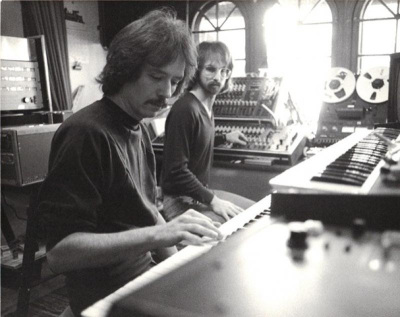
While John Carpenter neither wrote nor directed Halloween III himself, he did score the music. His partner in crime on this task was Alan Howarth, a Hollywood sound designer who co-wrote most of Carpenter’s 1980s film scores, including: Escape From New York (1981), Halloween II (1981), Christine (1983), Big Trouble in Little China (1986), Prince of Darkness (1987), They Live (1982), and the incidental music for The Thing (1982). Howarth also scored Halloween 4 (1988), Halloween 5 (1989), and Halloween 6 (1995) by himself, weaving Carpenter’s familiar 5/4-time piano melody into some truly impressive soundscapes of his own.

John Carpenter and Alan Howarth in 1982.

Carpenter and Howarth were an excellent team; I enjoy listening to their music by itself as much I enjoy watching the films for which it was all composed, and Season of the Witch boasts some of their very best work together. Since the entire point was to break away from the first two movies, the aforementioned 5/4 piano theme is nowhere to be heard (except whenever Halloween III’s characters happen to catch a glimpse of the first Halloween on TV!). We are instead given a host of new original tunes, all performed on classic Moog synthesizers and sequencers. “Chariots of Pumpkins” might well be considered the main Halloween III theme, and it is one of my favorite pieces of music ever written.

So given its fascinating plot, terrific performances, and outstanding musical score, why on earth did Halloween III: Season of the Witch tank in theaters?

Well, it’s all about marketing. Though John Carpenter and Debra Hill tried to make their creative intentions very clear, this information was only relayed to the general public by publications like Fangoria magazine. Considering that Fangoria didn’t have half the fanbase in 1982 that it has today, this meant that Carpenter and Hill’s plan went completely unnoticed by most audiences. At the same time, Universal Pictures found the notion of a “Shape-less” Halloween unsettling, and their advertising department actually tried to hide the fact that Halloween III would be different. Nothing about the new artistic direction was mentioned in any trailers or TV commercials for the film. As a result, most audiences in October 1982 were basically walking into the movie blind.


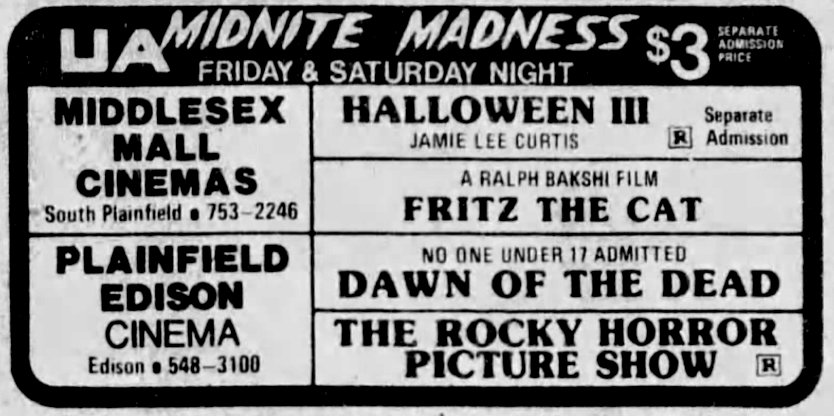
Note that Jamie Lee Curtis is incorrectly billed as the star in this newspaper ad for Halloween III.

In my experience at least, people who prefer slasher movies usually don’t “get” other kinds of horror, and viewers who prefer other subgenres tend to find slashers distasteful. So on the one hand, every slasher fan in the world went to see Halloween III and was greatly disappointed; on the other, fans of other subgenres avoided the film precisely because they thought it would be a slasher. An entire decade would pass before Season of the Witch finally started finding its audience on VHS and during late night monster movie marathons.

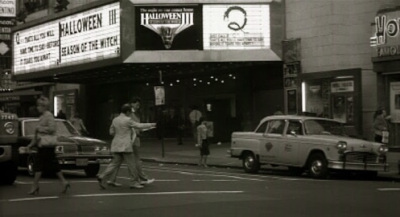
Halloween III makes a cameo appearance in Woody Allen’s Broadway Danny Rose (1984).

I first saw Season of the Witch in 1995. I understood it would not be a slasher film going in, but I think I was probably expecting something more like Stan Winston’s Pumpkinhead (1988), with old crones conjuring medieval hellbeasts out in the woods. I sure as fuck wasn’t expecting to see some alien Pied Piper, turning children into creepy crawlies with his maleficent merchandise, his android assassins, and his Stonehenge supercomputers. This was all WAY too much for my 13-year-old brain to process in just one viewing. The whole thing was somehow ludicrous and terrifying at the same time, and it kept me awake at night for weeks.

The original VHS sleeve for Halloween III.

The scene where Conal Cochran mentions the Festival of Samhain was a complete mystery to me at first. It wasn’t until I re-watched the film with subtitles that I realized he is even talking about Samhain, because I didn’t yet know the correct pronunciation of this term. In reading up about Samhain in real life, I learned that people still celebrate it today, including many Pagans. It would be a couple more years before I learned about Setians, but Season of the Witch facilitated my awareness that there is even a Pagan community in general at all. And while I’ve never felt drawn to the Celtic pantheon in any religious capacity, Samhain or Hallowtide has always been a huge deal to me. So in a weird way, Halloween III didn’t just expand my mind on how people can tell stories; it expanded my mind on how people can believe and live their faith, as well.

I consider Halloween III: Season of the Witch to be the absolute best follow-up to the original Halloween (1978) that has ever been made, and it is unlikely to ever be superceded in this respect. None of the sequels or remakes with Michael Myers can hold a candle to it, because even the best of them are essentially just copies of the first movie, a story that was never meant to be continued in the first place. And while the Myers follow-ups have each been motivated primarily by box office avarice, Season of the Witch is a unique and original story that demanded to be told, much like its thematic predecessor from 1978. John Carpenter and Debra Hill’s pitch for an anthology is equally interesting, but I think it would have been neat to see Conal Cochran a few more times before Dan O’Herlihy passed away in 2005. One reason I love the Halloween movies as much as I do is because this series features not one, but two of the scariest horror movie supervillains I have ever seen. Only one of them visibly wears a mask and stalks people, stabbing them with kitchen utensils. The other one wears a much less obvious mask—a handsome human smile—and tricks people into purchasing their own deaths.

…THE END (OR IS IT?)

Halloween: The Curse of Michael Myers (1995)

How one of the goofier Halloween movies taught me to think beyond Hollywood depictions of Paganism, with a brief tribute to Donald Pleasence.

While Halloween 4 succeeded in breathing fresh life into the Halloween franchise, the series was almost killed off again with Halloween 5 (1989), which was rushed into production as soon as Halloween 4 proved successful. The production didn’t even have a completed script when filming began, and boy does it show. Halloween 5 is a sordid mess, with characters behaving in contemptible ways that make absolutely no sense, and with several aimless plot threads that were clearly only included to build up hype for the next movie. The most obvious of these missteps is the Man in Black, a mysterious asshole who wears cowboy boots and who keeps walking in and out of the movie, showing up at the very end to bust the Shape out of jail and kidnap his niece, Jamie Lloyd. And though Halloween 5 implied that the next installment would be released ASAP, we were not given Halloween: The Curse of Michael Myers (otherwise known affectionately as Halloween 6) until about half a decade later. 

When Halloween 6 opens, we learn the Man in Black leads a cult that appears to worship Michael Myers, and which has forced Jamie to bear a child (more on this in just a moment). One of the cultists seems to have a change of heart and helps Jamie escape with her newborn baby; but the Shape pursues them back to the town of Haddonfield, and yet another holiday murder spree begins.

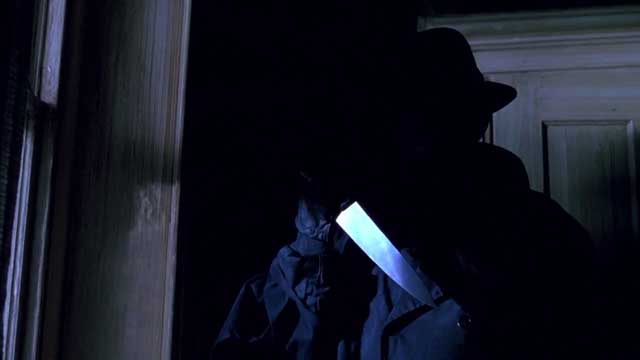
There are actually two versions of Halloween 6—the 1995 Theatrical Cut, and the original Producer’s Cut (which wouldn’t see an official release until the 2010s). Both cuts are radically different from each other. The Producer’s Cut is what was originally put together before Donald Pleasence passed away shortly after filming wrapped in 1995. The director, Joe Chappelle, then re-filmed the entire ending and re-edited the rest of the movie for no apparent reason. We are thus left with two very unique films that tell completely asynchronous stories. Both versions are about Michael Myers stalking his niece, her baby, and a family that has moved into the Myers House (relatives of Laurie Strode, in fact). But the Producer’s Cut explains that Myers is merely a puppet for the Man in Black, who appears to be driven by (fanatical) Pagan beliefs. In the Theatrical Cut, the Man in Black’s motives are revealed to be more pseudoscientific than occult, and it turns out he does not actually have the Shape under his control at all.

Both versions of Halloween 6 feature a cult of so-called “druids” who worship a theoretical demon called “Thorn.” Both versions also posit that Michael Myers is possessed by this demon, thereby explaining his immortality and his drive to kill. The symbol for Thorn is actually the Norse rune Thurisaz (the third letter of the Elder Futhark), and it has nothing to do with the druids or with Celtic polytheism. It represents Mjollnir, the hammer of the thunder God Thor, and it is used to magically harness destructive and chaotic energies for protective ends. It is similar in principle to Khepesh, the starry Iron of Set, and and to the use of gargoyles in Christian church decor; it’s not about glorifying evil, but repelling it. So when certain characters claim that “Thorn” demands one family in Haddonfield be ritually murdered every now and again—and that Michael is simply the current bearer of this curse—I can confirm this is complete bullshit. This stuff is not based on any authentic Paganism; the writer, Daniel Farrands, simply pulled it out of his butt to fill all the gaping plot holes left over from Halloween 5.

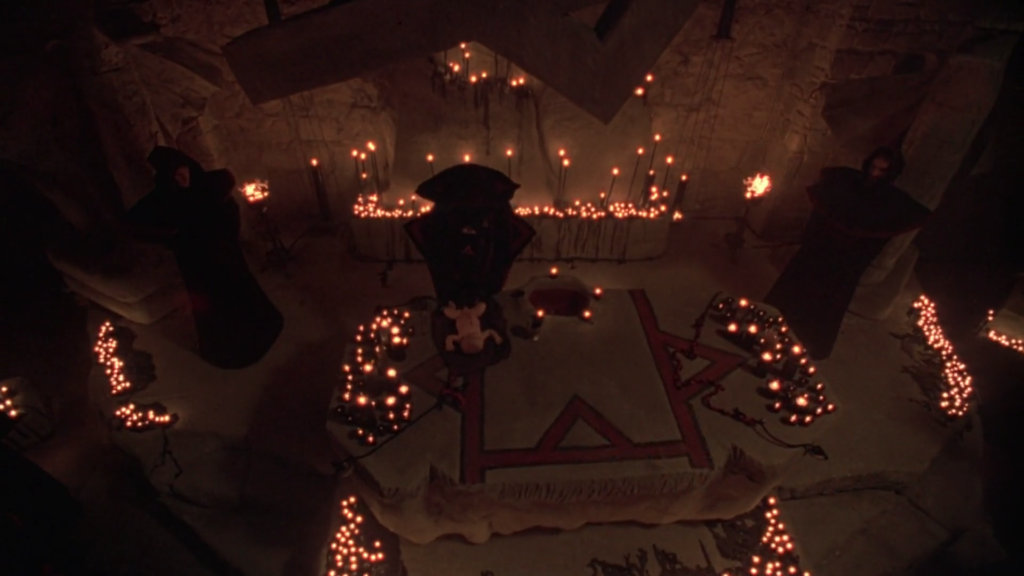
While the Producer’s Cut still follows the tried and true slasher formula (“spooky killer stalks protagonists one-by-one”), it also follows the Satanic Panic formula (“community is besieged by murderous, rapey witches”). Here is where we return to the subject of Jamie Lloyd’s baby, who is eventually named Stephen. The parentage of this child is extremely controversial. In the original script, Stephen is the result of Jamie’s rape by the Man in Black, who impregnates her so that yet another member of the Myers family can be offered to Thorn. While the film was being shot, the script was rewritten on an almost daily basis, and for some unholy reason, someone thought it was a good idea to have Stephen be Michael’s kid instead. There is actually a flashback which implies the Thorn Cult tied Jamie to an altar and forced the Shape to rape her. There are so many things wrong with this idea, I’m not even sure where to begin. First of all, the Halloween movies generally aren’t known for using rape as a convenient plot device. The Shape is a brutal killing machine, and murder has always been its sole biological imperative; it’s never shown any kind of sexual interest in its victims whatsoever. And the idea that anyone could “force” the Shape to rape someone—given that this motherfucker can rip people’s skulls apart with its bare hands—is just ridiculous.

Those of us who grew up watching her in Halloween 4 and 5 really look up to Jamie Lloyd’s character; so when Halloween 6 was still in the works, we were all anxious to see how this mighty young warrior would outwit the Shape once again. And we were all promptly heartbroken. It’s bad enough that they didn’t want to pay Danielle Harris the salary she deserved and cast an older woman (J.C. Brandy) in the role instead. (Jamie should have been about 15 or so in 1995; but J.C. Brandy was clearly in her late twenties or early thirties when Halloween 6 was made.) It’s even worse, however, that they decided to write Jamie out of any future sequels by having her be raped and killed. Yes, these are horror movies, it’s understood that upsetting things are going to happen. But this was an awful, thoughtless, and totally mean-spirited thing to do to a beloved, cherished character. The truth is, I’m glad Danielle Harris wasn’t in this one, because I wouldn’t be able to sit through it at all if I had to watch the real Jamie Lloyd suffer such a cruel fate.

In the Theatrical Cut, baby Stephen is strongly hinted to be a product of artificial insemination. Both versions end at Smith’s Grove Sanitarium, which is the Thorn Cult’s base of operations; and both versions reveal the Man in Black to be Dr. Terence Wynn (played by Mitch Ryan, otherwise known as Will Riker’s dad), who is the head of the hospital. But here is where the similarities end. The Producer’s Cut concludes with Dr. Loomis and company disrupting a sacrificial ceremony and binding the Shape with “the power of the runes.” The Theatrical Cut climaxes with our heroes learning that the Thorn Cult is not really a cult at all, but a bunch of mad scientists conducting some ghoulish lab experiment. The sanitarium is filled with human fetuses in test tubes, and Dr. Wynn mentions something about Stephen being “a very special baby” who represents “the dawn of a new age.” We also learn the Shape has been murdering pregnant women in the hospital who seem to be related to the test tube babies somehow. The Thorn scientists don’t seem to be aware of Michael’s activities at present, perhaps thinking they have safely locked him away. That’s when the Shape busts in on their operation and butchers every scientist in sight. It then comes down to Paul Rudd bludgeoning Myers with a big lead pipe in a room full of fetuses (and trust me, it’s every bit as spectacular as it sounds!).

None of these events are ever explained in any coherent way, and one fan’s interpretation of events is as good as another’s. But for what it’s worth, here’s what I think the Halloween 6 Theatrical Cut is trying to say with all this craziness. Dr. Wynn and his cronies never believed in Thorn at all; they simply pretended to worship the force possessing Michael so he would allow them to get close to him. They don’t really believe in the Boogeyman, but they do acknowledge Michael’s superhuman strength. Their true goal is to clone the Shape’s DNA; perhaps they work for the military, or maybe they just want an army of Shapes they can control. They artificially inseminated all of their female “patients,” including Jamie, with little Myers clones, and Stephen has proven to be some kind of breakthrough. More than anything, they want Stephen back so they can continue their experiments on him; so they release Michael to track him down, with plans to recapture the Shape before it can actually murder its prey. After succeeding at this, Dr. Wynn dispenses with all pretense at being a “druid,” thinking he has fooled the Shape. But Michael Myers has actually been in control of the entire situation all along, keeping the “Thorn Cult” close to himself for his own purposes. And that’s when these other villains who think they’re oh so bad find out the Boogeyman is VERY fucking real, indeed!

Given this interpretation of events, I much prefer the Halloween 6 Theatrical Cut to the Producer’s Cut. The former is essentially an X-Files episode that just happens to feature Michael Myers, with tons of bizarre shit happening and none of it being explained (saving material for future installments). While it is still a ridiculous film with many flaws, this leaves a much better taste in my mouth than the alternative. The Producer’s Cut is more like a gothic Hammer film, which I would normally find appealing, save for this: it reduces the Shape to being little more than Kharis the Mummy, with Dr. Wynn as his Mehemet Bey. I also really resent the addition of all that Satanic Panic baloney, which is just unnecessary. The idea of people being raped for witchcraft might be essential to a story like Rosemary’s Baby, but it has never been a part of John Carpenter’s Halloween. With all due respect to Ira Levin, I just do not want to see any of that shit when I put on a Halloween movie. The idea of genetically engineering a race of Michael Myers clones is equally crazy when you compare it to the original 1978 film; but at least it’s my kind of crazy, dammit!

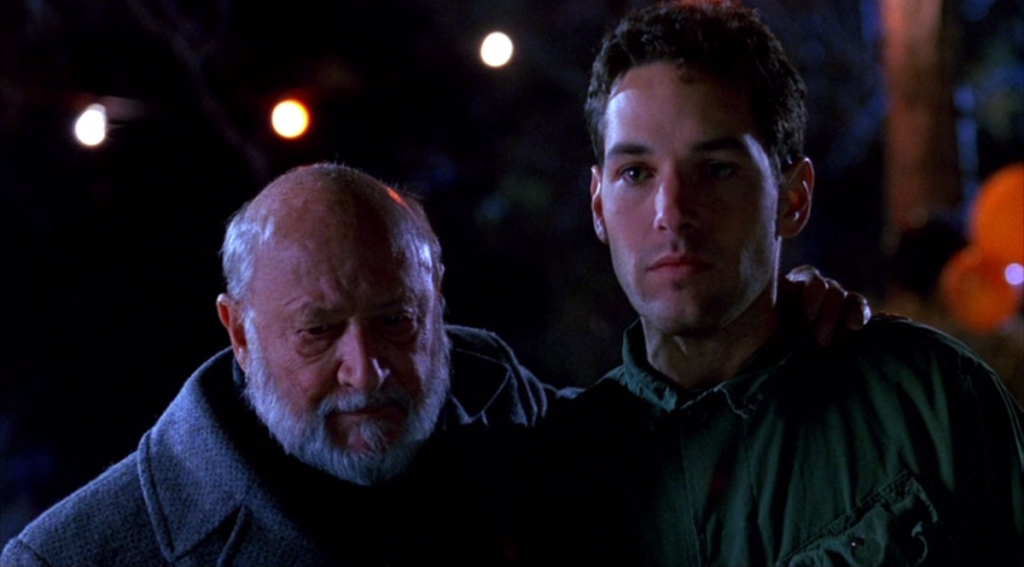
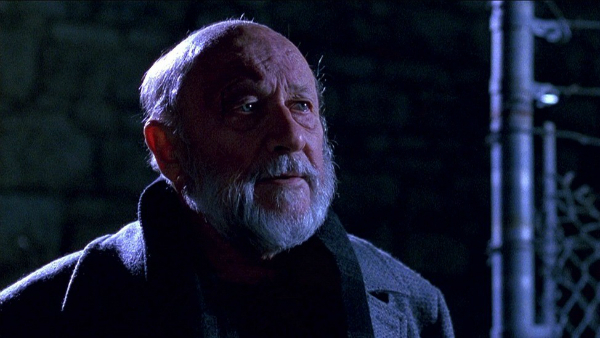
There are certain things about the Producer’s Cut that I happen to prefer, however. For one thing, there’s a whole lot more Donald Pleasence in that version, which is always a good thing (especially since this was his final appearance before he died). For whatever blasphemous reason, most of his scenes are either heavily trimmed or completely removed from the Theatrical Cut, and that’s just insulting. My number one reason for seeing Halloween 6 in the first place was to see how Dr. Loomis is doing, and to see what he does to stop the Shape this time. Removing most of his presence from the film leaves it feeling very hollow, like part of the movie’s soul has been lost. It helps that Dr. Loomis passes the torch to Tommy Doyle (played by Paul Rudd), who witnessed Michael’s first killing spree as one of the child characters in 1978. But the very last scene with Donald Pleasence in the Theatrical Cut (“I have a little business to attend to here…”) never fails to make me tear up a little.

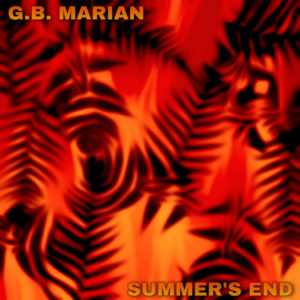
Halloween 6 might be goofier than shit (no matter which of the two versions you prefer to watch), but seeing it was a major step in my coming to Paganism as a teenager. Donald Pleasence is also my all-time favorite actor, and it was very sad for me when his passing was first announced back in February 1995. I have always thought the Thurisaz rune would be much better suited to representing Dr. Loomis as a protector against the Shape, rather than the Shape itself; so I decided to include a song on my new 2020 album, Summer’s End, that honors the concept of Thurisaz, and which is also dedicated to the memory of Donald Pleasence. I pray you will enjoy this offering, good sir! 

TO BE CONTINUED…


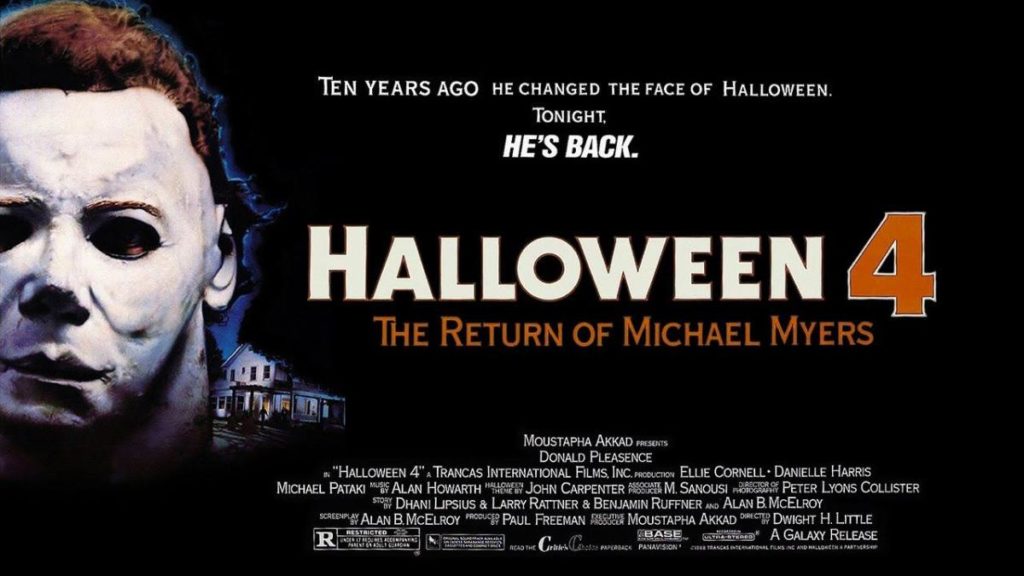
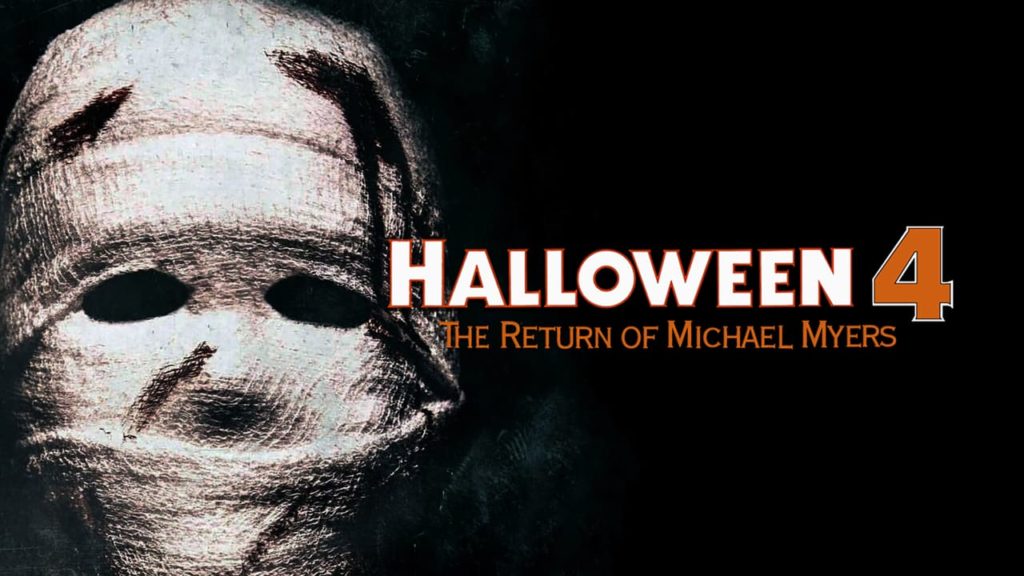
Halloween 4: The Return of Michael Myers (1988)

Why Halloween 4 (1988) is one of my favorite flicks to watch for the Samhain season.

John Carpenter’s Halloween (1978) made a shit-ton more money than anyone was betting it would, and that ending just screamed for a follow-up. Carpenter never intended to make any sequels, but was legally forced into making one for contractual reasons. The mixed result was Halloween II (1981), which takes place on the same night as the original. The Shape is still on the loose in Haddonfield in 1978, with Dr. Loomis and the fuzz in hot pursuit. Laurie Strode is taken to the local hospital for her injuries, and the Shape follows her there, stalking and slashing through the entire graveyard shift. Meanwhile, Loomis comes to suspect that Michael Myers is driven to kill by some kind of “druidic curse.” The final act begins when it’s revealed that Laurie is actually Michael’s younger sister, whom he apparently meant to kill in 1963 along with his elder sibling Judith. All hell breaks loose when Dr. Loomis shows up at the hospital to save Laurie and blow himself and the Shape to smithereens.

Halloween II broke some big box office records of its own, so it was only a matter of time before another sequel would be greenlit. Carpenter insisted on taking the series in a new direction, turning it into an anthology like The Twilight Zone. Hence why Halloween III: Season of the Witch (1982) has nothing at all to do with the Michael Myers storyline. I will save my analysis of Halloween III for later, but suffice it to say for now that the film was not very well received by audiences at the time, making the Shape’s resurrection inevitable.

Jason Voorhees and Freddy Krueger were making big bank in the mid- to late 1980s, and executive producer Moustapha Akkad was determined that Michael Myers should do the same. He approached John Carpenter for his input on a potential Halloween 4, but the two of them just couldn’t see eye to eye. Carpenter pitched a really weird script by horror novelist Dennis Etchinson that has the Shape returning from the dead as some kind of reality-bending ghost. It’s actually pretty neat, but Akkad just wanted to “go back to the basics” (or “Xerox the original” according to Carpenter), and Carpenter sold his interest in the franchise. Akkad then assembled his own creative team, headed by director Dwight H. Little, and produced Halloween 4: The Return of Michael Myers in 1988. The end product is not quite as interesting as what Dennis Etchinson cooked up for us, but it still turned out pretty awesome in my book.

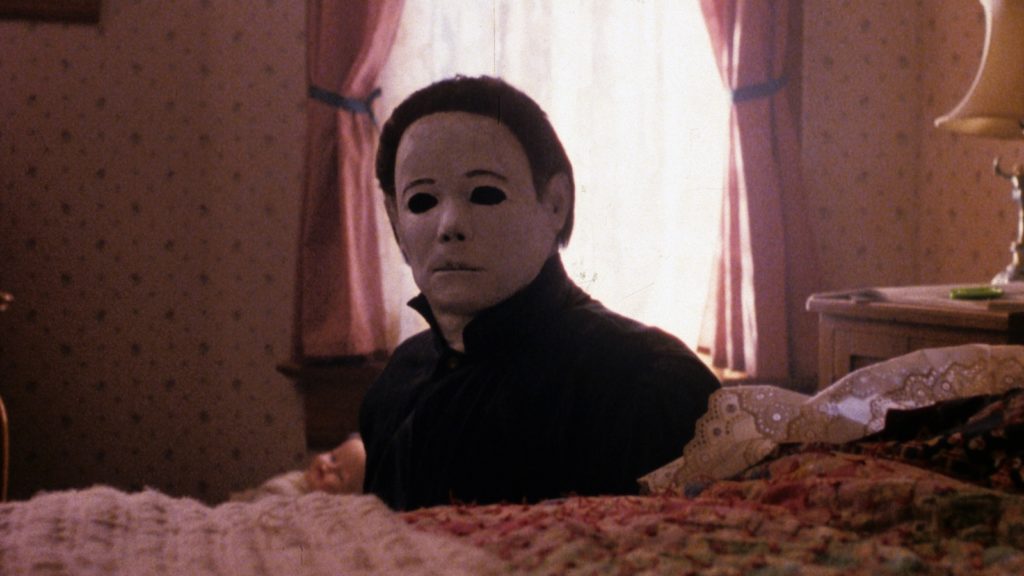
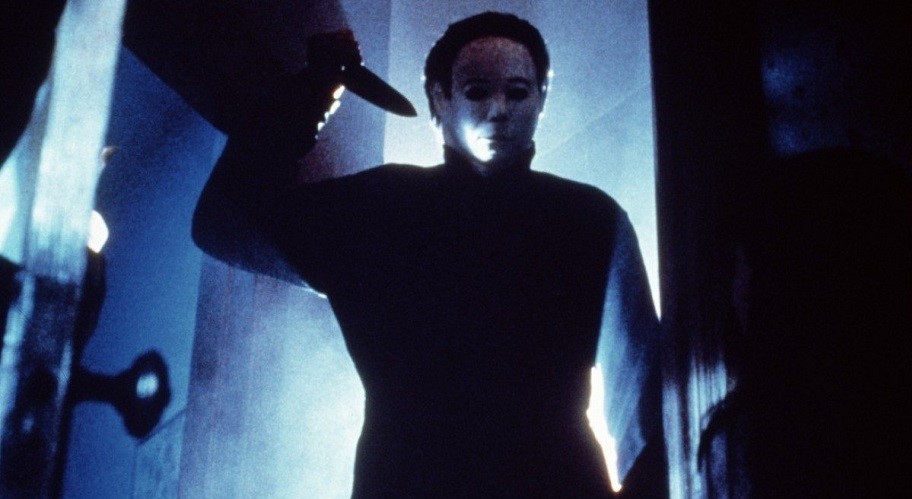
Halloween 4 ignores its immediate predecessor and picks up 10 years after the events of the first two movies, which technically makes it Michael Myers’ second killing spree. It also rewrites the ending of Halloween II so the Shape and Dr. Loomis weren’t immolated in that hospital explosion after all; they were burned and disfigured, but survived. Myers has been in a coma at a maximum security prison ever since, and Dr. Loomis has never left his side. Presumably the prison staff are tired of Loomis always demanding they take his patient off life support, for they arrange to have Myers transferred to some other facility across the state without the doctor’s knowledge. This might not have turned out so bad, except they decide to do this on the night of October 30. To make shit worse, the paramedics transporting the prisoner stupidly discuss the fact that Laurie Strode, while now deceased from a car accident, had a daughter named Jamie Lloyd (nice touch), who is currently living with a foster family back in Haddonfield. That’s when the “comatose” Michael Myers snaps into action and butchers every motherfucker in the ambulance; then he returns to Haddonfield and relentlessly stalks his niece the following Halloween night.

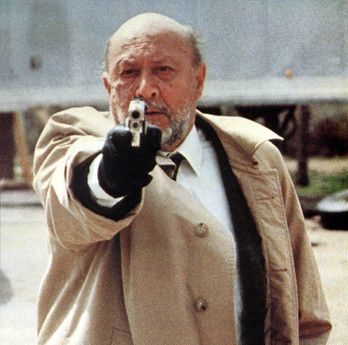
While it is extremely derivative of the 1978 original, Halloween 4 is actually a pretty fantastic movie, and there are two primary reasons for this. First, Donald Pleasence really shines as Dr. Loomis in this one. In fact, he is practically an action movie hero here, doing all kinds of crazy stunts (the exploding gas station sequence being one of my favorite scenes in the entire franchise). This shit could not have been easy for a 69-year-old WWII veteran to do, but Donald Pleasence did it anyway, and I love him for it. I can’t stress enough how his character is really what kept me coming back for more of these movies when I was a young’un. Seeing Dr. Loomis stick it to the authorities and risk his life and reputation to rescue a scared and defenseless 9-year-old girl always makes my heart glow! Plus, virtually everything he says throughout Halloween 4 is a classic one-liner. I think of Dr. Loomis as being an avatar of Set in these movies: the grim, doomy outcast who hunts down the evil regardless of whether he is ever thanked or recognized for doing so, and who is every bit as relentless in this pursuit as Michael Myers is in stalking his niece.

Which brings us to the second reason why Halloween 4 is so awesome: Danielle Harris, the talented young lady who plays Jamie Lloyd. There was simply no better child actor in the 1980s than Harris. If I didn’t know any better (and I do), I’d think the filmmakers were actually trying to kill her. This was definitely not the case, as every effort was made to make Harris feel totally comfortable with George P. Wilbur, the stuntman who plays the Shape. She also got to hang out with Donald Pleasence between shoots, and he would tell her all kinds of crazy stories (which must have been fuckin’ awesome). But when Harris screams or runs away from the Shape on film, she really SELLS it, making me want to leap through my TV screen and save her myself!

There is something to be said for the fact that Myers stalks a child for this venture. Other popular horror sequels at the time were becoming self-parodies, with slashers like Jason and Freddy getting up to all kinds of goofy hijinks (like going to Manhattan, or appearing in music videos by the hair metal band, Dokken). Having the Shape target a little girl really heightens the stakes in comparison, especially when we remember that Laurie Strode was a teenager in 1978 and could actually fight back against Michael. But Jamie depends on the adults around her to do all the fighting for her, and when most of those adults AREN’T Dr. Loomis, the situation is made even more suspenseful.

Halloween 4 is superior to Halloween II for several important reasons. While certain aspects of the latter film are classic and iconic in their own right (such as the hospital setting and the idea of having it take place on the same night as the first movie), the film is dreadfully paced (that entire second act is a total snoozefest), there is too much absurdist gore, and the bits about Celtic religion are especially distracting (given they are pure gibberish). The “family vendetta” premise nullifies the idea from the first movie that Myers is completely arbitrary in his actions (which is a much scarier idea to me personally). And while his newfound motive would seem to give Laurie a role of central importance, Halloween II puts her character to little use, rendering her drugged, silent, and powerless until the conclusion. But here in Halloween 4, the pacing is just right, the amount of gore is significantly reduced, and we don’t have to sit through any of that anti-druidic bullshit. Also, Danielle Harris’ performance as Jamie is so fucking intense, it makes me forget how stupid the “family vendetta” storyline from Halloween II really is.

Halloween 4 takes a big risk by not only presumably killing Michael Myers once and for all, but by passing his curse on to Jamie, driving her to re-enact her uncle’s original murder in 1963 by stabbing her foster-mother to death. The film ends with Dr. Loomis discovering what Jamie has done and screaming hysterically, understanding immediately that the Shape has now taken a new incarnation. Given this set-up, Halloween 5 seemed ready to begin in 2003 (15 years later), with a full-grown female Shape terrorizing everybody on Halloween that year. Something like that might have been pretty damn cool; but we ended up with a lot of bullshit instead. 

TO BE CONTINUED…

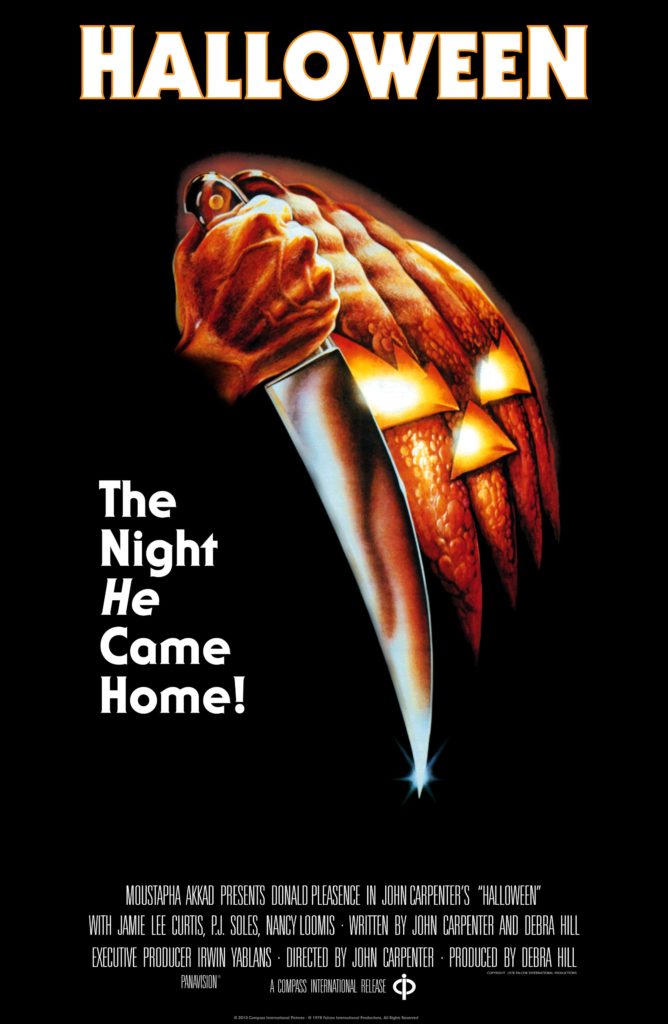
John Carpenter’s Halloween (1978)

How a simple “slasher movie” deplores the patriarchy and evokes Celtic folklore.

Merry Samhain! Happy Hallowtide! To mark this blessed holiday occasion, the next several episodes of this series will feature my analyses of the Halloween horror film franchise, with a particular focus on my five favorite installments thereof.

If I had to rank my top 5 Halloween movies as things currently stand here in 2020, the countdown (from fifth to first favorite) would run as follows:

I find it difficult to discuss these films in a countdown, and would prefer to discuss them chronologically instead. But unlike most other popular movie franchises, the Halloween series does not follow a single coherent timeline. It instead includes several alternate continuities, and even a completely different cinematic universe in the case of Halloween III (which diverges thematically from all the other films). That being said, I think it would make the most sense if I discussed my favorite entries from the “A-plot” storyline of the series (the Michael Myers saga) first, then concluded with an analysis of the “B-plot” story. So the first four episodes in this little mini-series will feature my four favorite Myers films in their chronological order of release; then I will end by discussing Halloween III.

It’s Halloween night, 1963, in the sleepy little town of Haddonfield, Illinois. Dressed as a clown, a six-year old boy named Michael Myers stabs his teenage sister, Judith, to death—and for no apparent reason at all. He neither moves nor speaks afterwards, and he is admitted to a state mental hospital, where he is treated by Dr. Samuel Loomis (Donald Pleasence). After a while, Loomis claims Myers is the single most dangerous patient he has ever observed, and he does everything he can to have the boy transferred to a maximum security prison—despite the fact that Michael just sits there motionless, never reacting to any external stimuli. The doctor’s colleagues think Loomis has gone crackers, but he seems to understand something about Michael that modern psychiatry just isn’t equipped to explain. Much to everyone’s horror, Loomis is proven 100% correct about his patient 15 years later, when a full-grown Myers gets a hair up his ass and makes a jailbreak on Halloween Eve. The authorities continue to gaslight Dr. Loomis and ignore what’s happening, thinking they will probably find Michael just sitting in a park somewhere in his hospital clothes. But Loomis knows his patient is really up to something terrible, so he follows his only lead: the possibility that Myers might return to the scene of his childhood crime, the old Myers House back in Haddonfield.

Here is where we meet Laurie Strode (Jamie Lee Curtis), a meek and lonely teenager who happens to live in Haddonfield. She’s good-natured and smart as a whip; but her closest “friends,” Annie and Lynda (Nancy Loomis and P.J. Soles), constantly treat her like shit, making fun of her good grades and her shyness around dudes. Yet Laurie does, in fact, attract a “man” when she passes by the Myers House on her way to school that Halloween morning in 1978. For a mysterious Shape inside the abandoned property notices her and fixates on her, following her wherever she goes from that point on. Laurie keeps catching glimpses of the Shape as she sits in class, walks home from school, and goes to babysit her pre-adolescent friend Tommy Doyle (Brian Andrews) for the evening. But the Shape keeps appearing and vanishing like a phantom, and Laurie doesn’t really believe what she sees as first, thinking it’s probably just some holiday prankster, or perhaps her eyes playing tricks. Tommy refers to the Shape as “the Boogeyman” whenever he sees it lurking outside the windows, and Dr. Loomis insists this thing is really the devil himself. By the time Laurie is forced to defend herself and Loomis arrives to shoot the Shape six times in the chest at close range, the viewer is unable to dispute with Tommy or Loomis on either of these theories. There really is no “Michael Myers” at all, or at least not in any human sense; there is only the deathless Shape, which has now dropped all pretense at being a mortal man.

This story might not seem to have anything to do with magic or the occult, but there is a curious parallel to Celtic mythology and folklore that is seldom noticed. Celtic lore tells of changelings, or faery children who are swapped for human babies (without the human parents’ knowledge or consent). A changeling will look and behave just like a human baby at first, but eventually it starts exhibiting weird superhuman powers, and misfortune follows it wherever it goes. It seems to me that Michael Myers fits this motif perfectly; his parents appear to have had no idea of what they were really raising, and much like the evil spirits in Celtic folk religion, he only roams free during the festival of Samhain. Additionally, the apotropaic Halloween traditions that once kept us safe from entities like the Shape—wearing costumes, carving pumpkins, trick-or-treating, etc.—have been completely secularized, rendering them powerless. The evil can stalk and slash as much as it wants to now, since the people of Haddonfield aren’t even willing to acknowledge its existence in the first place.

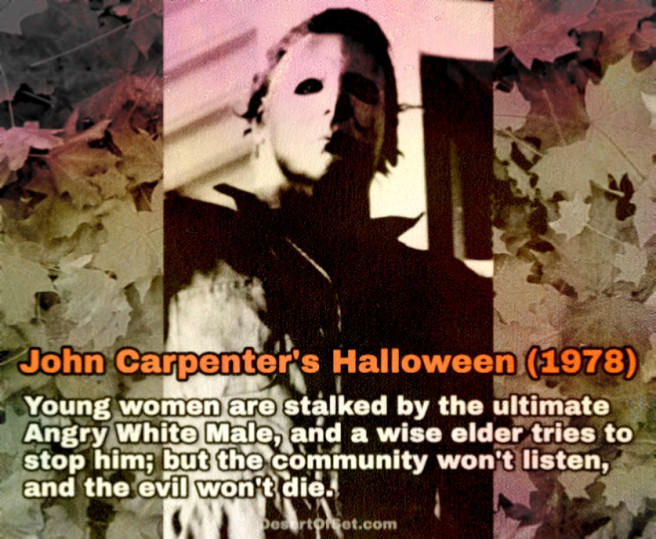
The fact that Myers wears a pale white mask and stalks defenseless young women is also significant. Myers is the ultimate Angry White Male, and he is just as difficult to kill as the horrific patriarchy in which we all live. The authorities’ insistence on minimizing his evil is paralleled by how our society continues to trivialize issues like systemic misogyny and toxic masculinity today. I think most people would agree with me that even when these evils are exposed in broad daylight for all to see, the common reaction is to ignore the problem and pretend nothing bad is really happening. Here in 2020, the entire United States is still responding to evil men the same way Haddonfield responded to the Shape in 1978: by ignoring them and letting them do whatever the fuck they want.

John Carpenter’s Halloween (1978) is amazing and beautiful on many different levels. It is, in fact, my all-time favorite film. It might be a “slasher” film (and the template for many slashers to come, at that), but it feels much more like an old-fashioned ghost story to me. The point is not to build a body count or gross out the audience with gore, but to build relentless suspense, to make us yell at the characters in the movie, and to leave us all wondering, “What happens next?” when the credits roll. The fact that this film was made on a nonexistent budget by mostly unknown talent (many of whom worked multiple jobs on set for free, including Curtis) only enhances the impression it leaves on the viewer. The most expensive part of the entire production was probably just hiring Donald Pleasence to play Dr. Loomis for a few key scenes, and even he (being the fantastic professional that he was) admired all the heart that was put into the project. This was also Jamie Lee Curtis’ first big break, and she truly shines as Laurie Strode, the timid girl who never goes looking for trouble, but who turns out to be much tougher and cooler than she or her peers think she is. And lest I forget, the eerie electronic music by director John Carpenter is truly a work of art unto itself. The soundtrack is my #1 favorite album to listen to, which I suppose is probably obvious to anyone who’s heard my music.

TO BE CONTINUED…

Summer’s End

Shameless self-promotion for my new album, Summer’s End (2020), a musical anthology of Halloween happenings.

It’s October 1, 2020, and the Season of the Witch is nigh! The Festival of Samhain, otherwise known as the Feast of All Hallows, is my very favorite holiday. The following clip from Episode #32 of this series (Holy Days of the LV-426 Tradition) explains why:

Halloween isn’t “just for kids,” and it wasn’t invented by the candy companies either. It originates from a blend of Celtic folk religion and Roman Catholicism. It is just the first of three holy days—All Hallows’ Eve (October 31), All Saints’ Day (November 1), and All Souls’ Day (November 2)—which are collectively known as Hallowtide.

Even before the Catholic Church reached Great Britain and Ireland, these three dates were already an ancient festival called Samhain(“SOW-wynn”) in Gaelic and Nos Galan Gaeaf (“knows GAIL-uhn GUY-ov”) in Welsh. It marked the end of the harvest season and the start of winter, which was an extremely frightening time for the Celts. Many of them would die of starvation, disease, or freezing temperatures before the following summer. For this reason, the first night of winter weighed heavily upon their minds, and people thought the barriers between this world and the next were temporarily lifted, allowing the dead and other paranormal beings to roam free. This wasn’t so bad when it came to ghosts, who were viewed as beloved ancestors to be welcomed. Malevolent faeries and qliphothic entities were the real concern, and people dressed in frightening animal skins, carved protective charms from turnips, and left out offerings of food to keep such things away. It’s from these ancient traditions that wearing costumes, carving jack o’lanterns, and trick-or-treating are all descended.

Halloween was always my favorite holiday growing up, more important than the winter holidays, and it’s the first thing in which I ever took a religious interest, even before Set. I enjoy handing out candy to trick-or-treaters on October 31st; but once the boils and ghouls have all gone home, I begin my all-night vigil for the dead. I light some candles for our ancestor shrine in the kitchen, and I say some words to our dearly departed. I keep the candles burning all night long, not going to bed until 5:30 in the morning or so. Then I repeat this process the following two nights.

Spooky things do tend to happen during these vigils, like voices or footsteps that come from nowhere (especially around 3:00 am). But nothing scary or sinister ever happens, perhaps due to our ancestors’ protection. Call it “superstition” if you like, but we take this stuff pretty seriously. I think it’s important to keep the true spirit of Halloween alive as much as we can.

And to that end, I would like very much to present my new album, Summer’s End, in honor of this most sacred occasion. 2020 has been a terrible year for so many people, too many lives have been lost or ruined, and there probably won’t be a lot of trick-or-treating or bobbing for apples this year. Plus, many of us are afraid of what next month will bring, and I can offer little comfort when it comes to that. BUT, one thing I CAN do is give the world a special holiday present that will hopefully bring others some much-needed joy. If nothing else, play this music on Halloween night with no lights on apart from some jack-o’lanterns! Perhaps something magical might happen…

To stream or download this album, visit gbmarian.bandcamp.com!