A free 22-minute album of ambient devotional Setian music.
I decided to drop a free, 22-minute album of music I wrote in honor of Lord Set. If pressed to categorize this material, I would describe it as a combination of ambient, electronic, industrial, and trance—except everything you hear is actually just my voice. There are no musical instruments to speak of, just samples of myself that have been processed through a variety of voice changers, then painstakingly sequenced together in an audio editor to construct the melodies included here. Personally, I don’t think this turned out half bad considering the whole thing is really just me humming and whispering and wailing to myself in my back yard. Anyway, if you enjoy this music, it is also available for free streaming and download at gbmarian.bandcamp.com, and here is a copy you can stream on YouTube as well. Dua Sutekh!
A discussion of the Egyptian hippo Goddess Taweret, Her connections with Set, and the reasons I love Her so much.
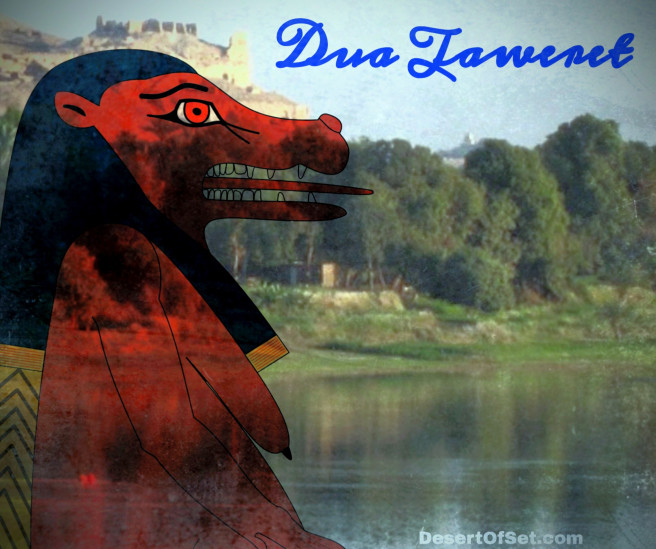
Taweret is the Egyptian hippo Goddess of childbirth. Her name means “Great Female,” and She is otherwise known as Taurt, Reret, Apet, or Thoueris. According to some accounts, She was originally the female counterpart of Apep, the Chaos Serpent; but She became a Goddess and a defender of Ma’at. Now—along with Her trusty sidekick, the benevolent daemon Bes—Taweret protects the frightened and the vulnerable. As frightening as all the qliphoth of the Void might be, they are frightened of Taweret, and for good reason. Her sacred animal is one of the deadliest creatures on earth, and She is the only other Netjer or Egyptian divinity who is powerful enough to wield Khepesh, the celestial Iron of Set!
Hippos are Typhonian animals, which means there’s a very strong connection between Taweret and Set. While male hippos were feared, females were celebrated for their ferocity in protecting their young. The Egyptians channeled this ferocity by invoking Taweret for protection, especially when it came to mothers and little children. Midwives commonly used hippo statuettes to instill Taweret’s strength in women who were giving birth. People kept Her image around their homes because it made them feel SAFE in a world of terror and chaos, with no hospitals or public health system as we understand such things today. People generally don’t behave that way toward influences they think are “ugly” or “disturbing,” so clearly the sight of Taweret inspired confidence. Despite Her so-called “demonic” appearance, the Great Female is there to defend the defenseless.
Taweret never had any temples or priesthoods of Her own (that we presently know of, at least); Hers was a purely folk tradition, kept alive by Egyptian peasants in their own homes. This is ironic, given that Taweret is also linked with one of the largest and most important constellations in the northern sky. The Egyptians viewed Draco not as a dragon, but as a great big hippo with a crocodile on Her back. In funerary art, this hippo was shown with sagging breasts that are heavy with milk. She holds a chain by which the Big Dipper is tethered to Polaris, the North Star. Taweret is said to keep the Dipper restrained to prevent Set from completely destroying the universe whenever He becomes too angry. She is helped in this regard by the Four Sons of Horus: Duamutef, Hapi, Imsety and Qebshenuf.
The Great Female was eventually recast as an alternate form of Isis, the sister-wife of Osiris; but I disagree with this conflation myself. Isis is linked to Sirius and the Sothic cycle, not to Draco or the circumpolar stars, and the Isian religion is known for having absorbed virtually every other Goddess religion it encountered in Late Antiquity (including the cults of Aphrodite, Demeter, and Diana). But most importantly to me, Taweret is a “monstrous” divinity who was born of chaos and who exhibits chaotic traits, yet who uses Her chaotic powers to defend the cosmic order (not to un-create it, as Apep seeks to do). She trades in an altogether different, more primeval kind of fertility than Isis does. The Egyptian Gods are kind of like Voltron or the Megazord; they can converge in various formations and become composite deities, and this includes Taweret and Isis as much as the rest. But this is not the same thing as saying Taweret is simply a “different version of Isis.”
Many Goddesses are portrayed as beautiful, slender-bodied women, but Taweret has always been depicted as rotund, with a gaping mouth full of razor sharp teeth. She certainly isn’t the sort of “glamour girl” one normally finds in pinup magazines, and I absolutely love Her for this. (Not that I have anything against the more glamorous Goddesses; remember, I revere Ishtar too.) Our patriarchal society pretends to love women, but continues to shame them for not keeping fit, wearing makeup, shaving their armpits, or bearing children. There is nothing wrong with doing either of these things so long as it is your choice, just like there is nothing wrong with wearing a skirt or a hijab so long as it is your choice. But the expectation that every woman must fit some kind of “mold” is not only misogynist; it goes against nature, as holy figures like Taweret are here to remind us.
By the time the Greek writer Plutarch came along (circa 46–120 C.E.) to offer his version of events, Taweret’s story had been changed so that She was a concubine of Set who abandoned Him after the killing of Osiris. This change was probably the result of Set’s demonization in Late Antiquity, when He was conflated with the Chaos Serpent and blamed for Egypt’s fall to foreign rule. I think Taweret is still one of Set’s many romantic partners, but She also acts as a kind of “buffer” between Him and the other Netjeru, restraining Set when He loses His self-restraint. (A Lady who’s not afraid to smack Big Red around with His own iron genitals whenever She thinks He’s being an asshole? How can such a Female be regarded with anything but boundless AWE?)
Taweret also resembles Big Red in that She seems to have identified more with the “little people” who didn’t benefit as much from Pharaonic privilege. The peasants knew She would always listen to them, even if the “more important” Gods of the Pharaohs and the priesthoods didn’t. In Typhonian Thelemic lore, it is said that Set is the male offspring or avatar of Typhon, whom Kenneth Grant depicts as a saurian mother Goddess associated with Draco. Grant further claimed that “Typhon’s” worship was suppressed by later patriarchal religions. As far as I can tell, there is no historical evidence to support either of these claims, which Grant appears to have drawn from the poet Gerald Massey (who was not an Egyptologist). But I do agree with Massey and Grant that Set’s worship is linked to that of a “monstrous” female divinity who resonates with Draco, and who was ignored by the Pharaohs for some reason. I just think the entity they were describing is actually Taweret.
I think of Draco and the Big Dipper as being at the “center” of heaven. Being circumpolar, they never descend beneath the horizon, which is why the ancient Egyptians called them “the Imperishable Ones.” Unlike the planets and the constellations of the Zodiac, the circumpolar stars can be seen on any night at any time of year (in the northern hemisphere, at least, and weather permitting). Since Draco and the Dipper are above the Zodiac, I think of Taweret and Set as being “older” and “darker” than any of the various planetary divinities (e.g., Marduk and Zeus for Jupiter, Ishtar and Aphrodite for Venus, etc.), as well as divinities associated with Sirius and Orion (e.g., Isis and Osiris, respectively), which are beneath the Zodiac. Mind you, I am not asserting any of this to be a dogmatic “fact”; it’s just the way I prefer to think about the Gods based on Their related stars. I also incorporated this theoretical cosmogony into A Would-Be Ombite Creation Myth, with Set and Taweret cast as the first Netjeru to be born from Nut or Mother Sky.
An LV-426 Setian adaptation of the Lesser Banishing Ritual of the Pentagram.
The Lesser Banishing Ritual of the Pentagram (or LBRP for short) is a magical procedure developed by the Hermetic Order of the Golden Dawn during the late 19th and early 20th centuries. It involves casting a magician’s circle, tracing pentagrams in the air, and reciting divine names of power to repel any chaotic or qliphothic forces that might be hanging around you.
The litany for this rite was adapted from a traditional Jewish prayer that is recited before sleeping:
In the Name of God, the God of Israel: may Michael be at my right hand, Gabriel at my left, Uriel before me, Raphael behind me, and above my head, the presence of God.
The actual Golden Dawn procedure is much more complicated than just a bedtime prayer, requiring the use of an altar, robes, and various ritual tools. But the effect was so remarkable that even people outside the Golden Dawn started using the procedure, re-writing it to suit their own needs. More than a century later, a Google search for “LBRP” will retrieve countless variants of the rite that are now used in various faiths today, including Wicca, Thelema, and even Satanism.
Upon learning that the LBRP descends from a bedtime prayer, I felt moved to draft an adaptation of my own. This version of the rite is written from an LV-426 Setian perspective, which means it is much simpler than what most ceremonial magicians are probably used to. You can include an altar and any additional ritual items you wish, but this is entirely optional. The only things you really need are yourself and a nice quiet place where you can be alone.
The Procedure
Stand facing north, with your eyes closed. Count down silently from 100. Then raise your head up high and recite:
In the Name of SUTEKH, God of Deshret.
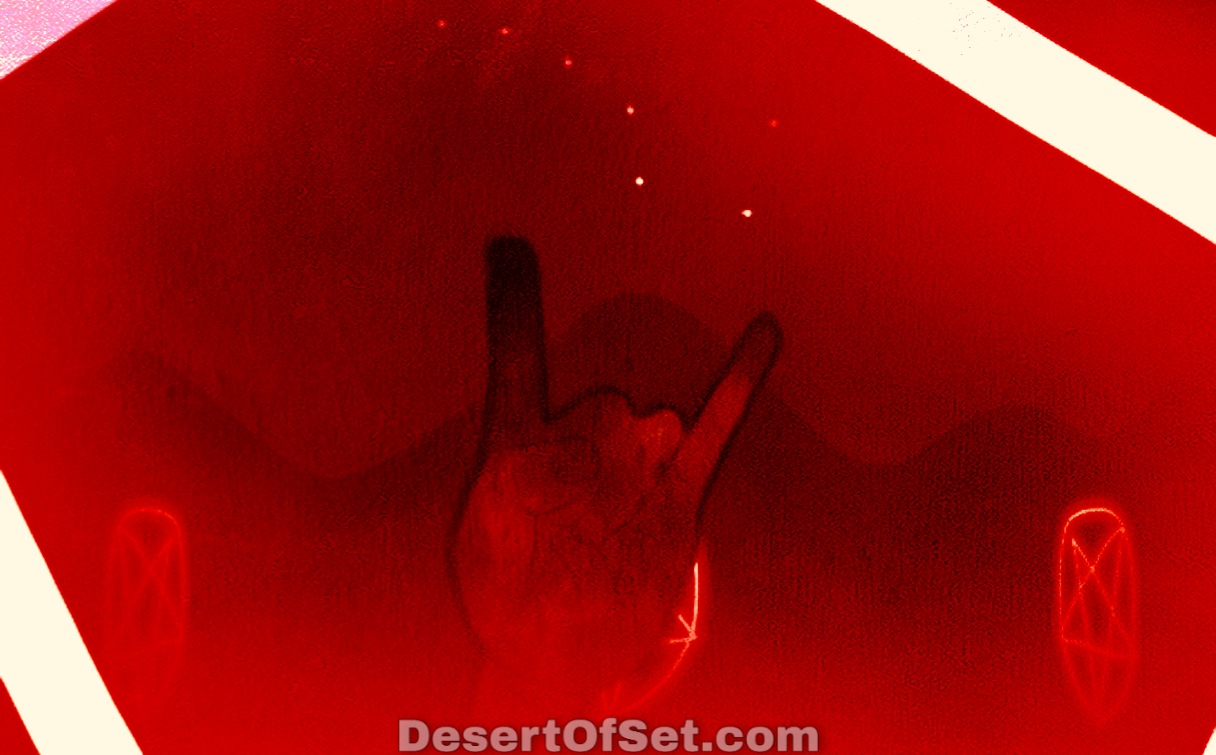
Open your eyes and turn slowly to the left, facing west. Raise both your hands in the sign of the horns, pointing up to the sky.
Draw a horned pentagram in the air before you with your left hand; imagine a red light trailing behind your fingertips, so there is an invisible afterglow. Then, arms still raised into the air, recite:
Hear me, NUBTI of Ombos, Golden One, Provider of Life on the Frontier.
Turn to the left, facing south. Draw another pentagram in the air, in the same manner. Then, arms still raised, recite:
Hear me, TYPHON of Aegyptos, Disturber of the Dark, Giver of Winds.
Turn to the left, facing east. Repeat the same procedure; then recite:
Hear me, HADAD of Kemet, Savior of Khepera, Hero of the Light.
Turn to the left, so that you are facing north once again. Draw one last pentagram in the air; then recite:
Hear me, ASH of the Oases, Horned Night-Hunter, Wanderer of the Wastes.
Gently lower your arms and close your eyes. Remain silent for a few moments; then recite:
I am SUTEKH’S Child, the Dazzling One in mortal flesh. I alone am Sovereign Ruler of my innermost self.
Raise your left hand in the sign of the horns, pointing west. Recite:
May NUBTI ever be at my left; I will survive and persevere in all hostile terrain.
Raise your right hand in the sign of the horns, pointing east. Recite:
May HADAD be ever at my right; I will smite the forces of isfet and champion the Light.
Keeping both arms in the air, take a half-step backwards, so that your left foot is behind you. Recite:
May TYPHON ever be behind me; I will ride the winds of change and create myself anew.
Take a half-step forwards (with your arms still in the air), so that your right foot is before you. Recite:
May ASH ever be before me; I will drink sweetwater in the Desert between the Worlds.
Rise into a standing position and cross your arms over your chest, with your hands still in the sign of the horns. Close your eyes once more and recite:
May the presence of SUTEKH be ever upon my crown.
Silently count backwards from 100; then open your eyes and go forth by day.
Today’s episode is not a proper sermon as such, but a collection of brief melodies composed by yours truly. I don’t consider myself much of a musician, but I hope you will enjoy. Praise be to Set!