A discussion of the Egyptian hippo Goddess Taweret, Her connections with Set, and the reasons I love Her so much.
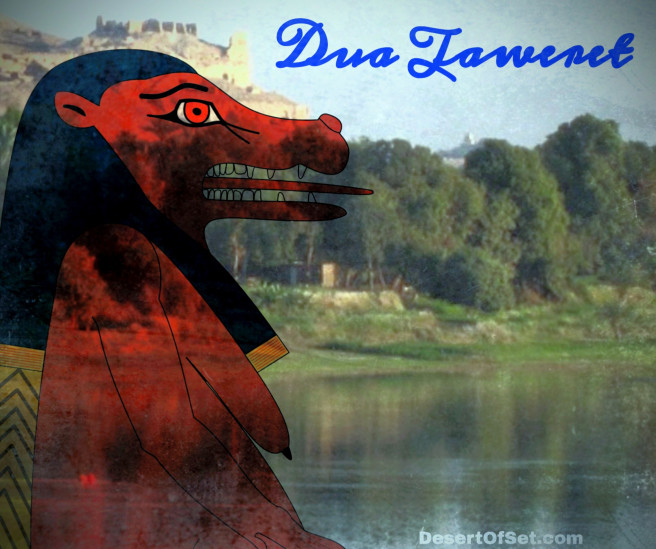
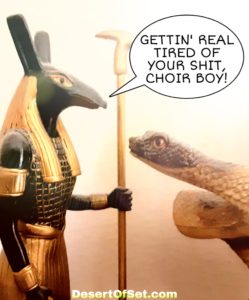
Taweret is the Egyptian hippo Goddess of childbirth. Her name means “Great Female,” and She is otherwise known as Taurt, Reret, Apet, or Thoueris. According to some accounts, She was originally the female counterpart of Apep, the Chaos Serpent; but She became a Goddess and a defender of Ma’at. Now—along with Her trusty sidekick, the benevolent daemon Bes—Taweret protects the frightened and the vulnerable. As frightening as all the qliphoth of the Void might be, they are frightened of Taweret, and for good reason. Her sacred animal is one of the deadliest creatures on earth, and She is the only other Netjer or Egyptian divinity who is powerful enough to wield Khepesh, the celestial Iron of Set!
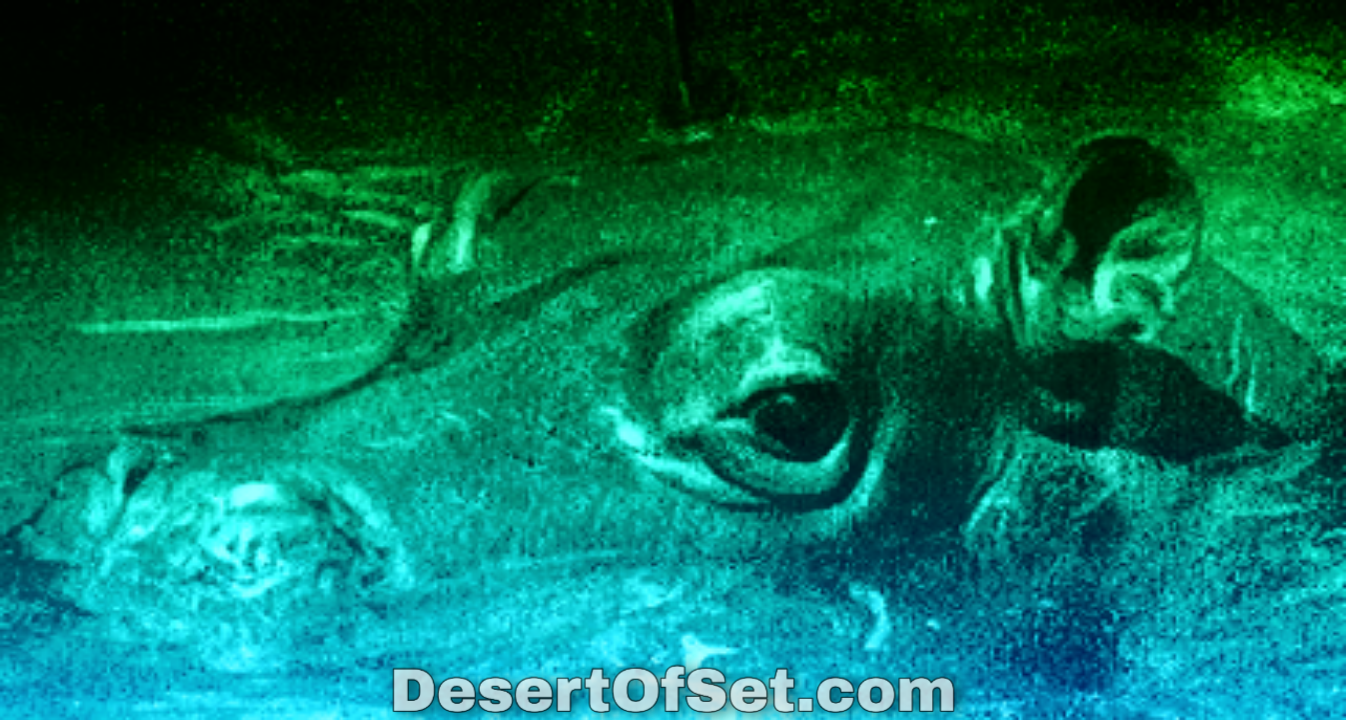
Hippos are Typhonian animals, which means there’s a very strong connection between Taweret and Set. While male hippos were feared, females were celebrated for their ferocity in protecting their young. The Egyptians channeled this ferocity by invoking Taweret for protection, especially when it came to mothers and little children. Midwives commonly used hippo statuettes to instill Taweret’s strength in women who were giving birth. People kept Her image around their homes because it made them feel SAFE in a world of terror and chaos, with no hospitals or public health system as we understand such things today. People generally don’t behave that way toward influences they think are “ugly” or “disturbing,” so clearly the sight of Taweret inspired confidence. Despite Her so-called “demonic” appearance, the Great Female is there to defend the defenseless.
Taweret never had any temples or priesthoods of Her own (that we presently know of, at least); Hers was a purely folk tradition, kept alive by Egyptian peasants in their own homes. This is ironic, given that Taweret is also linked with one of the largest and most important constellations in the northern sky. The Egyptians viewed Draco not as a dragon, but as a great big hippo with a crocodile on Her back. In funerary art, this hippo was shown with sagging breasts that are heavy with milk. She holds a chain by which the Big Dipper is tethered to Polaris, the North Star. Taweret is said to keep the Dipper restrained to prevent Set from completely destroying the universe whenever He becomes too angry. She is helped in this regard by the Four Sons of Horus: Duamutef, Hapi, Imsety and Qebshenuf.
The Great Female was eventually recast as an alternate form of Isis, the sister-wife of Osiris; but I disagree with this conflation myself. Isis is linked to Sirius and the Sothic cycle, not to Draco or the circumpolar stars, and the Isian religion is known for having absorbed virtually every other Goddess religion it encountered in Late Antiquity (including the cults of Aphrodite, Demeter, and Diana). But most importantly to me, Taweret is a “monstrous” divinity who was born of chaos and who exhibits chaotic traits, yet who uses Her chaotic powers to defend the cosmic order (not to un-create it, as Apep seeks to do). She trades in an altogether different, more primeval kind of fertility than Isis does. The Egyptian Gods are kind of like Voltron or the Megazord; they can converge in various formations and become composite deities, and this includes Taweret and Isis as much as the rest. But this is not the same thing as saying Taweret is simply a “different version of Isis.”
Many Goddesses are portrayed as beautiful, slender-bodied women, but Taweret has always been depicted as rotund, with a gaping mouth full of razor sharp teeth. She certainly isn’t the sort of “glamour girl” one normally finds in pinup magazines, and I absolutely love Her for this. (Not that I have anything against the more glamorous Goddesses; remember, I revere Ishtar too.) Our patriarchal society pretends to love women, but continues to shame them for not keeping fit, wearing makeup, shaving their armpits, or bearing children. There is nothing wrong with doing either of these things so long as it is your choice, just like there is nothing wrong with wearing a skirt or a hijab so long as it is your choice. But the expectation that every woman must fit some kind of “mold” is not only misogynist; it goes against nature, as holy figures like Taweret are here to remind us.
By the time the Greek writer Plutarch came along (circa 46–120 C.E.) to offer his version of events, Taweret’s story had been changed so that She was a concubine of Set who abandoned Him after the killing of Osiris. This change was probably the result of Set’s demonization in Late Antiquity, when He was conflated with the Chaos Serpent and blamed for Egypt’s fall to foreign rule. I think Taweret is still one of Set’s many romantic partners, but She also acts as a kind of “buffer” between Him and the other Netjeru, restraining Set when He loses His self-restraint. (A Lady who’s not afraid to smack Big Red around with His own iron genitals whenever She thinks He’s being an asshole? How can such a Female be regarded with anything but boundless AWE?)
Taweret also resembles Big Red in that She seems to have identified more with the “little people” who didn’t benefit as much from Pharaonic privilege. The peasants knew She would always listen to them, even if the “more important” Gods of the Pharaohs and the priesthoods didn’t. In Typhonian Thelemic lore, it is said that Set is the male offspring or avatar of Typhon, whom Kenneth Grant depicts as a saurian mother Goddess associated with Draco. Grant further claimed that “Typhon’s” worship was suppressed by later patriarchal religions. As far as I can tell, there is no historical evidence to support either of these claims, which Grant appears to have drawn from the poet Gerald Massey (who was not an Egyptologist). But I do agree with Massey and Grant that Set’s worship is linked to that of a “monstrous” female divinity who resonates with Draco, and who was ignored by the Pharaohs for some reason. I just think the entity they were describing is actually Taweret.
I think of Draco and the Big Dipper as being at the “center” of heaven. Being circumpolar, they never descend beneath the horizon, which is why the ancient Egyptians called them “the Imperishable Ones.” Unlike the planets and the constellations of the Zodiac, the circumpolar stars can be seen on any night at any time of year (in the northern hemisphere, at least, and weather permitting). Since Draco and the Dipper are above the Zodiac, I think of Taweret and Set as being “older” and “darker” than any of the various planetary divinities (e.g., Marduk and Zeus for Jupiter, Ishtar and Aphrodite for Venus, etc.), as well as divinities associated with Sirius and Orion (e.g., Isis and Osiris, respectively), which are beneath the Zodiac. Mind you, I am not asserting any of this to be a dogmatic “fact”; it’s just the way I prefer to think about the Gods based on Their related stars. I also incorporated this theoretical cosmogony into A Would-Be Ombite Creation Myth, with Set and Taweret cast as the first Netjeru to be born from Nut or Mother Sky.
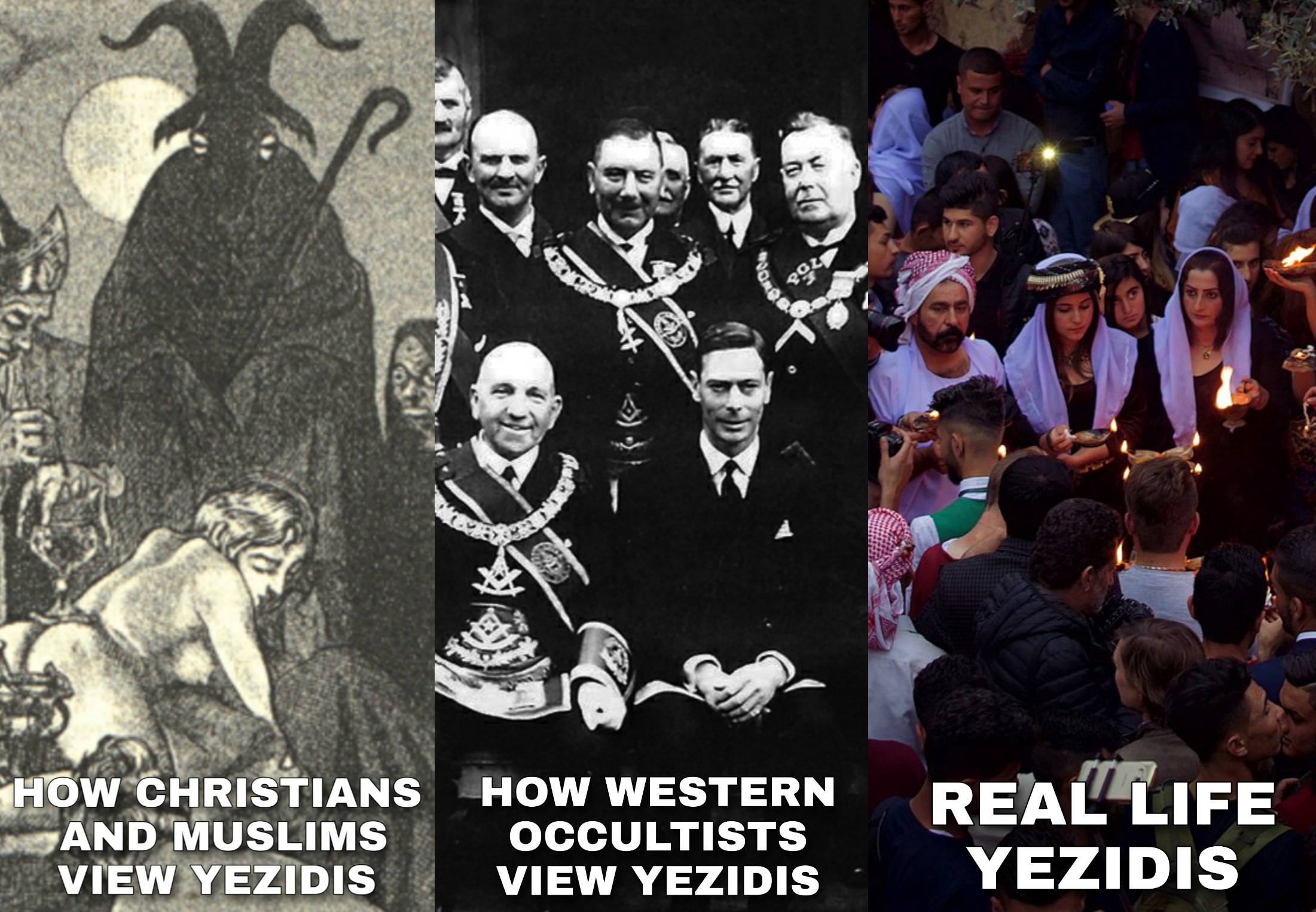
The Yezidis are accused of “worshiping the devil,” but are also romanticized by Western occultists—neither of which is acceptable.
I first learned about the Yezidis from reading Terri Hardin’s Supernatural Tales From Around the World in the late 1990s. At that point, most people—including Western scholars—were still calling them “devil worshipers,” and accurate information about this culture was still very hard to come by. It’s only been during the past 15 years or so that the outside world has finally given the Yezidis the proper attention they deserve, but the cause for this is unfortunate. After many centuries of persecution, the Yezidis continue to be systematically slaughtered by Islamic jihadists. They are especially despised by the Islamic State terrorist group, which has exterminated entire crowds of Yezidi men and kidnapped countless Yezidi women and children, forcing them into slavery.
Yezidism is a syncretized religion that combines pre-Zoroastrian Kurdish polytheism with certain elements from the biblical faiths. It revolves around nine theological personas, including: a deistic Creator God who takes little direct interest in mortal affairs; seven archangels that serve as custodians for Creation; and a holy prophet named Sheikh Adi ibn Musafir, who is believed to have been one of the seven archangels in human form. Yezidis believe that worshiping the Creator God is pointless, because this entity does not actually care what happens to mortal beings. Our prayers are more productively directed toward the archangels instead, since they now rule the universe in the Creator’s place. Of these seven angels, the most important is called Melek Taus or Ta’usi-Melek, “the Peacock Angel.”
Melek Taus appears to have been a polytheist deity who was later conflated with the Islamic version of Satan, and this is where the accusation of Yezidi “devil worship” comes from. According to the Koran, Iblis (“Doubt,” the Islamic name for Satan) was originally a genie who refused to prostate himself before Adam per Allah’s command. Iblis is said to have thought he was superior to human beings, and Allah cast him out of heaven for his insolence and pride. Afterwards, Iblis became the Shaitan and devoted himself to tricking as many people into disobeying Allah as possible (so they will go to hell). Aside from this origin story, the Islamic devil functions in much the same way as the Christian devil does; he is basically there to harass, frighten, and/or deceive monotheists into committing various “sins.”
The Yezidis worshiped their peacock God long before they ever heard this story; but at some point, attempts were made to convert them to Islam. They were told that their Peacock Angel is actually the Shaitan (just as all polytheist deities are really “Satan” in monotheist eyes). Strangely, the Yezidis seem to have agreed that Melek Taus is the same person as Iblis; and they do agree that he disobeyed a direct order from the Creator by refusing to worship human beings. But this is where the resemblance between these two narratives ends. The Yezidis believe that instead of becoming the devil, Melek Taus actually became the first monotheist. He disobeyed the Creator not out of pride but out of loyalty, for he was refusing to worship anyone else but the Creator. The Yezidis further hold that Melek Taus was rewarded for this act of disobedience, and that the Creator chose him to rule our cosmos. In this way, they justified the continued worship of their Peacock Angel not as the “enemy” of Allah, but as his regent.
Sheikh Adi ibn Musafir was a medieval Sufi Muslim who traveled to Kurdistan in search of some peace and quiet. Despite his attempts to live a monastic life, he drew the attention of his new Yezidi neighbors, who seem to have thought he was a wizard. Sheikh Adi likely tried converting the Yezidis to Islam (and he was probably one of the very few who ever tried to do this peacefully). As far as I’ve been able to trace, the idea of Iblis being “the first monotheist” originates from the Sufi movement, which follows a more mystical reading of Islam. I bet Sheikh Adi introduced this idea to the Yezidis, who then equated it with their own God Melek Taus. In any case, Sheikh Adi made such an impression on these people that they started to believe he was actually a human incarnation of the Peacock Angel. To this very day, making a pilgrimage to Sheikh Adi’s tomb is still an important component of the Yezidi faith.
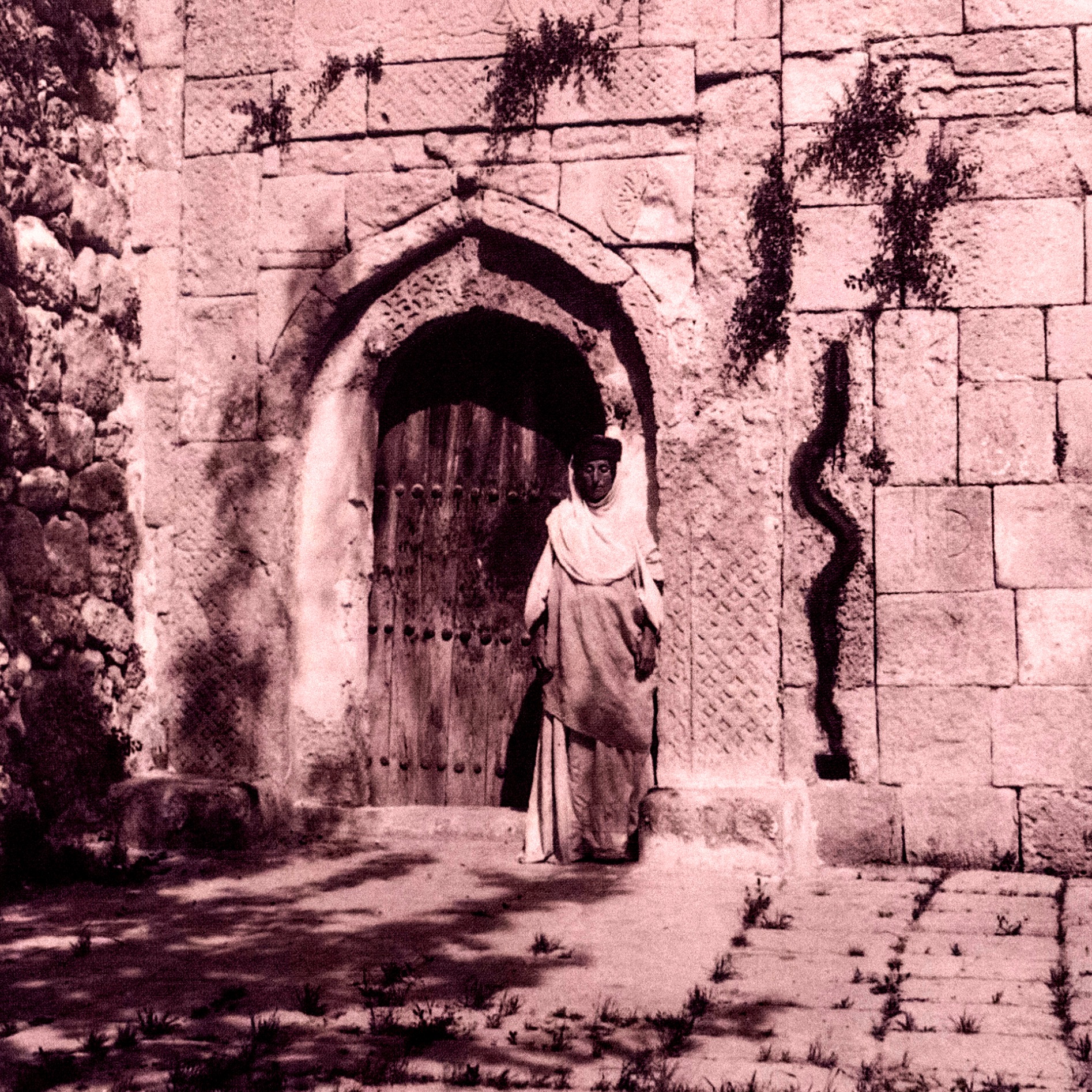
The Khatun at the door of Sheikh Adi’s temple in Lalish, Iraq
Much of the attention Yezidism has received here in the West comes from Satanists, who often cite the religion as “proof” for the historicity of a pre-LaVeyan Satanism. (Nevermind the fact that Anton LaVey was preceded by two earlier 20th century Satanists, Maria de Naglowska and Herbert Sloane.) LaVey even included part of a so-called Yezidi text—the Al-Jilwah—in his book, The Satanic Rituals (Avon, 1972). This text is now accepted by some theistic Satanists as a direct revelation from Lucifer himself; but its true history is far less certain. For one thing, the Al-Jilwah is only part of a longer text called the Mishaf Resh (“Black Book”). And while it does reflect some Yezidi beliefs, it was not written by Yezidis. Back in 2007, I had an opportunity to speak about this with Dr. Philip G. Kreyenbroek (one of the leading scholars of Yezidi culture today), and this is what Dr. Kreyenbroek shared with me:
“The so-called ‘Sacred Books’ are forgeries and have little to do with Yezidi belief. [. . .] I can still remember the face of a learned Yezidi friend of mine when I first showed him the ‘Sacred Books,’ first he was scandalized and then he laughed fit to burst.”
—P.G. Kreyenbroek (Personal Communication, October 20, 2007)
I have met theistic Satanists who believe everything in the Al-Jilwah word-for-word, as if it were the Bible and they were fundamentalist Christians. Yet the truth is that:
Melek Taus and Satan are two completely different figures.
Yezidis don’t believe in “Satan” as he is defined in Christianity or Islam at all.
Yezidis consider the Al-Jilwah to be some Westerner’s idea of a joke.
This pretty much destroys the entire notion of using the Al-Jilwah as some kind of “infallible” sacred scripture. But Yezidi beliefs have also been appropriated by other Western occult groups, including Theosophists and Thelemites . While romanticizing the Yezidis as “ascended occult masters” is much better than vilifying them as “devil worshipers,” it is equally removed from reality. What these people have written about Yezidism really says more about Western occultists than it does about Yezidis. It’s equivalent to saying, “I can’t find more than a single paragraph about the Yezidis in any of my encyclopedias, and I’ve never actually met a Yezidi person or directly experienced their faith in any way; but since I’m a Snooticus Maximus XXI° of the Ordo Assholius Genericus, I automatically know more about Yezidism than anyone else—including those silly Yezidis!”
A much better example of how Western occultists can treat Yezidi beliefs and culture would be the Feri Tradition of Traditional Witchcraft. For better information on this particular subject, check out The Blue God of Faery, an interview with Storm Faerywolf on Patheos.com.
Alexander Hislop once conflated Melek Taus with Set, but my research has convinced me that this claim is false. However, I continue to feel great empathy for the Yezidis. I appreciate their unique theology, and I can identify with how frustrating it is when people think your God is “evil.” My heart also breaks whenever I think of all the human rights abuses the Yezidis have suffered en masse. This has been my attempt at setting the record straight about some of their beliefs, which are grossly misrepresented not only by Christians and Muslims, but also by Satanists and other Western occultists. There is nothing wrong with taking some inspiration from the Yezidi faith, if people feel a calling to do so; after all, the Yezidis themselves maintain that Melek Taus “belongs to everyone.” But if a person does take inspiration from the Yezidis, they should make every effort to understand Yezidism on its own terms, as well as to clarify that they are not actual Yezidis themselves. Since the Yezidis are an ethnic group as much as they are a religion, white people have no business trying to include themselves in their culture.
Acikyildiz, B. (2010). The Yezidis: The history of a community, culture and religion. New York, NY: I.B. Tauris & Co.
Allison, C. (2001). The Yezidi oral tradition in Iraqi Kurdistan. Richmond, Surrey: Curzon Press.
Arakelova, V. (2004). Notes on the Yezidi religious syncretism. Iran & the Caucasus, 8(1), 19–28. Stable URL: http://www.jstor.org/stable/4030889
Asatrian, G. (1999). The holy brotherhood: The Yezidi religious institution of the”brother” and the “sister” of the next world. Iran & the Caucasus, 3/4. Stable URL: http://www.jstor.org/stable/4030767
Asatrian, G., & Arakelova, V. (2004). The Yezidi pantheon. Iran & the Caucasus, 8(2), 231–279. Stable URL: http://www.jstor.org/stable/4030995
Guest, J.S. (1987). Survival among the Kurds: A history of the Yezidis. Abingdon, Oxon: Routledge.
Kreyenbroek, P.G. (2009). Yezidism in Europe: Different generations speak about their religion. Göttingen, Germany: Hubert & Co.
An LV-426 Setian adaptation of the Lesser Banishing Ritual of the Pentagram.
The Lesser Banishing Ritual of the Pentagram (or LBRP for short) is a magical procedure developed by the Hermetic Order of the Golden Dawn during the late 19th and early 20th centuries. It involves casting a magician’s circle, tracing pentagrams in the air, and reciting divine names of power to repel any chaotic or qliphothic forces that might be hanging around you.
The litany for this rite was adapted from a traditional Jewish prayer that is recited before sleeping:
In the Name of God, the God of Israel: may Michael be at my right hand, Gabriel at my left, Uriel before me, Raphael behind me, and above my head, the presence of God.
The actual Golden Dawn procedure is much more complicated than just a bedtime prayer, requiring the use of an altar, robes, and various ritual tools. But the effect was so remarkable that even people outside the Golden Dawn started using the procedure, re-writing it to suit their own needs. More than a century later, a Google search for “LBRP” will retrieve countless variants of the rite that are now used in various faiths today, including Wicca, Thelema, and even Satanism.
Upon learning that the LBRP descends from a bedtime prayer, I felt moved to draft an adaptation of my own. This version of the rite is written from an LV-426 Setian perspective, which means it is much simpler than what most ceremonial magicians are probably used to. You can include an altar and any additional ritual items you wish, but this is entirely optional. The only things you really need are yourself and a nice quiet place where you can be alone.
The Procedure
Stand facing north, with your eyes closed. Count down silently from 100. Then raise your head up high and recite:
In the Name of SUTEKH, God of Deshret.
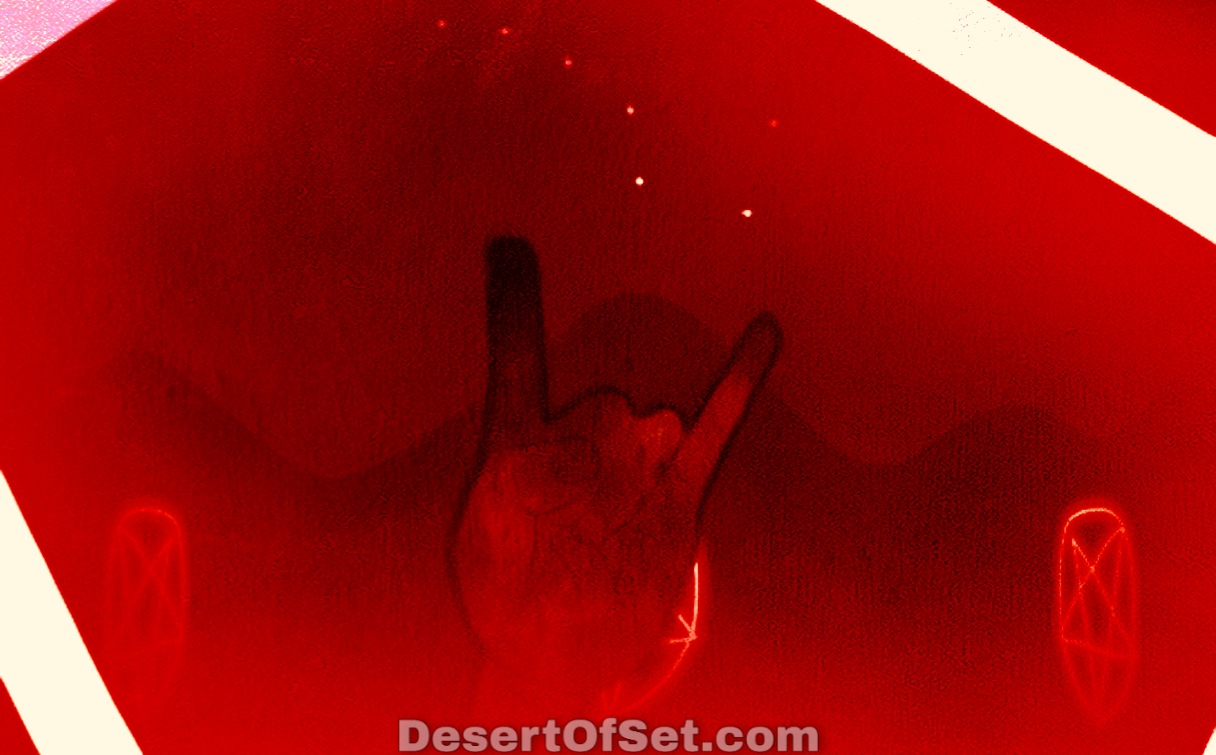
Open your eyes and turn slowly to the left, facing west. Raise both your hands in the sign of the horns, pointing up to the sky.
Draw a horned pentagram in the air before you with your left hand; imagine a red light trailing behind your fingertips, so there is an invisible afterglow. Then, arms still raised into the air, recite:
Hear me, NUBTI of Ombos, Golden One, Provider of Life on the Frontier.
Turn to the left, facing south. Draw another pentagram in the air, in the same manner. Then, arms still raised, recite:
Hear me, TYPHON of Aegyptos, Disturber of the Dark, Giver of Winds.
Turn to the left, facing east. Repeat the same procedure; then recite:
Hear me, HADAD of Kemet, Savior of Khepera, Hero of the Light.
Turn to the left, so that you are facing north once again. Draw one last pentagram in the air; then recite:
Hear me, ASH of the Oases, Horned Night-Hunter, Wanderer of the Wastes.
Gently lower your arms and close your eyes. Remain silent for a few moments; then recite:
I am SUTEKH’S Child, the Dazzling One in mortal flesh. I alone am Sovereign Ruler of my innermost self.
Raise your left hand in the sign of the horns, pointing west. Recite:
May NUBTI ever be at my left; I will survive and persevere in all hostile terrain.
Raise your right hand in the sign of the horns, pointing east. Recite:
May HADAD be ever at my right; I will smite the forces of isfet and champion the Light.
Keeping both arms in the air, take a half-step backwards, so that your left foot is behind you. Recite:
May TYPHON ever be behind me; I will ride the winds of change and create myself anew.
Take a half-step forwards (with your arms still in the air), so that your right foot is before you. Recite:
May ASH ever be before me; I will drink sweetwater in the Desert between the Worlds.
Rise into a standing position and cross your arms over your chest, with your hands still in the sign of the horns. Close your eyes once more and recite:
May the presence of SUTEKH be ever upon my crown.
Silently count backwards from 100; then open your eyes and go forth by day.
Today’s episode is not a proper sermon as such, but a collection of brief melodies composed by yours truly. I don’t consider myself much of a musician, but I hope you will enjoy. Praise be to Set!
How The Final Conflict (a.k.a. Omen III: The Final Conflict) can be read as an allegory for the Goddess Ishtar and Her rivalry with the spirit of human tyranny.
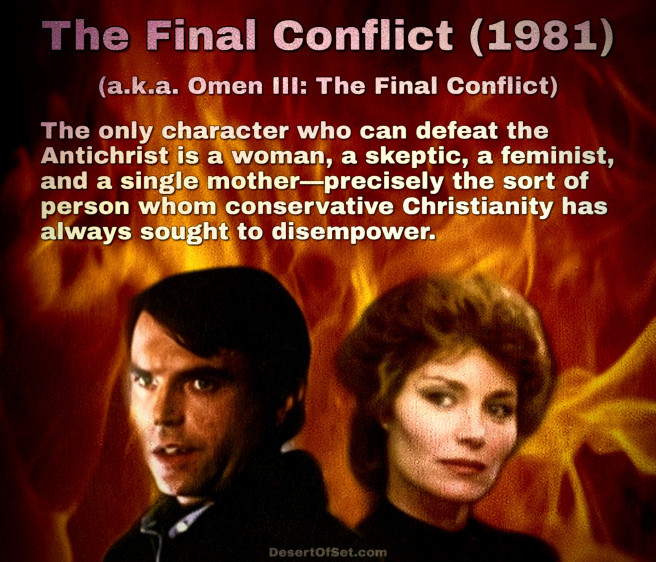
The Final Conflict (1981)—which was re-christened Omen III: The Final Conflict for its DVD release in the early 2000s—is the second sequel to Richard Donner’s 1976 masterpiece, The Omen. I enjoy the original Omen trilogy in its entirety, but The Final Conflict is the one installment thereof that’s made the largest impression on me. This film also makes me think about the Akkadian Goddess Ishtar, who is one of Set’s many romantic partners and the second-most important deity to me personally.
In case you’ve never seen The Omen or its initial sequel, Damien: Omen II (1978), here is a brief recap of their events. The 1976 original is about a U.S. politician named Robert Thorn (played by Gregory Peck) who learns his child has died while his wife Katherine (Lee Remick) was giving birth. A Catholic priest convinces Thorn to adopt an orphan who was born at the same time at the same hospital. Robert agrees, and the Thorns leave with their newborn baby boy (and with Katherine none the wiser to his true parentage). But as the child, Damien, grows older, weird shit starts to happen. One of his nannies hangs herself in front of his entire birthday party. A new, creepy nanny shows up to take the old one’s place. A crazy priest stalks and harasses Robert. A big black dog starts hanging around the Thorn household. A photographer (David Warner) captures prophetic photos of people’s deaths. And poor Katherine becomes terrified of the child who is supposed to be her offspring. All of which leads Robert to visit Rome, a monastery in Subiaco, and an archaeological dig in the valley of Megiddo, where he learns that Damien is really the son of Satan and can only be killed with these mystical artifacts called the Seven Daggers of Meggido.
What follows is the most disturbingly sympathetic depiction of attempted infanticide that has ever been filmed. Unfortunately, Robert only succeeds in getting himself killed when he tries to prevent the apocalypse (spoilers!), and Damien is then adopted by his uncle Richard (William Holden) in Damien: Omen II. Now an adolescent, Damien (Jonathan Scott-Taylor) remembers nothing of what happened to him or his parents in the first film. He’s also best friends with his cousin Mark, who’s more like a brother to him. Damien and Mark both attend military school, where their drill sergeant (Lance Henriksen) teaches Damien about his true identity. Meanwhile, a nosy reporter tries to convince Uncle Richard of the truth, and this leads to a bunch of increasingly over-the-top deaths. (My favorite is the guy who gets sawed in half by an elevator cable. Truly classic.) Eventually, Damien grows into his predestined role and wipes out all that remains of his family tree so he can be the sole inheritor of the Thorn family fortune.
The Omen is a perfect horror show from start to finish, and it’s every bit as scary as people say it is. The script wastes no time getting down to business, and each of the actors’ performances is Oscar-worthy. But it’s also my least favorite film in the trilogy, for Damien is only a peripheral character in the story. Granted, this is exactly what makes the film so scary; Damien remains completely alien to both his parents and the audience right to the very end, and it’s always easier to be frightened of something when it’s part of the unknown. But I find Damien: Omen II much more interesting, because it’s the first film ever made that actually puts us inside the Antichrist’s head. When Damien learns he is the Great Beast, he’s just as horrified as everyone else is; but the most powerful moment is when his cousin Mark gets wise and confronts Damien about his true identity. Mark threatens to tell everyone, and Damien reluctantly uses his powers to give Mark a brain aneurysm. When Mark drops dead, Damien screams the most convincing scream of despair I’ve ever heard from any character in any movie ever. That scene always makes me weep a little whenever I see it, because Jonathan Scott-Taylor really sells it. Damien: Omen II is quite derivative of the first movie, but it deserves credit for one thing at least: the character of Damien is perfectly written.
A lobby card for the film.
In The Final Conflict, Damien is now an adult in his thirties, and he’s played by Sam Neill. He has now become the owner of Thorn Industries, a multi-billion dollar company that has revolutionized the food industry, and which is working to solve the world hunger crisis forever. Damien is also the U.S. President’s first choice for Ambassador to Great Britain (after the current guy gets possessed by a black demon dog and blows his brains out). Damien is hot for Great Britain because he has this entirely fictitious apocryphal text called the “Book of Hebron,” which prophesies that Jesus will be reincarnated in Jolly Old England any day now. (Maybe they didn’t have the budget to do a proper Second Coming, with the J-Man flying down from the sky?) But after he sets up shop across the pond, Damien falls for a news reporter named Kate Reynolds (Lisa Harrow); then these Catholic monks at a monastery in Subiaco, Italy find the Seven Daggers of Meggido and try to assassinate him. This leads to a series of hilariously incompetent murder attempts that will have you shaking your head in disbelief. Meanwhile, Jesus is born again somewhere (did you see what I just did there?), but nobody knows where. Lucky for him, Damien knows the birth coincided with a weird astronomical convergence that occurred a few nights ago, so he sends his worshipers out to murder every male baby in England who was born within that time frame. Then Kate Reynolds finds out what the rest of us already know about Damien, and the titular Final Conflict truly begins.
The number one attraction in this film, and the most important reason for anyone to see it, is Sam Neill; he’s literally the greatest Antichrist I’ve ever seen in any film ever. Forget about Michael York, Nick Mancuso, Gordon Currie, or anyone else who’s ever played the Beast in those movies they show on the Trinity Broadcast Network; Sam Neill’s performance here is the gold standard. Rather than playing Damien like some two-dimensional cartoon villain, he plays him like he’s the Gods-damn hero of the movie. He brings so much charisma and charm to the role that he succeeds in making Damien extremely likeable, even when he’s ordering hundreds of newborns to their deaths. Everyone I know who’s ever seen The Final Conflict ends up rooting for Damien somehow (even though they know they’re not supposed to), and they can’t help but feel disappointed with the ending. (More on that in a minute.) The only other performance that’s comparable to this is that of Sir Anthony Hopkins as Dr. Hannibal “the Cannibal” Lecter in The Silence of the Lambs (1991). If there is an Antichrist and he ever tries to take over the world, we’d all better pray he isn’t just like Sam Neill in this movie—or else we might actually want him to take over.
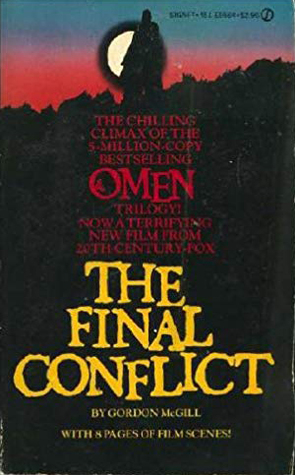
The novelization of the 1981 film, The Final Conflict, by Gordon McGill.
In one scene, Damien and Kate walk through a park and see one of the monks, who’s standing on a soapbox, preaching. Damien notices the monk is staring right at him, and he instantly knows the guy is here to kill him. So he starts surveying the area like a hawk—without breathing a word of his concerns to Kate—and he actually looks worried. Is he concerned for himself, or is he concerned for Kate’s safety should there be an ambush? Then there’s another scene where Damien goes to work right after the Christ child has been born. He’s been up all night because he could sense the birth happening, and Kate catches him at the elevator, asking if it’s okay for her to try interviewing him again. (Her last attempt was foiled by another assassin.) Damien smiles and agrees, and she leaves; then he gets in the elevator, sighs, and slumps his shoulders. I’d like to remind you that this character is supposed to be Friedrich Nietzsche’s Übermensch with a vast array of supernatural powers; and yet Neill sneaks in all of these brief human touches—a look of genuine concern, a tired sigh—and actually makes us care about this evil, rotten bastard…
I hate to blow the ending of this film for anyone who hasn’t seen it, but trust me; you probably want to know about this going in. For some reason, I thought this movie was going to end with a big showdown between Damien and Jesus; surely, that would be the “Final Conflict” everyone was expecting, right? I knew things wouldn’t end well for the Beast, but I figured there would at least be some kind of special effects extravaganza. No such luck; the movie ends with Damien being led into a trap by Kate, and Kate stabs him in the back with one of those nifty Meggido daggers. Then Damien limps away, curses Jesus, and promptly dies. Cue music, roll credits. When I first saw this, I was royally pissed. The film had done an excellent job of keeping me at the edge of my seat for the first 90 minutes or so; but it starts running out of steam real fast during the final 20, and that ending just didn’t seem fair. They went through all that hard work of building up this magnificent character and this huge final battle he’s going to have, and what do they give us? Sam Neill getting stabbed in the back (literally) by the woman he loves. I mean, what the hell were they thinking? I wanted to see Damien and Jesus go “Hell in a Cell” on that shit!
An additional lobby card for the film, with Lisa Harrow as “Kate Reynolds” in the center.
But I’ve watched The Final Conflict countless times since that first viewing in 1999, and I think I’ve figured out what they were really going for here. Let’s consider that this film was not made by evangelical Christians with a religious axe to grind; if it had been, they would have kept things as close to their scriptures as possible. Let’s also consider the fact that none of the avowed Christian men in this movie can stop Damien; hell, not even Jesus himself can stop him! The only character who actually poses a real, substantial threat to the Antichrist is (1) a woman, (2) a skeptic, (3) a feminist, and (4) a single mother. In other words, she is precisely the sort of person whom conservative Christianity has always sought to disempower. The real “Final Conflict” here is not between Christ and Satan at all; it’s between male religious violence (perpetuated by Christians and Satanists) and a female secularist who just wants the violence to stop. Note that while Kate scoffs at Christianity at various points in the film, she nevertheless respects its right to exist; and while she eventually sends Damien back to hell, it’s clear she would much rather work things out and share a life with him somehow. Kate is also the only character who commits an act of violence for purely personal reasons. The monks want to kill Damien because he’s the Beast, and Damien wants to kill the Christ child because he’s Jesus; both sides are motivated by purely ideological concerns. But when Kate stabs Damien, it’s because he’s just murdered her son. (Peter is accidentally killed by one of the monks when Damien uses him as a human shield; the poor kid is literally caught between two religious fanatics.) With all this in mind, I now think the climax of this film is far more daring than I originally thought.
I used to think the conclusion to this film was just an example of lazy screenwriting, but I’ve noticed over the years that The Final Conflict gives us several hints about how it will end. In one scene, one of Damien’s “Disciples of the Watch” advises him to stay away from Kate. “I decide who’s dangerous and who isn’t!” Damien shouts angrily, betraying the fact that he feels insecure about Kate himself. Later, Kate falls into a river and almost drowns at Damien’s house. He hesitates before rescuing her (as if he senses that he shouldn’t), but his concern for her overpowers him. As Kate dries herself by the fire back in the house, she tells Damien she feels like a moth who’s flown too close to the flame; she knows he’s dangerous, but she can’t stay away. Damien’s response to her is perhaps the most beautifully-delivered line in the entire film: “Yes—but who is the moth, and who is the flame?” Finally, when Kate stabs Damien at the end with the Megiddo blade, he smiles to himself ever so subtly, as if he’s always known that she would be his undoing. Kate Reynolds was clearly meant to be the savior of humanity in this film from its very conception; and in casting her as such, The Final Conflict offers us a most unexpected soteriology.
“[Damien] is the human son of Satan, fully committed to his Father. But just as Mary Magdalene represented temptation to Jesus, so Kate represents temptation to Damien. She arouses human feelings within him that could so easily lead him astray from his insidious mission, his inglorious destiny.”
—Sam Neill in an 1981 interview upon the film’s release
The hero of this film is an independent, powerful, and successful woman. She isn’t owned or controlled by any man or male divinity. She comes awful close to losing herself in Damien, especially when she spends a dark night of the soul with him in bed. But she rises again from that proverbial pit, stronger than before, and equipped with the power to send her two-faced lover back to the Underworld. Is any of this starting to sound familiar yet? By Gods, it should; for Kate’s arc is basically the Descent of Ishtar all over again. Damien is like a really nasty corruption of Tammuz, a version that’s turned completely rotten. All of his power and wealth are tied to the food industry, just as Tammuz is the God of food and vegetation. But while this “anti-Tammuz” and his enemies are gridlocked in their increasingly futile holy war, Ishtar sneaks in and chooses Her own “messiah” to save the day. The filmmakers try to give Jesus all the credit for this by slapping an obligatory Bible quote on the screen just before the end titles roll; but as far as I’m concerned, it isn’t the Lion of Judah who snuffs the Great Beast here. It’s the Lion of Babylon!
Ishtar be praised!
Contrary to popular wisdom, there is a distinction between “the Antichrist” and “the Great Beast 666” from Revelation 13. Early Christians used the word antichristos to describe anyone who (1) refused Jesus Christ as their Lord and Savior, (2) propagated a “heretical” version of Christianity, or (3) claimed to be Christian but didn’t behave like one. The first of these definitions is practically useless since it would seem to include all non-Christians. The second is equally problematic since it requires demonizing all Christian denominations apart from one’s own. The third, however, makes a great deal of sense, for what else can you call someone who claims to love Jesus but fails to treat people in a Christian manner? The real Antichrist has nothing to do with Satanism, but is actually the spirit of Christian hypocrisy itself. Turn on your local televangelist TV network and you will find the true disciples of Antichrist at work, pushing their insane political agendas and extorting millions from their hapless followers in Jesus’ name.
The Great Beast (or Therion in Greek) is based on several ancient kings who persecuted monotheists. People like the Pharaoh in Exodus and the Roman Emperor Nero all had three things in common: (1) they ruled over polytheist nations, (2) they considered themselves to be divine, and (3) they considered the Hebrews and the early Christians to be a threat. After being fed to lions for so long, Christians became convinced that such rulers were actually possessed by Satan himself, and prophetic texts like the book of Revelation were built upon this core concept. While Antichrist represents the evil that lurks within Christianity, the Great Beast represents the archetypal “evil king”—a ruler who tyrannizes his people, and whose actions will bring about destruction and doom. Unlike Antichrist, the Beast doesn’t try to pervert Christianity from within; he seeks instead to destroy it from without. So if we want to get technical about it, Damien Thorn is not really the Antichrist per se, but the spirit of Therion in human form.
Mind you, monotheists have not exactly been “kind” to Pagans throughout history, either. It was especially bad for those civilizations that lived right next door to ancient Israel. The Gods and Goddesses of these cultures are specifically named as “demons” in the Old Testament (e.g., Ba’al, Asherah, etc.) and are commonly invoked as such in contemporary media. Lady Ishtar is just one of these divinities, and it’s sad to think that whenever She is discussed in today’s world, it is almost always in terms of biblical prophecy. She is even linked with Therion in the book of Revelation:
Then the angel said to me, “The waters you saw, where the prostitute sits, are peoples, multitudes, nations and languages. The beast and the ten horns you saw will hate the prostitute. They will bring her to ruin and leave her naked; they will eat her flesh and burn her with fire. For [Yahweh] has put it into their hearts to accomplish his purpose by agreeing to hand over to the beast their royal authority, until [Yahweh]’s words are fulfilled. The woman you saw is the great city that rules over the kings of the earth.”
—Revelation 17:15–18
As I’ve discussed before, the Whore of Babylon is clearly inspired by Ishtar, even if her symbolic purpose is different. But what I find especially interesting here is the contrast between a female entity who “rules over the kings of the earth” and an evil king who has turned against her. Ishtar presides over the concept of “sacred kingship,” which required a Babylonian king to “marry” the Goddess and serve the people as Her priest. He had to ensure that his nation’s crops didn’t fail, that his borders remained protected from foreign invaders, and that his people were cared for in times of disaster. He also had to perform religious rituals all the time to ensure that his people’s Gods were properly appeased. A lousy ruler who brought ruin to his people would have been considered “unfaithful” to Ishtar, and some kings were even sacrificed to atone for this sin. This only reinforces my opinion that by killing Damien in The Final Conflict, Kate Reynolds is actually sacrificing him to Ishtar as penance for his disastrous leadership. (It’s reassuring to think that with the Queen of Heaven, even monarchs can be held accountable and taken to task.)
Sam Neill and Lisa Harrow posing for a behind-the-scenes photo.
Don’t get me wrong; The Final Conflict is not a perfect film. There are times when it sabotages itself by trying to copy the original Omen too much. Why are we still wasting time with lone individuals getting slaughtered in isolated places? Why isn’t Damien the President already when this film begins, sending troops to invade the Middle East and start World War III? They missed an opportunity to enlarge the scale and the stakes of the story here; and by restricting all the action to Great Britain, they do a great injustice to the premise. The only exception to this is the baby-killing conspiracy sequence, which is one of the most chilling things I’ve ever seen. The murders themselves are never shown, but are only suggested through quick cuts, musical cues, and horrified reactions from the actors. This is a perfect example of how the power of suggestion can leave a much deeper impression on the mind than just painting the screen with gore. It also helps keep the violence as tasteful as possible (which is no small feat, considering the subject matter), while also making it more disturbing to sit through. If you think the jump scares in The Conjuring (2013) are scary, try watching the scene where one of Damien’s disciples—an Anglican priest—gives a newborn his own version of a “baptismal rite.” It makes my skin crawl just thinking about it.