Updates
The Temple of DOOM

With apologies to Bruce Wolfe, the artist who originally painted the Indiana Jones and the Temple of Doom poster; this was just too much fun for me to resist.
Typhonian Melodies
Songs from a Setian soul.

Today’s episode is not a proper sermon as such, but a collection of brief melodies composed by yours truly. I don’t consider myself much of a musician, but I hope you will enjoy. Praise be to Set!
Ishtar’s Final Conflict With “The Man”
How The Final Conflict (a.k.a. Omen III: The Final Conflict) can be read as an allegory for the Goddess Ishtar and Her rivalry with the spirit of human tyranny.
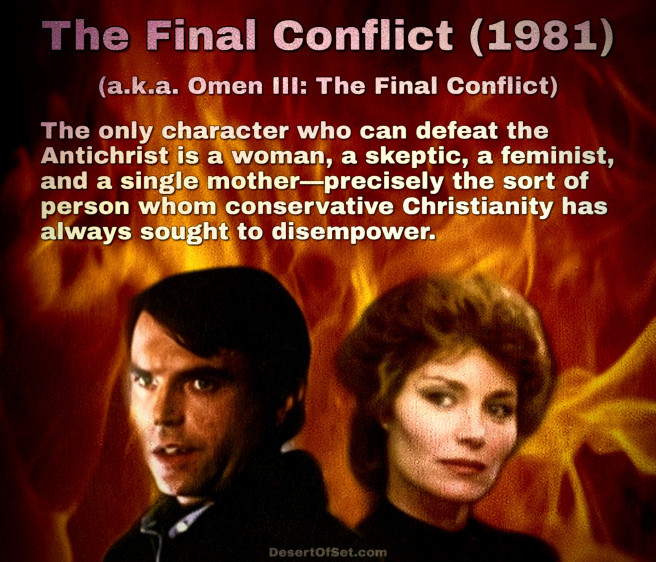
The Final Conflict (1981)—which was re-christened Omen III: The Final Conflict for its DVD release in the early 2000s—is the second sequel to Richard Donner’s 1976 masterpiece, The Omen. I enjoy the original Omen trilogy in its entirety, but The Final Conflict is the one installment thereof that’s made the largest impression on me. This film also makes me think about the Akkadian Goddess Ishtar, who is one of Set’s many romantic partners and the second-most important deity to me personally.
In case you’ve never seen The Omen or its initial sequel, Damien: Omen II (1978), here is a brief recap of their events. The 1976 original is about a U.S. politician named Robert Thorn (played by Gregory Peck) who learns his child has died while his wife Katherine (Lee Remick) was giving birth. A Catholic priest convinces Thorn to adopt an orphan who was born at the same time at the same hospital. Robert agrees, and the Thorns leave with their newborn baby boy (and with Katherine none the wiser to his true parentage). But as the child, Damien, grows older, weird shit starts to happen. One of his nannies hangs herself in front of his entire birthday party. A new, creepy nanny shows up to take the old one’s place. A crazy priest stalks and harasses Robert. A big black dog starts hanging around the Thorn household. A photographer (David Warner) captures prophetic photos of people’s deaths. And poor Katherine becomes terrified of the child who is supposed to be her offspring. All of which leads Robert to visit Rome, a monastery in Subiaco, and an archaeological dig in the valley of Megiddo, where he learns that Damien is really the son of Satan and can only be killed with these mystical artifacts called the Seven Daggers of Meggido.
What follows is the most disturbingly sympathetic depiction of attempted infanticide that has ever been filmed. Unfortunately, Robert only succeeds in getting himself killed when he tries to prevent the apocalypse (spoilers!), and Damien is then adopted by his uncle Richard (William Holden) in Damien: Omen II. Now an adolescent, Damien (Jonathan Scott-Taylor) remembers nothing of what happened to him or his parents in the first film. He’s also best friends with his cousin Mark, who’s more like a brother to him. Damien and Mark both attend military school, where their drill sergeant (Lance Henriksen) teaches Damien about his true identity. Meanwhile, a nosy reporter tries to convince Uncle Richard of the truth, and this leads to a bunch of increasingly over-the-top deaths. (My favorite is the guy who gets sawed in half by an elevator cable. Truly classic.) Eventually, Damien grows into his predestined role and wipes out all that remains of his family tree so he can be the sole inheritor of the Thorn family fortune.
The Omen is a perfect horror show from start to finish, and it’s every bit as scary as people say it is. The script wastes no time getting down to business, and each of the actors’ performances is Oscar-worthy. But it’s also my least favorite film in the trilogy, for Damien is only a peripheral character in the story. Granted, this is exactly what makes the film so scary; Damien remains completely alien to both his parents and the audience right to the very end, and it’s always easier to be frightened of something when it’s part of the unknown. But I find Damien: Omen II much more interesting, because it’s the first film ever made that actually puts us inside the Antichrist’s head. When Damien learns he is the Great Beast, he’s just as horrified as everyone else is; but the most powerful moment is when his cousin Mark gets wise and confronts Damien about his true identity. Mark threatens to tell everyone, and Damien reluctantly uses his powers to give Mark a brain aneurysm. When Mark drops dead, Damien screams the most convincing scream of despair I’ve ever heard from any character in any movie ever. That scene always makes me weep a little whenever I see it, because Jonathan Scott-Taylor really sells it. Damien: Omen II is quite derivative of the first movie, but it deserves credit for one thing at least: the character of Damien is perfectly written.

A lobby card for the film.
In The Final Conflict, Damien is now an adult in his thirties, and he’s played by Sam Neill. He has now become the owner of Thorn Industries, a multi-billion dollar company that has revolutionized the food industry, and which is working to solve the world hunger crisis forever. Damien is also the U.S. President’s first choice for Ambassador to Great Britain (after the current guy gets possessed by a black demon dog and blows his brains out). Damien is hot for Great Britain because he has this entirely fictitious apocryphal text called the “Book of Hebron,” which prophesies that Jesus will be reincarnated in Jolly Old England any day now. (Maybe they didn’t have the budget to do a proper Second Coming, with the J-Man flying down from the sky?) But after he sets up shop across the pond, Damien falls for a news reporter named Kate Reynolds (Lisa Harrow); then these Catholic monks at a monastery in Subiaco, Italy find the Seven Daggers of Meggido and try to assassinate him. This leads to a series of hilariously incompetent murder attempts that will have you shaking your head in disbelief. Meanwhile, Jesus is born again somewhere (did you see what I just did there?), but nobody knows where. Lucky for him, Damien knows the birth coincided with a weird astronomical convergence that occurred a few nights ago, so he sends his worshipers out to murder every male baby in England who was born within that time frame. Then Kate Reynolds finds out what the rest of us already know about Damien, and the titular Final Conflict truly begins.
The number one attraction in this film, and the most important reason for anyone to see it, is Sam Neill; he’s literally the greatest Antichrist I’ve ever seen in any film ever. Forget about Michael York, Nick Mancuso, Gordon Currie, or anyone else who’s ever played the Beast in those movies they show on the Trinity Broadcast Network; Sam Neill’s performance here is the gold standard. Rather than playing Damien like some two-dimensional cartoon villain, he plays him like he’s the Gods-damn hero of the movie. He brings so much charisma and charm to the role that he succeeds in making Damien extremely likeable, even when he’s ordering hundreds of newborns to their deaths. Everyone I know who’s ever seen The Final Conflict ends up rooting for Damien somehow (even though they know they’re not supposed to), and they can’t help but feel disappointed with the ending. (More on that in a minute.) The only other performance that’s comparable to this is that of Sir Anthony Hopkins as Dr. Hannibal “the Cannibal” Lecter in The Silence of the Lambs (1991). If there is an Antichrist and he ever tries to take over the world, we’d all better pray he isn’t just like Sam Neill in this movie—or else we might actually want him to take over.
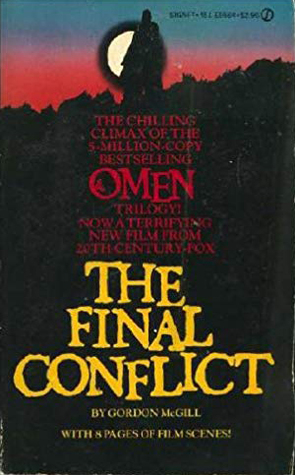
The novelization of the 1981 film, The Final Conflict, by Gordon McGill.
In one scene, Damien and Kate walk through a park and see one of the monks, who’s standing on a soapbox, preaching. Damien notices the monk is staring right at him, and he instantly knows the guy is here to kill him. So he starts surveying the area like a hawk—without breathing a word of his concerns to Kate—and he actually looks worried. Is he concerned for himself, or is he concerned for Kate’s safety should there be an ambush? Then there’s another scene where Damien goes to work right after the Christ child has been born. He’s been up all night because he could sense the birth happening, and Kate catches him at the elevator, asking if it’s okay for her to try interviewing him again. (Her last attempt was foiled by another assassin.) Damien smiles and agrees, and she leaves; then he gets in the elevator, sighs, and slumps his shoulders. I’d like to remind you that this character is supposed to be Friedrich Nietzsche’s Übermensch with a vast array of supernatural powers; and yet Neill sneaks in all of these brief human touches—a look of genuine concern, a tired sigh—and actually makes us care about this evil, rotten bastard…
I hate to blow the ending of this film for anyone who hasn’t seen it, but trust me; you probably want to know about this going in. For some reason, I thought this movie was going to end with a big showdown between Damien and Jesus; surely, that would be the “Final Conflict” everyone was expecting, right? I knew things wouldn’t end well for the Beast, but I figured there would at least be some kind of special effects extravaganza. No such luck; the movie ends with Damien being led into a trap by Kate, and Kate stabs him in the back with one of those nifty Meggido daggers. Then Damien limps away, curses Jesus, and promptly dies. Cue music, roll credits. When I first saw this, I was royally pissed. The film had done an excellent job of keeping me at the edge of my seat for the first 90 minutes or so; but it starts running out of steam real fast during the final 20, and that ending just didn’t seem fair. They went through all that hard work of building up this magnificent character and this huge final battle he’s going to have, and what do they give us? Sam Neill getting stabbed in the back (literally) by the woman he loves. I mean, what the hell were they thinking? I wanted to see Damien and Jesus go “Hell in a Cell” on that shit!

An additional lobby card for the film, with Lisa Harrow as “Kate Reynolds” in the center.
But I’ve watched The Final Conflict countless times since that first viewing in 1999, and I think I’ve figured out what they were really going for here. Let’s consider that this film was not made by evangelical Christians with a religious axe to grind; if it had been, they would have kept things as close to their scriptures as possible. Let’s also consider the fact that none of the avowed Christian men in this movie can stop Damien; hell, not even Jesus himself can stop him! The only character who actually poses a real, substantial threat to the Antichrist is (1) a woman, (2) a skeptic, (3) a feminist, and (4) a single mother. In other words, she is precisely the sort of person whom conservative Christianity has always sought to disempower. The real “Final Conflict” here is not between Christ and Satan at all; it’s between male religious violence (perpetuated by Christians and Satanists) and a female secularist who just wants the violence to stop. Note that while Kate scoffs at Christianity at various points in the film, she nevertheless respects its right to exist; and while she eventually sends Damien back to hell, it’s clear she would much rather work things out and share a life with him somehow. Kate is also the only character who commits an act of violence for purely personal reasons. The monks want to kill Damien because he’s the Beast, and Damien wants to kill the Christ child because he’s Jesus; both sides are motivated by purely ideological concerns. But when Kate stabs Damien, it’s because he’s just murdered her son. (Peter is accidentally killed by one of the monks when Damien uses him as a human shield; the poor kid is literally caught between two religious fanatics.) With all this in mind, I now think the climax of this film is far more daring than I originally thought.
I used to think the conclusion to this film was just an example of lazy screenwriting, but I’ve noticed over the years that The Final Conflict gives us several hints about how it will end. In one scene, one of Damien’s “Disciples of the Watch” advises him to stay away from Kate. “I decide who’s dangerous and who isn’t!” Damien shouts angrily, betraying the fact that he feels insecure about Kate himself. Later, Kate falls into a river and almost drowns at Damien’s house. He hesitates before rescuing her (as if he senses that he shouldn’t), but his concern for her overpowers him. As Kate dries herself by the fire back in the house, she tells Damien she feels like a moth who’s flown too close to the flame; she knows he’s dangerous, but she can’t stay away. Damien’s response to her is perhaps the most beautifully-delivered line in the entire film: “Yes—but who is the moth, and who is the flame?” Finally, when Kate stabs Damien at the end with the Megiddo blade, he smiles to himself ever so subtly, as if he’s always known that she would be his undoing. Kate Reynolds was clearly meant to be the savior of humanity in this film from its very conception; and in casting her as such, The Final Conflict offers us a most unexpected soteriology.
“[Damien] is the human son of Satan, fully committed to his Father. But just as Mary Magdalene represented temptation to Jesus, so Kate represents temptation to Damien. She arouses human feelings within him that could so easily lead him astray from his insidious mission, his inglorious destiny.”
—Sam Neill in an 1981 interview upon the film’s release
The hero of this film is an independent, powerful, and successful woman. She isn’t owned or controlled by any man or male divinity. She comes awful close to losing herself in Damien, especially when she spends a dark night of the soul with him in bed. But she rises again from that proverbial pit, stronger than before, and equipped with the power to send her two-faced lover back to the Underworld. Is any of this starting to sound familiar yet? By Gods, it should; for Kate’s arc is basically the Descent of Ishtar all over again. Damien is like a really nasty corruption of Tammuz, a version that’s turned completely rotten. All of his power and wealth are tied to the food industry, just as Tammuz is the God of food and vegetation. But while this “anti-Tammuz” and his enemies are gridlocked in their increasingly futile holy war, Ishtar sneaks in and chooses Her own “messiah” to save the day. The filmmakers try to give Jesus all the credit for this by slapping an obligatory Bible quote on the screen just before the end titles roll; but as far as I’m concerned, it isn’t the Lion of Judah who snuffs the Great Beast here. It’s the Lion of Babylon!

Ishtar be praised!
Contrary to popular wisdom, there is a distinction between “the Antichrist” and “the Great Beast 666” from Revelation 13. Early Christians used the word antichristos to describe anyone who (1) refused Jesus Christ as their Lord and Savior, (2) propagated a “heretical” version of Christianity, or (3) claimed to be Christian but didn’t behave like one. The first of these definitions is practically useless since it would seem to include all non-Christians. The second is equally problematic since it requires demonizing all Christian denominations apart from one’s own. The third, however, makes a great deal of sense, for what else can you call someone who claims to love Jesus but fails to treat people in a Christian manner? The real Antichrist has nothing to do with Satanism, but is actually the spirit of Christian hypocrisy itself. Turn on your local televangelist TV network and you will find the true disciples of Antichrist at work, pushing their insane political agendas and extorting millions from their hapless followers in Jesus’ name.
The Great Beast (or Therion in Greek) is based on several ancient kings who persecuted monotheists. People like the Pharaoh in Exodus and the Roman Emperor Nero all had three things in common: (1) they ruled over polytheist nations, (2) they considered themselves to be divine, and (3) they considered the Hebrews and the early Christians to be a threat. After being fed to lions for so long, Christians became convinced that such rulers were actually possessed by Satan himself, and prophetic texts like the book of Revelation were built upon this core concept. While Antichrist represents the evil that lurks within Christianity, the Great Beast represents the archetypal “evil king”—a ruler who tyrannizes his people, and whose actions will bring about destruction and doom. Unlike Antichrist, the Beast doesn’t try to pervert Christianity from within; he seeks instead to destroy it from without. So if we want to get technical about it, Damien Thorn is not really the Antichrist per se, but the spirit of Therion in human form.
Mind you, monotheists have not exactly been “kind” to Pagans throughout history, either. It was especially bad for those civilizations that lived right next door to ancient Israel. The Gods and Goddesses of these cultures are specifically named as “demons” in the Old Testament (e.g., Ba’al, Asherah, etc.) and are commonly invoked as such in contemporary media. Lady Ishtar is just one of these divinities, and it’s sad to think that whenever She is discussed in today’s world, it is almost always in terms of biblical prophecy. She is even linked with Therion in the book of Revelation:
Then the angel said to me, “The waters you saw, where the prostitute sits, are peoples, multitudes, nations and languages. The beast and the ten horns you saw will hate the prostitute. They will bring her to ruin and leave her naked; they will eat her flesh and burn her with fire. For [Yahweh] has put it into their hearts to accomplish his purpose by agreeing to hand over to the beast their royal authority, until [Yahweh]’s words are fulfilled. The woman you saw is the great city that rules over the kings of the earth.”
—Revelation 17:15–18
As I’ve discussed before, the Whore of Babylon is clearly inspired by Ishtar, even if her symbolic purpose is different. But what I find especially interesting here is the contrast between a female entity who “rules over the kings of the earth” and an evil king who has turned against her. Ishtar presides over the concept of “sacred kingship,” which required a Babylonian king to “marry” the Goddess and serve the people as Her priest. He had to ensure that his nation’s crops didn’t fail, that his borders remained protected from foreign invaders, and that his people were cared for in times of disaster. He also had to perform religious rituals all the time to ensure that his people’s Gods were properly appeased. A lousy ruler who brought ruin to his people would have been considered “unfaithful” to Ishtar, and some kings were even sacrificed to atone for this sin. This only reinforces my opinion that by killing Damien in The Final Conflict, Kate Reynolds is actually sacrificing him to Ishtar as penance for his disastrous leadership. (It’s reassuring to think that with the Queen of Heaven, even monarchs can be held accountable and taken to task.)

Sam Neill and Lisa Harrow posing for a behind-the-scenes photo.
Don’t get me wrong; The Final Conflict is not a perfect film. There are times when it sabotages itself by trying to copy the original Omen too much. Why are we still wasting time with lone individuals getting slaughtered in isolated places? Why isn’t Damien the President already when this film begins, sending troops to invade the Middle East and start World War III? They missed an opportunity to enlarge the scale and the stakes of the story here; and by restricting all the action to Great Britain, they do a great injustice to the premise. The only exception to this is the baby-killing conspiracy sequence, which is one of the most chilling things I’ve ever seen. The murders themselves are never shown, but are only suggested through quick cuts, musical cues, and horrified reactions from the actors. This is a perfect example of how the power of suggestion can leave a much deeper impression on the mind than just painting the screen with gore. It also helps keep the violence as tasteful as possible (which is no small feat, considering the subject matter), while also making it more disturbing to sit through. If you think the jump scares in The Conjuring (2013) are scary, try watching the scene where one of Damien’s disciples—an Anglican priest—gives a newborn his own version of a “baptismal rite.” It makes my skin crawl just thinking about it.
Ishtar, the Lady Morningstar
She rebelled to help humanity before Prometheus. She died and rose from the grave before Jesus. And She invented the “zombie apocalypse” before George Romero.

Almost every culture has viewed Venus—the “Lucifer” or Morningstar—as an aggressive, contrary force. This is because it is usually the first star seen at sunset, and the last star seen at dawn. Based on this phenomenon, people imagined that Venus is a “rebel” who defies the Sun, refusing to disappear as her superior rises, then rushing to ascend as the Sun sets. Even before medieval Christians incorporated Lucifer into their devil myth, most theological beings associated with Venus were perceived as unruly, cosmic shit-disturbers.
Ishtar, the Akkadian Goddess of Venus, is no exception. She stole the sacred mes, the powers of civilization, from Her uncle Ea and gave them to the people of Uruk. She insisted on visiting Her deadly sister Ereshkigal, the Queen of the Underworld, and conquered death in the process (with some help from Ea). When She learned Her husband Tammuz had not grieved for Her at all while She was dead, She killed and kicked His ass straight down into hell. When the “hero” Gilgamesh refused to marry Her, She sent the apocalyptic Bull of Heaven after him. And when Her father Anu refused to give Her the Bull at first, She threatened to raise all the dead across the earth and send them to feast on the living. She is also said to have an insatiable sex drive, exhausting all of Her various lovers to death.
If you think that sounds bad, Gilgamesh was a king who tyrannized his people, breaking into their homes and raping all the women. He only stopped when the Gods created Enkidu to challenge him, giving him something else to do with his time. Gilgamesh then became so obsessed with finding the secret to immortality that he abandoned his people and left them to fend for themselves. (What an asshole!) So it’s always seemed weird to me that he is portrayed as the “hero” in this story (despite being a tyrant and a rapist), while Ishtar is framed as the “villain” (even though She is divine and transcends all human understanding). The greatest threat Ishtar poses for this megalomaniac is not to his life, but to his ego.
(If Ishtar appeared and said She wanted to marry me, I’d say, “Okay.” Better to be mauled ecstatically by Ishtar’s lovely, blood-splattered mouth than to die by the hand of any mortal man!)
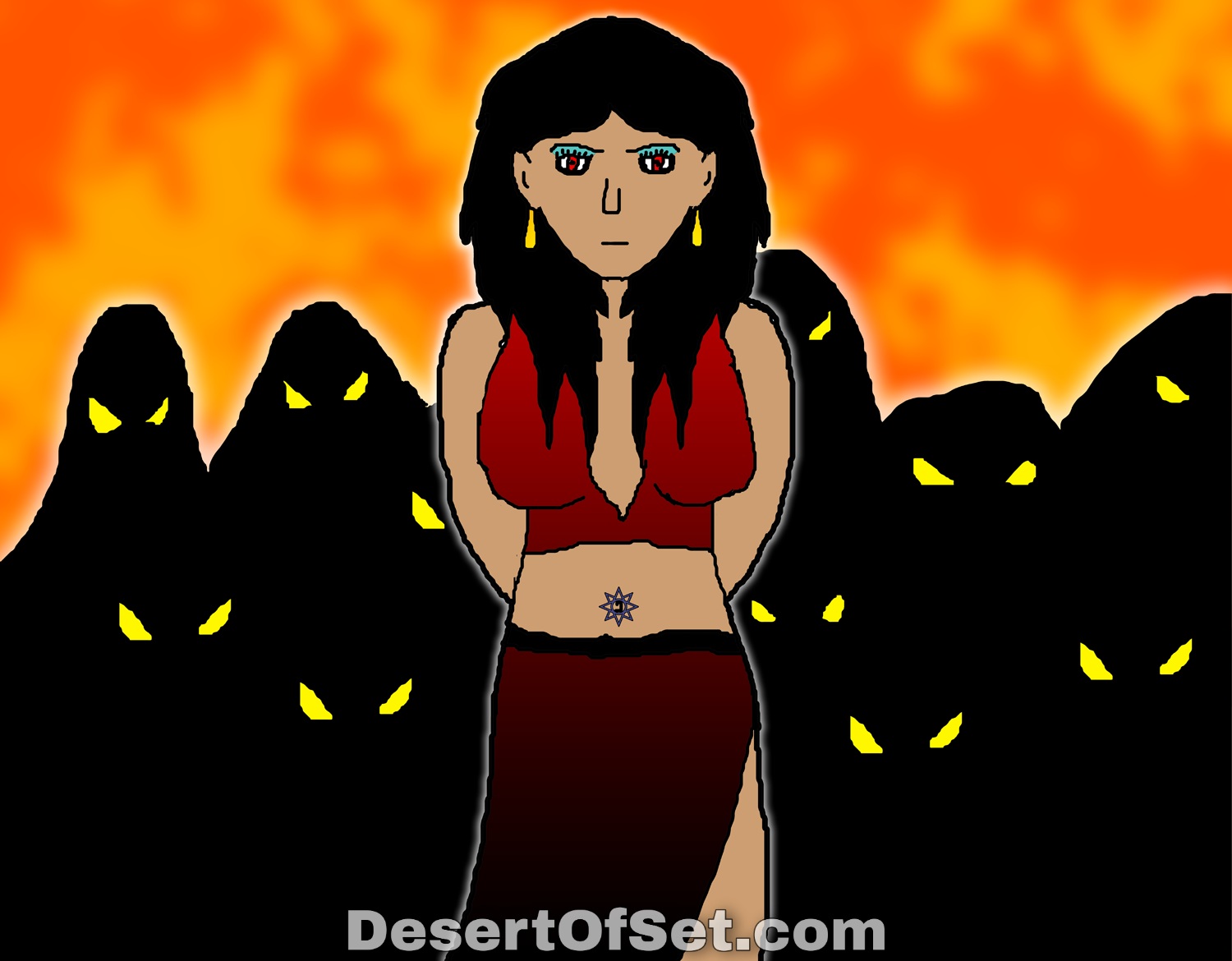

Ishtar appears in Babylonian art as a badass Amazon standing on a Gods-damn lion, getting ready to beat the shit out of some motherfuckers. Assyrian kings prayed for Her to join them on the battlefield like a Valkyrie and slaughter their foes like cattle. (And if their records are to be believed, She answered their prayers…brutally.) As a warrior Goddess, Ishtar was very popular with the Hyksos, who called Her Astarte and paired Her with their chief deity, Ba’al Hadad. When the Hyksos ruled Egypt during the Second Intermediate Period, they brought Ishtar’s worship into the Land of the Pharaohs. And since Ba’al Hadad was identified with Set by the Egyptians, they came to view Ishtar/Astarte as one of Set’s romantic interests as well.
There is a fragmentary Egyptian text from Edfu in which Yamm, a sea monster, demands the hand of Ishtar in marriage. For a moment, it seems the beast will claim its bride; but Set intercedes, and while the rest of the story is uncertain, there is a similar Ugaritic tale in which Ba’al Hadad rescues Astarte from Yamm. Since Hadad’s name is substituted for Set’s in the Edfu texts, the Egyptian version most likely ends with Set destroying Yamm and marrying Ishtar. Considering Their unruliness and Their shared frustrations with dying-and-rising fertility Gods (like Osiris and Tammuz), don’t you think Set and Ishtar make a perfect couple?

Ishtar is often vilified for being so “promiscuous.” This is due to a complete misunderstanding of hierogamy or hieros gamos, the concept of “sacred marriage.” It is a religious rite in which people have sexual intercourse, with at least one of the participants being “possessed” by a deity. Such procedures served a twofold purpose in the ancient world. The practical purpose was to channel the fertility of a God and/or Goddess into the crops, livestock, and people of a community. The spiritual purpose was to reach a higher level of consciousness. Under the right circumstances (all of which require CONSENT), a really good orgasm can totally “blow your mind” and make you feel like you’re in tune with the rest of the cosmos. It makes total sense why people would consider that ecstatic moment of self-surrender to be supremely magical. From this standpoint, sex can be much more than just some “dirty” animal act; it can be a divine religious experience that is both self-fulfilling and incredibly humbling.
The clergy in ancient religions that practiced hierogamy are often described as “cult prostitutes” by biblical scholars. This is especially true when it comes to the qadishtu or holy women of Ishtar. Sex did in fact play a part in the beliefs of the qadishtu, and they were ostensibly paid by the laity for their clerical services. But the way I see it, there probably wasn’t always a direct relation between these two things.
First of all, it is unclear whether Ishtar’s holy women actually engaged in hierogamy with everyone who entered their temples, or if just one priestess performed the rite with a king during the annual Akitu spring festival. To be honest, I have my doubts that even the latter case was always true. Many contemporary examples of hierogamy (such as the Great Rite in Wicca) are often performed symbolically (e.g., sticking an athame in a chalice, rather than actually copulating). It is entirely possible that hierogamy wasn’t always practiced quite so literally in pre-Christian times, either.
Secondly, it is wrong to assume that every service the qadishtu provided for their society was sexual in nature. In fact, it is very likely that most of what they did had nothing to do with sex at all. The available evidence would seem to suggest they were more like nuns than nymphs, caring for the sick and the orphaned, keeping chaste, and living their day-to-day lives in quiet, contemplative prayer. So the fact that Herodotus and the biblical patriarchs defined the qadishtu in terms of sex says infinitely more about them and their dirty little minds than it does about Ishtar’s holy women.

The Mušḫuššu dragon from the Ishtar Gate
Yet another attack on Ishtar is the false claim that She is the alleged “Pagan origin” of Easter. This story goes back to Alexander Hislop, who published a pamphlet called The Two Babylons in 1853. Hislop claimed that Ishtar was originally a mortal Babylonian queen named Semiramis, who single-handedly invented all of polytheism. She then became worshiped as Ishtar—which many Christians claim is pronounced “Easter” for some reason—and created the holiday we now know by that name for herself.
Hislop was partially correct; Easter does in fact have polytheist origins. But its name is actually derived from Eostre, a Teutonic fertility Goddess who bears no historical relation to Ishtar whatsoever. The imagery of rabbits and eggs is taken from a myth in which Eostre transformed a bird into a rabbit that could lay eggs (the Easter Bunny). These symbols do not appear anywhere in Ishtar’s iconography, which has plenty more to do with bulls, dragons, lions, and owls. Nevertheless, evangelicals continue to repeat Hislop’s bullshit at every turn, criticizing Easter as a so-called “satanic” rite to Ishtar.

The Burney Relief, depicting an unknown female figure who could be Ishtar or Ereshkigal (but who likely isn’t Lilith)
One thing that really sticks in my craw is when people confuse Ishtar with the succubus, Lilith. In the 1970s, many Pagan writers circulated a claim that Lilith originated not as the “first wife of Adam,” but as a “handmaiden” of Ishtar who served the Goddess by bringing men to Her temple for worship. Another claim states that Lilith is really a Goddess in her own right; she was later demonized, or so the story goes, when biblical patriarchy replaced the Goddess religions of old. And some people seem to think Ishtar and Lilith are really just the same person at the end of the day.
There is no evidence to support any of these theories. Even in pre-biblical polytheist cultures, Lilith was a qliphothic entity that ate newborn children and sapped men of their seed at night. She was never worshiped, but was only warded off with apotropaic spells. This was as true when the Epic of Gilgamesh was being written as it was when the Old Testament was being written. I can accept the idea of people believing Lilith is a Goddess today, if that is truly how they feel; but they should admit this is a new belief in the grand scheme of things, and not an ancient one. They should also avoid conflating Ishtar with Lilith, because the two are very different figures indeed. At the very least, the former is my Spirit Mama, and the latter is not.

I first met Ishtar in McClennan County, Texas, during the autumn of 1999. I was about to turn 17, and I had been walking with Set for just over two years. I can’t really explain what drew me to Ishtar so suddenly that cloudy afternoon; the best I can say is that Set “traded” me with Her, and I walked with Her for the following year. They traded me back after that, and I’ve been with Set ever since. I never quite understood why this happened until about a decade later, when I met the woman who became my wife. We met in a Pagan discussion forum, and the only reason we did is because I wanted to meet other people who knew about Set, and she wanted to meet other people who knew about Ishtar. Considering this, we’ve always felt that Set and Ishtar are personally responsible for micromanaging things just so the two of us would meet. And that hiatus I had with Ishtar was the Goddess sizing me up as a potential match for one of Her contemporary qadishtu. (I sure am glad I passed the test!)

Holy Days of the LV-426 Tradition
The times we consider most sacred in our coven.
Today I figured I’d discuss the major holidays observed by Setians of the LV-426 Tradition. These aren’t necessarily the only holidays we celebrate; some of us also celebrate things like Christmas, Mabon, or even St. Patrick’s Day. But these particular times are the ones we all agree are most important to our shared religious calendar.
The LV-426 Sabbat

The word Sabbat is used differently in many faiths. In LV-426, we use this term in reference to a weekly night of worship that has most often been observed on Friday nights, but which can really be observed on any night of the week. The idea is to meet with Set for a Sabbat every seventh night, in any case, and whenever possible.
Our Sabbat procedure is simple. We use the basic rite that is offered in the very first episode of this series (Setianism: A Brief Introduction). When we get to the part when we speak our wills to Set, we discuss all the high and low points of our week with Him, speaking informally. If more than one person is present for worship, each attendee takes a turn at doing this.
Once everyone has had a chance to say what they wish to say, we throw on some heavy metal and break out the booze, chatting through the night until dawn. Set is asked to remain present if it pleases Him to do so, and He guides the conversations we have during these sessions. There is no other situation in which I am quite so comfortable, happy, or grateful as when I am meeting with Set and my brothers and sister in Him for our Sabbat.

It’s been several years now since our coven has been able to keep the Sabbat together as a group; but the procedure can be followed in a solitary context as well. You don’t even need the booze or the heavy metal; all you really need is to pick a night that works best for you, then try your best to spend some time with Set on that same night every week. How you choose to spend or structure that time with Him is entirely up to you. And if you are unable to follow the same procedure every week for any reason, do not hate on yourself. Set is always with His chosen ones, and He knows what we are all going through. Our Sabbat is not a commandment, but a gift. There is no expectation that we must observe it every week; but it is always there whenever we need it.
Egyptian New Year
The Egyptian New Year festival (or Wep Ronpet, which means “Opening of the Year”) coincides with the heliacal rise of Sirius, the annual flooding of the Nile, and the Dog Days of Summer. It technically falls on a different date each year, and the precise calculation of this date depends on your geographical location.

A heliacal rising occurs when a star that hasn’t been seen in the nighttime sky for a while becomes visible again in the east, just before dawn. Sirius disappears for about 70 days in May, and it reappears toward the end of July and the middle of August. (This is called the “Sothic Cycle.”) The Nile River always floods soon thereafter, just like clockwork. There isn’t much rainfall in Egypt at all, so this annual inundation provided the only means for irrigation in ancient times. And when the Egyptians saw Sirius rising in the east just before dawn in late July, they took it as a sign from the Goddess Isis (the ruler of Sirius) that it was time to start planting all their crops for the year. To this very day, the Egyptian people still celebrate the annual flooding of the Nile as a two-week civil holiday called Wafaa El-Nil, which begins each year on August 15.
August 15 is also a significant date for me personally, as it marks the anniversary of when I first came to Set in 1997. So while everyone who observes this holiday will understandably observe it on different dates due to the Sothic Cycle, I just celebrate it on August 15 each year and call it a day. To be honest, the Dog Days of Summer (which take their name from Sirius, “the Dog Star” in Canis Major) just feel very sacred to me in general.

Wep Ronpet is not just the start of a new year; it is also an echo of the Zep Tepi or “First Time,” when the first God began to stir within the primordial ocean of chaos. One way to mark this occasion is to greet the sun as it rises (on whichever date you prefer to celebrate) beside a body of water (preferably a large one, if possible). As you watch the sunrise, know that you aren’t just watching the start of another day; you are witnessing a “re-run” of the Creation of the universe. Another worthwhile holiday activity would be execrating any negativity you might have collected in your life over the past year, which is something many people who walk with the Egyptian Gods do. (For an example of an execration rite that we use in LV-426, check out Episode #31 of this series.)
Hallowtide
Halloween isn’t “just for kids,” and it wasn’t invented by the candy companies either. It originates from a blend of Celtic folk religion and Roman Catholicism. It is just the first of three holy days—All Hallows’ Eve (October 31), All Saints’ Day (November 1), and All Souls’ Day (November 2)—which are collectively known as Hallowtide.

Even before the Catholic Church reached Great Britain and Ireland, these three dates were already an ancient festival called Samhain (“SOW-wynn”) in Gaelic and Nos Galan Gaeaf (“knows GAIL-uhn GUY-ov”) in Welsh. It marked the end of the harvest season and the start of winter, which was an extremely frightening time for the Celts. Many of them would die of starvation, disease, or freezing temperatures before the following summer. For this reason, the first night of winter weighed heavily upon their minds, and people thought the barriers between this world and the next were temporarily lifted, allowing the dead and other paranormal beings to roam free. This wasn’t so bad when it came to ghosts, who were viewed as beloved ancestors to be welcomed. Malevolent faeries and qliphothic entities were the real concern, and people dressed in frightening animal skins, carved protective charms from turnips, and left out offerings of food to keep such things away. It’s from these ancient traditions that wearing costumes, carving jack o’lanterns, and trick-or-treating are all descended.

Halloween was always my favorite holiday growing up, more important than the winter holidays, and it’s the first thing in which I ever took a religious interest, even before Set. I enjoy handing out candy to trick-or-treaters on October 31st; but once the boils and ghouls have all gone home, I begin my all-night vigil for the dead. I light some candles for our ancestor shrine in the kitchen, and I say some words to our dearly departed. I keep the candles burning all night long, not going to bed until 5:30 in the morning or so. Then I repeat this process the following two nights.

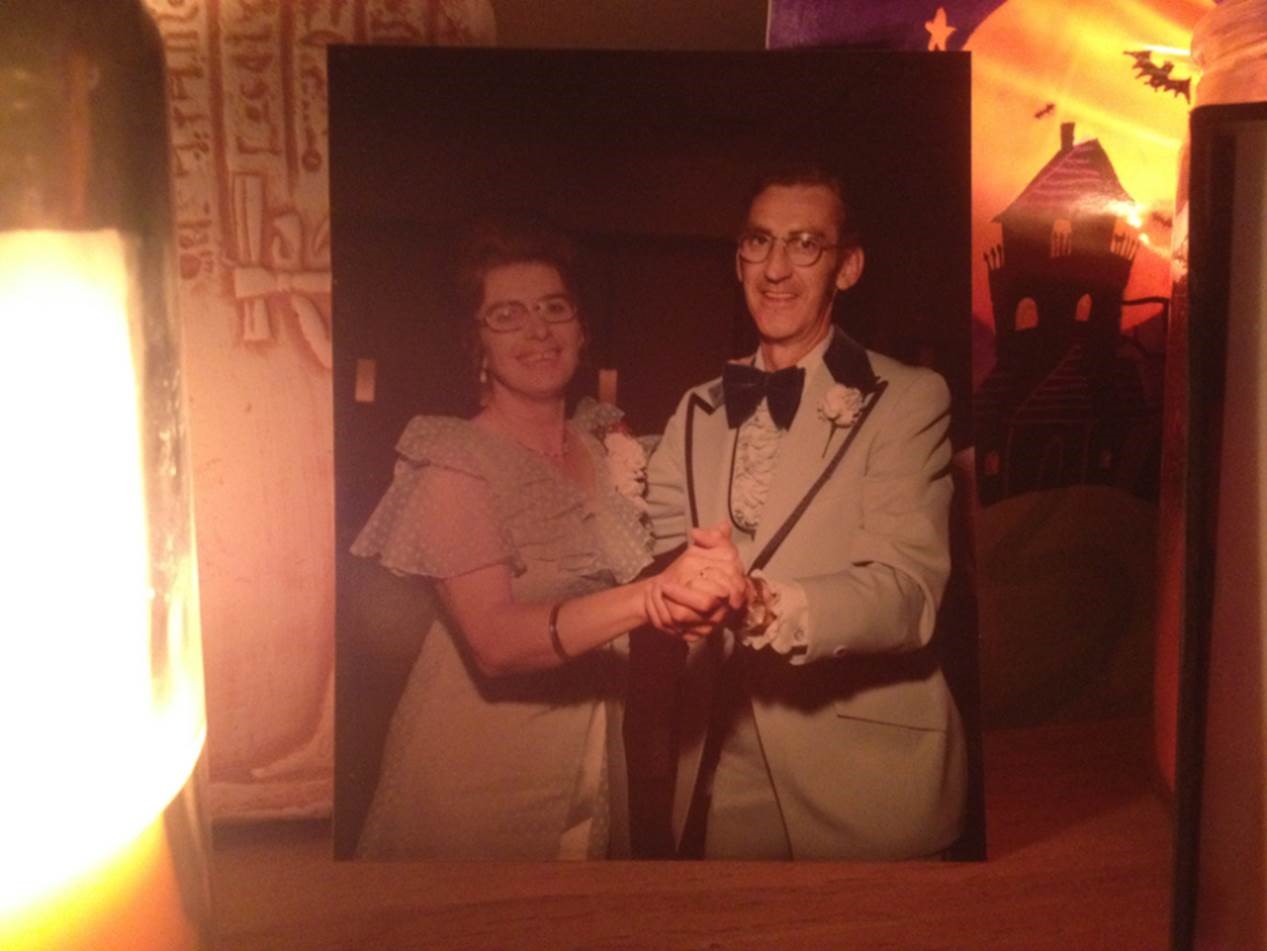


Spooky things do tend to happen during these vigils, like voices or footsteps that come from nowhere (especially around 3:00 am). But nothing scary or sinister ever happens, perhaps due to our ancestors’ protection. Call it “superstition” if you like, but we take this stuff pretty seriously. I think it’s important to keep the true spirit of Halloween alive as much as we can.

Walpurgis
Walpurgisnacht or Walpurgis Night is a spring fertility festival that’s observed each year on April 30. It’s the Teutonic equivalent to May Day or the Celtic Beltaine, but was later renamed after the medieval Christian Saint Walpurga. It represents the cross-quarter point of our solar year between the Spring Equinox and the Summer Solstice, and it’s a time for warding off the last vestiges of winter. It’s most often observed in continental Europe by wearing scary costumes, lighting huge bonfires, and making all kinds of Gods-awful racket to scare away the evil spirits. In fact, you might say Walpurgisnacht is Germany’s version of Halloween; one might even call it “Samhain in the Spring.”

A Walpurgisnacht gathering at the Heidelberg Thingstätten in 2007 (from Wikimedia Commons)

For Setians in LV-426, the lore of witches roaming mountains on this night, throwing bacchanalian rites to a horned God mistaken for “Satan” is suggestive of our own experiences with Set. Since He is a nocturnal God of the wilderness, we’ve always preferred to recite our incantations to Him in lonely woodsy areas after dark (or immediately before dawn). And since the ears of Set’s most holy symbol, the Sha, resemble “horns” (not to mention that some of His other sacred animals include such horned and hoofed critters as antelope and oryx), it is easy enough to conceptualize ourselves as “witches” who invoke a horned God at night. So adopting Walpurgisnacht into our religious calendar has always made sense, at least to us.
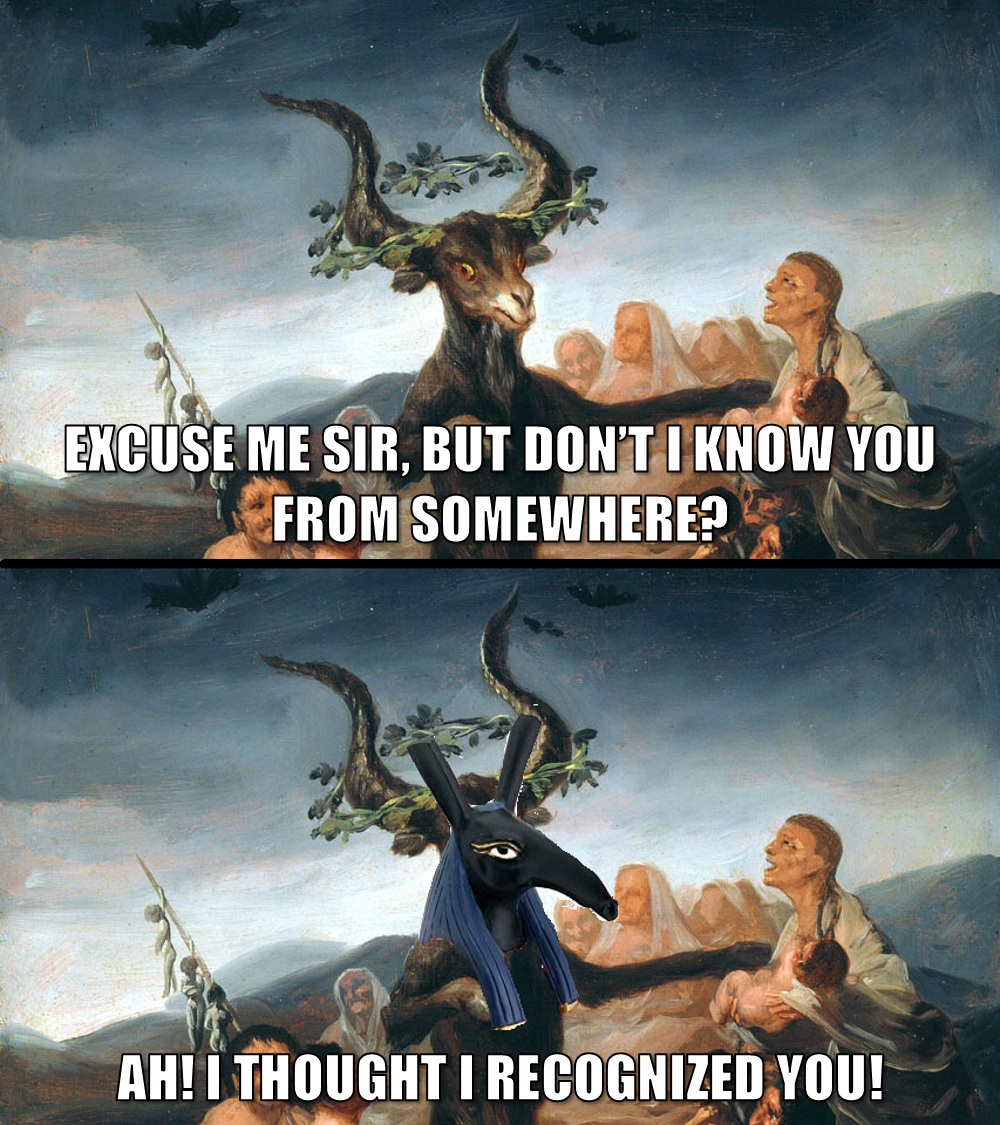
With apologies to Francisco Goya…
Perhaps the greatest Walpurgisnacht in LV-426 history so far was in 2005. It was on a Saturday that year, and I was living in Houston. The Tonester drove down to visit me for the whole weekend, and we hit the city together like bricks fired from a machine gun. We roamed every strip club, antique book store, and vintage record shop we could afford at the time, growling the lyrics to all our favorite death metal songs and shouting a random “DUA SET!” at every turn. It was perhaps the only time in my life that I have ever felt completely comfortable wearing my spirituality on my sleeve in public. It was a weekend full of booze, lewd jokes, horror flicks, and about a ton and a half of heavy fuckin’ metal. We really shook the pillars of heaven, by Gods, and when it was over, we both knew Big Red was mighty pleased.

“Turn it up to 11, Hoss!”
Saturday, April 30, 2005: The city of Houston fell under siege to a bizarre sect known only as LV-426. Heads were turned and jaws were dropped as two strapping young lads of Sutekh took to the streets. No slice of pepperoni pizza was safe. No vintage record shop could run. No 1970s folk horror movie could hide. But lo, musical instrument shops had it the worst by far; for Set’s crazed servants did ecstastically hammer on drums, strum on electric guitars, and scream psalms to His Majesty on microphones turned up to 11 in full public view. Never before had such madness been seen or endured by the community, and the dark wizards soon vanished as mysteriously as they had appeared, like a nightmare before the break of day. No evidence remains of the outlandish lunacies that were witnessed on that fateful Walpurgis Night—not even a photograph…

Friday the Thirteenth
When Set slays Osiris in Egyptian mythology, He chops him into 14 pieces, 13 of which are then buried throughout the world (before they are re-assembled and restored to life by Isis), while Set feeds the final piece—Osiris’ phallus—to an elephantfish. (Dennis Wheatley refers to this fish as “the Talisman of Set” in his 1934 novel, The Devil Rides Out.) There were also 13 people at the Last Supper of Christ, which was soon followed by his crucifixion (on a Friday, no less). In both tales, the dying-and-rising God can’t rise from the dead until he is killed first (with Judas Iscariot fulfilling the Setian role in the Christian narrative). The God must be sacrificed before he can rise again and offer new life to the world, and in this context, the number 13 represents initiation: the (often painful) ending of one phase of existence, followed by the glorious emergence of a new and better life.
In LV-426, we don’t view Set and Osiris as “enemies”; we think of the two as being like a gardener and a rosebush, respectively. It’s Set’s job to “prune” Osiris so the latter can produce fresh “blooms,” which keeps the universe alive and healthy. If Set were not there to keep Osiris regenerating himself, there would be no past and no future; there would only be a static present in which nothing new can thrive. So while the experience of being “pruned” by life’s hard knocks certainly isn’t pleasant for anyone, Setians in LV-426 believe it’s important to honor Set for His role in this process. We also think it’s important to take a moment and Hail Osiris as well, and Friday the Thirteenth is our preferred time for doing so.

Watermelon is reported to be one of Set’s favorite foods, and since it’s a plant, it is also sacred to Osiris. So one LV-426 custom for Friday the Thirteenth is to buy a watermelon, recite some prayers over it, chop it up, and share it with Set and Osiris as a sacred meal. As we each eat the watermelon, we also partake of Osiris’ regenerative powers so we can heal and grow back stronger from whatever trials we are currently facing in life. One year, we hosted this dinner at a derelict cemetery, and we respectfully shared our offerings of watermelon with the forgotten ancestors who were buried there.

“Dinner with the Dead” we hosted in honor of Osiris for Friday the 13th, August 2010.
Aside from hockey masks (thanks to Jason Voorhees), black cats are one of the first things people associate with Friday the Thirteenth. Everyone knows the old superstition about how you’ll get “seven years’ bad luck” if a black cat crosses your path. But what most people don’t realize is that cats are actually very lucky creatures to have around, and that black cats are especially lucky. Remember, cats were worshiped in ancient Egypt; they were protected by law from injury and death, and families mourned, mummified, and buried their beloved felines as if they were human beings. Cats were thought to have a special connection to the spirit world, and were especially cherished for driving away evil spirits. The color black was also considered very lucky indeed, given its association with the fertile soil of the Nile Valley. From this perspective, a black cat is twice as lucky as usual, for it not only has all the standard demon-repelling bells and whistles; it also carries the promise of hope, fertility, and regeneration wherever it goes.

My youngest child, Bishop.
The number of days in February and March are such that if Friday the Thirteenth ever falls in the former, it will also fall in the latter (unless we’re in a leap year). Having two consecutive Friday the Thirteenths in the same month like this only happens 3 times every 28 years, and it never happens at any other time of year. For these and other reasons, this occasion is considered highly sacred in LV-426 and is observed as a month-long festival that we call Miew Khem or “the Month of the Black Cat.”
An LV-426 Execration Ceremony
An example of an execration ritual, a procedure to cast out and/or ward off negative energy.

Everyone showed up at our house around 5:00 PM that Saturday, and each person was given a small ceramic pot and a black Sharpie marker. I instructed them to write and/or draw whatever they liked on their pots. Whatever they wrote or drew had to represent negative things that were bothering them and that they wanted to cast out from their lives. It was a silent and solemn twenty minutes as everyone meditated on the demons that were haunting them the most, pouring all that sad and frightening energy into their drawings.
Once everyone had finished decorating their qliphothic pots, I implored them not to touch anyone else’s pot (or to let anyone else touch theirs). We had just created the magical equivalent of bio-hazardous waste products, and it was vital that no one be “infected” by anyone else’s bad vibes.
Then we all went out into the back yard, where Blackwyn and I had prepared a small altar to Set (complete with His statue and a big red lantern). We had also set up a couple of garden tiles on which all of our qliphothic pots could be smashed.
One of our friends brought her 2-year-old daughter, and the little girl had brought her toy pig. As we prepared to recite the opening invocation, the girl approached the altar and stared at Big Red’s statue. We were briefly worried that we’d need to intercede, but she just stood there, quietly and respectfully gazing at the man with the funny animal head. Then she placed her toy pig right beside the statue and said, “That better”—as if she somehow understood that pigs are one of Set’s favorite critters. As the child walked back to her mother, everyone who was present felt a powerful chill, including those who weren’t committed believers.
It was evident that Set was already present, but I invoked Him into our ceremony just the same:
Hail, Son of Nut! You Before Whom the Sky Shakes! Hear us, O Lord of the Wastelands! O Divine Foreigner! O Bringer of Winds! O Savior of the Sun! As You travel the Desert between the Worlds, as You smite the Evil One again and again, look down upon us and straighten our spines! Open our mouths to speak great words of power! We are Your soldiers upon this Earth; put us to Your work!
Now it was time to conjure the Chaos Serpent and kill it together as a tribe—as a constellation brought together by Set from across the Earth:
Torment be upon you,
Apep! You enemy of Set, of all gods and all creatures! The Companions of Set prevail over you, for you are but the filth of unborn pasts! Accursed shell and nothingness, the Typhonian Beast shall rip and tear you asunder, and scatter your meat as confetti to the winds! Taste your death,Apep! Get back and retreat, O enemy of Set! Fall down, be repulsed, get back and retreat! For the Eye of Set is upon you, piercing you like a spear! It is His Army that drives you back with all of our thunder and metal! O vile and vapid corruption, WE CAST YOU BACK INTO NOTHINGNESS!
Then we all took a deep breath…and we chucked our qliphothic pots upon the garden tiles as forcefully as we could, all at the same time.

No one expected the crash of the pots to be as loud as it was; it echoed throughout the neighborhood like a thunderclap. The shards flew more violently than we had anticipated as well, but no one was harmed. We were briefly shaken by the sight and the sound of what we had done, but we also felt a clear and powerful sense of release, like a knotted muscle melting into butter.
Then I brought our spell to a close:
Back, fiend! An end to you! Set has driven thunder and lightning at you! Set has made you to be destroyed, and Set has condemned you to evil! An end, an end to you! Taste your death! An end to you! You will NEVER swallow the dawn! You will NEVER win the night!
Our curse had been cast, and our demons were on the run. The others went inside to decompress from this experience, and Blackwyn and I went to sweep up the debris of the qliphothic pots.
Then, as if on cue, it started to rain.
We decided to leave the qliphothic pots alone, so Big Red could piss on the Chaos Serpent’s corpse for a spell.