How a simple “slasher movie” deplores the patriarchy and evokes Celtic folklore.
Merry Samhain! Happy Hallowtide! To mark this blessed holiday occasion, the next several episodes of this series will feature my analyses of the Halloween horror film franchise, with a particular focus on my five favorite installments thereof.
If I had to rank my top 5 Halloween movies as things currently stand here in 2020, the countdown (from fifth to first favorite) would run as follows:
I find it difficult to discuss these films in a countdown, and would prefer to discuss them chronologically instead. But unlike most other popular movie franchises, the Halloween series does not follow a single coherent timeline. It instead includes several alternate continuities, and even a completely different cinematic universe in the case of Halloween III (which diverges thematically from all the other films). That being said, I think it would make the most sense if I discussed my favorite entries from the “A-plot” storyline of the series (the Michael Myers saga) first, then concluded with an analysis of the “B-plot” story. So the first four episodes in this little mini-series will feature my four favorite Myers films in their chronological order of release; then I will end by discussing Halloween III.
It’s Halloween night, 1963, in the sleepy little town of Haddonfield, Illinois. Dressed as a clown, a six-year old boy named Michael Myers stabs his teenage sister, Judith, to death—and for no apparent reason at all. He neither moves nor speaks afterwards, and he is admitted to a state mental hospital, where he is treated by Dr. Samuel Loomis (Donald Pleasence). After a while, Loomis claims Myers is the single most dangerous patient he has ever observed, and he does everything he can to have the boy transferred to a maximum security prison—despite the fact that Michael just sits there motionless, never reacting to any external stimuli. The doctor’s colleagues think Loomis has gone crackers, but he seems to understand something about Michael that modern psychiatry just isn’t equipped to explain. Much to everyone’s horror, Loomis is proven 100% correct about his patient 15 years later, when a full-grown Myers gets a hair up his ass and makes a jailbreak on Halloween Eve. The authorities continue to gaslight Dr. Loomis and ignore what’s happening, thinking they will probably find Michael just sitting in a park somewhere in his hospital clothes. But Loomis knows his patient is really up to something terrible, so he follows his only lead: the possibility that Myers might return to the scene of his childhood crime, the old Myers House back in Haddonfield.
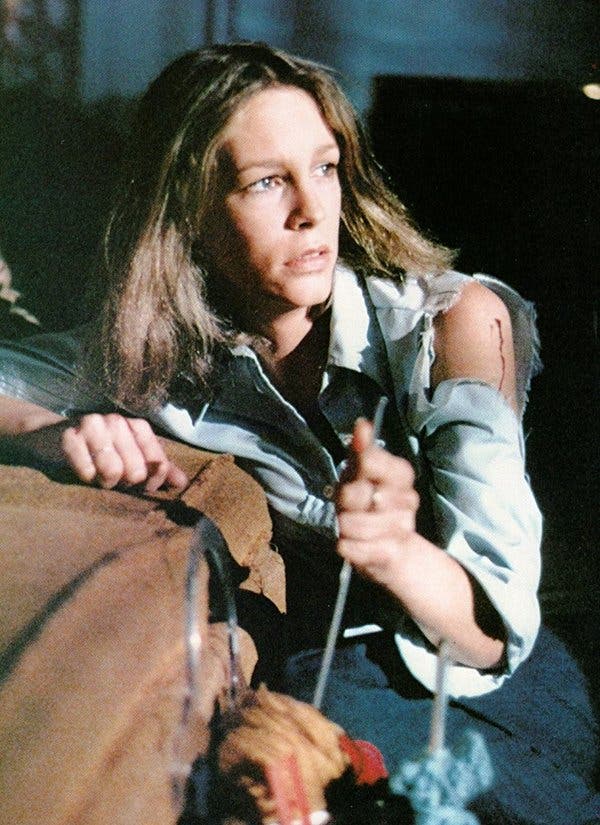
Here is where we meet Laurie Strode (Jamie Lee Curtis), a meek and lonely teenager who happens to live in Haddonfield. She’s good-natured and smart as a whip; but her closest “friends,” Annie and Lynda (Nancy Loomis and P.J. Soles), constantly treat her like shit, making fun of her good grades and her shyness around dudes. Yet Laurie does, in fact, attract a “man” when she passes by the Myers House on her way to school that Halloween morning in 1978. For a mysterious Shape inside the abandoned property notices her and fixates on her, following her wherever she goes from that point on. Laurie keeps catching glimpses of the Shape as she sits in class, walks home from school, and goes to babysit her pre-adolescent friend Tommy Doyle (Brian Andrews) for the evening. But the Shape keeps appearing and vanishing like a phantom, and Laurie doesn’t really believe what she sees as first, thinking it’s probably just some holiday prankster, or perhaps her eyes playing tricks. Tommy refers to the Shape as “the Boogeyman” whenever he sees it lurking outside the windows, and Dr. Loomis insists this thing is really the devil himself. By the time Laurie is forced to defend herself and Loomis arrives to shoot the Shape six times in the chest at close range, the viewer is unable to dispute with Tommy or Loomis on either of these theories. There really is no “Michael Myers” at all, or at least not in any human sense; there is only the deathless Shape, which has now dropped all pretense at being a mortal man.
This story might not seem to have anything to do with magic or the occult, but there is a curious parallel to Celtic mythology and folklore that is seldom noticed. Celtic lore tells of changelings, or faery children who are swapped for human babies (without the human parents’ knowledge or consent). A changeling will look and behave just like a human baby at first, but eventually it starts exhibiting weird superhuman powers, and misfortune follows it wherever it goes. It seems to me that Michael Myers fits this motif perfectly; his parents appear to have had no idea of what they were really raising, and much like the evil spirits in Celtic folk religion, he only roams free during the festival of Samhain. Additionally, the apotropaic Halloween traditions that once kept us safe from entities like the Shape—wearing costumes, carving pumpkins, trick-or-treating, etc.—have been completely secularized, rendering them powerless. The evil can stalk and slash as much as it wants to now, since the people of Haddonfield aren’t even willing to acknowledge its existence in the first place.
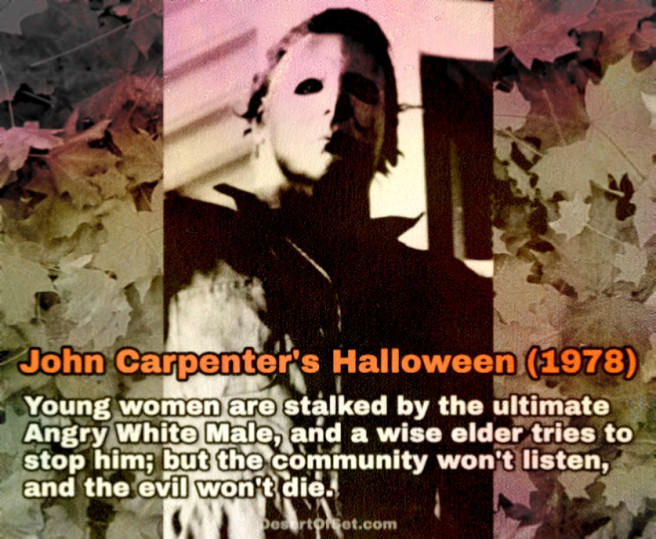
The fact that Myers wears a pale white mask and stalks defenseless young women is also significant. Myers is the ultimate Angry White Male, and he is just as difficult to kill as the horrific patriarchy in which we all live. The authorities’ insistence on minimizing his evil is paralleled by how our society continues to trivialize issues like systemic misogyny and toxic masculinity today. I think most people would agree with me that even when these evils are exposed in broad daylight for all to see, the common reaction is to ignore the problem and pretend nothing bad is really happening. Here in 2020, the entire United States is still responding to evil men the same way Haddonfield responded to the Shape in 1978: by ignoring them and letting them do whatever the fuck they want.
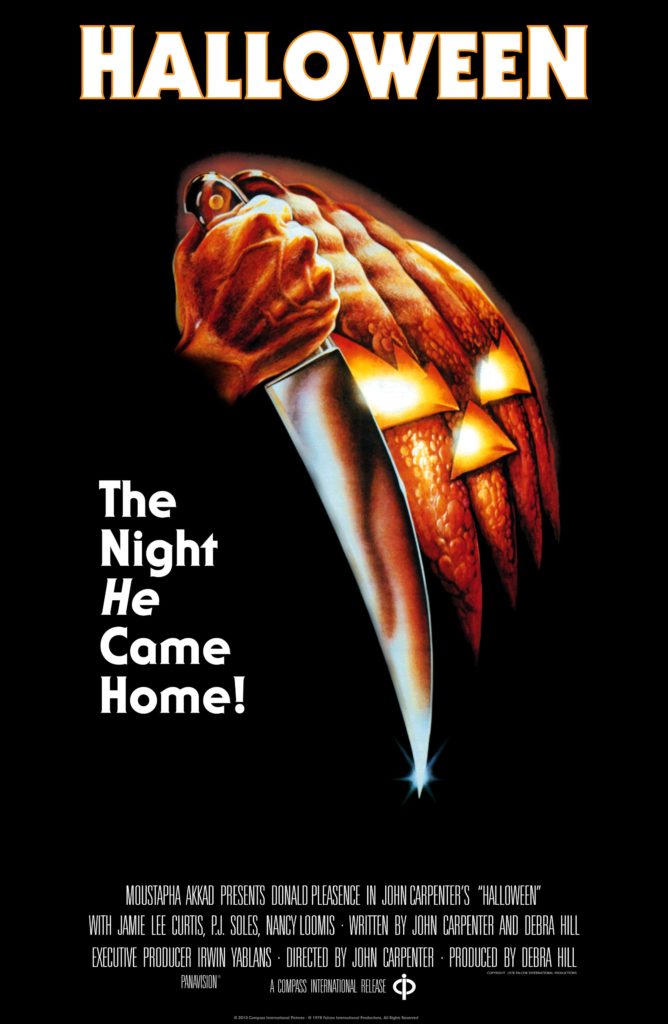
John Carpenter’sHalloween (1978) is amazing and beautiful on many different levels. It is, in fact, my all-time favorite film. It might be a “slasher” film (and the template for many slashers to come, at that), but it feels much more like an old-fashioned ghost story to me. The point is not to build a body count or gross out the audience with gore, but to build relentless suspense, to make us yell at the characters in the movie, and to leave us all wondering, “What happens next?” when the credits roll. The fact that this film was made on a nonexistent budget by mostly unknown talent (many of whom worked multiple jobs on set for free, including Curtis) only enhances the impression it leaves on the viewer. The most expensive part of the entire production was probably just hiring Donald Pleasence to play Dr. Loomis for a few key scenes, and even he (being the fantastic professional that he was) admired all the heart that was put into the project. This was also Jamie Lee Curtis’ first big break, and she truly shines as Laurie Strode, the timid girl who never goes looking for trouble, but who turns out to be much tougher and cooler than she or her peers think she is. And lest I forget, the eerie electronic music by director John Carpenter is truly a work of art unto itself. The soundtrack is my #1 favorite album to listen to, which I suppose is probably obvious to anyone who’s heard my music.
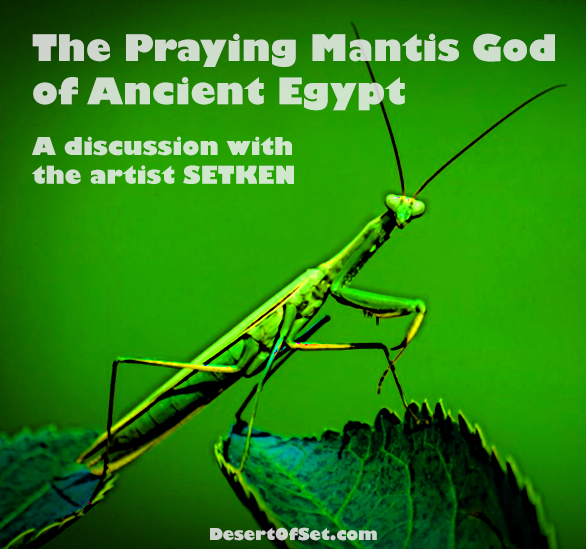
An interview with the Kemetic and Neo-Pharaonic artist Setken regarding his new film, The Praying Mantis God of Ancient Egypt, in which we meet another of Set’s theological colleagues: the Netjer Abyt.
For today’s adventure, we have a very special guest: the artist Setken, who creates Neo-Pharaonic art inspired by the ancient Kemetic or Egyptian Netjeru. Setken’s artistic range extends beyond painting, even though the latter is his primary focus. This includes singing and writing in a band, physique and physical display escapades, as well as writing and acting. This magnificent servant of the Netjeru has just released a mini-documentary about the praying mantis God of ancient Egypt, which concerns a little-known Netjer by the name of Abyt. Listeners can view the film for free at vimeo.com/setken, and I encourage everyone to check it out!
And now, without any further ado, please welcome Setken!
G.B.: Setken, welcome to the show!
SETKEN: Thanks for having me on, G.B., it’s an honor!
G.B.: I just want to say, I’m not just blowing steam up your ass; you really are one of my favorite artists. All of your paintings that you have been producing that I’ve seen over the past—what has it been, a decade?
SETKEN: Yeah, it’s getting close to a decade now.
G.B.: Yes, especially the Winged Set piece. That one has always been my favorite.
SETKEN: It’s still one of my favorites, and I was just remarking to a friend tonight that I don’t know how I actually created that piece as early on in my painting career as I did, because it was way, way ahead of what I was doing at the time.
G.B.: What year was that?
SETKEN: That was 2013, so it’s coming up to its seven year anniversary. But that is still one of my favorite paintings.
G.B.: Well, I guess that opens the door for what we’re really here to discuss tonight: a very well-unknown ancient Egyptian deity by the name of ABYT.
SETKEN: Right!
G.B.: A God whom, of whom, or for whom I should probably say, you have just recently directed, produced, and released a short documentary entitled The Praying Mantis God of Ancient Egypt, right? I just want to thank you for making this thing in the first place, because the end product is just amazingly educational and spiritual to watch.
SETKEN: Well, thanks. And thanks for your kind words about my paintings before as well. I didn’t quite get that in. This was a first crack at trying to find new ways to show my art, which is part of how the documentary came out. It’s just I’m happy with the way it’s turned out, you know; there are some rough edges to it. But as a short experimental documentary, I’m happy with how it turned out. I’m glad that you, and now more people, have started to see it as well—that you and others are starting to find some value in it.
G.B.: I’ll probably mention this multiple times as we speak; but for the listeners, this video is currently available at Setken’s vimeo.com website. Is that correct?
SETKEN: Yeah, if you go to Vimeo.com and search for Setken, all of my public videos are there. Alternatively, you can go to my website, and at the very bottom of the page, all of my social media contacts are there along the social media bar at the bottom. There’s like five different socials. You can have a look at it, and that will lead you to the documentary one way or the other, because it’s really all I’ve been raving on about at the moment.
G.B.: Oh SHIT, what was my next question?
[Both speakers laughing.]
SETKEN: You started to ask about Abyt, and because He is unknown and everything, we got distracted.
G.B.: Oh yeah. So, can you talk a little more about this sort of multimedia approach that you are taking?
SETKEN: Sure. So I gave my one and only exhibition at the beginning of 2018, and we made a documentary about that as well (called Neo-Pharaonic). I should pronounce that right, probably [laughs]. That was the name of the exhibition, and we did a 15-minute documentary about that with thoughts are on that Neo site, if people are keen to see that. And whilst I’m glad that I did it, I came away with a feeling of dissatisfaction that this is the only way to show my art, because it’s the accepted way. And that made me think about the history of art and how it’s traditionally being used and shown, and all of that stuff that I’m sure you would probably explore by going to art school, which I never did. And I came out of it feeling, it’s unacceptable that this should be the only way I get to show you my work—which is representative of, you know, hours and hours of creative time, and you know, is painted from the depths of my souls. So I started to think more and more about how there could be different ways to show what I’m doing, and even perhaps use the paintings as a kind of springboard to move into something else; and that’s how it began.
SETKEN: I started to write short film scripts where the paintings were pivotal in the storyline—which you know, was a short five-minute film, so there wasn’t that much of a big storyline to go with it—but it was very visual. But then I came up against the thing of, well to fund something like that is going to be, you know, a small fortune just to get it the basics filmed. Having someone to film it, directors, lighting, and all that sort of stuff. So those projects got left on the sidelines; but fast-forward to pandemic times, and I’ve got the Galaxy Note 10.1 camera phone. It’s more of a camera that it is a phone, with a multimedia station, and I’ve had that for quite a few months and had already worked out that the filming capabilities on this thing. It’s pretty amazing because I had been filming my paintings and putting them up on my Patreon for people. Give them, you know, a good look at them whatever. So, I guess that sat in the back of my mind, and then when Abyt mantis documentary came into being, it was almost like, you know, “The gates are open now! Off you go!” And I did pretty well with all the filming for it myself.
SETKEN: I wrote the script; one piece had to be filmed outdoors. So a friend filmed that for me; but apart from that, all of the raw material I had already made; I didn’t have to wait for funding or someone else to come in and help me. I got a simple editing suite thing that I downloaded, you know, and went from there. And then to pull the final products together wasn’t very difficult at all, because I had yourself, who contributed the music, and my friend Ptahmassu, who contributed the transliterations of the texts. Then I got my friend Christian at Spacetone to do the editing, and it was complete. So the process was a lot smoother and slicker out of necessity, because the other thing is, of course, you can’t have too many people around when you’re in a Stage Four lockdown helping you to make a film. So that’s how that came about.
G.B.: I have to imagine this simpler process is also a little bit more affordable?
SETKEN: Yeah. Yeah, you know I already had the lights—the colored lights that I used in the video. I already had them because I use them in my ritual space. I already had the plinths made up from the Neo-Pharaonic exhibition, you know, the plinths with my cartouche logo on it. I love it. I have a mantis on it.
G.B.: By the way, that was probably my favorite shot in the whole film!
SETKEN: Oh, yeah, it’s cool, huh? That particular mantis is really what I use in place of a statue for Abyt on my altar, because there are no statues of Him yet. So I basically got that from a kid’s playset, painted it up in this super cool black paint, which I just happened to have sitting here that this guy in England makes. It’s meant to be a take on vantablack, which is the black that they use to paint airplanes and things so it looks like you’re looking into a black hole.
G.B.: Well you’ve impressed the hell out of me, because I thought—I thought that was an actual bug in that shot!
SETKEN: Oh, really? Really? Right up to me just saying this now?
G.B.: Yes! Oh my goodness. Either you are really good, or I’m just totally losing my eyesight or something, because I thought it was real!
SETKEN: That particular statue’s been on my altar for some time. So there’s been a lot of heka around it. And besides that particularly amazing black, I gave it those purple eyes, and there’s all kinds of magic associated with that. So it has got a kind of life to it. I’m glad that it had that effect! Maybe everyone else thinks that, as well. That’s really cool! That could be the highlight of my day actually!
The icon of Abyt featured in Setken’s The Praying Mantis God of Ancient Egypt (2020). (I STILL say it looks real!)
G.B.: Oh good! Well that that opens the door nicely to start discussing just who is Abyt, exactly? So I gotta be honest with you, I didn’t even know there were any mantises in Egypt!
SETKEN: Yes. So the Egyptians were very keen observers of nature, and besides wall art, with their depictions of life in the swamps that feature different insects. The Abyt mantis was actually used as a glyph in one place in particular, which was King Seti I’s tomb, and it is a piece taken from The Book of Opening the Mouth. It’s probably not a surprise that people may not be aware of it, because that tomb—until very, very recently—has been closed for about 50 years, because it’s one of the most spectacular tombs as far as tomb decoration goes in Egypt (if not one of the most), and it was deteriorating very badly. So the Ministry of Antiquities closed it permanently, but then they reopened it within the last 18 months—very, very recently they’ve reopened it. And this particular line that features the mantis—which I’ve made a sketch of, that goes all the way through the documentary, is on the poster, and is featured in a colorized version at the top of my painting, Kemetery—it is basically that glyph. And it’s unusual because they’ve emphasized the long neck, which I comment about in the documentary, and because of the habits and the way the creature behaves. Some Egyptologists have remarked that it’s strange we haven’t heard more about the deity [Abyt] than we have, just by its freaky nature alone, and the way it looks like it’s praying and looking at you and everything else.
SETKEN: The other two texts where Abyt is mentioned; His name is spelled out with the hieroglyphs and the determinatives that had been used. I’m studying Egyptian hieroglyphs at the moment. So, a determinative is a glyph which will be placed at the end of a sentence to let you know what is being referred to, in case that’s unclear. They have the two texts that I have mentioned in the documentary; in one case they actually used the pintail duck, and in another this wingless fly—which doesn’t appear very much anywhere else. I believe there are some versions of the text that actually include Abyt Himself, because of course The Book of the Dead was translated over and over inside coffins and things at different stages of Egyptian history. So there would have been scribes who perhaps used different glyphs for different things, rather than translating the exact original over time. But I think this points to the fact that Abyt may not be as easy to “pin down” in one form as, perhaps, some of the other Netjeru. We know that from the glyphs that were used, there are references to Him “flying,” to Him being able to “lift up something,” to something “going away from the ground,” and to something “making its way.” And the reason for this is because it’s not spelled out in the texts exactly what He is. Egyptologists have argued over who and what He is; are the Egyptians referring to a deity? Is it saying that this creature, in and of itself, is the thing that’s showing the person past the king’s house and into the realm of the Gods?
SETKEN: Well, we know as mystics and people who have an interest in the numinous that the ancients wouldn’t have just simply listed something mundane in relation to the Divine, and I think the key text here is the one from King Seti I’s tomb—the one from The Opening of the Mouth, where the actual mantis itself is used as the determinative of the word itself in the phrase. And the phrase is, “I have seen my Father in his every form; the form of the Abyt mantis.” Well, the king is divine and born of the Divine. So to suggest that he isn’t would be, you know, a Kemetic blasphemy!
G.B.: Right!
SETKEN: So I think that text is a qualifier as far as, you know, conservative Egyptology goes. My experiences that have developed with the deity over the years paint a picture of Him and who and what He is that is, you know, entirely related to my experience. But I do find synchronicities here and there that crop up, and I also note that the ǀXam tribe in South Africa had a praying mantis God called ǀKaggen. His primary form was a praying mantis, but He also had many other forms, and they emphasize that with Him.
G.B.: Just going back to the glyphs; so I can see the mantis, the bee and the wingless fly, but then they throw in that duck, and it’s like, “Whoa!”
SETKEN: Yeah, I’m still getting to the bottom of the duck thing as well. I’m not sure exactly why the duck is there in that context.
G.B.: This does remind me of another thing, though, that I meant to mention to you earlier, and which would take some further investigation on my part to really delve into it (and I’m not exactly sure how practical that would be). However, I know that Kenneth Grant wrote often about the symbolism of the bee; bees are apparently very significant in the Typhonian Tradition of Thelema for some reason. I’m not the best person to explain why, I’d have to do some further research. I don’t know why that suddenly made me remember that, though.
SETKEN: Now that you’ve given me that thread, I’ll investigate it. The bee is definitely one, like when [E.A. Wallis] Budge did the translation of The Opening of the Mouth. After he did the translation or transliteration, he said it is unclear; he said on the one hand it could be read as mantis; on the other hand, it’s bee; and hornet is in there as well. They also had glyphs for all three of these creatures, so for some reason it’s deliberately unclear. I feel the energy of the bee is much more aligned to Abyt than perhaps the duck, and I’ve noticed that when I paint Abyt in profile, with His head on the side, you could look at that and think it was a bee. Yeah, so I’ll have a look at what Kenneth Grant has written about the bee—which, as I mentioned in the documentary, is pronounced byt. Not Abyt, just byt—and of course, we’re speculating about the vowel sounds; we can only guess at that because the language has been lost. But the bee is one of the determinatives that’s used whenever the king’s name is written. The bee and the reed basically means you are talking about the Pharaoh.
SETKEN: Yeah. If you look into the ǀXam tribe (I hope I’m saying that right), [their mantis deity] ǀKaggen is tied up with other creatures as well, like mammals. This isn’t the first time a Netjer would have many forms of many creatures associated with it like that. Look at, for example, Set—we would say that the Sha is most likely His most identifiable and predominant form; but then there is, of course, the oryx and the gazelle, the pig, and panthers, etc. I had a lot of fun painting Set in His anthropomorphic oryx form in one of my paintings.
G.B.: Oh, yeah. I remember that! I love that painting! I only just fairly recently made the connection myself on that point—the fact that Set is also kind of another “Horned God.”
SETKEN: Yeah, yeah, probably the original one!
G.B.: Back to Abyt though. I’m just curious; do we wonder—do we know if it is a male deity or a female deity, or maybe something different?
SETKEN: I think, because in one of the texts specifically, the male is referenced in that one—“I have seen my Father in His every form.” And I sense, when I connect with Him in meditation or whatever, that that He is male. I sense that.
G.B.: When did you first become interested in Abyt, exactly?
SETKEN: So I keep diaries of my dreams, and I will write my dreams down after they happen, and also meditation experiences. And I noticed this praying mantis being, showing up in various contexts. So I was unsure at that stage who and what He was, because I couldn’t find Him attested to in the literature that’s been uncovered over time from ancient Kemet. So the relationship more or less continued with me not knowing. I think that was the way it had to be in the beginning, and to a large degree, it’s the way that it has to be now. I think Abyt is tied up with the higher mysteries of life, and when we get involved with Him, we’re looking “under the skirt” of reality and creation and evolution and beingness—and you may not be prepared for what you’re going to see.
SETKEN: So the more I was seeing and interacting with Abyt in that state, I guess the more voracious I became in my investigation. The Egyptologist, Linda Evans, is the only one who has written an academic paper about the praying mantis in ancient Egypt, and it’s a good paper. I wrote to her about it and didn’t get a reply (which, you know, happens). She made reference to a praying mantis coffin being found, an anthropomorphic coffin, with a mummified mantis inside. And I thought, that’s weird! Because until very recently—let’s say 18 months—we hadn’t found any mummified insects. We know that, for example, the scarab is sacred to Khepera. We found them now—they unearthed a tomb where there were mummified scarabs.
G.B.: That is so cool!
SETKEN: It is so cool! So, I went on a quest to try and find pictures of this mantis coffin and mummy, and I couldn’t find it anywhere. Since Bernard Bruyère is the Egyptologist who discovered the coffin back in 1929, I wrote to the museums in Brussels—because he’s Belgian, and that’s where all his work ended up. Could not get an answer. I tried Google Search, I tried everything, and occasionally I would notice things that happened with the phrase I read earlier (“I have seen my Father in His every form”). That finally came about, after years of looking for it, via Ptahmassu. He’s got access to the hardcore original translations of these texts as they were found back in the early 1900s. So he was able to come up and find that for me. This is how my research seems to go—I’ll have a period of intense looking for something; you let it go, and then all of a sudden, something emerges. And this is what happened with the mantis coffin.
SETKEN: I get this magazine called Nile. And even though their delivery of the magazine is rather random—it seems to show up whenever they feel like sending it out.
G.B.: Oh my goodness! [Laughing.]
SETKEN: It doesn’t seem to be what I’d call, erm…
G.B.: A “periodical”?
SETKEN: [Laughs.] It’s more like an annual at the moment! This company, a book shop in France called Meretseger Books, advertised in there. I thought, “I’m going to write this guy and see if he knows.” His name is Francois, the gentleman who runs the shop, and he wrote back to me. So that was something new, someone writing back is always nice! Unfortunately with academia, if you’re writing to academics, they’re going to be looking for the letters after your name or the institution you’re studying at, and if you don’t have those, they probably relegate you to “this is not worthy of my time” or “I don’t have time to do it,” or whatever.
SETKEN: So anyway, this guy wrote back and said, “Can you give me more information—was this ever published in a periodical?” So I looked and went back to Linda Evans’s paper, and it did have references to where [the mummy coffin] was, because academics have to do that. So I sent [this information] back to [Francois], and within a day, he had sent me an image and a PDF of the mantis coffin, which is anthropoid. The head looks mantis-ish and human at the same time, and then inside of it is, you know, a disintegrated mantis mummy. And when I saw that, the Abyt documentary was born at that very moment, and I just had to do something with it. I just had to. I was in a particularly raw creative state because you know, I’m not working at the moment, because we’re in Stage 4 lock downs. I’ve not been working most of the year, and I just had this open space to do what I wanted to do—and that’s how it came about.
G.B.: That’s such an amazing story; it’s really cool that fellow answered you and sent you the photo. I’m still getting over the fact that they mummified mantises, too!
SETKEN: Right! Now we know they mummified other creatures that we don’t necessarily associate with deity; but is it because we just haven’t associated them with deity yet? Are we waiting for a text that will have the Netjer determinative to say, “Well, this is a deity”? In fact, the Kemetics associated all kinds of creatures with all kinds of Gods. So perhaps we need to rethink how the ancients were thinking about deity per se; that’s my take on it.
G.B.: Well it makes sense, and it seems only logical. I mean, a religion in which so much of nature is considered divine; why would they draw the line at mantises, you know? Like there are cats and cows and falcons and ibises and jackals. Why not mantises too, right?
SETKEN: Right. It just doesn’t make sense. Well, I think further down the track, because they are making more discoveries in Egypt. According to archaeology and Egyptology, they’ve only uncovered not even a third of what they know is there. And as ground-penetrating radar gets more and more sophisticated, we’re likely to get a much larger picture of ancient Egypt. And as that emerges, I guess the question is going to be, will Egyptology as a science be able to keep up? Because it’s not changed a lot in the 200 years that it’s been around, and they’ve got some pretty set ideas about how they look at that part of our ancient history. I’m not saying [their ideas are] necessarily wrong; but when a cross-disciplined scientist comes into the fold, I guess like all the disciplines they don’t want to share their work with anyone else that’s going to perhaps challenge their own findings, as we’re talking tenure and publications that need to be changed, et cetera.
SETKEN: But we all know the story of John Anthony West’s friend Robert M. Schoch, who just happened to accompany him on a trip to Egypt and, as I understand it, didn’t have a particularly big interest in Egyptology itself (apart from the general fascination of it that most people have got). He’s standing at the Sphinx enclosure, and he’s a geologist, and he just happens to look at the walls and realize that the dating of the Sphinx is quite likely wrong. It’s thousands of years older than what was thought. So they did test it, they went and tested the enclosure and the Sphinx itself. And the conclusions (according to geology) is that that thing was carved originally about 10,000 years ago. Traditionally, Egyptology will not accept that—they want to align the Sphinx with the reign of King Khufu. So that’s an interesting case in point.
G.B.: So earlier you mentioned ritual space, and I believe that this is the same space in which you filmed the artistic sequences of your film. Is that correct?
SETKEN: So I recreated my ritual space in my outdoor shed, because it’s larger and I could set it up to look more visually appealing. But I used the plinths, the incense, and the lights to get the same kind of feeling that I get in my shrine room. I basically converted my shed into a studio to get those ritual sequences.
G.B.: That is amazing—and also something that I really kind of want to do! [Laughs.]
SETKEN: Yeah, you’d be good at it!
G.B.: So what’s next? What kind of projects are you thinking about exploring next?
SETKEN: Most of the paintings I’ve done this year are studies, which means they are preparations for the final version of that work. So the three studies I’ve created so far—and there’s a fourth one coming—will eventually go into their final painting form. So that’s the next step. There’s more paintings coming featuring sacred texts—they tend to generate paintings on their own. I’m thinking about recreating two of my earlier paintings that, for some reason, I’m either unhappy with (in the case of one), and just that I think that I can tell more of a story in the case of the second (by doing another version of it). So that more on the painting side as far as video projects go.
SETKEN: I’m doing a new video project for Nehebukau, who is one of the snake Gods of the Kemetic pantheon. Your listeners will be interested to know that you’ve done the music for that as well! We’ve not really mentioned this, you did the music for the Praying Mantis God of Ancient Egypt documentary.
G.B.: Oh shit! Yeah, I forgot this whole time. [Laughing.]
SETKEN: I didn’t even think about that, but it will be a video project about Nehebukau, rather than a documentary. It’s something a bit different. Then, I am revisiting my painting, Winged Set, which is turning seven years old this year. So there’s a project related to that.
G.B.: Lucky number seven, huh?
SETKEN: Yeah, lucky seven, right? I want to put The Praying Mantis God of Ancient Egypt onto a DVD, with all the uncut ritual sequences. This will be special, just for patrons. So I’ll put that on the same DVD, and that will be something to give to future patrons, you know, who join up whenever, and you get sent that. I also want to go back to Egypt.
G.B.: To revisit some favorite places, or to explore something new?
SETKEN: To explore something new. They’ve reopened Seti I’s tomb, of course, so I’ve got to go there. I want to go back inside the Red Pyramid, just because I have to do that. But I’m also interested in creating a new painting of a mausoleum in Cairo of one of their famous politicians, whose name is Saad Zaghloul; I’d like to paint him and his mausoleum. So they’re the reasons I’d like to return to Egypt.
G.B.: That’ll be a trip!
SETKEN: Yeah, and I guess I want to do a painting about Charles Musès, who created this thing called the Lion Path, and who is famously known as discovering a branch of mathematics. He was also an Egyptologist, and he discovered the Pyramid of King Ameny Qemau (whose name has come up a couple of times recently in Egyptology because they discovered a stele that references him). There was a collapsed pyramid that was unopened—that belonged to someone who they’re pretty sure was his daughter.
G.B.: Yeah, all these new discoveries and stuff. Going back to what you were mentioning earlier, just real quick, about Egyptology changing and what-not. That is one of the things I’ve always loved about Egypt, is that it just seems like for every one thing we reasonably know for sure about what they believed and did, there are countless other things that we don’t. And with new information coming in every couple of decades or whatever, and we’re going to have some new information.
SETKEN: Yes, because new discoveries happen. You would think this would add to our library of how we think about the ancient Kemetic world; but if that library is constantly filtered through an academic lens, but only wants to see something one particular way—or if it’s being filtered through the lens of Victorian England, or if it’s being filtered through the lens of another religion—where they are going to get the same kind of answer? I guess the point I was making back then is, bring on all the new discoveries! But let’s also look at them as ways that we can expand how we’re thinking about the ancients, rather than drawing a conclusion that is just more of the same to bolster up what we originally thought about them. [Kemetic] culture is so rich, it has a much richer yield than perhaps we’re currently paying full attention to anyway.
G.B.: I agree with you completely. Well, I suppose it’s only right I should mention a little bit of my process of how I composed the music for your film real quick!
SETKEN: I don’t think “real quick,” I mean it’s an important part of the documentary! So please, tell us about it!
G.B.: Not too much to it, really; it’s kind of like how you were mentioning earlier with your Galaxy phone. I have a Samsung something or other—I don’t know, I’m no good with this shit. But it’s also got like some pretty nifty apps on it and stuff. I found a variety of voice changers, a variety of synthesizer apps. Earlier this summer, when I first put together the Dua SutekhEP; well first of all, that whole thing was the result of pandemic-mania. Living in quarantine and not having enough shit to do, and one day playing around with voice changers and changing my voice over and over again. And that’s all [Dua Sutekh] really is, just my voice over and over again on each layer, manipulated to sound like it’s not.
SETKEN: I didn’t know that!
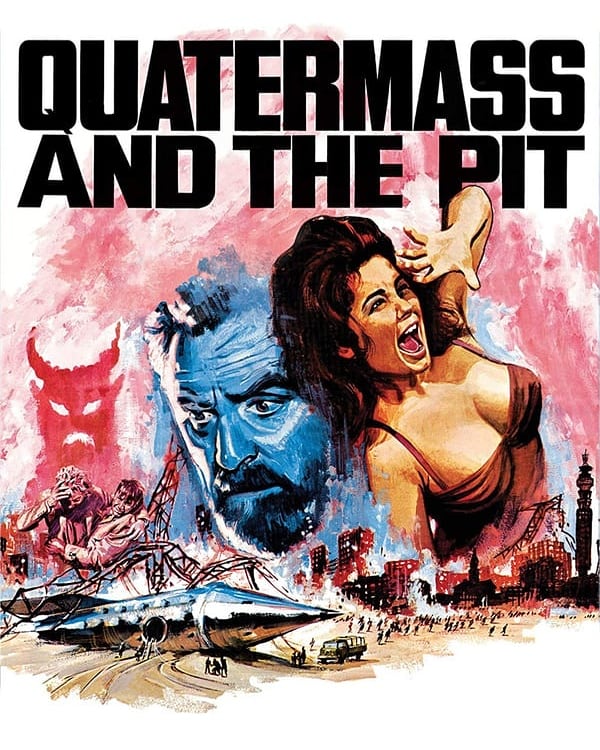
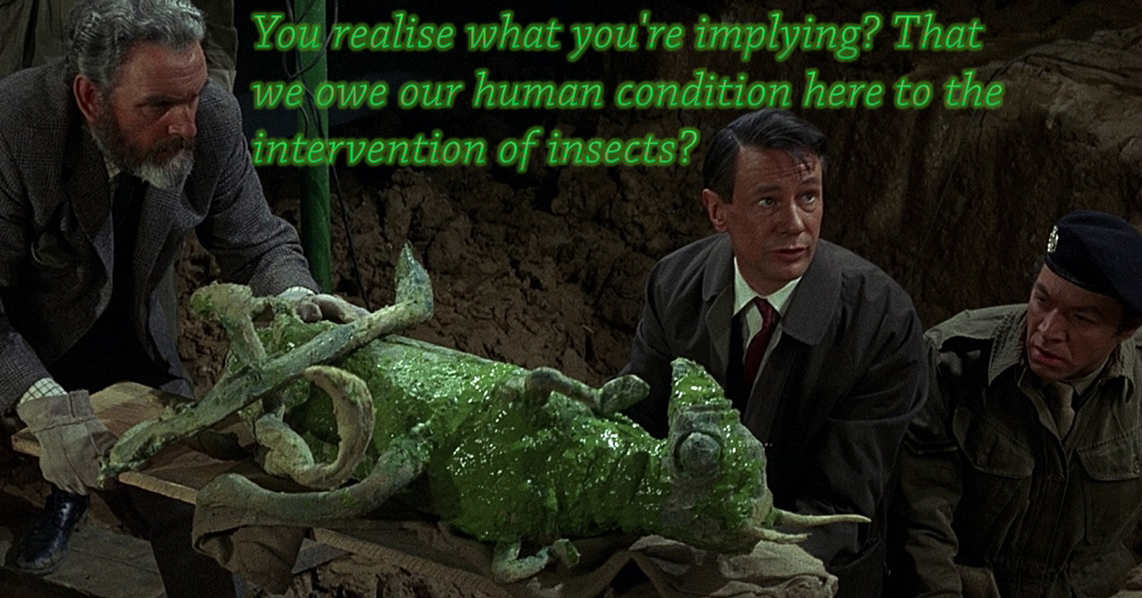
G.B.: And with Mantis Religiosa, the piece I did for your film, I didn’t quite keep it that “pure.” I used a couple of different synthesizer apps that I found that replicate old-school sequencers, like the kind of shit where they don’t even have any keys on the instruments, you’re just playing with dials and everything, you know? I started with that to create the two basic structures of the piece, because it really ended up being divided into two. I’m not quite sure why, it just ended up that way. That was the baseline for the piece, and then I went over that with my voice changer technique to make it a little bit, you know, rawer and fuzzier. I really wanted to capture the idea of fluttering insect wings, but couldn’t quite find the right noise samples. So I just had to kind of get creative and make it myself. But that’s not to say that there is no sampling at all, because I did decide to sample from one of my very favorite horror movies: Quatermass and the Pit from 1964. A fantastic British horror movie about—you guessed it—mantises from outer space! Mantises that genetically modified our primate ancestors to produce the witches and warlocks that roam this planet today. That’s some pretty heavy shit!
SETKEN: I love that film, and I only recently watched it because of your reference to it on In the Desert of Set. I really liked that film, and I know it’s very much the era of crappy BBC effects and everything, right?
G.B.: But still a great story.
SETKEN: It was a great story, and I liked what they did with that sequence where they hooked up whatever that device was that could go back in time, and there was that mass of insect people overcoming the planet and all that stuff flying on the sand coming to Earth; I think it was genius. But what you did with that; I was going to ask you. The very beginning of the track, where the words Mantis Religiosa are spoken—I didn’t know that was you, and I actually thought it sounds like Vincent Price. Is that what you’re going for?
G.B.: With a lot of help from the voice changers!! [Laughter.]. Thank you! It’s sort of like a little homage to Alice Cooper’s Welcome To My Nightmare, the sequence with the Black Widow and Vincent Price showing off his spider collection. Which, by the way, if you ever find a mummified—if you ever find evidence of mummified spiders, don’t tell me, okay? Let’s just draw the line there!
SETKEN: [Laughing.] Okay. I’m pretty sure there is a spider glyph.
G.B.: There would have to be, I’m sure; I know there’s scorpions.
SETKEN: Definitely, and there is a scorpion Goddess, who is a rather powerful being. But yeah, I’ll find out if there’s a spider glyph, just for you.
G.B.: Oh God. [Laughing.] Okay, last question. so I’m sure that there are relatives of my family—or somebody’s family—watching this documentary at home, and they’re wondering, “What the fuck is there a mummy stripping? What’s with that stripping mummy?”
SETKEN: That’s a very good question. So I referenced earlier that I’d made some short film scripts because I was looking at ways of trying to tell the story of paintings in a more creative way, and I have a mummy costume in my repertoire of costumes that I’ve held onto—from when I used to be a stripper. And the mummy costume was a particularly good one that didn’t get a lot of use because in fact it was part of—I did this mini Rocky Horror Show version, okay, and the idea was that I would do two characters from The Rocky Horror Show and two or three songs. From that, whilst hosting an event—and I did actually have a Halloween event that I got hired for years ago when I was living overseas; I think I’ve actually got that on my Vimeo and I tried to make it private, but I’ve got it as part of my profile for Star now, which is an actor’s website—because you know, we need to think of all of our skills and different ways of making money when you’re not allowed to work in a gym because the chief medical officer thinks it’s a breeding ground for bugs.
SETKEN: So anyway, I digress; I had the mummy costume as part of Rocky’s costume for The Rocky Horror Show, and I thought I could use that mummy because the concept has not been lost on me—looking deeply into the symbolism of ancient Egypt as a cocoon for the soul to rise out of. So I’ve used it as something along those lines in the documentary. And the idea of projecting alternating pictures of the coffin and the mummified mantis because you realize that’s what’s going on while all of that is happening right now. Having that projected onto my body onto the mummy wrappings as I go emerging into something else.
SETKEN: I’m interested in a era of photography and video from the 50s and 60s called the Athletic Model Guild, and it was the beginning or perhaps the precursor to bodybuilding. Bob Mizer, the guy who created it, was interested in the male physique as I am—not only as an artist, but as an amateur bodybuilder, I guess, even though I have professionally competed and stuff like that. I still consider myself an amateur, because I’ve only recently got back into some sort of shape. And I guess wanted to show it off, and was able to weave that into the artistic interpretation of what I was doing with the documentary. And so I think people will definitely look at that thing—What the fuck is this? What’s going on with this? But I think I’ve weaved it in a way that is kind of interesting certainly. It was fun for me to do. But if you’re looking for the inspiration for it, look up Athletic Model Guild, and that should answer some of some of those questions! Of course, I’ve used my makeup and stuff that I use whenever I’m public as Setken, so that of course was in there too. That wouldn’t be used in a legit AMG shoot if I was ever to recreate one. But anyway, these are the things we do with artists to take, you know, different takes on things.
G.B.: That’s really fascinating. As you know, I’ve been working with all kinds of public domain footage from yesteryear. I have like a curious fascination with old footage I guess. Not sure if “industrial films” is like the right term, but like, films that were made not necessarily as like to tell a story or whatever, they’re just showing some aspect of culture or whatever that you don’t really see much anymore, or at least not everywhere today. Is that something that still happens today with the Guild?
SETKEN: Bob Mizer passed away some time ago, and he left all of his work—a considerable library of negatives and prints and film—and that’s created the Bob Mizer Foundation, which you contribute to so they can hire people to catalog and preserve these negatives and films and prints because they really are telling an interesting story about the male physique. And what we now know as bodybuilding was starting to emerge into Western society and culture after perhaps not being considered for thousands of years. The Greeks were really the last ones to really look at, and specialize in, the male form to the degree that they did. So it’s interesting to look at it through that lens. There’s also the looking at it through the lens of homoerotic male art and looking at the male body in a sexual context, which of course was taboo then, and is to a degree now, as well as how we consider the male body in the current context and the sexualizing of it. So all of that was there in what he was doing, and there is some sordid stuff because the models that he had—he had this system of “hieroglyphics,” for want of a better word, that he used to make notes to himself about who the model was and whether or not they might they may be interested in sexual persuasions that were considered illegal at the time. So there’s that stream as well, which is interesting.
G.B.: What a horrible way to live.
SETKEN: Yeah, he was fascinating, and his is an art form in and of itself. You look at his art and you say that’s Bob Mizer photography, the same way that you might recognize a [Robert] Mapplethorpe painting. He had a style happening, you know, right from the get-go.
G.B.: That’s really cool that you were able to work that influence into this. Quatermass, mantises, the male physique, and the—say it again? The AMG?
SETKEN: Yes that’s right, the Athletic Model Guild.
G.B.: This is such an eclectic web of ingredients!
SETKEN: I think so! I very much got told earlier this year by one of the Netjeru that it’s time to get your stuff out there. Like do it, do it, and I’ve held back on a lot of artistic stuff at my own over the years for whatever reason. So this documentary was in some ways a crude manifestation of a lot of things coming together in one. I’m happy with the way it turned out.
G.B.: Well, thank you so much once again for joining me here tonight, Setken it’s been a real treat to have you onboard. Thank you for being my first and only guest on the podcast so far! And thank you so much for the opportunity to contribute to your project. I just really loved the film, and I hope that everyone out there listening will go watch it on Vimeo.com and perhaps give some consideration to visiting your Patreon account as well!
SETKEN: Yes, that would be cool! Every bit helps. I do keep Patreon-only content for people; you want to reward the people that have gone that little bit step further to invest in what you’re doing. I’m very grateful for my patrons, I’m very grateful you asked me to do this podcast, and I’m grateful for your amazing contribution to the documentary.
G.B.: Thank you! And on that note, Dua Abyt, and SET BLESS!
SETKEN: Dua Abyt! Dua Sutekh!
And to close out today’s adventure, here is the aforementioned track—Mantis Religiosa—that I composed for Setken’s film. Again, listeners can view The Praying Mantis God of Ancient Egypt at https://vimeo.com/setken, and if you enjoy this little tune I’ve cooked up as an offering to Lord Abyt, you can stream and download Mantis Religiosa for free at gbmarian.bandcamp.com.
How The Final Conflict (a.k.a. Omen III: The Final Conflict) can be read as an allegory for the Goddess Ishtar and Her rivalry with the spirit of human tyranny.
The Final Conflict (1981)—which was re-christened Omen III: The Final Conflict for its DVD release in the early 2000s—is the second sequel to Richard Donner’s 1976 masterpiece, The Omen. I enjoy the original Omen trilogy in its entirety, but The Final Conflict is the one installment thereof that’s made the largest impression on me. This film also makes me think about the Akkadian Goddess Ishtar, who is one of Set’s many romantic partners and the second-most important deity to me personally.
In case you’ve never seen The Omen or its initial sequel, Damien: Omen II (1978), here is a brief recap of their events. The 1976 original is about a U.S. politician named Robert Thorn (played by Gregory Peck) who learns his child has died while his wife Katherine (Lee Remick) was giving birth. A Catholic priest convinces Thorn to adopt an orphan who was born at the same time at the same hospital. Robert agrees, and the Thorns leave with their newborn baby boy (and with Katherine none the wiser to his true parentage). But as the child, Damien, grows older, weird shit starts to happen. One of his nannies hangs herself in front of his entire birthday party. A new, creepy nanny shows up to take the old one’s place. A crazy priest stalks and harasses Robert. A big black dog starts hanging around the Thorn household. A photographer (David Warner) captures prophetic photos of people’s deaths. And poor Katherine becomes terrified of the child who is supposed to be her offspring. All of which leads Robert to visit Rome, a monastery in Subiaco, and an archaeological dig in the valley of Megiddo, where he learns that Damien is really the son of Satan and can only be killed with these mystical artifacts called the Seven Daggers of Meggido.
What follows is the most disturbingly sympathetic depiction of attempted infanticide that has ever been filmed. Unfortunately, Robert only succeeds in getting himself killed when he tries to prevent the apocalypse (spoilers!), and Damien is then adopted by his uncle Richard (William Holden) in Damien: Omen II. Now an adolescent, Damien (Jonathan Scott-Taylor) remembers nothing of what happened to him or his parents in the first film. He’s also best friends with his cousin Mark, who’s more like a brother to him. Damien and Mark both attend military school, where their drill sergeant (Lance Henriksen) teaches Damien about his true identity. Meanwhile, a nosy reporter tries to convince Uncle Richard of the truth, and this leads to a bunch of increasingly over-the-top deaths. (My favorite is the guy who gets sawed in half by an elevator cable. Truly classic.) Eventually, Damien grows into his predestined role and wipes out all that remains of his family tree so he can be the sole inheritor of the Thorn family fortune.
The Omen is a perfect horror show from start to finish, and it’s every bit as scary as people say it is. The script wastes no time getting down to business, and each of the actors’ performances is Oscar-worthy. But it’s also my least favorite film in the trilogy, for Damien is only a peripheral character in the story. Granted, this is exactly what makes the film so scary; Damien remains completely alien to both his parents and the audience right to the very end, and it’s always easier to be frightened of something when it’s part of the unknown. But I find Damien: Omen II much more interesting, because it’s the first film ever made that actually puts us inside the Antichrist’s head. When Damien learns he is the Great Beast, he’s just as horrified as everyone else is; but the most powerful moment is when his cousin Mark gets wise and confronts Damien about his true identity. Mark threatens to tell everyone, and Damien reluctantly uses his powers to give Mark a brain aneurysm. When Mark drops dead, Damien screams the most convincing scream of despair I’ve ever heard from any character in any movie ever. That scene always makes me weep a little whenever I see it, because Jonathan Scott-Taylor really sells it. Damien: Omen II is quite derivative of the first movie, but it deserves credit for one thing at least: the character of Damien is perfectly written.
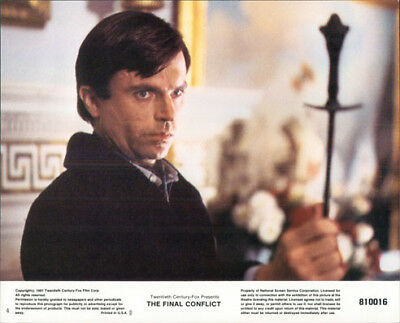
A lobby card for the film.
In The Final Conflict, Damien is now an adult in his thirties, and he’s played by Sam Neill. He has now become the owner of Thorn Industries, a multi-billion dollar company that has revolutionized the food industry, and which is working to solve the world hunger crisis forever. Damien is also the U.S. President’s first choice for Ambassador to Great Britain (after the current guy gets possessed by a black demon dog and blows his brains out). Damien is hot for Great Britain because he has this entirely fictitious apocryphal text called the “Book of Hebron,” which prophesies that Jesus will be reincarnated in Jolly Old England any day now. (Maybe they didn’t have the budget to do a proper Second Coming, with the J-Man flying down from the sky?) But after he sets up shop across the pond, Damien falls for a news reporter named Kate Reynolds (Lisa Harrow); then these Catholic monks at a monastery in Subiaco, Italy find the Seven Daggers of Meggido and try to assassinate him. This leads to a series of hilariously incompetent murder attempts that will have you shaking your head in disbelief. Meanwhile, Jesus is born again somewhere (did you see what I just did there?), but nobody knows where. Lucky for him, Damien knows the birth coincided with a weird astronomical convergence that occurred a few nights ago, so he sends his worshipers out to murder every male baby in England who was born within that time frame. Then Kate Reynolds finds out what the rest of us already know about Damien, and the titular Final Conflict truly begins.
The number one attraction in this film, and the most important reason for anyone to see it, is Sam Neill; he’s literally the greatest Antichrist I’ve ever seen in any film ever. Forget about Michael York, Nick Mancuso, Gordon Currie, or anyone else who’s ever played the Beast in those movies they show on the Trinity Broadcast Network; Sam Neill’s performance here is the gold standard. Rather than playing Damien like some two-dimensional cartoon villain, he plays him like he’s the Gods-damn hero of the movie. He brings so much charisma and charm to the role that he succeeds in making Damien extremely likeable, even when he’s ordering hundreds of newborns to their deaths. Everyone I know who’s ever seen The Final Conflict ends up rooting for Damien somehow (even though they know they’re not supposed to), and they can’t help but feel disappointed with the ending. (More on that in a minute.) The only other performance that’s comparable to this is that of Sir Anthony Hopkins as Dr. Hannibal “the Cannibal” Lecter in The Silence of the Lambs (1991). If there is an Antichrist and he ever tries to take over the world, we’d all better pray he isn’t just like Sam Neill in this movie—or else we might actually want him to take over.
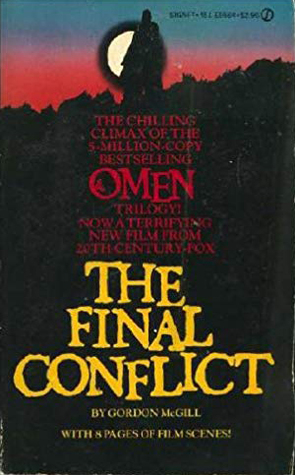
The novelization of the 1981 film, The Final Conflict, by Gordon McGill.
In one scene, Damien and Kate walk through a park and see one of the monks, who’s standing on a soapbox, preaching. Damien notices the monk is staring right at him, and he instantly knows the guy is here to kill him. So he starts surveying the area like a hawk—without breathing a word of his concerns to Kate—and he actually looks worried. Is he concerned for himself, or is he concerned for Kate’s safety should there be an ambush? Then there’s another scene where Damien goes to work right after the Christ child has been born. He’s been up all night because he could sense the birth happening, and Kate catches him at the elevator, asking if it’s okay for her to try interviewing him again. (Her last attempt was foiled by another assassin.) Damien smiles and agrees, and she leaves; then he gets in the elevator, sighs, and slumps his shoulders. I’d like to remind you that this character is supposed to be Friedrich Nietzsche’s Übermensch with a vast array of supernatural powers; and yet Neill sneaks in all of these brief human touches—a look of genuine concern, a tired sigh—and actually makes us care about this evil, rotten bastard…
I hate to blow the ending of this film for anyone who hasn’t seen it, but trust me; you probably want to know about this going in. For some reason, I thought this movie was going to end with a big showdown between Damien and Jesus; surely, that would be the “Final Conflict” everyone was expecting, right? I knew things wouldn’t end well for the Beast, but I figured there would at least be some kind of special effects extravaganza. No such luck; the movie ends with Damien being led into a trap by Kate, and Kate stabs him in the back with one of those nifty Meggido daggers. Then Damien limps away, curses Jesus, and promptly dies. Cue music, roll credits. When I first saw this, I was royally pissed. The film had done an excellent job of keeping me at the edge of my seat for the first 90 minutes or so; but it starts running out of steam real fast during the final 20, and that ending just didn’t seem fair. They went through all that hard work of building up this magnificent character and this huge final battle he’s going to have, and what do they give us? Sam Neill getting stabbed in the back (literally) by the woman he loves. I mean, what the hell were they thinking? I wanted to see Damien and Jesus go “Hell in a Cell” on that shit!
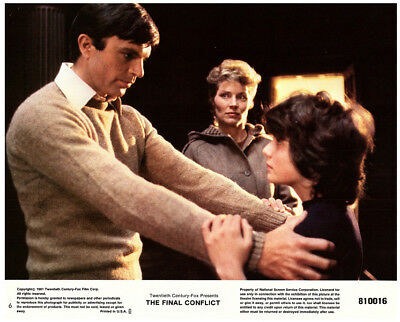
An additional lobby card for the film, with Lisa Harrow as “Kate Reynolds” in the center.
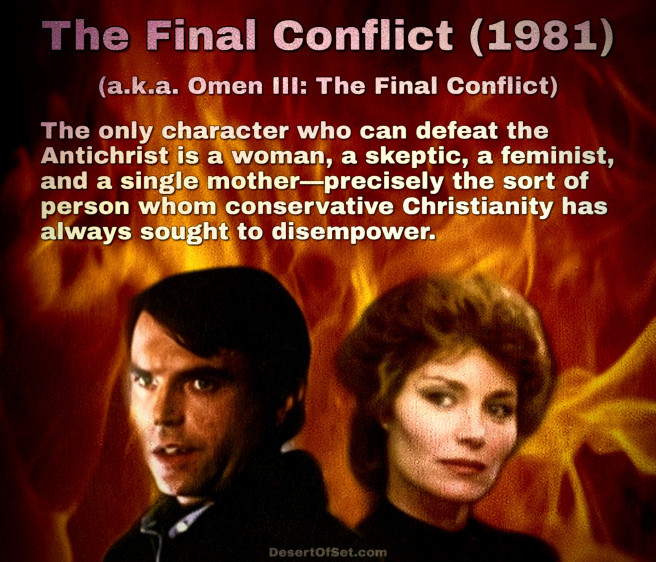
But I’ve watched The Final Conflict countless times since that first viewing in 1999, and I think I’ve figured out what they were really going for here. Let’s consider that this film was not made by evangelical Christians with a religious axe to grind; if it had been, they would have kept things as close to their scriptures as possible. Let’s also consider the fact that none of the avowed Christian men in this movie can stop Damien; hell, not even Jesus himself can stop him! The only character who actually poses a real, substantial threat to the Antichrist is (1) a woman, (2) a skeptic, (3) a feminist, and (4) a single mother. In other words, she is precisely the sort of person whom conservative Christianity has always sought to disempower. The real “Final Conflict” here is not between Christ and Satan at all; it’s between male religious violence (perpetuated by Christians and Satanists) and a female secularist who just wants the violence to stop. Note that while Kate scoffs at Christianity at various points in the film, she nevertheless respects its right to exist; and while she eventually sends Damien back to hell, it’s clear she would much rather work things out and share a life with him somehow. Kate is also the only character who commits an act of violence for purely personal reasons. The monks want to kill Damien because he’s the Beast, and Damien wants to kill the Christ child because he’s Jesus; both sides are motivated by purely ideological concerns. But when Kate stabs Damien, it’s because he’s just murdered her son. (Peter is accidentally killed by one of the monks when Damien uses him as a human shield; the poor kid is literally caught between two religious fanatics.) With all this in mind, I now think the climax of this film is far more daring than I originally thought.
I used to think the conclusion to this film was just an example of lazy screenwriting, but I’ve noticed over the years that The Final Conflict gives us several hints about how it will end. In one scene, one of Damien’s “Disciples of the Watch” advises him to stay away from Kate. “I decide who’s dangerous and who isn’t!” Damien shouts angrily, betraying the fact that he feels insecure about Kate himself. Later, Kate falls into a river and almost drowns at Damien’s house. He hesitates before rescuing her (as if he senses that he shouldn’t), but his concern for her overpowers him. As Kate dries herself by the fire back in the house, she tells Damien she feels like a moth who’s flown too close to the flame; she knows he’s dangerous, but she can’t stay away. Damien’s response to her is perhaps the most beautifully-delivered line in the entire film: “Yes—but who is the moth, and who is the flame?” Finally, when Kate stabs Damien at the end with the Megiddo blade, he smiles to himself ever so subtly, as if he’s always known that she would be his undoing. Kate Reynolds was clearly meant to be the savior of humanity in this film from its very conception; and in casting her as such, The Final Conflict offers us a most unexpected soteriology.
“[Damien] is the human son of Satan, fully committed to his Father. But just as Mary Magdalene represented temptation to Jesus, so Kate represents temptation to Damien. She arouses human feelings within him that could so easily lead him astray from his insidious mission, his inglorious destiny.”
—Sam Neill in an 1981 interview upon the film’s release
The hero of this film is an independent, powerful, and successful woman. She isn’t owned or controlled by any man or male divinity. She comes awful close to losing herself in Damien, especially when she spends a dark night of the soul with him in bed. But she rises again from that proverbial pit, stronger than before, and equipped with the power to send her two-faced lover back to the Underworld. Is any of this starting to sound familiar yet? By Gods, it should; for Kate’s arc is basically the Descent of Ishtar all over again. Damien is like a really nasty corruption of Tammuz, a version that’s turned completely rotten. All of his power and wealth are tied to the food industry, just as Tammuz is the God of food and vegetation. But while this “anti-Tammuz” and his enemies are gridlocked in their increasingly futile holy war, Ishtar sneaks in and chooses Her own “messiah” to save the day. The filmmakers try to give Jesus all the credit for this by slapping an obligatory Bible quote on the screen just before the end titles roll; but as far as I’m concerned, it isn’t the Lion of Judah who snuffs the Great Beast here. It’s the Lion of Babylon!
Ishtar be praised!
Contrary to popular wisdom, there is a distinction between “the Antichrist” and “the Great Beast 666” from Revelation 13. Early Christians used the word antichristos to describe anyone who (1) refused Jesus Christ as their Lord and Savior, (2) propagated a “heretical” version of Christianity, or (3) claimed to be Christian but didn’t behave like one. The first of these definitions is practically useless since it would seem to include all non-Christians. The second is equally problematic since it requires demonizing all Christian denominations apart from one’s own. The third, however, makes a great deal of sense, for what else can you call someone who claims to love Jesus but fails to treat people in a Christian manner? The real Antichrist has nothing to do with Satanism, but is actually the spirit of Christian hypocrisy itself. Turn on your local televangelist TV network and you will find the true disciples of Antichrist at work, pushing their insane political agendas and extorting millions from their hapless followers in Jesus’ name.
The Great Beast (or Therion in Greek) is based on several ancient kings who persecuted monotheists. People like the Pharaoh in Exodus and the Roman Emperor Nero all had three things in common: (1) they ruled over polytheist nations, (2) they considered themselves to be divine, and (3) they considered the Hebrews and the early Christians to be a threat. After being fed to lions for so long, Christians became convinced that such rulers were actually possessed by Satan himself, and prophetic texts like the book of Revelation were built upon this core concept. While Antichrist represents the evil that lurks within Christianity, the Great Beast represents the archetypal “evil king”—a ruler who tyrannizes his people, and whose actions will bring about destruction and doom. Unlike Antichrist, the Beast doesn’t try to pervert Christianity from within; he seeks instead to destroy it from without. So if we want to get technical about it, Damien Thorn is not really the Antichrist per se, but the spirit of Therion in human form.
Mind you, monotheists have not exactly been “kind” to Pagans throughout history, either. It was especially bad for those civilizations that lived right next door to ancient Israel. The Gods and Goddesses of these cultures are specifically named as “demons” in the Old Testament (e.g., Ba’al, Asherah, etc.) and are commonly invoked as such in contemporary media. Lady Ishtar is just one of these divinities, and it’s sad to think that whenever She is discussed in today’s world, it is almost always in terms of biblical prophecy. She is even linked with Therion in the book of Revelation:
Then the angel said to me, “The waters you saw, where the prostitute sits, are peoples, multitudes, nations and languages. The beast and the ten horns you saw will hate the prostitute. They will bring her to ruin and leave her naked; they will eat her flesh and burn her with fire. For [Yahweh] has put it into their hearts to accomplish his purpose by agreeing to hand over to the beast their royal authority, until [Yahweh]’s words are fulfilled. The woman you saw is the great city that rules over the kings of the earth.”
—Revelation 17:15–18
As I’ve discussed before, the Whore of Babylon is clearly inspired by Ishtar, even if her symbolic purpose is different. But what I find especially interesting here is the contrast between a female entity who “rules over the kings of the earth” and an evil king who has turned against her. Ishtar presides over the concept of “sacred kingship,” which required a Babylonian king to “marry” the Goddess and serve the people as Her priest. He had to ensure that his nation’s crops didn’t fail, that his borders remained protected from foreign invaders, and that his people were cared for in times of disaster. He also had to perform religious rituals all the time to ensure that his people’s Gods were properly appeased. A lousy ruler who brought ruin to his people would have been considered “unfaithful” to Ishtar, and some kings were even sacrificed to atone for this sin. This only reinforces my opinion that by killing Damien in The Final Conflict, Kate Reynolds is actually sacrificing him to Ishtar as penance for his disastrous leadership. (It’s reassuring to think that with the Queen of Heaven, even monarchs can be held accountable and taken to task.)
Sam Neill and Lisa Harrow posing for a behind-the-scenes photo.
Don’t get me wrong; The Final Conflict is not a perfect film. There are times when it sabotages itself by trying to copy the original Omen too much. Why are we still wasting time with lone individuals getting slaughtered in isolated places? Why isn’t Damien the President already when this film begins, sending troops to invade the Middle East and start World War III? They missed an opportunity to enlarge the scale and the stakes of the story here; and by restricting all the action to Great Britain, they do a great injustice to the premise. The only exception to this is the baby-killing conspiracy sequence, which is one of the most chilling things I’ve ever seen. The murders themselves are never shown, but are only suggested through quick cuts, musical cues, and horrified reactions from the actors. This is a perfect example of how the power of suggestion can leave a much deeper impression on the mind than just painting the screen with gore. It also helps keep the violence as tasteful as possible (which is no small feat, considering the subject matter), while also making it more disturbing to sit through. If you think the jump scares in The Conjuring (2013) are scary, try watching the scene where one of Damien’s disciples—an Anglican priest—gives a newborn his own version of a “baptismal rite.” It makes my skin crawl just thinking about it.
Here I geek out for a bit about my vote for “the scariest monster movie ever made,” and I draw some parallels between the themes of this film and my beliefs as a Setian.
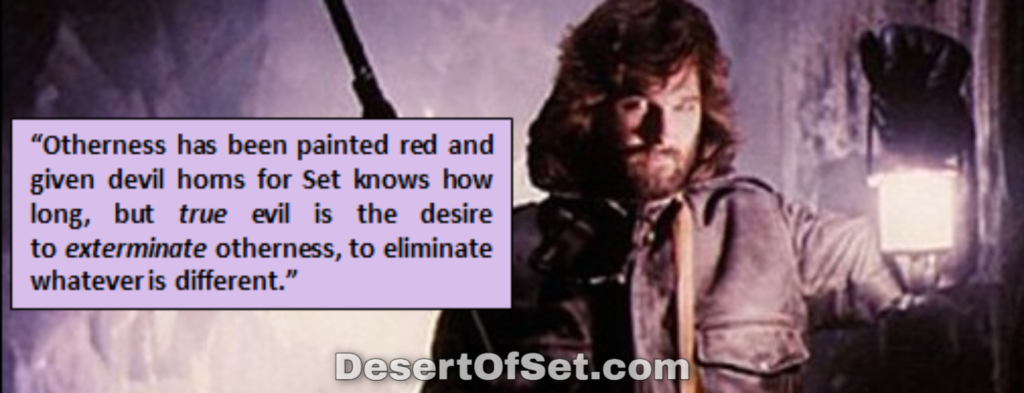
John Carpenter’s The Thing (1982) wins my vote for “the most frightening monster film ever made.” Its unique history begins with a science fiction author named John W. Campbell, Jr., who wrote a short story in the 1930s called “Who Goes There?” It features a team of scientists who discover a spaceship buried beneath the ice in Antarctica. They dig out the ship’s pilot and bring it back to their base, thinking it’s just a frozen fossil. But once the creature thaws out, it springs into action and starts terrorizing everybody. Then it’s discovered that the Thing (as this hostile invader comes to be called) not only digests its prey, but can manipulate the cells of its body to shapeshift into whatever it has eaten at will. The men at the research facility soon learn this applies to human beings as well as to animals, and they descend into violence and paranoia as they accuse each other of being the monster. That’s when a guy named R.J. MacReady takes charge of the situation and figures out a way to determine who’s who.
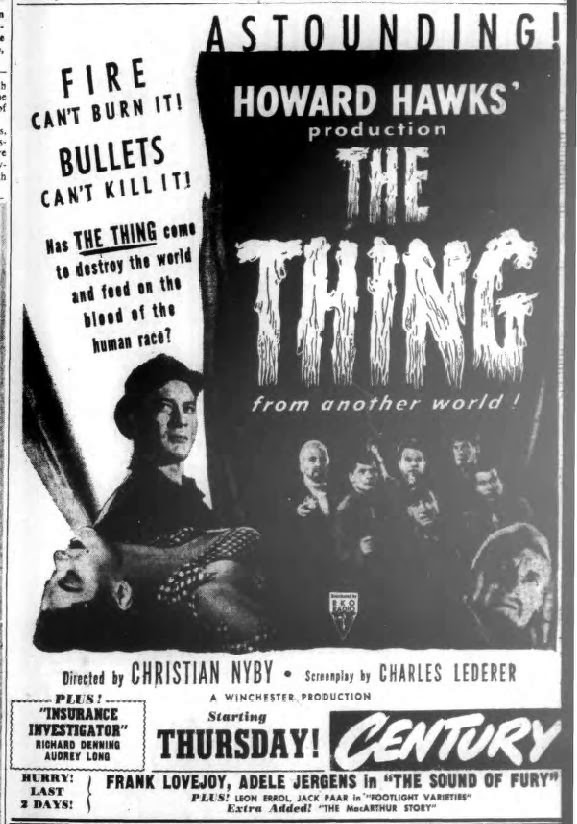
In 1951, the great Howard Hawks decided to make a film adaptation of “Who Goes There?” that was renamed The Thing From Another World. This was the first of what would later be called the “atomic horror” films, in which humanity is threatened by giant radioactive animals, mad science experiments, or Commies from outer space. For whatever reason, the setting of Campbell’s story was switched from Antarctica to the North Pole, and the shapeshifting alien was re-conceptualized as a blood-drinking humanoid made entirely of vegetable matter. (One character actually refers to it as a “super-carrot.”) Despite these drastic changes, The Thing From Another World is one of the greatest sci-fi/horror films ever made. It has lovable and humorous characters, some intense machine gun-paced dialogue, and several suspenseful scenes that still hold up today. The film influenced an entire generation of filmmakers, including John Carpenter, who loved it so much that he has his characters watching it on TV in Halloween (1978).
When Ridley Scott’s Alien came out in 1979, it made a shit-ton of money. Suddenly, big-budget creature features were in vogue. That’s when Universal Pictures acquired the rights to produce a remake of The Thing From Another World. I believe monster movie remakes are generally a horrible idea, and that they should be avoided as much as possible. But in The Thing’s case, this rule does not apply. Part of what makes the Carpenter film work is that the original 1951 version deviated from its source material so much. While it’s still about an alien terrorizing people in the snow, Hawks’ monster and human protagonists are totally different. (There isn’t even a “MacReady” in Hawks’ film.) So John Carpenter and his team decided to make this new film a more faithful adaptation of the original Campbell story, which had never been properly adapted for the screen before. For this reason, the 1982 Thing is radically different from its 1951 predecessor, which caught many audiences off guard at the time. Most viewers in 1982 were expecting to see something fairly light-hearted and optimistic, much like the 1951 original. They weren’t expecting to see anything quite so bleak, depressing, or nightmarish as what they were given.
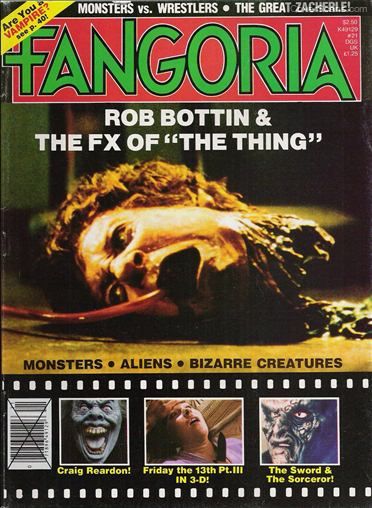
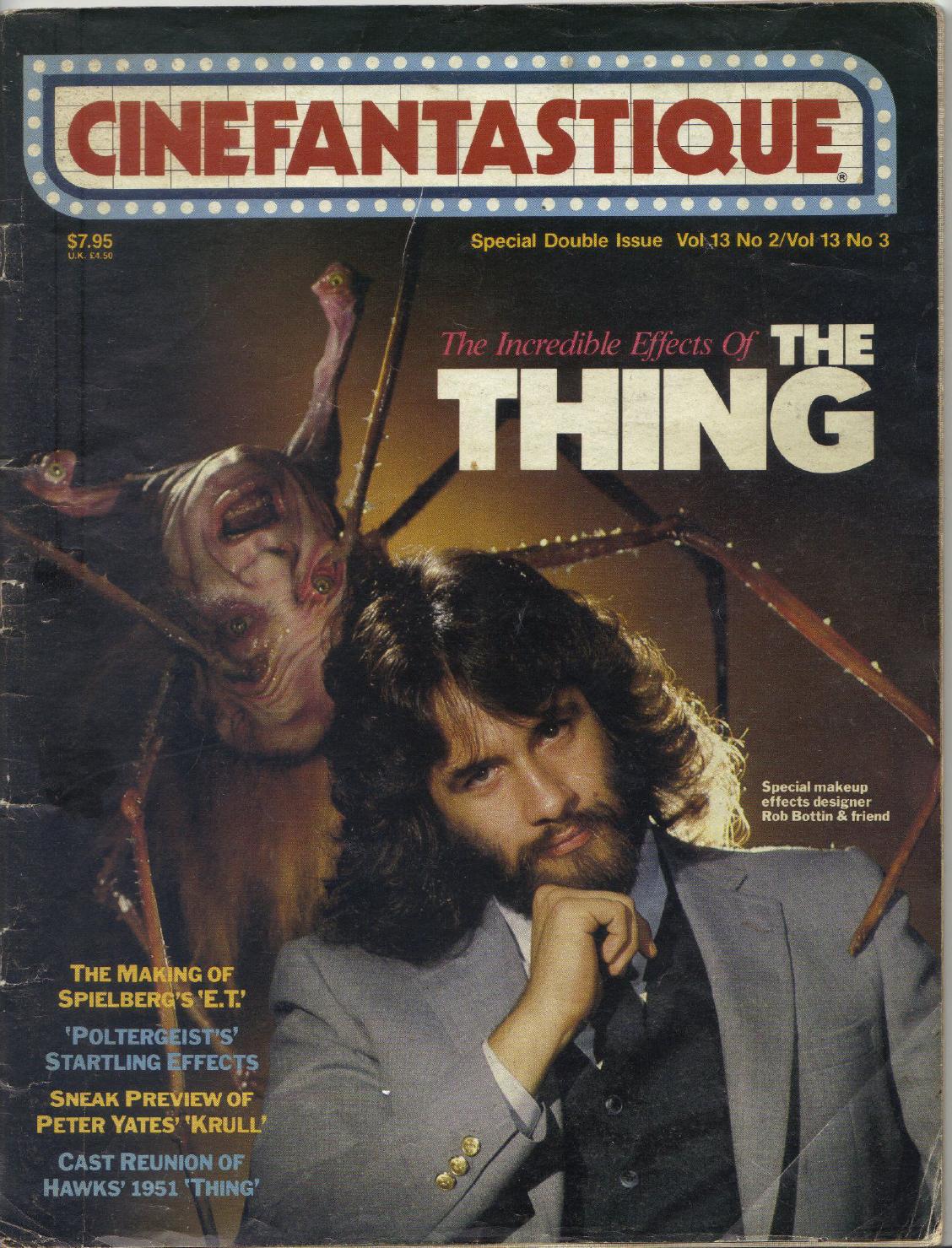
The Thing boasts some of the most convincing makeup and creature effects you will ever see; in fact, the effects are perhaps a little too convincing. It’s hard to believe the monster is really just a bunch of puppets, but creature effects wizard Rob Bottin put so much of his heart and soul into them that they still look superior to most CGI effects that are used in films today. Unfortunately, audiences in 1982 just weren’t ready for what they saw. The most well-known sequences of the film are those in which the monster devours, digests, and transforms into its helpless prey. Globs of slime, blood, and stinking pus are splattered all over the walls while men are physically disfigured into shapes that defy all rational categorization. These scenes are grisly, revolting, and very hard to sit through, but the amount of imagination put into them is absolutely staggering—even by 2019 standards. The effects are so realistic and excessive, however, that people just went apeshit. Film critics rabidly accused John Carpenter of being “a pornographer of violence,” and he was practically blacklisted by Universal. Indeed, audience reactions to The Thing during its original theatrical run almost ended Carpenter’s career entirely. How ironic, then, that the film would be re-evaluated by fans and critics over the following decade, to the point of being accepted today as Carpenter’s very best work. And the sheer number of other media properties it has influenced (e.g., Dead Space, The Mist, Resident Evil, Slither, Stranger Things, The X-Files, and practically everything on Guillermo del Toro’s resume) demonstrates that The Thing has had a major impact on popular culture.
I love it that this film features an ensemble cast, which means there are multiple principal actors who are given roughly equal amounts of screen time. The great thing about ensembles is that the actors will rehearse together and develop a chemistry you just can’t get anywhere else. The players in this film are all well-seasoned stage actors, to boot. While the script is rather skimpy on character development, the actors make up for this with all the neat visual cues they worked out together. We can tell that Clark (played by Richard Masur) is much more comfortable with the dogs at Outpost 31 than he is with the other men. When he learns that one of the other men has died, he shows little emotion apart from fear; but when he learns that one of his dogs have been killed, he becomes upset and mournful. We can also tell that Garry (played by Donald Moffat) resents being the leader of the group, because he always has a reluctant look on his face whenever he has to take charge. It’s obvious from their expressions that none of the other men take his authority very seriously, and Garry is also much quicker to relinquish his authority to MacReady (played by Kurt Russell) than most leaders would be. Despite having lived and worked together for some time, the men at Outpost 31 seem to know practically nothing about each other. They’re alienated from the rest of the world by living in Antarctica, but they’re also alienated from each other by their own apathy and disinterest. Since the Thing can imitate any life form perfectly, neither the characters nor the audience can ever tell who is who. This is made even more horrific by the notion that these people never really knew or cared about each other that much in the first place. The Thing doesn’t have to work very hard to push them into a panic, for they are already in a position to fear and loathe each other when the film begins. If their humanity is all that really separates these men from the Thing, that wall of separation must be frightfully thin.
One criticism I sometimes hear about this film is that the actors are all male; there are literally no women to be seen anywhere. I can understand why this bothers some viewers, but I actually appreciate the all-male cast for a couple of reasons. First, there’s this unspoken rule in Hollywood that monster movies must always have some kind of heteronormative sex appeal; there must be gorgeous hot women removing their clothes for the male viewers, and there must be one dude and one dame who make it to the end so they can presumably fornicate once the credits roll. The Thing dispenses with this “wisdom” by not even allowing the subject of sex to be breached in the first place. Furthermore, this movie is about a slimy tentacled monster that likes to rip people’s clothes off and insert itself into their bodily orifices, which is already disturbing enough as it is. If there had been any women in the film, I guarantee they would have been sexualized; there were other films being produced during the same era that indulged in this exact form of sexual exploitation (including 1980’s Humanoids From The Deep and 1981’s Galaxy of Terror, which both feature monsters raping women on camera). Indeed, The Thing is one of very few 1980s monster films that doesn’t feature any kind of sexual exploitation at all.
I think another reason audiences hated this film upon its original release is that it’s just so Gods-damn bleak. Even the goriest slasher movies of the 1980s usually had some kind of comic relief or silliness in them; but aside from some brief touches of humor here and there, The Thing offers no such relief. Nor does it offer any clarity with regards to its conclusion. Audiences prefer happy endings in their monster movies, but they can also handle bad or scary endings, as long as they’re clear-cut. The evil can either win or be defeated, but it must clearly be one or the other. The Thing throws this archaic rule right out the window, for its ending is completely ambiguous, leaving us uncertain as to how the story really ends. And that is something most people just can’t seem to handle in a movie. Mind you, I can understand why; it bothers me that we never find out exactly who won or who survived. But that’s what makes the ending work; it continues to bother you and haunt you long after the credits have rolled. (I still wake up in the middle of the night every so often, wondering: “Who’s really human at the end of The Thing?!”)
In my opinion, the titular beast is an even better representation of Apep, the supreme enemy of all Gods and creatures, than H.R. Giger’s Alien. The xenomorph can be pleasing to look at, with its shiny symmetrical body and its humanoid shape; but the Thing is absolutely horrible to observe in either of its myriad, spidery forms. And while the Alien is just an animal that seeks to eat and reproduce according to its primal dispositions, the Thing has assimilated countless worlds and species into itself. It is sentient, can build and operate spacecraft far superior to ours, and is totally capable of communicating with humans. (It speaks perfect English whenever it pretends to be an American scientist.) If such an ancient intelligence had any goodness in its heart, it would try to reach some kind of understanding with the men of Outpost 31 at least once. Yet the Thing never bothers to communicate with the men at all (apart from when it imitates them). This suggests that the creature is purely and simply evil. It deliberately terrifies, harms, and divides other sentient beings with a malevolent self-awareness, and it will settle for nothing less than the extinction of all life upon this earth. If that doesn’t sound like Apep, I don’t know what does.
But there is much of Set to be found in this film, as well. Most of Antarctica is actually a polar desert, since there is little to no precipitation or vegetation there. A “desert” is technically defined in terms of how dry a given location is (rather than how hot), and Antarctica is drier than a bone; very little rain or snowfall ever occurs across the entire continent. Given that The Thing’s premise is essentially a modernized combat myth (in which a heroic warrior fights a gruesome monster to save the world), it’s only fitting that this battle should unfold in an ecosystem that falls under Set’s jurisdiction. And in Egyptian mythology, Apep has a paralyzing stare that freezes most of the Gods with fear, rendering them motionless and inert. Set is the only God who is immune to this; hence why He was chosen to serve as Ra’s Champion against the beast. Perhaps it is no accident that when most of The Thing’s characters come face-to-face with their extraterrestrial assailant, they too become motionless and inert. MacReady is the only one who seems unfazed whenever he sees the monster; he even has the nerve to taunt it right to its ugly face. (His best line is when he tells the creature, “Yeah? Well fuck you too!”) Indeed, he exudes the time-honored Setian attitude of “I’m-just-saving-the-world-so-I-can-get-back-to-drinking” quite nicely.
As a Setian, I believe autonomy is divine—a gift not only from the Gods in general, but also from Set in particular. He is the God of otherness, the principle that makes it possible for everyone to exist as individuals with distinct identities. The word “other” often bears a negative connotation in common discourse, as when we speak of societies “othering” minorities. But we are all others to each other, even in the cultures and cliques we call our own. Otherness is a good thing, something to be cherished and celebrated, because it enables each of us to determine ourselves as unique sentient beings. It is not otherness, but the fear of otherness which poses the ultimate threat to our existence. As frustrating and confusing as Set can be for the other Gods, even they must accept Him as a necessary force in this world; for without Him, they would be frozen by the Serpent’s stare and absorbed into its vacuum. They would cease to have selves and be dissolved into the void forever. Otherness has been painted red and given devil horns for Set knows how long, but true evil is the desire to exterminate otherness, to eliminate whatever is different. And the Thing is a perfect representation of such erasure. Just like Apep, it is homogeneity personified, hating whatever is not itself and robbing its victims of their innermost identities and souls.
Ennio Morricone (left) and John Carpenter (right), circa 1982.
John Carpenter is legendary for scoring most of his films himself; but for this venture, he recruited the Italian composer Ennio Morricone (who is most well-known for scoring 1967’s The Good, the Bad, and the Ugly). Morricone wrote about 50 minutes’ worth of orchestral music, approximately half of which would never be used in the final cut. Supposedly, Carpenter had difficulty deciding where to insert certain pieces of music into the film. So while The Thing was in post-production, Carpenter went to the recording studio and hammered out some incidental pieces to make up for the material he couldn’t use. As a result, about 90% of the music in The Thing is Morricone’s work, while the remaining 10% consists of Carpenter’s trademark electronic drones. The theme song (which is actually titled “Humanity Part II”) was originally written by Morricone, but was later re-arranged with electronic instrumentation to make it sound more “Carpenter-esque.” I happen to own a version of the soundtrack that includes both Morricone and Carpenter’s material, and it’s my all-time favorite album to play during worship.
I mention this because I find the Thing soundtrack useful for execrations (i.e., hexes or curses that target spiritual rather than human adversaries). In the procedure we’ve used in the LV-426 Tradition, we take some ceramic pots and draw or write things on them to represent our fears and our personal demons. Then we invoke the Serpent into these pots, and we invoke the Red Lord into ourselves. Once a spell against Apep has been recited (with plenty of angry and forceful language), everyone smashes their “qliphothic pot” to bits and pieces, sending the Serpent back to whatever hell it comes from. This is more than just a therapeutic activity for stress relief; it’s a spiritual battle in which we actually smite the negativity in our lives with all of Set’s power and fury. It’s helpful to use music in this kind of worship service, and the Thing soundtrack has always given me the best results. It heightens the effect of the ritual, making me feel as if I’m actually in some desolate wasteland, getting ready to face off against an ancient evil. Even when I listen to the music outside of ritual, it always puts me in a meditative mood, steeling my nerves against whatever stressful crap I happen to be worrying about at the time.
I suppose I’ve rambled on about this movie long enough now. The point is, John Carpenter’s The Thing isn’t just a great sci-fi/horror movie; it’s also a great parable for Setian spirituality. It’s the ultimate cinematic combat myth for the contemporary age, and it is deeply inspirational to me in my own daily quest against the Serpent. It still gets under my skin, too, despite the fact that I’m an adult now and I’ve seen this movie over a thousand times. I still get spooked whenever the power goes out and I have to walk around my house in the middle of the night; I can’t help but imagine the Thing slithering around down there in the dark beneath my bed, waiting to assimilate me in my sleep. There is simply no other movie monster that continues to hold this kind of power over my imagination today, and there are few other films that inspire me as much as The Thing does. If you’re a Setian and you’ve never seen this movie, give it a try as soon as possible, and feel free to share your thoughts about it with me. I’d love to know what you think!
Martian grasshoppers. Genetically modified super-apes. Invisible forces only certain people can see. Quatermass and the Pit (1967) has it all.
I love those old Hammer horror films from the 1960s and 1970s: the ones with Christopher Lee and Peter Cushing, filmed in vivid Technicolor, with some of the most atmospheric set pieces you’ll ever see on screen. Hammer revamped all the traditional gothic horror film monsters, and they weren’t afraid to use gallons of blood in the process (which really pissed off the British censors at the time, even though the gore looks pretty fake by today’s standards). They turned Dr. Frankenstein (portrayed by Peter Cushing) into a psychopathic killer who prefers to get the parts for his monsters fresh (if you know what I mean, and I think you do). They turned Count Dracula (Christopher Lee) into a frothing-at-the-mouth sexual predator who can break mere men in half with his pinky finger. They also cast some of the most beautiful demigoddesses to have ever graced this earth. (Seriously, these ladies make their Victorian costumes look more provocative and exciting than even the skimpiest of modern beach attire.) Whether we are addressing The Evil of Frankenstein (1964), Dracula: Prince of Darkness (1966), or even The Devil Rides Out (1968), Hammer films are fucking awesome and warrant multiple repeated viewings.
If I had to choose just one Hammer film as my personal favorite, it would not be easy; but surely Quatermass and the Pit (1967, also known as Five Million Years To Earth) would be counted among my Top Five. This is a sequel to an earlier 1955 film called The Quatermass Xperiment and its immediate 1957 successor, Quatermass II. All three movies are theatrical adaptations of TV serials that were originally broadcast on the BBC in the 1950s. These serials were written and created by Nigel Kneale, who is also known for writing The Abominable Snowman of the Himalayas (1957), The Stone Tape (1972), and the original screenplay for Halloween III: Season of the Witch (1982). Kneale was a fantastic science fiction writer whose work fits rather nicely with the likes of H.P. Lovecraft, and he has been a major inspiration to such horror maestros as John Carpenter and Stephen King, whose Prince of Darkness (1987) and The Tommyknockers (1987) are both directly inspired byQuatermass and the Pit.
The Quatermass films are named for their main character, Professor Bernard Quatermass, a British rocket scientist who contends with various alien forces that seek to wipe out the human race. (In many ways, the original serials also provided a great deal of inspiration for Doctor Who.) Of the trilogy, Quatermass and the Pit is easily the best; and despite being the third film in sequence, it is written in such a way that you don’t have to view either of its predecessors to understand the characters or plot. All you really need to know going in is that it’s about a small British town called Hobb’s End (which should sound familiar to anyone who enjoys John Carpenter’s In the Mouth of Madness). Some subway workers uncover a bunch of weird fossils and an object that looks like an unexploded bomb from the German air raids during World War II. This was not an uncommon problem in England in the 1960s (hell, it’s still a problem today), so panic immediately ensues, and the military is called in to investigate. But it is soon determined that the excavated object is not a bomb after all, and that’s when Professor Quatermass is called in.
Quatermass discovers that the object is actually a spaceship, and that it contains a couple of ancient alien corpses. (The aliens look like man-sized grasshoppers.) The weird fossils that were discovered close to the ship appear to have been primates that the aliens were using as experimental test subjects. Quatermass also learns that Hobb’s End has been subject to all manner of paranormal disturbances since time immemorial; whenever someone disturbs the ground where the spaceship now rests, ghost and hauntings are soon reported throughout the surrounding area. And when a man accidentally scrapes the spaceship with a wrench, it causes all these weird telekinetic phenomena to start happening.
Quatermass figures the aliens are from Mars, and that they came to colonize the Earth before humans evolved. He thinks they planned to transfer their consciousness to the ancient primates they found, so that they could live more comfortably in our ecosystem. But something went wrong, and the aliens all died. Yet the super-apes they created survived, and some people today are actually descended from them. Such people tend to be born with weird psychic abilities, and Quatermass theorizes that this may be where all our legends of magic and witchcraft come from. The aliens even resemble Satan, with tiny horns poking out of their skulls. But there’s just one problem: even though the aliens and their super-apes are dead, the powers they evoked continue to exist in human beings today, and the alien spaceship is still functional. Quatermass fears that if anything is done to disturb the vessel, it could re-awaken the dormant Martian hive consciousness that resides within every person who is descended from the modified apes. And this is exactly what happens when the British government decides to hold a big press conference at the excavation site. Some knucklehead drops some live electrical wiring on the ship, and it wakes up.
The awakening of the Hobb’s End spaceship is one of the most terrifying sequences I’ve ever seen in any horror film. Approximately half the local population is suddenly possessed by the Martian hive mind, which then drives them to murder all their neighbors, co-workers, and families. These people even kill all the animals they encounter as well; there’s one ghoulish moment when we hear them slaughtering a bunch of cats and dogs outside, and it never fails to make my blood run cold. To think that someone can just flip a biological switch and make hundreds of people suddenly murder their own loved ones is scary enough; but the situation is made even scarier by the fact that this is all caused by an accident. The Hobb’s End Massacre is not caused by the aliens (who are all deceased), but by an act of human ignorance that totally could have been prevented (had anyone heeded Quatermass’ warnings).
The heroes end up using a big iron crane to discharge the Martian spaceship’s energy back into the Earth. As in a great deal of folklore, it is the apotropaic power of iron (a substance most sacred to Set) that dispels the forces of evil in the end. But unlike most other science-fiction/horror films from this period, Quatermass and the Pit does not conclude with the male and female survivors hugging and kissing each other like everything’s going to be all right. Here, Professor Quatermass and his friend Dr. Judd (played by Barbara Shelley, my favorite Hammer glamour girl) are left standing alone amidst a sea of urban ruin, not breathing a word to each other. They’re too frightened to even look at each other, much less touch. (Perhaps they fear that doing so might spark up the Martian hive mind again?) They just stare fearfully into the night, forever traumatized by what they’ve seen and experienced. Roll credits!
One sure way to make me want to read a story or watch a film is by telling me, “It’s horror AND science fiction.” Some of my favorite films fall into this category, including Ridley Scott’sAlien (1979) and John Carpenter’sThe Thing (1982). But Nigel Kneale’s work is distinct because it combines science fiction with supernatural horror, using science to plausibly substantiate the paranormal (rather than dispelling it). The genealogical descent of all witches and wizards from Martian-engineered apes is just one example. Another would be the concept behind The Stone Tape, in which Kneale has scientists discovering that “ghosts” are actually residual “recordings” of past events that have been embedded into certain rocks. (This hypothesis is now called “the Stone Tape Theory,” which still carries considerable weight among paranormal researchers today.) And of course, Halloween III: Season of the Witch proposes that the mineral content of Stonehenge is catastrophically dangerous and can actually be weaponized by any corporation with the necessary know-how. As far as I’m concerned at least, Nigel Kneale belongs in the same company as such hard science fiction masters as Isaac Asimov and Arthur C. Clarke.
In Quatermass and the Pit, the Christian concept of “the devil” is revealed to be nothing more than a genetic race memory of the Martian colonists who experimented on our primate ancestors. These aliens were not necessarily “evil,” either; they were simply doing what they could to survive. As a Setian, the idea that “Satan was originally something else, and it wasn’t evil” has been a very old recurring theme in my life. And the idea that a sufficiently advanced or “magical” technology can be misused to wreak unspeakable havoc is also familiar, given what I have seen when ill-prepared occultniks fuck around with things like qliphoth or the Simon Necronomicon. Finally, I can identify with the idea of there being a scientific basis for “superstitions” like the use of iron objects to execrate evil spiritual forces. Indeed, Quatermass and the Pit is not only scary, but incredibly thought-provoking for anyone who takes an interest in the esoteric side of life. For Pagans and witches, I really can’t recommend it highly enough.
A Setian look at Ishiro Honda’s Gojira (1954) and how Big G parallels Set in Egyptian mythology.
Prior to the 1950s, creature features were dominated by gothic characters like vampires, werewolves, and Frankenstein’s monster. This all changed after the bombings of Hiroshima and Nagasaki. At the height of the Cold War, Count Dracula and the Wolf Man just didn’t seem that frightening anymore. Now people were worried about the effects of atomic radiation. Would it cause terrible mutations to plague the earth (like in 1954’s Them)? Would it awaken prehistoric monsters and drive them to seek revenge (like in 1953’s The Beast From 20,000 Fathoms)? Would it attract the attention of aliens who could easily conquer or even destroy us (like in 1951’s The Thing From Another World)? This was the age of the “atomic horrors,” when people wrestled with the dark side of science. In many of these films, the horrific events result from unethical scientists who overstep the boundaries between mortals and the Gods. By upsetting the cosmic balance in this way, these anti-heroes enable the Chaos Serpent to wreak havoc upon the earth in any number of forms. They are, in fact, the direct progeny of Dr. Victor Frankenstein, who had a much easier time adapting to the atomic era than either of his more supernatural colleagues.
The tropes of the “mad science” subgenre came into much clearer focus during the aftermath of World War II. It was absolutely horrible that the United States dropped not one but two atomic bombs on Japan during the war. But lest we forget, the Japanese committed some truly ghoulish atrocities as well. Kamikaze suicide flights; the attacks on Pearl Harbor, Malaya, Singapore, and Hong Kong; the systematic extermination of 30 million Filipinos, Malays, Vietnamese, Cambodians, Indonesians, and Burmese; the Nanking, Manila, and Kalagong massacres of civilians; the use of chemical weapons, biological warfare, and human experimentation on civilians and prisoners of war; the list goes on and on. The atrocities of Imperial Japan rival those of Nazi Germany, and for better or worse, the A-Bomb was the only thing that stopped them. And though Japan and the United States have been peaceful allies ever since, Japan continues to be haunted by the experience of being bombed with nuclear weapons.
When the U.S. started testing hydrogen bombs on the Marshall Islands during the 1950s, a Japanese fishing boat called The Lucky Dragon 5 was accidentally exposed to fallout from one of the exploded bombs. The entire crew was contaminated and suffered nausea, headaches, and bleeding gums. The chief radio operator, Aikichi Kuboyama, died in terrible agony and pain, praying that he would be the last victim of such terrible weaponry. Next thing anyone knew, the whole country of Japan was plunged into a panic, and that’s when the guys at Toho Studios decided to make a film about nuclear chaos as a living thing. Pulling together the creative team of director Ishiro Honda and special effects wizard Eiji Tsuburaya, it wasn’t long before Japanese movie screens were showcasing everyone’s favorite Iguanadon/Stegosaurus/Tyrannosaurus hybrid, the one and only Godzilla (or, as he is known in Japan, Gojira).
The original Godzilla, released in 1954, begins with a re-creation of the Lucky Dragon 5 incident, wherein the crew of a Japanese fishing boat notice that the ocean is glowing around them. Something roars from beneath the surface of the water, and the boat burns and sinks. A few of the men survive, but by the time the Japanese coast guard rescues them, the survivors are all suffering from radiation sickness. Not long after that, a fishing village on Odo Island is destroyed during a storm. A scientist named Kyohei Yamane (played by Takashi Shimura) leads a detailed investigation of the island, only to learn that it’s experiencing nuclear fallout. All the wells are poisoned, and the place is riddled with giant radioactive footprints. Then Godzilla shows up, and everyone gets a real good look at him. Lucky for them, Big G is just going for a walk, not seeking to cause any trouble, and he soon returns to the sea. Dr. Yamane and his team then return to Japan and report what they’ve found to the government, which promptly divides itself between those who think the story should be kept under wraps (and who are mostly men) and those who think they should be warning everybody in the country about what’s really happening (and who are mostly women).
Now Dr. Yamane has a lovely daughter named Emiko (played by Momoko Kochi), and she is caught in a tragic love triangle. She’s engaged to marry a scientist named Dr. Daisuke Serizawa (Akihiko Hirata), who is a World War II veteran. He was injured in the war, now wears an eyepatch, and seems to be alienated from everyone else around him. Unfortunately for Dr. Serizawa, Emiko has fallen in love with another dude named Hideto Ogata (Akira Takarada), a salvage ship captain who’s involved in the investigation of Godzilla. But before Emiko can break off their engagement, Serizawa shows her why he’s become so alienated from everybody. He takes her to the basement of his house and shows her a new invention he’s been working on. We can’t really see what the device does just yet, but whatever it is, it makes Emiko scream and faint. And when she leaves Serizawa’s house, it’s like she’s been lobotomized.
Meanwhile, the government begs Dr. Yamane for a way to kill Godzilla; but as Yamane himself points out, the creature has absorbed all that fallout from those H-Bomb tests at the Marshall Islands. In other words, Godzilla literally eats, pisses, and shits pure atomic energy; so just how the fuck is anyone supposed to kill the big guy? Furthermore, Dr. Yamane does not want Godzilla to die, but thinks the creature should be contained and studied instead. He figures there are probably all kinds of things scientists can learn from an animal that’s strong enough to survive a atomic blast. But the government doesn’t listen; it just tries to neutralize Godzilla before he becomes too much of a nuisance. This only pisses the monster off, of course, and Big G eventually hits the city of Tokyo for a night on the town.
When Godzilla attacks Tokyo for the first time, there’s absolutely nothing humorous or “cheesy” about it. We see men being set on fire and screaming for the mercy of death. We see a mother holding her children and crying, “We’ll be with your Daddy in heaven very soon, now!” We see news anchors offering their lives to keep reporting on Godzilla for any listeners who are still trying to escape the city. We see hospital doctors waving Geiger counters over newly orphaned children (while the kids scream for their dead parents), and we see schoolchildren singing prayers for all the people who’ve died. These scenes are made even more disturbing by the fact that they weren’t just “dreamed up” by a storyboard artist. They’re based on real events Ishiro Hondo personally witnessed during the aftermaths of Hiroshima and Nagasaki. So in a way, the 1954 Godzilla isn’t just a science fiction/horror film; it’s practically a documentary.
Some have argued that Godzilla is a work of anti-American propaganda; surely, having the giant lizard puke radioactive shit all over Tokyo is really America’s fault, right? But it seems to me that Big G is actually a self-critical symbol of Japanese ultraviolence turned against itself. The way Ishiro Honda frames the narrative, it feels almost as if he thought Japan deserved to be wiped off the face of the planet by an atomic fire-breathing dinosaur. Godzilla is like a judgment from the Gods, sent to humble Japan for every horrific war crime it ever committed as an Axis Power. And as the film eventually reveals, the only way to defeat the monster is by creating something even worse than what awakened him. That’s when Emiko finally reveals what Dr. Serizawa’s been hiding in his basement all this time.
Akihiko Hirata as Dr. Daisuke Serizawa.
Serizawa fought on the wrong side of an immoral war. He has directly experienced true evil more than any other character in the entire film. Perhaps he has even committed a few wartime atrocities of his own. Horrified by what probably he saw (and did) during the war, he is now a devout pacifist; yet he has invented something called “the Oxygen Destroyer,” completely by accident. This device somehow removes all oxygen from the body, instantly skeletonizing its victims; and after witnessing the holocaust in Tokyo, Emiko and Ogata try to convince Serizawa to use this new weapon against the beast. But Serizawa refuses; he’s terrified that if his Oxygen Destroyer is ever discovered, corrupt political forces from around the world will conspire to use it as a new weapon of war. What if they somehow coerce or trick him into creating more of these hellish devices? And if nuclear weapons have given us Godzilla, what terrible thing will the Oxygen Destroyer bring in its wake? That’s when Ogata says the most chilling line in the entire movie. He admits that Serizawa’s fear might become a reality; then he points out that Godzilla is reality.
Serizawa agrees to use the Oxygen Destroyer, but he destroys all of his research first to prevent anyone from ever building another one. Then he is joined by Emiko, Ogata, Yamane, and the entire Japanese navy out at sea. They find where Godzilla is currently located, and Ogata and Serizawa descend together to the ocean floor. There they find Godzilla resting, at peace with himself and his surroundings. This is the most disturbing part of the film for me personally, because it reminds us that Godzilla is just an animal, another innocent victim of World War II. After Ogata returns to the surface, Serizawa activates the Oxygen Destroyer; then he decides to stay with Godzilla. He gives his life to take the secret of his invention to his grave, and I sense he also thinks it would be unjust for Godzilla to die alone. When Godzilla and Serizawa are skeletonized together, it never fails to make me weep profusely. Godzilla is like Set in His role as the slayer of Osiris; he’s this frightening destructive force that’s been pushed too far, and which has finally gone berserk. But Serizawa is like Set as the Champion of Ra; he is capable of causing great destruction, yet he’s a good guy who wants to protect civilization from chaos. In dying together (during their first and only meeting), these two versions of Set come together as one. Normally in this kind of movie, it’s a “good” thing when someone figures out a way to defeat the monster; but here, the creature’s death is treated as a tragedy and a potential starting point for even more violence and horror to come.
“Awwww! Who’s a good little atomic dinosaur?”
Ishiro Honda’s Godzilla was so tremendously successful in Japan that an American film company called Jewell Enterprises bought the international rights for the movie in 1956. Then they adapted the film for an English-speaking audience, and this went far beyond just dubbing the film with American voice actors. Due to the sizable rift between the American and Japanese styles of storytelling, Jewell totally restructured Godzilla to make it more accessible to the average American moviegoer. They filmed entirely new scenes with Raymond Burr, who played a new character named Steve Martin (not to be confused with the comedian). This character was then edited into the film (along with some Japanese-American actor doubles), and he was made a news reporter so he would have an excellent excuse for asking so many questions of the Japanese characters. This would give American audiences a character with whom they could identify, and to whom important plot elements could be explained.
Truth be told, most Americans would never have seen Godzilla if Jewell Enterprises hadn’t re-tooled the film for its own purposes in this way. In 1956, World War II was still fresh on everyone’s minds, and Americans were still racist as fuck against Japanese people. While the original Toho film isn’t “anti-American” at all, the folks at Jewell worried that some viewers might interpret it that way. They wanted the audience to identify with the Japanese characters as much as possible, not react to them with hostility. Plus, adding Raymond Burr to the mix does absolutely nothing to brighten or cheapen the sequence in which Godzilla destroys Tokyo; the entire segment is still just as dark and depressing as it is in the Japanese cut. If it hadn’t been for Jewell’s re-packaging of the film, no one outside Japan would even know about Godzilla today. It’s definitely not above criticism, and it’s certainly inferior to the original Japanese cut; but Jewell’s Godzilla: King of the Monsters (the American title) still deserves some respect for what it’s given us. (Besides, you’re missing out on the full Godzilla experience if you only watch one version of the film or the other.)
At the end of Godzilla, Dr. Yamane predicts that if people don’t end the nuclear arms race, another Godzilla might eventually appear to punish the world again. He was proven correct less than a year later when the much less impressive Godzilla Raids Again was released in 1955. Since then, Godzilla has appeared in over 30 different films. One of my personal favorites is Ghidorah: The Three-Headed Monster (1964), which is when Godzilla becomes a defender of the earth rather than its potential destroyer. A three-headed space dragon named King Ghidorah shows up and starts burning everything to the ground with his yellow lightning breath. Then Mothra, a giant caterpillar Goddess, appears and tries to get Godzilla and Rodan (a giant pterosaur) to help her kick Ghidorah’s ass. This leads to one of the most endearing scenes in any Godzilla film ever, where the three beasties actually speak to each other (while being translated for the human audience by Mothra’s twin fairies). Godzilla and Rodan say they don’t give a shit what happens to humankind; they just want to be left alone. So Mothra goes to face Ghidorah herself, only to have her ass handed to her; and when Godzilla and Rodan see that, they get royally pissed and start beating Ghidorah like he owes them money. It’s one of the greatest monster throwdowns ever made!
This sequence is so damn important and inspirational to me, I’m going to throw up a video review someone else has made about it, just so you can see some clips.
https://www.youtube.com/embed/7iXU8LYo-dE
From Michael D.’s “Depression & Anti-Bullying Awareness” web series on YouTube.
Godzilla’s evolution from apocalyptic monster to child-friendly superhero is a fascinating discussion in and of itself. Recall that in the original 1954 film, Big G is a lot like Set as the slayer of Osiris. The story goes that once His rivalry with Osiris was resolved, Set was “reigned in” by the rest of the Gods to save them from Apep, the Chaos Serpent. In much the same way, Godzilla starts out in the first movie as an innocent freak of nature who goes apeshit and almost nukes the entire planet; then, in Ghidorah, the world realizes it needs Godzilla to defend us from even worse monsters that just want to eat our planet. Ghidorah is really just Apep with wings, feet, and two extra heads, so whenever I watch Godzilla put the smackdown on him, I always feel like I’m watching some kind of Setian “miracle play” (with Godzilla and Rodan as a combative Set and Horus, respectively, and with Mothra as Thoth the mediator).
Since Godzilla’s rise to fame, Hollywood has tried adapting him for American audiences a number of times. In 1998, Dean Devlin and Roland Emmerich produced that terrible remake starring Matthew Broderick. It’s odd that they even chose to name the film Godzilla, considering that it’s actually a remake (or perhaps a parody) of The Beast From 20,000 Fathoms (1953). Any hardboiled Godzilla fan will tell you the 1998 film stinks and should be ignored at all costs; but in 2014, director Gareth Edwards tried adapting Big G for the West once again. And while audience reactions have been very mixed, I was quite pleased with the result myself. It is surprisingly not a remake of the 1954 original, but more of an homage to all the sequels that make Godzilla the hero. Michael Dougherty’s 2019 follow-up, Godzilla: King of the Monsters (named after the Raymond Burr re-edit from 1956), was even better in my opinion, since it’s more or less a remake of Ghidorah: The Three-Headed Monster (complete with Mothra and Rodan teaming up with Godzilla). There’s even a scene that pays homage to the Oxygen Destroyer sequence from 1954, and it makes me cry like a baby whenever I see it. These newer Godzilla flicks might not be to everyone’s liking, but I wholeheartedly approve, and I can’t wait to see more of them.
The 1980s Satanic Panic; the persecution of Pagans (in some cases BY Pagans) as “Satanists”; and Rosemary’s Baby as a statement against systemic misogyny. Listener discretion is strongly advised.
In 1973, a woman named Michelle Smith was treated by a psychiatrist named Lawrence Pazder. Under hypnosis, Smith “remembered” being repeatedly abused by a “satanic cult” as a child. She was allegedly tortured, locked in a cage, and forced to mutilate several babies, all in the name of Satan. These stories were published in Pazder’s 1980 book, Michelle Remembers, which became an overnight sensation. Next thing anyone knew, other hypnotherapists started parading their patients around on TV, calling them “Satanic abuse survivors” and making a shit-ton of money off of them. Sensationalists like Geraldo Rivera popularized these stories, bullying their viewers into accepting these “survivors” and their stories at face value. People started believing there really was an international conspiracy of Satanists who were sexually abusing and cannibalizing little children. Even psychiatric and law enforcement professionals blindly accepted these stories as true. Just being a daycare worker and having someone accuse you of being a “Satanist” (perhaps because you enjoy heavy metal music, or because you play Dungeons & Dragons) was enough to get you prosecuted for alleged child abuse. As with any witch hunt in history, no evidence was required; countless people were thrown in prison and prohibited from seeing their children just on the basis of rumors and hearsay. This was the “Satanic Panic” of the 1980s.
Things didn’t improve until the FBI launched an official investigation of the matter in the early 1990s and said, “Woops! There’s zero hard evidence to support prosecuting any of the people who’ve been put away for this shit! Plus, it turns out that when people are under hypnosis, they’ll remember random shit they saw on TV and think it actually happened!” The adult “Satanic abuse survivors” were actually remembering things they had all seen in popular horror films. Many of them had suffered real abuse in their lives, but were not receiving the kind of care they actually needed. Their therapists were making far too much money being interviewed on daytime talk shows and playing off of people’s fears. Worse yet, this prevented children who really were being abused during the 1980s from getting help as well. The police were too busy hunting imaginary “witches” to do anything about the real pedophiles who were all around them the whole time, preying on children from within their police cars, their clinical offices, or even their church pews. These realizations helped to debunk the entire urban legend of organized “Satanic Ritual Abuse” (SRA), which has not been taken seriously by anyone in psychiatry or law enforcement ever since.
(This isn’t to say that no one has ever been abused by an actual, real life Satanist; it does occasionally happen. It just isn’t as widespread a problem as people think. Such acts are typically committed by lone individuals, not by organized groups, and the victims are usually children in the abusers’ families, not other people’s children. Those who continue to peddle organized SRA stories today are right-wing conspiracy nuts who insist that all the “evidence” for SRA is being “covered up” by nonexistent cults like the Illuminati. (And newer conspiracies like “Pizzagate” are simply a variation of the same theme.) Strange that these people think themselves to be such paragons of moral virtue, given how disappointed they seem to be that there isn’t an international Satanist conspiracy to abuse and murder scores of children!)
As a result of the Panic, the 1980s were a dangerous time to be participating in any new religious movements (NRMs). This was definitely the case for Pagans, many of whom also identify as witches. The word witch is of uncertain origin, but it generally refers to any woman who is wise in the ways of the spirit world. Its use as a slur is rooted in systemic misogyny toward empowered women, and it was reclaimed by Pagans during the 20th century (especially by Wiccans). But the stigma against witchcraft continues to thrive outside of Pagan culture; I can’t tell you how many times I’ve heard about someone calling Child Protective Services on a parent simply because that parent identifies as a witch.
And while it’s understandable that Pagans would want to distance themselves from violent criminals, this was being done in some extremely deplorable ways. Some high profile leaders wrote scathing tirades against Satanism that were every bit as paranoid, deluded, and misinformed as Michelle Remembers. Some even argued that Pagans who follow Gods like Loki and Set should be completely “shunned” from the Pagan community, regardless of anything we might say to explain ourselves. So while Christians were accusing Wiccans and Druids of “worshiping the devil,” Wiccans and Druids were throwing the exact same accusation at Lokeans and Setians. This strategy of deflecting hatred by redirecting it toward other religious minorities is the most disgusting and contemptible act of hypocrisy I have ever personally witnessed, and it continues to color my perspective on many “white light” Pagans to this very day.
Contrary to what most people assume, Satanism never really existed prior to the 20th century. It began as a purely imaginary religion that Christians accused Jews, Muslims, Pagans, and even other Christians of practicing. Apart from the decadent “hellfire clubs” of the Enlightenment period, Satanism wouldn’t become an actual movement until the 1960s. That’s when Anton LaVey founded the Church of Satan and published The Satanic Bible, in which he defined Satanism as a non-theistic spirituality that emphasizes self-deification. Lucifer is viewed not as a supernatural being, but as a symbol for the base animal urges in all people. Satanist rituals are about fulfilling these urges in ways that don’t actually harm anyone, like venting your hatred for someone by destroying something you’ve created to represent them. (Whether this “spell” of sympathetic magic actually works on your intended “victim” is incidental; its true purpose is to work on you.) Many of the people who follow LaVey’s teachings are narcissists, eccentrics, or even Social Darwinists; but surprisingly, most of them aren’t serial killers or child molesters.
The theme of witches harming children goes back thousands of years to the earliest known cases of blood libel in Alexandrian Egypt; but if there is any contemporary influence that gave shape to the Satanic Panic in particular, it is most certainly Rosemary’s Baby (1968), which set the standard for all “devil cult” movies to follow. (In fact, I’m willing to bet most of the “survivors” were specifically remembering things from this film while they were under hypnosis.) And due to its depiction of witches and witchcraft, Rosemary’s Baby can be a very difficult film for many Pagans to watch or even discuss.
Rosemary Woodhouse (played by Mia Farrow) and her husband Guy (John Cassavettes) move into a new apartment in Manhattan. Guy is a struggling actor looking for work, and Rosemary dreams of having a baby to care for at home. She appears to have mixed feelings toward her Roman Catholic upbringing; she blushes when other characters voice criticisms against the Pope, but she dreams of domineering nuns and of parties that are for “Catholics Only” while she’s asleep. The Woodhouses also have some peculiar new neighbors named Minnie and Roman Castavet. They’re an elderly couple who have a young hippie woman living with them, and they make lots of strange noises in their apartment at night. Their young lady friend soon turns up dead (after jumping out a window near the top of the apartment building), and then the Castavets suddenly become very interested in the Woodhouses. Rosemary notices Roman talking conspiratorially with Guy, who seems to have formed a close friendship with the old man, and Minnie keeps invading Rosemary’s space, showing up at the front door all the time and just inviting herself in.
Eventually the Woodhouses decide to try and have a baby, so they schedule a romantic evening at home. But Rosemary falls sick after dinner and collapses in their bed. She has a dream in which she is surrounded by the Castavets and many other elderly people (all of whom are nude). Then she is raped in the dream by a big hairy creature with snake-like eyes. Upon waking, she notices all these bruises and claw marks on her body. This is when we get our first clue that something is seriously wrong with her marriage, because Guy tries to comfort Rosemary by claiming that he had sex with her after she passed out (ostensibly because he was worried about missing her fertile window). Rosemary clearly isn’t comforted by this admission of marital rape, but she suppresses her anger and submits to her husband’s will. And when she discovers soon thereafter that she is actually pregnant, she seems to forget the whole thing for a while.
Rosemary is overjoyed with the prospect of motherhood, but her happiness wanes as she starts to feel a terrible pain in her stomach. The Castavets recommend that she see a doctor named Sapirstein, who prescribes a special vitamin drink for her and tells her she’ll be fine. But the pain only gets worse after that, and whenever Rosemary tries to tell Guy about it, he just becomes angry and belligerent. She begins to lose more and more control over her own body (even receiving criticism for a haircut she gets halfway through the film), and she starts to imagine that the Castavets are child-murdering witches. She comes to suspect Guy of having made a pact with them, a pact that somehow involves her unborn child. This is sustained by the fact that Guy visibly hated the Castavets when he and Rosemary first met them, but now he adores them for no apparent reason, listening to everything they suggest about Rosemary’s pregnancy. But are the neighbors really witches? Do they really want to hurt Rosemary’s baby? And is Guy really in on the plot? Or could it be that poor Rosemary has just gone crackers?
(If you wish to avoid reading any spoilers, stop reading this and go watch Rosemary’s Baby right now. If you’ve seen the movie already, or if you don’t care about spoilers, please proceed.)
It turns out the Castavets are indeed leading a coven of Satanist witches, but they’re not interested in harming Rosemary’s baby; since the father is actually Lucifer himself, they’re working to protect the little monster instead. And Guy is definitely in cahoots with them, having prostituted his wife to the devil in exchange for a solid movie career. But the real horror in Rosemary’s Baby is neither witchery nor diabolism; it’s the experience of being physically violated, of not being able to trust your spouse, and of being caught between two clashing ideologies that both regard your body as someone else’s property. It’s easy to see how this applies to the Castavets and their followers; for them, Rosemary is simply a vehicle for the delivery of their dark messiah, and she has no choice but to obey them at the end of the film. But do you know what else is good for oppressing women and legislating their uteruses? Roman Catholicism, that’s what. Were Rosemary to approach the Catholic Church for help, her situation would not be any different; she would still be expected to carry her pregnancy to term, and she would still be told what to do with her body by men who know nothing of what it’s like to be pregnant. (If the church thinks it’s a woman’s “duty” to give birth even when she’s been impregnated by a rapist, why should we expect anything different when that rapist turns out to be the devil?) In fact, Rosemary’s Christian upbringing actually helps the Castavets control her, because it has already conditioned her to go along with whatever is expected of her.
But this subtext goes even deeper, for Rosemary is the mother of the Antichrist, who is naturally the opposite of Jesus Christ. And what happens in the story of Jesus? Well, he’s born of a young woman who’s made pregnant by a supernatural being without her prior knowledge or consent, and—
Woops.
The Satanists in Rosemary’s Baby are nothing like real life diabolists; they are instead a metaphor for the twisted chauvinist society in which we all live. Sure, they worship Lucifer instead of Yahweh, and they serve Antichrist rather than Jesus; but at the end of the day, they’re still an oppressive, abusive, and manipulative patriarchy. The men are in charge, the women are subservient, and one woman is raped so their male “savior” can walk the earth. How is the story of the Virgin Mary any different from that of Rosemary in principle? How is the Christian “pro-life” movement any better than what Guy and the Castavets do to keep Rosemary under their control? When I first saw this film, I couldn’t get past the fact that so many people think its depiction of witchcraft is 100% accurate. But as I re-watched it over the years, I began to understand its true purpose: to illustrate how horrible it is for women to be treated as “property” in the name of any male superbeing. Even Ira Levin, who wrote the novel on which Rosemary’s Baby is based, has expressed regret that it would later be used to reinforce the Satanic Panic so much. (Levin is Jewish, which means he doesn’t even believe in Satan and would have no reason to believe in organized SRA.)
Strangely, Anton LaVey was obsessed with this film, and it continues to enjoy a strong fan base among real life Satanists. The reasons for this are not immediately clear. LaVey appears to have thought the Satanist characters are revolutionary insofar as they resemble realistic, everyday people (as opposed to being a bunch of weirdos wearing black hooded robes). He also claimed to have served as an uncredited technical advisor for the film, providing some authenticity to the film’s ritual scenes. To the best of my knowledge, this claim has never been substantiated; LaVey simply spread the rumor around to cash in on the film and generate some free publicity for his church. Every now and then, I encounter a Satanist who thinks Rosemary’s Baby is “pro-Satan” somehow, and I can only shake my head at them. Considering how much fuel this movie gave to the Satanic Panic about 13 years after its original theatrical release, you’d think these people would find it just as troubling as most Wiccans or Druids do; but I digress.
Back in the 1990s, when I was still a young Setian novice, things were very different in the Pagan community than they are now. Nowadays, I can attend a Pagan meetup, mention I worship Set, and most people will probably be OK with having me around. But in the 1990s, it was a whole other deal. As soon as people saw my horned pentacle necklace or heard me praise the Son of Nut, they would tell me I wasn’t welcome, that I was being a “disruptive influence,” and that I should just leave. They automatically assumed I was some demented freak who just wanted to cause trouble. I’m pretty sure most Wiccans and Druids have no idea what it feels like to be excluded and alienated by other Pagans in this way. The thing that has always infuriated me the most about this treatment is that it was trickling down from the top. Big name Pagan leaders like Isaac Bonewits were actively encouraging their followers to treat Setians, Lokeans, and other Pagans they didn’t approve of like we’re all a bunch of extremist psychopaths. These “leaders” seemed to think the most appropriate way to deal with the Satanic Panic was by diverting society’s attention from themselves to people in Paganism they wanted to exclude. In doing this, they helped to promote a “legitimized” stereotype about Paganism that is not representative of the entire Pagan population.
To make things even more interesting, the #MeToo Movement has helped to reveal that some of these Pagan “leaders” are or might have been child abusers themselves. This brings new light to every nasty thing these people have ever said about people like us when the Satanic Panic was still fresh. Trying to save their reputations by targeting an entire sector of the Pagan population for exclusion is one thing; but to think that even the late great Isaac Bonewits was one of the people the police should have been investigating the whole time? I hope you can understand why I would be enraged by this.
The lessons to be taken from all of this are as follows. No one should ever be deprived of their bodily autonomy like Rosemary Woodhouse is by her husband Guy and the Castavets. While the Castavets don’t reflect actual Satanist practices or values, they do reflect the very real issue of human trafficking, which was not an issue most people were aware of during the 1960s. But if Rosemary’s Baby was meant to galvanize society into addressing this particular concern, perhaps it succeeded a little too well. It blurred the line between “new religious movements” and “human trafficking rings,” leading people to assume that all religious minorities are extremely dangerous. This distracted law enforcement from sufficiently investigating and prosecuting some of the real trafficking rings that were actually in operation at the time. It also led to several Pagan “leaders” throwing Pagans they didn’t like under the bus, even while some of them were allegedly abusing children behind locked doors. And if that doesn’t make you feel sick to your stomach, you must have a much weaker gag reflex than I do.
Wes Craven’s A Nightmare on Elm Street (1984) is a terrific allegory for the eternal conflict between Set and the Chaos Serpent. With instructions for a spell for protection during sleep.
In Wes Craven’s A Nightmare on Elm Street (1984), some teenagers start having nightmares in which they’re menaced by this disfigured creep who has knives for fingers. Whenever this asshat kills someone in their dreams, they die in real life at the same time. One of the teenagers, Nancy Thompson (played by Heather Langenkamp), discovers that when they were little children, their community was terrorized by a serial killer who preyed on little kids. The man was arrested and put on trial, but he got off on a technicality and was released. Then, fearing for their children’s safety, the parents of the community took the law into their own hands and burned the killer alive. But this has only made things worse, for it is the killer’s ghost who now haunts the kids in their dreams, seeking revenge against the parents by finishing what he started. Now it’s up to Nancy to find a way of execrating this evil spirit.
On the one hand, A Nightmare on Elm Street has more than its fair share of devoted fans; on the other, it receives far more derision from mainstream critics and the general public than it really deserves. I blame this on most of the sequels, which became increasingly goofy with each new installment. By the end of the 1980s, Freddy Krueger was practically a live action cartoon character, and this is the version of him that most people remember today. Sequels like The Dream Warriors (1987) and The Dream Child (1988) are more like self-parodies than straight horror films; they don’t even bother to take themselves that seriously. But if you watch the original Nightmare from 1984, I promise you: even if it doesn’t scare you, it will make you quite uncomfortable at the very least. There’s absolutely nothing “funny” about this film at all, and the Freddy Krueger character is really just the tip of the iceberg.
When the film begins, the daylight reality in which Nancy and her friends all live seems safe enough; but as Freddy Krueger becomes more prominent in their dreams, the ugly truth about their everyday world begins to unfold. These things are never stated to the audience outright, but viewers will notice that Nancy’s parents are divorced (and that the proceedings of this arrangement were anything but amicable). Nancy’s mother is an alcoholic, and her father—the town sheriff—only shows up whenever there’s a tragedy. At the same time, Tina’s mother also seems to be divorced and would much rather spend time with her boyfriend in Las Vegas than stay with her daughter (even when she knows the poor kid has been having terrible nightmares). Rod’s parents seem to be completely absent from his life, leading him to take on a life of petty crime. And then there’s Glenn (played by a baby-faced Johnny Depp), whose parents demonize Nancy for no good reason aside from the fact that two of her friends are dead.
It’s ironic that these parents once resorted to mob justice to protect their community, for they don’t seem to care very much about their community now. None of them are involved in their children’s lives anymore, and none of them seem to care that much when each other’s kids die. When Tina gets butchered, Rod is immediately accused of the crime, and none of the adults ever question this. We never see Tina’s mother afterwards, so we’re left to wonder if she even grieves for her daughter at all. When Rod gets strangled by Freddy in his jail cell, it’s clear to all the adults that it was suicide and no one shows any kind of sympathy for him. Clearly, Tina and Rod’s deaths mean nothing to Glenn’s parents, who seem to think they can avoid having anything like that happen to Glenn by keeping him away from Nancy. Meanwhile, Nancy knows exactly what’s happening, but no one will believe or even listen to her, even when the evidence is staring them in the face. For Duat’s sake, she can’t even get any help from her father, the sheriff!
It is this complete absence of parental support that makes the film truly terrifying, in my opinion. Never mind the idea that Nancy and her friends are being targeted by a supernatural force; Freddy Krueger is simply the 1980s American version of an ancient Akkadian Alû demon (i.e., a spirit that terrifies people while they sleep), and the ancient Akkadians knew well enough how to deal with such things. If an Akkadian child reported having certain experiences while he or she was asleep, his or her parents didn’t take any chances; they simply execrated the Alû with their magic and the problem usually went away. So the idea of Freddy Krueger in and of himself is not that impressive; entities like him are just little things in this world, and it doesn’t take that much to get rid of them. It would help if the Elm Street families were willing to entertain the possibility of such events in the first place; but even more importantly, the fact that the children can neither trust nor depend on their parents is a serious problem. That is what enables demonic forces like Freddy to perpetuate themselves in the first place, and that is what disturbs me most in this film.
Mind you, I’m not claiming that every childhood boogeyman is actually real; nor do I contend that magical thinking is always the best answer to one’s problems. But if I had a kid and she told me that some freak was coming after her in her dreams, I wouldn’t laugh at her or treat her like she’s crazy. I’d say, “Well, it could be one of two things going on here, hon. It could be that there really is some freak coming after you in your dreams; or, it could be that it’s just a dream and nothing more. Either way…I say we whack the fucker, just in case.” And then I’d have her draw a picture of the creep that’s scaring her, and we’d hurl all kinds of abusive language at him in Set’s good name. We’d stick pins in his ass and chop him up into little pieces; then we’d throw him in the fireplace and watch the little bastard burn. Call me superstitious if you like, but like the Akkadians, I don’t believe in taking any chances with this kind of stuff. No kid should ever have to face a monster alone like Nancy does in Nightmare on Elm Street.
(If it seems crazy that I’m talking about the things that happen in Nightmare like they’re real, I’d like to point out that the film is partially inspired by true events. During the 1970s, director Wes Craven read an article in the L.A. Times about a group of Khmer refugees who were living in the United States, and whose children were having nightmares that disturbed them so badly, they refused to sleep. Some of them later died in their sleep, and it was as if they had known they would die if they didn’t stay awake. This story disturbed Craven to his core, and it later became his main inspiration for writing Nightmare. Craven has also said that he took inspiration for the film from certain Buddhist and Taoist ideas, and anyone who’s ever listened to the man talk will know that he actually believed in some kind of spirit world.)
The Nancy Thompson character is easily the best thing about this film; in fact, she’s the very best “Final Girl” since Laurie Strode in Halloween and Ellen Ripley in Alien (1979). Unlike Laurie, she becomes aware of her nemesis early in the film and she actively hunts him down; and unlike Ripley, she has no weapons aside from her own determination and resourcefulness. Nancy eventually discovers that if she holds on to something in her dreams while she’s waking up, she can bring it over to the real world. She decides to conduct this extremely dangerous experiment with Krueger, and when it proves successful, the tables are immediately turned. Freddy finds himself at Nancy’s mercy, suffering every form of abuse the teenager can throw at him; he even becomes afraid of her at one point. And considering just how slimy a character Freddy really is, it feels really good to see him get his comeuppance this way.
This humiliation of the antagonist is a recurring theme in many of Wes Craven’s films (including 1972’s The Last House on the Left, 1977’s The Hills Have Eyes, 1988’s The Serpent and the Rainbow, 1991’s The People Under the Stairs, and 1996’s Scream). There’s almost always a transition point in these movies where the surviving victims gain some kind of advantage over the villains, and the villains become blubbering, pathetic fools. I believe Craven’s intention here was to demonstrate that while evil may often seem very powerful and formidable, it only has as much power as we allow it to have. When we take that power back, evil is revealed for the frail and empty little thing that it really is. And in the original script for Nightmare on Elm Street, that is exactly what happens; Nancy defeats Freddy Krueger by taking back all the energy she’s put into him with her fear, and his spirit is dissolved back into the Void forever.
My only criticism of A Nightmare on Elm Street is the fact that its ending was sloppily changed at the last minute, and for purely commercial reasons. Nancy defeats Krueger, and all seems well; but then she realizes she’s actually having another nightmare, and the rotten bastard gets her after all. This ending always leaves a very bad taste in my mouth. They go through the entire movie developing this really likable character who’s noble and strong and who succeeds in defeating (and even humiliating) the villain; then they pull the rug out from under her at the last minute just to give the audience one last jump scare. Granted, it scared the hell out of me when I first saw this film as a kid; but as an adult who’s digested the rest of Wes Craven’s work, I can see just how “un-Cravenian” that ending really is. As it turns out, Craven had a major dispute with Nightmare’s producer, Robert Shaye, who wanted a scary ending to set the stage for a sequel. Craven eventually gave in to Shaye’s demands just so they could finish making the film. I think this was an unfortunate choice on Craven’s part, as it prevents Nightmare from being a truly perfect film; but the rest of the film holds up remarkably well, even after 30 years, so at least there’s that.
When you stop to think about it, sleep really is kind of a scary thing. If we hold to the Cartesian definition of existence (i.e., “I think, therefore I am”), we technically cease to “exist” for a while when we aren’t awake. Sure, our bodies are still there and our brains continue to function; but we don’t really “think” in the normal sense of the term, since we aren’t conscious. So in a way, we all become like Schrödinger’s Cat when we’re asleep; we’re neither alive nor dead, and we only collapse back into a solid state of reality when we regain our capacity for conscious self-reflection. We’re extremely vulnerable while we’re in this state (both physically and otherwise), and this is partly what the Egyptians were getting at with their tales about Ra being menaced by Apep in the Underworld each night. By attacking Ra, Apep isn’t just posing a cosmic threat against the Creator; it’s also posing a personal threat against all creatures that sleep and dream.
Nancy Thompson’s struggle with Freddy Krueger is a perfect representation of this principle, especially since it’s built upon fears that many cultures traditionally associate with sleep. Apep and Krueger are both astral monsters that try to kill living things while they regenerate (whether this means a sleeping Creator or a sleeping human). Both attempt to kill the future (whether by preventing the dawn or by murdering kids). Both thrive when the good do nothing (whether this is due to a paralyzing gaze or a conspiracy of silence). And both are easily overpowered once you learn how to see through their tricks (whether this is achieved by a badass Thunder God or a plucky suburban teenager). In this way, I consider the character of Nancy Thompson to be a true daughter and warrior of Set.
Incidentally, here is a procedure you can use to help you feel a little more like Nancy Thompson when you need it most. If you ever get scared when you’re in bed at night, give this procedure a shot. No Freddy Kruegers can hold a candle to the awesome power of He Before Whom the Sky Shakes.
Get a blank sheet of paper and some red paint. (If you don’t have any red paint, you can use a pen with red ink.) Draw a donkey that’s facing left, and write the word “EOEOE” in the shape of triangle on its neck. Then write “LERTHEMINO” on its back, and write “SABAOTH” on its breast. Finally, write the name “ABRASAX” directly beneath the donkey’s hooves, so that it looks as if the donkey is “walking” on the word. You don’t have to be a great artist; even the simplest and most child-like scribbling will do. (In fact, the simpler and more child-like you can manage, the better.) Just make absolutely sure that you draw the donkey facing to the left and that you write the voces magicae (“words of power”) exactly as I’ve said. When you’re finished, your painting or drawing should look like this:
Next, place this painting or drawing in a folder or something else in which it can stay unfolded and flat. (Under no circumstances should you fold it or crumple it.) You must never let any sunlight touch this image you’ve created; it must always be kept in darkness. Once you’ve placed it inside a folder, place it under the mattress of your bed. Preferably, it should be sandwiched between your mattress and your springboard. If the negative energy in your home seems to be centered on someone else in the house (e.g., a child), place the folder under his or her mattress instead. You can make one of these donkey images for each person who lives and sleeps in your home, if you like. Just follow the exact same procedure for each one. Make sure you place the images in areas where they can’t be seen, where no sunlight can touch them, and where they’re close to you and your loved ones while you sleep. Keep them there for at least seven days and nights; you can feel free to remove them after that amount of time has passed.
One Setian’s opinion on how certain media depictions of Set hold up against the real-life God.
Sometimes when people find out I believe in Set, they ask me how I can possibly believe in a “fictional character” from Doctor Who or Marvel Comics. Occasionally, I’m even asked if I think I’m some kind of vampire. This really gets on my nerves, but I suppose I can’t blame the people who ask such questions. Popular culture has appropriated and taken so much liberty with Set over the years that most people only know about Him from reading comic books or watching science fiction TV shows. Inevitably, Set is always cast as a villain in these and other popular media, and this compounds the problem by leading people to think I’m some kind of “devil worshipper.” (This isn’t helped by the fact that Set is so often appropriated in Satanist legitimation strategies, wherein Satanism is re-conceptualized as something “pre-Christian”—but we’ll address that particular can of worms another day.)
There are various forms of popular media that I consider to be very Setian indeed. However, the evocation of Set in these media is most often unintentional; He is to be divined in the subtext rather than the text. In most creative works that actually mention Set by name, there is little to nothing of His actual presence to be found. Allow me to show you just what I mean.
Set in Robert E. Howard’s Conan Cycle (1930s)
Set is most often conceptualized in pop culture as some kind of “evil snake God.” This is ironic given that He’s actually a mammalian God who’s primarily associated with herbivorous artiodactyla (i.e., cloven-hoofed animals). But it isn’t hard to see where the “snake God” idea came from. By the time the Greeks were in control of ancient Egypt, Set was completely demonized by the Egyptians. They blamed Him for the decline of their civilization, and they deliberately confused Him with His enemy, the monster Apep. When the Greek writer Plutarch started writing his own account of Egyptian mythology, he identified this fusion of Set and Apep with Typhon, a monster from Greek mythology. Plutarch’s version of events was taken at face value by many of the early Egyptologists; it wasn’t until the publication of Herman te Velde’s Seth: God of Confusion in the 1970s that more accurate information about Set started becoming available. So when Robert E. Howard drew from pre-Christian mythology for his stories about Conan the Barbarian during the 1920s, the “evil snake God” idea was still in vogue.
Set is cast in Howard’s tales as a gigantic snake from outer space that was originally worshiped by a race of alien Serpent Men. He plots to cause the extinction of humanity so these Serpent Men can rule the Earth once more. I really enjoy Howard’s Conan stories, but I can’t help but laugh at this fictional version of Set. If you’re a Christian, imagine what it might be like if Jesus appeared in a story as a giant alien goat that just wants to eat everybody. That would be pretty silly, right? (I mean, Set could appear as a giant snake and eat everybody if He really wanted to; but…)
Robert E. Howard’s Set, as depicted in Marvel Comics
So is there anything of the real Set in Howard’s fiction? Actually, I would say yes…but not in the form of Set the Stygian snake God. I would contend that Set’s true nature is better revealed through the character of Conan himself, a nomadic anti-hero who rejects the authority of kings and priests. He’s primarily interested in his own gain, but he also rescues the innocent and defeats frightening monsters…just like Set. In one particular story, “The Tower of the Elephant,” Howard describes some of Conan’s feelings about the organized religions that are practiced in his world, and I believe his views on this subject are in keeping with Set’s:
He had entered the part of the city reserved for the temples. On all sides of him they glittered white in the starlight—snowy marble pillars and golden domes and silver arches, shrines of Zamora’s myriad strange gods. He did not trouble his head about them; he knew that Zamora’s religion, like all things of a civilized, long-settled people, was intricate and complex, and had lost most of the pristine essence in a maze of formulas and rituals. He had squatted for hours in the courtyard of the philosophers, listening to the arguments of theologians and teachers, and come away in a haze of bewilderment, sure of only one thing, and that, that they were all touched in the head.His gods were simple and understandable; Crom was their chief, and he lived on a great mountain, whence he sent forth dooms and death. It was useless to call on Crom, because he was a gloomy, savage god, and he hated weaklings. But he gave a man courage at birth, and the will and might to kill his enemies, which, in the Cimmerian’s mind, was all any god should be expected to do.
—Robert E. Howard, “The Tower of the Elephant”
I don’t think it’s “useless” to call on Gods for help (and there are times in the stories when even Conan must do so), but I do agree that spirituality should be kept as simple and practical as it possibly can. The fact that Conan thinks this way makes sense, since he’s a nomad. He doesn’t have time to sit around and discuss theology; he only cares about what works at any given time. Who cares whether the Gods are spirits, aliens, or Jungian archetypes so long as our prayers and rituals to them continue to work? And since Set’s most ancient worshipers were nomads who lived in the Sahara Desert, I believe they would have thought in much the same terms. I try to keep this attitude as well, eschewing theological arguments in favor of whatever works to get me through the struggles I must face. In this sense, I believe there really is quite a bit of Set in Robert E. Howard’s fiction; just not in the way you might expect.
Set in the Marvel Universe (1970s)
In the 1970s, the Marvel Comics Group was licensed to print its own stories based on Robert E. Howard’s Conan character, and it incorporated Conan’s world into its own unique universe. As a result, Howard’s version of Set was expanded upon and became an integral part of Marvel’s lore. According to this version of events, Set originated as one of the Elder Gods at the beginning of time, and He became evil by cannibalizing His own kind. Then, to escape from the vengeance of a younger God called Atum (who’s named after Atum-Ra), He slithered away into an alternate dimension. (Yes, this Set is still a giant snake.) Unfortunately for Set, He can’t escape this dimension by Himself, but must instead procure servants in this world to help facilitate His return. This role was originally filled by the Serpent Men of the Conan stories, but Set would also recruit followers in the twentieth century. This, in turn, would lead to several confrontations between the followers of Set and such well-known superhero teams as the Avengers.
Confusingly, Marvel Comics also created another fictional version of Set who is identified as being the actual Egyptian God (as opposed to the Stygian God). He’s a recurring villain in the Thor comic books, and most of His role in the Osirian myth cycle is kept intact. He actually tricks Osiris into a coffin, then drowns Him in the Nile and dismembers Him. Naturally, Marvel built upon this story in certain ways to integrate it with its universe (and they conveniently removed all the parts about Set defending Atum-Ra from Apep). But the strangest twist is when Seth supposedly tricks mortals into worshiping Him by transforming Himself into a giant snake and pretending to be Set (i.e., the snake God of Howard’s Serpent Men). In other words, a demonized version of Set pretends to be another demonized version of Set to gain His followers.
Seth—as opposed to Set—in Marvel Comics.
If that doesn’t strike you as sounding completely nonsensical, let’s switch the names again. Not only is Jesus really a giant space-goat who wants to eat everybody; now there’s another, less-powerful Jesus who impersonates the space-goat Jesus so that people will worship him. (Huh?)
Set in Doctor Who (1975)
Big Red appears in the episode Pyramids of Mars as Sutekh, an alien tyrant from the planet Osiris. (Yeah.) He destroyed His own people and planet aeons ago, but then He was imprisoned by His brother Horus in a tomb on the planet Mars. When Pyramids of Mars begins, Sutekh uses His telekinetic powers to possess a guy here on Earth in the early 20th century. He then makes the guy build a bunch of robot mummies, as well as a rocket. The plan is for Sutekh’s hypnotized slave to fire that rocket straight into Sutekh’s prison on Mars. This will effectively release Sutekh from His prison, allowing Him to resume His dastardly plan of atomizing the entire universe (for no apparent reason). Thankfully, our favorite Gallifreyan Time Lord, the Doctor (played here by Tom Baker), is on the case. (And since this episode aired in 1975 and Doctor Who is still being produced four decades later, I’m sure you can guess how things turn out for this version of Big Red).
Though the writers of Pyramids of Mars clearly didn’t know (or care) that much about Set or Egyptian mythology, there are a couple of things going for this version of Sutekh as defined by the BBC. For one thing, at least they had the good sense to depict Him with the head of His sacred sha beast; I can appreciate this over depicting Him as a giant snake. For another, Sutekh is played by Gabriel Woolf, who has the coolest-sounding supervillain voice ever. (Woolf would later return to voice the character of “the Beast” in 2006’s The Impossible Planet/The Satan Pit.) If you’re going to make Set a villain, at least make Him impressive and charismatic like Doctor Who does. I for one think it would be pretty awesome if they revisited this character in a future episode.
Sutekh the Destroyer from the planet Osiris (without mask)
Set in Conan the Barbarian (1982)
In this magnificent film adaptation of Howard’s Conan stories, the villain is a wizard named Thulsa Doom (played by James Earl Jones), who is actually two characters in one. Thulsa Doom was originally the name of a very different villain in Howard’s Kull stories, an undead necromancer with a skeletal face. (Actually, Skeletor from the 1980s He-Man and the Masters of the Universe cartoon is basically a child-friendly version of Thulsa Doom.) The Doom in this movie is actually Thoth-Amon, a Stygian sorcerer and priest of Set who was Conan’s arch-nemesis in the original stories. I have no bloody idea why the filmmakers decided to mix up the characters’ names like this, as it serves no rational purpose that I can see. But it doesn’t matter that much, because the movie is still awesome to behold (and Jones’ performance as “Doom” is simply amazing).
In this film, it remains unclear as to whether Howard’s Set (or any other God) actually exists or not. The film does hint that the Set cult has existed for much longer than Thulsa Doom has, but the cult doesn’t appear to have any substantial interest in facilitating Set’s return to their dimension. If anything, Doom seems to have appropriated the cult and turned it into a vehicle for his own personal gain; one might even say the cultists are far less interested in worshiping Set than they are in worshiping Doom himself. And as far as I can tell, they don’t do anything aside from practice cannibalism, throw wild sex orgies, and feed naked women to giant snakes. Honestly, this is more of a commentary on dangerous cult leaders like Jim Jones than a straight adaptation of Howard’s fiction. That being said, I actually like this version of Howard’s Set cult much better. It wasn’t necessarily evil from the beginning, nor does it necessarily follow an evil god; it’s just been twisted to fit an evil wizard’s agenda. (Though I will admit that it’s pretty damn cool to hear James Earl Jones preach about how “THE EYE OF SET IS UPON YOU!”)
I do believe there are messages from Set in this film; but as with the original Conan stories, they’re to be found in the character of Conan more than in Thulsa Doom. If anything, I think the story is telling us that Set doesn’t like it when power-hungry madmen like Doom appropriate His worship for such horrific ends, and that He actually favors people like Conan. In fact, it’s possible to interpret Conan as a warrior chosen by Set to cleanse His religion of Doom’s twisted fanaticism.
Set in Conan the Adventurer (Animated, 1993)
In the 1990s, there was an animated Conan series. In this adaptation, Set is clearly real and can actually act upon Conan’s world. (He’s even played by a voice actor!) Set appears as a gigantic talking cobra that comes from some alternate universe and that wants to take over the world. Long ago, He was banished to “the Abyss” by damn near every living wizard on Earth; but Set has His own wizard, Wrath-Amon, whose mission is to collect what he calls “Star Metal.” This is a magical glowing iron that comes from meteors and that can apparently open doorways to interdimensional worlds. This is a rather interesting idea, considering that iron (especially meteoric iron) is quite sacred to the real-life Set and is used in His worship to “open the mouths” of physical objects (which turns them into magical “interfaces” with the spirit world).
Enough of the “giant snake” thing, already!
Wrath-Amon is clearly based on Thoth-Amon from the original Robert E. Howard stories, but they decided to change his name and turn him into a Serpent Man (rather than let him be a regular human, like Thoth-Amon). This begs the question; just what the hell is so difficult about adapting the Conan stories into movies, cartoons, or even TV shows? Why is it that every cinematic adaptation has to mix characters up or reverse their names or give them names that are kind of the same, but slightly different? Is there a law somewhere that says they have to do this?
Set in G.I. Joe (Animated, 1985)
Believe it or not, Set—as well as Osiris, Horus, Thoth, Buto, Ammut, Ma’at, Amun-Ra, Sekhmet and Anubis—appears in a 1985 episode of G.I. Joe called “The Gods Below.” The plot of this episode concerns an Egyptologist who’s discovered “the Tomb of Osiris” and who is then kidnapped by the terrorist group, Cobra. Cobra Commander and the Baroness hope to plunder the treasures of this tomb to fund their next evil plan, and somehow the G.I. Joe team catches wind of this. Before you can say, “Raiders of the Lost Ark,” the Cobras and the Joes are running around inside Osiris’ tomb, firing bazookas at each other (and somehow not causing the entire structure to cave in on them). They do succeed in attracting the attention of the Netjeru, however, and the Joes are tested in the court of Osiris to determine their moral worthiness. Meanwhile, the Cobras encounter Set and try to trick Him into giving them the treasure they seek. They do this by pretending to worship Him, but Big Red sees right through their bullshit and stomps their asses with a powerful thunderstorm.
Set is of course described as “the God of Evil” by several characters throughout this episode, but He actually helps to stop Cobra in the end, and He does so without harming anyone. Even better, He’s depicted in His proper form as a big muscular dude with the head of His holy sha beast. He does take the form of a gigantic serpent at one point, but it’s clearly indicated that this isn’t His true form, and the context in which this occurs is quite remarkable. When the Cobras first encounter Him, Set asks if they are “worshipers of the Serpent.” They say yes, and He transforms Himself into a big snake and commands them all to kneel. They do so, and Set changes back to His sha form and gives them the treasure. Then the Cobras leave, and Set attacks them in the sky while they’re flying away. The way I read it, this whole exchange is a trick to see if the Cobras really know what it means to worship Set. By kneeling before Him while He’s in snake form, they prove that they know nothing about Him and that they see no difference between worshiping Him and worshiping His enemy, Apep. This, in turn, incites Big Red to smite the rotten bastards just when they think they’ve won.
Big Red actually looks kind of cute here!
As a Setian, I think that’s pretty fucking awesome! I love G.I. Joe, and I really love this episode. Who would have thought that a simple-minded cartoon from the Reagan era would contain one of the very best representations I’ve ever seen of the Red Lord in Western pop culture?
Set in the Puppet Master movies (1989–Present)
Oh, boy.
So the Puppet Master franchise is a series of cheap direct-to-video horror films that are produced by Full Moon Entertainment, which was probably the King of direct-to-video schlock in the 1990s. Have you ever seen the Trancers, Dollman, Demonic Toys or Subspecies movies? They’re all Full Moon flicks, and Puppet Master, like the rest of them, barely qualifies as “horror.” These flicks are more like unfunny comedies that just happen to include healthy portions of gore and sleaze. It’s impossible to take them seriously; but as long as you don’t try, some of them can actually be pretty enjoyable. That being said, the Puppet Master movies concern the legacy of Andre Toulon, a French alchemist in World War II who discovers a magic elixir that can bring inanimate objects to life. When the Nazis kill his wife, Toulon gets revenge by bringing his puppets to life and sending them to bleed those fascist bastards dry. Then Toulon and his puppets relocate to America, where the puppets cause more trouble long after Toulon’s death.
It just so happens that one of the villains in this series is Set, who’s known here as Sutekh (as in Doctor Who). And to be honest, this has to be the most original design for Big Red that I’ve ever seen in any movie (though I don’t mean that as a compliment). Full Moon’s Sutekh resembles a pudgy BDSM Buddha with a face that looks like a skull carved out of a spoiled cabbage. He also has two glowing Florida oranges for eyes, and He even has nipples. (Nipples, I say!) Apparently, this version of Set is responsible for creating the magic elixir that gives Toulon’s puppets their life, and He wants it back so He can use it to unleash the apocalypse somehow (naturally). Of course, Sutekh is trapped in some kind of alternate dimension (I wonder where they got that idea), and He’s only powerful enough to send really tiny versions of Himself into our world. These miniature clones are called “Totems,” and they’re just about the same size as Andre Toulon’s puppets (which means we get to see lots of puppet vs. puppet action).
Where the hell did THAT come from?
I have to hand it to Full Moon Entertainment; at least they didn’t take the lazy way out and go with the “Set is a giant snake” idea. But this particular version of Big Red is so bizarre, I can’t even figure out where it came from. At least the Sutekh in Doctor Who actually looks like Set (complete with those cute rectangular ears of His). But how the hell did they come up with the idea for a bald, naked potato-man Sutekh with glowing googly eyes? (And one who can only get hokey-looking 3-inch dolls to do His bidding?)
Set in Vampire: The Masquerade (1991)
In the role-playing game, Vampire: The Masquerade, there’s a clan of vampires known as the Setites or the Followers of Set. Unfortunately, Set is defined not as a God in Masquerade lore, but as an Antediluvian vampire (i.e., a vampire from before the biblical Flood) who has merely set Himself up to be worshiped as a God (and as an evil “snake God,” to boot). You see, Masquerade posits that all vampires are descended from Cain (i.e., the biblical son of Adam and Eve who slew his brother, Abel). According to this thesis, Set is just one of thirteen vampires that were later created by Cain’s immediate descendants, Enoch, Irad and Zillah. In other words, Masquerade is saying that an ancient Egyptian God was brought into being by a rejected biblical patriarch—and while I wouldn’t go so far as to say that I find this idea “offensive,” I do think it’s pretty ridiculous. (I don’t care if this isfiction; Gods trump vampires, and Set trumps Cain.)
In the game, Setite vampires have special interests, abilities, and weaknesses that are not necessarily shared by other vampires, and this is due to their descent from Set. Their main interest is in spreading as much corruption in as many different areas of life as they can (e.g., promoting crooked politicians, funding terrorist organizations, supporting the snuff film market, selling hard drugs to little children, etc.). They also have a discipline called “Serpentis,” which is the ability to control or take on aspects of snakes. Their greatest weakness is that they are far more sensitive to light than almost any other kind of vampire; they can even be harmed by strobe lights. Apparently, their obsession with ruining the world is all part of their religious devotion to Set, whom they believe is still alive and sleeping somewhere deep in the Earth, waiting to return at some future time when He will destroy the Sun (thus liberating all Setites forever). As such, the Setites are something like the Islamic State of the Masquerade world; they’re just a bunch of dangerous religious fanatics whose ultraviolent activities don’t make any sense.
I’m guessing this is what Set “really” looks like in this game.
I know there are people out there who really enjoy Vampire: The Masquerade and who are especially interested in playing as Setite characters. That’s all well and good, I suppose, and I know Big Red doesn’t really care what some role-playing game has to say about Him. But while I can forgive someone saying He was created by a Bible character, I find all this stuff about “corruption” to be pretty damn offensive. Just in case there are any Masquerade players reading this, I’d like to you to know that the real Set has nothing to do with that stuff. He might have killed Osiris, but it was a necessary event in the Creation of the universe. (How else could Osiris rise from the dead if He didn’t die first?) Furthermore, Gods killing Gods is very different from mortals killing mortals; we all know that it isn’t a good idea to re-enact what professional wrestlers do in our own living rooms, and the same principle applies here. I might also mention that Set only killed Osiris once; as the Defender of Ra, He rescues us all Apepevery single night. So regardless of the value judgments that people might attach to Set’s role in killing Osiris, that role is secondary to His primary job as a Savior God.
Also, real-life Setites are not evil people who want to ruin the world and destroy the Sun. We’re just like everybody else; we have families, we work jobs, and we try to live as best we can. Many of us are environmentalists (especially those of us who identify as Pagans), and even those of us who walk the left-hand path are usually humanitarian to some degree at least. Do you know where this whole idea of wanting to ruin oneself and murder the world really comes from? It comes from Apep, which is the arch-enemy of Set (and, indeed, of all Gods and creatures). The things that Setites are supposed to do in Vampire: The Masquerade are not Setian at all, but are utterly qliphothic instead. Now I’m not trying to launch a personal crusade against White Wolf Entertainment or anything like that, but I do think that linking Set worshipers to things like terrorism and the snuff film industry is going a bit too far. And since I’ve never seen anyone else come out and criticize Vampire: The Masquerade for doing this, I decided to go ahead and scratch this off my bucket list.
(I might also mention that the word Setite is not the intellectual property of White Wolf Entertainment. To the best of my knowledge, it first appears in E. A. Wallis Budge’s From Fetish To God in Ancient Egypt, which was originally published in 1934. In that book, Budge uses the word in reference to people in ancient Egypt who worshiped Set. Now I’ve never met a real Set follower who actually wanted to call him or herself a Setite, and this is probably because we all know it would lead people to confuse us with the fictional vampire clan. But just in case anybody out there really likes that word, I just want everyone to know that it pre-exists Vampire: The Masquerade and that it was actually coined by a real life Egyptologist.)
Set in Stargate SG-1 (1997 – 2007)
Stargate SG-1 is based on the popular 1994 film Stargate, which was directed by Roland Emmerich and written by Dean Devlin (i.e., the same team that brought us 1996’s Independence Day and the horrifically awful 1998 version of Godzilla). This is the one where Kurt Russell and James Spader walk through an ancient intergalactic wormhole machine that spits them out on another planet that looks like ancient Egypt, and which is ruled by hostile aliens that claim to be the Egyptian Gods. In SG-1, Richard Dean Anderson plays the Russell role, Michael Shanks portrays the Spader character, and the evil Egyptoid aliens are given a backstory. Here the aliens are identified as the Goa’uld, a race of parasitic snakes from the planet P3X-888. They take possession of people’s bodies and then use their advanced technology to pose as Gods, demanding worship.
It’s never made explicitly clear as to whether the Goa’uld are merely impersonating Egyptian deities, or if they’re actually supposed to be “the reality” behind the gods. Considering the amount of respect the show’s writers seem to have for ancient mythology (which is to say, none), I wouldn’t be at all surprised if it’s the latter. Either way, there is a Goa’uld who’s “based” on Set in this show. Called Setesh, He appears to have hidden Himself away on Earth for thousands of years, convincing different groups of people to worship Him throughout history. The SG-1 team manages to track Him down and kill Him pretty easily (in just one episode, in fact!). Considering the way Set is normally treated in fiction, it’s surprising that He would only be a “Villain of the Week” here (rather than a recurring villain who’s integral to an entire story arc). I’m not quite sure if I should be thankful for this, or if I should feel insulted!
At least He’s handsome!
(I suppose SG-1 deserves credit for not going with the whole “Set is an evil snake God” idea—but wait! The Goa’uld are evil alien snakes! Dammit!)
When people find out that I worship an Egyptian God, they always ask me if I’m a fan of this show for some reason, or if I’m personally offended by it. No, I’m not a fan of Stargate, and I wouldn’t say that I’m “offended” by it either. I do find it a little annoying that Pagan deities are so often depicted in fiction as evil aliens. (Stargate SG-1 even has a Gao’uld character who’s based on a Hindu deity, which seems especially insensitive since the Devas are still worshiped by thousands of people today.) You almost never see this sort of thing done with Jesus; the only exception I can think of is in John Carpenter’s Prince of Darkness (1987), where the J-Man is revealed to have been an extraterrestrial. But aside from this bit of mild annoyance, I don’t think such ideas are really that harmful; I just don’t care for them that much.
Why I enjoy certain “killer mummy” movies, and why I usually roll my eyes at the rest of this subgenre.
If there’s one thing I’ve always enjoyed doing since birth, it’s watching monster movies. It all started with the old black-and-white ones with guys like Boris Karloff, Bela Lugosi, and Lon Chaney, Jr. When I was seven or eight years old, there was a local UHF TV station that used to broadcast many of these flicks on weekend afternoons or late at night. This is how I remember seeing things like King Kong (1933), Godzilla (1954), and Them! (1954) for the very first time. Most of these movies didn’t scare me that much (though I remember being absolutely traumatized by The Thing From Another World), but I loved them anyway, especially the Universal monster movies. And naturally, Karl Freund’s The Mummy (1932) is the one selection from that particular canon that made the greatest impression on me.
An ancient Egyptian priest named Imhotep (played by Boris Karloff) has a forbidden crush on the princess Ankh-es-en-Amon, who is a virgin priestess of the Goddess Isis. When Ankh-es-en-Amon dies an untimely death, Imhotep steals the legendary Scroll of Thoth to resurrect her corpse. The Pharaoh’s guards apprehend him and rip out his tongue; then they bury him alive, all as punishment for his blasphemy. To add insult to injury, Imhotep’s fellow priests scratch out all the hieroglyphic spells inside his coffin that are meant to procure a safe journey to the Otherworld for its occupant, thereby condemning his soul. Thousands of years later, some European archaeologists dig up Imhotep’s tomb and accidentally resurrect him with the Scroll of Thoth. One of them sees the old boy walking around, and the poor dumbass goes stark raving mad. Then the mummy disappears, snatching the Scroll on its way out.
Years later, Sir Joseph Whemple (the European who hasn’t gone crackers) returns to Egypt with his son Frank to launch a new expedition. That’s when a guy calling himself “Ardath Bey” (an anagram of “Death by Ra”) shows up. Bey appears to be the oldest (and dustiest) Shriner walking the Middle East, and he walks around like he’s got a Louisville slugger rammed up between his ass cheeks. He also has an incredible knack for knowing exactly where the archaeologists should dig to find more treasure. Thanks to Bey, the archaeologists discover the tomb of Princess Ankh-es-en-Amon—and that’s when a European lady named Helen Grosvenor (played by Zita Johann) starts sleepwalking through traffic in the middle of Cairo. Thinking Helen might be the reincarnation of his old lady (literally), Imhotep—er, I mean Ardath Bey—decides to put the wammy on her so he can kill her, mummify her, and resurrect her corpse.
Of course, Helen doesn’t exactly relish the thought of becoming a drooling, undead trophy wife. So Imhotep does what any sensible star-crossed sorcerer would do; he kidnaps her, hypnotizes her with his magic, and forces her to go along with what he wants. But just before he’s able to claim his final victory, Helen feels a sudden inspiration to pray to Isis, whose statue springs to life and electrocutes Imhotep with magic lightning. At that point, the world’s oldest (and dustiest) Shriner reverts back to the walking, talking mummy he really is, and he promptly disintegrates into a pile of bones. Then Helen goes home and presumably marries her other suitor, the archaeologist’s son. (Actually, Helen simply exchanges one kind of “zombification” for another. Considering how Frank treats her while he’s keeping her safe from Imhotep, it seems like she’s doomed to become someone’s zombie trophy wife sooner or later.)
The Mummy was inspired by on the opening of Pharaoh Tutankhamen’s tomb in 1922 by the archaeologist, Howard Carter. There was a lot of media hype back then about Carter and his colleagues bringing down a so-called “Curse of the Pharaohs” for committing this “sacrilege.” Everyone who had a hand in opening the tomb was supposed to die a strange and mysterious death. (Even Sir Arthur Conan Doyle, the famous creator of Sherlock Holmes, believed there was some kind of truth to this curse.) But it actually would have been rude of Tutankhamen to unleash such a curse, given that Carter’s the one who gave the poor kid his biggest break. Tutankhamen was hardly an afterthought in Egyptian history during his woefully short life; it wasn’t until Carter found him that he became the most famous Pharaoh of all. Even people who’ve never read a single Egyptology book know who “King Tut” is, and it’s all thanks to Carter. I’ve always figured Tutankhamen would be mighty grateful to Carter for this.
And did you know there was actually a real, historical Imhotep? He wasn’t anything like Boris Karloff’s character; he is actually the oldest known physician in history. He wrote one of the earliest medical treatises that offered purely scientific (and not magical) treatments for illnesses (predating the Greek physician Hippocrates by over 2,000 years). He was also the master architect and engineer who designed the Pyramid of Djoser (otherwise known as “the Step Pyramid”). Far from being cursed for any blasphemy, Imhotep was something more like a saint who had achieved great enlightenment and holiness during his earthly life, and who could intercede as a spirit on behalf of the living. Such was the real Imhotep’s popularity that he eventually gained his own religious following and was worshiped as the “Son of Thoth” (the God of wisdom, who was Imhotep’s tutelary deity). My guess is, the makers of The Mummy wanted an authentically Egyptian-sounding name for their film’s antagonist, and they most likely chose “Imhotep” without knowing anything about the historical figure to whom it belongs.
The thing that really sets The Mummy apart from other films of the period is the way in which its titular monster is defeated. Most gothic horror movie monsters—vampires, werewolves, Frankenstein monsters—are easily defeated with Christian religious symbols, or with purely practical weapons like fire. Imhotep is impervious to all of these things, and it is neither Jesus Christ nor Professor Van Helsing (nor even The Mummy‘s own perpetually dumbstruck “hero”) who saves Helen at the end. Her savior is a Goddess who’s assumed by the (male) archaeologists in the film to have been a mere superstition, but who’s shown to be real and benevolent enough to answer an innocent woman’s desperate plea. The Mummy is pro-Pagan in its insistence that the ancient Egyptian religion is true and continues to have power and currency today. The fact that most people no longer believe in the Egyptian Gods has absolutely nothing to do with it, and all of the characters are forced to accept these facts by the end of the film.
There’s only one other character who understands these things from the start, and that’s Dr. Mueller (played by Edward Van Sloan). Mueller is Helen’s psychiatrist, but he’s also an esotericist who happens to put his faith in the Egyptian religion. He’s the one who insists that everyone should be wearing an amulet of Isis for protection (and he turns out to be right). He also warns the archaeologists that they shouldn’t be meddling around with the Scroll of Thoth, and that they should just torch it in a fireplace somewhere. Not only does he seem to know that using the Scroll is a bad idea, but he specifically uses the word “sacrilege.” I’m sure the filmmakers never put this much thought into it, but I bet Mueller is a member of something like the Hermetic Order of the Golden Dawn or the Ordo Templi Orientis—some European occult initiatory order that claims to be older than it really is, and which is full of bored social elites who claim to know more about Egypt than they really do. Except in this case, Mueller happens to know just enough to help keep some of the other characters alive, which is curiously pro-Egyptian for a movie from this era.
Of course, the film isn’t without criticism. One complaint I often hear is that it’s basically the same movie as 1931’s Dracula, but with Egyptian rather than Transylvanian window dressings. This is definitely true; the idea of an undead immortal man lusting after a mortal woman also appears in Dracula, and Dr. Mueller and Frank Whemple are both played by actors who also appeared in nearly identical roles in the Lugosi film (as Professor Van Helsing and Jonathan Harker, respectively). The opening title sequence even uses the exact same music that was used for Dracula (the “Swan Theme” from the second act of Pyotr Ilyich Tchaikovsky’s Swan Lake). But despite all of this, I feel The Mummy is superior to Dracula in almost every way. It has the benefit of being made after Hollywood had a chance to learn from making “talkies” for a while. Dracula has always seemed very stilted and boring to me, and I think it’s because they were only just starting to film with sound when it was being made. It’s also more faithful to Hamilton Deane’s 1924 stage play than it is the original Bram Stoker novel, which means it’s a fucking terrible adaptation. At least The Mummy doesn’t claim to be based on a book and then do a fantastically shitty job of adapting it.
The Mummy was followed in the 1940s by a string of so-called “sequels” (starting with The Mummy’s Hand in 1940) that have nothing to do with the original film’s characters or plot. They’re also not nearly as intelligent and much more racist. They follow a mummy named Kharis, who’s less of a savvy sorcerer like Imhotep and more of a stumbling, demented death machine. He’s sent by the ancient priesthood of Karnak to kill some archaeologists for desecrating the tomb of a princess, and he’s controlled by the priests with (ahem) petrified tea leaves. While the 1932 original depicts Egyptian magic as a morally neutral power that can be used to help or hinder, the 1940s films treat it as a bizarre and degenerative cult that can only bring savage violence and death. (Most insultingly, the priests of Karnak always end up falling in lust with some white woman and trying to rape her, which always leads to the priest’s demise.)
Thankfully, the story of Kharis was revisited in more thought-provoking terms in the 1959 remake by Hammer Studios, called simply The Mummy and starring Peter Cushing and Christopher Lee. Thanks partly to a great script by Jimmy Sangster and a terrific performance by George Pastell as Mehemet Bey (the priest of Karnak in this version), Hammer’s The Mummy casts its Egyptian characters in a somewhat more sympathetic light. It still views its own subject matter through a racist and colonialist lens, but at least Mehemet Bey is given a chance to articulate his position to the white protagonists, and Pastell really sells it. I can totally see how the systemic exploitation of his culture and religion would radicalize him to kill in the name of Karnak, regardless of the fact that Karnak is actually a city in Egypt and not a God. (I actually enjoy this flaw in the film, because it means none of the violence is being committed in the name of any deity that’s worshiped in any real life religion.) It’s also nice to see a version of the story that doesn’t have the priest of Karnak getting all rapey with the heroine and sabotaging himself in the end.
The Hammer Mummy is a close contender for “Greatest Movie Called The Mummy Ever Made” in my Setian scriptural canon, but the Universal original wins this category for the following reasons:
The Universal original is pro-Egyptian and has the good guys getting their asses saved by an Egyptian goddess; the Hammer version, despite having a sympathetic villain, still has an uncomfortably xenophobic message of “Anything that isn’t White Anglo-Saxon Protestantism is evil black magic and devil worship.”
While Mehemet Bey keeps his cool right up until the end, the Hammer version still has someone getting rapey with the female lead and thereby foiling Mehemet’s plot; in this case, it’s his own damn mummy Kharis (played by Christopher Lee), who I guess just wants to prove you’re never too old to sow your oats.
There’s been a truckload of other “killer mummy” movies since the Hammer Mummy, but most of them just repeat the same old premise from the Karloff original: some dead guy from Egypt rises from the grave with the worst case of morning wood ever, and he stops at nothing to claim the current reincarnation of his ancient sweetheart. Considering the complexity of Egyptian mythology and its huge cast of characters, it’s never made sense to me why Hollywood keeps circling back to this particular trope. There are so many other ideas from Egypt that could be adapted into much more interesting stories, such as the belief in kas (invisible doppelgangers that are supposed to follow us around throughout our lives), or the story of the Destruction of Humankind (in which humans are almost completely wiped out by the lion Goddess Sekhmet), or the idea that pictures and drawings are actually windows into alternate universes. There’s more than enough material in Egyptian literature to inform several long-lasting movie franchises, but audiences just want to see scantily-clad women being fondled by dudes wrapped in Charmin I guess.
Okay, so the 1999 version of The Mummy handles this trope a little differently. Yes, the evil mummy wants to bring back his dead lover; but at least here, the dead lover and the living heroine are two different characters. (The mummy still has to kill the heroine to bring back his ancient lover, though, so I guess it’s not that different after all. Also, the heroine turns out to be the reincarnation of another Egyptian princess in the 2001 sequel, The Mummy Returns. Doesn’t anyone ever get tired of writing this crap?) But one thing that does work to the 1999 film’s favor is the fact that it frames itself not as a gothic horror movie, but as an epic adventure yarn. It bears much greater resemblance to the Indiana Jones movies than to either of its own titular predecessors. The performances from Brendan Frasier, Rachel Weisz, and Arnold Vosloo are also quite enjoyable, and I like that the film has its heroes using Egyptian mysticism to defeat the villain. (Reading a spell from the Book of Amun-Ra is not quite as impressive as having a Goddess show up to personally rescue you from the monster, but I digress.) If you can look past the horrible computer graphics that are in this movie (and mind you, this is a 1990s movie, so its digital effects are craptastic in that special way that only 1990s CG could give us), you could do a whole lot worse.
Which brings us to the latest Mummy reboot, the 2017 version starring Tom Cruise. Sweet Set O Mighty, I don’t even know where to begin with this one. Okay, so we have an Egyptian sorceress who’s mummified alive for trying to take the Pharaoh’s throne. We have Tom Cruise digging up her coffin in contemporary Iraq (?) after an airstrike. We have Tom’s pal getting killed and showing up as a ghost that only Tom can see (probably because he got confused and thought they were making An American Werewolf in London). And we have Russel Crowe showing up as Dr. Jekyll/Mr. Hyde (yes, from the Robert Louis Stevenson novel), who has somehow become the leader of a secret society that knows everything there is to know about the mummy. I appreciate that they made this mummy a chick (and I won’t lie, Sofia Boutella looks fucking hot wrapped in Charmin like that), and I’m especially grateful that the “ancient lovers” theme was completely removed. Yet the film makes other unforgivable mistakes, and its absolute worst offense is the sheer number of aimless plot points that are clearly meant to be resolved in future movies. It’s one thing to do this when you have a clear vision of how everything’s going to tie together in the end; but the 2017 Mummy is not a finished product that can stand or be judged on its own merits. It amounts to little more than a 110-minute long preview of coming attractions (which we will never get to see).
But that isn’t what upsets me most about the 2017 Mummy. I can forgive movies for all kinds of cinematic sins, but I find it difficult to watch anything in which Set is used as a stand-in for the Christian devil. The mummy Ahmanet has acquired her supernatural powers as a result of making a “pact” with Set, and pretty much everything she does in the film is to serve Him. Naturally, this means Set is “evil” and wants to destroy the world. Would it kill Hollywood filmmakers to make a movie for once where Set isn’t written like He’s some two-dimensional cartoon villain? Even better, the film ends with Tom Cruise killing the mummy, inheriting her powers from her pact with Set, and becoming a superhero. If you don’t understand why I would be bothered by this, imagine for a moment that someone has made a film in which Jesus comes back to start a global holocaust, only to be defeated by Val Kilmer, who then promptly uses his new Jesus powers to become “Captain Nazareth.” Sounds pretty stupid, right?