The Amityville Error

Discussing the Amityville Horror, the greatest American paranormal hoax of the 1970s, and its influence on the Satanic Panic of the 1980s. 

The Amityville Horror began as a hoax concocted by the late George Lutz, which he based on the real life case of Ronald DeFeo. DeFeo murdered his family one night at 112 Ocean Avenue in Amityville, Long Island back in 1973, and the Lutz family were the first to move into that address afterwards. They only stayed there for one month, during which they claimed to be harassed by demonic voices, phantom pigs, invisible marching bands, and a mysterious black ooze dripping out of the walls. Neither of these stories has ever been substantiated, but Lutz landed a book deal with author Jay Anson, who novelized the story as The Amityville Horror (Prentice Hall, 1977). This was later adapted into a 1979 film starring James Brolin and Margot Kidder. For whatever reason, it became one of the most financially successful films of the 1970s, despite the fact that it was produced by American International Pictures (known best for their cheap drive-in schlock from the 1950s and 1960s), and the fact that it’s boring as shit.

Amityville was so successful, in fact, that it quickly spawned a prequel: Amityville II: The Possession (1982). This second film is ostensibly about the DeFeo family, but it takes so many sickening liberties with their lives that I can’t really endorse watching it. It takes its inspiration from Ronald DeFeo’s murder defense, wherein his lawyer, William Weber, seriously tried to push the claim of “demonic possession” in court. This seems especially tasteless considering that George Lutz and William Weber turned out to be in cahoots with each other at the time. (Not for long, though; Lutz soon tried to sue Weber, as well as several other people, for saying things about him he didn’t like. This guy seems to have spent more time suing people than he ever did working an honest job.) Yet Amityville II was also successful at the box office, which meant another film would soon be following in its wake. So in 1983, Orion Pictures gave us Amityville 3D, which is commonly thought to be even worse than the original Amityville.

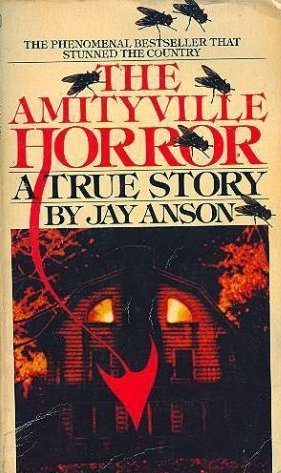
The Amityville Horror by Jay Anson

The thing is, I actually enjoy Amityville 3D quite a bit; in fact, I think it’s the best Amityville film ever made. (Don’t get overly excited now—that isn’t really saying much!) One thing I like about this one is the fact that it isn’t “based on a true story”; it’s completely fictional, and it never claims to be otherwise. Sure, the story is abysmally stupid, and the characters are more two-dimensional than you can possibly imagine. I can’t even remember any of their names; I just remember Tony Roberts plays an asshole skeptic who moves into 112 Ocean Avenue and stubbornly refuses to believe it’s haunted. Never mind the fact that it kills his best friend (Candy Clark) and his daughter (Lori Loughlin). Then he and his ex-wife Tess Harper get help from Dr. Robert Joy to free their daughter’s soul from the house. There’s also a slimy Bug-Eyed Monster living in the basement, and it seems to be responsible for all the weird shit that happens in the house. That’s pretty much the entire plot right there; there’s nothing about the DeFeos or the Lutzes, and nobody connected with the Amityville Horror hoax appears to have collected any royalties from this entry (which automatically makes it better than either of its predecessors, as far as I’m concerned).

Mind you, Amityville 3D is not what I would call a “good” movie by any means. It’s just that it chooses to exploit a silly movie theater gimmick (3D camera photography) instead of a real-life murder case, which I find much more forgivable. Yet there are some things about this film that I truly enjoy. For one thing, it scared me pretty badly when I first saw it as a kid. In a sequence that shamelessly rips off The Omen (1976), Candy Clark’s character discovers a demonic face in the photos she has taken of the 112 Ocean Avenue property. She freaks out and goes to warn Tony Roberts, but then gets harassed by a demon fly while she’s driving in her car. She crashes her vehicle and is then set on fire, and as she dies, she screams one of the most convincing screams of pain I’ve ever heard in any horror flick. Now up until this point in the film, Clark is built up as being the main female lead, so it was really unexpected (not to mention upsetting) to see her get bumped off like that. It’s not an easy scene for me to watch even as an adult, so I have to give the creative team behind Amityville 3D a great deal of credit for scaring me pretty good.

The Amityville House in 1973

The infamous Amityville house (112 Ocean Avenue) in 1973.

Robert Joy’s character is a parapsychologist who works at some nameless university or institute somewhere, and who is both a “believer” and a “skeptic” at once. He clearly believes in the paranormal, but he’s slow to accept any particular claims about it without sufficient evidence. He was likely only written into the film to make it feel more like 1982’s Poltergeist (which features a number of similar characters), but I enjoy his presence all the same. The other characters are either too quick to believe whatever wild-eyed crap they hear (like Candy Clark and Tess Harper), too quick to dismiss it (like Tony Roberts), or too quick to fuck around with it (like Lori Loughlin and her teenage friends). Of course, the believers turn out to be right about everything in the end; but Robert Joy seems to be the only person in Amityville with a good head between his shoulders, and he’s charming and likable to boot.

It’s too easy to pick this film apart for everything it does wrong; my only serious complaint against it is that there just isn’t enough of the gooey booger monster that shows up at the end. It would have been much more impressive if the writers had decided to unleash this beastie at the beginning of the final act, so he can raise some serious hell for the last 20 minutes or so. As it is, we only see the damn thing for a few seconds before it scorches off Robert Joy’s face and drags his ass down to hell. Then we get some telekinetic-fu as Tony Roberts, Tess Harper, and the rest of Robert Joy’s investigative team get thrown around by invisible forces throughout the house. This part is actually pretty entertaining (especially the shot where the basement door explodes and crashes into one of the scientists, resembling a live-action Looney Tunes segment); but I really wanted to see some monster-fu instead. Oh well, at least the house blows up; if I can’t have my fill of slimy glopola goodness, I’ll settle for a nice random explosion!
Just what in tarnation IS that thing, anyway?

In the earlier movies, the evil of the house is “confronted” by the Roman Catholic Church. The first movie features Rod Steiger as a priest who tries to help the Lutzes from afar, but who really doesn’t accomplish anything useful in the end; he just sort of loses his marbles, and then the movie forgets about him. The second film features a priest who tries to perform an exorcism on the Ronald DeFeo character, but he only succeeds in getting himself possessed instead. In Amityville 3D, Robert Joy’s character is a little more successful in dealing with the evil. (I mean, he does piss it off enough to make it blow its own home to smithereens; that’s got to count for something, right?) This transition from relying on organized religion to relying on quacky pseudoscience for answers was characteristic of the early 1980s. This was the era when the New Age movement really let fly and when “ancient astronauts” were all the rage. Not that I’m criticizing anyone for believing in that stuff if that is what they wish to believe; I just think it’s fascinating that the Amityville filmmakers would choose to take this course. The entire point of 1979’s The Amityville Horror was to cash in on earlier films like The Exorcist (1973), which is practically a late night infomercial for the Catholic Church. Amityville 3D is more like the bastard stepchild of Nigel Kneale’s The Stone Tape (1972), which uses scientific speculation to explain its supernatural events.

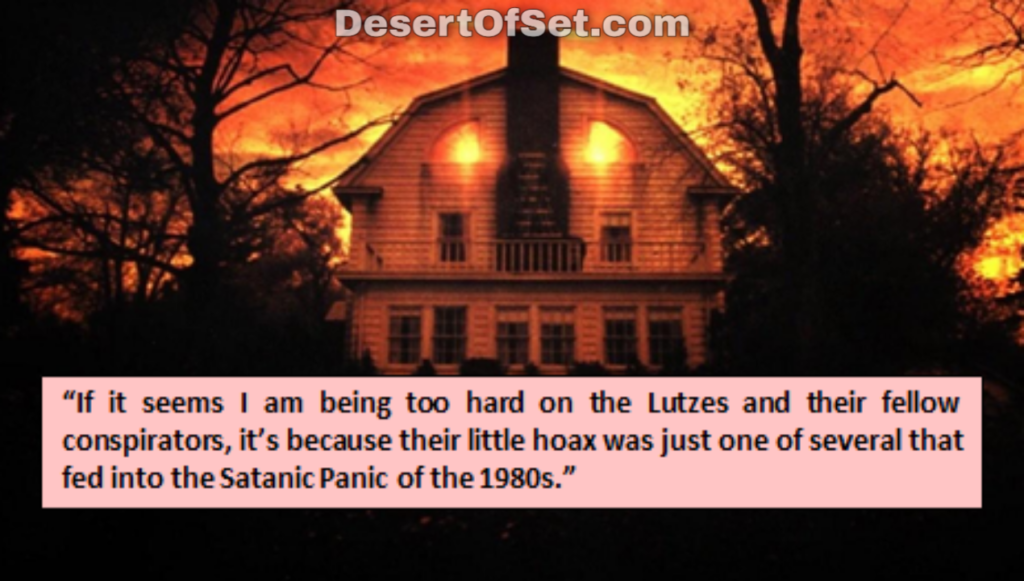
If it seems I am being too hard on the Lutzes and their fellow conspirators, it’s because their little hoax was just one of several that fed into the Satanic Panic of the 1980s. Of all the paranormal investigators who ever looked into their story, Ed and Lorraine Warren are perhaps the most famous and well-known. You might remember their names from all those Conjuring and Annabelle movies that have been produced over the past decade. Ed and Lorraine were a self-styled demonologist and clairvoyant, respectively, who claimed to have investigated over 10,000 hauntings together between 1952 and 2006. And during the late 1970s and 1980s, they were featured on damn near every TV special about the paranormal you might care to mention. My first exposure to them was in Scream Greats Volume 2: Satanism and Witchcraft, a direct-to-video “documentary” from 1986, wherein the Warrens insisted that organized “satanic ritual abuse” (SRA) is absolutely real. These hucksters made their fortunes by hoodwinking people into thinking that minority faiths like mine want to abuse and butcher your children, and the Amityville hoax is what facilitated their rise to fame. Granted, the Warrens weren’t the only SRA-peddlers in business at the time, and they certainly weren’t the worst. But whenever I see a trailer for yet another “Conjuring Universe” movie that probably cost about $140 million to produce, it just makes me feel a little queasy, you know?

There are several other Amityville films that came out after Amityville 3D, but only one of them—the 2005 remake starring Ryan Reynolds—was ever released theatrically. The rest are all direct-to-video or made-for-TV cheapies. The ones that were produced by Steve White—Amityville: The Evil Escapes (1989), Amityville: It’s About Time (1992), Amityville: A New Generation (1993), and Amityville: Dollhouse (1996)—are actually pretty enjoyable in my opinion; but they have almost nothing to do with Amityville or the house at 112 Ocean Avenue at all, so their titles are misleading at best.

On Rosemary’s Baby, the Satanic Panic, and Pagan Leadership

The 1980s Satanic Panic; the persecution of Pagans (in some cases BY Pagans) as “Satanists”; and Rosemary’s Baby as a statement against systemic misogyny. Listener discretion is strongly advised.

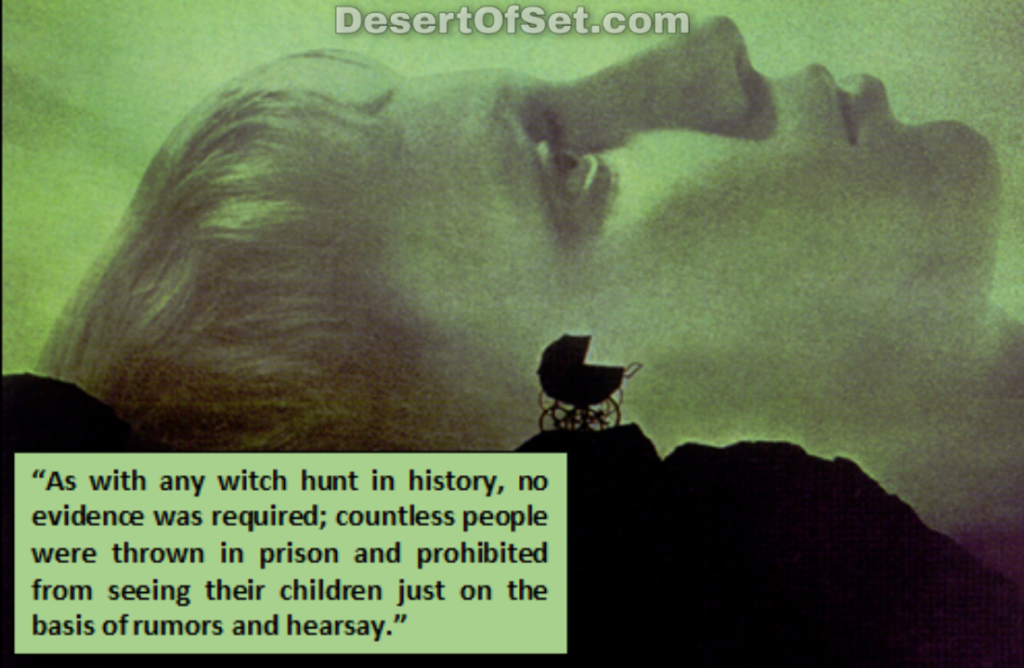
In 1973, a woman named Michelle Smith was treated by a psychiatrist named Lawrence Pazder. Under hypnosis, Smith “remembered” being repeatedly abused by a “satanic cult” as a child. She was allegedly tortured, locked in a cage, and forced to mutilate several babies, all in the name of Satan. These stories were published in Pazder’s 1980 book, Michelle Remembers, which became an overnight sensation. Next thing anyone knew, other hypnotherapists started parading their patients around on TV, calling them “Satanic abuse survivors” and making a shit-ton of money off of them. Sensationalists like Geraldo Rivera popularized these stories, bullying their viewers into accepting these “survivors” and their stories at face value. People started believing there really was an international conspiracy of Satanists who were sexually abusing and cannibalizing little children. Even psychiatric and law enforcement professionals blindly accepted these stories as true. Just being a daycare worker and having someone accuse you of being a “Satanist” (perhaps because you enjoy heavy metal music, or because you play Dungeons & Dragons) was enough to get you prosecuted for alleged child abuse. As with any witch hunt in history, no evidence was required; countless people were thrown in prison and prohibited from seeing their children just on the basis of rumors and hearsay. This was the “Satanic Panic” of the 1980s.

Things didn’t improve until the FBI launched an official investigation of the matter in the early 1990s and said, “Woops! There’s zero hard evidence to support prosecuting any of the people who’ve been put away for this shit! Plus, it turns out that when people are under hypnosis, they’ll remember random shit they saw on TV and think it actually happened!” The adult “Satanic abuse survivors” were actually remembering things they had all seen in popular horror films. Many of them had suffered real abuse in their lives, but were not receiving the kind of care they actually needed. Their therapists were making far too much money being interviewed on daytime talk shows and playing off of people’s fears. Worse yet, this prevented children who really were being abused during the 1980s from getting help as well. The police were too busy hunting imaginary “witches” to do anything about the real pedophiles who were all around them the whole time, preying on children from within their police cars, their clinical offices, or even their church pews. These realizations helped to debunk the entire urban legend of organized “Satanic Ritual Abuse” (SRA), which has not been taken seriously by anyone in psychiatry or law enforcement ever since.

(This isn’t to say that no one has ever been abused by an actual, real life Satanist; it does occasionally happen. It just isn’t as widespread a problem as people think. Such acts are typically committed by lone individuals, not by organized groups, and the victims are usually children in the abusers’ families, not other people’s children. Those who continue to peddle organized SRA stories today are right-wing conspiracy nuts who insist that all the “evidence” for SRA is being “covered up” by nonexistent cults like the Illuminati. (And newer conspiracies like “Pizzagate” are simply a variation of the same theme.) Strange that these people think themselves to be such paragons of moral virtue, given how disappointed they seem to be that there isn’t an international Satanist conspiracy to abuse and murder scores of children!)

As a result of the Panic, the 1980s were a dangerous time to be participating in any new religious movements (NRMs). This was definitely the case for Pagans, many of whom also identify as witches. The word witch is of uncertain origin, but it generally refers to any woman who is wise in the ways of the spirit world. Its use as a slur is rooted in systemic misogyny toward empowered women, and it was reclaimed by Pagans during the 20th century (especially by Wiccans). But the stigma against witchcraft continues to thrive outside of Pagan culture; I can’t tell you how many times I’ve heard about someone calling Child Protective Services on a parent simply because that parent identifies as a witch.

And while it’s understandable that Pagans would want to distance themselves from violent criminals, this was being done in some extremely deplorable ways. Some high profile leaders wrote scathing tirades against Satanism that were every bit as paranoid, deluded, and misinformed as Michelle Remembers. Some even argued that Pagans who follow Gods like Loki and Set should be completely “shunned” from the Pagan community, regardless of anything we might say to explain ourselves. So while Christians were accusing Wiccans and Druids of “worshiping the devil,” Wiccans and Druids were throwing the exact same accusation at Lokeans and Setians. This strategy of deflecting hatred by redirecting it toward other religious minorities is the most disgusting and contemptible act of hypocrisy I have ever personally witnessed, and it continues to color my perspective on many “white light” Pagans to this very day.

Contrary to what most people assume, Satanism never really existed prior to the 20th century. It began as a purely imaginary religion that Christians accused Jews, Muslims, Pagans, and even other Christians of practicing. Apart from the decadent “hellfire clubs” of the Enlightenment period, Satanism wouldn’t become an actual movement until the 1960s. That’s when Anton LaVey founded the Church of Satan and published The Satanic Bible, in which he defined Satanism as a non-theistic spirituality that emphasizes self-deification. Lucifer is viewed not as a supernatural being, but as a symbol for the base animal urges in all people. Satanist rituals are about fulfilling these urges in ways that don’t actually harm anyone, like venting your hatred for someone by destroying something you’ve created to represent them. (Whether this “spell” of sympathetic magic actually works on your intended “victim” is incidental; its true purpose is to work on you.) Many of the people who follow LaVey’s teachings are narcissists, eccentrics, or even Social Darwinists; but surprisingly, most of them aren’t serial killers or child molesters.

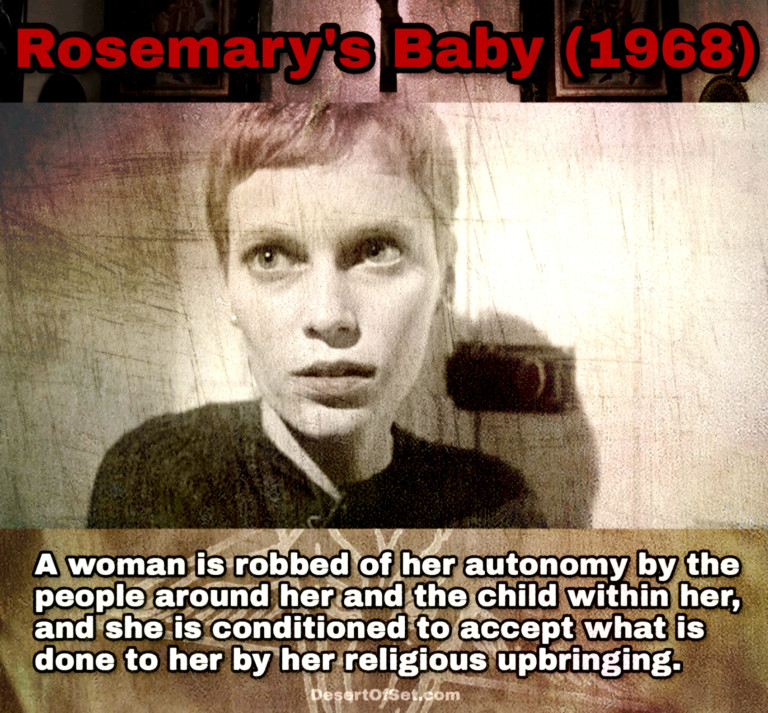
The theme of witches harming children goes back thousands of years to the earliest known cases of blood libel in Alexandrian Egypt; but if there is any contemporary influence that gave shape to the Satanic Panic in particular, it is most certainly Rosemary’s Baby (1968), which set the standard for all “devil cult” movies to follow. (In fact, I’m willing to bet most of the “survivors” were specifically remembering things from this film while they were under hypnosis.) And due to its depiction of witches and witchcraft, Rosemary’s Baby can be a very difficult film for many Pagans to watch or even discuss.

Rosemary Woodhouse (played by Mia Farrow) and her husband Guy (John Cassavettes) move into a new apartment in Manhattan. Guy is a struggling actor looking for work, and Rosemary dreams of having a baby to care for at home. She appears to have mixed feelings toward her Roman Catholic upbringing; she blushes when other characters voice criticisms against the Pope, but she dreams of domineering nuns and of parties that are for “Catholics Only” while she’s asleep. The Woodhouses also have some peculiar new neighbors named Minnie and Roman Castavet. They’re an elderly couple who have a young hippie woman living with them, and they make lots of strange noises in their apartment at night. Their young lady friend soon turns up dead (after jumping out a window near the top of the apartment building), and then the Castavets suddenly become very interested in the Woodhouses. Rosemary notices Roman talking conspiratorially with Guy, who seems to have formed a close friendship with the old man, and Minnie keeps invading Rosemary’s space, showing up at the front door all the time and just inviting herself in.

Eventually the Woodhouses decide to try and have a baby, so they schedule a romantic evening at home. But Rosemary falls sick after dinner and collapses in their bed. She has a dream in which she is surrounded by the Castavets and many other elderly people (all of whom are nude). Then she is raped in the dream by a big hairy creature with snake-like eyes. Upon waking, she notices all these bruises and claw marks on her body. This is when we get our first clue that something is seriously wrong with her marriage, because Guy tries to comfort Rosemary by claiming that he had sex with her after she passed out (ostensibly because he was worried about missing her fertile window). Rosemary clearly isn’t comforted by this admission of marital rape, but she suppresses her anger and submits to her husband’s will. And when she discovers soon thereafter that she is actually pregnant, she seems to forget the whole thing for a while.

Rosemary is overjoyed with the prospect of motherhood, but her happiness wanes as she starts to feel a terrible pain in her stomach. The Castavets recommend that she see a doctor named Sapirstein, who prescribes a special vitamin drink for her and tells her she’ll be fine. But the pain only gets worse after that, and whenever Rosemary tries to tell Guy about it, he just becomes angry and belligerent. She begins to lose more and more control over her own body (even receiving criticism for a haircut she gets halfway through the film), and she starts to imagine that the Castavets are child-murdering witches. She comes to suspect Guy of having made a pact with them, a pact that somehow involves her unborn child. This is sustained by the fact that Guy visibly hated the Castavets when he and Rosemary first met them, but now he adores them for no apparent reason, listening to everything they suggest about Rosemary’s pregnancy. But are the neighbors really witches? Do they really want to hurt Rosemary’s baby? And is Guy really in on the plot? Or could it be that poor Rosemary has just gone crackers?

(If you wish to avoid reading any spoilers, stop reading this and go watch Rosemary’s Baby right now. If you’ve seen the movie already, or if you don’t care about spoilers, please proceed.)

It turns out the Castavets are indeed leading a coven of Satanist witches, but they’re not interested in harming Rosemary’s baby; since the father is actually Lucifer himself, they’re working to protect the little monster instead. And Guy is definitely in cahoots with them, having prostituted his wife to the devil in exchange for a solid movie career. But the real horror in Rosemary’s Baby is neither witchery nor diabolism; it’s the experience of being physically violated, of not being able to trust your spouse, and of being caught between two clashing ideologies that both regard your body as someone else’s property. It’s easy to see how this applies to the Castavets and their followers; for them, Rosemary is simply a vehicle for the delivery of their dark messiah, and she has no choice but to obey them at the end of the film. But do you know what else is good for oppressing women and legislating their uteruses? Roman Catholicism, that’s what. Were Rosemary to approach the Catholic Church for help, her situation would not be any different; she would still be expected to carry her pregnancy to term, and she would still be told what to do with her body by men who know nothing of what it’s like to be pregnant. (If the church thinks it’s a woman’s “duty” to give birth even when she’s been impregnated by a rapist, why should we expect anything different when that rapist turns out to be the devil?) In fact, Rosemary’s Christian upbringing actually helps the Castavets control her, because it has already conditioned her to go along with whatever is expected of her.

But this subtext goes even deeper, for Rosemary is the mother of the Antichrist, who is naturally the opposite of Jesus Christ. And what happens in the story of Jesus? Well, he’s born of a young woman who’s made pregnant by a supernatural being without her prior knowledge or consent, and—

Woops.

The Satanists in Rosemary’s Baby are nothing like real life diabolists; they are instead a metaphor for the twisted chauvinist society in which we all live. Sure, they worship Lucifer instead of Yahweh, and they serve Antichrist rather than Jesus; but at the end of the day, they’re still an oppressive, abusive, and manipulative patriarchy. The men are in charge, the women are subservient, and one woman is raped so their male “savior” can walk the earth. How is the story of the Virgin Mary any different from that of Rosemary in principle? How is the Christian “pro-life” movement any better than what Guy and the Castavets do to keep Rosemary under their control? When I first saw this film, I couldn’t get past the fact that so many people think its depiction of witchcraft is 100% accurate. But as I re-watched it over the years, I began to understand its true purpose: to illustrate how horrible it is for women to be treated as “property” in the name of any male superbeing. Even Ira Levin, who wrote the novel on which Rosemary’s Baby is based, has expressed regret that it would later be used to reinforce the Satanic Panic so much. (Levin is Jewish, which means he doesn’t even believe in Satan and would have no reason to believe in organized SRA.)

Strangely, Anton LaVey was obsessed with this film, and it continues to enjoy a strong fan base among real life Satanists. The reasons for this are not immediately clear. LaVey appears to have thought the Satanist characters are revolutionary insofar as they resemble realistic, everyday people (as opposed to being a bunch of weirdos wearing black hooded robes). He also claimed to have served as an uncredited technical advisor for the film, providing some authenticity to the film’s ritual scenes. To the best of my knowledge, this claim has never been substantiated; LaVey simply spread the rumor around to cash in on the film and generate some free publicity for his church. Every now and then, I encounter a Satanist who thinks Rosemary’s Baby is “pro-Satan” somehow, and I can only shake my head at them. Considering how much fuel this movie gave to the Satanic Panic about 13 years after its original theatrical release, you’d think these people would find it just as troubling as most Wiccans or Druids do; but I digress.

Back in the 1990s, when I was still a young Setian novice, things were very different in the Pagan community than they are now. Nowadays, I can attend a Pagan meetup, mention I worship Set, and most people will probably be OK with having me around. But in the 1990s, it was a whole other deal. As soon as people saw my horned pentacle necklace or heard me praise the Son of Nut, they would tell me I wasn’t welcome, that I was being a “disruptive influence,” and that I should just leave. They automatically assumed I was some demented freak who just wanted to cause trouble. I’m pretty sure most Wiccans and Druids have no idea what it feels like to be excluded and alienated by other Pagans in this way. The thing that has always infuriated me the most about this treatment is that it was trickling down from the top. Big name Pagan leaders like Isaac Bonewits were actively encouraging their followers to treat Setians, Lokeans, and other Pagans they didn’t approve of like we’re all a bunch of extremist psychopaths. These “leaders” seemed to think the most appropriate way to deal with the Satanic Panic was by diverting society’s attention from themselves to people in Paganism they wanted to exclude. In doing this, they helped to promote a “legitimized” stereotype about Paganism that is not representative of the entire Pagan population.

To make things even more interesting, the #MeToo Movement has helped to reveal that some of these Pagan “leaders” are or might have been child abusers themselves. This brings new light to every nasty thing these people have ever said about people like us when the Satanic Panic was still fresh. Trying to save their reputations by targeting an entire sector of the Pagan population for exclusion is one thing; but to think that even the late great Isaac Bonewits was one of the people the police should have been investigating the whole time? I hope you can understand why I would be enraged by this.

The lessons to be taken from all of this are as follows. No one should ever be deprived of their bodily autonomy like Rosemary Woodhouse is by her husband Guy and the Castavets. While the Castavets don’t reflect actual Satanist practices or values, they do reflect the very real issue of human trafficking, which was not an issue most people were aware of during the 1960s. But if Rosemary’s Baby was meant to galvanize society into addressing this particular concern, perhaps it succeeded a little too well. It blurred the line between “new religious movements” and “human trafficking rings,” leading people to assume that all religious minorities are extremely dangerous. This distracted law enforcement from sufficiently investigating and prosecuting some of the real trafficking rings that were actually in operation at the time. It also led to several Pagan “leaders” throwing Pagans they didn’t like under the bus, even while some of them were allegedly abusing children behind locked doors. And if that doesn’t make you feel sick to your stomach, you must have a much weaker gag reflex than I do.

Satan Sells

The Stuff Nightmares Are Afraid Of

Wes Craven’s A Nightmare on Elm Street (1984) is a terrific allegory for the eternal conflict between Set and the Chaos Serpent. With instructions for a spell for protection during sleep.

In Wes Craven’s A Nightmare on Elm Street (1984), some teenagers start having nightmares in which they’re menaced by this disfigured creep who has knives for fingers. Whenever this asshat kills someone in their dreams, they die in real life at the same time. One of the teenagers, Nancy Thompson (played by Heather Langenkamp), discovers that when they were little children, their community was terrorized by a serial killer who preyed on little kids. The man was arrested and put on trial, but he got off on a technicality and was released. Then, fearing for their children’s safety, the parents of the community took the law into their own hands and burned the killer alive. But this has only made things worse, for it is the killer’s ghost who now haunts the kids in their dreams, seeking revenge against the parents by finishing what he started. Now it’s up to Nancy to find a way of execrating this evil spirit.

On the one hand, A Nightmare on Elm Street has more than its fair share of devoted fans; on the other, it receives far more derision from mainstream critics and the general public than it really deserves. I blame this on most of the sequels, which became increasingly goofy with each new installment. By the end of the 1980s, Freddy Krueger was practically a live action cartoon character, and this is the version of him that most people remember today. Sequels like The Dream Warriors (1987) and The Dream Child (1988) are more like self-parodies than straight horror films; they don’t even bother to take themselves that seriously. But if you watch the original Nightmare from 1984, I promise you: even if it doesn’t scare you, it will make you quite uncomfortable at the very least. There’s absolutely nothing “funny” about this film at all, and the Freddy Krueger character is really just the tip of the iceberg.

When the film begins, the daylight reality in which Nancy and her friends all live seems safe enough; but as Freddy Krueger becomes more prominent in their dreams, the ugly truth about their everyday world begins to unfold. These things are never stated to the audience outright, but viewers will notice that Nancy’s parents are divorced (and that the proceedings of this arrangement were anything but amicable). Nancy’s mother is an alcoholic, and her father—the town sheriff—only shows up whenever there’s a tragedy. At the same time, Tina’s mother also seems to be divorced and would much rather spend time with her boyfriend in Las Vegas than stay with her daughter (even when she knows the poor kid has been having terrible nightmares). Rod’s parents seem to be completely absent from his life, leading him to take on a life of petty crime. And then there’s Glenn (played by a baby-faced Johnny Depp), whose parents demonize Nancy for no good reason aside from the fact that two of her friends are dead.

It’s ironic that these parents once resorted to mob justice to protect their community, for they don’t seem to care very much about their community now. None of them are involved in their children’s lives anymore, and none of them seem to care that much when each other’s kids die. When Tina gets butchered, Rod is immediately accused of the crime, and none of the adults ever question this. We never see Tina’s mother afterwards, so we’re left to wonder if she even grieves for her daughter at all. When Rod gets strangled by Freddy in his jail cell, it’s clear to all the adults that it was suicide and no one shows any kind of sympathy for him. Clearly, Tina and Rod’s deaths mean nothing to Glenn’s parents, who seem to think they can avoid having anything like that happen to Glenn by keeping him away from Nancy. Meanwhile, Nancy knows exactly what’s happening, but no one will believe or even listen to her, even when the evidence is staring them in the face. For Duat’s sake, she can’t even get any help from her father, the sheriff!

It is this complete absence of parental support that makes the film truly terrifying, in my opinion. Never mind the idea that Nancy and her friends are being targeted by a supernatural force; Freddy Krueger is simply the 1980s American version of an ancient Akkadian Alû demon (i.e., a spirit that terrifies people while they sleep), and the ancient Akkadians knew well enough how to deal with such things. If an Akkadian child reported having certain experiences while he or she was asleep, his or her parents didn’t take any chances; they simply execrated the Alû with their magic and the problem usually went away. So the idea of Freddy Krueger in and of himself is not that impressive; entities like him are just little things in this world, and it doesn’t take that much to get rid of them. It would help if the Elm Street families were willing to entertain the possibility of such events in the first place; but even more importantly, the fact that the children can neither trust nor depend on their parents is a serious problem. That is what enables demonic forces like Freddy to perpetuate themselves in the first place, and that is what disturbs me most in this film.

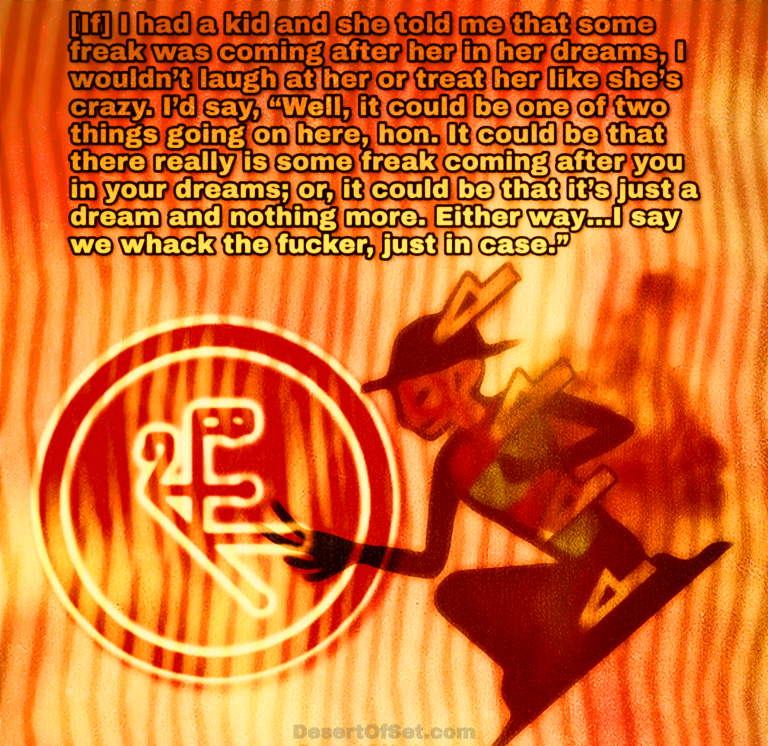
Mind you, I’m not claiming that every childhood boogeyman is actually real; nor do I contend that magical thinking is always the best answer to one’s problems. But if I had a kid and she told me that some freak was coming after her in her dreams, I wouldn’t laugh at her or treat her like she’s crazy. I’d say, “Well, it could be one of two things going on here, hon. It could be that there really is some freak coming after you in your dreams; or, it could be that it’s just a dream and nothing more. Either way…I say we whack the fucker, just in case.” And then I’d have her draw a picture of the creep that’s scaring her, and we’d hurl all kinds of abusive language at him in Set’s good name. We’d stick pins in his ass and chop him up into little pieces; then we’d throw him in the fireplace and watch the little bastard burn. Call me superstitious if you like, but like the Akkadians, I don’t believe in taking any chances with this kind of stuff. No kid should ever have to face a monster alone like Nancy does in Nightmare on Elm Street.

(If it seems crazy that I’m talking about the things that happen in Nightmare like they’re real, I’d like to point out that the film is partially inspired by true events. During the 1970s, director Wes Craven read an article in the L.A. Times about a group of Khmer refugees who were living in the United States, and whose children were having nightmares that disturbed them so badly, they refused to sleep. Some of them later died in their sleep, and it was as if they had known they would die if they didn’t stay awake. This story disturbed Craven to his core, and it later became his main inspiration for writing Nightmare. Craven has also said that he took inspiration for the film from certain Buddhist and Taoist ideas, and anyone who’s ever listened to the man talk will know that he actually believed in some kind of spirit world.)

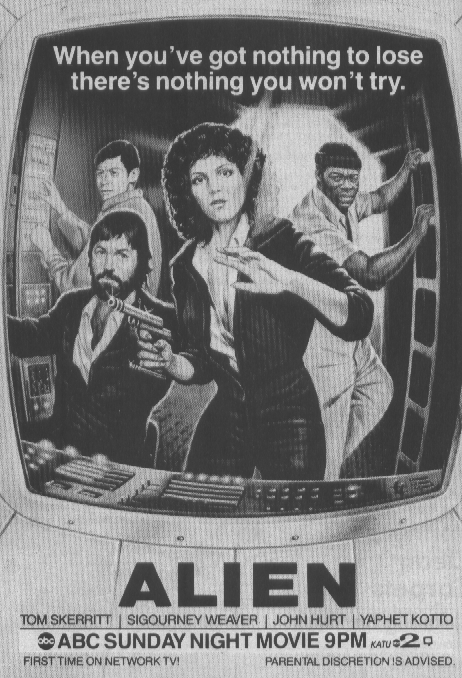
The Nancy Thompson character is easily the best thing about this film; in fact, she’s the very best “Final Girl” since Laurie Strode in Halloween and Ellen Ripley in Alien (1979). Unlike Laurie, she becomes aware of her nemesis early in the film and she actively hunts him down; and unlike Ripley, she has no weapons aside from her own determination and resourcefulness. Nancy eventually discovers that if she holds on to something in her dreams while she’s waking up, she can bring it over to the real world. She decides to conduct this extremely dangerous experiment with Krueger, and when it proves successful, the tables are immediately turned. Freddy finds himself at Nancy’s mercy, suffering every form of abuse the teenager can throw at him; he even becomes afraid of her at one point. And considering just how slimy a character Freddy really is, it feels really good to see him get his comeuppance this way.

This humiliation of the antagonist is a recurring theme in many of Wes Craven’s films (including 1972’s The Last House on the Left, 1977’s The Hills Have Eyes, 1988’s The Serpent and the Rainbow, 1991’s The People Under the Stairs, and 1996’s Scream). There’s almost always a transition point in these movies where the surviving victims gain some kind of advantage over the villains, and the villains become blubbering, pathetic fools. I believe Craven’s intention here was to demonstrate that while evil may often seem very powerful and formidable, it only has as much power as we allow it to have. When we take that power back, evil is revealed for the frail and empty little thing that it really is. And in the original script for Nightmare on Elm Street, that is exactly what happens; Nancy defeats Freddy Krueger by taking back all the energy she’s put into him with her fear, and his spirit is dissolved back into the Void forever.

My only criticism of A Nightmare on Elm Street is the fact that its ending was sloppily changed at the last minute, and for purely commercial reasons. Nancy defeats Krueger, and all seems well; but then she realizes she’s actually having another nightmare, and the rotten bastard gets her after all. This ending always leaves a very bad taste in my mouth. They go through the entire movie developing this really likable character who’s noble and strong and who succeeds in defeating (and even humiliating) the villain; then they pull the rug out from under her at the last minute just to give the audience one last jump scare. Granted, it scared the hell out of me when I first saw this film as a kid; but as an adult who’s digested the rest of Wes Craven’s work, I can see just how “un-Cravenian” that ending really is. As it turns out, Craven had a major dispute with Nightmare’s producer, Robert Shaye, who wanted a scary ending to set the stage for a sequel. Craven eventually gave in to Shaye’s demands just so they could finish making the film. I think this was an unfortunate choice on Craven’s part, as it prevents Nightmare from being a truly perfect film; but the rest of the film holds up remarkably well, even after 30 years, so at least there’s that.

When you stop to think about it, sleep really is kind of a scary thing. If we hold to the Cartesian definition of existence (i.e., “I think, therefore I am”), we technically cease to “exist” for a while when we aren’t awake. Sure, our bodies are still there and our brains continue to function; but we don’t really “think” in the normal sense of the term, since we aren’t conscious. So in a way, we all become like Schrödinger’s Cat when we’re asleep; we’re neither alive nor dead, and we only collapse back into a solid state of reality when we regain our capacity for conscious self-reflection. We’re extremely vulnerable while we’re in this state (both physically and otherwise), and this is partly what the Egyptians were getting at with their tales about Ra being menaced by Apep in the Underworld each night. By attacking Ra, Apep isn’t just posing a cosmic threat against the Creator; it’s also posing a personal threat against all creatures that sleep and dream.

Nancy Thompson’s struggle with Freddy Krueger is a perfect representation of this principle, especially since it’s built upon fears that many cultures traditionally associate with sleep. Apep and Krueger are both astral monsters that try to kill living things while they regenerate (whether this means a sleeping Creator or a sleeping human). Both attempt to kill the future (whether by preventing the dawn or by murdering kids). Both thrive when the good do nothing (whether this is due to a paralyzing gaze or a conspiracy of silence). And both are easily overpowered once you learn how to see through their tricks (whether this is achieved by a badass Thunder God or a plucky suburban teenager). In this way, I consider the character of Nancy Thompson to be a true daughter and warrior of Set.

Set & Nancy Thompson vs. the Serpent & Freddy Krueger

Incidentally, here is a procedure you can use to help you feel a little more like Nancy Thompson when you need it most. If you ever get scared when you’re in bed at night, give this procedure a shot. No Freddy Kruegers can hold a candle to the awesome power of He Before Whom the Sky Shakes.

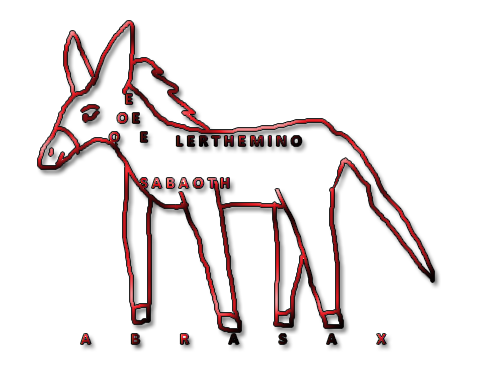
Get a blank sheet of paper and some red paint. (If you don’t have any red paint, you can use a pen with red ink.) Draw a donkey that’s facing left, and write the word “EOEOE” in the shape of triangle on its neck. Then write “LERTHEMINO” on its back, and write “SABAOTH” on its breast. Finally, write the name “ABRASAX” directly beneath the donkey’s hooves, so that it looks as if the donkey is “walking” on the word. You don’t have to be a great artist; even the simplest and most child-like scribbling will do. (In fact, the simpler and more child-like you can manage, the better.) Just make absolutely sure that you draw the donkey facing to the left and that you write the voces magicae (“words of power”) exactly as I’ve said. When you’re finished, your painting or drawing should look like this:

Typhonian Spell for Protection During Sleep

Next, place this painting or drawing in a folder or something else in which it can stay unfolded and flat. (Under no circumstances should you fold it or crumple it.) You must never let any sunlight touch this image you’ve created; it must always be kept in darkness. Once you’ve placed it inside a folder, place it under the mattress of your bed. Preferably, it should be sandwiched between your mattress and your springboard. If the negative energy in your home seems to be centered on someone else in the house (e.g., a child), place the folder under his or her mattress instead. You can make one of these donkey images for each person who lives and sleeps in your home, if you like. Just follow the exact same procedure for each one. Make sure you place the images in areas where they can’t be seen, where no sunlight can touch them, and where they’re close to you and your loved ones while you sleep. Keep them there for at least seven days and nights; you can feel free to remove them after that amount of time has passed.

What Are You Afraid Of? It’s Only Rock & Roll!

Discussing the theme of “backmasked” messages in heavy metal music during the Satanic Panic, as explored in the 1986 comedy horror film, Trick or Treat. 

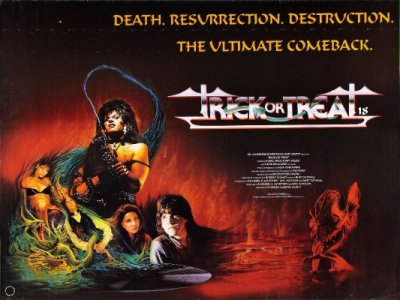
One of my all-time favorite movies is a flick that hardly anyone seems to know about. You have to be a real 1980s horror nerd to have seen Charles Martin Smith’s Trick or Treat (1986), and it probably helps if you’re a metalhead too. I’ve never once seen the flick listed on anyone’s “Top 10 Favorite Movies” list, but you will certainly find it on mine, and I’ll tell you why. To the best of my knowledge, this is the first film ever made that features a plot inspired entirely by heavy metal and the hatred it received from politicians, televangelists, and self-righteous soccer moms during the 1980’s Satanic Panic. It may not necessarily be the best film of its subgenre; undoubtedly, many people would probably vote for Jason Lei Howden’s Deathgasm (2015), which has a very similar plot. But despite Deathgasm’s superior production values, Trick or Treat did it first, and it made a huge impression on me while I was growing up.

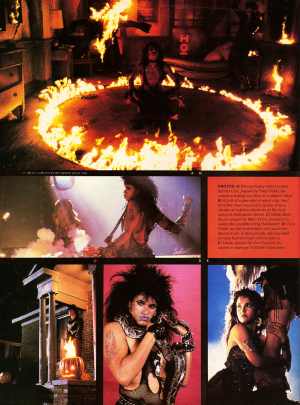
Eddie Weinbauer (played by Marc Price, better known as “Skippy” from Family Ties) is a teenage metalhead who lives in the town of Lakeridge, North Carolina, and who goes by the nickname “Ragman.” Eddie is especially dedicated to the music of Sammi Curr (Tony Fields), a glam metal shock rocker who’s obviously inspired by Alice Cooper. Eddie absolutely worships Sammi, and he’s friends with a radio DJ named “Nuke” (Gene Simmons of KISS), a nerd named Roger (Glen Morgan, one of the lead writers for The X-Files and the Final Destination movies), and a pretty girl at his school named Leslie (Lisa Orgolini). Unfortunately, Ragman is also bullied at his school by a bunch of jocks (led by Doug Savant of Desperate Housewives fame), who all think he’s creepy and weird. These guys are pretty harsh, too, because they apparently see nothing wrong with trying to drown poor Eddie in a swimming pool.

Trick or Treat 1986 movie poster

Why does Ragman dig Sammi Curr so much? Because Curr’s music helps him cope with his feelings of subjugation. In a strange way, Curr is eerily prophetic of Marilyn Manson, who took shock rock to a whole new level in the 1990s. Not content with just scaring or pissing off parents, Manson made himself into a full-blown culture war iconoclast (the “Antichrist Superstar”) and deliberately terrorized the entire American Religious Right. In a similar way, Curr uses his music and his fanbase to declare war on society. He offers his fans a future in which “Rock’s Chosen Warriors will rule the Apocalypse,” and he promises all who try to ban his music that “We will bring you down.” For Eddie, Curr is more than just a rock icon or a hero; he’s a counter-cultural messiah who promises total emancipation from Christian society.

But all of this seems to vanish into thin air when Eddie turns on the TV one morning to learn that Sammi Curr has died in a hotel fire. The boy is instantly crushed and descends into despair, but when he visits his friend Nuke at the local WZLP radio station, Nuke gives him a special gift. You see, Sammi Curr actually grew up right here in Eddie’s hometown, and Nuke was friends with him when they were kids. As it turns out, Nuke just happens to have a demo recording of an album Curr was still recording when he died. (The album is named Songs in the Key of Death.) Nuke gives the record to Eddie, telling him Sammi would have wanted him to have it. And while listening to it later that night, Eddie discovers the album contains a bunch of backmasked messages. Then he plays the record in reverse to see what the messages are saying, and that’s when he receives the biggest shock of his life.

Ragman

Eddie “Ragman” Weinbauer and his hero, Sammi Curr.

The voice of Sammi Curr speaks to Eddie through the backmasked messages, telling the boy to do certain things while he’s at school the next day. When Eddie follows the advice he is given, he outsmarts his foes and gets them in trouble (while getting away scotch free, himself). It then seems like the two conspirators will get to realize their shared vision of a world without bullies after all; but as Curr continues to help Ragman “nail” his tormenters, he also demands the boy’s help in “nailing” everyone who ever tried to ban his music. Their Halloween pranks soon turn deadly, and Ragman realizes his beloved demigod is actually a demon. By the end, Eddie must stop Sammi from killing everyone in Lakeridge when Nuke plays Songs in the Key of Death backwards on his radio show (on All Hallows’ Eve, no less).

Now I know good and well what some of you must be thinking. Trick or Treat sounds like something that was made by evangelical Christians, right? It sounds like the entire point of the film is to demonize heavy metal and anyone who listens to it. As a devoted metalhead myself, I probably shouldn’t enjoy this film at all, should I? But consider the fact that Ozzy Osbourne appears in a cameo as “the Reverend Aaron Gilstrom,” an anti-rock televangelist. Yes, you read that correctly: Ozzy fuckin’ Osbourne plays a Jimmy Swaggart clone who preaches that metal musicians are all Satanists brainwashing our kids. (Now that’s what I call irony!) I might also point out that Trick or Treat doesn’t quite end the way you’d expect. If this were an evangelical propaganda film like Rock: It’s Your Decision (1982), Eddie would swear off metal for good after defeating Sammi Curr and “give himself to Jesus” (as they say). But after he defeats the ghost of the man who used to be his hero, what do you suppose Ragman actually does?

By Gods, he plays a Gods-damn Sammi Curr record!

Yes, that’s right—and I think this is where Trick or Treat really shines the most. While the film is inspired by urban American myths about “backmasking” in heavy metal music, it obviously does not agree with the people who take such fears literally. Instead, the film presents metal as something that’s legitimately fun but misunderstood—and not only by parents, preachers, or politicians. Eddie Weinbauer eventually sees that Sammi Curr is a much worse bully than any of the jocks who’ve been tormenting him at Lakeridge High. But when Eddie takes Sammi down, he isn’t turning his back on metal (or even on Curr’s music, necessarily). He’s just learning to separate the art he loves from the artist who created it. The artist might be a major asshole, but it’s OK to still enjoy and take inspiration from their art.

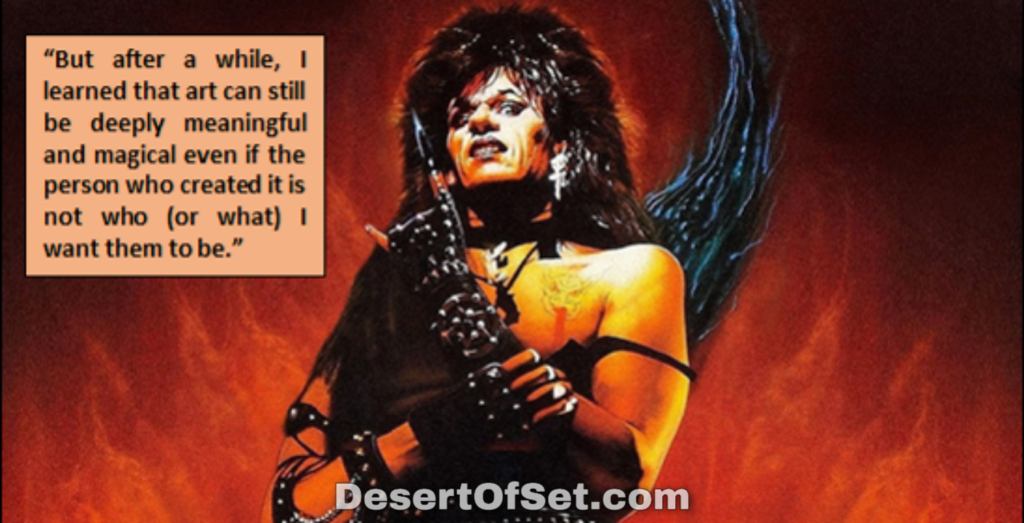
When I was in high school, I used to worship the ground Marilyn Manson walked on. But then I learned he really isn’t the all-powerful “Antichrist Superstar” he made himself out to be. At first, this made me feel like I could never listen to Manson’s music again; my sense of disappointment was just too much. But after a while, I learned that art can still be deeply meaningful and magical even if the person who created it is not who (or what) I want them to be. I went through this exact same process with Alice Cooper and Ozzy Osbourne. In heavy metal especially, it’s easy to confuse the people creating the music with the characters they play on stage. Marilyn, Alice, and Ozzy aren’t real people; they’re bigger-than-life personas that were created by Brian Warner, Vincent Furnier, and John Osbourne, respectively. The funny thing is that once I finally began to understand this principle, I started to enjoy their music even more.

Heavy Metal

Some promotional photos for the film.

In Trick or Treat, the problem is not with heavy metal itself, but with the fact that Sammi Curr takes his hype and his stage persona way too seriously. When Eddie fights him, Sammi accuses him of being “false metal”—but in reality, Sammi is the one who is false. Part of the fun to heavy metal is that it’s basically a huge power fantasy that can be taken to some truly ridiculous extremes. What’s more, this is usually done while keeping one’s tongue planted firmly in-cheek. Sure, there are people like Sammi Curr who take themselves way too seriously; but this genre was built on the backs of guys like Coop and Ozzy, who sing about strangling people or having sex with the devil while winking at their audiences. It’s all make-believe, much like a Halloween party that never ends, and the people who take it too seriously—including both the Pat Robertsons and the Varg Vikerneses of this world—are completely missing the point.

Most people who’ve seen Trick or Treat will tell you it’s a total dud. To be fair, it is full of bloopers; you can even see the boom mike at the top of the screen at one point. (Keep your eyes peeled when Ragman answers the front door, only to find his mom’s boyfriend dressed up as Rambo on the other side. Pay close attention to the top right-hand corner of the screen!) The movie also can’t seem to settle on whether it wants to be a genuine horror film or a comedy with horrific overtones, which is something that normally tends to annoy me. But even with all that being said, Trick or Treat is very well-acted, the music is phenomenal (featuring songs by Fastway and a score by Christopher Young), and a great deal of creative effort was clearly put into it. They weren’t just trying to make a quick buck with this one; they were actually trying to make something witty and intelligent—and for my money, at least, they succeeded.

Trick or Treat is also a film that we hold sacred in the LV-426 Tradition (much like 1979’s Alien and 1982’s The Thing). It nicely reflects our own personal histories with Set. We were all like Eddie Weinbauer when we were kids; we were alienated youth, and we coped with our problems by listening to angry, aggressive-sounding music. That same music became one of our various “doorways” into Setianism, and for this reason, we treated our rock heroes like they were pillars of wisdom and virtue. Big Red had to disabuse us of this notion over time; like Ragman, we had to learn how to enjoy our favorite artists without believing in all their hype, and Trick or Treat reminds us of what it was like to go through all of that.

Alternate poster

Alternate poster art for the film.

Set On Screen

One Setian’s opinion on how certain media depictions of Set hold up against the real-life God. 

Sometimes when people find out I believe in Set, they ask me how I can possibly believe in a “fictional character” from Doctor Who or Marvel Comics. Occasionally, I’m even asked if I think I’m some kind of vampire. This really gets on my nerves, but I suppose I can’t blame the people who ask such questions. Popular culture has appropriated and taken so much liberty with Set over the years that most people only know about Him from reading comic books or watching science fiction TV shows. Inevitably, Set is always cast as a villain in these and other popular media, and this compounds the problem by leading people to think I’m some kind of “devil worshipper.” (This isn’t helped by the fact that Set is so often appropriated in Satanist legitimation strategies, wherein Satanism is re-conceptualized as something “pre-Christian”—but we’ll address that particular can of worms another day.)

There are various forms of popular media that I consider to be very Setian indeed. However, the evocation of Set in these media is most often unintentional; He is to be divined in the subtext rather than the text. In most creative works that actually mention Set by name, there is little to nothing of His actual presence to be found. Allow me to show you just what I mean.

Set in Robert E. Howard’s Conan Cycle (1930s)

Set is most often conceptualized in pop culture as some kind of “evil snake God.” This is ironic given that He’s actually a mammalian God who’s primarily associated with herbivorous artiodactyla (i.e., cloven-hoofed animals). But it isn’t hard to see where the “snake God” idea came from. By the time the Greeks were in control of ancient Egypt, Set was completely demonized by the Egyptians. They blamed Him for the decline of their civilization, and they deliberately confused Him with His enemy, the monster Apep. When the Greek writer Plutarch started writing his own account of Egyptian mythology, he identified this fusion of Set and Apep with Typhon, a monster from Greek mythology. Plutarch’s version of events was taken at face value by many of the early Egyptologists; it wasn’t until the publication of Herman te Velde’s Seth: God of Confusion in the 1970s that more accurate information about Set started becoming available. So when Robert E. Howard drew from pre-Christian mythology for his stories about Conan the Barbarian during the 1920s, the “evil snake God” idea was still in vogue.

Set is cast in Howard’s tales as a gigantic snake from outer space that was originally worshiped by a race of alien Serpent Men. He plots to cause the extinction of humanity so these Serpent Men can rule the Earth once more. I really enjoy Howard’s Conan stories, but I can’t help but laugh at this fictional version of Set. If you’re a Christian, imagine what it might be like if Jesus appeared in a story as a giant alien goat that just wants to eat everybody. That would be pretty silly, right? (I mean, Set could appear as a giant snake and eat everybody if He really wanted to; but…)

Robert E. Howard's version of Set in Marvel Comics

Robert E. Howard’s Set, as depicted in Marvel Comics

So is there anything of the real Set in Howard’s fiction? Actually, I would say yes…but not in the form of Set the Stygian snake God. I would contend that Set’s true nature is better revealed through the character of Conan himself, a nomadic anti-hero who rejects the authority of kings and priests. He’s primarily interested in his own gain, but he also rescues the innocent and defeats frightening monsters…just like Set. In one particular story, “The Tower of the Elephant,” Howard describes some of Conan’s feelings about the organized religions that are practiced in his world, and I believe his views on this subject are in keeping with Set’s:

He had entered the part of the city reserved for the temples. On all sides of him they glittered white in the starlight—snowy marble pillars and golden domes and silver arches, shrines of Zamora’s myriad strange gods. He did not trouble his head about them; he knew that Zamora’s religion, like all things of a civilized, long-settled people, was intricate and complex, and had lost most of the pristine essence in a maze of formulas and rituals. He had squatted for hours in the courtyard of the philosophers, listening to the arguments of theologians and teachers, and come away in a haze of bewilderment, sure of only one thing, and that, that they were all touched in the head.His gods were simple and understandable; Crom was their chief, and he lived on a great mountain, whence he sent forth dooms and death. It was useless to call on Crom, because he was a gloomy, savage god, and he hated weaklings. But he gave a man courage at birth, and the will and might to kill his enemies, which, in the Cimmerian’s mind, was all any god should be expected to do.


—Robert E. Howard, “The Tower of the Elephant”

I don’t think it’s “useless” to call on Gods for help (and there are times in the stories when even Conan must do so), but I do agree that spirituality should be kept as simple and practical as it possibly can. The fact that Conan thinks this way makes sense, since he’s a nomad. He doesn’t have time to sit around and discuss theology; he only cares about what works at any given time. Who cares whether the Gods are spirits, aliens, or Jungian archetypes so long as our prayers and rituals to them continue to work? And since Set’s most ancient worshipers were nomads who lived in the Sahara Desert, I believe they would have thought in much the same terms. I try to keep this attitude as well, eschewing theological arguments in favor of whatever works to get me through the struggles I must face. In this sense, I believe there really is quite a bit of Set in Robert E. Howard’s fiction; just not in the way you might expect.

Set in the Marvel Universe (1970s)

In the 1970s, the Marvel Comics Group was licensed to print its own stories based on Robert E. Howard’s Conan character, and it incorporated Conan’s world into its own unique universe. As a result, Howard’s version of Set was expanded upon and became an integral part of Marvel’s lore. According to this version of events, Set originated as one of the Elder Gods at the beginning of time, and He became evil by cannibalizing His own kind. Then, to escape from the vengeance of a younger God called Atum (who’s named after Atum-Ra), He slithered away into an alternate dimension. (Yes, this Set is still a giant snake.) Unfortunately for Set, He can’t escape this dimension by Himself, but must instead procure servants in this world to help facilitate His return. This role was originally filled by the Serpent Men of the Conan stories, but Set would also recruit followers in the twentieth century. This, in turn, would lead to several confrontations between the followers of Set and such well-known superhero teams as the Avengers.

Confusingly, Marvel Comics also created another fictional version of Set who is identified as being the actual Egyptian God (as opposed to the Stygian God). He’s a recurring villain in the Thor comic books, and most of His role in the Osirian myth cycle is kept intact. He actually tricks Osiris into a coffin, then drowns Him in the Nile and dismembers Him. Naturally, Marvel built upon this story in certain ways to integrate it with its universe (and they conveniently removed all the parts about Set defending Atum-Ra from Apep). But the strangest twist is when Seth supposedly tricks mortals into worshiping Him by transforming Himself into a giant snake and pretending to be Set (i.e., the snake God of Howard’s Serpent Men). In other words, a demonized version of Set pretends to be another demonized version of Set to gain His followers.

Seth–as opposed to Set–in Marvel Comics

Seth—as opposed to Set—in Marvel Comics.

If that doesn’t strike you as sounding completely nonsensical, let’s switch the names again. Not only is Jesus really a giant space-goat who wants to eat everybody; now there’s another, less-powerful Jesus who impersonates the space-goat Jesus so that people will worship him. (Huh?)

Set in Doctor Who (1975)

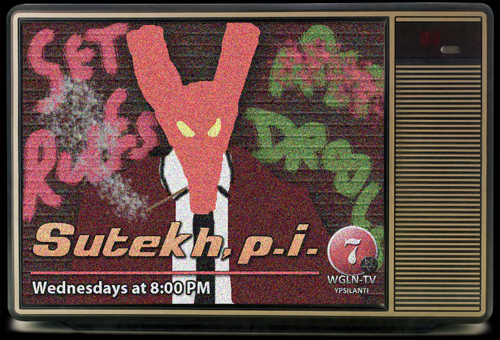
Big Red appears in the episode Pyramids of Mars as Sutekh, an alien tyrant from the planet Osiris. (Yeah.) He destroyed His own people and planet aeons ago, but then He was imprisoned by His brother Horus in a tomb on the planet Mars. When Pyramids of Mars begins, Sutekh uses His telekinetic powers to possess a guy here on Earth in the early 20th century. He then makes the guy build a bunch of robot mummies, as well as a rocket. The plan is for Sutekh’s hypnotized slave to fire that rocket straight into Sutekh’s prison on Mars. This will effectively release Sutekh from His prison, allowing Him to resume His dastardly plan of atomizing the entire universe (for no apparent reason). Thankfully, our favorite Gallifreyan Time Lord, the Doctor (played here by Tom Baker), is on the case. (And since this episode aired in 1975 and Doctor Who is still being produced four decades later, I’m sure you can guess how things turn out for this version of Big Red).

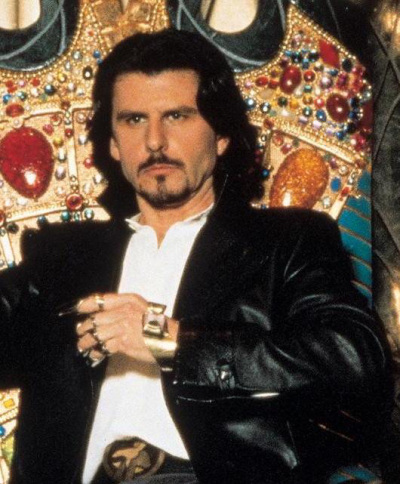
Though the writers of Pyramids of Mars clearly didn’t know (or care) that much about Set or Egyptian mythology, there are a couple of things going for this version of Sutekh as defined by the BBC. For one thing, at least they had the good sense to depict Him with the head of His sacred sha beast; I can appreciate this over depicting Him as a giant snake. For another, Sutekh is played by Gabriel Woolf, who has the coolest-sounding supervillain voice ever. (Woolf would later return to voice the character of “the Beast” in 2006’s The Impossible Planet/The Satan Pit.) If you’re going to make Set a villain, at least make Him impressive and charismatic like Doctor Who does. I for one think it would be pretty awesome if they revisited this character in a future episode.

Sutekh the Destroyer in Doctor Who

Sutekh the Destroyer from the planet Osiris (without mask)

Set in Conan the Barbarian (1982)

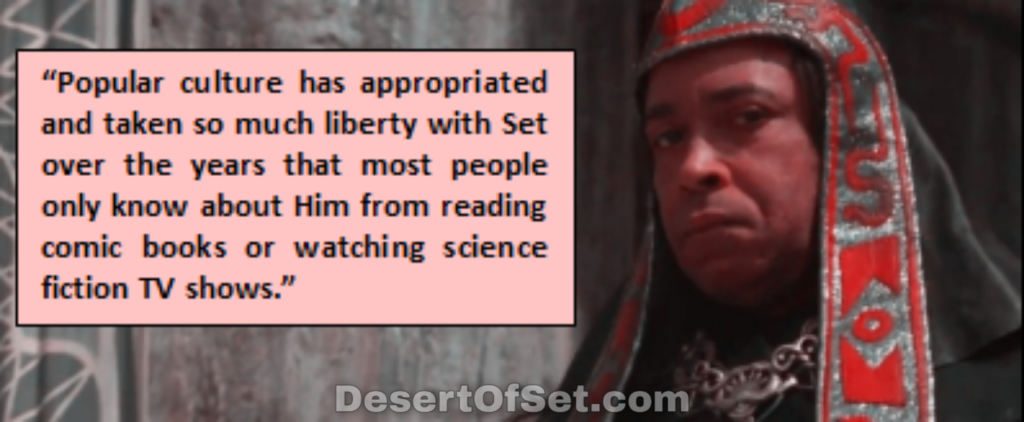
In this magnificent film adaptation of Howard’s Conan stories, the villain is a wizard named Thulsa Doom (played by James Earl Jones), who is actually two characters in one. Thulsa Doom was originally the name of a very different villain in Howard’s Kull stories, an undead necromancer with a skeletal face. (Actually, Skeletor from the 1980s He-Man and the Masters of the Universe cartoon is basically a child-friendly version of Thulsa Doom.) The Doom in this movie is actually Thoth-Amon, a Stygian sorcerer and priest of Set who was Conan’s arch-nemesis in the original stories. I have no bloody idea why the filmmakers decided to mix up the characters’ names like this, as it serves no rational purpose that I can see. But it doesn’t matter that much, because the movie is still awesome to behold (and Jones’ performance as “Doom” is simply amazing).

In this film, it remains unclear as to whether Howard’s Set (or any other God) actually exists or not. The film does hint that the Set cult has existed for much longer than Thulsa Doom has, but the cult doesn’t appear to have any substantial interest in facilitating Set’s return to their dimension. If anything, Doom seems to have appropriated the cult and turned it into a vehicle for his own personal gain; one might even say the cultists are far less interested in worshiping Set than they are in worshiping Doom himself. And as far as I can tell, they don’t do anything aside from practice cannibalism, throw wild sex orgies, and feed naked women to giant snakes. Honestly, this is more of a commentary on dangerous cult leaders like Jim Jones than a straight adaptation of Howard’s fiction. That being said, I actually like this version of Howard’s Set cult much better. It wasn’t necessarily evil from the beginning, nor does it necessarily follow an evil god; it’s just been twisted to fit an evil wizard’s agenda. (Though I will admit that it’s pretty damn cool to hear James Earl Jones preach about how “THE EYE OF SET IS UPON YOU!”)

I do believe there are messages from Set in this film; but as with the original Conan stories, they’re to be found in the character of Conan more than in Thulsa Doom. If anything, I think the story is telling us that Set doesn’t like it when power-hungry madmen like Doom appropriate His worship for such horrific ends, and that He actually favors people like Conan. In fact, it’s possible to interpret Conan as a warrior chosen by Set to cleanse His religion of Doom’s twisted fanaticism.

Set in Conan the Adventurer (Animated, 1993)

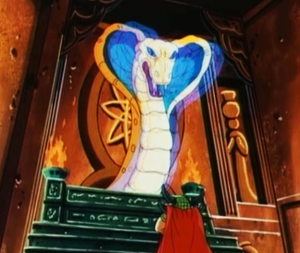
In the 1990s, there was an animated Conan series. In this adaptation, Set is clearly real and can actually act upon Conan’s world. (He’s even played by a voice actor!) Set appears as a gigantic talking cobra that comes from some alternate universe and that wants to take over the world. Long ago, He was banished to “the Abyss” by damn near every living wizard on Earth; but Set has His own wizard, Wrath-Amon, whose mission is to collect what he calls “Star Metal.” This is a magical glowing iron that comes from meteors and that can apparently open doorways to interdimensional worlds. This is a rather interesting idea, considering that iron (especially meteoric iron) is quite sacred to the real-life Set and is used in His worship to “open the mouths” of physical objects (which turns them into magical “interfaces” with the spirit world).

Set as a Giant Snake in Conan: The Adventurer

Enough of the “giant snake” thing, already!

Wrath-Amon is clearly based on Thoth-Amon from the original Robert E. Howard stories, but they decided to change his name and turn him into a Serpent Man (rather than let him be a regular human, like Thoth-Amon). This begs the question; just what the hell is so difficult about adapting the Conan stories into movies, cartoons, or even TV shows? Why is it that every cinematic adaptation has to mix characters up or reverse their names or give them names that are kind of the same, but slightly different? Is there a law somewhere that says they have to do this?

Set in G.I. Joe (Animated, 1985)

Believe it or not, Set—as well as Osiris, Horus, Thoth, Buto, Ammut, Ma’at, Amun-Ra, Sekhmet and Anubis—appears in a 1985 episode of G.I. Joe called “The Gods Below.” The plot of this episode concerns an Egyptologist who’s discovered “the Tomb of Osiris” and who is then kidnapped by the terrorist group, Cobra. Cobra Commander and the Baroness hope to plunder the treasures of this tomb to fund their next evil plan, and somehow the G.I. Joe team catches wind of this. Before you can say, “Raiders of the Lost Ark,” the Cobras and the Joes are running around inside Osiris’ tomb, firing bazookas at each other (and somehow not causing the entire structure to cave in on them). They do succeed in attracting the attention of the Netjeru, however, and the Joes are tested in the court of Osiris to determine their moral worthiness. Meanwhile, the Cobras encounter Set and try to trick Him into giving them the treasure they seek. They do this by pretending to worship Him, but Big Red sees right through their bullshit and stomps their asses with a powerful thunderstorm.

Set is of course described as “the God of Evil” by several characters throughout this episode, but He actually helps to stop Cobra in the end, and He does so without harming anyone. Even better, He’s depicted in His proper form as a big muscular dude with the head of His holy sha beast. He does take the form of a gigantic serpent at one point, but it’s clearly indicated that this isn’t His true form, and the context in which this occurs is quite remarkable. When the Cobras first encounter Him, Set asks if they are “worshipers of the Serpent.” They say yes, and He transforms Himself into a big snake and commands them all to kneel. They do so, and Set changes back to His sha form and gives them the treasure. Then the Cobras leave, and Set attacks them in the sky while they’re flying away. The way I read it, this whole exchange is a trick to see if the Cobras really know what it means to worship Set. By kneeling before Him while He’s in snake form, they prove that they know nothing about Him and that they see no difference between worshiping Him and worshiping His enemy, Apep. This, in turn, incites Big Red to smite the rotten bastards just when they think they’ve won.

Set in G.I. Joe

Big Red actually looks kind of cute here!

As a Setian, I think that’s pretty fucking awesome! I love G.I. Joe, and I really love this episode. Who would have thought that a simple-minded cartoon from the Reagan era would contain one of the very best representations I’ve ever seen of the Red Lord in Western pop culture?

Set in the Puppet Master movies (1989–Present)

Oh, boy.

So the Puppet Master franchise is a series of cheap direct-to-video horror films that are produced by Full Moon Entertainment, which was probably the King of direct-to-video schlock in the 1990s. Have you ever seen the TrancersDollmanDemonic Toys or Subspecies movies? They’re all Full Moon flicks, and Puppet Master, like the rest of them, barely qualifies as “horror.” These flicks are more like unfunny comedies that just happen to include healthy portions of gore and sleaze. It’s impossible to take them seriously; but as long as you don’t try, some of them can actually be pretty enjoyable. That being said, the Puppet Master movies concern the legacy of Andre Toulon, a French alchemist in World War II who discovers a magic elixir that can bring inanimate objects to life. When the Nazis kill his wife, Toulon gets revenge by bringing his puppets to life and sending them to bleed those fascist bastards dry. Then Toulon and his puppets relocate to America, where the puppets cause more trouble long after Toulon’s death.

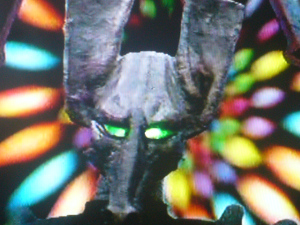
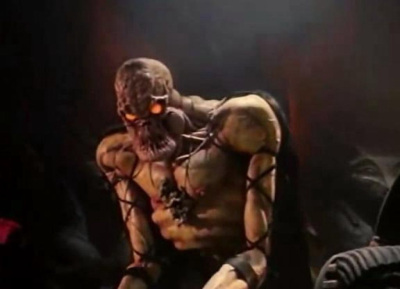
It just so happens that one of the villains in this series is Set, who’s known here as Sutekh (as in Doctor Who). And to be honest, this has to be the most original design for Big Red that I’ve ever seen in any movie (though I don’t mean that as a compliment). Full Moon’s Sutekh resembles a pudgy BDSM Buddha with a face that looks like a skull carved out of a spoiled cabbage. He also has two glowing Florida oranges for eyes, and He even has nipples. (Nipples, I say!) Apparently, this version of Set is responsible for creating the magic elixir that gives Toulon’s puppets their life, and He wants it back so He can use it to unleash the apocalypse somehow (naturally). Of course, Sutekh is trapped in some kind of alternate dimension (I wonder where they got that idea), and He’s only powerful enough to send really tiny versions of Himself into our world. These miniature clones are called “Totems,” and they’re just about the same size as Andre Toulon’s puppets (which means we get to see lots of puppet vs. puppet action).

Set in Full Moon's Puppet Master series

Where the hell did THAT come from?

I have to hand it to Full Moon Entertainment; at least they didn’t take the lazy way out and go with the “Set is a giant snake” idea. But this particular version of Big Red is so bizarre, I can’t even figure out where it came from. At least the Sutekh in Doctor Who actually looks like Set (complete with those cute rectangular ears of His). But how the hell did they come up with the idea for a bald, naked potato-man Sutekh with glowing googly eyes? (And one who can only get hokey-looking 3-inch dolls to do His bidding?)

Set in Vampire: The Masquerade (1991)

In the role-playing game, Vampire: The Masquerade, there’s a clan of vampires known as the Setites or the Followers of Set. Unfortunately, Set is defined not as a God in Masquerade lore, but as an Antediluvian vampire (i.e., a vampire from before the biblical Flood) who has merely set Himself up to be worshiped as a God (and as an evil “snake God,” to boot). You see, Masquerade posits that all vampires are descended from Cain (i.e., the biblical son of Adam and Eve who slew his brother, Abel). According to this thesis, Set is just one of thirteen vampires that were later created by Cain’s immediate descendants, Enoch, Irad and Zillah. In other words, Masquerade is saying that an ancient Egyptian God was brought into being by a rejected biblical patriarch—and while I wouldn’t go so far as to say that I find this idea “offensive,” I do think it’s pretty ridiculous. (I don’t care if this isfiction; Gods trump vampires, and Set trumps Cain.)

In the game, Setite vampires have special interests, abilities, and weaknesses that are not necessarily shared by other vampires, and this is due to their descent from Set. Their main interest is in spreading as much corruption in as many different areas of life as they can (e.g., promoting crooked politicians, funding terrorist organizations, supporting the snuff film market, selling hard drugs to little children, etc.). They also have a discipline called “Serpentis,” which is the ability to control or take on aspects of snakes. Their greatest weakness is that they are far more sensitive to light than almost any other kind of vampire; they can even be harmed by strobe lights. Apparently, their obsession with ruining the world is all part of their religious devotion to Set, whom they believe is still alive and sleeping somewhere deep in the Earth, waiting to return at some future time when He will destroy the Sun (thus liberating all Setites forever). As such, the Setites are something like the Islamic State of the Masquerade world; they’re just a bunch of dangerous religious fanatics whose ultraviolent activities don’t make any sense.

Set in Vampire: The Masquerade

I’m guessing this is what Set “really” looks like in this game.

I know there are people out there who really enjoy Vampire: The Masquerade and who are especially interested in playing as Setite characters. That’s all well and good, I suppose, and I know Big Red doesn’t really care what some role-playing game has to say about Him. But while I can forgive someone saying He was created by a Bible character, I find all this stuff about “corruption” to be pretty damn offensive. Just in case there are any Masquerade players reading this, I’d like to you to know that the real Set has nothing to do with that stuff. He might have killed Osiris, but it was a necessary event in the Creation of the universe. (How else could Osiris rise from the dead if He didn’t die first?) Furthermore, Gods killing Gods is very different from mortals killing mortals; we all know that it isn’t a good idea to re-enact what professional wrestlers do in our own living rooms, and the same principle applies here. I might also mention that Set only killed Osiris once; as the Defender of Ra, He rescues us all Apep every single night. So regardless of the value judgments that people might attach to Set’s role in killing Osiris, that role is secondary to His primary job as a Savior God.

Also, real-life Setites are not evil people who want to ruin the world and destroy the Sun. We’re just like everybody else; we have families, we work jobs, and we try to live as best we can. Many of us are environmentalists (especially those of us who identify as Pagans), and even those of us who walk the left-hand path are usually humanitarian to some degree at least. Do you know where this whole idea of wanting to ruin oneself and murder the world really comes from? It comes from Apep, which is the arch-enemy of Set (and, indeed, of all Gods and creatures). The things that Setites are supposed to do in Vampire: The Masquerade are not Setian at all, but are utterly qliphothic instead. Now I’m not trying to launch a personal crusade against White Wolf Entertainment or anything like that, but I do think that linking Set worshipers to things like terrorism and the snuff film industry is going a bit too far. And since I’ve never seen anyone else come out and criticize Vampire: The Masquerade for doing this, I decided to go ahead and scratch this off my bucket list.

(I might also mention that the word Setite is not the intellectual property of White Wolf Entertainment. To the best of my knowledge, it first appears in E. A. Wallis Budge’s From Fetish To God in Ancient Egypt, which was originally published in 1934. In that book, Budge uses the word in reference to people in ancient Egypt who worshiped Set. Now I’ve never met a real Set follower who actually wanted to call him or herself a Setite, and this is probably because we all know it would lead people to confuse us with the fictional vampire clan. But just in case anybody out there really likes that word, I just want everyone to know that it pre-exists Vampire: The Masquerade and that it was actually coined by a real life Egyptologist.)

Set in Stargate SG-1 (1997 – 2007)

Stargate SG-1 is based on the popular 1994 film Stargate, which was directed by Roland Emmerich and written by Dean Devlin (i.e., the same team that brought us 1996’s Independence Day and the horrifically awful 1998 version of Godzilla). This is the one where Kurt Russell and James Spader walk through an ancient intergalactic wormhole machine that spits them out on another planet that looks like ancient Egypt, and which is ruled by hostile aliens that claim to be the Egyptian Gods. In SG-1, Richard Dean Anderson plays the Russell role, Michael Shanks portrays the Spader character, and the evil Egyptoid aliens are given a backstory. Here the aliens are identified as the Goa’uld, a race of parasitic snakes from the planet P3X-888. They take possession of people’s bodies and then use their advanced technology to pose as Gods, demanding worship.

It’s never made explicitly clear as to whether the Goa’uld are merely impersonating Egyptian deities, or if they’re actually supposed to be “the reality” behind the gods. Considering the amount of respect the show’s writers seem to have for ancient mythology (which is to say, none), I wouldn’t be at all surprised if it’s the latter. Either way, there is a Goa’uld who’s “based” on Set in this show. Called Setesh, He appears to have hidden Himself away on Earth for thousands of years, convincing different groups of people to worship Him throughout history. The SG-1 team manages to track Him down and kill Him pretty easily (in just one episode, in fact!). Considering the way Set is normally treated in fiction, it’s surprising that He would only be a “Villain of the Week” here (rather than a recurring villain who’s integral to an entire story arc). I’m not quite sure if I should be thankful for this, or if I should feel insulted!

Setesh in Stargate SG-1

At least He’s handsome!

(I suppose SG-1 deserves credit for not going with the whole “Set is an evil snake God” idea—but wait! The Goa’uld are evil alien snakes! Dammit!)

When people find out that I worship an Egyptian God, they always ask me if I’m a fan of this show for some reason, or if I’m personally offended by it. No, I’m not a fan of Stargate, and I wouldn’t say that I’m “offended” by it either. I do find it a little annoying that Pagan deities are so often depicted in fiction as evil aliens. (Stargate SG-1 even has a Gao’uld character who’s based on a Hindu deity, which seems especially insensitive since the Devas are still worshiped by thousands of people today.) You almost never see this sort of thing done with Jesus; the only exception I can think of is in John Carpenter’s Prince of Darkness (1987), where the J-Man is revealed to have been an extraterrestrial. But aside from this bit of mild annoyance, I don’t think such ideas are really that harmful; I just don’t care for them that much.

Sutekh, P.I.

Too Many Mummies!

Why I enjoy certain “killer mummy” movies, and why I usually roll my eyes at the rest of this subgenre.

If there’s one thing I’ve always enjoyed doing since birth, it’s watching monster movies. It all started with the old black-and-white ones with guys like Boris Karloff, Bela Lugosi, and Lon Chaney, Jr. When I was seven or eight years old, there was a local UHF TV station that used to broadcast many of these flicks on weekend afternoons or late at night. This is how I remember seeing things like King Kong (1933), Godzilla (1954), and Them! (1954) for the very first time. Most of these movies didn’t scare me that much (though I remember being absolutely traumatized by The Thing From Another World), but I loved them anyway, especially the Universal monster movies. And naturally, Karl Freund’s The Mummy (1932) is the one selection from that particular canon that made the greatest impression on me.

An ancient Egyptian priest named Imhotep (played by Boris Karloff) has a forbidden crush on the princess Ankh-es-en-Amon, who is a virgin priestess of the Goddess Isis. When Ankh-es-en-Amon dies an untimely death, Imhotep steals the legendary Scroll of Thoth to resurrect her corpse. The Pharaoh’s guards apprehend him and rip out his tongue; then they bury him alive, all as punishment for his blasphemy. To add insult to injury, Imhotep’s fellow priests scratch out all the hieroglyphic spells inside his coffin that are meant to procure a safe journey to the Otherworld for its occupant, thereby condemning his soul. Thousands of years later, some European archaeologists dig up Imhotep’s tomb and accidentally resurrect him with the Scroll of Thoth. One of them sees the old boy walking around, and the poor dumbass goes stark raving mad. Then the mummy disappears, snatching the Scroll on its way out.

Years later, Sir Joseph Whemple (the European who hasn’t gone crackers) returns to Egypt with his son Frank to launch a new expedition. That’s when a guy calling himself “Ardath Bey” (an anagram of “Death by Ra”) shows up. Bey appears to be the oldest (and dustiest) Shriner walking the Middle East, and he walks around like he’s got a Louisville slugger rammed up between his ass cheeks. He also has an incredible knack for knowing exactly where the archaeologists should dig to find more treasure. Thanks to Bey, the archaeologists discover the tomb of Princess Ankh-es-en-Amon—and that’s when a European lady named Helen Grosvenor (played by Zita Johann) starts sleepwalking through traffic in the middle of Cairo. Thinking Helen might be the reincarnation of his old lady (literally), Imhotep—er, I mean Ardath Bey—decides to put the wammy on her so he can kill her, mummify her, and resurrect her corpse.

Of course, Helen doesn’t exactly relish the thought of becoming a drooling, undead trophy wife. So Imhotep does what any sensible star-crossed sorcerer would do; he kidnaps her, hypnotizes her with his magic, and forces her to go along with what he wants. But just before he’s able to claim his final victory, Helen feels a sudden inspiration to pray to Isis, whose statue springs to life and electrocutes Imhotep with magic lightning. At that point, the world’s oldest (and dustiest) Shriner reverts back to the walking, talking mummy he really is, and he promptly disintegrates into a pile of bones. Then Helen goes home and presumably marries her other suitor, the archaeologist’s son. (Actually, Helen simply exchanges one kind of “zombification” for another. Considering how Frank treats her while he’s keeping her safe from Imhotep, it seems like she’s doomed to become someone’s zombie trophy wife sooner or later.)

The Mummy was inspired by on the opening of Pharaoh Tutankhamen’s tomb in 1922 by the archaeologist, Howard Carter. There was a lot of media hype back then about Carter and his colleagues bringing down a so-called “Curse of the Pharaohs” for committing this “sacrilege.” Everyone who had a hand in opening the tomb was supposed to die a strange and mysterious death. (Even Sir Arthur Conan Doyle, the famous creator of Sherlock Holmes, believed there was some kind of truth to this curse.) But it actually would have been rude of Tutankhamen to unleash such a curse, given that Carter’s the one who gave the poor kid his biggest break. Tutankhamen was hardly an afterthought in Egyptian history during his woefully short life; it wasn’t until Carter found him that he became the most famous Pharaoh of all. Even people who’ve never read a single Egyptology book know who “King Tut” is, and it’s all thanks to Carter. I’ve always figured Tutankhamen would be mighty grateful to Carter for this.

And did you know there was actually a real, historical Imhotep? He wasn’t anything like Boris Karloff’s character; he is actually the oldest known physician in history. He wrote one of the earliest medical treatises that offered purely scientific (and not magical) treatments for illnesses (predating the Greek physician Hippocrates by over 2,000 years). He was also the master architect and engineer who designed the Pyramid of Djoser (otherwise known as “the Step Pyramid”). Far from being cursed for any blasphemy, Imhotep was something more like a saint who had achieved great enlightenment and holiness during his earthly life, and who could intercede as a spirit on behalf of the living. Such was the real Imhotep’s popularity that he eventually gained his own religious following and was worshiped as the “Son of Thoth” (the God of wisdom, who was Imhotep’s tutelary deity). My guess is, the makers of The Mummy wanted an authentically Egyptian-sounding name for their film’s antagonist, and they most likely chose “Imhotep” without knowing anything about the historical figure to whom it belongs.

The thing that really sets The Mummy apart from other films of the period is the way in which its titular monster is defeated. Most gothic horror movie monsters—vampires, werewolves, Frankenstein monsters—are easily defeated with Christian religious symbols, or with purely practical weapons like fire. Imhotep is impervious to all of these things, and it is neither Jesus Christ nor Professor Van Helsing (nor even The Mummy‘s own perpetually dumbstruck “hero”) who saves Helen at the end. Her savior is a Goddess who’s assumed by the (male) archaeologists in the film to have been a mere superstition, but who’s shown to be real and benevolent enough to answer an innocent woman’s desperate plea. The Mummy is pro-Pagan in its insistence that the ancient Egyptian religion is true and continues to have power and currency today. The fact that most people no longer believe in the Egyptian Gods has absolutely nothing to do with it, and all of the characters are forced to accept these facts by the end of the film.

There’s only one other character who understands these things from the start, and that’s Dr. Mueller (played by Edward Van Sloan). Mueller is Helen’s psychiatrist, but he’s also an esotericist who happens to put his faith in the Egyptian religion. He’s the one who insists that everyone should be wearing an amulet of Isis for protection (and he turns out to be right). He also warns the archaeologists that they shouldn’t be meddling around with the Scroll of Thoth, and that they should just torch it in a fireplace somewhere. Not only does he seem to know that using the Scroll is a bad idea, but he specifically uses the word “sacrilege.” I’m sure the filmmakers never put this much thought into it, but I bet Mueller is a member of something like the Hermetic Order of the Golden Dawn or the Ordo Templi Orientis—some European occult initiatory order that claims to be older than it really is, and which is full of bored social elites who claim to know more about Egypt than they really do. Except in this case, Mueller happens to know just enough to help keep some of the other characters alive, which is curiously pro-Egyptian for a movie from this era.

Of course, the film isn’t without criticism. One complaint I often hear is that it’s basically the same movie as 1931’s Dracula, but with Egyptian rather than Transylvanian window dressings. This is definitely true; the idea of an undead immortal man lusting after a mortal woman also appears in Dracula, and Dr. Mueller and Frank Whemple are both played by actors who also appeared in nearly identical roles in the Lugosi film (as Professor Van Helsing and Jonathan Harker, respectively). The opening title sequence even uses the exact same music that was used for Dracula (the “Swan Theme” from the second act of Pyotr Ilyich Tchaikovsky’s Swan Lake). But despite all of this, I feel The Mummy is superior to Dracula in almost every way. It has the benefit of being made after Hollywood had a chance to learn from making “talkies” for a while. Dracula has always seemed very stilted and boring to me, and I think it’s because they were only just starting to film with sound when it was being made. It’s also more faithful to Hamilton Deane’s 1924 stage play than it is the original Bram Stoker novel, which means it’s a fucking terrible adaptation. At least The Mummy doesn’t claim to be based on a book and then do a fantastically shitty job of adapting it.

The Mummy was followed in the 1940s by a string of so-called “sequels” (starting with The Mummy’s Hand in 1940) that have nothing to do with the original film’s characters or plot. They’re also not nearly as intelligent and much more racist. They follow a mummy named Kharis, who’s less of a savvy sorcerer like Imhotep and more of a stumbling, demented death machine. He’s sent by the ancient priesthood of Karnak to kill some archaeologists for desecrating the tomb of a princess, and he’s controlled by the priests with (ahem) petrified tea leaves. While the 1932 original depicts Egyptian magic as a morally neutral power that can be used to help or hinder, the 1940s films treat it as a bizarre and degenerative cult that can only bring savage violence and death. (Most insultingly, the priests of Karnak always end up falling in lust with some white woman and trying to rape her, which always leads to the priest’s demise.)

Thankfully, the story of Kharis was revisited in more thought-provoking terms in the 1959 remake by Hammer Studios, called simply The Mummy and starring Peter Cushing and Christopher Lee. Thanks partly to a great script by Jimmy Sangster and a terrific performance by George Pastell as Mehemet Bey (the priest of Karnak in this version), Hammer’s The Mummy casts its Egyptian characters in a somewhat more sympathetic light. It still views its own subject matter through a racist and colonialist lens, but at least Mehemet Bey is given a chance to articulate his position to the white protagonists, and Pastell really sells it. I can totally see how the systemic exploitation of his culture and religion would radicalize him to kill in the name of Karnak, regardless of the fact that Karnak is actually a city in Egypt and not a God. (I actually enjoy this flaw in the film, because it means none of the violence is being committed in the name of any deity that’s worshiped in any real life religion.) It’s also nice to see a version of the story that doesn’t have the priest of Karnak getting all rapey with the heroine and sabotaging himself in the end.

The Hammer Mummy is a close contender for “Greatest Movie Called The Mummy Ever Made” in my Setian scriptural canon, but the Universal original wins this category for the following reasons:

  • The Universal original is pro-Egyptian and has the good guys getting their asses saved by an Egyptian goddess; the Hammer version, despite having a sympathetic villain, still has an uncomfortably xenophobic message of “Anything that isn’t White Anglo-Saxon Protestantism is evil black magic and devil worship.”
  • While Mehemet Bey keeps his cool right up until the end, the Hammer version still has someone getting rapey with the female lead and thereby foiling Mehemet’s plot; in this case, it’s his own damn mummy Kharis (played by Christopher Lee), who I guess just wants to prove you’re never too old to sow your oats.

There’s been a truckload of other “killer mummy” movies since the Hammer Mummy, but most of them just repeat the same old premise from the Karloff original: some dead guy from Egypt rises from the grave with the worst case of morning wood ever, and he stops at nothing to claim the current reincarnation of his ancient sweetheart. Considering the complexity of Egyptian mythology and its huge cast of characters, it’s never made sense to me why Hollywood keeps circling back to this particular trope. There are so many other ideas from Egypt that could be adapted into much more interesting stories, such as the belief in kas (invisible doppelgangers that are supposed to follow us around throughout our lives), or the story of the Destruction of Humankind (in which humans are almost completely wiped out by the lion Goddess Sekhmet), or the idea that pictures and drawings are actually windows into alternate universes. There’s more than enough material in Egyptian literature to inform several long-lasting movie franchises, but audiences just want to see scantily-clad women being fondled by dudes wrapped in Charmin I guess.

Okay, so the 1999 version of The Mummy handles this trope a little differently. Yes, the evil mummy wants to bring back his dead lover; but at least here, the dead lover and the living heroine are two different characters. (The mummy still has to kill the heroine to bring back his ancient lover, though, so I guess it’s not that different after all. Also, the heroine turns out to be the reincarnation of another Egyptian princess in the 2001 sequel, The Mummy Returns. Doesn’t anyone ever get tired of writing this crap?) But one thing that does work to the 1999 film’s favor is the fact that it frames itself not as a gothic horror movie, but as an epic adventure yarn. It bears much greater resemblance to the Indiana Jones movies than to either of its own titular predecessors. The performances from Brendan Frasier, Rachel Weisz, and Arnold Vosloo are also quite enjoyable, and I like that the film has its heroes using Egyptian mysticism to defeat the villain. (Reading a spell from the Book of Amun-Ra is not quite as impressive as having a Goddess show up to personally rescue you from the monster, but I digress.) If you can look past the horrible computer graphics that are in this movie (and mind you, this is a 1990s movie, so its digital effects are craptastic in that special way that only 1990s CG could give us), you could do a whole lot worse.

Which brings us to the latest Mummy reboot, the 2017 version starring Tom Cruise. Sweet Set O Mighty, I don’t even know where to begin with this one. Okay, so we have an Egyptian sorceress who’s mummified alive for trying to take the Pharaoh’s throne. We have Tom Cruise digging up her coffin in contemporary Iraq (?) after an airstrike. We have Tom’s pal getting killed and showing up as a ghost that only Tom can see (probably because he got confused and thought they were making An American Werewolf in London). And we have Russel Crowe showing up as Dr. Jekyll/Mr. Hyde (yes, from the Robert Louis Stevenson novel), who has somehow become the leader of a secret society that knows everything there is to know about the mummy. I appreciate that they made this mummy a chick (and I won’t lie, Sofia Boutella looks fucking hot wrapped in Charmin like that), and I’m especially grateful that the “ancient lovers” theme was completely removed. Yet the film makes other unforgivable mistakes, and its absolute worst offense is the sheer number of aimless plot points that are clearly meant to be resolved in future movies. It’s one thing to do this when you have a clear vision of how everything’s going to tie together in the end; but the 2017 Mummy is not a finished product that can stand or be judged on its own merits. It amounts to little more than a 110-minute long preview of coming attractions (which we will never get to see).

But that isn’t what upsets me most about the 2017 Mummy. I can forgive movies for all kinds of cinematic sins, but I find it difficult to watch anything in which Set is used as a stand-in for the Christian devil. The mummy Ahmanet has acquired her supernatural powers as a result of making a “pact” with Set, and pretty much everything she does in the film is to serve Him. Naturally, this means Set is “evil” and wants to destroy the world. Would it kill Hollywood filmmakers to make a movie for once where Set isn’t written like He’s some two-dimensional cartoon villain? Even better, the film ends with Tom Cruise killing the mummy, inheriting her powers from her pact with Set, and becoming a superhero. If you don’t understand why I would be bothered by this, imagine for a moment that someone has made a film in which Jesus comes back to start a global holocaust, only to be defeated by Val Kilmer, who then promptly uses his new Jesus powers to become “Captain Nazareth.” Sounds pretty stupid, right?

Mummy

The LV-426 Tradition

Some background on the unique Setian coven in which I became a priest.

There are three other Setians with whom I’ve been privileged to work some truly life-changing magic over the years. These individuals know who they are, but out of respect for their privacy, I will only identify them here as Blackwyn, the Tonester, and Sister Bean. To walk with Set is a solitary path, even when you’re part of a group, and not everyone in my circle will always agree with each other on everything. But the point isn’t that we always believe or practice the same things. The point is that we are each drawn to Set in our own ways and for our own reasons; that we’ve crafted a number of effective rituals and spells together; and that we’ve all witnessed the same eerie results these procedures can yield. Years have passed since we first declared ourselves a coven back in 2003; we’re spread far apart from each other now, living in our own areas and focusing on our own priorities. But even if we never meet in person to hold another ritual together again, we will always be connected with each other somehow.

That “somehow” is Set.

In 2007, we started referring to our collected rites as the LV-426 Tradition for the following reasons:

  • The 1979 sci-fi/horror film Alien is a prime example of what we call “the monster film as mythos,” and we wanted our name to memorialize the film for this reason.
  • The Tonester and I were both living in the Bible Belt at the time, and Ripley’s struggle against the Alien was a perfect metaphor for how we felt about living there.
  • Being a couple of smartasses, we wanted a name that was far too cumbersome for repeated use in brief conversation. (Say “LV-426 Tradition” six times in the same paragraph to see what I mean!)

The Setians of the LV-426 Tradition

From left to right: The Tonester, Sister Bean, Yours Truly, and Blackwyn.

In case you’ve never seen it (and shame on you if you haven’t!), the original Alien is about these astronauts in the distant future who follow what seems to be a distress signal of unknown origin. They make their way to a desolate planet called “LV-426” in their star charts, where they find a crashed alien spaceship with a dead crew and a shit-ton of weird, leathery eggs for its cargo. One of these eggs hatches, unleashing a horrific beast that reproduces itself by raping one of the men (!). Due to a breach in protocol, the creature enters the next phase of its life cycle back on board the ship, and the movie then becomes a slasher flick in outer space. The last person standing is Ellen Ripley, played by Sigourney Weaver, who emerges from the chaos and the carnage to become the first female action movie hero.

1980's Ad in TV Guide for Alien (1979)

The Alien strongly resembles Apep, that timeless arch-nemesis of Set. Designed by the Swiss surrealist, H.R. Giger, its biology makes no sense. How can it see without any eyes? Why would anything evolve to have two mouths—one inside the other—when just one mouth is simpler? How can its blood be so corrosive that it will burn through any metal, but without being deadly to the creature itself?1 Nothing in nature can exist like that, and the same is true of Apep. It’s described as lacking any sensory organs—it has neither eyes nor ears—yet it’s somehow able to locate and paralyze its prey with a hypnotic gaze. It’s also described as “breathing by means of its own roar” and “living by means of its cries,” which means it doesn’t require any sustenance for its survival; it just eats things to make them suffer (Manassa, 2014). Both Apep and the Alien are monsters that can only exist in nightmares, that operate in total defiance of natural law, and that would be absolutely poisonous to any ecosystem in which they managed to thrive.

Ellen Ripley, on the other hand, is a perfect stand-in for the Red Lord. She is the outsider or “black sheep” among her crew, the only one who takes her job seriously, and a real stickler for protocol (even refusing to let Captain Dallas [Tom Skerritt] board their ship when she learns he has an infected crew member in tow). Compare this to the other female crew member, Lambert (played by Veronica Cartwright), who complains, screams, or cries helplessly throughout the film. Then there’s the fact that Ripley dresses and behaves like a man. One of Set’s many lovers is the Ugaritic Goddess Anat, who is usually depicted in men’s clothes (Patai, 1990), and whom Set is said to find especially attractive for this reason. Given how much He enjoys smiting monsters like the xenomorph, and given how partial He is to androgynous ladies like Anat, it’s hard for me not to imagine Set cheering for Ripley from upon His throne behind the Great Bear. (Plus, going through so much trouble to save Jones the Cat must surely score Ripley some additional points with Bast, Ishtar, Sekhmet, and other like-minded Goddesses of feline goodness.)2

Anat, an Ugaritic goddess

Anat, an Ugaritic Goddess who is one of Set’s many consorts.

Alien is also filled with various references to sexual anatomy and the reproductive process. The ship’s computer is called “Mother”; the astronauts look like they’re being born when they awaken from their cryogenic sleep chambers; the tunnels of the derelict craft on LV-426 resemble giant fallopian tubes; and the xenomorph’s head is shaped like an erect penis (which always makes me think of someone being raped in reverse during the infamous “chestburster” scene).3 Ripley even has her final confrontation with the beast in her underwear,4 and she must also contend with “Mother,” which insists on keeping the Alien alive for future study (even at the cost of the astronauts’ lives). So a secondary conflict rages between Ripley and the computer, which cares more for the survival of the “child” than it does for the “parents.” This is especially intriguing given that Set is thought to cause abortions and miscarriages (te Velde, 1977). As His cinematic avatar, Ripley must further alienate herself from her society by “aborting” the gestating life form her superiors have deemed more important than herself (Cobbs, 1990).

H.R. Giger was obviously influenced by the New England horror writer, H.P. Lovecraft; but I’m fairly certain he was also inspired by a British occultist named Kenneth Grant. Once a disciple of the infamous Aleister Crowley, Grant was obsessed with what he called the “Tunnels of Set,” which are supposed to be these astral wormholes that loop back and forth between various alternate universes. He was the first occult author to suggest that H.P. Lovecraft was a “sleeping prophet,” and that monsters like Cthulhu and Nyarlathotep are real beings that actually exist in some other dimension. (He beat the Simon Necronomicon to this punch by at least a decade, if not longer.) Given this, I’m sure Grant’s ajna chakra or “third eye” probably exploded wide open if and when he ever got around to seeing Alien for himself. And if H.R. Giger wasn’t specifically thinking about the “Tunnels of Set” when he first envisioned the winding, cyclopean corridors of that ghost ship on LV-426, he sure as hell could have fooled me.

H.P. Lovecraft, Kenneth Grant, and H.R. Giger

From left to right: H.P. Lovecraft (1890–1937), Kenneth Grant (1924–2011), and H.R. Giger (1940–2014).

Though we tend to share Grant’s enthusiasm for the “many-worlds” interpretation of quantum mechanics, my coven mates and I have zero interest in contacting any of the horrific fauna that H.P. Lovecraft envisioned for his lurid tales. We instead emphasize execration, or the use of magic to repel negativity and misfortune from people’s lives. This is functionally similar in principle to casting a death curse on someone, save that the target of your spell is Apep, the true source of all evil, and not any human victim. As far as we’re concerned, walking with Set isn’t about getting chummy with Lovecraftian space monsters; it’s about ferociously defending the autonomy of all sentient beings.

The idea that we must be “ferocious” in this regard comes from when the Tonester and I lived in the Bible Belt during the early 2000s. We were constantly under siege from “Rapture-ready” teachers, classmates, employers, cops, and politicians. We couldn’t even go for prayer walks in the woods without being harassed by people who thought we were “worshiping the devil.” After a while, it began to feel as if we were actually trapped in some hostile wilderness, with a very real monster coming after us. That monster wasn’t an actual xenomorph, of course, but Apep; and instead of literally trying to eat us, it was trying to eat our hearts from within. But Set is merciful; He brought us together in that wretched place, against all odds, and He blessed us with each other’s company and support. Then we met Blackwyn and Sister Bean in Michigan a few years later, and the rest is history. Each of us is proof for the others of Set’s providence, and Alien is an excellent parable for our own private quests against the Serpent.

Training to be Ellen Ripley

But execrations are not the only staple of our practice; there’s also our weekly Sabbat ritual, which is observed on Friday nights. We enter a darkened room that has been prepared with an altar, an image of Set, and some red candles. We recite our standard invocation together, and then we take turns praying to Set informally, as if He were just a regular person in the room with us. Usually this means discussing our hopes and fears, our best and/or worst moments of the week, or something along those lines. When one person finishes their prayer, they turn to the next person in sequence (which is always to the left) and say, “If there is anything you wish to say to the Red Lord at this time, please feel free to do so.” And if the next person has nothing they wish to pray about, they keep silent so the next person can proceed. Once everyone has finished, we break out the beer, blast some heavy metal, and chat with each other into the wee hours, sometimes not adjourning until daybreak. The exchanges we’ve shared during these late night Sabbat talks are some of the most profound meditations I’ve ever experienced in my life.

Some other things we’ve done include a spell for protection during sleep, an astral pilgrimage technique, and a matrimonial ceremony that was used for my wedding in 2012 and for Sister Bean’s in 2015. There’s also an initiation ritual that’s used for inducting new members, but this procedure is known only to those who pass our vetting process and are invited to join. (Considering there have only been four of us since Set first struck me with His black lightning in 1997, you can imagine how often this happens.) Our liturgical calendar includes not only our weekly Sabbat but also Hallowtide (October 31–November 2), Walpurgisnacht (April 30), and Friday the Thirteenth (on which we celebrate Set as the catalyst for Osiris’ resurrection and Horus’ conception). Importantly, we have no leader or “high priest/ess”; each of us is fully qualified to administer our rites to anyone who might need them, and all of our group decisions (including whether to initiate any new brothers and/or sisters) are made by unanimous vote.

Set's Charge to LV-426 Clergy

Apart from the above, we Setians of the LV-426 Tradition may each entertain any additional beliefs or practices we like. Some of us revere other sacred figures along with Set, like Buddha, the Norse God Odin, or the Babylonian Goddess Ishtar. Some of us even celebrate Christmas or Saint Patrick’s Day. Our eclecticism is rooted in Set’s New Kingdom role as an ambassador between the Egyptian Gods and other pantheons. Just as He can roam between alternate realities and canoodle with alien divinities, so are we free to mix the old Kemetic wisdom with just about anything we find useful, from American colonial witch lore to Zoroastrian demonology. Some outsiders may find this permissiveness toward religious dogma repugnant, but we couldn’t care less; Big Red is the only justification we need.

It’s been a while since we last met as a coven to keep the Sabbat, execrate our inner demons on Walpurgisnacht, or offer up a feast of watermelon to Big Red on Friday the Thirteenth. I can’t speak to how often the others may or may not “keep up” with these practices nowadays (though I must admit it has been hard for me to do so consistently, myself), but none of us has ever been expected to make such a commitment anyway. It’s the fact that we even did these things at all—and the magic we shared when we did—that really matters. And there’s always the possibility that somewhere down the road, a fifth initiate of LV-426 might present him or herself to us, setting a whole new cycle of ritual work into motion. For now, all LV-426 alumni are off exploring other proverbial worlds, but always with Set’s Iron in our spines.

The LV-426 Sigil

The LV-426 Sigil

Notes

1 I’m well aware that in Ridley Scott’s prequels to this film—Prometheus (2012) and Alien: Covenant (2017)—it’s revealed that the xenomorphs did not evolve naturally, but were genetically engineered as a kind of biological warfare. This still doesn’t explain why their blood, which can burn through any damn metal you please, doesn’t just burn right through their own bodies as well.

2 Some viewers—including Big Steve King—complain that Ripley’s quest to save Jones the Cat is a “sexist interlude” that undermines her role as a feminist character (King, 1983). I’m a proud cat parent, and if I were in Ripley’s position, I’d risk everything to save my fur baby too. (Ten bucks says if Jones were a dog, nobody would be bitching about this.)

3 The “chestburster” scene is quite similar to the story of Set’s birth according to Plutarch (1970). He recounts that Set was not born at the normal time or in the normal fashion, but that He impatiently exploded forth from the belly of His mother, the sky Goddess Nut. It’s tempting to think the screenwriter, Dan O’Bannon, might have encountered this story at some point while writing the script for Alien.

4 Some viewers—again, including Mr. King—complain that this final sequence “sexualizes” Ripley too much (King, 1983). I have to say that as a straight dude, this scene has never once made me think, “Ooooh, look at the naked chick!” Instead, it always makes me think about this one time I had to fumble around in my basement naked to get some clean clothes out of the dryer, only to be greeted by a huge spider that made me piss myself. In other words, it makes me identify with Ripley rather than objectify her, and I for one applaud Ridley Scott for framing the scene in that way.

H.R. Giger's Alien

References

Cobbs, J.L. (1990). Alien as an abortion parable. Literature / Film Quarterly, 18(3), 198–201. Retrieved on October 5, 2017.

King, S. (1983). Danse macabre (2nd edition). New York, NY: Berkley Books.

Manassa, C. (2014). Soundscapes in ancient Egyptian literature and religion. In E. Meyer-Dietrich (Ed.), Laut und leise: Der gebrauch von stimme und klang in historischen kulturen (pp. 147–172). Bielefield, Germany: Transcript Verlag.

Patai, R. (1990). The Hebrew Goddess (3rd edition). Detroit, MI: Wayne State University Press.

Plutarch (1970). De Iside de Osiride. Cardiff, Wales: University of Wales.

te Velde, H. (1977). Seth, God of confusion: A study of His role in Egyptian mythology and religion. Leiden, Netherlands: E.J. Brill.

The Monster Film As Mythos

Explaining the LV-426 belief that monster movies are more sacred and profound than any Kirk Cameron flick.

I enjoy interpreting films, TV shows, and popular music from a Setian perspective. This isn’t just a “hobby”; it’s an essential part of my spirituality. I believe Set and other Pagan Gods like to reveal themselves through popular cultural media, and in ways that are more often subliminal than not. It’s easy to recognize the Goddess Isis in that old 1970s TV show, The Secrets of Isis, where she’s an actual character who fights crime. But have you ever noticed how similar James Cameron’s The Terminator (1984) is to the myth of Isis fleeing from Set to ensure the safe birth of Horus? Just imagine that Sarah Connor is Isis, Kyle Reese is Osiris, the Terminator is Set, and John Connor is Horus; see what I mean?

I’m not suggesting that James Cameron actually did this on purpose. I just think one or more of the Gods probably reached into his brain back in 1984 and shuffled some stuff around in there while he was writing the script. I think this happens all the time, not just with James Cameron, but with potentially any filmmaker. I know it sounds silly or perhaps even “crazy,” but the idea that the Gods would leave “secret messages” for us to find in movies, TV shows, or even Saturday morning cartoons is no different from divining omens in tea leaves or the Zodiac. Just because these media are human inventions doesn’t mean the Gods can’t use them for their own purposes. If they can reveal themselves through clouds and trees and dreams, they can just as easily do the same thing through anything created by human hands.

“But G.B.,” I hear some of you asking, “What about things that are purposely inspired by Egypt? Things like Stargate SG-1?” Well my answer to that question is so complex, I had to write a whole other sermon about it to do the subject any justice. But with very few exceptions, I am almost never impressed with anything that’s intentionally inspired by Egyptian mythology.

I find that such works tend to fall into one of three clichéd categories:

  • The “killer mummy” movies, in which the mummy is always some ancient evildoer who seeks to claim the modern reincarnation of his long-lost love. (This includes pretty much any film called The Mummy or that has the word “Mummy” somewhere in the title, like 1964’s The Curse of the Mummy’s Tomb.)
  • The “ancient astronaut” movies, in which the Egyptian Gods turn out be gooey aliens that fly around in spaceships. (This would be where Stargate fits in.)
  • The “biblical epic” movies, which all treat the book of Exodus like it’s a Gods-damn court transcript. (This includes such esteemed classics as The Ten Commandments, The Prince of Egypt, and Exodus: Gods and Kings.)

You’d expect there to be more of Set in something like Gods of Egypt (in which He’s an actual character) than there is in a movie like the original Godzilla from 1954 (which has nothing to do with Egypt on the surface); but I find the opposite is more often true. Whenever Egyptian mythology is intentionally adapted into fiction, the result is often far less interesting than the original source material. Cinematic portrayals of Set in particular have absolutely nothing to do with how anyone has ever worshiped Him in real life. (The next time you watch the original Conan the Barbarian from 1982, bear in mind that feeding naked women to giant snakes has never been a standard feature of Setian religious practice.) Yet there are other creative works that don’t intentionally invoke Set in any way, but which do so serendipitously, and which are more consistent with actual Setian ideas and values. This to me is a sign that these films have been “touched” by Set, especially if the people who created them have never heard of Him before.

In my opinion at least, the films that seem to resonate with Set the most are monster movies—sci-fi, horror, and fantasy romps that feature aliens, giant animals, mutants, supernatural beasties, or even cryptids like Bigfoot or the Loch Ness Monster. No matter what creatures they might feature, all monster films are about chaos intruding upon the world of order. Sometimes this chaos is caused by forces external to humanity (as with alien invaders), and sometimes it’s caused by human monsters (as with serial killers). Sometimes the chaos is visited upon the innocent (making the story a tragedy, or an example of when bad things happen to good people), and sometimes it falls upon the wicked (making it a morality tale, or an example of when bad people get their comeuppance). Either way, it all boils down to the eternal struggle between order and chaos, light and darkness, creation and annihilation.

You’re probably wondering why a minister would take such a serious interest in this kind of subject matter. (After all, aren’t religious people supposed to think that monster movies are “sick” at best or “satanic” at worst?) The truth is, I think monster tales are the oldest kind of story known to humankind. Sure, epic adventures and steamy romances have been with us a long time too, but the one emotion our earliest ancestors were probably most familiar with was fear.

Consider what John Goodman says in Joe Dante’s Matinee (1993):

A zillion years ago, a guy’s living in a cave. He goes out one day, Bam! He gets chased by a mammoth. Now he’s scared to death, but he gets away. And when it’s all over with, he feels great […] So he goes home, back to the cave, the first thing he does, […] he does a drawing of the mammoth. And he thinks, “People are coming to see this. Let’s make it good. Let’s make the teeth real long, and the eyes real mean.” Boom! The first monster movie.

When you think about it, fear has motivated people to do many things. It motivated our ancient ancestors to band together, hunt for food, develop agriculture, and establish laws to prevent themselves from killing each other. It also motivated them to tell stories, to put their faith in higher powers, to repel misfortune with charms and magic, and to hope for a better life in the great hereafter. In short, fear is just about the mother of everything that’s included in human civilization, including religion.

Monster films are magical

There’s even an element of the monstrous in religion itself. The theme of chaos intruding upon order appears in every religious mythology. Every pantheon of Gods must contend with at least one horrific monstrosity that wants to destroy us all:

  • In the Coffin Texts (dating to circa the 20th century BCE), Set is and will always be defeating the monster Apep.
  • In the Babylonian Enuma Elish (dating to the 7th century BCE), the God Marduk slays the dragon Tiamat and creates the cosmos from her corpse.
  • In Hesiod’s Theogony (dating to the 7th century BCE), the Olympian Gods defeat the gigantic Titans and bury them within the earth.
  • In Psalm 74 (dating to 586 BCE), Yahweh slays Leviathan and feeds it to his saints at the end of time.
  • In Revelation 20 (dating to 81–96 CE), Christ defeats Satan and Antichrist, casting them both into a lake of fire.
  • In the Bundahishn (dating to the 9th century CE), Ahura Mazda destroys the monster Ahriman and rehabilitates the damned.
  • In the Poetic Edda (dating to the 13th century CE), the Aesir and Vanir will kill and be killed by the frost giants of old.

Every monster film echoes one or more of these combat myths on some basic level. Even in the original Friday the 13th (1980), the character of Pamela Voorhees (played by Betsy Palmer) is really just another Tiamat, and the camp counselor Alice (Adrienne King) is the stand-in for Marduk. The characters and circumstances are quite different, but the story is essentially the same, and it’s the oldest story in the world.

Many faiths also have some horrific notion of what might happen if people just stopped practicing religion altogether. The Gods might abandon us; the dead might rise up to torment the living; the whole world might fall apart; and so on. Films like The Birds (1963) and The Mist (2007) may not seem to have anything to do with religion on the surface, but each depicts some stern, cosmic judgment against humanity for its collective sins. And the number of films that depict vengeance upon the living by the restless dead—such as Poltergeist (1982) and A Nightmare on Elm Street (1984)—is in the thousands. For these reasons, I think monster films are the finest medium for religious expression and interpretation, superior even to most overtly religious films. There is far more divinity and truth to be found in something like It Came from Outer Space (1953) than there is in, say, Kirk Cameron’s Saving Christmas (2014).

Now praise Set, and pass the remote!

Remote for your Television SET


1 3 4 5