
Tag: Music
Nephthys, the Dark Midwife
The sister and ex-wife of Set is a renowned healer of wounded hearts and minds.
Even more than Ishtar or Taweret, Nephthys is the Goddess who is most often linked with Set. In fact, some people might be wondering why it’s taken me 40 whole episodes before I got around to discussing Her. Truth is, I wanted to highlight the aforementioned Goddesses first because Their interactions with Set are far less known. I also think Set and Nephthys share a much more complex relationship than what is typically imagined about God and Goddess couples, for reasons I shall explain.
The name of this Goddess, which comes from the Egyptian Nebet-Het, means “Lady of the House.” It refers to a temple enclosure, rather than a domestic residence. In the Heliopolitan cosmogony, Nephthys is one of the fourth generation of Netjeru (the others being Osiris, Isis, Set, and even Horus in some accounts). As such, She is one of the divinities who facilitate life here on earth, and who contributes to the arts of human civilization.
The fourth generation of Gods was somewhat disruptive to the natural order of things at first. There is even a story about Ra, the first Netjer, prohibiting their granddaughter, the sky Goddess Nut, from giving birth to these young’uns (despite already being pregnant). Thankfully, the wise God Thoth finds a technicality that allows Nut to have her children while still technically obeying Ra’s decree. So first it was just Ra, and all things were united in them. Then Ra begat Shu and Tefnut, the breath and the waters of life, who are the first male and female. After that, Shu and Tefnut begat another male and female, Nut and Geb, the deities of heaven and earth. While Ra themself is hermaphroditic, the second and third theological generations are dichotomous, falling into a strict gender binary that is strongly tied to the reproductive cycle.
Reproduction becomes a major theme for the fourth generation of Netjeru as well, but in a radically different way. For one thing, there are not just two deities in this generation, but at least four (if not five, depending on whether you choose to include Horus—but more on that in a moment). Only two of these figures—Isis and Osiris—are a fertile heteronormative couple, and they become the darlings of the pantheon for this reason. Set and Nephthys are sterile and barren, incapable of producing any offspring. Set is also attracted to Gods of the same sex, and there is reason to think the same might be true of Nephthys. While Isis and Osiris are like celebrities, receiving all the glory and the privilege from their elders, everybody tries to forget about Set and Nephthys in the beginning, pairing Them together and leaving Them to fend for Themselves.
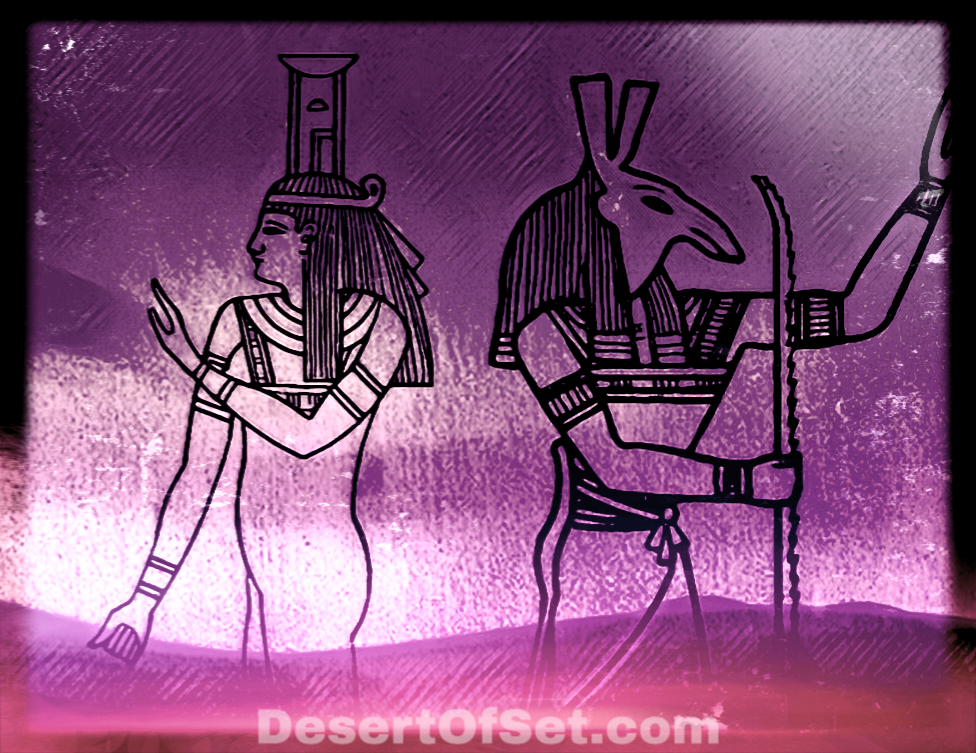
The way I see it, this is what sets the entire Osirian drama into motion. More than anything, Nephthys—sometimes described as “an imitation woman with no vagina”—wants to have a child; She wants to experience all the same parts of womanhood that Isis enjoys. So She disguises Herself as Isis and sleeps with Osiris, who is so miraculously fertile, he could even impregnate a corpse. Nephthys then gives birth to Anubis, the jackal God, and tries to hide Him so Set won’t find out what happened. But Set learns the truth and loses His temper big time. Instead of trying to harm Nephthys or Anubis, however, He squashes Osiris instead (twice, in fact). Then Isis goes on her journey to raise Osiris from the dead. She succeeds, sleeps with her brother-husband one last time before he goes to Duat, and becomes pregnant with Horus. (This is where the question of when Horus is born comes up again. I prefer to place it here at this point in the narrative, as it makes the most thematic sense to me personally; but there are other versions of the same narrative that cite Nut as the mother of Horus. Just one more example of how the ancient Egyptians were way ahead of quantum physicists or science fiction writers when it comes to the idea of alternate universes.) Nephthys dutifully accompanies Isis through all of this insanity, helping Her sister every step of the way.
This is especially the case when it comes to the funeral of Osiris; and here is where Nephthys’ innermost drive becomes most evident. She and Her son Anubis help Isis reconstruct the body of Osiris and restore him to life. Through much of this process, Nephthys weeps and wails and whimpers with Isis, empathizing with the widowed Goddess and sharing in her profound sorrow. The Egyptians prayed to Nephthys as a kind of “dark midwife” you might say, a divine grief counselor who assists those in terrible emotional anguish, helping them heal and feel better over time. This fits together with the role of Anubis, who invents the funerary arts and becomes the first mortician. Nobody enjoys experiencing death or loss, but they are facts of life, and those of us who survive must find a way to live again. To think that Nephthys and Anubis have always been there to nurture things that help us cope with such experiences (such as counseling or mortuary science) makes my heart glow like a jack-o’lantern.
Nephthys sides with the Osirian Trinity during the Contendings of Horus and Set, and She sticks with them for the most part after the Great Reconciliation. She continues associating with Big Red when it comes to fighting the Chaos Serpent, and She appears to have been revered as a powerful fire-breathing warrior in this regard. But the one member of the Divine Family Nephthys truly seems to have fallen in love with is Isis. To make things even more interesting, other cosmogonies have cited Set as being Anubis’ father; the two are often linked (or even outright confused with each other) even today.
None of what I say next should be treated as any kind of official religious dogma. This is just what I personally take from these wonderful stories, and you can either take it or leave it. But I think Nephthys is a lesbian Goddess. I think She and Set still love each other; They have just always loved each other as brother and sister for the most part. They are divorced, but for good reason; They were never very attracted to each other in the first place. Isis and Osiris are married because they love each other; Set and Nephthys were paired together as an afterthought to make the rest of the pantheon happy. This refusal to properly integrate the forms of life and being that Set and Nephthys represent is what almost caused the downfall of Creation, and the apocalypse was only averted when the Netjeru got wise as a society and changed their ways. Now these two outcasts are truly accepted by Their family as equals, and Set has even grown to love Anubis and become His stepdad.
This trinity of Set, Nephthys, and Anubis is truly remarkable for many reasons. A divorced pansexual genderbending dad, a barren lesbian spinster mom, and a so-called “illegitimate” stepchild born of “adultery”? What isn’t there to love about this, or the fact that these figures were considered acceptable and divine in ancient Egyptian culture? The Western patriarchal concept of “the nuclear family”—which insists that all families must consist of two heteronormative cisgender adults with 2.3 biological offspring born in wedlock—is not only a more recent invention in the grand scheme of things, but a blatant work of isfet (poisonous falsehood and injustice) that contradicts Ma’at (everlasting goodness and truth). There is a place for EVERY sentient being in this world, AND for the sentient beings they love too. It simply DOES NOT MATTER whether we are male or female, gay or straight, trans or cisgender, married or unmarried, monogamous or non-monogamous, biologically related or adopted—and it NEVER has. Other religions need to hurry the fuck up and get wise to this, already. Set, Nephthys, and Anubis were already on top of this well ahead of Yahweh and Jesus, and things still don’t look so good for those two on this score today.
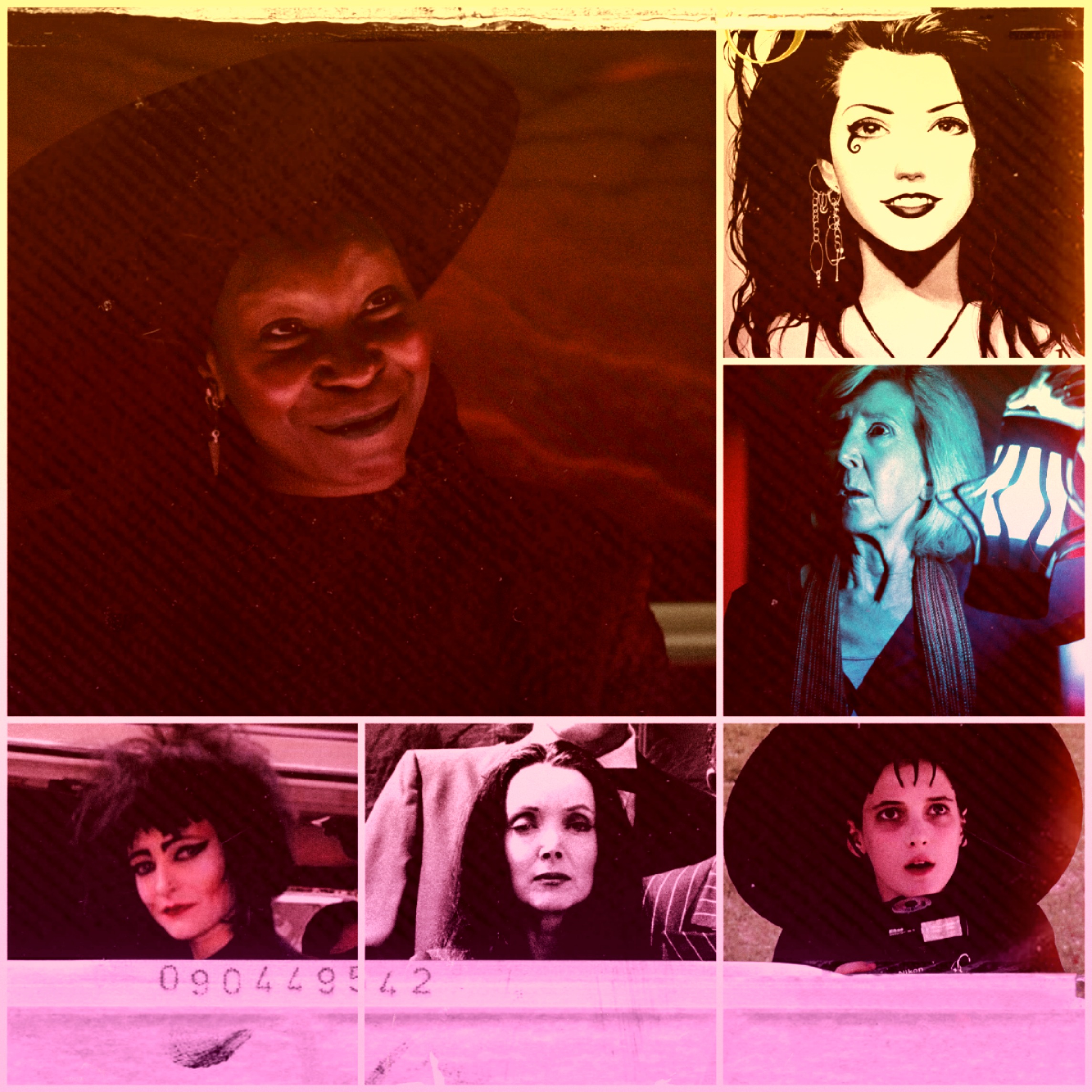
(Plus, Set, Nephthys, and Anubis are all goth as hell, like They’re the original Addams Family—and that is just cool.)

If there is any one divinity I associate with Hallowtide in particular (which is no easy task, given the sheer quantity of Gods who align with the occasion perfectly), Nephthys is the one. My wife and I enjoy visiting cemeteries all around our state in October and November, and to me, this is a way of honoring Nephthys throughout the holiday season. Just to walk among the graves and admire the craftsmanship of the headstones and tombs; to see all the ancient iconography that still shows up, even among the newer statuary; to soak in the names of the ancestors who rest there, and the times in which they lived; to be alone in the eerie silence. Even if you don’t believe in ghosts, there is just something about visiting such places for a couple of hours that has an effect on you. Most people seem to find the idea spooky, but I find it very peaceful and meditative, helping me achieve a level of mindfulness I usually can’t reach otherwise. To me, this kind of mindfulnessness is a huge part of what Lady Nephthys is all about.
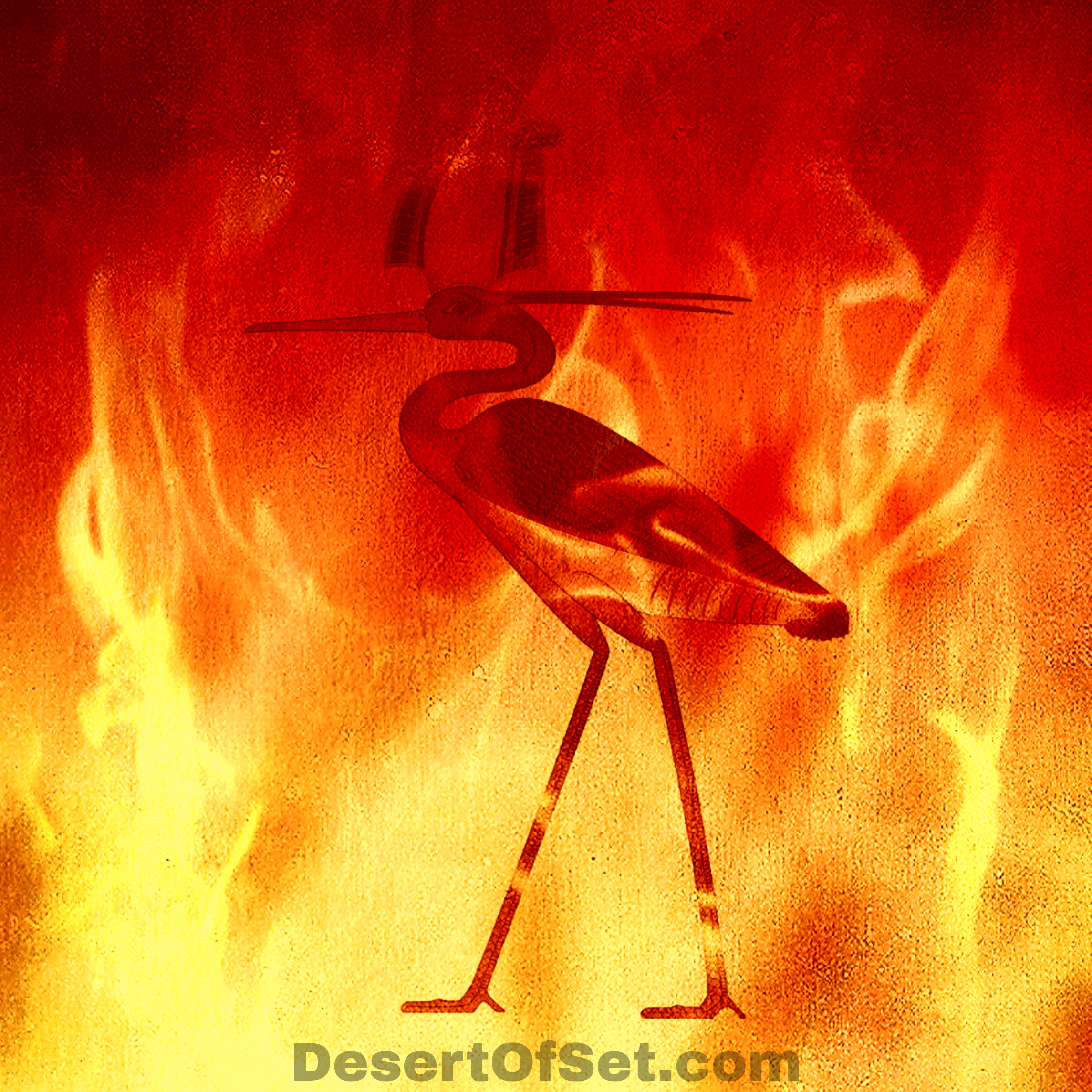
Lest She be accused of never being colorful, Nephthys is also the guardian of the Bennu. This avian divinity was associated with heron birds and the solar cycle in Heliopolis. The Greek writer Herodotus described it as the phoenix (a possible Greek derivative of Bennu), which later developed into the archetypal “bird of fire” that ritually burns and rises from its own ashes. These more modern associations are fascinating when put together with Nephthys’ reputation as a healer of wounded minds and hearts, as well as Her role as a fiery monster-slayer. Though it is really about Russian folklore, I enjoy listening to Igor Stravinsky’s The Firebird each year at Hallowtide because I find the titular creature analogous to that of the Bennu, and phoenix symbolism is very evocative of Nephthys to me personally.

Dua Sutekh (Free Album)
A free 22-minute album of ambient devotional Setian music.
I decided to drop a free, 22-minute album of music I wrote in honor of Lord Set. If pressed to categorize this material, I would describe it as a combination of ambient, electronic, industrial, and trance—except everything you hear is actually just my voice. There are no musical instruments to speak of, just samples of myself that have been processed through a variety of voice changers, then painstakingly sequenced together in an audio editor to construct the melodies included here. Personally, I don’t think this turned out half bad considering the whole thing is really just me humming and whispering and wailing to myself in my back yard. Anyway, if you enjoy this music, it is also available for free streaming and download at gbmarian.bandcamp.com, and here is a copy you can stream on YouTube as well. Dua Sutekh!
FREE ALBUM — Dua Sutekh
https://gbmarian.bandcamp.com/releases
Electronic ambient devotional music for the Egyptian god Set, composed and recorded by G.B. Marian in July 2020.
Tracks:
1. Creation’s Frontier (5:03)
2. Dua Sutekh (2:36)
3. Prince of the Darkest Heavens (4:30)
4. Snakedance (6:00)
5. Going Forth By Dawn (4:15)
Typhonian Melodies
Songs from a Setian soul.

Today’s episode is not a proper sermon as such, but a collection of brief melodies composed by yours truly. I don’t consider myself much of a musician, but I hope you will enjoy. Praise be to Set!
What Are You Afraid Of? It’s Only Rock & Roll!
Discussing the theme of “backmasked” messages in heavy metal music during the Satanic Panic, as explored in the 1986 comedy horror film, Trick or Treat.
One of my all-time favorite movies is a flick that hardly anyone seems to know about. You have to be a real 1980s horror nerd to have seen Charles Martin Smith’s Trick or Treat (1986), and it probably helps if you’re a metalhead too. I’ve never once seen the flick listed on anyone’s “Top 10 Favorite Movies” list, but you will certainly find it on mine, and I’ll tell you why. To the best of my knowledge, this is the first film ever made that features a plot inspired entirely by heavy metal and the hatred it received from politicians, televangelists, and self-righteous soccer moms during the 1980’s Satanic Panic. It may not necessarily be the best film of its subgenre; undoubtedly, many people would probably vote for Jason Lei Howden’s Deathgasm (2015), which has a very similar plot. But despite Deathgasm’s superior production values, Trick or Treat did it first, and it made a huge impression on me while I was growing up.
Eddie Weinbauer (played by Marc Price, better known as “Skippy” from Family Ties) is a teenage metalhead who lives in the town of Lakeridge, North Carolina, and who goes by the nickname “Ragman.” Eddie is especially dedicated to the music of Sammi Curr (Tony Fields), a glam metal shock rocker who’s obviously inspired by Alice Cooper. Eddie absolutely worships Sammi, and he’s friends with a radio DJ named “Nuke” (Gene Simmons of KISS), a nerd named Roger (Glen Morgan, one of the lead writers for The X-Files and the Final Destination movies), and a pretty girl at his school named Leslie (Lisa Orgolini). Unfortunately, Ragman is also bullied at his school by a bunch of jocks (led by Doug Savant of Desperate Housewives fame), who all think he’s creepy and weird. These guys are pretty harsh, too, because they apparently see nothing wrong with trying to drown poor Eddie in a swimming pool.

Why does Ragman dig Sammi Curr so much? Because Curr’s music helps him cope with his feelings of subjugation. In a strange way, Curr is eerily prophetic of Marilyn Manson, who took shock rock to a whole new level in the 1990s. Not content with just scaring or pissing off parents, Manson made himself into a full-blown culture war iconoclast (the “Antichrist Superstar”) and deliberately terrorized the entire American Religious Right. In a similar way, Curr uses his music and his fanbase to declare war on society. He offers his fans a future in which “Rock’s Chosen Warriors will rule the Apocalypse,” and he promises all who try to ban his music that “We will bring you down.” For Eddie, Curr is more than just a rock icon or a hero; he’s a counter-cultural messiah who promises total emancipation from Christian society.
But all of this seems to vanish into thin air when Eddie turns on the TV one morning to learn that Sammi Curr has died in a hotel fire. The boy is instantly crushed and descends into despair, but when he visits his friend Nuke at the local WZLP radio station, Nuke gives him a special gift. You see, Sammi Curr actually grew up right here in Eddie’s hometown, and Nuke was friends with him when they were kids. As it turns out, Nuke just happens to have a demo recording of an album Curr was still recording when he died. (The album is named Songs in the Key of Death.) Nuke gives the record to Eddie, telling him Sammi would have wanted him to have it. And while listening to it later that night, Eddie discovers the album contains a bunch of backmasked messages. Then he plays the record in reverse to see what the messages are saying, and that’s when he receives the biggest shock of his life.

Eddie “Ragman” Weinbauer and his hero, Sammi Curr.
The voice of Sammi Curr speaks to Eddie through the backmasked messages, telling the boy to do certain things while he’s at school the next day. When Eddie follows the advice he is given, he outsmarts his foes and gets them in trouble (while getting away scotch free, himself). It then seems like the two conspirators will get to realize their shared vision of a world without bullies after all; but as Curr continues to help Ragman “nail” his tormenters, he also demands the boy’s help in “nailing” everyone who ever tried to ban his music. Their Halloween pranks soon turn deadly, and Ragman realizes his beloved demigod is actually a demon. By the end, Eddie must stop Sammi from killing everyone in Lakeridge when Nuke plays Songs in the Key of Death backwards on his radio show (on All Hallows’ Eve, no less).
Now I know good and well what some of you must be thinking. Trick or Treat sounds like something that was made by evangelical Christians, right? It sounds like the entire point of the film is to demonize heavy metal and anyone who listens to it. As a devoted metalhead myself, I probably shouldn’t enjoy this film at all, should I? But consider the fact that Ozzy Osbourne appears in a cameo as “the Reverend Aaron Gilstrom,” an anti-rock televangelist. Yes, you read that correctly: Ozzy fuckin’ Osbourne plays a Jimmy Swaggart clone who preaches that metal musicians are all Satanists brainwashing our kids. (Now that’s what I call irony!) I might also point out that Trick or Treat doesn’t quite end the way you’d expect. If this were an evangelical propaganda film like Rock: It’s Your Decision (1982), Eddie would swear off metal for good after defeating Sammi Curr and “give himself to Jesus” (as they say). But after he defeats the ghost of the man who used to be his hero, what do you suppose Ragman actually does?
By Gods, he plays a Gods-damn Sammi Curr record!
Yes, that’s right—and I think this is where Trick or Treat really shines the most. While the film is inspired by urban American myths about “backmasking” in heavy metal music, it obviously does not agree with the people who take such fears literally. Instead, the film presents metal as something that’s legitimately fun but misunderstood—and not only by parents, preachers, or politicians. Eddie Weinbauer eventually sees that Sammi Curr is a much worse bully than any of the jocks who’ve been tormenting him at Lakeridge High. But when Eddie takes Sammi down, he isn’t turning his back on metal (or even on Curr’s music, necessarily). He’s just learning to separate the art he loves from the artist who created it. The artist might be a major asshole, but it’s OK to still enjoy and take inspiration from their art.
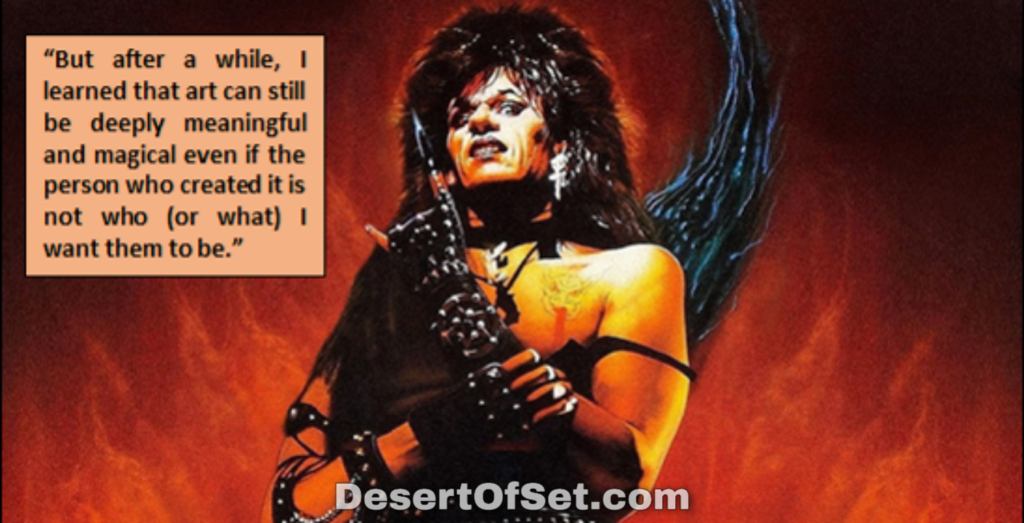
When I was in high school, I used to worship the ground Marilyn Manson walked on. But then I learned he really isn’t the all-powerful “Antichrist Superstar” he made himself out to be. At first, this made me feel like I could never listen to Manson’s music again; my sense of disappointment was just too much. But after a while, I learned that art can still be deeply meaningful and magical even if the person who created it is not who (or what) I want them to be. I went through this exact same process with Alice Cooper and Ozzy Osbourne. In heavy metal especially, it’s easy to confuse the people creating the music with the characters they play on stage. Marilyn, Alice, and Ozzy aren’t real people; they’re bigger-than-life personas that were created by Brian Warner, Vincent Furnier, and John Osbourne, respectively. The funny thing is that once I finally began to understand this principle, I started to enjoy their music even more.
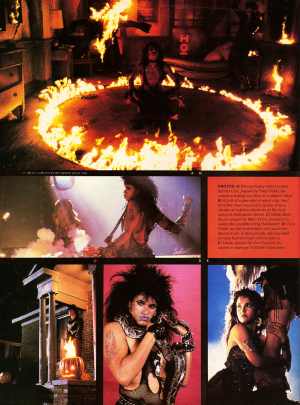
Some promotional photos for the film.
In Trick or Treat, the problem is not with heavy metal itself, but with the fact that Sammi Curr takes his hype and his stage persona way too seriously. When Eddie fights him, Sammi accuses him of being “false metal”—but in reality, Sammi is the one who is false. Part of the fun to heavy metal is that it’s basically a huge power fantasy that can be taken to some truly ridiculous extremes. What’s more, this is usually done while keeping one’s tongue planted firmly in-cheek. Sure, there are people like Sammi Curr who take themselves way too seriously; but this genre was built on the backs of guys like Coop and Ozzy, who sing about strangling people or having sex with the devil while winking at their audiences. It’s all make-believe, much like a Halloween party that never ends, and the people who take it too seriously—including both the Pat Robertsons and the Varg Vikerneses of this world—are completely missing the point.
Most people who’ve seen Trick or Treat will tell you it’s a total dud. To be fair, it is full of bloopers; you can even see the boom mike at the top of the screen at one point. (Keep your eyes peeled when Ragman answers the front door, only to find his mom’s boyfriend dressed up as Rambo on the other side. Pay close attention to the top right-hand corner of the screen!) The movie also can’t seem to settle on whether it wants to be a genuine horror film or a comedy with horrific overtones, which is something that normally tends to annoy me. But even with all that being said, Trick or Treat is very well-acted, the music is phenomenal (featuring songs by Fastway and a score by Christopher Young), and a great deal of creative effort was clearly put into it. They weren’t just trying to make a quick buck with this one; they were actually trying to make something witty and intelligent—and for my money, at least, they succeeded.
Trick or Treat is also a film that we hold sacred in the LV-426 Tradition (much like 1979’s Alien and 1982’s The Thing). It nicely reflects our own personal histories with Set. We were all like Eddie Weinbauer when we were kids; we were alienated youth, and we coped with our problems by listening to angry, aggressive-sounding music. That same music became one of our various “doorways” into Setianism, and for this reason, we treated our rock heroes like they were pillars of wisdom and virtue. Big Red had to disabuse us of this notion over time; like Ragman, we had to learn how to enjoy our favorite artists without believing in all their hype, and Trick or Treat reminds us of what it was like to go through all of that.
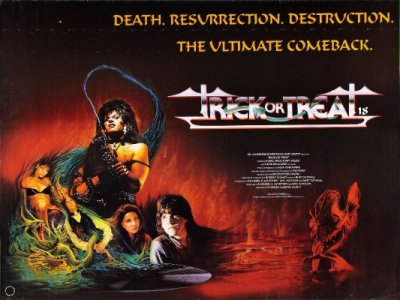
Alternate poster art for the film.