Tag: Sutekh
Nephthys, the Dark Midwife
The sister and ex-wife of Set is a renowned healer of wounded hearts and minds.
Even more than Ishtar or Taweret, Nephthys is the Goddess who is most often linked with Set. In fact, some people might be wondering why it’s taken me 40 whole episodes before I got around to discussing Her. Truth is, I wanted to highlight the aforementioned Goddesses first because Their interactions with Set are far less known. I also think Set and Nephthys share a much more complex relationship than what is typically imagined about God and Goddess couples, for reasons I shall explain.
The name of this Goddess, which comes from the Egyptian Nebet-Het, means “Lady of the House.” It refers to a temple enclosure, rather than a domestic residence. In the Heliopolitan cosmogony, Nephthys is one of the fourth generation of Netjeru (the others being Osiris, Isis, Set, and even Horus in some accounts). As such, She is one of the divinities who facilitate life here on earth, and who contributes to the arts of human civilization.
The fourth generation of Gods was somewhat disruptive to the natural order of things at first. There is even a story about Ra, the first Netjer, prohibiting their granddaughter, the sky Goddess Nut, from giving birth to these young’uns (despite already being pregnant). Thankfully, the wise God Thoth finds a technicality that allows Nut to have her children while still technically obeying Ra’s decree. So first it was just Ra, and all things were united in them. Then Ra begat Shu and Tefnut, the breath and the waters of life, who are the first male and female. After that, Shu and Tefnut begat another male and female, Nut and Geb, the deities of heaven and earth. While Ra themself is hermaphroditic, the second and third theological generations are dichotomous, falling into a strict gender binary that is strongly tied to the reproductive cycle.
Reproduction becomes a major theme for the fourth generation of Netjeru as well, but in a radically different way. For one thing, there are not just two deities in this generation, but at least four (if not five, depending on whether you choose to include Horus—but more on that in a moment). Only two of these figures—Isis and Osiris—are a fertile heteronormative couple, and they become the darlings of the pantheon for this reason. Set and Nephthys are sterile and barren, incapable of producing any offspring. Set is also attracted to Gods of the same sex, and there is reason to think the same might be true of Nephthys. While Isis and Osiris are like celebrities, receiving all the glory and the privilege from their elders, everybody tries to forget about Set and Nephthys in the beginning, pairing Them together and leaving Them to fend for Themselves.
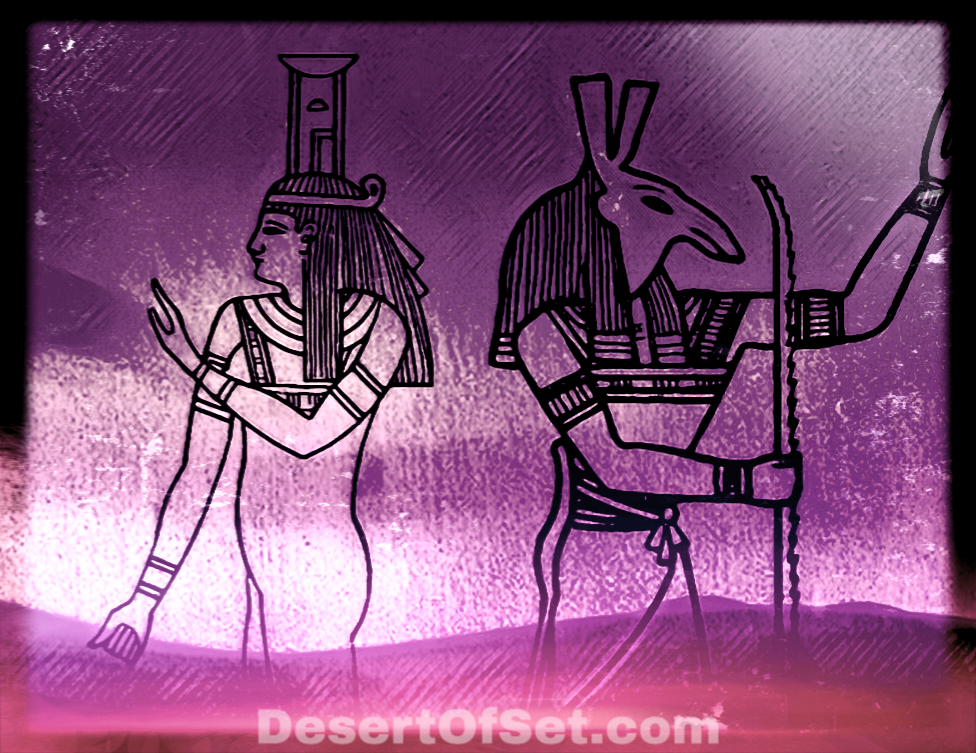
The way I see it, this is what sets the entire Osirian drama into motion. More than anything, Nephthys—sometimes described as “an imitation woman with no vagina”—wants to have a child; She wants to experience all the same parts of womanhood that Isis enjoys. So She disguises Herself as Isis and sleeps with Osiris, who is so miraculously fertile, he could even impregnate a corpse. Nephthys then gives birth to Anubis, the jackal God, and tries to hide Him so Set won’t find out what happened. But Set learns the truth and loses His temper big time. Instead of trying to harm Nephthys or Anubis, however, He squashes Osiris instead (twice, in fact). Then Isis goes on her journey to raise Osiris from the dead. She succeeds, sleeps with her brother-husband one last time before he goes to Duat, and becomes pregnant with Horus. (This is where the question of when Horus is born comes up again. I prefer to place it here at this point in the narrative, as it makes the most thematic sense to me personally; but there are other versions of the same narrative that cite Nut as the mother of Horus. Just one more example of how the ancient Egyptians were way ahead of quantum physicists or science fiction writers when it comes to the idea of alternate universes.) Nephthys dutifully accompanies Isis through all of this insanity, helping Her sister every step of the way.
This is especially the case when it comes to the funeral of Osiris; and here is where Nephthys’ innermost drive becomes most evident. She and Her son Anubis help Isis reconstruct the body of Osiris and restore him to life. Through much of this process, Nephthys weeps and wails and whimpers with Isis, empathizing with the widowed Goddess and sharing in her profound sorrow. The Egyptians prayed to Nephthys as a kind of “dark midwife” you might say, a divine grief counselor who assists those in terrible emotional anguish, helping them heal and feel better over time. This fits together with the role of Anubis, who invents the funerary arts and becomes the first mortician. Nobody enjoys experiencing death or loss, but they are facts of life, and those of us who survive must find a way to live again. To think that Nephthys and Anubis have always been there to nurture things that help us cope with such experiences (such as counseling or mortuary science) makes my heart glow like a jack-o’lantern.
Nephthys sides with the Osirian Trinity during the Contendings of Horus and Set, and She sticks with them for the most part after the Great Reconciliation. She continues associating with Big Red when it comes to fighting the Chaos Serpent, and She appears to have been revered as a powerful fire-breathing warrior in this regard. But the one member of the Divine Family Nephthys truly seems to have fallen in love with is Isis. To make things even more interesting, other cosmogonies have cited Set as being Anubis’ father; the two are often linked (or even outright confused with each other) even today.
None of what I say next should be treated as any kind of official religious dogma. This is just what I personally take from these wonderful stories, and you can either take it or leave it. But I think Nephthys is a lesbian Goddess. I think She and Set still love each other; They have just always loved each other as brother and sister for the most part. They are divorced, but for good reason; They were never very attracted to each other in the first place. Isis and Osiris are married because they love each other; Set and Nephthys were paired together as an afterthought to make the rest of the pantheon happy. This refusal to properly integrate the forms of life and being that Set and Nephthys represent is what almost caused the downfall of Creation, and the apocalypse was only averted when the Netjeru got wise as a society and changed their ways. Now these two outcasts are truly accepted by Their family as equals, and Set has even grown to love Anubis and become His stepdad.
This trinity of Set, Nephthys, and Anubis is truly remarkable for many reasons. A divorced pansexual genderbending dad, a barren lesbian spinster mom, and a so-called “illegitimate” stepchild born of “adultery”? What isn’t there to love about this, or the fact that these figures were considered acceptable and divine in ancient Egyptian culture? The Western patriarchal concept of “the nuclear family”—which insists that all families must consist of two heteronormative cisgender adults with 2.3 biological offspring born in wedlock—is not only a more recent invention in the grand scheme of things, but a blatant work of isfet (poisonous falsehood and injustice) that contradicts Ma’at (everlasting goodness and truth). There is a place for EVERY sentient being in this world, AND for the sentient beings they love too. It simply DOES NOT MATTER whether we are male or female, gay or straight, trans or cisgender, married or unmarried, monogamous or non-monogamous, biologically related or adopted—and it NEVER has. Other religions need to hurry the fuck up and get wise to this, already. Set, Nephthys, and Anubis were already on top of this well ahead of Yahweh and Jesus, and things still don’t look so good for those two on this score today.
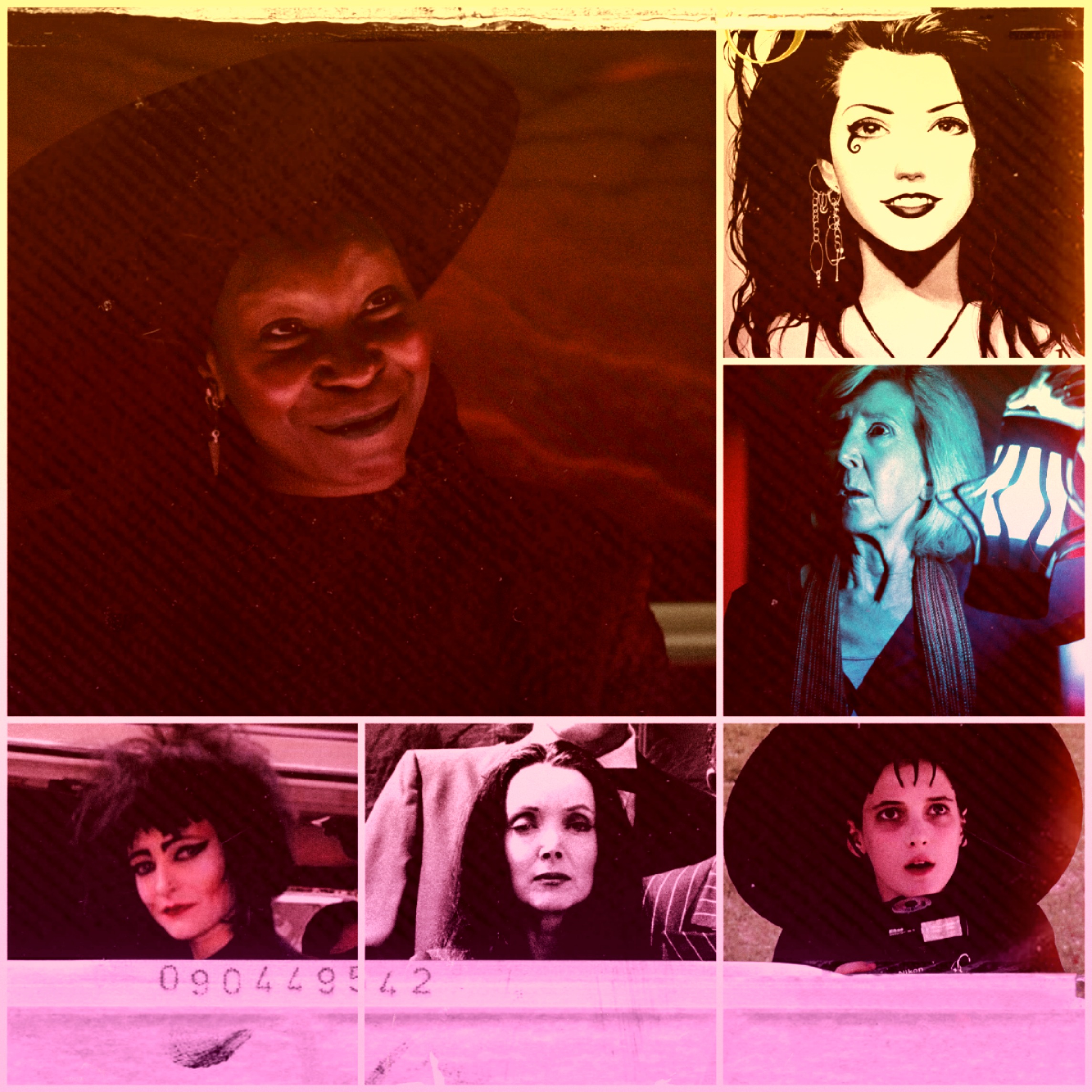
(Plus, Set, Nephthys, and Anubis are all goth as hell, like They’re the original Addams Family—and that is just cool.)

If there is any one divinity I associate with Hallowtide in particular (which is no easy task, given the sheer quantity of Gods who align with the occasion perfectly), Nephthys is the one. My wife and I enjoy visiting cemeteries all around our state in October and November, and to me, this is a way of honoring Nephthys throughout the holiday season. Just to walk among the graves and admire the craftsmanship of the headstones and tombs; to see all the ancient iconography that still shows up, even among the newer statuary; to soak in the names of the ancestors who rest there, and the times in which they lived; to be alone in the eerie silence. Even if you don’t believe in ghosts, there is just something about visiting such places for a couple of hours that has an effect on you. Most people seem to find the idea spooky, but I find it very peaceful and meditative, helping me achieve a level of mindfulness I usually can’t reach otherwise. To me, this kind of mindfulnessness is a huge part of what Lady Nephthys is all about.
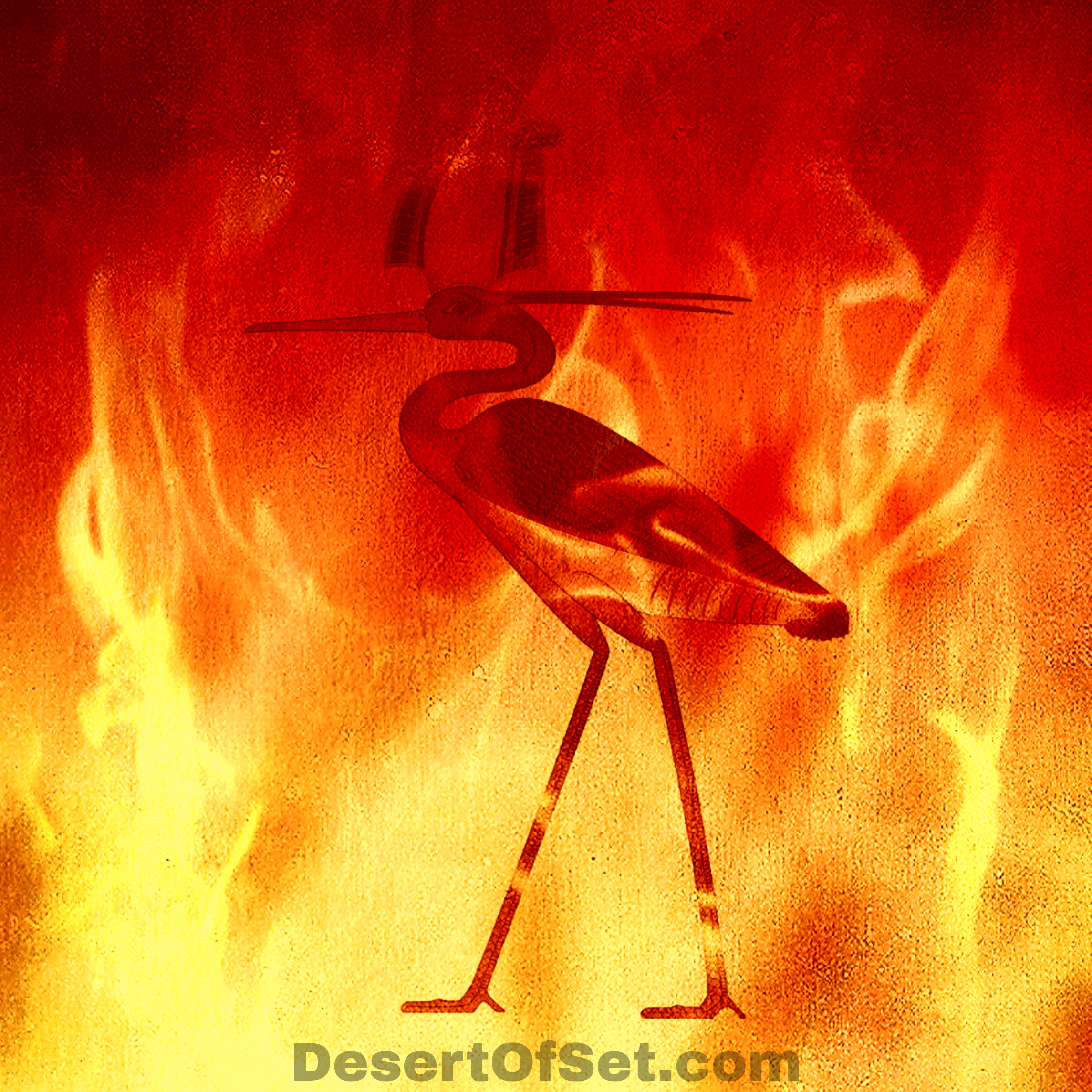
Lest She be accused of never being colorful, Nephthys is also the guardian of the Bennu. This avian divinity was associated with heron birds and the solar cycle in Heliopolis. The Greek writer Herodotus described it as the phoenix (a possible Greek derivative of Bennu), which later developed into the archetypal “bird of fire” that ritually burns and rises from its own ashes. These more modern associations are fascinating when put together with Nephthys’ reputation as a healer of wounded minds and hearts, as well as Her role as a fiery monster-slayer. Though it is really about Russian folklore, I enjoy listening to Igor Stravinsky’s The Firebird each year at Hallowtide because I find the titular creature analogous to that of the Bennu, and phoenix symbolism is very evocative of Nephthys to me personally.

Gorgo, the Irish Feminist Sea-Dragon
Gorgo (1961) is a British kaiju (giant monster) movie with several interesting subtexts, all of which seem relevant to the Goddess Taweret.

In Gorgo (1961), two guys named Sam and Joe are traveling the British seas, looking for gold and other precious junk on the ocean floor. Their ship gets damaged during a weird volcanic eruption that happens in the middle of the sea for no apparent reason, and they end up having to stay on an island off the coast of Ireland for a few days. While repairing their ship, Sam and Joe notice that the people of this island seem to be hiding something. Well, that something turns out to be a giant bipedal lizard with big floppy fins for ears. Sam and Joe decide to capture the creature, and when they do, the Irish government implores them to give the beast to the University of Dublin for scientific research. Unfortunately, our protagonists decide to bring the reptile to Dorkin’s Circus in London instead, where they make a shit-ton of money off the poor creature. The joke’s on them, though, because they soon learn that “Gorgo” (the name Dorkin gives to the creature, which is taken from the three Gorgons in Greek mythology) is not the only one of its breed. It’s really just a baby, in fact, and its mother—who is significantly larger and meaner—is now on her way to file one hell of a grievance against the entire city of London.
That’s pretty much the entire plot to the film right there, and considering its year of release, we’re dealing with some pretty predictable stuff. For the most part, Gorgo is largely a remake of King Kong (1933), save that its giant monster is of the saurian persuasion. Yet there are several things that distinguish this kaiju film from all of its contemporaries. At the most obvious level, it’s not Japanese but British, and it provides some interesting insight into the United Kingdom’s sociopolitical situation at the time. When Sam and Joe arrive at the island with their crew, they seek help from the Irish locals. But the locals will only respond to them in Gaelic, even though they clearly understand English. Sam and Joe also learn the harbormaster has been salvaging archaeological finds from the ocean, and they bully the dude into giving them all of his loot as “payment” for capturing Gorgo. Later on, when they decide to sell Gorgo to the London circus, they are effectively giving the Irish government the middle finger. That’s not once, but twice in the same film where Ireland gets screwed over by Anglo-Saxons, who rob the Gaels not only of their history (in the form of their archaeological treasures), but of their very own real-life dragon as well.
I first saw Gorgo when I was five or six years old. I had already seen a lot of giant monster flicks by that point, and in most of them, the “ethnic” people are usually people of color (or white and/or Japanese people in blackface or brownface). This goes all the way back to King Kong (1933), which unfortunately depicts black people as savages whom the white characters could easily exploit. But Gorgo was the first of these movies I ever saw where it’s white people treating other white people this way. Seeing Englishmen mistreat Irish people and animals in Gorgo was my introduction to subjects like Hibernophobia and the Troubles of Northern Ireland. I also love the film for being my first exposure to Gaelic language and culture.
But there’s another subtext in this film. So there’s this Irish kid named Sean, and he’s the only character who sympathizes with the monsters at first. He even stows away on Sam and Joe’s ship, hoping to free Baby Gorgo out at sea. The kid gets caught, but what do you think happens after that? Sam and Joe decide to let Sean live with them, that’s what. And yes, I said “with them.” With only a few brief exceptions, these two men spend the entire movie together; and the body language they use around each other at home is most interesting. There’s one scene where Sam and Joe are comfort little Sean while he tries to go to sleep, and Joe stands at the head of the bed in a typical fatherly pose, while Sam sits beside Sean on the mattress in a more gentle and nurturing pose. Then there’s another scene where Sam and Joe squabble over a carnival worker who has been killed by Baby Gorgo. Sam is worried about the guy’s wife and kids, and Joe, not wanting Sam to worry, promises he will send the family some money. There’s even a scene where the two of them are introduced as “Joe Ryan and his partner, Sam Slade”—and while that kind of terminology didn’t have the same connotation in 1961 that it has today, it’s hard not to imbue it with contemporary significance. It’s also interesting that there isn’t a single girl or woman in the entire cast, and that when one of the adult characters finally starts to side with Sean about setting Baby Gorgo free, it’s Sam (the “motherly” father). In other words, it’s totally believable to me that Sam and Joe are a couple, that they’ve adopted Sean, and that the three of them have become a family.

Sam (William Sylvester), Joe (Bill Travers), and Sean (Vincent Winter)—a 1960s same-sex family?
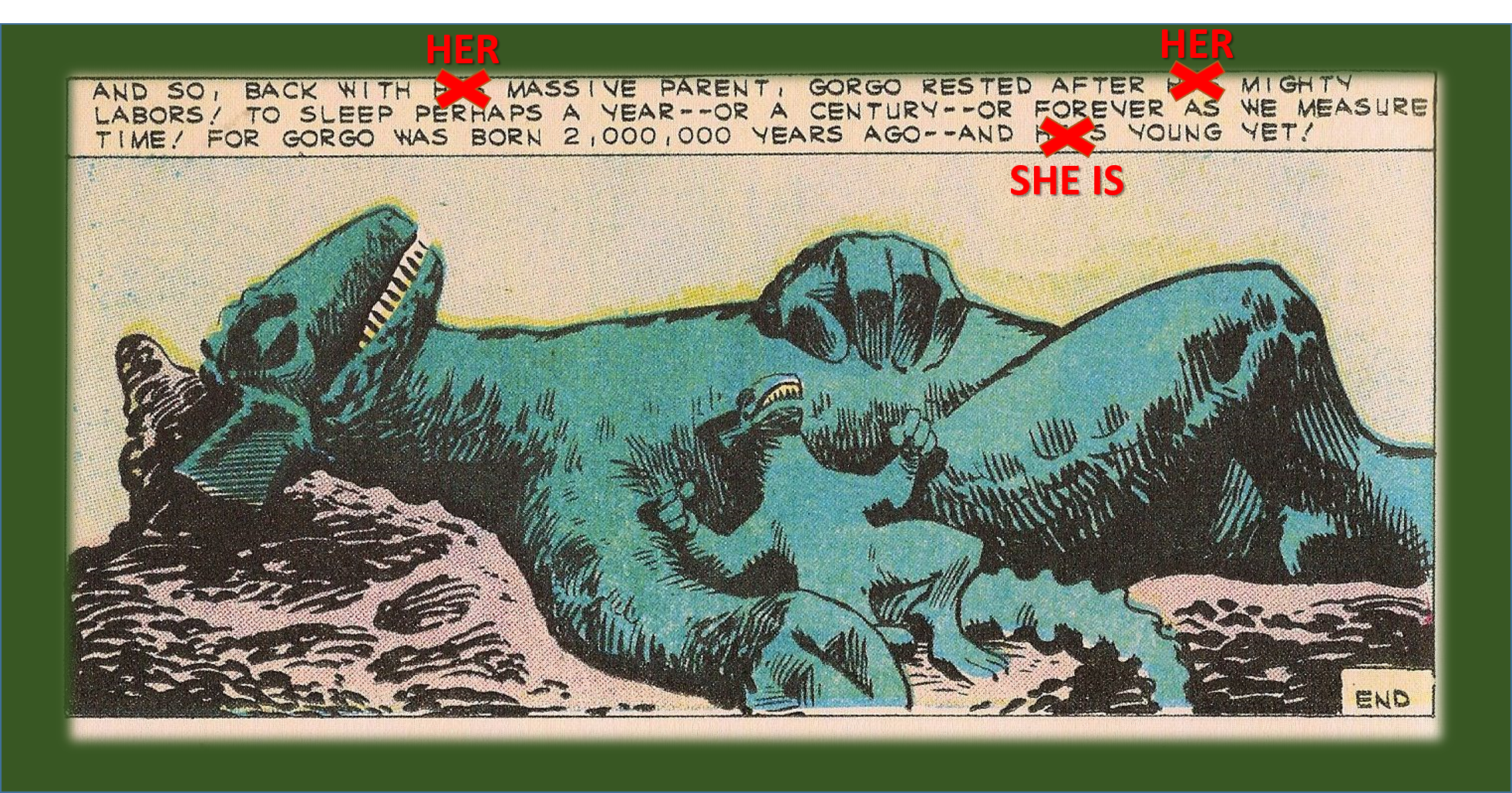
I say Gorgo has no women in it (aside from a few here or there among the extras during the final act), but there is at least one female in the film (if not two), and that’s Mama Gorgo. It’s never specifically confirmed at any point that she’s got a XX pair of sex chromosomes, but I think we can safely assume that this is true. How else can we explain Baby Gorgo? If you’re wondering where the father might be, there are such things as the New Mexico whiptail, a lizard species that is entirely female and that reproduces through parthenogenesis. It seems likely to me that Baby Gorgo is female as well, given that Dorkins names her after the Gorgons of Greek mythology (all of whom are ladies). Gorgo was also the name of a famous Queen of Sparta who lived and ruled during the 6th and 5th centuries BCE. So any way you slice it, it would seem that the giant lizards in Gorgo are the only female characters in this entire movie. This would make sense in light of certain combat myths like the Enuma Elish, for just as Marduk used his masculine strength to slay his saurian mother Tiamat and create the universe from Her corpse, so too do Sam and Joe try to create a multimillion dollar empire with the female Irish sea dragon they’ve captured. But things don’t go quite so well for them as they did for ol’ Marduk, which brings us to why I think Gorgo is something more than just a King Kong cash-in.

I’ve always found the original 1933 King Kong too horrific to watch, because it’s about people committing acts of animal cruelty and not having to pay any real consequences for doing so. While many viewers sympathize with the titular giant ape, there is no indication in the film itself that we’re supposed to; Kong is presented as being just a big dumb animal who has to die so the damsel in distress can live to marry the dashing male hero. None of the characters mourn for Kong, and no one acknowledges that removing him from his natural environment and exploiting him was wrong (or at least, not until the remakes came along). Such was the general attitude audiences had toward giant monsters until 1954, when Ishiro Honda gave us the original Godzilla. The monster in that film also had to die, but its death is treated more like a funeral; the audience is actively encouraged to sympathize with it and to consider the aftermath of all the violence that happens in the film. Gorgo, in contrast, is the first kaiju film in which the monsters are not only sympathetic, but victorious. There’s nothing quite so satisfying as seeing Mama and Baby Gorgo swimming back home to Ireland at the end of the film, and it wasn’t long after their victory that Mothra, Godzilla, King Kong, and the giant turtle Gamera were each re-imagined as kid-friendly superheroes.

No phallic symbolism is safe from Mama Gorgo!
So the conflict in this film would seem to exist between two different same-sex families: (1) a single mother and her little girl (the Gorgos), and (2) two men and their son (Sam, Joe, and Sean). Neither of these two families is “normal” according to “traditional” patriarchal standards; and yet the film never tries to “punish” either of them for this. As mentioned earlier, the Gorgos are reunited and get to go home, alive and happy; but even the human family turns out okay in the end. They also share a collective character arc; at first it’s just Sam and Joe, and all they care about is fame and money. Then they adopt Sean, and Sam starts sympathizing with the Gorgos like Sean does. Joe—the “fatherly” dad—remains an asshole for most of the story, but then redeems himself during Mama Gorgo’s attack on London. He protects Sean amidst all the destruction, and they are both safely re-united with Sam at the end. Based on how Joe behaves earlier in the film, you would expect this character to try and save his own skin while leaving the kid alone to die (and then be promptly eaten by the monster for being a dick). Not so with Joe; he sees the light, chooses his kid over his own self-preservation, and actually works hard to be a good dad. You almost never see this kind of character transition in giant monster movies, especially in the 1960s, and to think Joe is a gay man just makes it cooler.
Gorgo does have its flaws, but most of them are the kind I tend to overlook. The writing isn’t as sharp as it could have been; most of the character development is restricted to the first two acts (which tends to bore the hell out of most viewers), while most of the action occurs during the final act (at which point, the film forgets its human characters almost entirely). These things don’t really bother me; the only serious criticism I have about Gorgo is the fact that during its final 18 minutes, it suddenly introduces a news reporter character who narrates every single detail about Mama Gorgo’s parade through London. This segment is so glaringly unnecessary, it’s virtually impossible to ignore it. The first 60 minutes of the story are easy enough to follow, so why the hell did anyone think the last 18 needed a narrator?
Another thing I love about Gorgo is the fact that it makes me think about Taweret, the hippo fertility Goddess. Taweret is like a benign chaos monster; instead of being killed to save (or create) the world, She kills other monsters that threaten the future of the world. Mama Gorgo is a perfect cinematic avatar for Taweret, and watching this film is like watching the Great Female crush the white racist capitalist patriarchy beneath Her cute, stubby toes. Seeing this movie as a kid probably helped put me on Taweret’s wavelength, even back then. If you’re Pagan and you love animals (especially gigantic reptilian beasties with wiggly ears), I bet dollars to donuts you will enjoy Gorgo. If you’ve never seen it and you’d like an additional bonus to go with it, this movie is featured in Episode 9 from Season 9 of Mystery Science Theater 3000.
Dua Sutekh (Free Album)
A free 22-minute album of ambient devotional Setian music.
I decided to drop a free, 22-minute album of music I wrote in honor of Lord Set. If pressed to categorize this material, I would describe it as a combination of ambient, electronic, industrial, and trance—except everything you hear is actually just my voice. There are no musical instruments to speak of, just samples of myself that have been processed through a variety of voice changers, then painstakingly sequenced together in an audio editor to construct the melodies included here. Personally, I don’t think this turned out half bad considering the whole thing is really just me humming and whispering and wailing to myself in my back yard. Anyway, if you enjoy this music, it is also available for free streaming and download at gbmarian.bandcamp.com, and here is a copy you can stream on YouTube as well. Dua Sutekh!
FREE ALBUM — Dua Sutekh
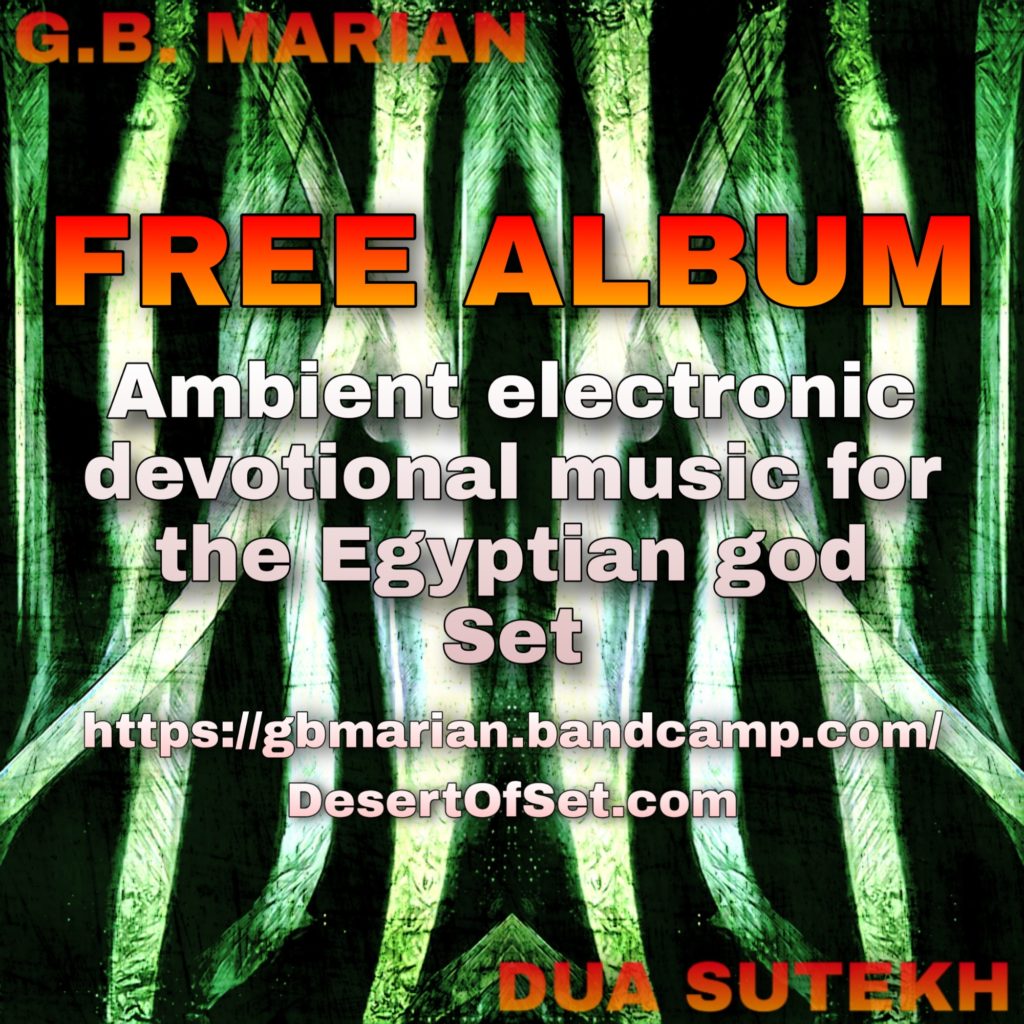
https://gbmarian.bandcamp.com/releases
Electronic ambient devotional music for the Egyptian god Set, composed and recorded by G.B. Marian in July 2020.
Tracks:
1. Creation’s Frontier (5:03)
2. Dua Sutekh (2:36)
3. Prince of the Darkest Heavens (4:30)
4. Snakedance (6:00)
5. Going Forth By Dawn (4:15)
Taweret—Or, When God is a Hippopotamus
A discussion of the Egyptian hippo Goddess Taweret, Her connections with Set, and the reasons I love Her so much.

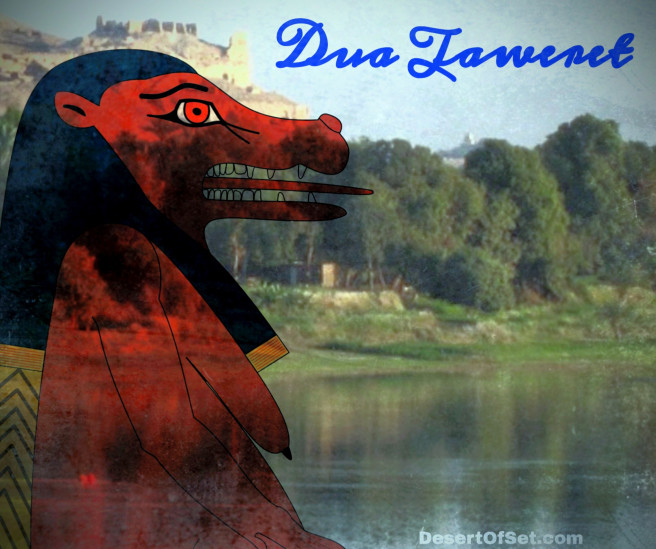
Taweret is the Egyptian hippo Goddess of childbirth. Her name means “Great Female,” and She is otherwise known as Taurt, Reret, Apet, or Thoueris. According to some accounts, She was originally the female counterpart of Apep, the Chaos Serpent; but She became a Goddess and a defender of Ma’at. Now—along with Her trusty sidekick, the benevolent daemon Bes—Taweret protects the frightened and the vulnerable. As frightening as all the qliphoth of the Void might be, they are frightened of Taweret, and for good reason. Her sacred animal is one of the deadliest creatures on earth, and She is the only other Netjer or Egyptian divinity who is powerful enough to wield Khepesh, the celestial Iron of Set!
Hippos are Typhonian animals, which means there’s a very strong connection between Taweret and Set. While male hippos were feared, females were celebrated for their ferocity in protecting their young. The Egyptians channeled this ferocity by invoking Taweret for protection, especially when it came to mothers and little children. Midwives commonly used hippo statuettes to instill Taweret’s strength in women who were giving birth. People kept Her image around their homes because it made them feel SAFE in a world of terror and chaos, with no hospitals or public health system as we understand such things today. People generally don’t behave that way toward influences they think are “ugly” or “disturbing,” so clearly the sight of Taweret inspired confidence. Despite Her so-called “demonic” appearance, the Great Female is there to defend the defenseless.
Taweret never had any temples or priesthoods of Her own (that we presently know of, at least); Hers was a purely folk tradition, kept alive by Egyptian peasants in their own homes. This is ironic, given that Taweret is also linked with one of the largest and most important constellations in the northern sky. The Egyptians viewed Draco not as a dragon, but as a great big hippo with a crocodile on Her back. In funerary art, this hippo was shown with sagging breasts that are heavy with milk. She holds a chain by which the Big Dipper is tethered to Polaris, the North Star. Taweret is said to keep the Dipper restrained to prevent Set from completely destroying the universe whenever He becomes too angry. She is helped in this regard by the Four Sons of Horus: Duamutef, Hapi, Imsety and Qebshenuf.

The Great Female was eventually recast as an alternate form of Isis, the sister-wife of Osiris; but I disagree with this conflation myself. Isis is linked to Sirius and the Sothic cycle, not to Draco or the circumpolar stars, and the Isian religion is known for having absorbed virtually every other Goddess religion it encountered in Late Antiquity (including the cults of Aphrodite, Demeter, and Diana). But most importantly to me, Taweret is a “monstrous” divinity who was born of chaos and who exhibits chaotic traits, yet who uses Her chaotic powers to defend the cosmic order (not to un-create it, as Apep seeks to do). She trades in an altogether different, more primeval kind of fertility than Isis does. The Egyptian Gods are kind of like Voltron or the Megazord; they can converge in various formations and become composite deities, and this includes Taweret and Isis as much as the rest. But this is not the same thing as saying Taweret is simply a “different version of Isis.”
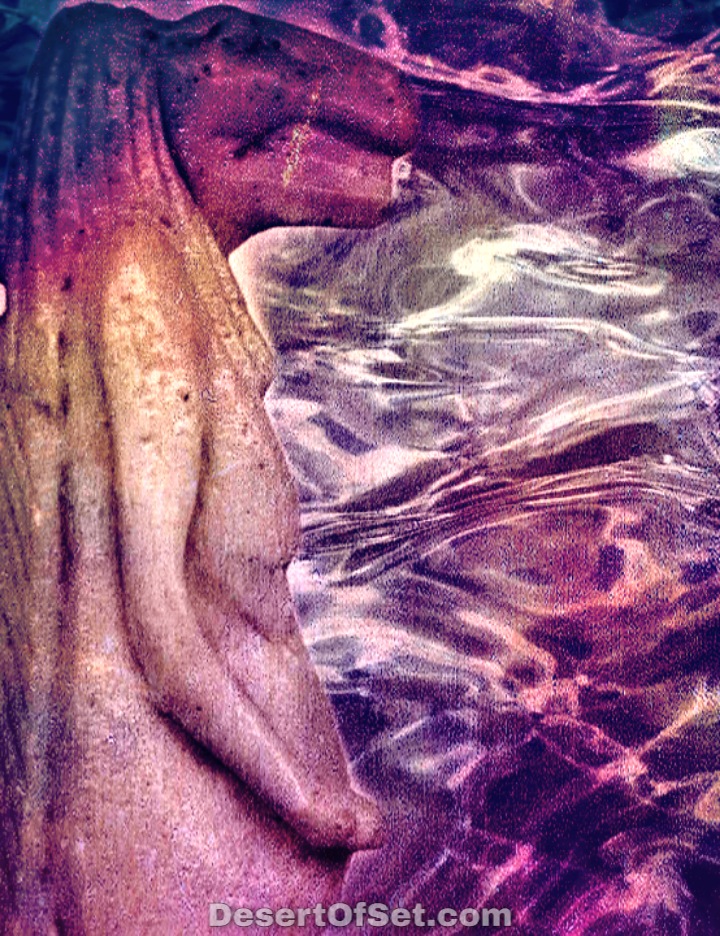
Many Goddesses are portrayed as beautiful, slender-bodied women, but Taweret has always been depicted as rotund, with a gaping mouth full of razor sharp teeth. She certainly isn’t the sort of “glamour girl” one normally finds in pinup magazines, and I absolutely love Her for this. (Not that I have anything against the more glamorous Goddesses; remember, I revere Ishtar too.) Our patriarchal society pretends to love women, but continues to shame them for not keeping fit, wearing makeup, shaving their armpits, or bearing children. There is nothing wrong with doing either of these things so long as it is your choice, just like there is nothing wrong with wearing a skirt or a hijab so long as it is your choice. But the expectation that every woman must fit some kind of “mold” is not only misogynist; it goes against nature, as holy figures like Taweret are here to remind us.
By the time the Greek writer Plutarch came along (circa 46–120 C.E.) to offer his version of events, Taweret’s story had been changed so that She was a concubine of Set who abandoned Him after the killing of Osiris. This change was probably the result of Set’s demonization in Late Antiquity, when He was conflated with the Chaos Serpent and blamed for Egypt’s fall to foreign rule. I think Taweret is still one of Set’s many romantic partners, but She also acts as a kind of “buffer” between Him and the other Netjeru, restraining Set when He loses His self-restraint. (A Lady who’s not afraid to smack Big Red around with His own iron genitals whenever She thinks He’s being an asshole? How can such a Female be regarded with anything but boundless AWE?)
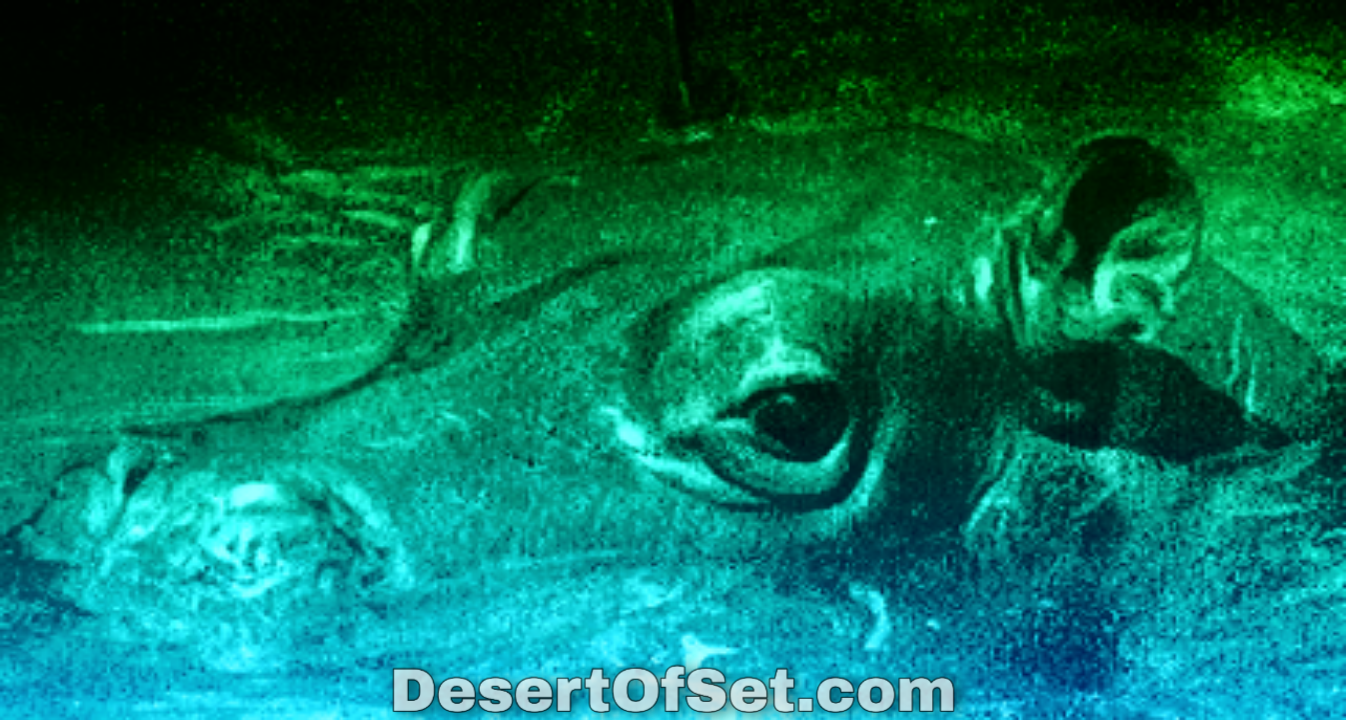
Taweret also resembles Big Red in that She seems to have identified more with the “little people” who didn’t benefit as much from Pharaonic privilege. The peasants knew She would always listen to them, even if the “more important” Gods of the Pharaohs and the priesthoods didn’t. In Typhonian Thelemic lore, it is said that Set is the male offspring or avatar of Typhon, whom Kenneth Grant depicts as a saurian mother Goddess associated with Draco. Grant further claimed that “Typhon’s” worship was suppressed by later patriarchal religions. As far as I can tell, there is no historical evidence to support either of these claims, which Grant appears to have drawn from the poet Gerald Massey (who was not an Egyptologist). But I do agree with Massey and Grant that Set’s worship is linked to that of a “monstrous” female divinity who resonates with Draco, and who was ignored by the Pharaohs for some reason. I just think the entity they were describing is actually Taweret.
I think of Draco and the Big Dipper as being at the “center” of heaven. Being circumpolar, they never descend beneath the horizon, which is why the ancient Egyptians called them “the Imperishable Ones.” Unlike the planets and the constellations of the Zodiac, the circumpolar stars can be seen on any night at any time of year (in the northern hemisphere, at least, and weather permitting). Since Draco and the Dipper are above the Zodiac, I think of Taweret and Set as being “older” and “darker” than any of the various planetary divinities (e.g., Marduk and Zeus for Jupiter, Ishtar and Aphrodite for Venus, etc.), as well as divinities associated with Sirius and Orion (e.g., Isis and Osiris, respectively), which are beneath the Zodiac. Mind you, I am not asserting any of this to be a dogmatic “fact”; it’s just the way I prefer to think about the Gods based on Their related stars. I also incorporated this theoretical cosmogony into A Would-Be Ombite Creation Myth, with Set and Taweret cast as the first Netjeru to be born from Nut or Mother Sky.