Set and the Scarab of Ra

Explaining kheper, the ancient Egyptian concept of divine transformation, and how it relates to the scarab beetle, the solar Creator deity Atum-Ra, and Set as the Champion of Ra. 

In Egyptian mythology, the solar deity Ra (or to be more specific, Atum-Ra) is not only our literal sun, but the first God, the progenitor of all things, and the divine spark that’s hidden within every person. They are the starfire from which our planet and our very bodies are forged, and I refer to them with gender-neutral pronouns as much as possible, given they are also known as “the Great He-She.”

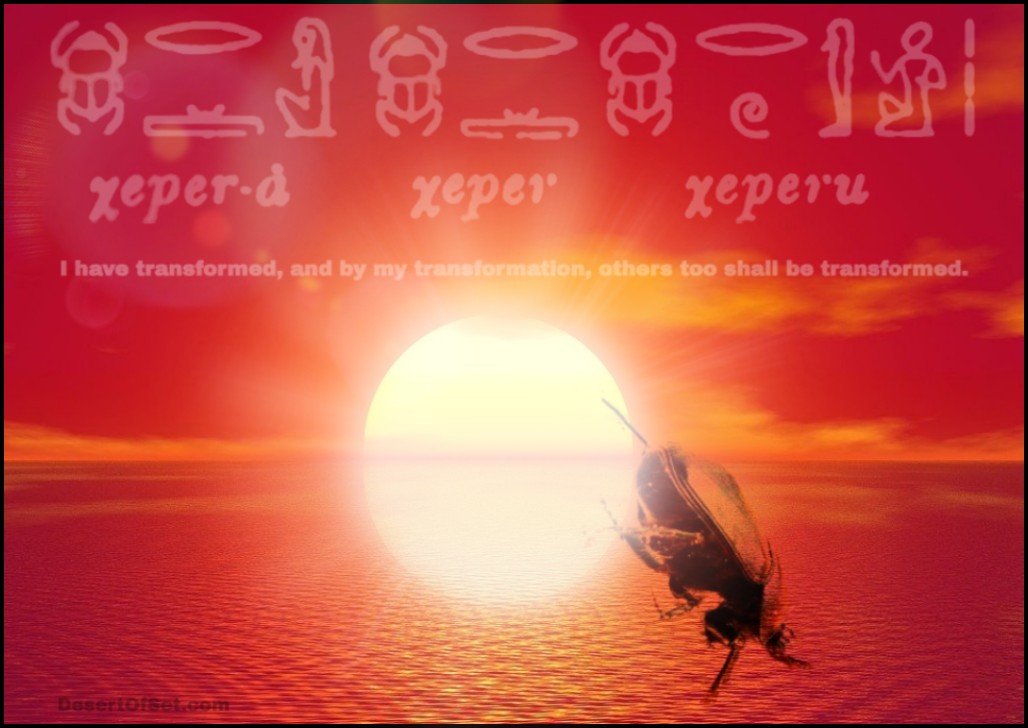
Ra is not said to design the universe like an architect, but to asexually reproduce it through an act of divine masturbation (both a theological and a literal “Big Bang,” you might say), right after creating themself through an act of divine introspection. First Ra lifts themself from Nun, the primordial ocean of infinite chaos, proclaiming, Khepera Kheper Kheperu—which means something to the effect of:

“I have transformed,
and by my transformation,
others too shall be transformed.”

Then Ra asexually begets the infinite plurality of Gods, animals, and people that exists today. Every sentient being is, in fact, a miniature alternate Ra within the macrocosmic collective Ra, right on down from the highest of the Netjeru to the tiniest baby animal or human.

Ra’s first children, Shu and Tefnut, were separated from the Self-Created One shortly after their births. So Ra removed one of their glowing Eyes, which became the solar cow Goddess Hathor, and sent her to search for the missing children. By the time Hathor reunited Shu and Tefnut with Ra, the children had come of age and produced babies of their own: the sky Goddess Nut and the earth God Geb (who would later beget Osiris, Isis, Set, and Nephthys). And when Ra was reunited with all these children, they wept the happy tears that fell down to Geb and mixed with the earth, becoming the first human beings. So while the Gods might be greater and more powerful than us, every person is a living demigod, a human particularization of the Great He-She, and we possess certain rights and dignities even the Netjeru can’t take away. We are not their creations or their playthings, but something more like their younger cousins.

At a later point in the myth cycle, Ra says they are “Khepera at dawn, Ra at midday, and Atum at sunset.” They are a child in the morning, an adult in the afternoon, and an elder in the evening. When night falls, Ra dies and becomes a ghost or “Night Sun” that journeys through the Underworld to be reborn again as Khepera. It is in the darkest hours before dawn that they are attacked by the Chaos Serpent, which is safely repelled by Set and His starry Iron. This is not just a solar myth, but an allegory for the sleep cycle. Many of the Netjeru are said to follow Ra’s same pattern of dying and rising, sleeping and reawakening, just as we ourselves do every day. And just as the Serpent’s assault on Ra is truly an assault on every God and mortal by extension, so too is Set’s battle with the monster a battle for all of us, from the Creator themself to that angry customer you have to deal with at work. Set is the God who never dies and who never sleeps, that the rest of us may all sleep and die and awaken and rise again in safety.

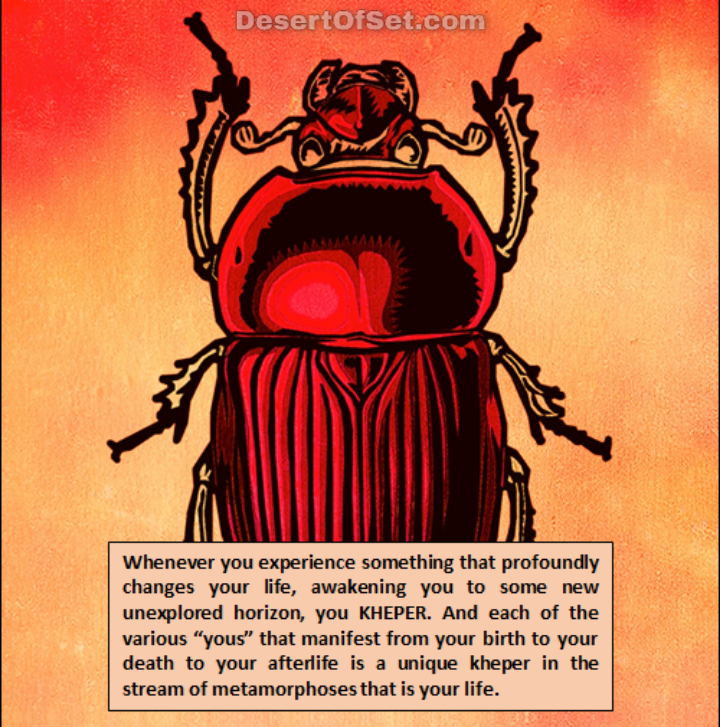
The name Khepera is especially interesting because it is related to the word kheper, which has at least two interrelated meanings. The most obvious translation is “scarab beetle,” an insect that is sacred to Ra. The Egyptians admired scarabs for their life cycle (from egg to larva to pupa to adult), and for their unique reproductive behavior. They lay their eggs in dung, which they then roll into large balls and move around as needed. People drew parallels between these egg-filled dung balls and the sun, imagining that Ra rolls a giant radiant egg ball across the sky. Furthermore, the scarab’s life cycle was likened to Ra’s cycle from night/ghost to dawn/child to noon/adult to dusk/elder, which brings us to the second translation for kheper. As a verb it means “to transform,” and as a noun it means “a transformation.” Whenever you experience something that profoundly changes your life, awakening you to some new unexplored horizon, you KHEPER. And each of the various “yous” that manifest from your birth to your death to your afterlife is a unique kheper in the stream of metamorphoses that is your life.

Considering that kheper is encoded in Ra’s first words at the Dawn of Time (“Khepera Kheper Kheperu”), this is an extremely powerful “magic word” indeed. So powerful, in fact, that when Michael Aquino, a leading minister in the Church of Satan, invoked “the devil” for guidance on what to do following a schism in the church in 1975, he was answered not by Lucifer but by Set, who permanently impressed the concept of kheper on Aquino that very night. Aquino and his colleagues in the Temple of Set prefer to capitalize and spell this word with the Greek letter chi (i.e., Xeper) to signify its centrality to their particular Setian current. I prefer to spell the word phonetically to prevent any confusion for my readers, and I diverge from Temple of Set members insofar as my love for Set is prioritized over kheper in my hierarchy of spiritual values. I agree kheper is important, and that Set cares more about getting us all to kheper than being worshiped. Nevertheless, I identify as a Setian because I love Set first and foremost; if kheper or Khepera were truly the central focus of my path, I would identify as a Kheperian instead.

That being said, kheper is what happens when the sun rises at dawn, when a grub emerges from the soil as an adult beetle, and when a soul or spirit is fundamentally transformed by some profound, life-altering experience. It is the principle that enables us all—cosmic God and mortal demigod alike—to theoretically live beyond death. Additionally, Set is the only other deity in the Ennead or Company of Nine to have willed Himself into existence apart from Ra (by tearing Himself from the womb of His mother, Nut). Since the Netjeru are both distinct beings and extensions of Ra’s own primeval essence, the argument can be made that Set is the aspect of Ra that enabled them to kheper in the first place, even before Big Red came forth as an entity in His own right. This would explain why He continues to play such an important role in procuring Khepera’s safe rebirth, both in the macrocosm and the microcosm. Similar to how St. John believed Christ was with Yahweh in the beginning, before the Creation of heaven and earth, you might say I believe Set was with Ra in the beginning, before the Dawn of Time.

Khepera Kheper Kheperu

On Setian Priesthood & Pagan Ministry

On being a priest of Set and a Pagan minister, and what spiritual leadership should (and shouldn’t) look like.

I occasionally receive inquiries about how I came to be ordained, and how others might do the same. Here is my best attempt at distilling all my thoughts on this matter, in one convenient place.

People often refer to the concepts of “priesthood” and “religious ministry” as if they were interchangeable, but I prefer to distinguish between these two functions very carefully. The assumption that a minister is always a priest and vice versa is rooted in the monotheist premise that people in the same religious community will always follow the same God, and it is inappropriate to hold Pagans to this standard.

  • In a polytheist context at least, priesthood is the act of serving one or more particular deities with regular rituals and/or offerings, by studying their lore, and by helping others understand them as necessary. It is a devotional occupation that is all about doing something for a God or a pantheon, or their followers.
  • Ministry, in my opinion, has less to do with serving any Gods in particular, and more to do with serving human beings. It is an act of community service that is mostly about helping people legally marry, procure good fortune, and/or memorialize their dead. These are practical issues that all kinds of people need help with, regardless of which God(s) they prefer to acknowledge (if any).

So when I officiate a wedding, bless a baby, or eulogize somebody’s ancestor, I am serving strictly as a minister. I don’t care if the people I help believe in any deity or not, and I will even tailor my services to reflect their beliefs (within reason, of course). Theology is only a point for discussion when it comes to my services for Set, which I see as fulfilling a more priestly role. While a person can certainly be a minister and a priest at the same time (as with most monotheist clergy), in Paganism you can also be just one or the other, or even alternate between the two as necessary.

I should clarify that I am not recognized as a priest in any particular congregation apart from my own, and that others are welcome to dispute my use of this term as they see fit. I would hope that all the work I have done so far will prove I sincerely do my best to live up to the label, and that I am not just some occultnik hack. Our coven might only consist of four people, but I’m confident enough in our shared experiences not to care too much if other groups consider us “legitimate” or not. We have little interest in increasing our own numbers, since we don’t believe anyone should have to join any sect, pay any dues, or kiss any hiney to learn about the mighty Champion of Ra. Hence my insistence on publishing everything I write about the Big Guy for free; everything in this ongoing work (such as it may be) is a votive offering not only to Him, but to all my fellow Setians as well. It is hoped that others will find the material helpful enough in some manner, even if we must agree to disagree on certain points.

As we LV-426 initiates reached adulthood, two of us decided to get married (not to each other, but to our own separate sweethearts). And since we manifest Set’s rebellious disposition so nicely, neither of us was willing to appease either of our extended families by conceding to a conventional Christian wedding ceremony, or even to a more secular procedure at a local courthouse. For this reason, I was legally ordained in the Universal Life Church Monastery so I could officiate a ceremony to my Sister Bean’s liking, and we enlisted another minister from the Monastery to officiate my own ceremony. Since then, I’ve officiated ceremonies for other couples who needed it, without concern for whether they are Setian or Pagan, and without charging any fees. Apart from working execrations, blessing a few newborns, and the one time I administered last rites for someone, weddings represent the bulk of my ministerial experience at present.

The ULC Monastery is one of those “anything goes” churches that ordains anyone who signs up for free. Such institutions are often viewed as “shams” by more traditional churches, which have huge populations and generate enough (tax-exempt) revenue to fund things like Bible colleges and theological seminaries, where they can actually send their clergy to be trained. Pagans do not enjoy anything close to the same numbers or resources that Christians enjoy, making it much harder for us to successfully launch our own churches (let alone seminaries) and keep them going. While it is not a Pagan church specifically, the Monastery makes it possible for covens like ours to enjoy the benefits of ordination without paying a shit-ton of money we don’t have to some institution we don’t even agree with. This seems only fair to us, given that we don’t own any property as a group, we have no treasury to speak of, we don’t request or accept monetary donations from anyone, and we certainly don’t charge each other any membership fees.

There are other multifaith churches that offer more conventional ordinations, such as the Universal Unitarian Church. Some Pagans I know have enrolled in such ministries to benefit from the training they offer. It’s a lot of hard work, and I have the utmost respect for anyone who chooses to go through that process. I’ve always lacked the time and the money to do it myself, and while I work well with authority in a strictly business context, this is not the case when it comes to religion. My faith is the one area in life where I get to have absolute control, and I chafe with resentment when I feel like that control is being restricted. However, I don’t wish to discourage anyone else from considering options like the UU. Online ordination has served my purposes pretty well thus far, but it is not the best option for everyone, and I wish nothing but the best for those who endeavor to graduate from more structured ministerial programs.

That being said, I fully disclose that I am not a licensed counselor or social worker, and that I am ill-equipped to handle some of the issues ministers in other faiths are trained to deal with. I do, however, work in a field relating to public health, and whenever I meet someone who needs help to such an extent, I always refer them to licensed (and preferably secular) professionals. I don’t milk them for all they’re worth like some televangelist faith healer. I also don’t fuck around with people’s safety, and if I think someone might be extremely dangerous to either themselves or others, I will report any evidence I find to the appropriate authorities. There are traditional organized churches that train their ministers in all kinds of ways, but which also harbor and protect obvious evildoers among their own leadership. So whenever I hear more privileged faiths poo-poo the idea of online ordination, it just tells me they hate minority religions and want to keep us down. Besides, my ministerial work is supplemental to my sacerdotal work anyway. While I do my best to help whomever I can whenever I can, I really do what I do for Set and for other Setians—which is to say, I identify as a Setian priest first and a Pagan minister second.

Piggybacking on a multifaith online church is certainly not an optimal method for circumventing the lack of legal equity between our various religious traditions; but starting my own church has never seemed like a practical idea. I doubt there would be that many people knocking down the door to join, and I am uncertain as to what I could really offer those who did. I also have serious ethical problems with how churches are allowed to become tax-exempt businesses, political interest groups, and safe havens for sex offenders in this country. Part of me would want any church I help launch to actually pay taxes, just as a matter of principle and accountability. But then again, there are many ways in which tax exemption is extremely helpful for Pagan churches that are already struggling to get by as it is; so I am conflicted on the matter. Until a better option presents itself, I’ll just make do with independently serving Set as a priest from LV-426, and with facilitating any ministerial work I might need to provide through the ULC Monastery.

While I take my work very seriously, I don’t claim to be some prophet who holds the keys to all the mysteries of the universe, and I am extremely critical of anyone else who does. Set demands self-determination, not blind obedience, and anything that infringes upon your personal sovereignty is anathema to Him. There are far too many priests and ministers (of all religions, including Paganism) who prey on the people they “help” for power, money, or sex. If someone demands that you give something of yourself that you don’t want to give—whether it’s your time, your money, your ability to think critically, or even your body—that is NOT OKAY. I don’t care what religion you are, Set’s gift of autonomy is for ALL sentient beings, and those who deprive others of this gift will become pet food for Ammut in the Underworld!

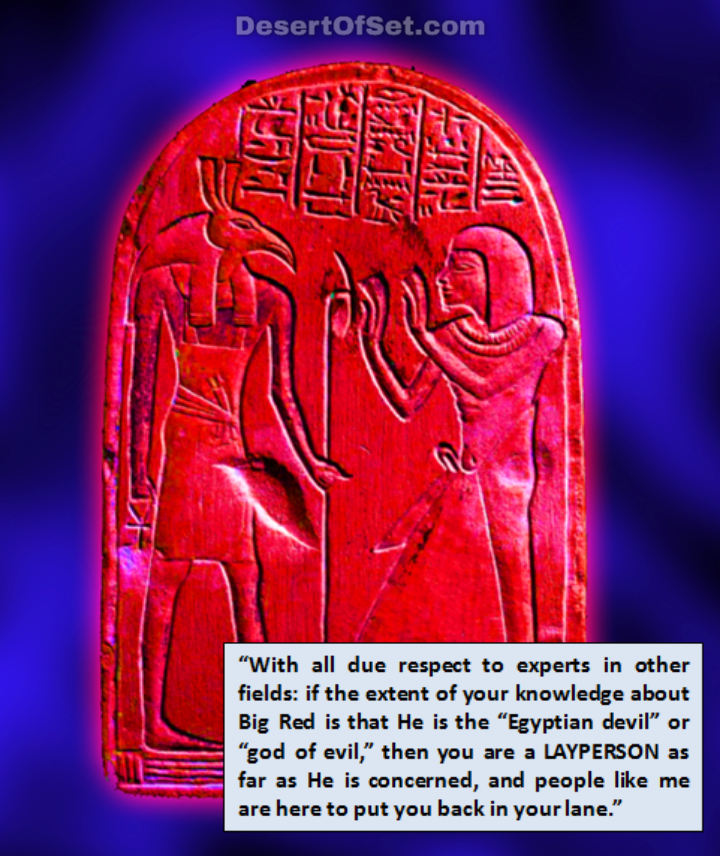
As a final note, I still occasionally meet other Pagans who think I must either talk backwards, eat babies, or spin my head around 360 degrees because I worship Set. With all due respect to experts in other fields: if the extent of your knowledge about Big Red is that He is the “Egyptian devil” or “God of evil,” then you are a LAYPERSON as far as He is concerned, and people like me are here to put you back in your lane. We aren’t going away any time soon, either; in fact, I reckon the 2020s will see more of us awakening to our true identities than ever before! Set is mighty, and so are we!

“Do You Worship the Devil?”

The word devil is really just as vague and complex as the word God, holding multiple meanings across the world. So when we “speak of the devil,” just what in hell are we actually speaking about? 

Accusing someone of “worshiping the devil” is the easiest way to discredit their faith and beliefs. Pagans are no strangers to such accusations, and this is doubly true for Setians, Lokeans, and others who walk with the so-called “powers of darkness.” But the word devil is really just as vague and complex as the word God, holding multiple meanings for different people and cultures across the world. So when we “speak of the devil,” just what in hell are we actually speaking about?

The figure identified as “Satan” in popular culture is not 100% Christian in origin, but something more like a schizoid Frankenstein monster patched together from various religious traditions over the centuries. The ideas that people have about this figure today are not only influenced by biblical teachings, but by generations of militant Christian deculturalization as well. Most accusations of “Satanism” turn out to be nothing more than non-Christian religions upon closer inspection (or in especially ludicrous cases, they turn out to be any Christian denomination apart from one’s own). There are also several different versions of “Satan” referenced throughout popular culture, and people never seem to know which of these variants they happen to be discussing at any given time. The situation gets even more complex when we account for actual Satanist beliefs about the devil, which is a whole other kettle of elephantfish.

Satan as the Heavenly Prosecutor

Introduced to us in the biblical book of Job, this version of Satan is far less subversive than people commonly know. He is but a servant of the Israelite God, only committing the harms his maker allows him to commit. Tormenting humans, tempting them, and testing their faith in Yahweh is not an act of rebellion, but a service he provides at his maker’s behest. As such, the purest distillation of Satan in my opinion is simply the shadow side of monotheism itself. If the entire point of such belief is our submission to just one God (and our strict avoidance of all others), then naturally someone is needed to periodically test that allegiance. The way I see it, the Old Testament Satan represents the dark side of Jehovah himself; there is no other role for a devil that makes any theological sense in a purely monotheist context.

While I accept the Christian God as being ontologically real, I remain skeptical of his alleged omnipotence, omniscience, omnipresence, and omnibenevolence. I believe Yahweh and Jesus Christ both exist, but they are just two more Gods occupying our shared multiverse, neither more nor less important or perfect than any other divinity in objective reality. I accept they are of central importance to their own followers, and I can see how Satan the Heavenly Prosecutor would figure largely in their personal value systems. But to “worship the devil” in this context seems equivalent to accepting a payoff from Mr. Slugworth, then learning the slick bastard was really working for Willy Wonka the whole damn time (but now you can’t have any chocolate!). In my experience, this version of the devil isn’t venerated by anyone (not even by real Satanists); people are only ever accused of trafficking with him by monotheists.

Satan as a Serpent, Dragon, or Gnostic Figure

In the book of Genesis, the first man and woman are deceived into disobeying Yahweh by a talking snake. Many people think of that snake as Satan, but it was never identified as such until New Testament times. By that point, Judaism and Christianity had both been influenced by such combat myths as the Babylonian Enuma Elish. These are tales of divine warriors battling monstrous serpents or dragons to create or save the world, and Set’s daily pre-dawn battle with Apep is just one of many variants. Judaism already developed its own variant of this story in the figure of Leviathan, a sea monster that represents all human and supernatural defiance of Yahweh. (Leviathan originally comes from Phoenician mythology, in which it is sent to attack the Elohim by the daemon Yamm, who is battled by Set in the Edfu Texts.) So by the time Roman emperors started feeding Christians to lions for sport, the biblical idea of the Genesis snake had been firmly conflated with the polytheist Chaos Serpent, which seeks to end the universe. Hence the depiction of Satan as an apocalyptic “great red dragon” in the book of Revelation.

The Gnostics were Jewish and Christian heretics who lived during New Testament times, and who deviated from monotheism. They believed in not one but two Gods: a benevolent God of pure spirit who transcends the physical universe, and an evil material God who keeps our souls trapped and miserable here on earth. Some viewed the Genesis snake as a messiah sent by the good God to free us from the prisons of our flesh. Mainstream Christians decided these people were “Satanists” for this reason, and some real life Satanists actually take their cues from Gnosticism as a result.

To be honest, I find Gnosticism troubling. It teaches that nature is soulless, and that human souls are alien not only to their surroundings, but to their own bodies as well. Such anti-cosmicism is really in vogue among left-hand path circles, which often re-define the Chaos Serpent as a kind of Gnostic savior figure. There are even Setians who engage in this, conflating Set with Apep (which is predicated on Set’s demonization as the Greek Typhon circa 712–323 BCE). With all due respect to these people, I believe Setianism is about revering a God who is a part of nature, and who is absolutely essential to how the cosmos perpetuates itself. Qliphothic diabolism, on the other hand, is the adoration of something external or even hostile to nature (which contradicts the entire premise of honoring a Pagan God in the first place). Setians can combine their love for Set with any other spiritual traditions they like, and we do not need each other’s approval to do so. But to my mind at least, Set shares more similarities with Jesus Christ, the archangel Michael, and even Jehovah in this particular context (Aberamentho!) than He does with Satan.

(Mind you, I don’t believe Set is “angered” or “offended” by anyone identifying Him with the Serpent. He’s a big god, He’s got a thick proverbial skin, and I’m sure He has His reasons for interacting with folks like Kenneth Grant and Michael W. Ford. I fully admit I am likely more bothered by this subject than Set is Himself. My intent here is not to “shame” anyone into ditching their copies of Nightside of Eden or Sekhem Apep, though I encourage people to at least consider the idea.)
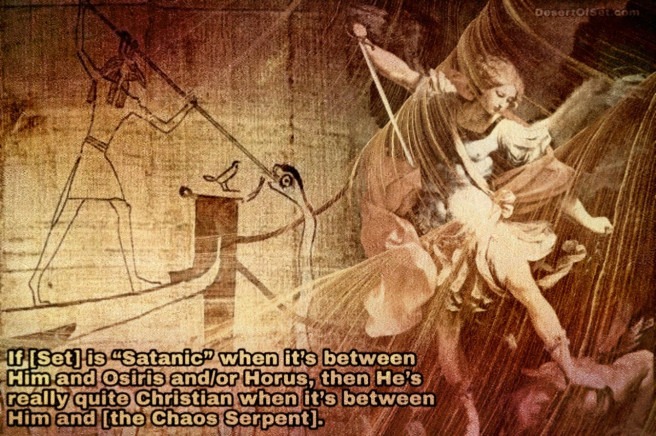
Satan as Antichrist or the Great Beast 666

There is a major biblical distinction between “the Antichrist” and “the Great Beast 666,” which is called Therion in Greek. Antichrist is basically the spirit of Christian hypocrisy itself, or the impulse to do un-Christian things in Christ’s name; Therion is the archetypal evil tyrant who brings disaster upon his own nation. The latter goes back to the primeval origins of human government, but Christians first met him in the guise of the Roman emperors, whom they considered to be satanically possessed (and for good reason). Somewhere down the line, Antichrist and Therion were blurred together into the same popular image: that of the devil’s half-human offspring, destined to set the world ablaze.

In this context, Satan is a metaphor for both Christian and political corruption. Anyone can be deceived by a corrupt politician, including Pagans; but the idea that we are out to cause the downfall of human civilization is just ridiculous. And accusing us of worshiping Christian hypocrisy makes no sense at all. People like Paula WhiteCreflo DollarKenneth CopelandRod Parsley, and other “prosperity gospel” televangelists do a much better job of driving people away from Christ than Pagans ever could. No one does a better job of publicly glorifying Antichrist than these false ministers of Mammon.

As for Therion, there are reasons for thinking he might be enemies with Ishtar, who is my Holy Mother Goddess. Part of Ishtar’s role in ancient Babylon was to empower the kings and punish them severely if they failed to take good care of their people. Especially shitty rulers were offered as blood sacrifices to Her, demonstrating that She does not suffer tyrants lightly. Even the Bible seems to agree that the Great Beast and the “Whore of Babylon” despise each other (Revelation 17:15–18). So if someone accuses me of “worshiping Satan” in the sense of supporting the tyrannical persecution of Christians, they couldn’t be further from the truth. As a Pagan, I would prefer to live in a world where no one is ever persecuted for living the life they want to live, neither Pagans nor Christians nor anyone else.

But while Therion is a symbol of tyranny and persecution for Christians, he more often represents freedom, liberty, and self-empowerment for Satanists. This interpretation is not biblical, but is influenced by the teachings of Aleister Crowley, who actually claimed to be Therion incarnate. (Considering how oppressive and manipulative a person he was, I’m inclined to agree that Crowley was a perfect avatar for the Final Tyrant.) If we define Therion in a strictly Thelemic or Satanic context, I can see how the figure might be used to exemplify key Setian values like autonomy and self-ownership. But if we define him in the Christian context, I consider him anti-Setian and want nothing to do with him.

Satan as a Fallen Angel (“Lucifer”)

The devil’s most well-known origin story is that he was originally an angel in heaven named Lucifer. He tried to usurp his Creator’s throne, was cast down from heaven for his pride, and now rules his own kingdom down in hell. This story does not appear anywhere in the entire Bible; it’s actually a polytheist theme that was not fully absorbed into Satan’s demonology until the medieval era. (The reference to “Lucifer” in Isaiah is a shoddy Latin translation; the original Hebrew text refers to a mortal Babylonian king.) Prior to this, Lucifer was one of many polytheist Gods identified with Venus, the Morningstar. The astronomical behaviors of this planet—keeping near the horizon; shining brightest at twilight; “defying” the sun by appearing just before dawn—led people to associate it with several uppity Gods who subverted their elders. Each of these Venusian powers is linked with fire and fertility, as well as with death and resurrection. Females like Aphrodite and Inanna are usually successful in their rebellious designs, but their male counterparts are more often ruined and forced into exile, which brings us back to Lucifer.

There is no direct relation between Set and the Lucifer myth, but some people draw parallels between the two anyway. Set’s demonization can be likened to Lucifer’s fall from heaven; and then there’s the theme of Set defending Ra from Apep in the Underworld just before sunrise. The idea of a rebellious Red God facilitating the sun’s rebirth can be linked with the theme of a “fallen angel” heralding the dawn. I must admit, however, that these associations are a bit of a stretch for me personally. Set has little to do with Venus, and most other divinities who do are “dying-and-rising” figures. Set never dies, and He never “falls down” into the Underworld either; He just travels there every night with the Creator to serve as Ra’s personal bodyguard. This dynamic doesn’t really jive so well with the “Fuck God, I’d rather rule in hell!” attitude that Lucifer more often exemplifies. In my opinion, Set and Lucifer are two completely unrelated figures, though I can see how Big Red might bond with the latter as a drinking buddy.

The truth is that when I hear or read the word Lucifer, I think of ISHTAR and not Set. Lady Morningstar appears in my mind’s eye as a beautiful angel with raven-black hair and wings, shining with unbridled fury. I can’t help but root for Her as She tricks Ea into giving Her the powers of civilization; as She descends into the Netherworld to face Her sister Ereshkigal; as She slays Her ungrateful husband Tammuz to take Her place in hell; and as She rages against that insolent megalomaniac, Gilgamesh. Ishtar’s resemblance to the biblical “Whore of Babylon” is famous, but She also resembles a female Lucifer who (unlike the more popular male version) generally succeeds in getting Her way. So if anyone accuses me of “worshiping Lucifer,” my first reaction is not to deny the accusation, but to correct it. (“My Angel of Light is a Lady, so if you absolutely have to call Her something in Latin, it really ought to be Lucifera!”)

Satan as a Horned God

By far, the most well-known version of the devil is that of a wooly goatman who frolicks with witches in the dead of night. This motif developed well after the Protestant Reformation, when the European witch hysterias reached their apex. It has no biblical basis, but is instead a synthesis of Protestant reactions to Judaism, Catholicism, several medieval Christian heresies, and numerous polytheist folk traditions. Much has already been said of how the devil’s horns and cloven hooves were appropriated from the Greek satyr God Pan, who similarly enjoys frolicking with nymphs at night. But there are actually several Gods who were absorbed into this devil, not just Pan. Virtually every culture has acknowledged some kind of nocturnal horned God who digs raunchy, bacchanalian rites; and it is here that I experience the most trouble with my surrounding culture. As with most people, this is the “Satan” I always think of first whenever anyone brings up “the devil.” Society has drilled it into me since birth that horned, hoofed goatmen are supposed to be “evil”; and yet this imagery is quite sacred and inspirational to me personally.

Set is just one of the many Gods whose imagery was appropriated for this version of Satan (thanks to the Coptic Church). We see this in Set’s affinity for nighttime, the color red, and such horned Artiodactyla as oryx and antelope. We can also see it in His attraction to Goddesses who defy conventional gender roles (Taweret, Ishtar, Nephthys, Anat, etc.). And then there’s the fact that He is the God of wilderness, deserts, and other places beyond human civilization. From the moment I first met Him back in 1997, I have always felt compelled to honor Set out in the woods at night; so I identify with the Horned God image pretty strongly. For this reason, my brain does two things whenever people talk about “Satan” around me (whether it’s in conversations about religion, horror movies, or heavy metal music):

  • It immediately conjures up a Horned God image.
  • It immediately translates the name Satan into SET.

Some claim that the Hebrew word Satan is etymologically derived from Set’s name (via “Set-Hen” or some variant thereof). There is no evidence to support this assertion; yet it speaks to a very real Setian emotional experience. Some of us (myself included) first come to Set without fully understanding who or what He really is. Some don’t even know that much about ancient Egypt when He first calls them; they might realize there’s this spooky nocturnal Red God speaking to their souls, but that’s it. Setians in these situations often have little choice but to conceptualize themselves as “Satanists” when they first answer the call. (What the hell else are we supposed to do when society tells us that’s exactly what we are, and we don’t know any different?) Some may continue to identify as such for life; remember, Setian beliefs are not limited to Kemeticism, but can also intersect with other religious traditions (including Satanism and Christianity, both). Still others may discard “Satan” into the proverbial wastebasket once they develop a more Kemetic understanding of Big Red. (I can’t tell you how much better I felt once I achieved this for myself.)

Here’s an example of what I mean about my brain “translating” the Horned God motif into Set. One of my favorite bands is the Danish metal group Mercyful Fate, fronted by King Diamond. One of their greatest songs is “The Oath” from their 1984 album, Don’t Break the Oath. The lyrics of the song are partially adapted from Dennis Wheatley’s 1960 novel, The Satanist, which features a so-called “black mass.” But whenever I listen to this song, here is how my brain translates the lyrics:
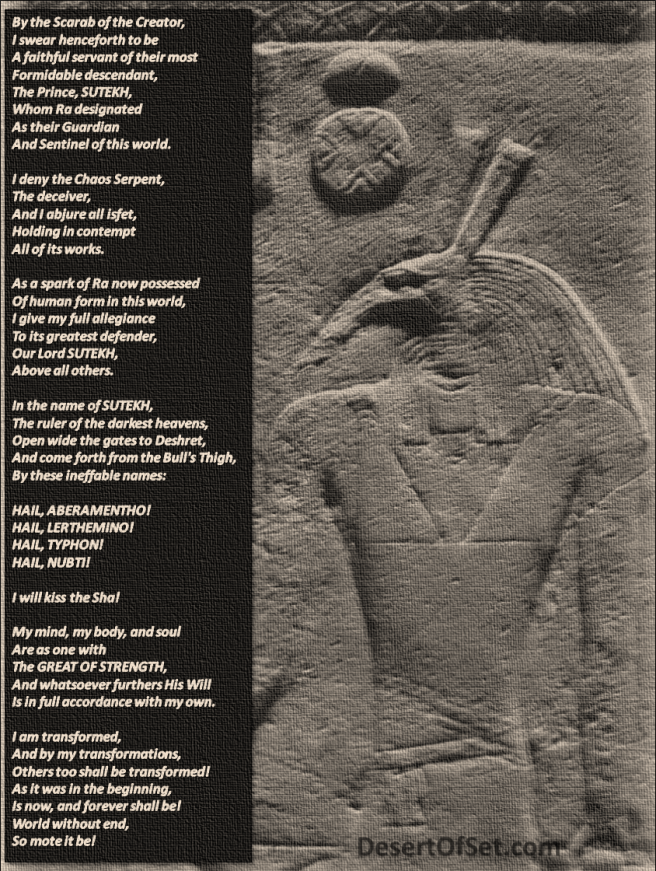
Here is a link to the original song by Mercyful Fate, for anyone who might be interested.

It might seem odd that anyone would appropriate Satanic symbolism for a Pagan God (as opposed to simply rejecting such iconography altogether); but the way I see it, this is a perfectly logical thing for Pagans to do in our contemporary environment. Christians came along, wrested control of our religious narratives, and indoctrinated entire generations into thinking our various horned Gods are really “the devil.” So it seems only right that Pagans, in turn, should appropriate “the devil” and turn it back into something positive that we can use for our own purposes, as demonstrated in the graphic above.

Satan as a Romantic Anti-Hero

From the 17th to the 19th centuries, serious belief in Satan had waned throughout the West, with the figure seldom appearing in any religious context. During this period, he was more often seen in works of art, literature, folklore, and political philosophy. Several artists, writers, and even radical leftists invoked the devil in their works as a sympathetic rebel against tyranny (personified by the Christian God). John Milton’s epic poem Paradise Lost is only the most prominent example; others include various works by William GodwinLord ByronPercy Bysshe ShelleyPierre-Joseph ProudhonMikhail Bakunin, and even Mark Twain. And since the point of this artistic movement was to encourage freethinking (for which Satan was thought to be the perfect symbol), it has since become known as “literary Satanism.”

It always confuses people to learn that mainstream Satanist groups like the Church of Satan and the Satanic Temple don’t actually “worship the devil” per se, but are atheists. This makes a great deal more sense when we remember that such groups are really descended from the literary Satanism movement. Anton LaVey didn’t take his Satan from the Bible; he drew him from Paradise Lost and other similar works. The point is not to be a “devil worshiper” but to actually become an arch-rebel oneself, in the flesh. While the chosen terminology might frighten outsiders, the whole thing amounts to little more than thinking rationally, challenging authority, and championing personal liberty, which I think are values most people can agree with. There are some things about mainstream Satanism I find annoying (e.g., I can do without Peter Gilmore’s near-constant assertion that all theists are categorically insane); but on the whole, I think it’s a pretty reasonable way of looking at the world (“Satanic” or not).

Returning to the $666 Million Question: “Do You Worship the Devil?”

When Pagans are accused of “worshiping the devil,” our typical response is to say “We don’t believe in Satan.” But as I have discussed here, the word devil is just as culturally loaded as the word God. If we define Satan in strictly biblical terms, then no, most of us do not believe in “the devil” at all. But when most people discuss this figure (including Christians), they are referring to one or more non-canonical tropes, not to the original biblical concept. And whenever this is the case, things become much less cut-and-dry. Many of us worship a horned God and consider ourselves to be witches (myself included). Some pray to Venusian deities who can be read as prototypes for Lucifer (again, myself included). And there are even people who actually glorify the Chaos Serpent (myself NOT included, thank you very much). Some Pagans who fit these descriptions actually identify as Satanists too (or as Luciferians). Who are we to tell them they aren’t welcome in our community, so long as they live and let live? If we can accept Christopagans and Jewitches in our subculture but not Satanists, then we are hypocrites.

While more Pagans are fortunate enough to be raised in Pagan families today, the majority of us are converts from other faiths, and most of us were raised either Catholic or Protestant. “I still have a soft spot for the Catholic Church” is a common sentiment I’ve heard from Pagans who were raised Catholic, and this is likely because Catholicism absorbed quite a bit of Paganism into itself over the centuries. Blooming Pagan teenagers in Catholic families are already exposed to countless Pagan ideas, from venerating a Goddess (the Virgin Mary) to celebrating the three nights of Samhain (All Hallows’ Eve, All Saints’ Day, and All Souls’ Day). But the entire point to Protestantism is to purify Christianity of all such Pagan influences, consigning them to the devil. So Satan is often the only Pagan thing many Protestant kids are exposed to when they are young. And when a Pagan first blooms in such surroundings, it can be much more difficult to “unlearn” the things they have been conditioned to believe. Going from “hailing Mary” to “hailing Hathor” is one thing, but going from “fearing Satan” to “loving Pan” is quite another.

The Many Names of Set

Some thoughts on what several of Set’s names mean to me personally.

Set is a very complex deity with more names than anyone can count. We can’t even be 100% sure of how the name Set itself was originally pronounced. (All we know for certain is that it contains the consonants S-T; we don’t know which vowels might have been used.) The following is my attempt at explaining what some of Big Red’s names actually mean (or at the very least, what they mean to me personally). However, we must always remember the fact that in Egyptology, new discoveries are made every day, and sometimes an accepted theory will need to be updated or even discarded. For this reason, nothing I write here about Set’s names should be considered “definitive” or taken as “gospel.” This is just one Setian’s perspective on these various voces magicae, so take from it what you will.

As an additional note, this is not an exhaustive list of Set’s names by any stretch of the imagination. There are far too many of them for me to count, and quite a few seem impossible to translate. The following list is limited to those names and titles I actually understand and use.

Set

The most basic and well-known name for Set. It is rendered into English as sts, sth, s(w)th, s(w)t(y), st(y), or st. Its variants are clearly determinative to various Egyptian words for storms, violence, and upheaval. The Greek writer Plutarch suggested that it might mean “the overmastering” or “overpowering.” This is the most popular form of the deity’s name among contemporary Pagans.

Seth

The Hellenized version of Set; very helpful for finding quality sources about the deity in academic literature searches. (Try searching for the name Set and you’ll get results on everything from the actual God to random kitchenware.) It also happens to be homonyms with the name of the third son of Adam and Eve in the Bible (who is a totally unrelated figure). So Seth is really best used in conjunction with the additional name Typhon to clarify when one is actually referring to Set (and not the biblical Seth).

Sutekh

Pronounced “SOO-tek.” This variation of Set’s name was popular in the Nile Delta region of Lower Egypt. As Sutekh, He was equated with the Hyksos’ chief deity, the thunder God Ba’al Hadad. This led Set’s cult to adopt many non-Egyptian elements, including the Edfu tale of how He rescued Ishtar from the sea monster Yamm. I refer to Set as Sutekh most often when I pray to Him alone.

Suti

Pronounced “SOO-tee.” This is probably the closest to how Set’s name was originally spoken in Upper Egypt during predynastic times (prior to 3200 BCE). I don’t see or hear people use this variant very often, but I sometimes use it during prayers, especially in times of great need. I feel like calling Set by this name is like calling someone by an intimate pet-name they don’t want anyone else to know about (“Pookie”), which I would only suggest doing if you are already on good terms with Big Red.

Aberamentho

“Lord of the Waters,” a name that is given to Set in the Demotic Leiden Papyrus, and which likely refers to His power over the forces of chaos. Strangely, Set shares this name with Jesus Christ, for whom it is also used in the Pistis Sophia. I believe this name represents a point of intersection and dialogue between Setianism and Christianity, and it always makes me think of the Alexamenos graffito.

Ash

Pronounced “OSH.” The name of a Libyan desert God who was identified with the holy Sha animal of Set, and who was believed to guide travelers to oases. There seem to be two different theories about Ash: (1) that he is an entity distinct from Set (and possibly a gay consort), or (2) that he is an alternate form or aspect of Set Himself. It could be that the two Gods are separate divinities, but that Set will also answer to the name Ash if it is ever used for Him. Either way, I can’t help but think of Ash Williams (Bruce Campbell), the protagonist in the Evil Dead movies, whenever I see or hear this name.

Ba’al

Pronounced “Buh-ALL.” An ancient Semitic title that means “Lord,” and which was used for many different storm Gods throughout Mesopotamia. It was inherited by Set when He was identified with the Hyksos deity, Ba’al Hadad. I sometimes refer to the Big Guy as “Ba’al Sutekh” or even just “my Ba’al” when I pray, but it must be understood that Set is not synonymous with all the other divinities who answer to this name. (And just in case anyone would like to know, the female equivalent is Ba’alat.)

Iao Sabaoth

Pronounced “YOW SAH-BAH-YOTH.” A Greek corruption of the Hebrew Iah (from Yahweh) and tsebha’oth (“armies”), which together mean “Lord of Hosts.” The name is used in several invocations to Set in the Greek magical papyri. For me, it represents Set’s fondness of donkeys, His sympathy for the Jewish people in Late Antiquity, and His eternal vigilance against the Chaos Serpent.

Nubti

Pronounced “NOOB-tee.” Meaning “Golden One,” this name was used for Set in the predynastic Naqada civilization. It refers to the prominence of His worship in Nubt (“Gold Town”), a gold-mining desert town in Upper Egypt that later became known as Ombos. I think this name represents Set as a God of life on the frontier, who helps His people find prosperity in the wilderness.

Typhon

Pronounced “TIE-fohn.” Meaning “Whirlwind,” this name was given to Set in Late Antiquity. It belonged to a monster in Hellenic mythology, and its association with Set was originally an error; but an entire magical system was developed in which Set is identified by this name (i.e., the Greek magical papyri), and the system happens to work. Typhon also sits well with Set’s aquatic aspect, complimenting His role as a desert God. I especially like to use this name while praying to Big Red by the seashore.

The Great Longhorn

Set as the Celestial Bull. In this form, He crushed Osiris beneath His thigh, which was later amputated by Horus. Set’s thigh was then chained to the pole star, whereupon it became the Big Dipper (or as the Egyptians called it, “the Bull’s Thigh”). This aspect of Set always reminds me of the Bull of Heaven in the Epic of Gilgamesh, which also had one of its legs removed and converted into a stellar object.

Great of Strength

Set as the one God who is strong enough to put other Gods in their place, as well as to fight the Chaos Serpent face-to-face. I associate this title with Set’s linear immortality (i.e., the fact that He neither dies nor rises again), which distinguishes Him from the rest of His pantheon.

He Before Whom the Sky Shakes

Set as the God of thunder and storms. I think it represents Him as this incredibly destructive force that could potentially destroy the entire cosmos at any time, but which decides to protect the world from monsters instead. Set is the single most frightening entity in existence, and yet He is on our side.

He of the Two Faces

A reference to the Secret of the Two Partners, or the idea that Set and Horus are really two aspects of the same God. This concept is depicted in Egyptian art as a humanoid figure with both the head of Horus and the head of Set, which I regard as the Egyptian precursor to the Tao. Naturally, the Secret of the Two Partners works both ways, and “He of the Two Faces” can also be used as a name for Horus.

Lord of the Red Lands

Set as the Lord of Deserts. Just as the deserts surrounding Egypt provided a “buffer” that protected the country from the rest of the world, so too does Set provide a “buffer” between our created universe and the primordial chaos. A shorter version of this title is “Red Lord,” which I use all the time.

Lord of Twofold Strength

This title reminds me of Set’s dual nature as a both an instigator of change (as seen in the Osirian drama) and a defender of the cosmic order (as seen in the execration of Apep).

Master of the Imperishable Ones

Set as the Lord of the circumpolar stars. The Egyptians considered these stars to be ancestral spirits who have achieved the same linear deathlessness that Set experiences. (Hence the term, “Imperishable Ones.”) These stars never descend beneath the horizon (unlike the Sun, the Moon, and the planets of our solar system), but are always located at the center of the sky (for those of us living in the northern hemisphere, at least). This reveals the stellar and nocturnal origins of Set’s worship.

Champion of Ra

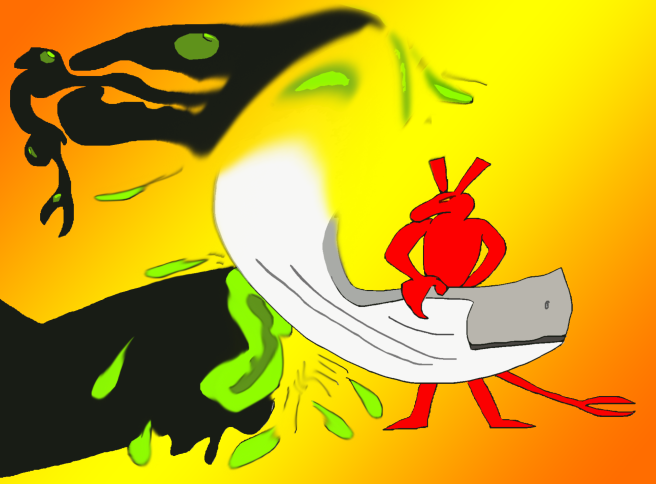
Set as the hero who protects and defends Ra from the Chaos Serpent each night. Ra dies and rises again each day, and they are attacked by the monster while undergoing their regenerative process. If the Serpent ever succeeds in swallowing Ra, all things—including the rest of the Gods—will cease to exist. When Thoth negotiated his truce between Horus and Set, part of the bargain was that Set would become Ra’s personal bodyguard. He has served Ra in this capacity ever since, and the fact that our universe continues to exist is a testament to His ultimate benevolence. This title is very important to me because it’s an important aspect of Set that most people don’t know or think about.

Son of Nut

While He isn’t the only son of Nut (Osiris being the other one), Set is the God who is most often identified by this title. This is due to the circumstances of His birth; for while Osiris, Isis, and Nephthys were all born in the natural way, Set clawed right out of the sky Goddess’ womb. This couldn’t have been pleasant for Nut, but it gives Set the distinction of being the only God aside from Ra to have willed Himself into existence (according to the Heliopolitan cosmogony, at least).

Big Red

An affectionate abbreviation of “Red Lord” or “Lord of the Red Lands” that many of Set’s people use for Him all over the world (myself included).

Cloven Hoof

A term for the Christian devil that’s inspired by his association with goats. Cloven-hoofed critters are members of the order Artiodactyla, which happens to include most of Set’s sacred animals (including antelope, hippopotami, oryx, pigs, etc.). If Christians can demonize Set and incorporate Him into their version of the devil, then it’s only fair for Setians to reclaim so-called “satanic terminology” for Set. So I will sometimes call Big Red “the Cloven Hoof” in reference to His sacred animals.

Holy Jackass

A humorous title for Set that we coined right here in the LV-426 Tradition. It refers to both Set’s affinity for donkeys and the fact that He’s a hellraiser.

Prince of the Darkest Heavens

A title that we gave to Set in the LV-426 Tradition; it refers to His role as the Son of Nut, and to the placement of His Khepesh in the northern sky. 

Set and the Greek Typhon—Are They the Same?

Comparing the Egyptian God Set with the Greek Titan Typhon, and explaining how the word “Typhonian” became a synonym for “Setian.” 

The name Typhon originally belonged to a Titan in Greek mythology who appears as a giant with a hundred serpents for his heads and legs. The Titans were primordial beings who existed before the Olympians (Zeus, Hera, Aphrodite, etc.) and who were ruled by a God named Kronos. After Zeus dethroned Kronos and took control over the universe, Typhon led the Titans to war against the Olympians. But Zeus overpowered him in battle and buried him alive beneath the Earth, from whence he now sends lava and volcanic eruptions. Typhon’s mate is the gruesome snake-woman Ekhidna, with whom he sired such terrible chaos monsters as Cerberus and the Chimaera. So far, I haven’t seen any evidence that the Greeks ever worshiped Typhon (though if anyone out there is aware of such evidence, please let me know). It would seem that he was only ever worshiped against, much like Apep in Egyptian religion.

Yet the name Typhon also became strongly associated the Egyptian Set after the New Kingdom fell to foreign invaders during the 8th century BCE. Since Set is the God of all things foreign to Egypt, He was blamed for these invasions as well as for the final dissolution of Pharaonic power. So the Egyptians went apeshit and smashed all His statues, scratched His name off every monument, and killed His sacred animals in excessively cruel ways (such as pushing scared and defenseless donkeys over cliffs). They ceased to believe in Him as the Savior of Ra and equated Him with Apep instead. They also persecuted and sometimes killed anyone who either continued to follow Set or was thought to resemble Him too much (such as redheads). This eventually led to one of the earliest recorded cases of blood libel, in which Alexandrian Jews were accused of practicing “onolatry” (donkey worship), poisoning wells, and murdering people in their religious rituals. Even Yahweh Himself was equated with Set during this period, which meant that Jews and Setians were both being portrayed as something like a pre-Christian “satanic cult.”

By the time guys like Herodotus started writing about the Egyptians in the 5th century BCE, there was far more of Apep to be found in the popular understanding of Set than there was of Set Himself. So when Herodotus applied the concept of interpretatio graecia to the Egyptian pantheon (identifying foreign people’s Gods as Greek Gods under different names), he identified this fallacious Set/Apep hybrid with the Typhon of his own culture. Once he made that link, Greco-Egyptian syncretists started calling Big Red Seth-Typhon, and people who continued to worship or “resemble” Him became known as Typhonians. This was a term of hostile derision, and classical Egyptians, Greeks, and Romans used it in much the same way that Christians continue to use the terms “Satanist” or “devil worshiper” today.

I’m not a big fan of interpretatio graecia; I understand why it made sense to the Greeks, but I’m skeptical of it myself (especially in this case). It doesn’t take an archaeologist to know the Egyptian Set and the Greek Typhon are almost nothing alike. Sure, there are certain superficial similarities; both became scary “bad guys” for a while. But until the 400s BCE at least, it had always been an accepted part of Set’s arc that He is a villain-turned-hero. He also had a proper priesthood of His own and was honored by the Pharaohs; this clearly wasn’t the case for Typhon, who never enjoyed any kind of state-endorsed following.

If Set and Typhon truly are identical, then Typhon’s family in Greek mythology should be like a “second family” that Set has apart from His Egyptian and Canaanite relatives. Theoretically at least, this would mean creatures like the Chimaera and Cerberus are fellow Children of Set, and I should feel some kind of spiritual resonance with them. Theology is not a science, of course, so there’s really no way for anyone to be 100% certain of such things; but aside from the complete absence of any lore to this effect, I’ve never acquired any gnosis that would support this idea. Ekhidna and Her frightening brood just don’t feel like they’re related to Set at all; and if Set is indeed sterile and incapable of siring any children (as He is described in Egyptian mythology), how the hell could He procreate with Ekhidna anyway? While mythology should never be taken literally, there does need to be some internal consistency at the very least. If Herodotus is correct and Set and Typhon are really the same guy, I would expect there to be stories of Typhon being childless, of Set fathering gigantic monster children, or perhaps even both.

However, I must admit I am guilty of using the name Typhon in reference to Set all the time. Isn’t this hypocritical? Aren’t I blaspheming Big Red by using a name that was given to Him out of hatred and fear? Shouldn’t I just stick to His Egyptian names and tell Herodotus to get the hell out of Dodge? And shouldn’t I have more respect for myself than to accept being called a Typhonian?

It has occurred to me that there might be other Companions of Set out there who strongly dislike my use of the Typhon moniker. (And if that’s true, I thank you all for being extremely polite to me, as no one has written me any angry emails about it yet.) But I actually have several very good reasons for sometimes referring to Set as Typhon, despite everything I’ve explained above.

1. It has historical precedent.

There are numerous spells in the Greco-Egyptian magical papyri that invoke a “Typhon” who is not in keeping with the Greek Titan’s character at all. The “Typhon” of the paypri is strongly associated with iron, donkeys, the color red, the Great Bear, and Hellenized corruptions of Hebrew God names. He’s even called “hater of the wicked” in one particular spell, which isn’t like the Greek Typhon at all. Furthermore, many of the spells involving “Typhon” are not malefical (death curses) but are incantations for love, protection, and other varieties of good fortune. Absolutely none of these things are consistent with the Greek Typhon at all—but they are consistent with Set as He was worshiped prior to the Late Period.

Also, I can personally attest that these spells carry quite a lot of firepower and that Big Red responds favorably to them. If He didn’t like being called Typhon, one would think the spells would fail utterly (or have deadly results). There are many different theories as to why magic works, of course, and not all of them are predicated on the assumption that anything “supernatural” is truly happening. But even if the Greco-Egyptian spells are just exercises in self-hypnotism, their Typhonian procedures are clearly modeled on the Egyptian God Set (and not the Greek monster Typhon).

2. The word Typhonian pretty much belongs to Set anyway.

This term simply didn’t exist prior to the emergence of Greco-Egyptian syncretism. When it was first coined, it was used to describe animals that are sacred to Set (including donkeys, fish, hippopotamuses, etc.) and people who resonate with Him. So while it might be taken from the name of a completely different entity, Typhonian has always been used specifically for things that pertain to Set. (This is probably due to the original Typhon never having a cultus of his own.) In fact, we can really just go right ahead and say that Typhonian is really just a synonym for Setian.

3. Typhon is very useful when interacting with academic hair-splitters.

In academia, the Egyptian Set is often called Seth-Typhon to distinguish Him from the biblical Seth (the third son of Adam and Eve). The latter plays an important role in certain heretical forms of Judaism and Christianity that developed during the latest years BCE and the earliest years CE. These belief systems are often called “Sethianism” or “Sethian Gnosticism,” and some scholars will refer to Set as Seth-Typhon to distinguish Him from this other religion. They also tend to use the word Typhonian for things that pertain to Set, while I more often see Sethian used in discussions of Gnosticism.

In a way, this actually kind of stinks; Big Red gets the short end of the stick while an obscure Bible character (who’s barely even mentioned in the book of Genesis at all) gets preferential treatment. But be that as it may, using the name Typhon in conjunction with Set’s is certain to dispel any potential confusion with Sethian Gnosticism (or at least among academics).

(I should note that some of Big Red’s followers think He and the Gnostic Seth really are the same entity. I respectfully disagree with this idea myself, but that’s a discussion for another day.)

4. The meaning of the name makes perfect sense.

Typhon literally means “whirlwind” in Greek, which ties in with Set’s role as a God of wind and storms. The name is also linked to our modern word typhoon, which is the Pacific Ocean’s equivalent to a hurricane. Therefore, the name doesn’t actually mean anything insulting in and of itself; if anything, it’s a totally valid description of Set’s jurisdiction in nature.

5. It describes one of Big Red’s much-forgotten aspects.

Remember how Set chopped Osiris to pieces and fed His penis to a fish? It may seem ironic that a desert God would be associated with an aquatic animal, but it happens to be the case. Fish—especially those of the Mormyridae or elephantfish family—were held sacred to Set in areas like the town of Oxyrhynchus. Hippopotamuses are also sacred to Him, and they are aquatic animals as well, as they spend most of their time in water. So based on Egyptian religion alone, Set most definitely has an aquatic aspect, and Typhon is the perfect name to describe Him in this context.

6. It is a reminder of the evils of blood libel.

The name Typhon was given to Set by people who feared Him so much that they were willing to harm innocent animals and people to drive Him away. It may seem blasphemous to call Him by this name for that very reason, but I find that it’s a good way of reminding myself about the evils of blood libel. The Burning Times, the Salem Witch Trials, the Holocaust, the “Satanic Panic” of the 1980s; these were all just different versions of the same thing that was done to Setian and Jewish people in Alexandrian Egypt. Remembering these horrific events is a huge part of my spirituality (especially the Satanic Panic, since I was actually alive while it was still happening). So reclaiming the name Typhon as a positive term for Set and myself is much the same for me as reclaiming a word like witch is for Wiccans.

7. Set has never killed me for using it.

I’ve been referring to Set as Typhon for a very long time now, and He’s never given me any grief about it. I’m pretty confident that if He didn’t like me using this name for Him, I would already be dead by now.

8. Who cares about the Greek Typhon’s feelings, anyway?

I’ve never met a single person who’s ever claimed to worship or even care about the Greek Typhon in and of himself (and trust me, I’ve searched for such a person far and wide; if there are any Hellenic reconstructionists out there who worship Typhon and who happen to stumble upon this sermon, I do hope they will share their thoughts on this with me). Whenever I meet anyone who works with something they call “Typhon,” the entity they’re experiencing always turns out to be Set upon closer inspection (except in the case of Kenneth Grant, whose “Draconian female” Typhon strikes me as being a misidentified version of the hippo Goddess, Taweret.) If the original Typhon has no cult to speak of, and if the Greeks themselves gave his name to Set, then why should I care? Does anyone even care that I’m talking about this?

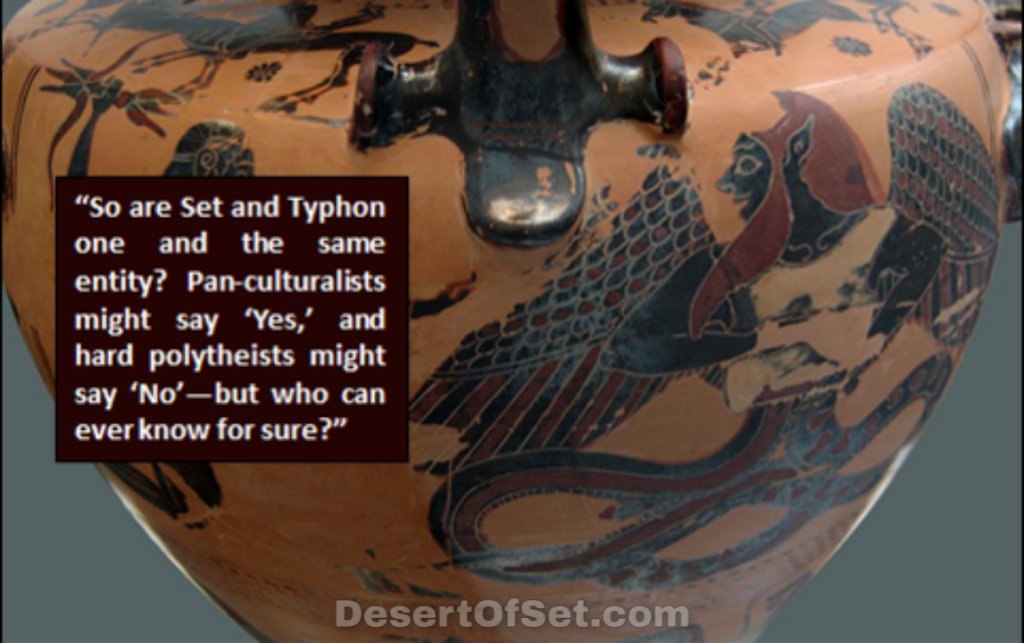
So are Set and Typhon one and the same entity? Pan-culturalists might say “Yes,” and hard polytheists might say “No”—but who can ever know for sure? All I know is, Set and Typhon don’t seem the same to me, but this doesn’t mean the two figures can’t share the same name. If there can be more than one “Seth,” why on earth can’t there be more than one “Typhon?”

Khepesh: The Iron of Set

Explaining Set’s connections to the Big Dipper, and why they are important.

In Egyptian mythology, Khepesh (“The Thigh”) is the Iron of Set. This powerful force was once a part of Set Himself, but it was removed from Him by Horus during Their war for the throne of civilization. It is sometimes described as being Set’s “bone,” “foreleg,” “semen,” or even His “testicles” (which means its removal is sometimes described as a “castration”). This Iron is what enabled Set to kill Osiris, and it was returned to Him once He was “tamed” enough to be reconciled with the rest of the Gods. Set now uses Khepesh to defend Ra from the Chaos Serpent, and its physical counterparts in nature include the asterism we know today as the Big Dipper, as well as the chemical element Fe (iron).

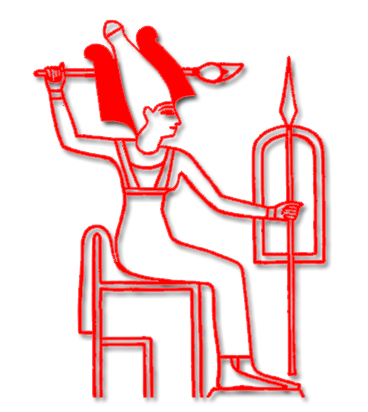
Khepesh is often contrasted with Wedjat, the Eye of Horus (or “All-Seeing Eye”), which Set removed from Horus during Their fight. We use our eyes to see things, which is why Wedjat is associated with light, knowledge, and order; it represents “shedding light” on the unknown and making it known. Khepesh, on the other hand, is linked to Set’s libido; it represents the unknown’s ability to intrude upon the known and force it to adapt. Despite this disruption, Khepesh is an altogether different kind of “chaos” from that of the Chaos Serpent, for it doesn’t threaten to destroy everything in Creation; it simply destroys certain things to make room for others. Hence why it is the perfect weapon against the Serpent, and in this respect it is often portrayed in Egyptian art as a lance or spear that Set carries into battle.

The Apotropaic Waltz

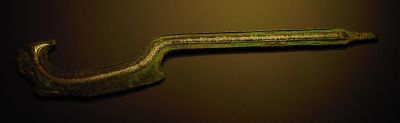
The Iron of Set is comparable to other monster-slaying weapons in mythology, such as Mjollnir (Thor’s hammer). Both are associated with red-haired storm deities; both must remain externalized from their users (for even Thor must wear gloves while handling Mjollnir); and both have strong phallic connotations (as when Mjollnir is placed on the bride’s lap during Nordic wedding ceremonies). We may further compare Khepesh to Thurisaz, the third rune in the Elder Futhark, which represents how the destructive powers of nature can be used for protective purposes. The word Khepesh was additionally used for a sword the ancient Egyptians carried in battle, and which is shaped like the Big Dipper.

“An

An Egyptian khepesh sickle-sword.

Khepesh was “tethered” to the star Polaris (our planet’s current north pole star) by the Goddess Taweret to keep it as far away from Osiris as possible. It’s also kept there as a kind of “cosmic scarecrow” to prevent the Chaos Serpent from attacking our world through the northern sky. In the Greek magical papyri, Set is said to live somewhere “behind” the Big Dipper, in a “Secret Place” that none of the other Gods can reach. This realm has been linked with the Hermetic concept of Daath on the Tree of Life, and it is sometimes called “the Mauve Zone” or “the Desert of Set.” That last term is taken from how the Egyptians considered their country to be the very pinnacle of human civilization. The deserts surrounding Egypt (called Deshret or “the Red Lands”) were viewed as protecting it from “the world outside”; hence this notion that Set roams the chaotic maelstrom “out there” to keep the created world safe “in here.”

From an animist perspective, everything about the Big Dipper may be seen as an astral reflection of Khepesh. Bearing this principle in mind, we can make the following observations about Set’s Iron:

  • Most of the Egyptian Gods are linked to stellar objects that “fall beneath” and “rise above” the horizon, including the Sun, the Moon, Sirius, and constellations like Orion. These deities are reported to “die” and “rise again” (or to accompany other dying-and-rising Gods through their transitions). But the Big Dipper is circumpolar and never sets, representing Set’s inability to ever die. While the other Gods experience a cyclical kind of immortality, Set’s is continuous and linear. Khepesh is what gives Him the immense strength He needs to be truly deathless.
  • Since the Dipper points north, it makes a perfect “cosmic compass” and has been used as such for centuries. For the ancient desert peoples who worshiped Him, it must have seemed like Set was faithfully guiding them through the night whenever they were lost. This indicates that Khepesh, no matter how destructive or frightening it might be, is actually a force for good in this world, as well as its last line of defense from the Serpent and its qliphoth.
  • The Dipper rotates counterclockwise (to the left), and leftness has always been linked with asymmetry, inversion, and reversal (whether social, political, or spiritual). So Khepesh is tied to Set’s anti-establishment sensibilities, which explains His popularity among left-hand path occultists.
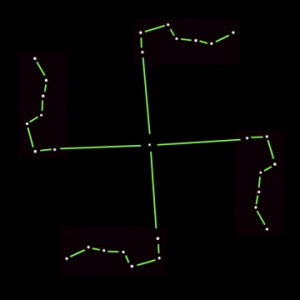
  • The Dipper forms a giant swastika in the northern sky. This is actually a symbol for prosperity and good luck in many cultures; it doesn’t “belong” to National Socialists anymore than crosses “belong” to the Ku Klux Klan. But that doesn’t change the fact that most Westerners react badly to the swastika for reasons that are completely understandable. This relates to Set’s reputation as a so-called “evil” God. Just as He really represents something good but is mistaken for being “evil” by outsiders, so too does the swastika represent something good in religions like Hinduism and Buddhism, despite being tied to Nazism in the West. Part of being Setian, in my opinion, involves being able to understand this kind of nuance, which is not easy for most people to do.

“The

That Khepesh is linked to iron (Fe) is also interesting, given that this chemical element has traditionally been used to ward off malevolent daemons, faeries, witches, and the Evil Eye. Prison bars were once made from iron to restrict any negative energy that might be emanating from the most dangerous prisoners. Even today, Bedouins still believe that a person who fights with a sword forged from meteoric iron will win any battle. It’s a little spooky that the Greek philosopher Pythagoras claimed that Typhon’s number is 56, considering that the atomic weight of iron is 55.845 (which rounds up to 56). Nor is it a coincidence that iron should be linked to the color red, the planet Mars, or the Qabalic sphere of Geburah.

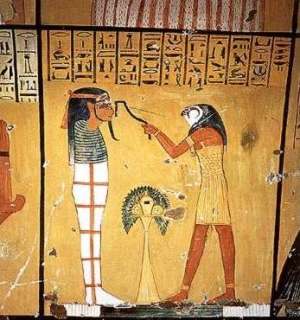
In the Ceremony of the Opening of the Mouth, Khepesh was invoked into an adze or chisel that had been forged from meteoric iron, and which was shaped to resemble the Big Dipper. This adze was then pressed against the mouth of a mummy or statue while the priests recited spells invoking “the iron that comes forth from Set.” Doing this effectively transformed the inanimate object into a living conduit for a deity or the ghost of a deceased loved one. The principle behind such ritual magic is more or less identical to that of Catholic transubstantiation. Prior to Mass, the communal bread and wine are merely foodstuffs; they don’t become the mystical body and blood of Christ until all the magic words have been properly recited. In the same way, an Egyptian cult image started its existence as merely an image; it would not “come alive” with the spirit of the God or ghost it was meant to represent until after its mouth had been symbolically “opened.” Interesting that Khepesh, the same power Set uses to stomp Osiris and smite the Serpent, can also be used to create magical interfaces between this world and the next.

“Horus

Horus “opening the mouth” of a mummy.

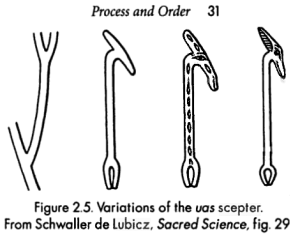
Khepesh is additionally connected to the was scepter, which bears the head and forked tail of the Sha animal. The name was (which rhymes with “Oz”) means “power” or “dominion,” and the scepter represents the royal power to sublimate chaos. Using the Sha in this symbolism is similar to the use of stone gargoyles in Christian churches. The gargoyles represent dark, chaotic forces that have been “domesticated” and which now protect us from other forces that are even worse. This reminds me of the parallels between Set and Tokyo’s favorite giant monster, Godzilla. Both begin innocently enough, but later become extremely dangerous beings that threaten to destroy the whole world. Then both are eventually “reigned in” to defend the Earth from evil hell monsters like Apep and King Ghidorah.

“The

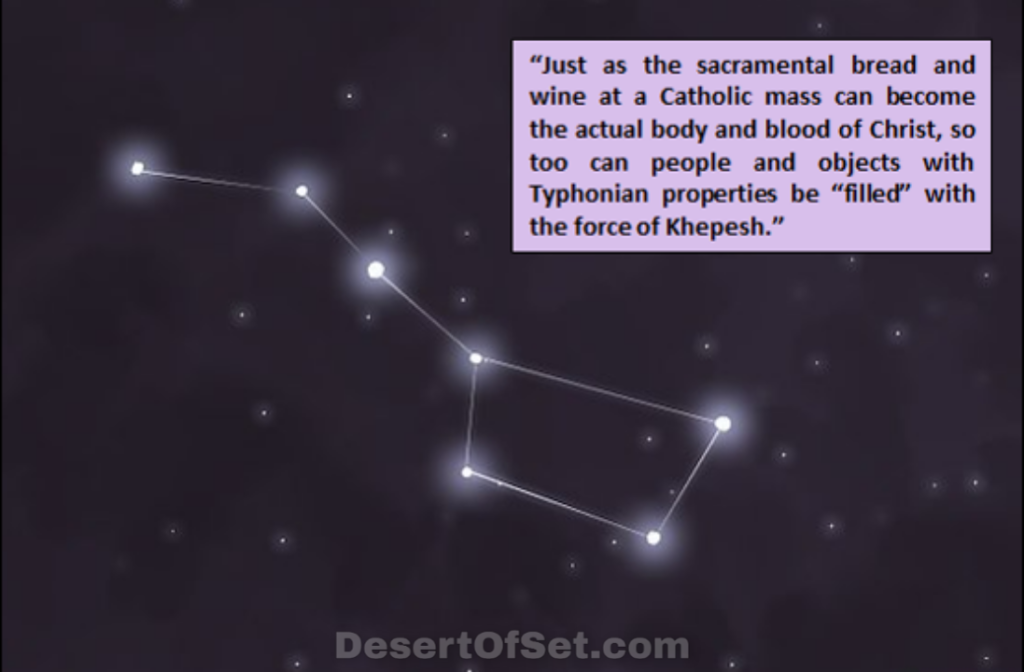
As a final thought, Khepesh is similar in concept to what Christians call “the Blood of Christ.” The latter is supposedly a real mystical substance that washes away all sin from a person’s heart. Likewise, Set’s Iron “straightens the spines” and “opens the mouths” of both the Gods and the dead. Both objects are formerly part of a deity’s body, and both can be magically “drawn down” by worshipers into physical devices. Just as the sacramental bread and wine at a Catholic mass can become the actual body and blood of Christ, so too can people and objects with Typhonian properties be “filled” with the force of Khepesh.

References

Alford, A. F. (2003). Pyramid of secrets: The architecture of the Great Pyramid reconsidered in the light of creational mythology. Walsall, England: Eridu Books.

Almond, J., & Seddon, K. (2004). Egyptian Paganism for beginners. St. Paul, MN: Llewellyn.

Assante, M. K., & Mazama, A. (Eds.) (2009). Encyclopedia of African religion, volume 1. Thousand Oaks, CA: SAGE Publications, Inc.

Assman, J. (2002). The mind of Egypt: History and meaning in the time of the Pharaohs. Cambridge, MA: Harvard University Press.

Budge, E. A. W. (1934). From fetish to God in ancient Egypt. New York, NY: Dover.

Budge, E. A. W. (1904). The Gods of the Egyptians: Or, studies in Egyptian mythology (volume 2). London, UK: Methuen & Co.

Eliade, M. (1978). The forge and the crucible: The origins and structure of alchemy. Chicago, IL: The University of Chicago Press.

Friedman, D. M. (2001). Mind of its own: A cultural history of the penis. New York, NY: The Free Press.

Guiley, R. (2006). The encyclopedia of magic and alchemy. New York, NY: Facts on File, Inc.

Isler, M. (2001). Sticks, stones and shadows: Building the Egyptian pyramids. Norman, OK: University of Oklahoma Press.

Penprase, B. E. (2011). The power of stars: How celestial observations have shaped civilization. New York, NY: Springer.

Pinch, G. (2002). Egyptian mythology: A guide to the Gods, Goddesses, and traditions of ancient Egypt. New York, NY: Oxford University Press.

Roberts, M. J. (1994). Norse Gods and heroes. New York, NY: Friedman Group.

Seeds, M. A., & Backman, D. E. (2011). The solar system. Boston, MA: Brooks/Cole.

Simon. (2006). The gates of the Necronomicon. New York, NY: Avon.

Teeter, E. (2011). Religion and ritual in ancient Egypt. New York, NY: Cambridge University Press.

Te Velde, H. (1977). Seth, God of confusion: A study of His role in Egyptian mythology and religion. Leiden: E. J. Brill.

My Understanding of Magic

A brief explanation of my perspective on magic, what it is, how it works, and how it dovetails into my theological views.

My understanding of actual magic—not to be confused with mere illusionism or stage magic—hinges on the Egyptian concept of heka, which more accurately translates to mean “divine speech.” This refers not only to literal verbal communication, but also to the use of visual arts and ritualized performances to “activate the ka,” which might be compared to our Western construct of the “astral body.” Virtually any form of dramatic self-expression can be a work of magic within this context, provided that it arouses your spirit and directs it toward some kind of goal. This goal can be operative (to heal the sick, ward off negative energy, divine omens), initiatory (to reach a higher state of consciousness), or even devotional (to honor a deity or ancestor). For the ancient Egyptians, everything from casting love spells to invoking the Creator themself was a magical working that bridged the gap between this world and Duat, its spiritual counterpart. Indeed, magic is fundamental to all spirituality and religion, for even Christian worship services involve “activating the ka” (feeling “the Holy Spirit”), implementing “divine speech” (using key language from the Bible), and accomplishing some kind of goal (feeling close to Jesus).

Naturally, most people scoff at the idea of anyone believing in magic here in our contemporary times. But there is a difference between thinking magic is effective and thinking it is necessarily “supernatural.” I wholeheartedly believe in Gods, ghosts, and other worlds, and many of the rites I’ve worked have wielded some truly eerie results. But I also accept that there are completely rational explanations for the things I’ve experienced, and I neither ask nor expect anyone else to forgo such conclusions. This is because I know magic can work regardless of whether the supernatural actually exists apart from the human imagination or not. If you invoke a blessing for someone, it might or might not have any effect on that person in the real world; but it will at least vent your desire for that person to be OK somehow, fulfilling a profound emotional need that all the logic in the world can never appease. So even if it’s all just a bunch of autohypnosis (which isn’t necessarily true, either), magic can still have efficacy and practical value today. Whether it works on objective reality or even on the subjective realities of others is completely secondary to whether it works on your own psyche and spirit. Its true purpose is to change and empower the user, not to directly affect literal changes on the physical world like in some epic fantasy movie.

These principles apply to my theology as well. I can’t claim to be absolutely 100% certain that Set (or any other deity) is really a sentient entity that actually hears my prayers, or that has ever directly intervened in my life to change it for the better. But apart from my personal belief that these things are true, I can at least be certain that if I had never uttered a single prayer to Set, I would never have met some of my closest loved ones; I would not have the family I now cherish; I would not have developed my current career; and I would never have hoisted myself from the cesspool of domestic abuse in which I was raised. None of this proves that Set is objectively real by any means, but it does prove that His influence in my life is strong enough for it not to matter whether He is or isn’t. And to this extent at least, He and the other divinities I’ve encountered are all quite real enough for my purposes. Whatever the Gods actually are or however they are to be explained, they are certainly effective, just as magic can be effective whether it is truly “paranormal” or not. So I will just go right ahead and keep praising Big Red until the cows come home!

Inevitably, we must address the issue of magical ethics. The same principle behind the blessing spell I described above will also empower a hex or a death curse to work in much the same way (i.e., on the “sender,” not necessarily the “recipient”). Many Pagans warn that doing this is “unethical” and will unleash terrible consequences upon the user(s), no matter how much the intended victim(s) might deserve whatever is wished upon them. I have even heard someone tell rape survivors they have no business casting hexes on the men who assaulted them, for fear of violating some lofty cosmic law.

This is all bullshit.

Burning effigies and sticking pins into dolls are perfectly healthy ways of vindicating yourself emotionally without actually harming anyone—especially if we’re talking about an injustice as heinous as rape. If the helpless can’t use magic to win some kind of control back over their lives, then what fucking good is it? The true concern here is not whether hexing or cursing violates any external standard, but whether it violates your own conscience. Let’s say you do cast that death curse on your tormentor, and he actually dies that painful, humiliating death you wished upon him. Would this “coincidence” spook you and make you feel guilty? If so, that guilt might eat you up inside, causing your curse to backfire. But if you are certain your enemy’s synchronous destruction in reality would only enhance your well-being, I see no reason you should not enjoy yourself by destroying them symbolically and nonviolently in a spell. Doing so is always preferable to actually harming that person in real life, and you may even find that it alleviates your desire to harm them, helping you re-focus your energy on more productive goals.

Some people describe such procedures as “black,” “dark,” or “left-handed” magic, but this too is bullshit. You don’t have to devote yourself to a dark God to cast a hex whenever you might need to, and you also don’t have to curse people all the time to worship a dark God. Setians enjoy the additional benefit of execration rituals, which work in much the same way, but which target non-human advarsaries like the qliphoth or even the Chaos Serpent instead. Nine times out of ten, a good execration will help you cast out that negative energy better than any death curse would. Nevertheless, there are situations in which a curse might be exactly what you need; so while the option of magically destroying your enemies should never be taken lightly, there is no sense in completely ruling it out either. Furthermore, the term “black magic” is a colonial racist inference to African magical traditions, and “dark magic” lacks any room for nuance. (Is it “dark” to invoke Set the nocturnal storm God in a blessing, or to invoke Sekhmet the fiery solar Goddess in a curse?) As for the “left-hand path,” this is a Tantric term for heterodox ritual practices, and it is rendered somewhat meaningless when removed from its original context. (Is it “left-handed” to praise Lucifer in a room full of Satanists?) I prefer to describe hexes, curses, and other such procedures as destructive magic and leave it at that, without assigning any color- or usability-coded value judgments to the matter.

Mind you, there are many “LHPers” (for lack of a better shorthand term) who enjoy my work, and I am very fond of those I know personally. I also have mad respect for writers like Kenneth Grant, Michael Aquino, and Don Webb, each of whom has been a major inspiration to me personally. So it is not a matter of wanting to distance myself from LHP culture at all. It’s just that I deviate from most LHP ideologies I know about, which all seem to emphasize worshiping the self over any external deity. I believe everyone is really a living demigod, so the idea of worshiping yourself actually makes perfect sense to me; but there is no reason a polytheist can’t also revere other divinities in addition to their own. Yet I have found that speaking of devotionalism in LHP circles can stir up just as much controversy as discussing hexes can in Wiccan circles, and for reasons that are equally small-minded. I worship and pray to Set as if He were a real sentient being (again, regardless of whatever He might actually be in objective reality, which is irrelevant). If being a devotional polytheist is enough to disqualify me from fitting beneath the LHP umbrella, then so be it—but I’ll thank you not to insult me by labeling me as “right-hand path” (the Tantric term for “orthodox” practices), since I do not have a single “orthodox” bone in my entire body.

Some writers argue that “magic” should be limited to purely operative and/or initiatory spiritual practices, and that devotional rites are more properly consigned to the less interesting category of “religion.” But even stargazing, lifting weights, or walking a dog can be just as magical or “spirit-activating” as casting a spell to heal your friends, attract a mate, or call down your Holy Guardian Angel. So how can anyone truly legislate what is or isn’t “magical” for others? All spiritual practices are magic of one kind or another, from the obscure Rite of the Bornless One to the common Sunday Mass; so there is no need for anyone to poo-poo other people’s preferences here. Maybe you’re the kind of person who doesn’t care about religion and who only cares about astrology or Tarot reading. Or maybe you’re the kind of person who doesn’t care about fortune telling, and who just wants to pray to some ancient fertility Goddess. Either way is enough to justify calling yourself a witch (or the cultural variant of your choice).

I’ve engaged in operative and initiatory projects over the years; I’ve worked spells, gone on vision quests, blessed people’s homes, execrated negative energy, etc. But the bulk of my craft has always been devotional in nature. There is nothing more magical to me than invoking Set at the shore of Lake Superior, out among the trees and the bears, with the Big Dipper twinkling in the sky above and the waters below, and for no other reason than just to enjoy Big Red’s company.

The Egyptian hieroglyphic for heka (“activating the ka”).

Set’s Sacred Critters

A discussion of the animals that are sacred to Set—including donkeys, pigs, hippos, oryx, and elephantfish.

As with most other Egyptian Gods, certain animals are considered sacred to Set. First and foremost is the mysterious creature that the Egyptians called the Sha.

The holy Sha, sacred to Set

The Sha Animal

This little fella—which is otherwise known as the “Set Animal” or “Typhonian Beast”—is one of history’s greatest cryptids. It resembles a red-haired greyhound with rabbit ears, a long curved snout, and a forked tail. Egyptologists are divided as to whether this animal actually existed and went extinct, or if it’s just a mythical creature the Egyptians created from bits and pieces of different animals (like a dragon, griffin, or phoenix). Some authors have theorized that it may be a stylized hyena, jackal, aardvark, or fox. It might actually be a fennec fox, which looks like this in real life:

The Fennec Fox

The Fennec Fox (From Pixabay.com)

Fennec foxes are nocturnal, and they’re native to the Sahara Desert in Northern Africa. As you can see, this little guy has the biggest ears you’ll ever find on any member of the Canidae family, and he even has reddish-orange hair. Fennec foxes are also very social animals, they mate for life, and they can live for up to 14 years in captivity. Unfortunately, they are often hunted by indigenous African tribes. They don’t cause any direct harm to humans (like attacking people or livestock), but their fur is highly prized. It hasn’t been definitively proven that the Sha is really a fennec fox by any means, but considering the shape of the Sha’s body in Egyptian religious art, I think this is the most likely possibility.

Later on, in Greco-Roman times, Set was more often drawn as a donkey-headed man, and donkeys are probably my favorite Setian beasties. Conventional wisdom assumes that a donkey’s stubbornness is due to stupidity (which is why the word “jackass” later became a derogatory term for people who act like imbeciles), but it’s actually because they’re very wise and cautious. It’s extremely difficult to force or frighten them into doing anything they perceive to be dangerous, and you must earn a donkey’s trust before you can convince it to work with you. Donkeys are so resistant to being bullied, in fact, that farmers will often keep them stabled with horses to keep the horses from spooking so easily. Other animals just seem to feel better when there’s a donkey around, which makes perfect sense to me. What better totem animal to represent the mighty Red Lord than a floppy-eared underdog that refuses to be bossed around (and that’ll crush your skull with its hind legs if you even dare to try)? Not to mention that donkeys are really very trusty companions and workers once you get to know them (and once they get to know you).

Donkeys

The Donkey (From Pixabay.com)

Pigs are also sacred to Set, and this includes all pigs (from Miss Piggy to those big Razorbacks that gore people to death in the Australian Outback with their tusks). Big Red takes the form of a black boar when He blinds one of Horus’ eyes in Egyptian mythology, which is just one reason why pigs are so often considered “unclean” in some faiths today. Other reasons relate to religious dietary laws and the fact that pigs are genetically closer to humans than any other animal. In Judaism and Islam, animals must have split hooves and chew their cud to be considered kosher or halal, and while pigs have split hooves, they don’t chew their cud. At the same time, pig flesh bears the closest resemblance to human flesh (i.e., “the long pork”) in the entire animal kingdom, as evidenced by the fact that pig carcasses are so often used by crime scene investigation units when they re-create crime scenes. In light of this resemblance, some ancient cultures probably thought that eating pork was much too close to cannibalism for comfort.

Pig

The Pig (From Pixabay.com)

Some Egyptologists have theorized that the Sha isn’t really a canid at all, but some kind of feral hog. (P. E. Newberry once claimed that some feral hogs have greyhound-shaped bodies, but I have yet to see anything like this for myself.) I’m skeptical of this interpretation, but I do think the Sha’s tail and curved snout are similar to those of a wild boar. In any case, perhaps the connection between Set and pigs is what inspired the creators of the Legend of Zelda video games to give the evil sorcerer Ganon a boar’s head.

In one myth, Set takes the form of a hippopotamus while battling Horus. Hippos are semi-aquatic, spending most of their time in water and only walking on land at dusk. They’re also the toughest and most dangerous herbivores on Earth. Male hippos are especially aggressive and were highly feared by the Egyptians for their tendency to attack people without provocation. They were revered by Zulu warriors for this same quality, and were considered braver and more difficult to kill than lions.

Hippopotamus

The Hippopotamus (From Pixabay.com)

If you’ve ever seen a baby hippo, you’ll know it’s just about the cutest thing in the entire world…and you’ll wonder how such a cute little thing could possibly grow up to become one of the world’s deadliest creatures. One of my least favorite things about ancient Egypt is that the Temple of Horus at Edfu includes an engraving of Horus spearing a baby hippopotamus. The image represents Horus defeating Set in one of their many battles, so I know it shouldn’t be taken literally. But I can’t help but wonder if it doesn’t also represent an actual ritual in which a priest of Horus might have slaughtered a captured baby hippopotamus as a way of sticking it to Big Red (which would be shitty).

Then there’s the oryx, which is a type of African antelope. Big Red was sometimes called “the White Oryx” and was also identified with antelope in general (perhaps as a result of being worshiped by desert-dwelling hunter-gatherer societies). The funny thing is, oryx, pigs, and hippopotamuses are all members of the same order, Artiodactyla, which includes all of the even-toed or “cloven-hoofed” ungulates (e.g., goats, sheep, deer, giraffe, etc.). It is no accident that cloven hooves were later identified with the Christian devil, who was identified with both Set and the oryx by the Coptic Church. It’s bizarre to me that horned, cloven-hoofed critters like the oryx and the goat would come to be considered “satanic” by such people, since they’re herbivores that pose absolutely no threat to human beings.

Oryx

The Oryx (From Pixabay.com)

Finally, Set is said to be rather fond of fish. When He drowns and dismembers Osiris in Egyptian mythology, He feeds the God’s phallus to a fish. No one’s really sure what kind of fish this supposedly was, but some sources theorize that it’s a member of the Mormyridae or “elephantfish” family. They’re called “elephantfish” because their snouts resemble elephant trunks. In fact, you might say that the faces of these fish bear a striking resemblance to the sha animal:

Elephantfish

The Elephantfish (From Wikimedia Commons)

I think it’s pretty safe to assume that Set’s fish is from the Mormyridae family, for the Egyptians were nice enough to make statues of the fish, especially in a city called Per Medjed or Oxyrhynchus (a Greek name which means “Town of the Sharp-Snouted Fish”). For whatever reason, the fish that swallowed Osiris’ penis was especially beloved to the people of this city. This is especially interesting since Oxyrhynchus was located in what archaeologists call “Upper Egypt” (i.e., the southern and most desert-like half of the country, which was dedicated to the cult of Set in predynastic times). Their statues of Set’s fish show once and for all that the fish is definitely a Mormyrus of one kind or another.
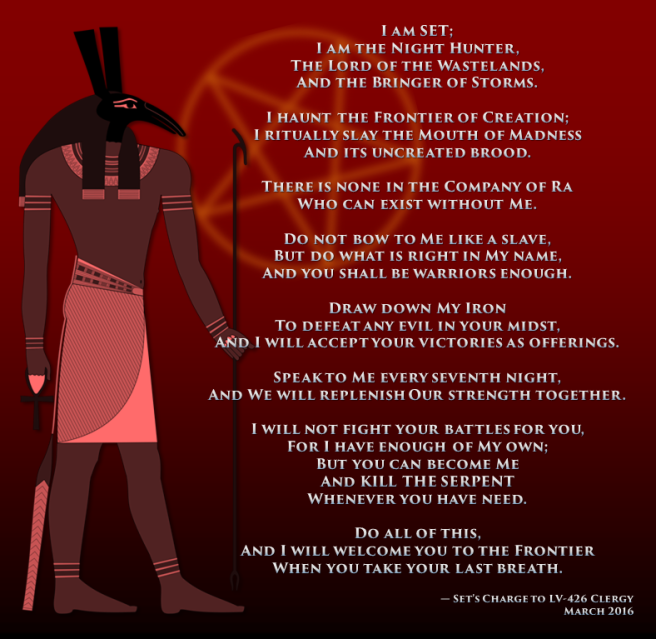
It’s ironic that a barren desert God would be associated with an aquatic animal, but it makes perfect sense to me at least. If you’re accustomed to living in an arid desert wilderness, what would you expect heaven to be like? You’d probably imagine it to be a place where there’s never any shortage of water, like an oasis, a lake, or even an ocean. The fish, in turn, would be seen as a powerful symbol of hope. Interestingly, Oxyrhynchus was one of the first Egyptian cities to accept Christianity under the Coptic Church. (Numerous non-canonical Christian texts have been discovered there.) Early Christians used the Ichthys or “Jesus Fish” as their primary religious symbol long before they switched to using the crucifix, and perhaps this is something that attracted the people of Oxyrhynchus to Christianity.

The LV-426 Tradition

Some background on the unique Setian coven in which I became a priest.

There are three other Setians with whom I’ve been privileged to work some truly life-changing magic over the years. These individuals know who they are, but out of respect for their privacy, I will only identify them here as Blackwyn, the Tonester, and Sister Bean. To walk with Set is a solitary path, even when you’re part of a group, and not everyone in my circle will always agree with each other on everything. But the point isn’t that we always believe or practice the same things. The point is that we are each drawn to Set in our own ways and for our own reasons; that we’ve crafted a number of effective rituals and spells together; and that we’ve all witnessed the same eerie results these procedures can yield. Years have passed since we first declared ourselves a coven back in 2003; we’re spread far apart from each other now, living in our own areas and focusing on our own priorities. But even if we never meet in person to hold another ritual together again, we will always be connected with each other somehow.

That “somehow” is Set.

In 2007, we started referring to our collected rites as the LV-426 Tradition for the following reasons:

  • The 1979 sci-fi/horror film Alien is a prime example of what we call “the monster film as mythos,” and we wanted our name to memorialize the film for this reason.
  • The Tonester and I were both living in the Bible Belt at the time, and Ripley’s struggle against the Alien was a perfect metaphor for how we felt about living there.
  • Being a couple of smartasses, we wanted a name that was far too cumbersome for repeated use in brief conversation. (Say “LV-426 Tradition” six times in the same paragraph to see what I mean!)

The Setians of the LV-426 Tradition

From left to right: The Tonester, Sister Bean, Yours Truly, and Blackwyn.

In case you’ve never seen it (and shame on you if you haven’t!), the original Alien is about these astronauts in the distant future who follow what seems to be a distress signal of unknown origin. They make their way to a desolate planet called “LV-426” in their star charts, where they find a crashed alien spaceship with a dead crew and a shit-ton of weird, leathery eggs for its cargo. One of these eggs hatches, unleashing a horrific beast that reproduces itself by raping one of the men (!). Due to a breach in protocol, the creature enters the next phase of its life cycle back on board the ship, and the movie then becomes a slasher flick in outer space. The last person standing is Ellen Ripley, played by Sigourney Weaver, who emerges from the chaos and the carnage to become the first female action movie hero.

1980's Ad in TV Guide for Alien (1979)

The Alien strongly resembles Apep, that timeless arch-nemesis of Set. Designed by the Swiss surrealist, H.R. Giger, its biology makes no sense. How can it see without any eyes? Why would anything evolve to have two mouths—one inside the other—when just one mouth is simpler? How can its blood be so corrosive that it will burn through any metal, but without being deadly to the creature itself?1 Nothing in nature can exist like that, and the same is true of Apep. It’s described as lacking any sensory organs—it has neither eyes nor ears—yet it’s somehow able to locate and paralyze its prey with a hypnotic gaze. It’s also described as “breathing by means of its own roar” and “living by means of its cries,” which means it doesn’t require any sustenance for its survival; it just eats things to make them suffer (Manassa, 2014). Both Apep and the Alien are monsters that can only exist in nightmares, that operate in total defiance of natural law, and that would be absolutely poisonous to any ecosystem in which they managed to thrive.

Ellen Ripley, on the other hand, is a perfect stand-in for the Red Lord. She is the outsider or “black sheep” among her crew, the only one who takes her job seriously, and a real stickler for protocol (even refusing to let Captain Dallas [Tom Skerritt] board their ship when she learns he has an infected crew member in tow). Compare this to the other female crew member, Lambert (played by Veronica Cartwright), who complains, screams, or cries helplessly throughout the film. Then there’s the fact that Ripley dresses and behaves like a man. One of Set’s many lovers is the Ugaritic Goddess Anat, who is usually depicted in men’s clothes (Patai, 1990), and whom Set is said to find especially attractive for this reason. Given how much He enjoys smiting monsters like the xenomorph, and given how partial He is to androgynous ladies like Anat, it’s hard for me not to imagine Set cheering for Ripley from upon His throne behind the Great Bear. (Plus, going through so much trouble to save Jones the Cat must surely score Ripley some additional points with Bast, Ishtar, Sekhmet, and other like-minded Goddesses of feline goodness.)2

Anat, an Ugaritic goddess

Anat, an Ugaritic Goddess who is one of Set’s many consorts.

Alien is also filled with various references to sexual anatomy and the reproductive process. The ship’s computer is called “Mother”; the astronauts look like they’re being born when they awaken from their cryogenic sleep chambers; the tunnels of the derelict craft on LV-426 resemble giant fallopian tubes; and the xenomorph’s head is shaped like an erect penis (which always makes me think of someone being raped in reverse during the infamous “chestburster” scene).3 Ripley even has her final confrontation with the beast in her underwear,4 and she must also contend with “Mother,” which insists on keeping the Alien alive for future study (even at the cost of the astronauts’ lives). So a secondary conflict rages between Ripley and the computer, which cares more for the survival of the “child” than it does for the “parents.” This is especially intriguing given that Set is thought to cause abortions and miscarriages (te Velde, 1977). As His cinematic avatar, Ripley must further alienate herself from her society by “aborting” the gestating life form her superiors have deemed more important than herself (Cobbs, 1990).

H.R. Giger was obviously influenced by the New England horror writer, H.P. Lovecraft; but I’m fairly certain he was also inspired by a British occultist named Kenneth Grant. Once a disciple of the infamous Aleister Crowley, Grant was obsessed with what he called the “Tunnels of Set,” which are supposed to be these astral wormholes that loop back and forth between various alternate universes. He was the first occult author to suggest that H.P. Lovecraft was a “sleeping prophet,” and that monsters like Cthulhu and Nyarlathotep are real beings that actually exist in some other dimension. (He beat the Simon Necronomicon to this punch by at least a decade, if not longer.) Given this, I’m sure Grant’s ajna chakra or “third eye” probably exploded wide open if and when he ever got around to seeing Alien for himself. And if H.R. Giger wasn’t specifically thinking about the “Tunnels of Set” when he first envisioned the winding, cyclopean corridors of that ghost ship on LV-426, he sure as hell could have fooled me.

H.P. Lovecraft, Kenneth Grant, and H.R. Giger

From left to right: H.P. Lovecraft (1890–1937), Kenneth Grant (1924–2011), and H.R. Giger (1940–2014).

Though we tend to share Grant’s enthusiasm for the “many-worlds” interpretation of quantum mechanics, my coven mates and I have zero interest in contacting any of the horrific fauna that H.P. Lovecraft envisioned for his lurid tales. We instead emphasize execration, or the use of magic to repel negativity and misfortune from people’s lives. This is functionally similar in principle to casting a death curse on someone, save that the target of your spell is Apep, the true source of all evil, and not any human victim. As far as we’re concerned, walking with Set isn’t about getting chummy with Lovecraftian space monsters; it’s about ferociously defending the autonomy of all sentient beings.

The idea that we must be “ferocious” in this regard comes from when the Tonester and I lived in the Bible Belt during the early 2000s. We were constantly under siege from “Rapture-ready” teachers, classmates, employers, cops, and politicians. We couldn’t even go for prayer walks in the woods without being harassed by people who thought we were “worshiping the devil.” After a while, it began to feel as if we were actually trapped in some hostile wilderness, with a very real monster coming after us. That monster wasn’t an actual xenomorph, of course, but Apep; and instead of literally trying to eat us, it was trying to eat our hearts from within. But Set is merciful; He brought us together in that wretched place, against all odds, and He blessed us with each other’s company and support. Then we met Blackwyn and Sister Bean in Michigan a few years later, and the rest is history. Each of us is proof for the others of Set’s providence, and Alien is an excellent parable for our own private quests against the Serpent.

Training to be Ellen Ripley

But execrations are not the only staple of our practice; there’s also our weekly Sabbat ritual, which is observed on Friday nights. We enter a darkened room that has been prepared with an altar, an image of Set, and some red candles. We recite our standard invocation together, and then we take turns praying to Set informally, as if He were just a regular person in the room with us. Usually this means discussing our hopes and fears, our best and/or worst moments of the week, or something along those lines. When one person finishes their prayer, they turn to the next person in sequence (which is always to the left) and say, “If there is anything you wish to say to the Red Lord at this time, please feel free to do so.” And if the next person has nothing they wish to pray about, they keep silent so the next person can proceed. Once everyone has finished, we break out the beer, blast some heavy metal, and chat with each other into the wee hours, sometimes not adjourning until daybreak. The exchanges we’ve shared during these late night Sabbat talks are some of the most profound meditations I’ve ever experienced in my life.

Some other things we’ve done include a spell for protection during sleep, an astral pilgrimage technique, and a matrimonial ceremony that was used for my wedding in 2012 and for Sister Bean’s in 2015. There’s also an initiation ritual that’s used for inducting new members, but this procedure is known only to those who pass our vetting process and are invited to join. (Considering there have only been four of us since Set first struck me with His black lightning in 1997, you can imagine how often this happens.) Our liturgical calendar includes not only our weekly Sabbat but also Hallowtide (October 31–November 2), Walpurgisnacht (April 30), and Friday the Thirteenth (on which we celebrate Set as the catalyst for Osiris’ resurrection and Horus’ conception). Importantly, we have no leader or “high priest/ess”; each of us is fully qualified to administer our rites to anyone who might need them, and all of our group decisions (including whether to initiate any new brothers and/or sisters) are made by unanimous vote.

Set's Charge to LV-426 Clergy

Apart from the above, we Setians of the LV-426 Tradition may each entertain any additional beliefs or practices we like. Some of us revere other sacred figures along with Set, like Buddha, the Norse God Odin, or the Babylonian Goddess Ishtar. Some of us even celebrate Christmas or Saint Patrick’s Day. Our eclecticism is rooted in Set’s New Kingdom role as an ambassador between the Egyptian Gods and other pantheons. Just as He can roam between alternate realities and canoodle with alien divinities, so are we free to mix the old Kemetic wisdom with just about anything we find useful, from American colonial witch lore to Zoroastrian demonology. Some outsiders may find this permissiveness toward religious dogma repugnant, but we couldn’t care less; Big Red is the only justification we need.

It’s been a while since we last met as a coven to keep the Sabbat, execrate our inner demons on Walpurgisnacht, or offer up a feast of watermelon to Big Red on Friday the Thirteenth. I can’t speak to how often the others may or may not “keep up” with these practices nowadays (though I must admit it has been hard for me to do so consistently, myself), but none of us has ever been expected to make such a commitment anyway. It’s the fact that we even did these things at all—and the magic we shared when we did—that really matters. And there’s always the possibility that somewhere down the road, a fifth initiate of LV-426 might present him or herself to us, setting a whole new cycle of ritual work into motion. For now, all LV-426 alumni are off exploring other proverbial worlds, but always with Set’s Iron in our spines.

The LV-426 Sigil

The LV-426 Sigil

Notes

1 I’m well aware that in Ridley Scott’s prequels to this film—Prometheus (2012) and Alien: Covenant (2017)—it’s revealed that the xenomorphs did not evolve naturally, but were genetically engineered as a kind of biological warfare. This still doesn’t explain why their blood, which can burn through any damn metal you please, doesn’t just burn right through their own bodies as well.

2 Some viewers—including Big Steve King—complain that Ripley’s quest to save Jones the Cat is a “sexist interlude” that undermines her role as a feminist character (King, 1983). I’m a proud cat parent, and if I were in Ripley’s position, I’d risk everything to save my fur baby too. (Ten bucks says if Jones were a dog, nobody would be bitching about this.)

3 The “chestburster” scene is quite similar to the story of Set’s birth according to Plutarch (1970). He recounts that Set was not born at the normal time or in the normal fashion, but that He impatiently exploded forth from the belly of His mother, the sky Goddess Nut. It’s tempting to think the screenwriter, Dan O’Bannon, might have encountered this story at some point while writing the script for Alien.

4 Some viewers—again, including Mr. King—complain that this final sequence “sexualizes” Ripley too much (King, 1983). I have to say that as a straight dude, this scene has never once made me think, “Ooooh, look at the naked chick!” Instead, it always makes me think about this one time I had to fumble around in my basement naked to get some clean clothes out of the dryer, only to be greeted by a huge spider that made me piss myself. In other words, it makes me identify with Ripley rather than objectify her, and I for one applaud Ridley Scott for framing the scene in that way.

H.R. Giger's Alien

References

Cobbs, J.L. (1990). Alien as an abortion parable. Literature / Film Quarterly, 18(3), 198–201. Retrieved on October 5, 2017.

King, S. (1983). Danse macabre (2nd edition). New York, NY: Berkley Books.

Manassa, C. (2014). Soundscapes in ancient Egyptian literature and religion. In E. Meyer-Dietrich (Ed.), Laut und leise: Der gebrauch von stimme und klang in historischen kulturen (pp. 147–172). Bielefield, Germany: Transcript Verlag.

Patai, R. (1990). The Hebrew Goddess (3rd edition). Detroit, MI: Wayne State University Press.

Plutarch (1970). De Iside de Osiride. Cardiff, Wales: University of Wales.

te Velde, H. (1977). Seth, God of confusion: A study of His role in Egyptian mythology and religion. Leiden, Netherlands: E.J. Brill.

The Monster Film As Mythos

Explaining the LV-426 belief that monster movies are more sacred and profound than any Kirk Cameron flick.

I enjoy interpreting films, TV shows, and popular music from a Setian perspective. This isn’t just a “hobby”; it’s an essential part of my spirituality. I believe Set and other Pagan Gods like to reveal themselves through popular cultural media, and in ways that are more often subliminal than not. It’s easy to recognize the Goddess Isis in that old 1970s TV show, The Secrets of Isis, where she’s an actual character who fights crime. But have you ever noticed how similar James Cameron’s The Terminator (1984) is to the myth of Isis fleeing from Set to ensure the safe birth of Horus? Just imagine that Sarah Connor is Isis, Kyle Reese is Osiris, the Terminator is Set, and John Connor is Horus; see what I mean?

I’m not suggesting that James Cameron actually did this on purpose. I just think one or more of the Gods probably reached into his brain back in 1984 and shuffled some stuff around in there while he was writing the script. I think this happens all the time, not just with James Cameron, but with potentially any filmmaker. I know it sounds silly or perhaps even “crazy,” but the idea that the Gods would leave “secret messages” for us to find in movies, TV shows, or even Saturday morning cartoons is no different from divining omens in tea leaves or the Zodiac. Just because these media are human inventions doesn’t mean the Gods can’t use them for their own purposes. If they can reveal themselves through clouds and trees and dreams, they can just as easily do the same thing through anything created by human hands.

“But G.B.,” I hear some of you asking, “What about things that are purposely inspired by Egypt? Things like Stargate SG-1?” Well my answer to that question is so complex, I had to write a whole other sermon about it to do the subject any justice. But with very few exceptions, I am almost never impressed with anything that’s intentionally inspired by Egyptian mythology.

I find that such works tend to fall into one of three clichéd categories:

  • The “killer mummy” movies, in which the mummy is always some ancient evildoer who seeks to claim the modern reincarnation of his long-lost love. (This includes pretty much any film called The Mummy or that has the word “Mummy” somewhere in the title, like 1964’s The Curse of the Mummy’s Tomb.)
  • The “ancient astronaut” movies, in which the Egyptian Gods turn out be gooey aliens that fly around in spaceships. (This would be where Stargate fits in.)
  • The “biblical epic” movies, which all treat the book of Exodus like it’s a Gods-damn court transcript. (This includes such esteemed classics as The Ten Commandments, The Prince of Egypt, and Exodus: Gods and Kings.)

You’d expect there to be more of Set in something like Gods of Egypt (in which He’s an actual character) than there is in a movie like the original Godzilla from 1954 (which has nothing to do with Egypt on the surface); but I find the opposite is more often true. Whenever Egyptian mythology is intentionally adapted into fiction, the result is often far less interesting than the original source material. Cinematic portrayals of Set in particular have absolutely nothing to do with how anyone has ever worshiped Him in real life. (The next time you watch the original Conan the Barbarian from 1982, bear in mind that feeding naked women to giant snakes has never been a standard feature of Setian religious practice.) Yet there are other creative works that don’t intentionally invoke Set in any way, but which do so serendipitously, and which are more consistent with actual Setian ideas and values. This to me is a sign that these films have been “touched” by Set, especially if the people who created them have never heard of Him before.

In my opinion at least, the films that seem to resonate with Set the most are monster movies—sci-fi, horror, and fantasy romps that feature aliens, giant animals, mutants, supernatural beasties, or even cryptids like Bigfoot or the Loch Ness Monster. No matter what creatures they might feature, all monster films are about chaos intruding upon the world of order. Sometimes this chaos is caused by forces external to humanity (as with alien invaders), and sometimes it’s caused by human monsters (as with serial killers). Sometimes the chaos is visited upon the innocent (making the story a tragedy, or an example of when bad things happen to good people), and sometimes it falls upon the wicked (making it a morality tale, or an example of when bad people get their comeuppance). Either way, it all boils down to the eternal struggle between order and chaos, light and darkness, creation and annihilation.

You’re probably wondering why a minister would take such a serious interest in this kind of subject matter. (After all, aren’t religious people supposed to think that monster movies are “sick” at best or “satanic” at worst?) The truth is, I think monster tales are the oldest kind of story known to humankind. Sure, epic adventures and steamy romances have been with us a long time too, but the one emotion our earliest ancestors were probably most familiar with was fear.

Consider what John Goodman says in Joe Dante’s Matinee (1993):

A zillion years ago, a guy’s living in a cave. He goes out one day, Bam! He gets chased by a mammoth. Now he’s scared to death, but he gets away. And when it’s all over with, he feels great […] So he goes home, back to the cave, the first thing he does, […] he does a drawing of the mammoth. And he thinks, “People are coming to see this. Let’s make it good. Let’s make the teeth real long, and the eyes real mean.” Boom! The first monster movie.

When you think about it, fear has motivated people to do many things. It motivated our ancient ancestors to band together, hunt for food, develop agriculture, and establish laws to prevent themselves from killing each other. It also motivated them to tell stories, to put their faith in higher powers, to repel misfortune with charms and magic, and to hope for a better life in the great hereafter. In short, fear is just about the mother of everything that’s included in human civilization, including religion.
Monster films are magical

There’s even an element of the monstrous in religion itself. The theme of chaos intruding upon order appears in every religious mythology. Every pantheon of Gods must contend with at least one horrific monstrosity that wants to destroy us all:

  • In the Coffin Texts (dating to circa the 20th century BCE), Set is and will always be defeating the monster Apep.
  • In the Babylonian Enuma Elish (dating to the 7th century BCE), the God Marduk slays the dragon Tiamat and creates the cosmos from her corpse.
  • In Hesiod’s Theogony (dating to the 7th century BCE), the Olympian Gods defeat the gigantic Titans and bury them within the earth.
  • In Psalm 74 (dating to 586 BCE), Yahweh slays Leviathan and feeds it to his saints at the end of time.
  • In Revelation 20 (dating to 81–96 CE), Christ defeats Satan and Antichrist, casting them both into a lake of fire.
  • In the Bundahishn (dating to the 9th century CE), Ahura Mazda destroys the monster Ahriman and rehabilitates the damned.
  • In the Poetic Edda (dating to the 13th century CE), the Aesir and Vanir will kill and be killed by the frost giants of old.

Every monster film echoes one or more of these combat myths on some basic level. Even in the original Friday the 13th (1980), the character of Pamela Voorhees (played by Betsy Palmer) is really just another Tiamat, and the camp counselor Alice (Adrienne King) is the stand-in for Marduk. The characters and circumstances are quite different, but the story is essentially the same, and it’s the oldest story in the world.

Many faiths also have some horrific notion of what might happen if people just stopped practicing religion altogether. The Gods might abandon us; the dead might rise up to torment the living; the whole world might fall apart; and so on. Films like The Birds (1963) and The Mist (2007) may not seem to have anything to do with religion on the surface, but each depicts some stern, cosmic judgment against humanity for its collective sins. And the number of films that depict vengeance upon the living by the restless dead—such as Poltergeist (1982) and A Nightmare on Elm Street (1984)—is in the thousands. For these reasons, I think monster films are the finest medium for religious expression and interpretation, superior even to most overtly religious films. There is far more divinity and truth to be found in something like It Came from Outer Space (1953) than there is in, say, Kirk Cameron’s Saving Christmas (2014).

Now praise Set, and pass the remote!

Remote for your Television SET