An LV-426 LBRP

An LV-426 Setian adaptation of the Lesser Banishing Ritual of the Pentagram.

The Lesser Banishing Ritual of the Pentagram (or LBRP for short) is a magical procedure developed by the Hermetic Order of the Golden Dawn during the late 19th and early 20th centuries. It involves casting a magician’s circle, tracing pentagrams in the air, and reciting divine names of power to repel any chaotic or qliphothic forces that might be hanging around you.

The litany for this rite was adapted from a traditional Jewish prayer that is recited before sleeping:

In the Name of God, the God of Israel: may Michael be at my right hand, Gabriel at my left, Uriel before me, Raphael behind me, and above my head, the presence of God.

The actual Golden Dawn procedure is much more complicated than just a bedtime prayer, requiring the use of an altar, robes, and various ritual tools. But the effect was so remarkable that even people outside the Golden Dawn started using the procedure, re-writing it to suit their own needs. More than a century later, a Google search for “LBRP” will retrieve countless variants of the rite that are now used in various faiths today, including Wicca, Thelema, and even Satanism.

Upon learning that the LBRP descends from a bedtime prayer, I felt moved to draft an adaptation of my own. This version of the rite is written from an LV-426 Setian perspective, which means it is much simpler than what most ceremonial magicians are probably used to. You can include an altar and any additional ritual items you wish, but this is entirely optional. The only things you really need are yourself and a nice quiet place where you can be alone.

The Procedure

Stand facing north, with your eyes closed. Count down silently from 100. Then raise your head up high and recite:

In the Name of
SUTEKH,
God of Deshret.

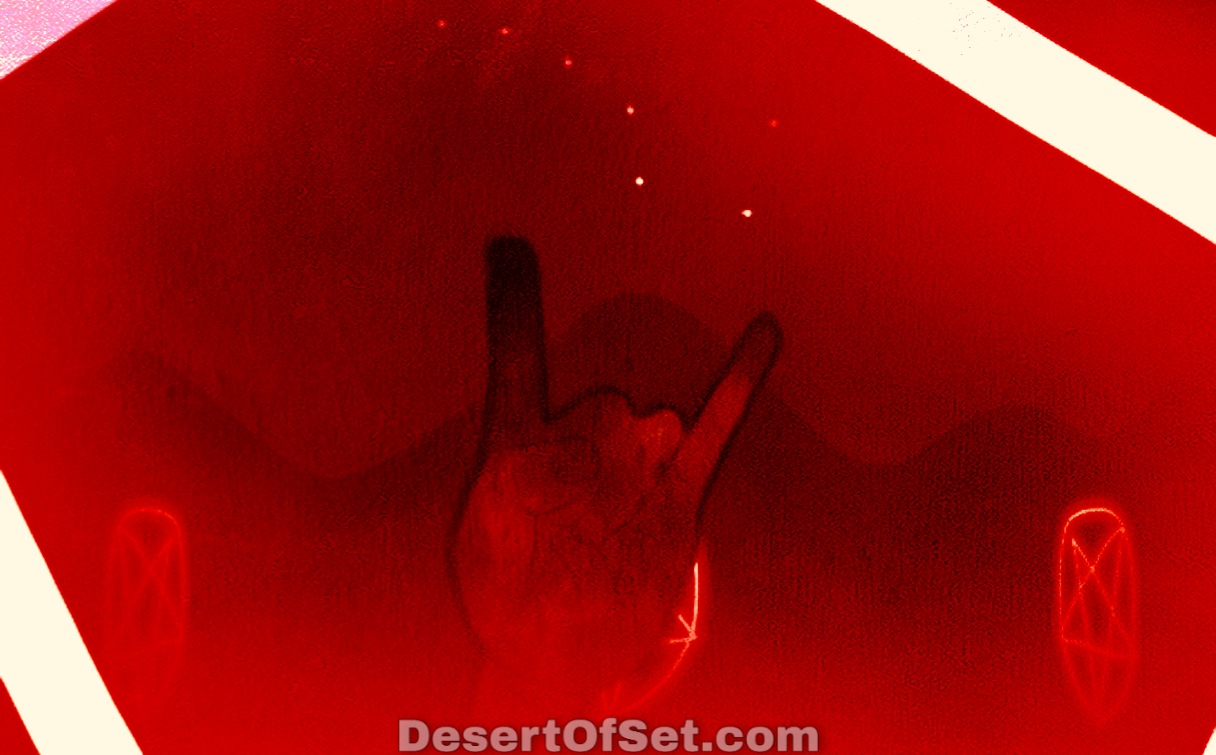
Open your eyes and turn slowly to the left, facing west. Raise both your hands in the sign of the horns, pointing up to the sky.

Draw a horned pentagram in the air before you with your left hand; imagine a red light trailing behind your fingertips, so there is an invisible afterglow. Then, arms still raised into the air, recite:

Hear me,
NUBTI of Ombos,
Golden One,
Provider of Life on the Frontier.

Turn to the left, facing south. Draw another pentagram in the air, in the same manner. Then, arms still raised, recite:

Hear me,
TYPHON of Aegyptos,
Disturber of the Dark,
Giver of Winds.

Turn to the left, facing east. Repeat the same procedure; then recite:

Hear me,
HADAD of Kemet,
Savior of Khepera,
Hero of the Light.

Turn to the left, so that you are facing north once again. Draw one last pentagram in the air; then recite:

Hear me,
ASH of the Oases,
Horned Night-Hunter,
Wanderer of the Wastes.

Gently lower your arms and close your eyes. Remain silent for a few moments; then recite:

I am
SUTEKH’S Child,
the Dazzling One in mortal flesh.
I alone am Sovereign Ruler
of my innermost self.

Raise your left hand in the sign of the horns, pointing west. Recite:

May
NUBTI
ever be at my left;
I will survive and persevere
in all hostile terrain.

Raise your right hand in the sign of the horns, pointing east. Recite:

May
HADAD
be ever at my right;
I will smite the forces of isfet
and champion the Light.

Keeping both arms in the air, take a half-step backwards, so that your left foot is behind you. Recite:

May
TYPHON
ever be behind me;
I will ride the winds of change
and create myself anew.

Take a half-step forwards (with your arms still in the air), so that your right foot is before you. Recite:

May
ASH
ever be before me;
I will drink sweetwater
in the Desert between the Worlds.

Rise into a standing position and cross your arms over your chest, with your hands still in the sign of the horns. Close your eyes once more and recite:

May the presence of
SUTEKH
be ever upon my crown.

Silently count backwards from 100; then open your eyes and go forth by day.

Calling Professor Quatermass!

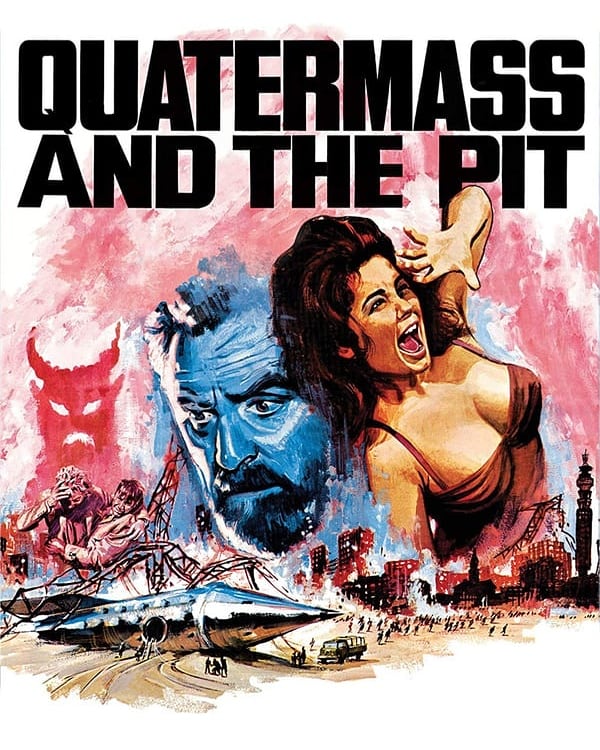
Martian grasshoppers. Genetically modified super-apes. Invisible forces only certain people can see. Quatermass and the Pit (1967) has it all.

I love those old Hammer horror films from the 1960s and 1970s: the ones with Christopher Lee and Peter Cushing, filmed in vivid Technicolor, with some of the most atmospheric set pieces you’ll ever see on screen. Hammer revamped all the traditional gothic horror film monsters, and they weren’t afraid to use gallons of blood in the process (which really pissed off the British censors at the time, even though the gore looks pretty fake by today’s standards). They turned Dr. Frankenstein (portrayed by Peter Cushing) into a psychopathic killer who prefers to get the parts for his monsters fresh (if you know what I mean, and I think you do). They turned Count Dracula (Christopher Lee) into a frothing-at-the-mouth sexual predator who can break mere men in half with his pinky finger. They also cast some of the most beautiful demigoddesses to have ever graced this earth. (Seriously, these ladies make their Victorian costumes look more provocative and exciting than even the skimpiest of modern beach attire.) Whether we are addressing The Evil of Frankenstein (1964), Dracula: Prince of Darkness (1966), or even The Devil Rides Out (1968), Hammer films are fucking awesome and warrant multiple repeated viewings.

If I had to choose just one Hammer film as my personal favorite, it would not be easy; but surely Quatermass and the Pit (1967, also known as Five Million Years To Earth) would be counted among my Top Five. This is a sequel to an earlier 1955 film called The Quatermass Xperiment and its immediate 1957 successor, Quatermass II. All three movies are theatrical adaptations of TV serials that were originally broadcast on the BBC in the 1950s. These serials were written and created by Nigel Kneale, who is also known for writing The Abominable Snowman of the Himalayas (1957), The Stone Tape (1972), and the original screenplay for Halloween III: Season of the Witch (1982). Kneale was a fantastic science fiction writer whose work fits rather nicely with the likes of H.P. Lovecraft, and he has been a major inspiration to such horror maestros as John Carpenter and Stephen King, whose Prince of Darkness (1987) and The Tommyknockers (1987) are both directly inspired by Quatermass and the Pit.

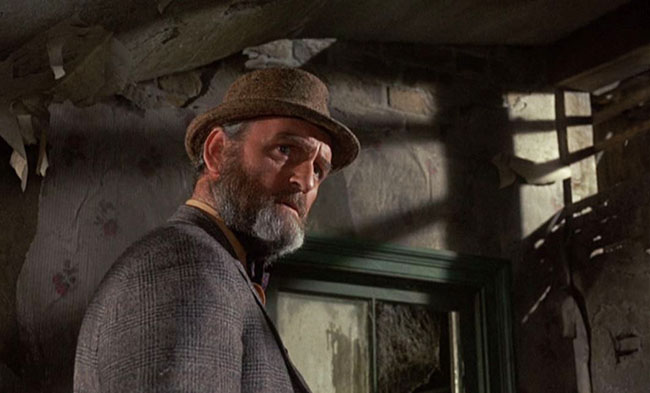
The Quatermass films are named for their main character, Professor Bernard Quatermass, a British rocket scientist who contends with various alien forces that seek to wipe out the human race. (In many ways, the original serials also provided a great deal of inspiration for Doctor Who.) Of the trilogy, Quatermass and the Pit is easily the best; and despite being the third film in sequence, it is written in such a way that you don’t have to view either of its predecessors to understand the characters or plot. All you really need to know going in is that it’s about a small British town called Hobb’s End (which should sound familiar to anyone who enjoys John Carpenter’s In the Mouth of Madness). Some subway workers uncover a bunch of weird fossils and an object that looks like an unexploded bomb from the German air raids during World War II. This was not an uncommon problem in England in the 1960s (hell, it’s still a problem today), so panic immediately ensues, and the military is called in to investigate. But it is soon determined that the excavated object is not a bomb after all, and that’s when Professor Quatermass is called in.

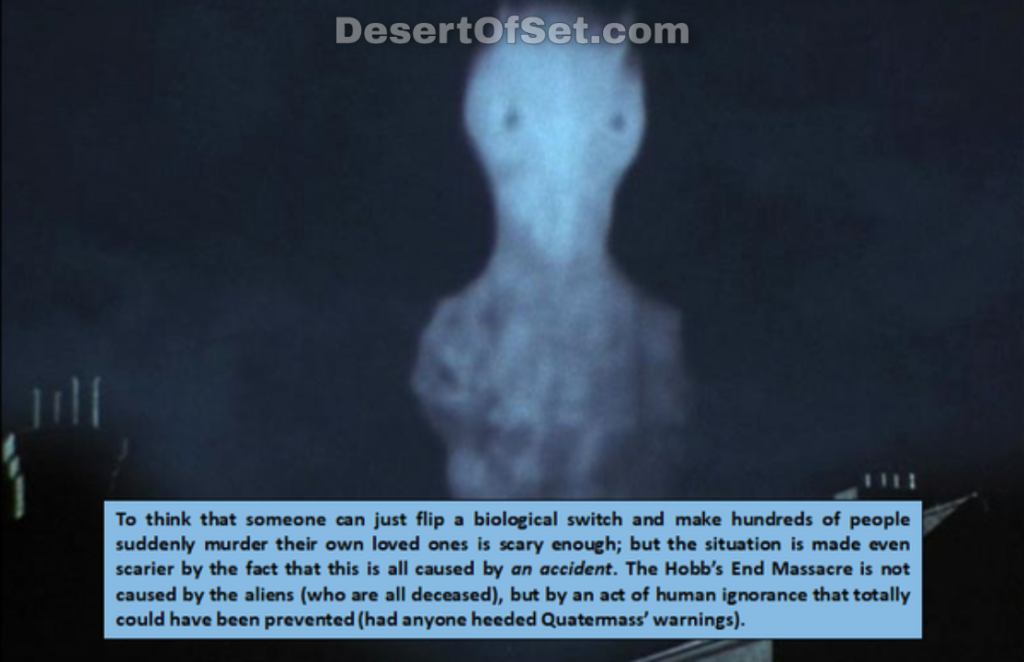
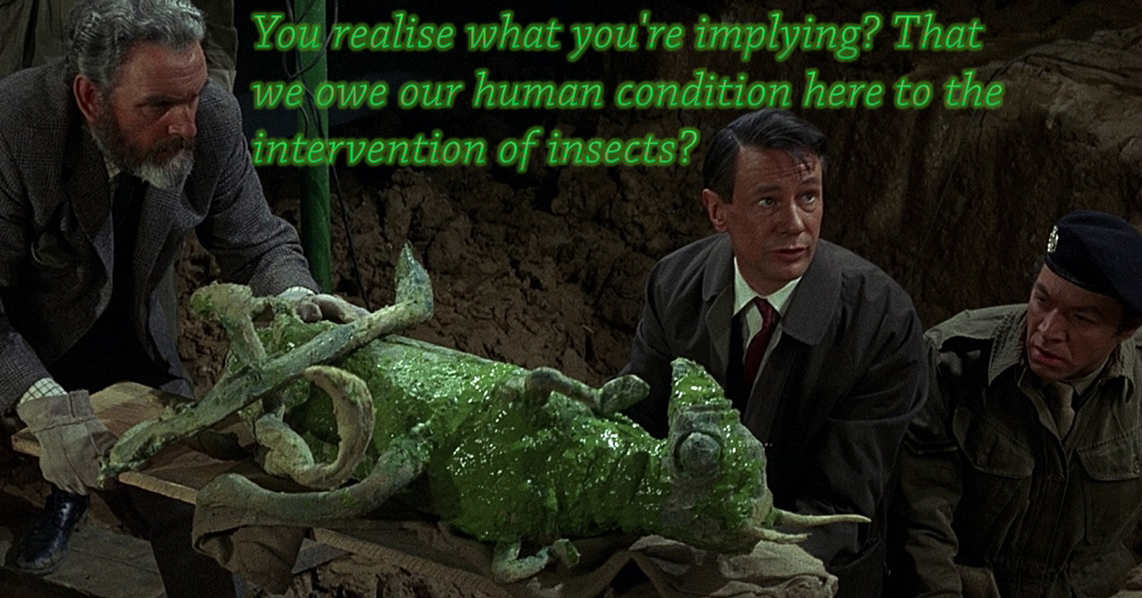
Quatermass discovers that the object is actually a spaceship, and that it contains a couple of ancient alien corpses. (The aliens look like man-sized grasshoppers.) The weird fossils that were discovered close to the ship appear to have been primates that the aliens were using as experimental test subjects. Quatermass also learns that Hobb’s End has been subject to all manner of paranormal disturbances since time immemorial; whenever someone disturbs the ground where the spaceship now rests, ghost and hauntings are soon reported throughout the surrounding area. And when a man accidentally scrapes the spaceship with a wrench, it causes all these weird telekinetic phenomena to start happening.

Quatermass figures the aliens are from Mars, and that they came to colonize the Earth before humans evolved. He thinks they planned to transfer their consciousness to the ancient primates they found, so that they could live more comfortably in our ecosystem. But something went wrong, and the aliens all died. Yet the super-apes they created survived, and some people today are actually descended from them. Such people tend to be born with weird psychic abilities, and Quatermass theorizes that this may be where all our legends of magic and witchcraft come from. The aliens even resemble Satan, with tiny horns poking out of their skulls. But there’s just one problem: even though the aliens and their super-apes are dead, the powers they evoked continue to exist in human beings today, and the alien spaceship is still functional. Quatermass fears that if anything is done to disturb the vessel, it could re-awaken the dormant Martian hive consciousness that resides within every person who is descended from the modified apes. And this is exactly what happens when the British government decides to hold a big press conference at the excavation site. Some knucklehead drops some live electrical wiring on the ship, and it wakes up.

Quatermass and the Pit

The awakening of the Hobb’s End spaceship is one of the most terrifying sequences I’ve ever seen in any horror film. Approximately half the local population is suddenly possessed by the Martian hive mind, which then drives them to murder all their neighbors, co-workers, and families. These people even kill all the animals they encounter as well; there’s one ghoulish moment when we hear them slaughtering a bunch of cats and dogs outside, and it never fails to make my blood run cold. To think that someone can just flip a biological switch and make hundreds of people suddenly murder their own loved ones is scary enough; but the situation is made even scarier by the fact that this is all caused by an accident. The Hobb’s End Massacre is not caused by the aliens (who are all deceased), but by an act of human ignorance that totally could have been prevented (had anyone heeded Quatermass’ warnings).

The heroes end up using a big iron crane to discharge the Martian spaceship’s energy back into the Earth. As in a great deal of folklore, it is the apotropaic power of iron (a substance most sacred to Set) that dispels the forces of evil in the end. But unlike most other science-fiction/horror films from this period, Quatermass and the Pit does not conclude with the male and female survivors hugging and kissing each other like everything’s going to be all right. Here, Professor Quatermass and his friend Dr. Judd (played by Barbara Shelley, my favorite Hammer glamour girl) are left standing alone amidst a sea of urban ruin, not breathing a word to each other. They’re too frightened to even look at each other, much less touch. (Perhaps they fear that doing so might spark up the Martian hive mind again?) They just stare fearfully into the night, forever traumatized by what they’ve seen and experienced. Roll credits!

One sure way to make me want to read a story or watch a film is by telling me, “It’s horror AND science fiction.” Some of my favorite films fall into this category, including Ridley Scott’sAlien (1979) and John Carpenter’sThe Thing (1982). But Nigel Kneale’s work is distinct because it combines science fiction with supernatural horror, using science to plausibly substantiate the paranormal (rather than dispelling it). The genealogical descent of all witches and wizards from Martian-engineered apes is just one example. Another would be the concept behind The Stone Tape, in which Kneale has scientists discovering that “ghosts” are actually residual “recordings” of past events that have been embedded into certain rocks. (This hypothesis is now called “the Stone Tape Theory,” which still carries considerable weight among paranormal researchers today.) And of course, Halloween III: Season of the Witch proposes that the mineral content of Stonehenge is catastrophically dangerous and can actually be weaponized by any corporation with the necessary know-how. As far as I’m concerned at least, Nigel Kneale belongs in the same company as such hard science fiction masters as Isaac Asimov and Arthur C. Clarke.

In Quatermass and the Pit, the Christian concept of “the devil” is revealed to be nothing more than a genetic race memory of the Martian colonists who experimented on our primate ancestors. These aliens were not necessarily “evil,” either; they were simply doing what they could to survive. As a Setian, the idea that “Satan was originally something else, and it wasn’t evil” has been a very old recurring theme in my life. And the idea that a sufficiently advanced or “magical” technology can be misused to wreak unspeakable havoc is also familiar, given what I have seen when ill-prepared occultniks fuck around with things like qliphoth or the Simon Necronomicon. Finally, I can identify with the idea of there being a scientific basis for “superstitions” like the use of iron objects to execrate evil spiritual forces. Indeed, Quatermass and the Pit is not only scary, but incredibly thought-provoking for anyone who takes an interest in the esoteric side of life. For Pagans and witches, I really can’t recommend it highly enough.

On the Temple of Set

Some thoughts on what is probably the most well-known Setian community today.

The Temple of Set was founded by Michael Aquino, a Lieutenant Colonel in the U.S. military, in 1975. This was the result of a schism within the Church of Satan, in which Aquino had been a high-ranking member. Aquino had some major philosophical and administrative differences with the church’s founder, Anton LaVey, especially when it came to the theological existence of “the devil.” LaVeyan Satanists are not theistic devil worshipers, but scientific materialists who just happen to share a taste for gothic theatricality. (And why not? Goth stuff is sexy.) But in 1975, some members believed a real supernatural force was somehow attending their rituals, and Anton LaVey eventually made it clear that such views just weren’t welcome in his outfit. So Aquino left and performed a rite of his own to invoke “the devil” and figure out what to do next. He was answered not by any biblical concept of Satan, but by the Egyptian god Set, who impressed upon Aquino the concept of kheper (spelled Xeper in Temple of Set literature). Aquino then founded the Temple, which is still the most publicly well-known Setian community today.

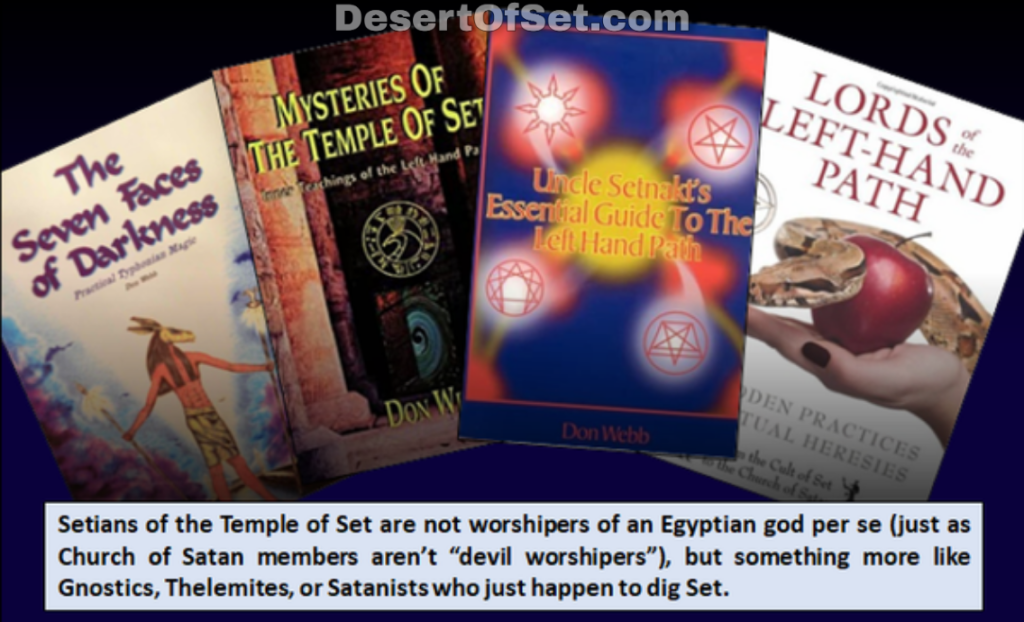
Aquino’s Setianism requires some explanation. Reconstructing a neo-Egyptian faith was never his intent; his philosophy really begins with a refutation of LaVeyan materialism, and not with any Kemetic groundwork. Aquino was reacting to LaVey’s teaching that human beings are just organic meat machines that cease to exist upon death; he argues that human intelligence is supernatural by its very definition, and that it can indeed survive the shedding of its mortal coil. He drew more of his inspiration from Gnosticism, Neoplatonism, Thelema, and LaVey than he did from actual Egyptian sources; and while he does acknowledge Set as a real being, he has never condoned venerating Him. Temple of Set members prioritize kheper, the evolution of their souls or psyches to become gods after death. Like LaVeyan Satanists, they seem to look down upon devotional religion of any sort, even when it is directed toward Set. They claim that submission to any external deity will lead to total dissolution of the soul in the afterlife. As such, Setians of the Temple of Set are not worshipers of an Egyptian God per se (just as Church of Satan members aren’t “devil worshipers”), but something more like Gnostics, Thelemites, or Satanists who just happen to dig Set. They approach the Red Lord from a completely different playing field than Kemetic-based traditions do; our faiths are rooted in Egyptology, while theirs is rooted in Western ceremonial magic.

I am occasionally asked if I am a Temple of Set affiliate. The answer is no, and I never have been. While I have a great deal of respect for the Temple and many of their publications, I determined a long time ago (when I was 18, in fact) that this organization would not be a good fit for me personally. I identify as a Setian first and foremost because I love Set and want to honor Him as much as I can in this life. I find it annoying when “left-hand path” occultists conflate all devotional religion with “submission” and “self-denial,” since this conveniently ignores the fact that historical Setians like Aapehty and Ramses II clearly worshiped Set. I resent the suggestion that ancient Setians “didn’t understand” Set as well as we do today; that is some major white colonialist bullshit right there. And I have never trusted religious organizations that charge annual membership fees, or that possess rigid hierarchies. I understand things can’t get done without regular funding, and that all churches require good administrative leadership if they are to succeed; but I don’t think anyone should have to pay any money or kiss any hiney to learn about Big Red.

I’ve interacted with some junior Temple members (“Setians I°”) who insisted I couldn’t possibly have any authentic standing with Set without joining the Temple and learning all the secret things they keep from the public. I realize these individuals weren’t speaking for the Temple’s priesthood; but in my experience, such clique-ish attitudes tend to trickle down from the top. And if people can’t reach out to Set and be answered by Him without the Temple’s guidance, how the fuck did people worship Him in ancient Egypt? What do these people have that the Egyptians didn’t, and which the rest of us can’t find by visiting any museum or public library? It’s one thing for homegrown witch covens to keep some of their lore and rituals private, so as to prevent these things that are sacred to them from being appropriated by outsiders. It’s quite another matter for organized, incorporated, tax-exempt churches to claim they hold cosmic secrets one can only learn by paying regular dues. So even as a young Typhonian foal, I saw little point in trying to join.

In Temple of Set literature, Set is often defined as the Platonic Form or Principle of “Isolate Intelligence,” a “non-natural” alien entity that somehow modified the DNA of our primate ancestors so we would evolve to have individual psyches or souls. (It gets even more complicated from there.) This has little to do with anything the ancient Egyptians believed, and that has always been a major turn-off for me. I am a Pagan; for me, Set is a part of nature, not something that exists apart from or in opposition to it. The latter idea is a little too close to qliphothic anti-cosmicism for my interest, and this is only reinforced by all the Temple literature I’ve seen that poo-poos Paganism. Mind you, I don’t believe Set even recognizes words like “heresy” or “blasphemy”; so disagreeing with someone else’s Setian theology is not really a big deal. I can think your understanding of Set is totally batshit while still accepting you as a fellow Setian. Yet I am a proud animist and devotional polytheist, and if you tell me you think worshiping nature is ignorant or backward, I’m going to question why you align yourself with a Pagan God in the first place.

But just as I can appreciate Anton LaVey without agreeing with everything he ever said, so too can I appreciate Michael Aquino. He used his professional reputation to help see that minority religions are better represented among the U.S. Armed Forces, and he was at the front lines when it came to fighting the Satanic Panic during the 1980s. He is somewhat infamous for being so fascinated with Nazi history; but he just writes about how Nazi occult rituals were perversions of Norse polytheism (which is absolutely true, as any Heathen can verify); I’ve never seen him praise Hitler, promote fascism, deny the Holocaust, call for the extermination of Israel, or anything that Nazis actually do. Plus he’s a veteran, and some vets are just really into certain areas of military history that make people uncomfortable in polite conversation. I’m sure the man ain’t perfect, but it means a lot to me that someone like Aquino was there to raise awareness about Set back in the day. Even though I disagree with some of his opinions, anyone who has learned about Set from me should know that learning about Aquino is what catalyzed my own conversion in 1997.

Even Zeena Schreck, the youngest daughter of Anton LaVey, eventually left the Church of Satan and joined the Temple for a while; then she left that as well and started her own project, the Sethian Liberation Movement. Remember that Schreck is the first person on record to have been raised a Satanist from birth. She ditched her father’s Satanism, but she came to Set instead of coming to Jesus you might say (and she identifies as a Buddhist, too). The idea that this forgotten Egyptian God would steal people away from Satan’s “Black Pope”—including his own daughter—and inspire them to be Setians instead has always been especially meaningful to me. Schreck is not the only former Temple member to continue walking with Set in her own unique direction, either. Some have become Kemetics or devotional polytheists, and as I mentioned above, even those of us in the LV-426 Tradition have benefitted from Aquino’s work. So while I have about as much interest in the Temple as they probably do in me, I believe Big Red really did answer Aquino’s call to “the devil” on that dark night in 1975; and I’m quite grateful He did.

Set, Horus, and the Law of Thelema

Set’s relationship with His brother and/or nephew, the god Horus, and how my faith is influenced by Thelemic beliefs.

Horus is the god who is most often contrasted with Set, but there were actually several deities called by this name in ancient Egypt. Heru-UrHaroeris, or Horus the Elder is a god of the sky whose eyes are the sun and the moon. He is a son of the sky goddess Nut, and a brother to Osiris and Set. He often conflicts with the latter, but is reconciled with Big Red in the end. Indeed, Set and Heru-Ur are both said to help Osiris ascend the ladder of heaven to join with Ra in the Pyramid Texts. But Heru-Sa-Aset or Horus the Younger, the son of Isis snd Osiris, is Set’s nephew who seeks revenge for Osiris’ death; He is the Horus who is more often referenced in popular culture today. And then there’s Ra-Horakhti, the Horus of the Two Horizons (East and West), who is a composite of Heru-Ur with the solar Creator deity, Ra.

Each of the various Horuses is firmly linked with falcons, solar imagery, and the Pharaohs, who were considered to be incarnations of the god (regardless of which “Horus” was being worshiped at the time). Each Horus also has a rocky relationship with Set and is said to either “castrate” Him or amputate His “foreleg” after Set “blinds” them in one eye. Either we are dealing with different gods sharing several synchronicities here, or we’re dealing with one god who has manifested under slightly different forms in numerous alternate timelines (sort of like how Jon Pertwee and Jodie Whittaker are both Doctor Who). Some Egyptologists and Kemetic Pagans seem to take the former of these two positions, and I believe they are likely correct. But I personally lean toward the latter position myself. Perhaps the “Horus” I have personally experienced is really a composite of several gods that answer to this name; and perhaps this composite has been influenced by Thelema as much as it has by Kemeticism.

Thelema is a religion started by Aleister Crowley, who had several powerful experiences in Cairo, Egypt in April 1904. These events were catalyzed by the Stele of Ankh-ef-en-Khonsu (otherwise known as Crowley’s “Stele of Revealing”), which was on exhibit at the Egyptian Museum of Cairo (serendipitously registered as Exhibit #666, no less). Ankh-ef-en-Khonsku’s Stele is a painted piece of wood with a vibrant image of the priest presenting gifts to Ra-Horakhti. This beautiful work caused first Rose Edith Kelly, Crowley’s wife, and then Crowley himself to receive prophetic messages from Aiwass, an angel of Horus, who revealed to them the text of Liber AL vel Legis (the Book of the Law). In this text, the goddess Nuit (Nut), the god Hadit (or Horus of Behudeti, identified with Ra as the midday sun) and the god Ra-Hoor-Khuit (Crowley’s rendering of Ra-Horakhti) together declare the beginning of a New “Aeon.”

The new Law proclaimed by the gods in Liber AL is this:

“Do what thou Wilt shall be the whole of the Law;
Love is the Law, Love under Will.”

People often assume this statement justifies doing whatever one likes, regardless of consequence; but I read it to mean something more like, “The highest priority in life is to find your true destiny and follow it; to truly love yourself (and not in a narcissistic sense) is the highest law.” Thelemites believe “Every man, woman and child is a star,” and that the way to “worship” Horus in his New Aeon is to bring out that glowing hot ball of light inside your soul and let it shine for all to see. Separating our fleeting, day-to-day desires from our everlasting True Wills can take years of reflection, and the rituals Crowley devised for Thelema are meant to facilitate this process of discretion in a powerful way.

There are some big problems with all of this, the most obvious being that Aleister Crowley was an abusive, racist, misogynist prick. He endangered many people’s lives, especially at his infamous “Abbey of Thelema” in Sicily (where he and his followers lived in unsanitary conditions, leading to at least one death), and during his ill-fated 1902 expedition of Mount Everest with Oscar Eckenstein. For a guy who liked preaching about the absolute divinity and autonomy of self, he sure was an authoritarian bully; he even enjoyed being called “the Great Beast 666” and “the Wickedest Man in the World.” He considered himself to be the spirit of Therion incarnate; and given that Therion is the archetypal evil ruler who brings ruin to his own people, I think he did a pretty good job of emulating that presence.

Why in Nut’s starry bosom would Horus (or any convergence of Horuses) choose such a horrible role model to herald the dawn of his (or their) New Aeon? I think the secret to this may lie in how the concept of Thelema resembles the Egyptian principle of Ma’at. Written in hieroglyphs as an ostrich feather, Ma’at is both a Goddess and an action. As a deity, she sets the order of the seasons, the movements of the stars, and the times of birth and death for all creatures. As an action, Ma’at is doing whatever is right, whatever is just, whatever is well-balanced. To uphold Ma’at in all of one’s affairs is to procure Ma’at and good fortune for oneself, both in this world and the next. A person’s fate in the afterlife depended on how much Ma’at was in their heart (shown as a Weighing of the Heart against an ostrich feather, with the idea being that your heart must weigh the same as Ma’at). This concept is tied to both one’s personal destiny and what people call “the Golden Rule,” and I think the same is equally true of Thelema.

Thelema teaches we can live harmoniously by following our true, Higher Wills, since no True Will can supposedly cross any other in the grand scheme of things. Crowley totally sucked at exemplifying this, but it does echo the idea of doing right by yourself and others so we can all enjoy a good life and afterlife. While the Egyptians had the Pharaohs to dispense Ma’at throughout the Two Lands for them, the Horus(es) in Liber AL seem(s) to charge every single individual with the task of dispensing Ma’at everywhere. You might say Horus/Hadit/Ra-Hoor-Khuit effectively democratizes the role of Pharaoh for everyone, so that everyone can recognize themselves as a royal demigod in their own right.

I think the Gods wanted everyone to see just how bad things can get if we let our individualized Pharaonic power go straight to our heads. Like the heretic king, Akhenaten, who put his obsession with one particular God (the Aten or Sun Disk) over his duty to defend all his people and their Gods, Crowley prioritized his own ego over being a good role model for the Aeon. This cost him dearly in the long run, but it’s almost like he did all the wrong things so we can know what not to do by his example, without having to learn it the hard way. Crowley’s ideas have influenced not only Thelemites, but also quite a few Pagans, Qabalists, Satanists, Chaos Magicians, and rock musicians (the Beatles, David Bowie, Black Sabbath, Led Zeppelin, and many others). It seems to me that Horus (or some version thereof) truly did work through Crowley somehow, for the man certainly made a difference despite all his faults.

I have not personally interacted with any Horus(es) in my own spiritual journey, or at least not in the devotional sense of actually worshiping him/them. But his/their relationship with Set is still an important theological consideration. The dichotomy of a God of light and a God of darkness being sworn enemies is nothing new to most religions; but the idea that both sides are evenly matched, that neither side is perfect, and that both must eventually get along is uniquely Egyptian. Greek adaptations of this story rewrote the ending so that Set is either destroyed or cast out from the pantheon entirely; but with all due respect to Herodotus and Plutarch, I simply don’t accept such accounts as “canon.” The Egyptian civilization lasted roughly 3,600 years, and Set was never completely demonized until well after the first 2,800. Egypt was an occupied territory by that time, being deprived of its own government and culture; and what was remembered of the old ways had been garbled and syncretized with Greek influences. For thousands of years prior to that, the official story was always that Set and Horus are reconciled in the end.

Appropriations of Egyptian mythology (like Alex Proyas’ 2016 film, Gods of Egypt) insist on forcing Horus and Set into a Christian-based “good versus evil” dichotomy; but this runs contrary to the source material. Recall that Set doesn’t kill Osiris until after He finds out that His sister-wife, Nephthys, slept with him. According to some accounts, Nephthys truly loves Osiris and Set truly loves Isis, but neither can be with the mate of Their choice; They are paired together as an afterthought because nobody else wants to be with either of Them. Is it any wonder, then, that Nephthys eventually sleeps with Osiris to bear a child (Anubis), the one thing She wants more than anything? And is it any wonder that when He finds out, Set loses His shit and goes crazy? Mind you, Horus isn’t exactly an innocent little choir boy, either. One of the more shocking moments in the story is when Horus captures Set and prepares to kill Him, but Isis releases Big Red because He’s still her brother and she loves him. Then Horus goes apeshit and decapitates his mother in a fit of blind rage. (Thankfully Isis is healed by Thoth, who gives her a cow’s head; but still.) So I’m afraid this idea that Horus is the “Jesus” to Sutekh’s “Satan” just doesn’t wash.

Set and the Scarab of Ra

Explaining kheper, the ancient Egyptian concept of divine transformation, and how it relates to the scarab beetle, the solar Creator deity Atum-Ra, and Set as the Champion of Ra. 

In Egyptian mythology, the solar deity Ra (or to be more specific, Atum-Ra) is not only our literal sun, but the first God, the progenitor of all things, and the divine spark that’s hidden within every person. They are the starfire from which our planet and our very bodies are forged, and I refer to them with gender-neutral pronouns as much as possible, given they are also known as “the Great He-She.”

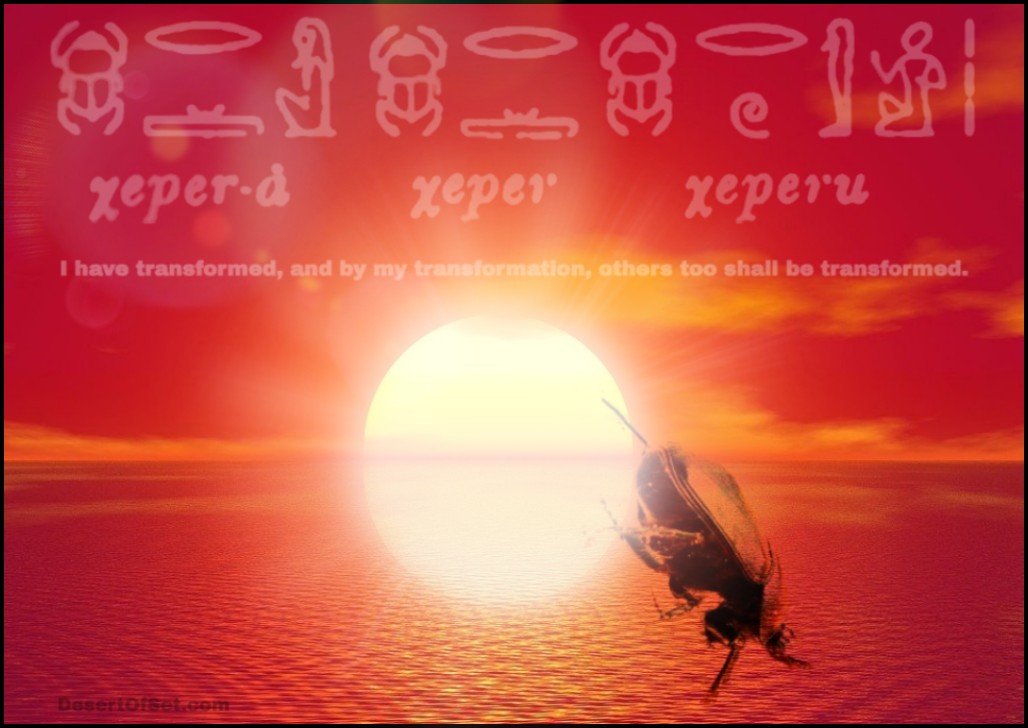
Ra is not said to design the universe like an architect, but to asexually reproduce it through an act of divine masturbation (both a theological and a literal “Big Bang,” you might say), right after creating themself through an act of divine introspection. First Ra lifts themself from Nun, the primordial ocean of infinite chaos, proclaiming, Khepera Kheper Kheperu—which means something to the effect of:

“I have transformed,
and by my transformation,
others too shall be transformed.”

Then Ra asexually begets the infinite plurality of Gods, animals, and people that exists today. Every sentient being is, in fact, a miniature alternate Ra within the macrocosmic collective Ra, right on down from the highest of the Netjeru to the tiniest baby animal or human.

Ra’s first children, Shu and Tefnut, were separated from the Self-Created One shortly after their births. So Ra removed one of their glowing Eyes, which became the solar cow Goddess Hathor, and sent her to search for the missing children. By the time Hathor reunited Shu and Tefnut with Ra, the children had come of age and produced babies of their own: the sky Goddess Nut and the earth God Geb (who would later beget Osiris, Isis, Set, and Nephthys). And when Ra was reunited with all these children, they wept the happy tears that fell down to Geb and mixed with the earth, becoming the first human beings. So while the Gods might be greater and more powerful than us, every person is a living demigod, a human particularization of the Great He-She, and we possess certain rights and dignities even the Netjeru can’t take away. We are not their creations or their playthings, but something more like their younger cousins.

At a later point in the myth cycle, Ra says they are “Khepera at dawn, Ra at midday, and Atum at sunset.” They are a child in the morning, an adult in the afternoon, and an elder in the evening. When night falls, Ra dies and becomes a ghost or “Night Sun” that journeys through the Underworld to be reborn again as Khepera. It is in the darkest hours before dawn that they are attacked by the Chaos Serpent, which is safely repelled by Set and His starry Iron. This is not just a solar myth, but an allegory for the sleep cycle. Many of the Netjeru are said to follow Ra’s same pattern of dying and rising, sleeping and reawakening, just as we ourselves do every day. And just as the Serpent’s assault on Ra is truly an assault on every God and mortal by extension, so too is Set’s battle with the monster a battle for all of us, from the Creator themself to that angry customer you have to deal with at work. Set is the God who never dies and who never sleeps, that the rest of us may all sleep and die and awaken and rise again in safety.

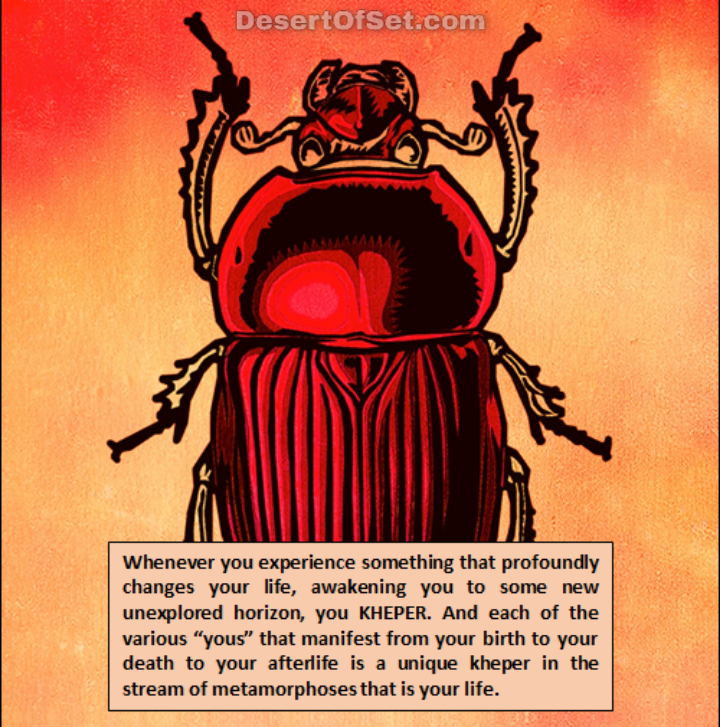
The name Khepera is especially interesting because it is related to the word kheper, which has at least two interrelated meanings. The most obvious translation is “scarab beetle,” an insect that is sacred to Ra. The Egyptians admired scarabs for their life cycle (from egg to larva to pupa to adult), and for their unique reproductive behavior. They lay their eggs in dung, which they then roll into large balls and move around as needed. People drew parallels between these egg-filled dung balls and the sun, imagining that Ra rolls a giant radiant egg ball across the sky. Furthermore, the scarab’s life cycle was likened to Ra’s cycle from night/ghost to dawn/child to noon/adult to dusk/elder, which brings us to the second translation for kheper. As a verb it means “to transform,” and as a noun it means “a transformation.” Whenever you experience something that profoundly changes your life, awakening you to some new unexplored horizon, you KHEPER. And each of the various “yous” that manifest from your birth to your death to your afterlife is a unique kheper in the stream of metamorphoses that is your life.

Considering that kheper is encoded in Ra’s first words at the Dawn of Time (“Khepera Kheper Kheperu”), this is an extremely powerful “magic word” indeed. So powerful, in fact, that when Michael Aquino, a leading minister in the Church of Satan, invoked “the devil” for guidance on what to do following a schism in the church in 1975, he was answered not by Lucifer but by Set, who permanently impressed the concept of kheper on Aquino that very night. Aquino and his colleagues in the Temple of Set prefer to capitalize and spell this word with the Greek letter chi (i.e., Xeper) to signify its centrality to their particular Setian current. I prefer to spell the word phonetically to prevent any confusion for my readers, and I diverge from Temple of Set members insofar as my love for Set is prioritized over kheper in my hierarchy of spiritual values. I agree kheper is important, and that Set cares more about getting us all to kheper than being worshiped. Nevertheless, I identify as a Setian because I love Set first and foremost; if kheper or Khepera were truly the central focus of my path, I would identify as a Kheperian instead.

That being said, kheper is what happens when the sun rises at dawn, when a grub emerges from the soil as an adult beetle, and when a soul or spirit is fundamentally transformed by some profound, life-altering experience. It is the principle that enables us all—cosmic God and mortal demigod alike—to theoretically live beyond death. Additionally, Set is the only other deity in the Ennead or Company of Nine to have willed Himself into existence apart from Ra (by tearing Himself from the womb of His mother, Nut). Since the Netjeru are both distinct beings and extensions of Ra’s own primeval essence, the argument can be made that Set is the aspect of Ra that enabled them to kheper in the first place, even before Big Red came forth as an entity in His own right. This would explain why He continues to play such an important role in procuring Khepera’s safe rebirth, both in the macrocosm and the microcosm. Similar to how St. John believed Christ was with Yahweh in the beginning, before the Creation of heaven and earth, you might say I believe Set was with Ra in the beginning, before the Dawn of Time.

Khepera Kheper Kheperu

An LV-426 Perspective on the Qliphoth

Why I refer to evil spirits as qliphoth rather than “demons,” and why I don’t recommend messing with them.

The word qliphoth comes from the Hebrew kellipot (“shells”). In Kabbalah (a tradition of Jewish mysticism), the kellipot aren’t necessarily “evil,” but can be good or bad depending on the context. But in Hermetic Qabalah (the European version of Kabbalah), they are considered to be the astral “shells” of beings that used to exist, but which have long since been destroyed. Soulless and bodiless, these vampiric entities do whatever they can to intrude upon our reality and feed on the psychological traumas of the living. Many of them are completely evil by any definition of the term, and should be avoided at all cost. The singular form of qliphoth is qlipha, and it is more or less equivalent to the term “demon” in our modern vernacular. In a Hermetic context at least, qliphoth are malevolent ghosts that are dangerous for the living to engage with, and which must be execrated whenever they are encountered.

I refer to evil spirits as qliphoth because I feel the word demon has become too culturally loaded. In the original Greek, a daimon is virtually any spirit that exists somewhere between Gods and human beings. This is a very wide spectrum that includes everything from ghosts and angels to nymphs and satyrs. Therefore, daimon (or daemon, the Latin equivalent) is a morally neutral term that has nothing to do with whether a paranormal entity is “good” or “evil.” In fact, the Greeks distinguished between “good demons” (agathodaimones) and “bad demons” (kakodaimones) until Christians came along and appropriated the label for their own use. The only reason demon came to mean “evil spirit” is because Christians applied it to spirits that didn’t submit to Yahweh’s authority—including not only the fallen angels of Christian myth, but all “Gentile” (i.e., Pagan) divinities as well. Hence why so many medieval grimoires refer to such “demons” as Ammon (a corruption of the Egyptian god Amun), Astaroth (a corruption of the Akkadian Ishtar/Astarte), and Bael (a corruption of the Phoenician Ba’al Hadad).

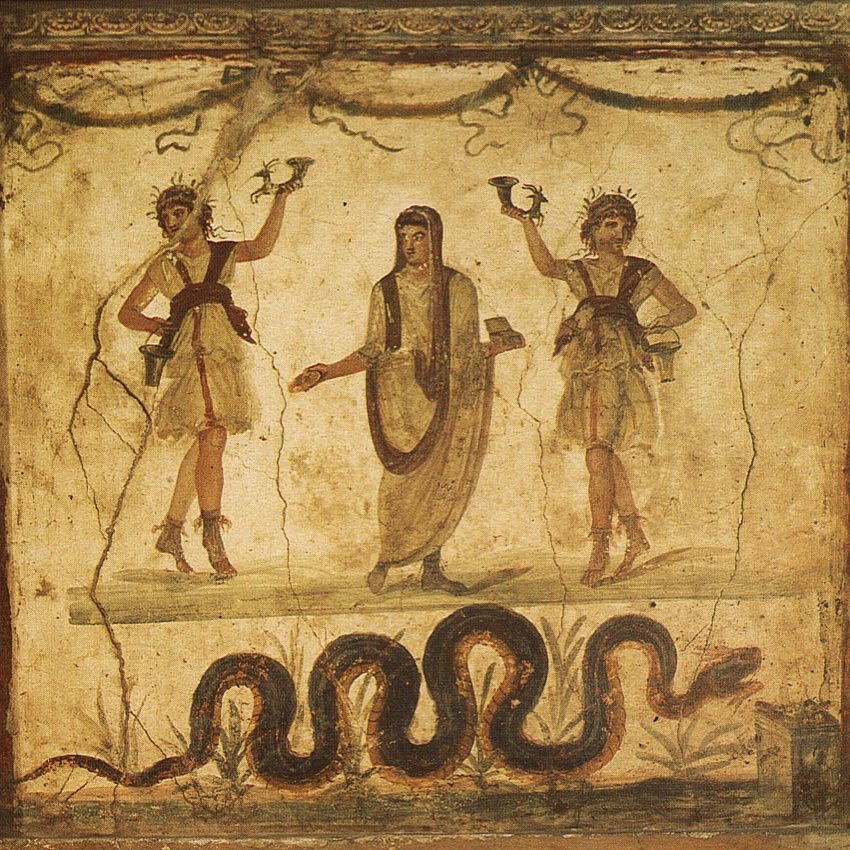
Agathodaimon

A Pompeian fresco from the Casa dei Vetti (“House of the Vetti”), featuring
an agathodaimon represented as a snake (circa 63–79 CE).

So when we discuss demonology, what are we actually discussing? Are we really talking about evil spirits, or are we just talking about someone else’s Gods? There are still Hellenic Pagans who invoke and make offerings to certain daimones today, and there is also a religion called Demonolatry, in which people worship Pagan Gods who were demonized in the Bible. The important thing to understand about both of these groups is that when they discuss “worshiping demons,” they are not claiming to revere evil spirits. They are simply using the word demon in a Pagan context, rather than a Christian one.

Even spirits that do hurt people aren’t necessarily “evil” through and through. Some are provoked into hurting people; consider Goetia, in which the magician evokes the spirits and binds them to his or her will. This involves hurling abusive insults at the spirits and bossing them around while standing within a protective circle. The idea is that the spirits might tear the magician apart if she is foolish enough to step outside the circle; but given how they are treated in such procedures, can anyone really blame them? It’s an entirely different matter when a spirit harms people simply because it can. We can debate all day as to why it does what it does, but for all practical intents and purposes, it’s just evil. The only appropriate way to interact with such an entity is to avoid and/or execrate it accordingly.

I reserve the term qliphoth for spirits that are specifically characterized as evil in their own lore, and that have always been considered evil for as long as we’ve known about them. For example, figures like Astaroth and Bael don’t count, for they are simply Pagan Gods who’ve been demonized. But beings like AnzuLamia, and Zahhak were considered evil even by Pagans in pre-biblical times. This is an indicator that such entities are extremely dangerous and should never be invoked or worshiped by anyone.

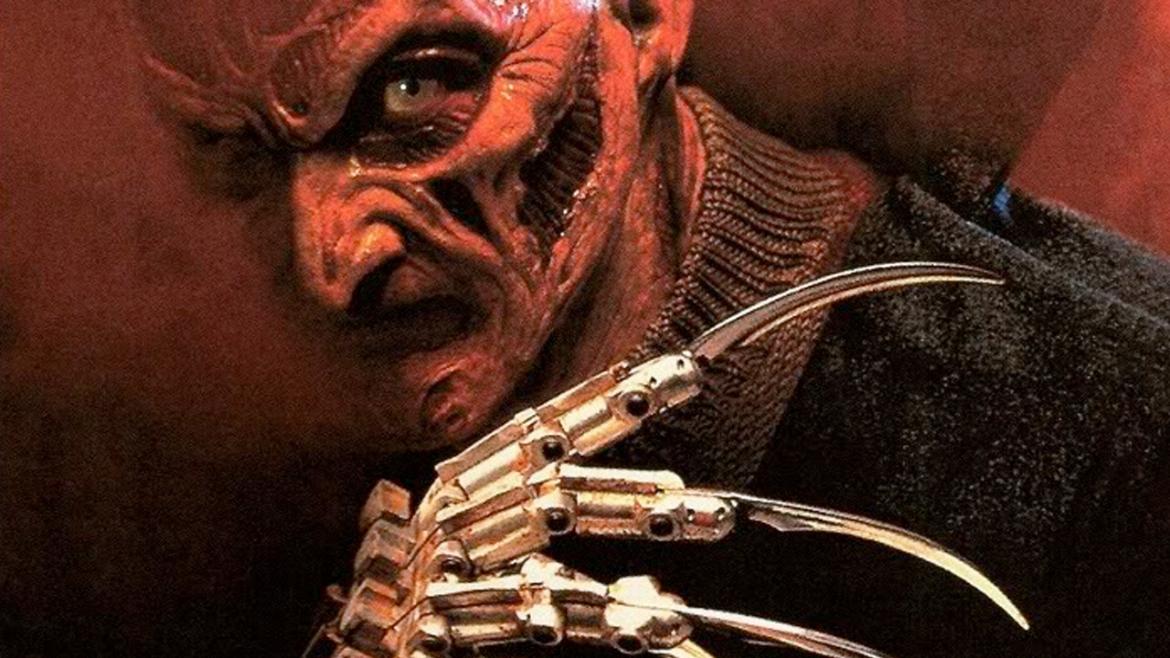
Where do the qliphoth come from? You might recall that in Egyptian ontology, there is a difference between the ba or soul and the ka or spirit. Let’s say there’s this guy named Freddy who really enjoys hurting people as much as he can. Then Freddy dies, and Anubis comes and takes his soul to the Otherworld for the Weighing of the Heart, while Freddy’s spirit remains here on Earth as a ghost. Once in Duat, Freddy’s heart is weighed and is found completely unworthy of the afterlife; so Anubis feeds it to Ammut, the Devourer of Hearts, and Freddy ceases to exist. Yet his ghost is still lingering down here on Earth, and since no one likes him enough to remember him or visit his grave, the ghost is in danger of fading away forever. Perhaps it might learn to perpetuate itself by tormenting the living and feeding on the bioelectrical energy they release when they are terrified. Perhaps it will realize children are its most suitable victims, since they are more vulnerable to astral attack than most adults. If and when this happens, Freddy’s ghost becomes a qlipha and will continue tormenting the living until someone forces it to stop.

Wes Craven's Freddy Krueger

Screw you, Krueger!

Qliphoth don’t always understand what they are doing; as Stephen King once wrote in his 1996 novel, Desperation: “Evil is both fragile and stupid, dying soon after the ecosystem it’s poisoned.” Whether they are fully cognizant or not, all qliphoth serve the Serpent and do its bidding. The Serpent’s ultimate goal is to un-create everything the Gods have made (including the Gods themselves); but it will also settle for un-creating little things whenever it can, such as an individual soul. This is precisely what happens when a human being is reduced to an astral fragment of him or herself after death. The more people dehumanize each other, the more likely it is they will lose their souls; the more souls that are lost, the more likely it is that we will become qliphoth when we die; and the more qliphoth that come into existence, the more minions the Serpent has to help it ruin more souls (and create more qliphoth).

There are some traditions in which people “work with” the qliphoth, or even worship them outright. Kenneth Grant developed a system of ceremonial magic based on this premise, and the Simon Necronomicon is loaded with qliphothic “traps” that can backfire on unwary dabblers. (Check out David Harms’ and John Wisdom Gonce III’s The Necronomicon Files for some more background on this particular tangent.) Grant knew how dangerous his work with the qliphoth was, so he took steps to limit who could access it. (You’d have to be a Gods-damn Wall Street tycoon to even buy one of Grant’s books, which are all out of print and exceedingly overpriced.) The Necronomicon guys, on the other hand, made their material available to everyone, and for less than $10 to boot. Thanks to them, we now live in an age when any asscracker can go around opening qliphothic wormholes, letting Set knows what slither into our world. I’m not in the business of telling others what to do with their souls, but I would strongly recommend against playing around with this stuff (unless you actually want to drive yourself crazy and become possessed).1

The Simon Necronomicon

The Simon Necronomicon (Avon Books, 1977).

One thing Kenneth Grant and “Simon” had in common was their shared belief that H.P. Lovecraft was actually a “sleeping prophet.” They thought the monsters in Lovecraft’s fiction are very real entities that exist in some other dimension, which Lovecraft supposedly visited through his dreams. I’m willing to concede that some Lovecraftian occultists, at least, are really contacting spiritual beings of some kind. I don’t believe for one second that fictional characters like Cthulhu or Nyarlathotep are real; but I do believe that if you invoke “Cthulhu” in a ritual, someone or something might choose to answer you by that name. If you’re lucky, it will be a God or a benevolent daemon of some sort; if you’re unlucky, it will be a qlipha that wants to skull-fuck you six ways from Sunday. We can be fairly confident that when you invoke a God like Set, whose name has been used for centuries, you will get the real Set and not an imposter. But a name like Cthulhu is still too new and fresh for it to consistently “belong” to any particular spiritual entity, so there’s just no telling what might answer you if you use it. You could be blessed by some Mesopotamian Goddess, or you could end up tormented by an aqrabuamelu scorpion-man for the rest of your life.

This tendency to create religions around fictional characters is not always so disturbing. It might seem a little weird if someone chooses to worship Batman or Wonder Woman, but at least these are good role models for people to emulate, if that is what they wish to do. But I have never understood why anyone would want to worship something like Cthulhu or the Slender Man. These are monsters no one in their right mind would ever want to meet in real life, so honoring them just makes no sense. And as I explained above, invoking such figures can open your soul to forces you shouldn’t be trifling with. In the LV-426 Tradition, we refer to this phenomenon as “the Sutter Cane Effect” (in reference to the main antagonist in John Carpenter’s 1994 film, In the Mouth of Madness). Unlike the Buddhist concept of tulpas (in which people create paranormal beings with their own psychic energy), the Cane Effect is what happens when qliphoth impersonate fictional characters, making them seem to become “real.” I don’t think this is really an issue with characters like Batman or Wonder Woman, who are too strongly identified with things like justice and mercy to become qliphothic avatars. It seems to me that qliphoth more readily attach themselves to characters that reflect their true dispositions, like Yog-Sothoth or Hedorah the Smog Monster.

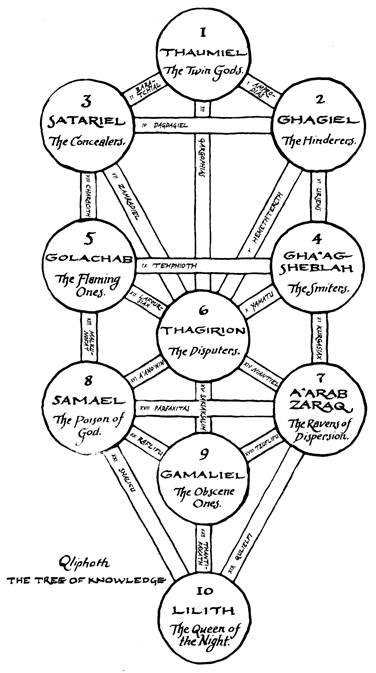
The Qabalic Tree of Death

The “Tree of Death” in Hermetic Qabalah.

Some occultists believe it is necessary to work with the qliphoth in order to develop a full understanding of the spirit world; they argue that by avoiding these entities, one is “ignoring one side of a two-sided coin.” I applaud anyone who, like Kenneth Grant, can do this while keeping all that qliphothic energy they are drawing to themselves under control. But with all due respect to Grant, most people are incapable of doing this and would only succeed in getting themselves possessed or killed if they tried. There are other ways to liberate and enlighten your soul than by trying to corral a bunch of invisible, rabid-ass baboons. In LV-426, we reject this notion of engaging with any Lovecraftian monsters at all, unless it is to execrate them and send them screaming back to the void. We take Set’s role as the Champion of Ra very seriously, and we are each committed to resisting the Serpent and its agents in as many ways as we can.

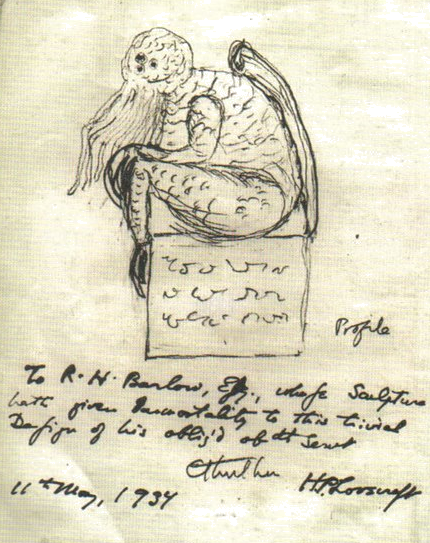
H.P. Lovecraft's Cthulhu

A sketch H.P. Lovecraft drew of his monster, Cthulhu, in 1934.

1 The Simon Necronomicon instructs its readers to attempt astral travel without taking any of the normal precautions (e.g., banishings). It also requires you to invoke an entity called “the Watcher,” which is supposed to “protect” your body while you go off exploring other worlds in spirit form. This Watcher has a carnivorous appetite and will supposedly kill you if you don’t keep it well-fed with all the proper sacrifices. To make things even worse, the book also implores practitioners to recite Sumerian “incantations” that actually translate into execrations of the Gods. So in effect, Necronomicon enthusiasts are putting themselves under the protection of evil spirits while also telling the good spirits to fuck off. This is rather like asking a serial killer to watch over you while you sleep, then smashing your phone so you can’t dial 911.

What Are You Afraid Of? It’s Only Rock & Roll!

Discussing the theme of “backmasked” messages in heavy metal music during the Satanic Panic, as explored in the 1986 comedy horror film, Trick or Treat. 

One of my all-time favorite movies is a flick that hardly anyone seems to know about. You have to be a real 1980s horror nerd to have seen Charles Martin Smith’s Trick or Treat (1986), and it probably helps if you’re a metalhead too. I’ve never once seen the flick listed on anyone’s “Top 10 Favorite Movies” list, but you will certainly find it on mine, and I’ll tell you why. To the best of my knowledge, this is the first film ever made that features a plot inspired entirely by heavy metal and the hatred it received from politicians, televangelists, and self-righteous soccer moms during the 1980’s Satanic Panic. It may not necessarily be the best film of its subgenre; undoubtedly, many people would probably vote for Jason Lei Howden’s Deathgasm (2015), which has a very similar plot. But despite Deathgasm’s superior production values, Trick or Treat did it first, and it made a huge impression on me while I was growing up.

Eddie Weinbauer (played by Marc Price, better known as “Skippy” from Family Ties) is a teenage metalhead who lives in the town of Lakeridge, North Carolina, and who goes by the nickname “Ragman.” Eddie is especially dedicated to the music of Sammi Curr (Tony Fields), a glam metal shock rocker who’s obviously inspired by Alice Cooper. Eddie absolutely worships Sammi, and he’s friends with a radio DJ named “Nuke” (Gene Simmons of KISS), a nerd named Roger (Glen Morgan, one of the lead writers for The X-Files and the Final Destination movies), and a pretty girl at his school named Leslie (Lisa Orgolini). Unfortunately, Ragman is also bullied at his school by a bunch of jocks (led by Doug Savant of Desperate Housewives fame), who all think he’s creepy and weird. These guys are pretty harsh, too, because they apparently see nothing wrong with trying to drown poor Eddie in a swimming pool.

Trick or Treat 1986 movie poster

Why does Ragman dig Sammi Curr so much? Because Curr’s music helps him cope with his feelings of subjugation. In a strange way, Curr is eerily prophetic of Marilyn Manson, who took shock rock to a whole new level in the 1990s. Not content with just scaring or pissing off parents, Manson made himself into a full-blown culture war iconoclast (the “Antichrist Superstar”) and deliberately terrorized the entire American Religious Right. In a similar way, Curr uses his music and his fanbase to declare war on society. He offers his fans a future in which “Rock’s Chosen Warriors will rule the Apocalypse,” and he promises all who try to ban his music that “We will bring you down.” For Eddie, Curr is more than just a rock icon or a hero; he’s a counter-cultural messiah who promises total emancipation from Christian society.

But all of this seems to vanish into thin air when Eddie turns on the TV one morning to learn that Sammi Curr has died in a hotel fire. The boy is instantly crushed and descends into despair, but when he visits his friend Nuke at the local WZLP radio station, Nuke gives him a special gift. You see, Sammi Curr actually grew up right here in Eddie’s hometown, and Nuke was friends with him when they were kids. As it turns out, Nuke just happens to have a demo recording of an album Curr was still recording when he died. (The album is named Songs in the Key of Death.) Nuke gives the record to Eddie, telling him Sammi would have wanted him to have it. And while listening to it later that night, Eddie discovers the album contains a bunch of backmasked messages. Then he plays the record in reverse to see what the messages are saying, and that’s when he receives the biggest shock of his life.

Ragman

Eddie “Ragman” Weinbauer and his hero, Sammi Curr.

The voice of Sammi Curr speaks to Eddie through the backmasked messages, telling the boy to do certain things while he’s at school the next day. When Eddie follows the advice he is given, he outsmarts his foes and gets them in trouble (while getting away scotch free, himself). It then seems like the two conspirators will get to realize their shared vision of a world without bullies after all; but as Curr continues to help Ragman “nail” his tormenters, he also demands the boy’s help in “nailing” everyone who ever tried to ban his music. Their Halloween pranks soon turn deadly, and Ragman realizes his beloved demigod is actually a demon. By the end, Eddie must stop Sammi from killing everyone in Lakeridge when Nuke plays Songs in the Key of Death backwards on his radio show (on All Hallows’ Eve, no less).

Now I know good and well what some of you must be thinking. Trick or Treat sounds like something that was made by evangelical Christians, right? It sounds like the entire point of the film is to demonize heavy metal and anyone who listens to it. As a devoted metalhead myself, I probably shouldn’t enjoy this film at all, should I? But consider the fact that Ozzy Osbourne appears in a cameo as “the Reverend Aaron Gilstrom,” an anti-rock televangelist. Yes, you read that correctly: Ozzy fuckin’ Osbourne plays a Jimmy Swaggart clone who preaches that metal musicians are all Satanists brainwashing our kids. (Now that’s what I call irony!) I might also point out that Trick or Treat doesn’t quite end the way you’d expect. If this were an evangelical propaganda film like Rock: It’s Your Decision (1982), Eddie would swear off metal for good after defeating Sammi Curr and “give himself to Jesus” (as they say). But after he defeats the ghost of the man who used to be his hero, what do you suppose Ragman actually does?

By Gods, he plays a Gods-damn Sammi Curr record!

Yes, that’s right—and I think this is where Trick or Treat really shines the most. While the film is inspired by urban American myths about “backmasking” in heavy metal music, it obviously does not agree with the people who take such fears literally. Instead, the film presents metal as something that’s legitimately fun but misunderstood—and not only by parents, preachers, or politicians. Eddie Weinbauer eventually sees that Sammi Curr is a much worse bully than any of the jocks who’ve been tormenting him at Lakeridge High. But when Eddie takes Sammi down, he isn’t turning his back on metal (or even on Curr’s music, necessarily). He’s just learning to separate the art he loves from the artist who created it. The artist might be a major asshole, but it’s OK to still enjoy and take inspiration from their art.

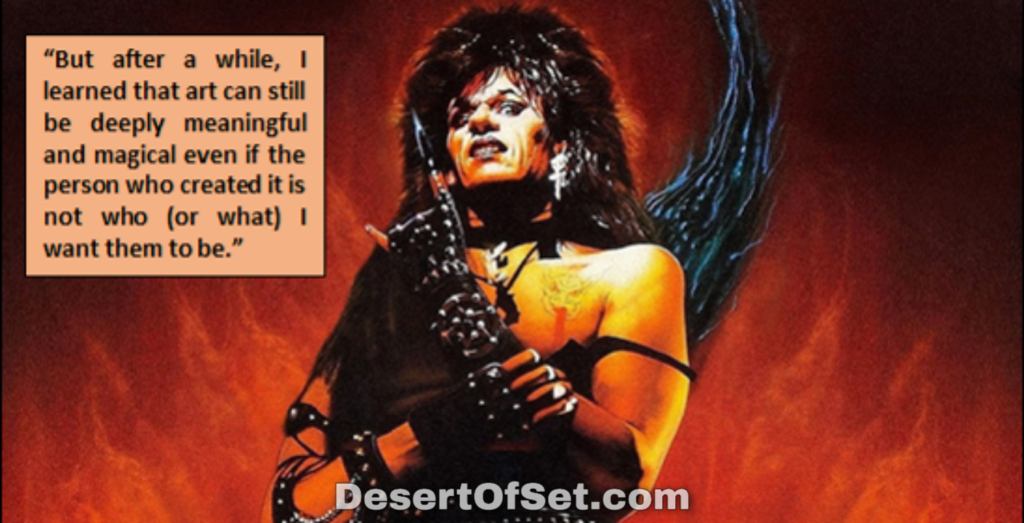
When I was in high school, I used to worship the ground Marilyn Manson walked on. But then I learned he really isn’t the all-powerful “Antichrist Superstar” he made himself out to be. At first, this made me feel like I could never listen to Manson’s music again; my sense of disappointment was just too much. But after a while, I learned that art can still be deeply meaningful and magical even if the person who created it is not who (or what) I want them to be. I went through this exact same process with Alice Cooper and Ozzy Osbourne. In heavy metal especially, it’s easy to confuse the people creating the music with the characters they play on stage. Marilyn, Alice, and Ozzy aren’t real people; they’re bigger-than-life personas that were created by Brian Warner, Vincent Furnier, and John Osbourne, respectively. The funny thing is that once I finally began to understand this principle, I started to enjoy their music even more.

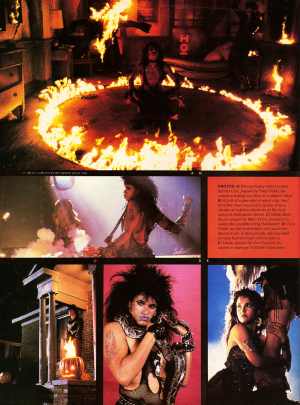
Heavy Metal

Some promotional photos for the film.

In Trick or Treat, the problem is not with heavy metal itself, but with the fact that Sammi Curr takes his hype and his stage persona way too seriously. When Eddie fights him, Sammi accuses him of being “false metal”—but in reality, Sammi is the one who is false. Part of the fun to heavy metal is that it’s basically a huge power fantasy that can be taken to some truly ridiculous extremes. What’s more, this is usually done while keeping one’s tongue planted firmly in-cheek. Sure, there are people like Sammi Curr who take themselves way too seriously; but this genre was built on the backs of guys like Coop and Ozzy, who sing about strangling people or having sex with the devil while winking at their audiences. It’s all make-believe, much like a Halloween party that never ends, and the people who take it too seriously—including both the Pat Robertsons and the Varg Vikerneses of this world—are completely missing the point.

Most people who’ve seen Trick or Treat will tell you it’s a total dud. To be fair, it is full of bloopers; you can even see the boom mike at the top of the screen at one point. (Keep your eyes peeled when Ragman answers the front door, only to find his mom’s boyfriend dressed up as Rambo on the other side. Pay close attention to the top right-hand corner of the screen!) The movie also can’t seem to settle on whether it wants to be a genuine horror film or a comedy with horrific overtones, which is something that normally tends to annoy me. But even with all that being said, Trick or Treat is very well-acted, the music is phenomenal (featuring songs by Fastway and a score by Christopher Young), and a great deal of creative effort was clearly put into it. They weren’t just trying to make a quick buck with this one; they were actually trying to make something witty and intelligent—and for my money, at least, they succeeded.

Trick or Treat is also a film that we hold sacred in the LV-426 Tradition (much like 1979’s Alien and 1982’s The Thing). It nicely reflects our own personal histories with Set. We were all like Eddie Weinbauer when we were kids; we were alienated youth, and we coped with our problems by listening to angry, aggressive-sounding music. That same music became one of our various “doorways” into Setianism, and for this reason, we treated our rock heroes like they were pillars of wisdom and virtue. Big Red had to disabuse us of this notion over time; like Ragman, we had to learn how to enjoy our favorite artists without believing in all their hype, and Trick or Treat reminds us of what it was like to go through all of that.

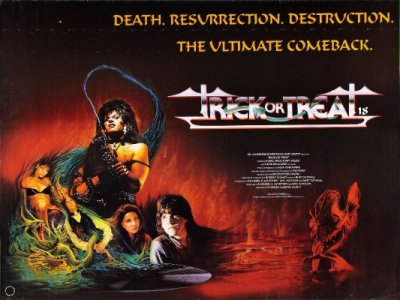
Alternate poster

Alternate poster art for the film.

The Horned Pentagram

Why I prefer to display my pentagrams with two points up.

The pentagram is a five-pointed star in a circle, and it is the most prominent symbol associated with Paganism today; but not everyone likes their pentagrams the same. Most often, you will see them with one point up, especially around Wiccans, who are the largest and most visible demographic beneath the Pagan umbrella. But occasionally you’ll see people arrange the symbol with two points up instead, and this sometimes provokes a negative reaction. I have actually been turned away from Pagan events before, believe it or not, just for wearing this kind of pentagram myself.

The reason for this prejudice stems from 19th century Europeans, who popularized the notion that pentagrams mean something different based on how they are drawn, and that this difference is somehow “ethical” in nature. They insisted that one-point-up pentagrams are “upright,” representing “goodness and light,” while two-point-up pentagrams are “inverted,” representing “darkness and evil.” The “inverted” pentagram with a goat’s head goes back to the French occultist Stanislas de Guaita in 1897, and it was later adopted by Anton LaVey as the Sigil of Baphomet in 1966. This has led people to assume that any pentagram with two points up is “satanic,” which isn’t true by a long shot. This symbol is held sacred and drawn differently in many traditions, and it means something unique to each one. Plus, it is hypocritical of Pagans to react so strongly to an image simply because it is linked with “the devil.” We ought to know better than to think people slash cats or eat newborns simply because of something they choose to wear.

I won’t outline the entire history of this symbol, or what it means to all the different belief systems that use it. I’d just like to explain what it means to me personally, and why I prefer to display it the way I do. As far as we Setians of the LV-426 Tradition are concerned, the two-point-up pentagram is not “inverted” AT ALL. We consider it to be exactly the way it should be: right-side up. In fact, whenever we see it displayed the Wiccan way, it looks upside down to us! But that’s OK, we just chalk the difference up to personal preference. A pentagram is still a pentagram, no matter which of its points are facing up or down, and since it is circular, there is no correct “This End Up” position whatsoever. Think of it as a wheel: does it matter which direction the spokes are pointing, as long as the wheel turns?

I don’t care much for de Guaita’s “goat’s head” pentagram, but only because I prefer to keep my pentagrams “empty.” When it’s just a plain old star in a circle with two points up, it indeed resembles the head of a horned animal; but the lack of additional illustration allows for imagining any number of horned critters in the symbol, not just goats. I imagine an antelope whenever I see it myself, which makes me think of Set in His form as the White Oryx. It also reminds me of His Imperishable Ones, the circumpolar stars of the northern sky. For me, this version of the pentagram is not a symbol of “evil” or “hatred for Wicca” at all. Unlike the Sha, it does not belong just to Set or to Setians, and it has only been adopted into the iconography we commonly share since the 1970s. But it is the first religious symbol apart from the Sha that ever made me stop whatever I was doing at the time and take a closer look. I’ve always felt Set looking back at me whenever I look into it, as well. Its soothing effect on me is so great, I wear it around my neck at all times to keep me mindful of Set’s presence (except when I’m showering).

It would be fantastic if people just ditched the “upright” and “inverse” verbiage altogether; it is divisive and small-minded. I prefer to call these images the “standing” and “horned” pentagrams, respectively, so as to break away from this pattern. When a pentagram is displayed with one point up, it is “standing” because it resembles a person doing aerobics, with their arms and legs outstretched. When it’s displayed with two points up, it’s “horned” because it resembles a goat, antelope, or deer. Neither one represents anything “bad” or “evil,” and whether you prefer one or the other is simply a question of aesthetics. There is absolutely nothing to stop a Setian from wearing a standing pentagram if it pleases her to do so; and there are British Traditional Witchraft covens that use horned pentagrams to represent some of their initiatory degrees. So things are not so clear-cut between the two pentagrams as certain “experts” have been insisting since the 1890s or so, and it would be nice if more Pagans understood this.

My Understanding of Magic

A brief explanation of my perspective on magic, what it is, how it works, and how it dovetails into my theological views.

My understanding of actual magic—not to be confused with mere illusionism or stage magic—hinges on the Egyptian concept of heka, which more accurately translates to mean “divine speech.” This refers not only to literal verbal communication, but also to the use of visual arts and ritualized performances to “activate the ka,” which might be compared to our Western construct of the “astral body.” Virtually any form of dramatic self-expression can be a work of magic within this context, provided that it arouses your spirit and directs it toward some kind of goal. This goal can be operative (to heal the sick, ward off negative energy, divine omens), initiatory (to reach a higher state of consciousness), or even devotional (to honor a deity or ancestor). For the ancient Egyptians, everything from casting love spells to invoking the Creator themself was a magical working that bridged the gap between this world and Duat, its spiritual counterpart. Indeed, magic is fundamental to all spirituality and religion, for even Christian worship services involve “activating the ka” (feeling “the Holy Spirit”), implementing “divine speech” (using key language from the Bible), and accomplishing some kind of goal (feeling close to Jesus).

Naturally, most people scoff at the idea of anyone believing in magic here in our contemporary times. But there is a difference between thinking magic is effective and thinking it is necessarily “supernatural.” I wholeheartedly believe in Gods, ghosts, and other worlds, and many of the rites I’ve worked have wielded some truly eerie results. But I also accept that there are completely rational explanations for the things I’ve experienced, and I neither ask nor expect anyone else to forgo such conclusions. This is because I know magic can work regardless of whether the supernatural actually exists apart from the human imagination or not. If you invoke a blessing for someone, it might or might not have any effect on that person in the real world; but it will at least vent your desire for that person to be OK somehow, fulfilling a profound emotional need that all the logic in the world can never appease. So even if it’s all just a bunch of autohypnosis (which isn’t necessarily true, either), magic can still have efficacy and practical value today. Whether it works on objective reality or even on the subjective realities of others is completely secondary to whether it works on your own psyche and spirit. Its true purpose is to change and empower the user, not to directly affect literal changes on the physical world like in some epic fantasy movie.

These principles apply to my theology as well. I can’t claim to be absolutely 100% certain that Set (or any other deity) is really a sentient entity that actually hears my prayers, or that has ever directly intervened in my life to change it for the better. But apart from my personal belief that these things are true, I can at least be certain that if I had never uttered a single prayer to Set, I would never have met some of my closest loved ones; I would not have the family I now cherish; I would not have developed my current career; and I would never have hoisted myself from the cesspool of domestic abuse in which I was raised. None of this proves that Set is objectively real by any means, but it does prove that His influence in my life is strong enough for it not to matter whether He is or isn’t. And to this extent at least, He and the other divinities I’ve encountered are all quite real enough for my purposes. Whatever the Gods actually are or however they are to be explained, they are certainly effective, just as magic can be effective whether it is truly “paranormal” or not. So I will just go right ahead and keep praising Big Red until the cows come home!

Inevitably, we must address the issue of magical ethics. The same principle behind the blessing spell I described above will also empower a hex or a death curse to work in much the same way (i.e., on the “sender,” not necessarily the “recipient”). Many Pagans warn that doing this is “unethical” and will unleash terrible consequences upon the user(s), no matter how much the intended victim(s) might deserve whatever is wished upon them. I have even heard someone tell rape survivors they have no business casting hexes on the men who assaulted them, for fear of violating some lofty cosmic law.

This is all bullshit.

Burning effigies and sticking pins into dolls are perfectly healthy ways of vindicating yourself emotionally without actually harming anyone—especially if we’re talking about an injustice as heinous as rape. If the helpless can’t use magic to win some kind of control back over their lives, then what fucking good is it? The true concern here is not whether hexing or cursing violates any external standard, but whether it violates your own conscience. Let’s say you do cast that death curse on your tormentor, and he actually dies that painful, humiliating death you wished upon him. Would this “coincidence” spook you and make you feel guilty? If so, that guilt might eat you up inside, causing your curse to backfire. But if you are certain your enemy’s synchronous destruction in reality would only enhance your well-being, I see no reason you should not enjoy yourself by destroying them symbolically and nonviolently in a spell. Doing so is always preferable to actually harming that person in real life, and you may even find that it alleviates your desire to harm them, helping you re-focus your energy on more productive goals.

Some people describe such procedures as “black,” “dark,” or “left-handed” magic, but this too is bullshit. You don’t have to devote yourself to a dark God to cast a hex whenever you might need to, and you also don’t have to curse people all the time to worship a dark God. Setians enjoy the additional benefit of execration rituals, which work in much the same way, but which target non-human advarsaries like the qliphoth or even the Chaos Serpent instead. Nine times out of ten, a good execration will help you cast out that negative energy better than any death curse would. Nevertheless, there are situations in which a curse might be exactly what you need; so while the option of magically destroying your enemies should never be taken lightly, there is no sense in completely ruling it out either. Furthermore, the term “black magic” is a colonial racist inference to African magical traditions, and “dark magic” lacks any room for nuance. (Is it “dark” to invoke Set the nocturnal storm God in a blessing, or to invoke Sekhmet the fiery solar Goddess in a curse?) As for the “left-hand path,” this is a Tantric term for heterodox ritual practices, and it is rendered somewhat meaningless when removed from its original context. (Is it “left-handed” to praise Lucifer in a room full of Satanists?) I prefer to describe hexes, curses, and other such procedures as destructive magic and leave it at that, without assigning any color- or usability-coded value judgments to the matter.

Mind you, there are many “LHPers” (for lack of a better shorthand term) who enjoy my work, and I am very fond of those I know personally. I also have mad respect for writers like Kenneth Grant, Michael Aquino, and Don Webb, each of whom has been a major inspiration to me personally. So it is not a matter of wanting to distance myself from LHP culture at all. It’s just that I deviate from most LHP ideologies I know about, which all seem to emphasize worshiping the self over any external deity. I believe everyone is really a living demigod, so the idea of worshiping yourself actually makes perfect sense to me; but there is no reason a polytheist can’t also revere other divinities in addition to their own. Yet I have found that speaking of devotionalism in LHP circles can stir up just as much controversy as discussing hexes can in Wiccan circles, and for reasons that are equally small-minded. I worship and pray to Set as if He were a real sentient being (again, regardless of whatever He might actually be in objective reality, which is irrelevant). If being a devotional polytheist is enough to disqualify me from fitting beneath the LHP umbrella, then so be it—but I’ll thank you not to insult me by labeling me as “right-hand path” (the Tantric term for “orthodox” practices), since I do not have a single “orthodox” bone in my entire body.

Some writers argue that “magic” should be limited to purely operative and/or initiatory spiritual practices, and that devotional rites are more properly consigned to the less interesting category of “religion.” But even stargazing, lifting weights, or walking a dog can be just as magical or “spirit-activating” as casting a spell to heal your friends, attract a mate, or call down your Holy Guardian Angel. So how can anyone truly legislate what is or isn’t “magical” for others? All spiritual practices are magic of one kind or another, from the obscure Rite of the Bornless One to the common Sunday Mass; so there is no need for anyone to poo-poo other people’s preferences here. Maybe you’re the kind of person who doesn’t care about religion and who only cares about astrology or Tarot reading. Or maybe you’re the kind of person who doesn’t care about fortune telling, and who just wants to pray to some ancient fertility Goddess. Either way is enough to justify calling yourself a witch (or the cultural variant of your choice).

I’ve engaged in operative and initiatory projects over the years; I’ve worked spells, gone on vision quests, blessed people’s homes, execrated negative energy, etc. But the bulk of my craft has always been devotional in nature. There is nothing more magical to me than invoking Set at the shore of Lake Superior, out among the trees and the bears, with the Big Dipper twinkling in the sky above and the waters below, and for no other reason than just to enjoy Big Red’s company.

The Egyptian hieroglyphic for heka (“activating the ka”).

The LV-426 Tradition

Some background on the unique Setian coven in which I became a priest.

There are three other Setians with whom I’ve been privileged to work some truly life-changing magic over the years. These individuals know who they are, but out of respect for their privacy, I will only identify them here as Blackwyn, the Tonester, and Sister Bean. To walk with Set is a solitary path, even when you’re part of a group, and not everyone in my circle will always agree with each other on everything. But the point isn’t that we always believe or practice the same things. The point is that we are each drawn to Set in our own ways and for our own reasons; that we’ve crafted a number of effective rituals and spells together; and that we’ve all witnessed the same eerie results these procedures can yield. Years have passed since we first declared ourselves a coven back in 2003; we’re spread far apart from each other now, living in our own areas and focusing on our own priorities. But even if we never meet in person to hold another ritual together again, we will always be connected with each other somehow.

That “somehow” is Set.

In 2007, we started referring to our collected rites as the LV-426 Tradition for the following reasons:

  • The 1979 sci-fi/horror film Alien is a prime example of what we call “the monster film as mythos,” and we wanted our name to memorialize the film for this reason.
  • The Tonester and I were both living in the Bible Belt at the time, and Ripley’s struggle against the Alien was a perfect metaphor for how we felt about living there.
  • Being a couple of smartasses, we wanted a name that was far too cumbersome for repeated use in brief conversation. (Say “LV-426 Tradition” six times in the same paragraph to see what I mean!)
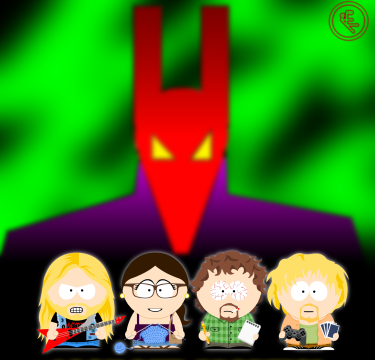
The Setians of the LV-426 Tradition

From left to right: The Tonester, Sister Bean, Yours Truly, and Blackwyn.

In case you’ve never seen it (and shame on you if you haven’t!), the original Alien is about these astronauts in the distant future who follow what seems to be a distress signal of unknown origin. They make their way to a desolate planet called “LV-426” in their star charts, where they find a crashed alien spaceship with a dead crew and a shit-ton of weird, leathery eggs for its cargo. One of these eggs hatches, unleashing a horrific beast that reproduces itself by raping one of the men (!). Due to a breach in protocol, the creature enters the next phase of its life cycle back on board the ship, and the movie then becomes a slasher flick in outer space. The last person standing is Ellen Ripley, played by Sigourney Weaver, who emerges from the chaos and the carnage to become the first female action movie hero.
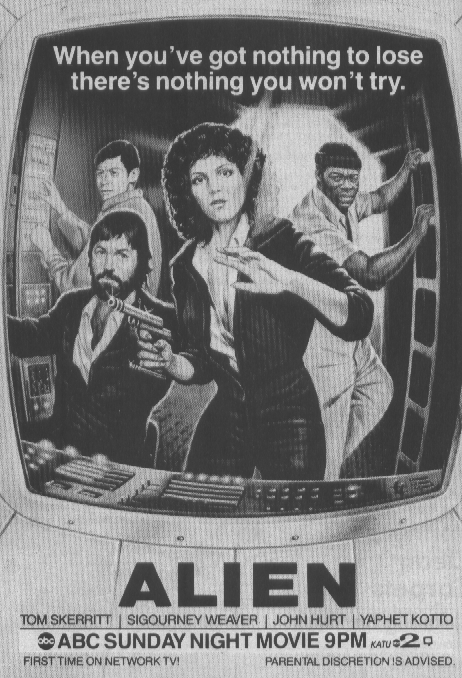
1980's Ad in TV Guide for Alien (1979)

The Alien strongly resembles Apep, that timeless arch-nemesis of Set. Designed by the Swiss surrealist, H.R. Giger, its biology makes no sense. How can it see without any eyes? Why would anything evolve to have two mouths—one inside the other—when just one mouth is simpler? How can its blood be so corrosive that it will burn through any metal, but without being deadly to the creature itself?1 Nothing in nature can exist like that, and the same is true of Apep. It’s described as lacking any sensory organs—it has neither eyes nor ears—yet it’s somehow able to locate and paralyze its prey with a hypnotic gaze. It’s also described as “breathing by means of its own roar” and “living by means of its cries,” which means it doesn’t require any sustenance for its survival; it just eats things to make them suffer (Manassa, 2014). Both Apep and the Alien are monsters that can only exist in nightmares, that operate in total defiance of natural law, and that would be absolutely poisonous to any ecosystem in which they managed to thrive.

Ellen Ripley, on the other hand, is a perfect stand-in for the Red Lord. She is the outsider or “black sheep” among her crew, the only one who takes her job seriously, and a real stickler for protocol (even refusing to let Captain Dallas [Tom Skerritt] board their ship when she learns he has an infected crew member in tow). Compare this to the other female crew member, Lambert (played by Veronica Cartwright), who complains, screams, or cries helplessly throughout the film. Then there’s the fact that Ripley dresses and behaves like a man. One of Set’s many lovers is the Ugaritic Goddess Anat, who is usually depicted in men’s clothes (Patai, 1990), and whom Set is said to find especially attractive for this reason. Given how much He enjoys smiting monsters like the xenomorph, and given how partial He is to androgynous ladies like Anat, it’s hard for me not to imagine Set cheering for Ripley from upon His throne behind the Great Bear. (Plus, going through so much trouble to save Jones the Cat must surely score Ripley some additional points with Bast, Ishtar, Sekhmet, and other like-minded Goddesses of feline goodness.)2
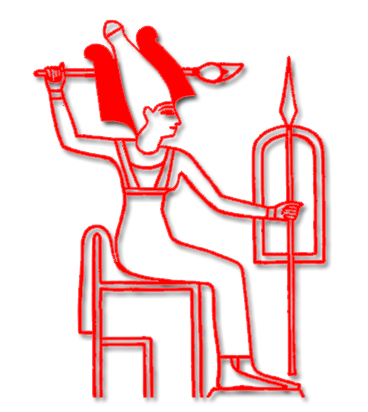
Anat, an Ugaritic goddess

Anat, an Ugaritic Goddess who is one of Set’s many consorts.

Alien is also filled with various references to sexual anatomy and the reproductive process. The ship’s computer is called “Mother”; the astronauts look like they’re being born when they awaken from their cryogenic sleep chambers; the tunnels of the derelict craft on LV-426 resemble giant fallopian tubes; and the xenomorph’s head is shaped like an erect penis (which always makes me think of someone being raped in reverse during the infamous “chestburster” scene).3 Ripley even has her final confrontation with the beast in her underwear,4 and she must also contend with “Mother,” which insists on keeping the Alien alive for future study (even at the cost of the astronauts’ lives). So a secondary conflict rages between Ripley and the computer, which cares more for the survival of the “child” than it does for the “parents.” This is especially intriguing given that Set is thought to cause abortions and miscarriages (te Velde, 1977). As His cinematic avatar, Ripley must further alienate herself from her society by “aborting” the gestating life form her superiors have deemed more important than herself (Cobbs, 1990).

H.R. Giger was obviously influenced by the New England horror writer, H.P. Lovecraft; but I’m fairly certain he was also inspired by a British occultist named Kenneth Grant. Once a disciple of the infamous Aleister Crowley, Grant was obsessed with what he called the “Tunnels of Set,” which are supposed to be these astral wormholes that loop back and forth between various alternate universes. He was the first occult author to suggest that H.P. Lovecraft was a “sleeping prophet,” and that monsters like Cthulhu and Nyarlathotep are real beings that actually exist in some other dimension. (He beat the Simon Necronomicon to this punch by at least a decade, if not longer.) Given this, I’m sure Grant’s ajna chakra or “third eye” probably exploded wide open if and when he ever got around to seeing Alien for himself. And if H.R. Giger wasn’t specifically thinking about the “Tunnels of Set” when he first envisioned the winding, cyclopean corridors of that ghost ship on LV-426, he sure as hell could have fooled me.
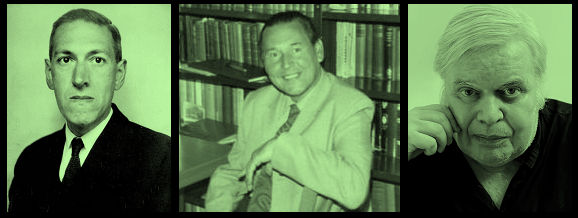
H.P. Lovecraft, Kenneth Grant, and H.R. Giger

From left to right: H.P. Lovecraft (1890–1937), Kenneth Grant (1924–2011), and H.R. Giger (1940–2014).

Though we tend to share Grant’s enthusiasm for the “many-worlds” interpretation of quantum mechanics, my coven mates and I have zero interest in contacting any of the horrific fauna that H.P. Lovecraft envisioned for his lurid tales. We instead emphasize execration, or the use of magic to repel negativity and misfortune from people’s lives. This is functionally similar in principle to casting a death curse on someone, save that the target of your spell is Apep, the true source of all evil, and not any human victim. As far as we’re concerned, walking with Set isn’t about getting chummy with Lovecraftian space monsters; it’s about ferociously defending the autonomy of all sentient beings.

The idea that we must be “ferocious” in this regard comes from when the Tonester and I lived in the Bible Belt during the early 2000s. We were constantly under siege from “Rapture-ready” teachers, classmates, employers, cops, and politicians. We couldn’t even go for prayer walks in the woods without being harassed by people who thought we were “worshiping the devil.” After a while, it began to feel as if we were actually trapped in some hostile wilderness, with a very real monster coming after us. That monster wasn’t an actual xenomorph, of course, but Apep; and instead of literally trying to eat us, it was trying to eat our hearts from within. But Set is merciful; He brought us together in that wretched place, against all odds, and He blessed us with each other’s company and support. Then we met Blackwyn and Sister Bean in Michigan a few years later, and the rest is history. Each of us is proof for the others of Set’s providence, and Alien is an excellent parable for our own private quests against the Serpent.

Training to be Ellen Ripley

But execrations are not the only staple of our practice; there’s also our weekly Sabbat ritual, which is observed on Friday nights. We enter a darkened room that has been prepared with an altar, an image of Set, and some red candles. We recite our standard invocation together, and then we take turns praying to Set informally, as if He were just a regular person in the room with us. Usually this means discussing our hopes and fears, our best and/or worst moments of the week, or something along those lines. When one person finishes their prayer, they turn to the next person in sequence (which is always to the left) and say, “If there is anything you wish to say to the Red Lord at this time, please feel free to do so.” And if the next person has nothing they wish to pray about, they keep silent so the next person can proceed. Once everyone has finished, we break out the beer, blast some heavy metal, and chat with each other into the wee hours, sometimes not adjourning until daybreak. The exchanges we’ve shared during these late night Sabbat talks are some of the most profound meditations I’ve ever experienced in my life.

Some other things we’ve done include a spell for protection during sleep, an astral pilgrimage technique, and a matrimonial ceremony that was used for my wedding in 2012 and for Sister Bean’s in 2015. There’s also an initiation ritual that’s used for inducting new members, but this procedure is known only to those who pass our vetting process and are invited to join. (Considering there have only been four of us since Set first struck me with His black lightning in 1997, you can imagine how often this happens.) Our liturgical calendar includes not only our weekly Sabbat but also Hallowtide (October 31–November 2), Walpurgisnacht (April 30), and Friday the Thirteenth (on which we celebrate Set as the catalyst for Osiris’ resurrection and Horus’ conception). Importantly, we have no leader or “high priest/ess”; each of us is fully qualified to administer our rites to anyone who might need them, and all of our group decisions (including whether to initiate any new brothers and/or sisters) are made by unanimous vote.
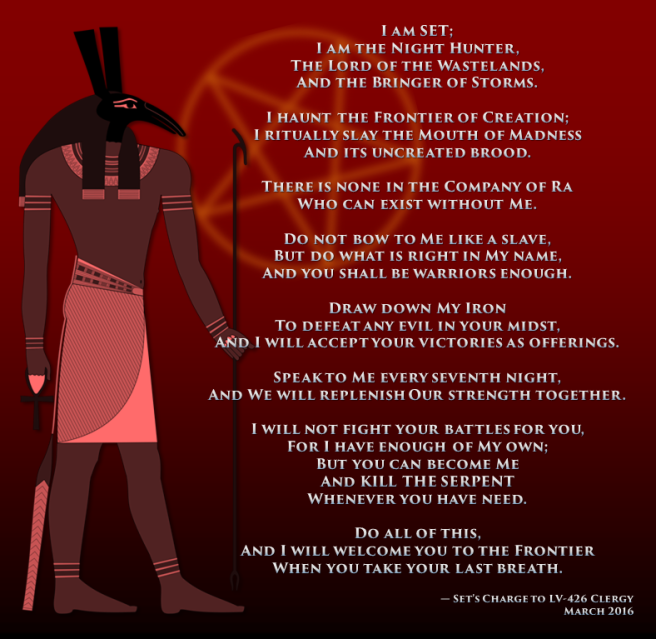
Set's Charge to LV-426 Clergy

Apart from the above, we Setians of the LV-426 Tradition may each entertain any additional beliefs or practices we like. Some of us revere other sacred figures along with Set, like Buddha, the Norse God Odin, or the Babylonian Goddess Ishtar. Some of us even celebrate Christmas or Saint Patrick’s Day. Our eclecticism is rooted in Set’s New Kingdom role as an ambassador between the Egyptian Gods and other pantheons. Just as He can roam between alternate realities and canoodle with alien divinities, so are we free to mix the old Kemetic wisdom with just about anything we find useful, from American colonial witch lore to Zoroastrian demonology. Some outsiders may find this permissiveness toward religious dogma repugnant, but we couldn’t care less; Big Red is the only justification we need.

It’s been a while since we last met as a coven to keep the Sabbat, execrate our inner demons on Walpurgisnacht, or offer up a feast of watermelon to Big Red on Friday the Thirteenth. I can’t speak to how often the others may or may not “keep up” with these practices nowadays (though I must admit it has been hard for me to do so consistently, myself), but none of us has ever been expected to make such a commitment anyway. It’s the fact that we even did these things at all—and the magic we shared when we did—that really matters. And there’s always the possibility that somewhere down the road, a fifth initiate of LV-426 might present him or herself to us, setting a whole new cycle of ritual work into motion. For now, all LV-426 alumni are off exploring other proverbial worlds, but always with Set’s Iron in our spines.
The LV-426 Sigil

The LV-426 Sigil

Notes

1 I’m well aware that in Ridley Scott’s prequels to this film—Prometheus (2012) and Alien: Covenant (2017)—it’s revealed that the xenomorphs did not evolve naturally, but were genetically engineered as a kind of biological warfare. This still doesn’t explain why their blood, which can burn through any damn metal you please, doesn’t just burn right through their own bodies as well.

2 Some viewers—including Big Steve King—complain that Ripley’s quest to save Jones the Cat is a “sexist interlude” that undermines her role as a feminist character (King, 1983). I’m a proud cat parent, and if I were in Ripley’s position, I’d risk everything to save my fur baby too. (Ten bucks says if Jones were a dog, nobody would be bitching about this.)

3 The “chestburster” scene is quite similar to the story of Set’s birth according to Plutarch (1970). He recounts that Set was not born at the normal time or in the normal fashion, but that He impatiently exploded forth from the belly of His mother, the sky Goddess Nut. It’s tempting to think the screenwriter, Dan O’Bannon, might have encountered this story at some point while writing the script for Alien.

4 Some viewers—again, including Mr. King—complain that this final sequence “sexualizes” Ripley too much (King, 1983). I have to say that as a straight dude, this scene has never once made me think, “Ooooh, look at the naked chick!” Instead, it always makes me think about this one time I had to fumble around in my basement naked to get some clean clothes out of the dryer, only to be greeted by a huge spider that made me piss myself. In other words, it makes me identify with Ripley rather than objectify her, and I for one applaud Ridley Scott for framing the scene in that way.
H.R. Giger's Alien

References

Cobbs, J.L. (1990). Alien as an abortion parable. Literature / Film Quarterly, 18(3), 198–201. Retrieved on October 5, 2017.

King, S. (1983). Danse macabre (2nd edition). New York, NY: Berkley Books.

Manassa, C. (2014). Soundscapes in ancient Egyptian literature and religion. In E. Meyer-Dietrich (Ed.), Laut und leise: Der gebrauch von stimme und klang in historischen kulturen (pp. 147–172). Bielefield, Germany: Transcript Verlag.

Patai, R. (1990). The Hebrew Goddess (3rd edition). Detroit, MI: Wayne State University Press.

Plutarch (1970). De Iside de Osiride. Cardiff, Wales: University of Wales.

te Velde, H. (1977). Seth, God of confusion: A study of His role in Egyptian mythology and religion. Leiden, Netherlands: E.J. Brill.